Head-to-head test
Anker 535 PowerHouse vs DJI Power 1000
The extra $399 doesn't buy battery — per watt-hour these two are nine cents apart — it buys an inverter that will actually start the thing you plugged in.
Full profiles: Anker 535 PowerHouse → · DJI Power 1000 →

Written by Ian SchneiderUpdated
Solar & Off-Grid Tester, Station Arena Test Desk
$299.99 · direct from Anker
Last checked 1 day ago. Prices move — check before you buy.

Superseded — buy the V2
DJI has superseded the Power 1000 with the Power 1000 V2 — same $699, with 2,600W output against 2,200W. The original may still be purchasable while stock lasts, but unless it is meaningfully discounted, buy the V2.
Power 1000 V2 · $699.00Spec deltas
Take the DJI Power 1000. Not because it holds twice the energy, though it does, but because $699 against $300 buys a 2,200W inverter where the Anker gives you 500W, and 500W is the line between charging things and running things.
Per watt-hour the two are closer than the sticker suggests. $300 over 512Wh is 59 cents; $699 over 1,024Wh is 68 cents. Nine cents. For that nine cents the output ceiling climbs four and a half times, the USB-C port goes from 60W to 140W, and you get a 20ms switchover the Anker has no version of. You're paying a fair price for the battery on both sides. The inverter comes nearly free on one of them.
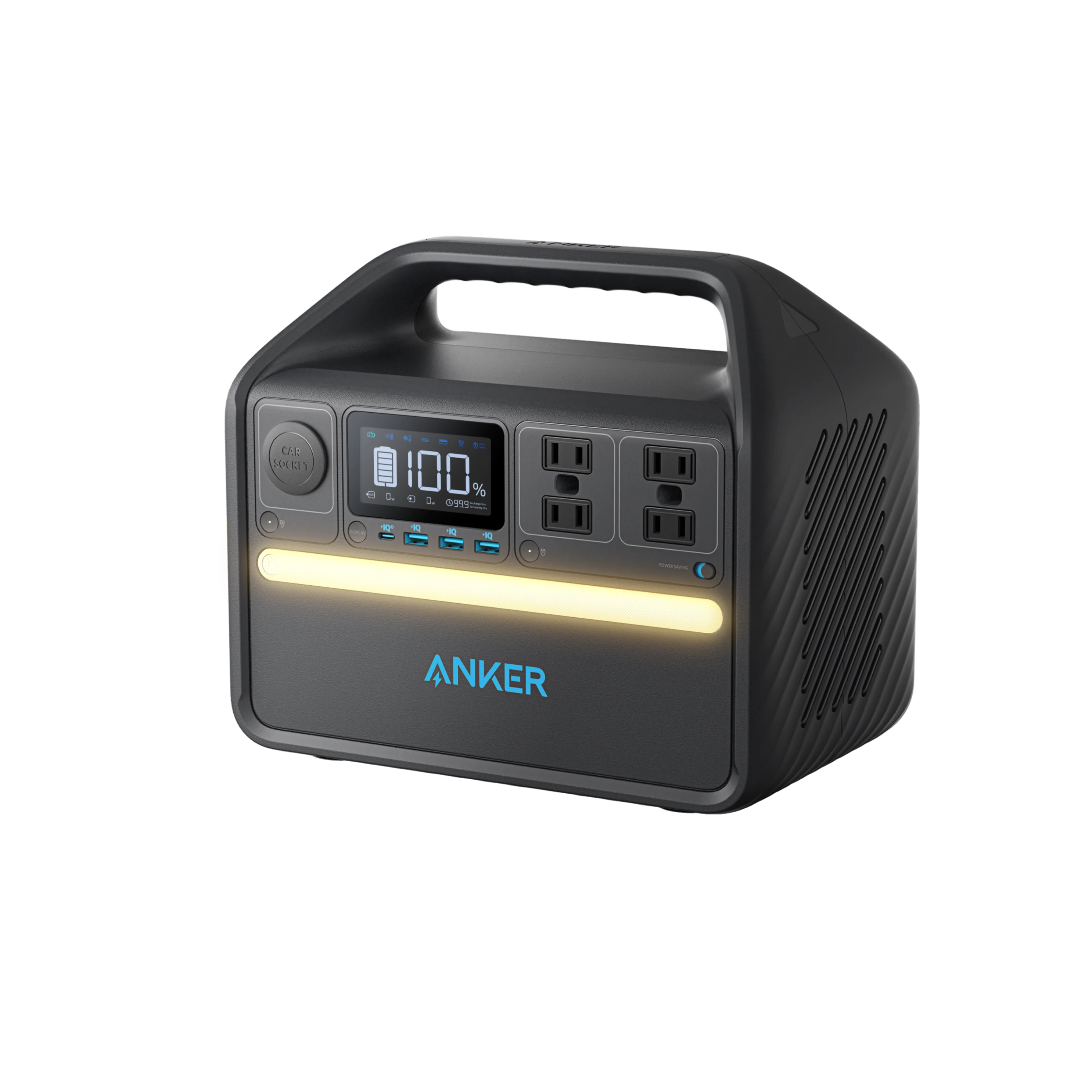
The Anker's argument is real and it's short: 16.7 pounds against 28.7, and $399 you don't spend. If the heaviest thing you will ever plug in is a laptop charger, that's a complete argument, and its 512Wh covers a CPAP night with a third of the pack still in hand. Everything past that, it can't do at any price.
What the Numbers Reveal
Each conclusion stated first — the numbers behind it on one line, the full analysis below.
continuous output
That matters because output is a gate, not a dial. A bench held the DJI at 2,400W, above its own 2,200W rating, for 20 minutes with no shutdownB2. The Anker at 500W doesn't run a kettle, a microwave or a hair dryer slowly; it declines them. So the question this page answers isn't how long each unit lasts on your load, it's whether the Anker will accept the load at all.
$300 over 512Wh is 59 cents per watt-hour; $699 over 1,024Wh is 68 centsAnker 535: 500W rated AC output. DJI Power 1000: 2,200W rated, 4,400W surge2,200W is 4.4 times 500W, while the price per watt-hour differs by nine cents
Why it mattersIf anything on your list has a heating element or a compressor bigger than a camping fridge, the Anker isn't the cheaper option — it isn't a candidate.
rated cycles
Both cycle counts are manufacturer ratings rather than measurements, so the three-cent gap is a division of two unverified numbers over four decades. Even the aggressive read — cycling one every day — lands at 8.2 years against 11, with both comfortably past the 5-year warranty they share. Nothing in that arithmetic justifies $399.
Anker: 3,000 cycles x 512Wh = 1,536 kWh of lifetime energy at $300, or 20 cents per lifetime kWhDJI: 4,000 cycles x 1,024Wh = 4,096 kWh at $699, or 17 cents per lifetime kWhAt weekend use that's 28.8 years for the Anker and 38.5 for the DJI; at daily cycling, 8.2 and 11 years
Why it mattersDon't let 'cheaper to own' talk you into the DJI. Let the inverter and the second night of CPAP do it, or keep the $399.
solar input
The margin is the whole product here, because neither one refills easily off-grid. The Anker's 120W ceiling turns a sunny day into one recharge, and the DJI's headline 800W figure requires hardware that isn't in the box. When you can't count on putting energy back in, the size of the buffer is the only spec that survives day two.
CPAP Overnight needs 320Wh; the Anker's usable pack is 435Wh (512Wh x 0.85) and the DJI's is 870Wh (1,024Wh x 0.85)That's 74% of the Anker's usable capacity and 37% of the DJI'sAnker solar input caps at 120W (roughly six hours of good sun for a 512Wh refill); the DJI's 800W input has no built-in charge controller and needs a separate DJI adapter
Why it mattersOne night of outage on medical equipment: the Anker covers it and you keep $399. Two or more nights: the Anker isn't cheaper, it's the wrong unit.
That tax only applies to what actually goes through the AC inverter. Run the laptop off the 140W USB-C port instead of a wall brick and most of it stops applying to that load, which is enough to close a 40Wh gap. The Anker can't run the same play: at 60W USB-C it won't keep a hungry laptop topped up, and it's at 209% of its usable pack anyway.
Remote Workday needs 910Wh; the DJI's usable pack is 870Wh — 105%, a 40Wh missUsable capacity on this page is nameplate x 0.85, an inverter derate; 15% of 1,024Wh is 154WhDJI USB-C tops out at 140W; the Anker's at 60W
Why it mattersFor a work-from-anywhere buyer, the DJI's failed workday is a cable choice. The Anker's is arithmetic.
The specific dimensions that decide these two units — everything else is a tie.
Your Life, Your Pick
Selected because: Four of the six load profiles end in 'neither' — who fails, and by how much, says more here than any single spec row.
Four of the six scenarios end in 'neither,' and that's the most useful thing this grid says. Weekend camping is a 2,100Wh load and van life daily is 4,685Wh, against 435Wh and 870Wh of usable capacity. Neither of these is a multi-day off-grid unit, and reading the grid as 'the DJI wins more' misses what's happening: the DJI loses the same scenarios, just by less.
The separation happens in the middle band. A 670Wh tailgate is 77% of the DJI's usable pack and 154% of the Anker's — comfortable for one, out of reach for the other. If your real day lands somewhere between 435Wh and 870Wh, that band is precisely what the $399 buys, and it's the only place on this grid where the money changes an outcome.
Runtime: Will It Power Your Gear?
Selected because: Usable capacity is 435Wh against 870Wh after the 15% inverter derate, and the 500W versus 2,200W output ceiling decides what you can plug in at all.
continuous output
The numbers that matter are 435Wh and 870Wh, not 512 and 1,024, because both get derated 15% for inverter losses. On the DJI that's 154Wh disappearing into heat before anything reaches your laptop, which is worth knowing because you can route around it: the 140W USB-C port skips most of that tax. The Anker's USB-C stops at 60W, so it can't make the same trade with a power-hungry laptop.
The 500W ceiling isn't a runtime figure, it's a bouncer. Kettles, microwaves, hair dryers, coffee makers — anything with a heating element gets turned away at the door, and no amount of patience changes that. Anker also doesn't publish a surge rating for the 535, so a compressor with a hard startup spike is a question mark rather than something you can check before you buy. The DJI's 4,400W of surge headroom exists mostly to make that question stop being interesting.
What the Specs Don't Tell You
Selected because: Solar, UPS and app control are where these diverge most, and the DJI's 800W solar figure needs an adapter that isn't in the box.
rated cycles
The DJI's 800W solar input is the most impressive number on this page and the hardest one to actually use. There's no built-in solar charge controller, so panels require a separate DJI adapter, and what ships in the box is a wall charger. The Anker's 120W ceiling is genuinely slow — about six hours of good sun to put 512Wh back — but it's 120W you own on day one. If sun is your primary input, neither of these is the purchase; go find a unit with MPPT built in.
The 20ms switchover is the gotcha that moves money. The DJI can sit under a desktop, a router or a NAS and carry it through a flicker without the machine noticing; the Anker has no UPS mode, so it's a battery you plug into after the lights are already out. The app gap reads bigger than it is, though: the 535 has no app, and the one you'd gain on the DJI side is rated 3.5 out of 5 across DJI's whole Home ecosystem rather than this power station specifically.
Lifetime Value
Selected because: The DJI is cheaper per lifetime kilowatt-hour, 17 cents against 20 — worth seeing exactly why that shouldn't drive the decision.
cost / lifetime kWh
The DJI is the cheaper unit to own by three cents a kilowatt-hour, and the fine print on collecting that is 38.5 years of weekend use. Nobody is on year 38 of a power station. Even cycling one daily you're looking at 8.2 years for the Anker and 11 for the DJI, both of them long past the five-year warranty the two share.
The other framing this section offers is cost per warranty year: $60 for the Anker, $140 for the DJI. That's an honest way to look at it, but note what it's actually measuring — identical coverage divided into different purchase prices. It's the $399 gap wearing a hat. Buy the DJI for what it does in the next twelve months, or don't buy it at all.
Portability & Form Factor
Selected because: 16.7 pounds against 28.7 is the Anker's strongest card after price.
weight
Twelve pounds is the Anker's whole case and it isn't a small one. 16.7 pounds is one hand and a car door; 28.7 is two hands, and you'll think about where you set it down. If the unit lives in a closet and comes out twice a year, that difference evaporates. If it goes into a canoe, onto a bike trailer, or up three flights to a walkup, it stops being a spec and starts being the decision.
Strengths & trade-offs
Anker 535 PowerHouse
Strengths
- +Costs $399 less
- +Lighter by 12 lb
Trade-offs
- –Weaker inverter (-1,700W) limits appliance compatibility.
- –Lacks smartphone app control for remote monitoring.
- –Shorter-lived battery — rated for 3,000 charge cycles vs the Power 1000's 4,000, so it wears out sooner.
DJI Power 1000
Strengths
- +Larger battery capacity
- +Higher AC output
- +Faster solar charging
- +Rated for 4,000 charge cycles — much longer battery lifespan
Trade-offs
- –Substantially more expensive (+$399) than the 535 PowerHouse.
- –Significantly heavier (+12 lbs), making it harder to move.
Will It Power Your Gear?
Scenario math and per-appliance runtimes, modeled from the spec record.
Scenario verdicts
We ran the math on six real-world scenarios. Here's which unit survives your actual life.
SCN-01 · 2 nights · needs 2,100Wh
Weekend Camping
Two nights off-grid with essential comfort
Neither unit
Neither unit covers this scenario's 2,100Wh: the 535 PowerHouse comes up 1,665Wh short (about 21% covered), the Power 1000 1,230Wh (41%). This is well outside what either unit is for; the right answer here is a larger station, not a choice between these two.
Battery budget usedlower = more headroom
LOAD Phone Charger 15W×6h · LED Lights 40W×8h · Box Fan 75W×14h · CPAP Machine 40W×16h
SCN-02 · 8 hours · needs 1,645Wh
8-Hour Blackout
Keep the essentials running through a night without power
Neither unit
A 1,645Wh outage is beyond both of these. The DJI's 870Wh of usable capacity covers a little over half of it and the Anker's 435Wh covers about a quarter, so the planning question isn't which one gets you to morning — it's which loads you drop. On the DJI that's a fridge and a router through the evening. On the Anker it's phones, lights and a laptop.
Battery budget usedlower = more headroom
LOAD Fridge 150W×8h · Router + Modem 20W×8h · LED Lights (4 bulbs) 40W×6h · Phone Charger 15W×3h
SCN-03 · 8 hours · needs 320Wh
CPAP Overnight
Sleep therapy without interruption — the #1 medical use case
Either unit
Both clear this one, the only scenario on the page where they agree. A 320Wh night takes 74% of the Anker's usable pack and 37% of the DJI's, so the real question is night two: the Anker has about a third of a night left in it, the DJI has nearly two more. One night at home with no power and the Anker is the smart buy. Anything multi-day and the margin is the entire product.
Battery budget usedlower = more headroom
LOAD CPAP Machine 40W×8h
SCN-04 · 8 hours · needs 910Wh
Remote Workday
Full work day off-grid without power anxiety
Neither unit
The DJI misses this by 40 watt-hours. A 910Wh day against 870Wh of usable capacity is 105% — close enough that the shortfall is a cable decision rather than a hardware limit, since the 15% inverter derate baked into that 870 largely stops applying if the laptop runs off the 140W USB-C port instead of a wall brick. The Anker is at 209% of its usable pack, which is not a problem you solve with a different cable.
Battery budget usedlower = more headroom
LOAD Laptop 60W×8h · External Monitor 30W×8h · Router + Modem 20W×8h · Phone Charger 15W×2h
SCN-05 · 4 hours · needs 670Wh
Tailgate Party
Game day power for the crew
Power 1000
670 watt-hours is a comfortable afternoon for the DJI at 77% of its usable pack and out of reach for the Anker at 154% of its own. This is the band where the price gap shows up as something you can see: add a blender or a warming tray to the speaker and the Anker's 500W ceiling starts declining requests long before capacity is the issue.
Battery budget usedlower = more headroom
LOAD Blender 400W×0.5h · LED TV (55") 80W×4h · Bluetooth Speaker 15W×4h · Phone Charger (×3) 45W×2h
SCN-06 · 24 hours · needs 4,685Wh
Van Life Daily
A full day of mobile living — the ultimate endurance test
Neither unit
Neither unit covers this scenario's 4,685Wh: the 535 PowerHouse comes up 4,250Wh short (about 9% covered), the Power 1000 3,815Wh (19%). This is well outside what either unit is for; the right answer here is a larger station, not a choice between these two.
Battery budget usedlower = more headroom
LOAD Mini-Fridge 150W×24h · Laptop 60W×4h · Phone Charger 15W×3h · LED Lights 40W×5h · Fan 75W×8h
The Load Test
RUNTIME = (Wh × 0.85) ÷ LOAD
None of the scenarios above exactly yours? Build it. Toggle what you'd plug in; both units are tested against the combined draw.
Essentials
Comfort & Convenience
High-Draw Appliances
Test duration
8h
Continuous draw
205W
Projected runtime
For this load: Power 1000 runs 4.2h vs 2.1h.
Modeled from the spec record — same math as the tables below. Methodology
Runtime by appliance
Real-world runtime estimates for common appliances, modeled at 85% inverter efficiency.¹
Essentials
The basics you need runningscale 0–58hComfort & Convenience
Makes off-grid life actually enjoyablescale 0–11.6hHigh-Draw Appliances
These reveal the real limitsscale 0–0.9h¹ Runtime = (capacity × 0.85) ÷ appliance watts. Within each group, all bars share one time scale (the group's longest runtime), so lengths are comparable across appliances; identical runtimes collapse into a single blue/orange bar. Actual runtime varies with battery age, temperature, and simultaneous loads — see methodology.
Conclusion
August 9, 2026
Verdict: the Power 1000, on Power Score margin
The Power 1000 is the buy at $699 unless your load list stops at devices. Nine cents more per watt-hour ($300 over 512Wh is 59 cents, $699 over 1,024Wh is 68 cents) is a fair price for the battery itself; what rides along with it is a 2,200W inverter against the Anker's 500W, 4,400W of surge headroom, a 140W USB-C port instead of 60W, and a 20ms UPS switchover the 535 doesn't offer at any setting. Confidence stops at 7 because the Anker's case is real inside its lane: 16.7 pounds, $399 you keep, and enough capacity to cover a 320Wh CPAP night with reserve left. If you can honestly promise yourself you will never plug in an appliance, buy the Anker and spend the difference on panels.
Editor-assigned confidence, based on cited owner research and spec analysis.
List prices as of August 9, 2026. The links below open Anker's and DJI's current prices.
$699.00 · direct from DJI
Last checked 1 day ago. Prices move — check before you buy.
or check the 535 PowerHouse price$299.99 list
Written by Ian Schneider, Solar & Off-Grid Tester · Station Arena Test Desk · Updated August 9, 2026
Measured Data
Benchmark scores and the full spec record, side by side.
Benchmark scores
Not rated for both units (minimum threshold unmet): UPS, RV Living, Home Backup, CPAP, Solar Generator, Food Truck.
Full specifications
ᵈ Derived: price ÷ rated capacity. See the data behind our comparisons →
Comparison ToolAdd more power stations, side by sideOpen Tool →How these numbers are produced
Numeric verification
Every figure on this page traces to our spec database or arithmetic on it — no estimated numbers.
Owner claims
Statements about owner experience are cited to published reviews — see Sources & Research Notes below.
Runtime model
Runtime = (rated capacity × 0.85 inverter efficiency) ÷ device wattage. Solar recharge estimates assume panels deliver 70% of rated output. Cold weather, battery age, and stacked loads reduce real-world results.
Power Score
Computed from 14 published spec dimensions, weighted per use-case bench. Higher is better; a unit must meet a bench's minimum threshold to be rated.
See the full weight table and data sourcing on our methodology page →Class ranking (the star rating)
Each unit's star score is a category ranking, not customer reviews — no buyer opinions feed it. We score every station on size-independent quality (value, output, portability, endurance, ports, warranty, and more), then percentile-rank it against the other units in its capacity class, so a class-leading compact unit and a class-leading whole-home unit can both earn 5★. Here, 535 PowerHouse rates 3.7/5 (21st percentile of 20 Compact-class units), and Power 1000 rates 3.8/5 (31st percentile of 27 Everyday-class units).
How the class ranking is computed →Test Notes & Caveats
Hidden gotchas and advantages we spotted that you won't find on the product page.
The Anker needs a whole sunny day. The DJI needs an adapter.
Refilling 512Wh through a 120W ceiling is about six hours of good sun — a full solar day for a weekend's worth of energy. The DJI's 800W figure looks like the fix until you check the box: there's no built-in solar charge controller, so panels require a separate DJI adapter that isn't included, and what does ship is a wall charger. On day one, the slow input is the one that actually works.
No app on the Anker, and not much of one to gain
The 535 has no app control — what you set, you set on the unit itself. That's a smaller loss than it sounds, because the app you'd be gaining is rated 3.5 out of 5 and that rating spans DJI's entire Home ecosystem rather than this power station. If you want to watch the pack from the couch, only one of these can do it. Just don't move $399 for that alone.
Twenty milliseconds, or nothing
The Power 1000 switches to battery in 20ms, fast enough that a desktop, a router or a NAS never notices the flicker. The 535 has no UPS mode, which makes it a battery you plug into after the outage has already started. If there's a machine in your house you'd rather not have reboot itself, this row is worth more than the capacity difference beside it.
Five years each, so this row is the price tag again
Both carry a 5-year warranty, so coverage isn't a tiebreak here. What the comparison actually measures is the same five years divided into two different purchase prices: $60 a year for the Anker, $140 for the DJI. Useful framing, but it's the $399 gap in different clothes.
Both outlast the warranty by a decade or more
3,000 cycles on the Anker and 4,000 on the DJI work out to 8.2 and 11 years of daily cycling, or 28.8 and 38.5 years if these only come out on weekends. Both figures are manufacturer ratings rather than measurements. Past a point, cycle life stops being a purchase criterion and becomes trivia — you'll replace either one because you wanted a feature, not because the cells gave up.
One published number, one blank
DJI publishes 23dB for the Power 1000. Anker publishes nothing for the 535, which is a disclosure gap rather than evidence of a loud unit — you simply can't check it before buying. Published figures come off the manufacturer's own bench either way, so let this inform where you set the unit down at night, not which one you buy.
Full record above — the Test Desk pick is the Power 1000.
Check Power 1000 price →or check the 535 PowerHouse priceOwnership Analysis
What happens after you buy — true cost of ownership, brand trust, and growth potential.
Lifetime value
Service lifeyears at one full cycle per day
Lifetime energy delivered
Cost per delivered kWh
│ warranty ends · Reaching the cycle rating means ~80% capacity remains — degraded, not dead.
Analyst note
The 535 PowerHouse is cheaper to buy, but the Power 1000 is cheaper to own. At $0.17/kWh over its lifetime vs $0.2/kWh, the Power 1000's higher cycle life and capacity make each dollar go further over the years.
Brand trust
Anker
Ecosystem
Seven or eight SOLIX power stations split between compact C-series and flagship F-series, plus the X1 home energy system. The 535 is a legacy unit that sits outside that lineup's current accessory and expansion story.
Support
US-based, and Anker's parent-brand reputation for no-hassle replacements is still a real reason people buy here. SOLIX-specific service is the soft spot: quality is trending down from its historically excellent level, and hazmat shipping makes returns on heavy units awkward.
Community
Moderate and growing, mostly on Reddit, carried along by Anker's consumer-electronics name recognition rather than a dedicated power-station following.
App experience
Rated 4.5/5 iOS (~1,100 ratings) · 4.3/5 Android
Unique strength
Parent-brand trust plus genuinely strong dollars-per-watt-hour across the mid-size and larger SOLIX units, and InfiniPower cells built for long cycle life.
Worth knowing
Firmware updates have removed features without warning before. The expansion ecosystem is thinner than EcoFlow's, though that's academic here — the 535 doesn't expand at all.
DJI
Ecosystem
Four power stations, all from 2024 onward, orbiting the drone business they were designed alongside. SDC ports fast-charge DJI flight batteries, which is a genuine feature if you own DJI gear and a dead port if you don't.
Support
Routed through DJI's established global repair network, which is mature — for drones. The power-station-specific track record is short by comparison.
Community
Effectively none yet for the power line. Questions land in r/dji among roughly a quarter-million drone users rather than in a power station forum.
App experience
Rated 3.5/5 iOS and Android (DJI Home app ratings reflect entire DJI ecosystem including drones/cameras, not power-station-specific). Users report the on-device screen is more reliable than the app.
Unique strength
Quiet operation is the line's signature at 23-30dB published across the range, cells are rated at 4,000+ cycles, and 700-plus battery patents from the drone side isn't filler on a product that is mostly a battery.
Worth knowing
Two things to check before buying on someone else's review. This unit has no built-in solar charge controller, so solar needs a separate DJI adapter. And battery expansion arrived with the Power 1000 V2 and the Power 2000 — the base Power 1000 here doesn't take an extra pack, whatever a V2 review shows you.
Analyst note
Anker is the known quantity with a service reputation that's slipping; DJI is the newcomer with the better hardware and almost no field history. Neither of those is a reason to pick a side, and both are a reason to keep your receipt. With an identical five-year warranty on the table, the brand column here is close to a wash — decide this one on the inverter.
Growth path
535 PowerHouse
FIXED CAPACITYFixed at 512Wh, with no expansion — so size it for your needs up front rather than planning to add capacity later.
Accepts up to 120W of solar. Limited to a single portable panel.
Adequate ports for most setups, but heavy users may want a power strip.
Power 1000
FIXED CAPACITYFixed at 1,024Wh, with no expansion — so size it for your needs up front rather than planning to add capacity later.
Accepts up to 800W of solar. Suitable for a 1-2 panel setup.
Adequate ports for most setups, but heavy users may want a power strip.
Realistic full solar rechargeat 70% of rated panel output — see methodology
Analyst note
Neither expands, and that's no knock on either — each is a complete unit at a fixed size. Buy the capacity that covers your needs now (the Power 1000 gives you the larger ceiling); you can't add to either later.
What Owners Report
Patterns from published owner reports and long-term reviews — every claim cited to its source below.
Anker 535 PowerHouse
Coverage on the 535 is bench-review rather than long-term ownership, and what exists is consistentA1A3. 512Wh on LFP cells rated past 3,000 cycles with a 5-year warrantyA1, 89% round-trip efficiency measured while it held its full 500W output and stayed cool and stableA3, and a compact 16.5-pound package with four AC outlets, three USB-A, a USB-C and a car socketA2. Inside its lane the reports are uniformly positiveA1A3.
The caveat is the one the spec sheet already hints at. AC charging reaches 80% in about 2.5 hours, but the 120W solar port realistically delivers 60 to 75WA4, which makes an afternoon of sun a partial top-up rather than a refill. That's a real constraint on a unit whose obvious use case is being away from a wall.
“512Wh capacity with 500W output on LiFePO4 cells rated for 3,000+ cycles and a 10-year lifespan, backed by a 5-year warranty.”
Sources
ankersolix.com · trustedreviews.com · macrumors.com · batteryessence.com
DJI Power 1000
The Power 1000's reputation is built on the absence of noise. Coverage consistently places it among the quietest in its class, near-silent under normal load, with sound only becoming noticeable past 1,500W and even then a soft whoosh rather than a whineB1. The fan stays quiet during full-speed AC charging too, which runs about 70 minutes from empty and roughly 50 minutes to 80%B3.
Output holds up under pressure: one bench ran it at 2,400W, above its 2,200W rating, for 20 minutes with no shutdown and no noise complaintB2. Over a week of camping it carried a 45W compressor fridge alongside phones, laptops and lights, and it's a known favorite among drone pilots for topping up DJI flight batteries while everything else stays runningB4. Worth holding lightly, though — this is review coverage of a 2024-era entrant, not five years of owner threads, so the depth of field evidence behind it doesn't match what exists for the incumbentsB2B4.
“Whisper-quiet operation — one of the quietest power stations in its class, nearly silent under normal loads; sound only becomes noticeable past 1,500W, and even then it's a soft whoosh rather than the high-pitched whirring you'd get from BLUETTI or EcoFlow.”
Sources
thesolarlab.com · trailandkale.com · offgridbenchmark.com · superfashion.us · dronexl.co
Sources & Research Notes
Every owner claim in this report is traceable to a published source. The bracketed references above resolve here.
Recurring owner themes
- Durable LFP (3,000+ cycles, 5-yr warranty), efficient, and compact for weekend camping; slow solar input is the caveat. [535 PowerHouse · 2 entries]
- Standout quiet operation (quieter than EcoFlow/BLUETTI), robust real-world output above its rating, and appeal to drone pilots and campers are the consistent themes. [Power 1000 · 3 entries]
- A1
“512Wh capacity with 500W output on LiFePO4 cells rated for 3,000+ cycles and a 10-year lifespan, backed by a 5-year warranty.”
ankersolix.com / trustedreviews.com — 535 PowerHouse review · 2026 · [positive]
- A2
“Weighs 16.5 lbs and is compact for a 512Wh unit, with 4 AC ports, 3 USB-A, a USB-C, and a car outlet.”
macrumors.com / batteryessence.com — 535 PowerHouse review · 2026 · [positive]
- A3
“Demonstrated 89% round-trip efficiency and stayed stable and cool while delivering its full 500W AC output.”
batteryessence.com — 535 PowerHouse review · 2026 · [positive]
- A4
“AC charging to 80% takes about 2.5 hours; solar input caps at 120W (realistically 60-75W), so panel charging is slow.”
batteryessence.com — 535 PowerHouse review · 2026 · [mixed]
- B1
“Whisper-quiet operation — one of the quietest power stations in its class, nearly silent under normal loads; sound only becomes noticeable past 1,500W, and even then it's a soft whoosh rather than the high-pitched whirring you'd get from BLUETTI or EcoFlow.”
thesolarlab.com / trailandkale.com — DJI Power 1000 review · 2026 · [positive]
- B2
“Tested at 2,400W — slightly above its 2,200W output rating — for 20 minutes and handled it without loud noise or automatic shut-offs.”
offgridbenchmark.com / superfashion.us — DJI Power 1000 review · 2026 · [positive]
- B3
“AC charging takes about 70 minutes from 0% to 100% (about 50 minutes to 80%), and during full-speed charging the fan barely makes a sound.”
thesolarlab.com — DJI Power 1000 review · 2026 · [positive]
- B4
“Over a week-long camping trip it powered a 45W compressor fridge, phones, laptops, and LED lights; it's also a favorite of drone pilots for fast-charging DJI batteries while running other devices.”
offgridbenchmark.com / dronexl.co — DJI Power 1000 review · 2026 · [positive]
Research compiled August 9, 2026.
Who Should Buy Which
Buy the 535 PowerHouse if you…
- →Your load list is a CPAP, a phone, a tablet and a laptop, and it needs to survive one night. A 320Wh night is 74% of the Anker's 435Wh usable pack — covered, with the $399 still in your pocket.
- →You carry it more than you use it. 16.7 pounds goes in a canoe, on a bike trailer, or up to a third-floor walkup in one trip.
- →You want the longest-lived inexpensive unit you can find. 3,000-cycle LFP cells and a 5-year warranty at $300 works out to $60 a warranty year, and nothing about the cells themselves is a compromiseA1.
Buy the Power 1000 if you…
- →Something on your list has a heating element or a motor. 2,200W rated with 4,400W of surge is a different class of appliance from 500W, and a bench held it at 2,400W for 20 minutes without flinchingB2.
- →The CPAP needs to survive two nights, not one. 870Wh of usable capacity against a 320Wh night is two full nights with most of a third in reserve.
- →There's a desktop, a router or a NAS in the house you'd rather not have reboot. 20ms switchover on the DJI; the Anker has no UPS mode at all.
- →You already fly DJI. The SDC ports fast-charge DJI flight batteries while the unit runs everything else, which is the one feature here that's worth real money to exactly one kind of buyerB4.
This is you — check the Power 1000 price
If neither fits
If your actual load is the weekend camping profile (2,100Wh) or a van-life day (4,685Wh), close this tab. That camping load is 241% of what the DJI can deliver and 483% of the Anker; the van-life day is 538% and 1,077%. Neither unit expands, either, so you can't buy in and grow. Start over at 2,000Wh or more with a battery expansion port and treat this page as having saved you a return shipment.
The Bottom Line
Take the DJI. Nine cents more per watt-hour is what you pay for the battery, and the 2,200W inverter, the 140W USB-C port and the 20ms switchover come along with it. For anyone whose list includes an actual appliance, that isn't close.
The Anker isn't a bad unit and it isn't a trap. It's a 500W device charger that's honest about being one, and at 16.7 pounds and $300 it'll do that job for years without complaint. Just be sure that's the job you're hiring for. The 535 doesn't grow into anything, and the day you plug in a kettle is the day you find that out.
Frequently Asked Questions
Answers drawn from the spec record and cited owner research.
Is the DJI Power 1000 worth $399 more than the Anker 535 PowerHouse?
If anything you plug in has a heating element, a motor or a compressor, yes — 2,200W against 500W is the difference between running it and being refused. If your list is phones, laptops and a CPAP, no. The Anker holds 512Wh, weighs 16.7 pounds, and covers a 320Wh night with about a third of the pack in reserve.
Can the Anker 535 PowerHouse run a refrigerator?
In steady state a small compressor fridge draws far less than the Anker's 500W rating; a week-long field test ran a 45W one on the DJI without trouble. The catch is startup. Anker doesn't publish a surge figure for the 535, so a compressor's inrush spike is an unknown rather than a spec you can check, while the DJI publishes 4,400W of headroom against its 2,200W rating. Either way, 435Wh of usable capacity is the ceiling on how long that fridge runs.
Does the DJI Power 1000 charge from solar panels?
It accepts up to 800W of solar on paper, but there's no built-in solar charge controller — panels need a separate DJI adapter, and the box ships with a wall charger. The Anker's 120W input is far slower, roughly six hours of good sun for a full 512Wh refill, but it works with what you already have. Budget for the adapter if solar is the plan.
Is the DJI Power 1000 the same as the Power 1000 V2?
No, and the difference matters when you're reading reviews. Battery expansion and DJI's fastest wall-charging figures belong to the Power 1000 V2 and the Power 2000; the base Power 1000 on this page doesn't take an extra pack. Check which model a review is actually testing before you trust its numbers against this listing.
Which of these is quieter?
DJI publishes 23dB for the Power 1000, and coverage describes it as near-silent under normal load with sound only appearing past 1,500W. Anker publishes no figure at all for the 535. Treat that as a disclosure gap rather than a measured one — an unpublished number isn't a loud one, and neither unit's noise should decide $399 on its own.
Check Power 1000 price →
Brand matchup
Anker SOLIX vs DJI: measured across every matchup →Where to buy
Anker 535 PowerHouse
$299.99
$299.99 · direct from Anker
Last checked 1 day ago. Prices move — check before you buy.
DJI Power 1000Pick
$699.00
$699.00 · direct from DJI
Last checked 1 day ago. Prices move — check before you buy.
Prices may vary by retailer and are subject to change.