News · Home backup · News analysis
Start Small or Buy the Big One First? We Priced All Three Roads to a Whole-House Battery.
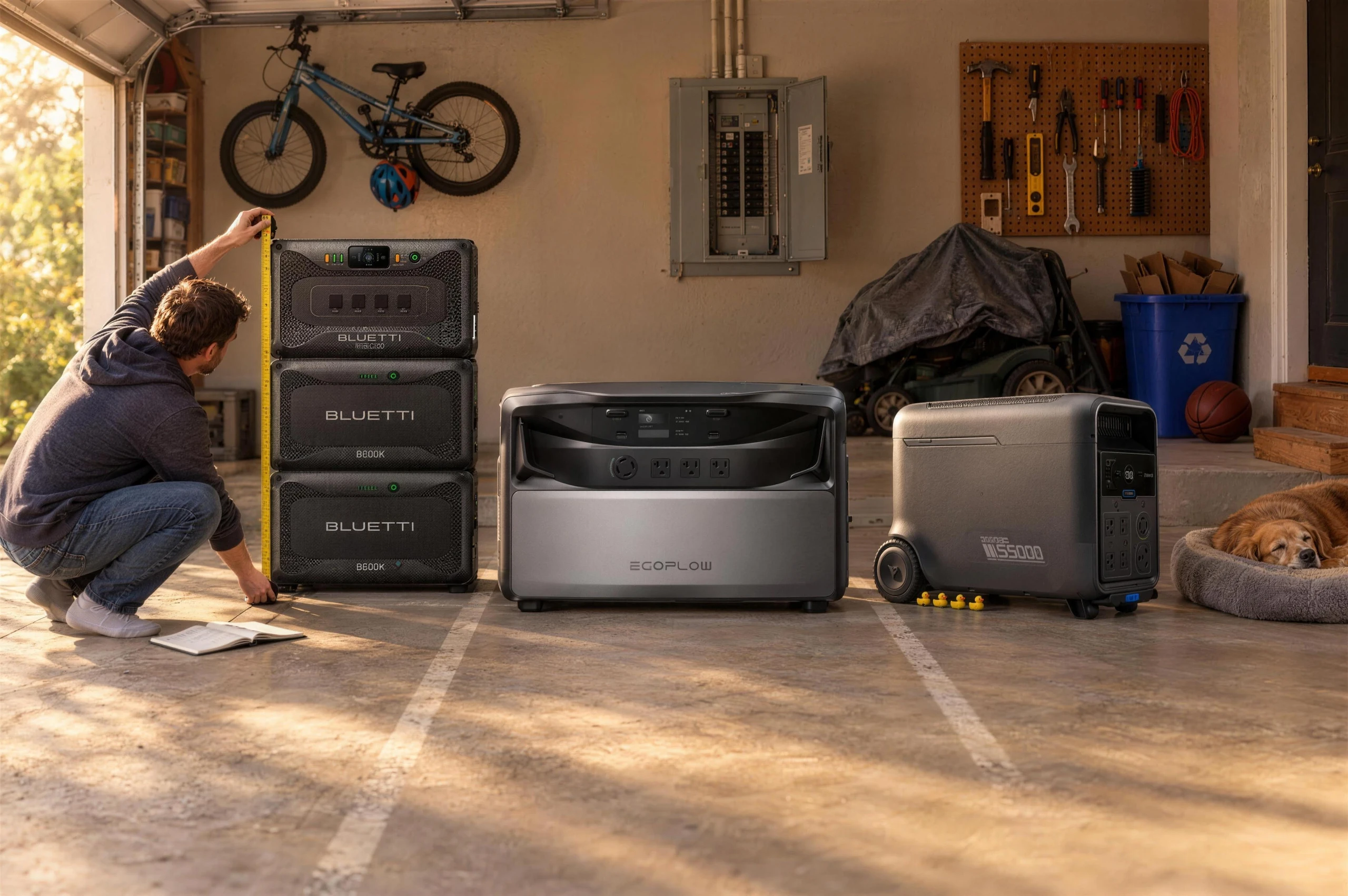
Start small, if the small power station’s inverter is enough for you. An Apex 300 grown to 31.1 kWh costs about $398 a kWh, against $498 on Anker’s S5000 road and $604 on EcoFlow’s TITAN road. The catch is the lifting, and the lighter Apex 200 gives up 240 V. Three ladders rung by rung, and the one we would climb.
 By Wenny Zheng, Portable Power TesterAdd as a preferred source on Google
The short version · as of October 31, 2026
- The small power station is the cheap road. Grow an Apex 300 to 30 kWh and you pay about $398 a kWh. The same 30 kWh is $498 a kWh on Anker’s S5000 road and $604 on EcoFlow’s TITAN road, at the prices its store prints today.
- The big ones buy power, not storage. The TITAN 5000 pushes 7,200 W and the S5000 4,500 W, against 3,840 W from the Apex 300. That is what the extra money is for, and for a house that runs a well pump while the range is on, it is worth paying.
- The lift is the catch on the small road. A B500K pack is about 99 lb by our subtraction, heavier than the Apex 300 itself, and you lift one five times on the way up. The S5000 rolls. The TITAN is a two-person carry.
Rung by rung
What does it cost to reach 30 kWh on each road?
We priced every rung, and the ladders don’t look alike. Each road starts with a power station that has an inverter in it and grows with batteries that don’t. BLUETTI’s is small and its batteries come in two sizes, so the cheapest way up changes at almost every rung; we let the arithmetic pick the cheapest build at each one, bundles included. EcoFlow’s and Anker’s units are twice the size and their batteries match the unit, so those ladders climb in even 5 kWh steps.
- Apex 300 · ends at $13,299
- TITAN 5000 · ends at $18,194
- SOLIX S5000 · ends at $15,000
| Rung | 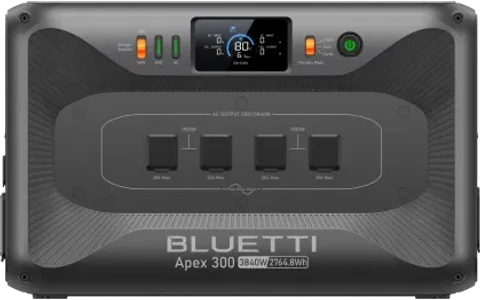 BLUETTI Apex 300 3,840 W · 120 / 240 V | 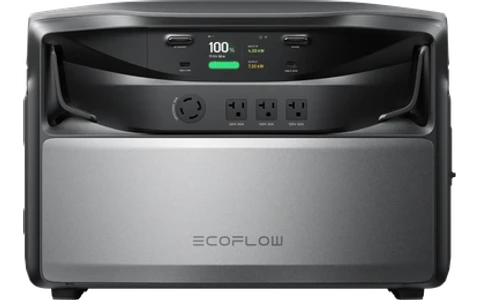 EcoFlow TITAN 5000 7,200 W · 120 / 240 V | 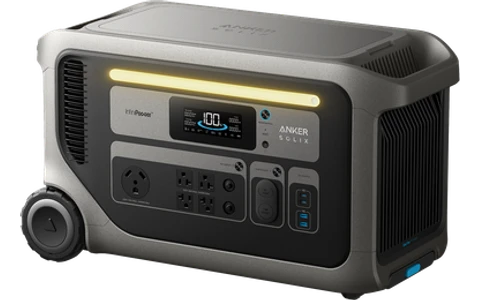 Anker SOLIX S5000 4,500 W · 120 / 240 V |
|---|---|---|---|
| The first unit | $578/kWh $1,599 for 2.8 kWh Apex 300 | $638/kWh $3,199from for 5.0 kWh TITAN 5000 | $498/kWhcheapest $2,500 for 5.0 kWh SOLIX S5000 |
| About 10 kWh | $413/kWhcheapest $4,398 for 10.6 kWh Apex 300 + 1 × B500K + 1 × B300K † | $618/kWh $6,198from for 10.0 kWh TITAN 5000 + 1 × TITAN 5 kWh Extra Battery | $498/kWh $5,000 for 10.0 kWh SOLIX S5000 + 1 × BP5000 |
| 30 kWh, the whole-house rung | $398/kWhcheapest $12,398 for 31.1 kWh Apex 300 + 5 × B500K + 1 × B300K † | $604/kWh $18,194from for 30.1 kWh TITAN 5000 + 5 × TITAN 5 kWh Extra Battery | $498/kWh $15,000 for 30.1 kWh SOLIX S5000 + 5 × BP5000 |
| The ceiling | $397/kWhcheapest $13,299 for 33.5 kWh Apex 300 + 6 × B500K † | $604/kWh $18,194from for 30.1 kWh TITAN 5000 + 5 × TITAN 5 kWh Extra Battery | $498/kWh $15,000 for 30.1 kWh SOLIX S5000 + 5 × BP5000 |
Cheapest is judged among the roads with a published price. The Apex 200 has none yet, so its road is not on the ladder; it goes on sale November 4. † Routes through a BLUETTI bundle. Base units and bundles: the catalogue, read when this page was built. Packs: the makers’ US stores, read 2026-10-31. Per kWh is our arithmetic on rated capacity.
Where to buy the first unit
Prices are the ones this page prints: the catalogue for the units, read when the page was built. We may earn a commission on the BLUETTI and EcoFlow links; we have no arrangement with Anker. The Apex 200 goes on sale November 4; its tracker page carries the link.
The table says the small road wins from the second rung. The first rung is where it loses, and why that matters less than it looks.
The first rung
Is the small power station really cheaper to start with?
Per kilowatt-hour, no. Per cheque, yes, and that is the honest trade. The Apex 300 is the cheapest 240 V power station on the page at $1,599, and the dearest per kilowatt-hour but one, because 2.8 kWh is not much battery for the money. Anker’s S5000 costs $901 more and holds nearly twice the storage, so on the first rung Anker’s big unit is the better buy per kWh, by a wide margin. EcoFlow’s TITAN 5000 is the worst buy on the rung at its “from” price.
What the small cheque does not buy is an inverter that can carry the house. 3,840 W is a fridge, a furnace fan, a microwave and the lights, with one 240 V outlet for a well pump. It is not 7,200 W. If the question is “which one do I buy this month”, we would buy the Apex 300 for a house that needs backup more than it needs capacity. If the question is “which one do I buy once”, keep reading, because the first rung is the rung that matters least.
Add one battery to each and the order changes.
About 10 kWh
Where does the small road pull ahead?
At the second rung, and it never gives the lead back. Past 10 kWh the cheapest build on BLUETTI’s road is an Apex 300 with one B500K and one B300K, $413 a kWh, because BLUETTI discounts the bundle and because the B500K is $391 a kWh of pure battery. Anker’s second rung is $498 a kWh and EcoFlow’s $618. The table has the cheques.
We like what Anker did with its price, even though it loses here. The BP5000 costs exactly what the S5000 costs, so Anker’s ladder is flat: the same price per kilowatt-hour at the first rung and the last. You can buy one, stop, and know you have not been punished for not buying the second. We cannot say that about EcoFlow, whose battery at $2,999 is priced like the power station it attaches to.
Which brings us to the rung the whole story is about.
30 kWh
So: start small and add, or buy the big one first?
Start small, if the small power station’s inverter is enough for you. The money is not close. BLUETTI’s road reaches 30 kWh for $12,398. Anker’s gets there for $2,602 more, and EcoFlow’s for $5,796 more at the prices on its store today, for the same 30 kWh.
One figure on EcoFlow’s side may be about to move. EcoFlow prints $2,999 for the extra battery on the TITAN 5000 Series bundle page on EcoFlow’s US store, and carries a second listing of the same battery, marked for creators, at $2,299. If that is the launch price that posts on November 3, the TITAN road falls to $488 a kWh, just under Anker and still well over BLUETTI. We will swap the figure in the day it is public.
And one on Anker’s side already has. The S5000’s $2,499.99 launch price was for buyers who signed up in October. At its $3,599.99 list price the road costs $534 a kWh, and the gap to BLUETTI widens. The side-by-side page reads both prices twice a day.
What the big power station buys for the extra money is real, and it is power. 7,200 W on a TITAN 5000 runs a well pump, a range and central air at once. The S5000 runs two of the three. The Apex 300 runs one, with the rest of the house behind it. Adding batteries to the Apex adds hours, never watts. If your biggest hour needs more than the Apex can push, the small road is closed to you however cheap the rungs, and the S5000 against the TITAN is the choice you are actually making.
Before you pick a road, try lifting it.
Muscle
What is the heaviest thing I have to lift on each road?
| Road | Heaviest single lift | Lifts to 30 kWh |
|---|---|---|
| Apex 300 | 99 lb, a B500K pack, by our subtraction | The 84 lb unit, then five B500Ks and one B300K at about 65 lb |
| Apex 200 | 99 lb, a B500K pack, by our subtraction | The 59.5 lb unit, then five B500Ks and one B300K |
| TITAN 5000 | 119 lb at least, the TITAN 5000; EcoFlow has not published the battery’s weight | The unit, then five batteries of unpublished weight |
| SOLIX S5000 | 97 lb, the SOLIX S5000, on wheels; Anker has not published the BP5000’s weight | The unit rolls; five BP5000s of unpublished weight |
Here is the part of the small road nobody puts in the brochure. BLUETTI sells the Apex 200 on the promise that one person can lift it, and that is true: 59.5 lb. But a 30 kWh system is not the power station. It is the power station and five B500Ks, and a B500K comes out at about 99 lb when we subtract the Apex 300 from BLUETTI’s bundle weights. That is the weight of an S5000, without the wheels. The light road exists, all B300Ks at about 65 lb each, and it tops out at 19.4 kWh. You cannot get to 30 kWh on BLUETTI’s road without lifting something heavier than the unit you chose for being light.
Anker’s road is the one we would want to move. 97 lb on wheels with a pull rod, and the BP5000s sit beside it rather than under it. EcoFlow’s TITAN is 119 lb with a handle recess at each end, which is to say a two-person carry, five or six times. Neither maker has told us what its battery weighs, and on a page about lifting that is the figure we most want.
Weight is the small road’s first catch. Voltage is the second.
240 V
Which roads keep 240 V?
Three of the four, and the exception is the lightest one. The Apex 300, the TITAN 5000 and the S5000 all put out 120 and 240 V, so a well pump, a dryer or central air is on the table from the first unit. The Apex 200 is 120 V only, and BLUETTI says so plainly: it points anyone who needs 240 V at the Apex 300. The TITAN 5000 Classic, EcoFlow’s cheapest unit, is also 120 V only, which is why this story prices the TITAN road from the base TITAN 5000 and not from the Classic.
Linking three Apex 200s does not fix it. BLUETTI’s Hub A1 joins three units for 6,000 W, and every watt of it is 120 V. If your house has a single 240 V load you care about, the Apex 200 road ends before it starts, however cheap the rungs. Our Apex 200 tracker has the full spec ledger.
Linking them has a price of its own, and it is mostly inverters you did not ask for.
The hub road
What does the Apex 200’s Hub A1 route cost in extra units?
Two more Apex 200s, plus a hub BLUETTI has not priced. One Apex 200 stops at 6 packs and 33.3 kWh. To go past that, BLUETTI’s answer is not a seventh battery but a second and third power station: three Apex 200s linked through the Hub A1, each with its own six packs, for 99.8 kWh and 6,000 W. The two extra units are inverter you are buying to unlock battery slots, at a price BLUETTI has not put a number on, before the hub itself, which it has not priced either.
The arithmetic is kinder than it sounds. The 18 B500Ks come to $36,000 at BLUETTI’s price today, $361 a kWh before the three units and the hub, and every thousand dollars on the Apex 200’s price adds about $30 a kWh across the whole. The batteries dominate the bill, whatever the unit turns out to cost. What the extra units are not is extra power in the sense a TITAN buyer means it: 6,000 W across three Apex 200s is still less than one TITAN 5000, and all of it at 120 V.
If you need that much battery, you have left this story’s question behind. 99.8 kWh is three days of an average American house with nothing switched off. For that buyer the honest comparison is a stationary system with a 240 V inverter, and our V2L and home battery story has that ladder.
What to watch
What could change these numbers?
- EcoFlow’s battery price. $2,999 is what its store lists today; $2,299 is on a creator-only listing. Final prices post November 3.
- Anker’s BP5000 price. $2,499.99, read on its product page, is the only pack price here with no asterisk. Its list price, if the launch figure lapses, is unpublished.
- BLUETTI’s bundles. The cheapest Apex 300 builds route through the Apex 300 + 2 × B500K bundle, which was $5,399 when this page was built; BLUETTI reprices bundles more often than units.
- Pack weights. BLUETTI’s are our subtraction of the catalogue’s bundle weights from the Apex 300’s; EcoFlow’s and Anker’s are unpublished.
- None of this is measured. Every kWh here is a rated capacity; the usable share, the round-trip loss and the idle draw are the figures that turn a 30 kWh purchase into the hours you actually get.
The decision
Which road would we take?
Start small, with an Apex 300, if 3,840 W and one 240 V outlet cover your worst hour. It is the cheapest first unit with 240 V, the cheapest 10 kWh and the cheapest 30 kWh on the page, and nothing you buy on the way is wasted. Plan the lifts: buy the B500K bundle first and accept that the top of this ladder weighs about 99 lb a step.
Buy the big one first, and make it the S5000, if you need 4,500 W or you need to move it alone. Anker’s flat ladder means the first purchase is a complete decision, and the wheels mean one person owns the whole project. You pay $2,602 more than BLUETTI’s road for 30 kWh and get 660 W more inverter for it.
Buy the TITAN 5000 only for the 7,200 W. At today’s prices it is the dearest road to 30 kWh, $3,194 over Anker, and its battery weighs an unpublished amount. If the house genuinely needs a well pump, a range and central air running together, none of the other three roads gets there, and the premium buys the only inverter that does. Our S5000 vs TITAN 5000 analysis goes through that choice unit against unit.
Wait for the Apex 200 only if your house has no 240 V load at all. BLUETTI has not priced it and we are not guessing, but the road above the unit is already fixed, because the batteries are priced: the cheapest way to 30 kWh is 5 × B500K + 1 × B300K, $11,099 in packs for 30.9 kWh with the unit. Against Anker’s road at 30 kWh that leaves about $3,900 of headroom for the unit, and against EcoFlow’s about $7,100. Whatever BLUETTI charges, the Apex 200 road undercuts Anker’s by thousands unless the Apex 200 costs more than the $1,599 Apex 300, and you can finish that sentence yourself. The catch is the one it had before: 120 V only, and the lightest first unit on the page by far. When BLUETTI’s figure lands on November 4, this page recomputes from it, and the Apex 200 takes its column in the table and its line on the chart. Until then, its tracker page has the spec ledger.
Where to buy the first unit
Prices are the ones this page prints: the catalogue for the units, read when the page was built. We may earn a commission on the BLUETTI and EcoFlow links; we have no arrangement with Anker. The Apex 200 goes on sale November 4; its tracker page carries the link. Neither arrangement changes what we report. How we make money.
Get one email when the Apex 200 gets a price
And when EcoFlow’s battery price is final. The ladders on this page rebuild the same day.
By subscribing, you agree to our Privacy Policy. Unsubscribe anytime.
How we did this
Method and sources
Base units and BLUETTI’s Apex 300 bundles are rows in our catalogue, whose prices this page reads when it is built; the TITAN’s is a “from” price on a store whose checkout opens November 3. Pack prices are the makers’ US stores, read 2026-10-31. At each rung we take the cheapest build that holds at least the rung’s kilowatt-hours, bundles and loose packs alike, and divide price by rated capacity. The Apex 200 has no published price and we print no estimate of one, so its road has no column here; when BLUETTI publishes the price, the page recomputes from it. Pack weights for BLUETTI are the catalogue’s bundle weights minus the Apex 300’s. Nothing here is measured.
- [1]BLUETTI (US store), “Apex 300 home battery backup: price and specifications”, 2026-10-31.
- [2]BLUETTI (US store), “B300K expansion battery, 2,764.8 Wh: price”, 2026-10-31.
- [3]BLUETTI (US store), “B500K expansion battery for the Apex 300, 5,120 Wh: price”, 2026-10-31.
- [4]BLUETTI (US store), “BLUETTI Apex 200 expandable power station: coming-soon page with specifications, the Hub A1 and the November 4 on-sale date; no price”, 2026-10-31.
- [5]EcoFlow US store, “EcoFlow TITAN 5000 Series: bundle page listing the TITAN 5 kWh Extra Battery, the Smart Home Panel 10 and the TITAN 5000 “from” price”, 2026-10-31.
- [6]EcoFlow US store, “EcoFlow TITAN Battery 5 kWh (UGC Creator): a creator listing of the same battery at a lower price, published October 28”, 2026-10-31.
- [7]Anker SOLIX, “Anker SOLIX BP5000 Expansion Battery: product page and price”, 2026-10-31.
- [8]Anker SOLIX, “Anker SOLIX S5000 product page: specifications, launch price and list price”, 2026-10-09.
- [9]EcoFlow, regulatory filing, “Rating labels for the TITAN 5000, TITAN 5000 Plus and TITAN 5000 Classic: capacity, output and the six-pack ceiling”, 2026-07-20.