Head-to-head test
Goal Zero Yeti 1000X vs Goal Zero Yeti 500
The extra $500 flips exactly one scenario on this page and hands back three quarters of the lifetime energy, so the Yeti 500 is the buy unless something you own pulls more than 500 watts.
Full profiles: Goal Zero Yeti 1000X → · Goal Zero Yeti 500 →

Written by Ian SchneiderUpdated
Solar & Off-Grid Tester, Station Arena Test Desk
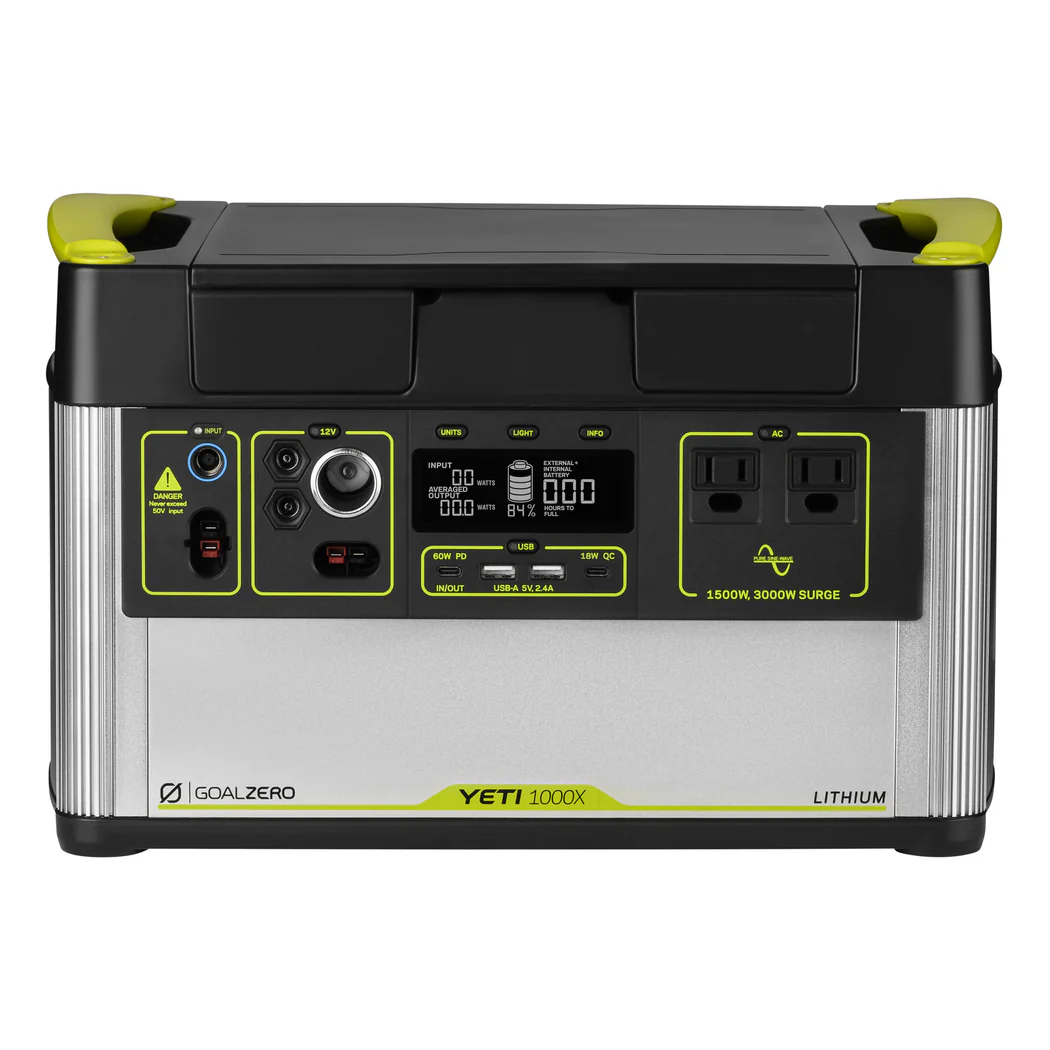
$999.95 · direct from Goal Zero
Last checked 1 day ago. Prices move — check before you buy.
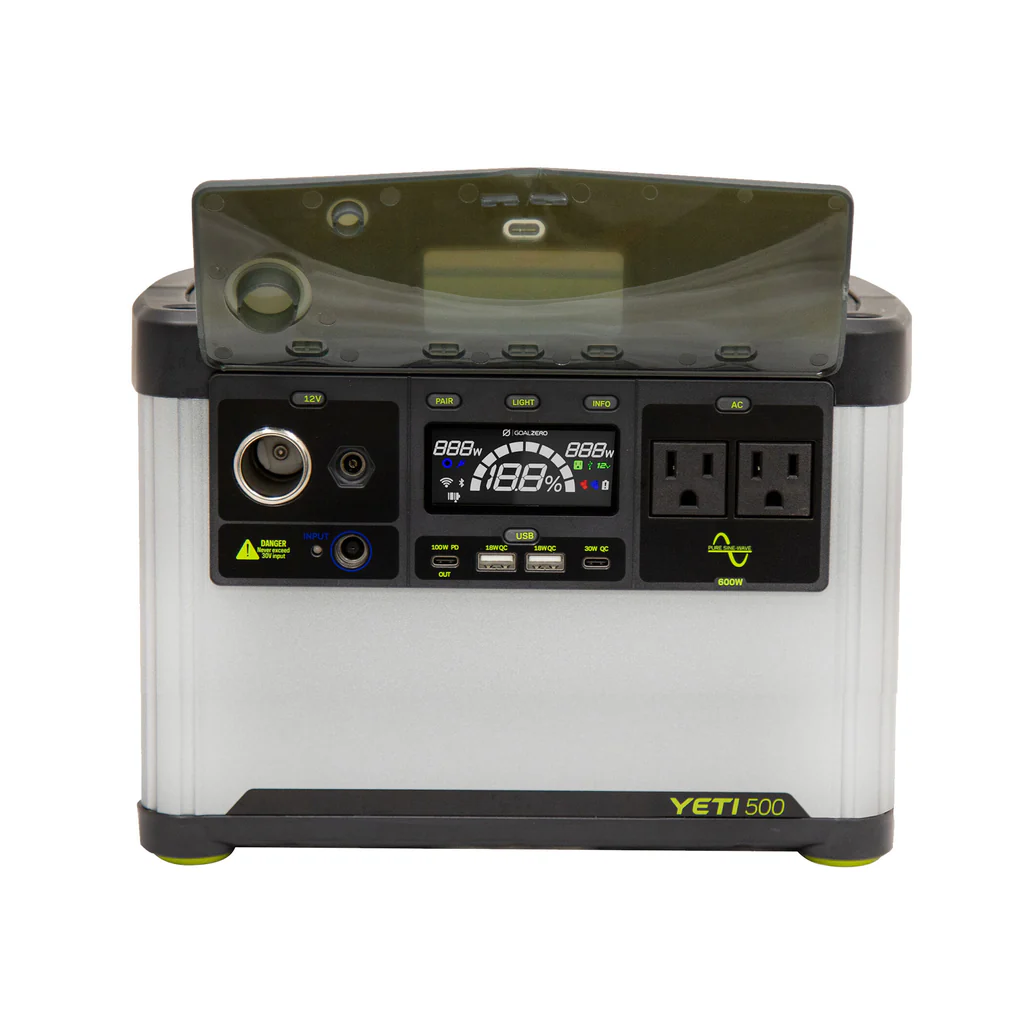
$499.95 · direct from Goal Zero
Last checked 1 day ago. Prices move — check before you buy.
Spec deltas
Buy the Yeti 500 and keep the other $500. Goal Zero has priced these two almost perfectly linearly: $1,000 against $500, 983Wh against 499Wh, 31.68 lbs against 16.1 lbs. Every headline number that should reward you for buying the bigger box scales right along with the price, so there's no volume discount hiding in the 1000X. The extra 484Wh costs the full $500 gap, which is $1.03 per added watt-hour, a shade more than the dollar a watt-hour you paid for the first 499.
What doesn't scale is the cell. The Yeti 500 uses LiFePO4 rated for 4,000 cyclesB1; the 1000X uses lithium NMC rated for 500A1. Multiply each rating by its capacity and the small unit delivers 1,996 kWh over its rated life against the big one's 492. Four times the energy, from the half-price unit.
There's one real exception and it has nothing to do with watt-hours. The Yeti 500's inverter stops at 500W continuous with 1,000W of surge headroom, against 1,500W and 3,000W on the 1000X. That's a wall no amount of battery gets you over. If you're buying this for a circular saw or a microwave, the Yeti 500 was never in the running. If you're buying it for a CPAP, a laptop, a router, some lights and a pile of phones, the Yeti 500 isn't the compromise pick. It's the better product.
What the Numbers Reveal
Each conclusion stated first — the numbers behind it on one line, the full analysis below.
rated cycles
Divide each price by the energy it will ever deliver and the deal inverts. Twenty-five cents per lifetime kilowatt-hour against two dollars and three. You aren't paying more to get more; you're paying double for a battery that reaches 80% of nameplate after 500 cycles while the cheap one still has 3,500 to go.
Yeti 1000X: $1,000 for 983Wh, rated 500 cyclesYeti 500: $500 for 499Wh, rated 4,000 cyclesLifetime energy: 983Wh x 500 cycles = 492 kWh; 499Wh x 4,000 cycles = 1,996 kWh
Why it mattersAnyone reading this as more battery for more money should notice they're getting less battery for more money, just not on the day it arrives.
Typical price
The place it nearly earns its money is the workday, where the 1000X misses by 74Wh out of 910. That's the last 8% of the day, and it's where the 1000X's 600W solar input against the Yeti 500's 200W stops being a spec-sheet line. 74Wh at a rated 600W is roughly seven minutes of panel. The Yeti 500's 486Wh gap at 200W is about two and a half hours it doesn't have. Real panels never hit their rating, but the ratio holds.
Tailgate Party needs 670Wh: the 1000X finishes with 166Wh of usable spare, the Yeti 500 falls 246Wh shortRemote Workday needs 910Wh: the 1000X is still 74Wh short, the Yeti 500 is 486Wh short8-Hour Blackout needs 1,645Wh: the 1000X is 809Wh shortUsable figures are the 85% inverter-derated ones: 836Wh and 424Wh
Why it mattersIf solar is part of the plan, the $500 is buying throughput and it's defensible. If this lives indoors on a wall charger, the $500 bought you one tailgate.
continuous output
Run the 1000X at the 1,500W its inverter advertises and 836Wh is gone in about half an hour (836 divided by 1,500). The big inverter is real, but it's sized to start things this battery can't sustain. The Yeti 500's 500W and 424Wh are the matched pair: the loads it can run are the loads it can run all night.
Yeti 500: 500W continuous, 1,000W surgeYeti 1000X: 1,500W continuous, 3,000W surgeYeti 1000X usable energy: 836Wh after the 85% derate
Why it mattersBuying the 1000X for its 1,500W only makes sense if the high-draw thing runs in bursts. If it runs for hours, neither of these is your unit.
Goal Zero's X-series doesn't do the seamless handover, so a 1000X wired between the wall and a PC still drops the machine when the grid drops. The Yeti 500 does it, at a rated 20 milliseconds. Stack that on 4,000 cycles and five years of cover and the always-on job goes to the half-price unit on every axis that job cares about.
The Yeti 500 carries a published 20ms switchover; the Yeti 1000X publishes noneWarranty: 5 years on the Yeti 500, 2 years on the Yeti 1000XPurchase price per warranty year: $100 on the Yeti 500, $500 on the Yeti 1000X
Why it mattersIf the unit's real work is waiting in a corner for the power to fail, buy the Yeti 500 and stop thinking about it.
The specific dimensions that decide these two units — everything else is a tie.
Your Life, Your Pick
Selected because: Six modelled loads, and the $500 upgrade changes the outcome in exactly one of them.
Four of the six rows come back neither, and that's information rather than a dodge. Weekend Camping asks for 2,100Wh and Van Life Daily asks for 4,685Wh; the 1000X has 836Wh of usable energy and nothing you can buy for $500 closes a gap measured in thousands. If your list looks like those rows, you're shopping a tier above both of these.
The row worth staring at is the 8-hour blackout at 1,645Wh, where the 1000X covers about half and the Yeti 500 about a quarter. Neither is a house. But half a blackout with 600W of solar input is a different animal from a quarter of one with 200W, because the outage that actually hurts is the multi-day one, and every one of those days has a sunrise in it.
Runtime: Will It Power Your Gear?
Selected because: The Yeti 500's 500W continuous ceiling is a harder limit than its 499Wh, and the two have to be read together.
continuous output
Check the label on whatever you plan to plug in before you check anything on this page. The Yeti 500 delivers 500W continuous with 1,000W of surge headroom, and anything with a heating element or a big motor rated above that simply won't start. The 499Wh behind it never enters the conversation.
Goal Zero's own copy has the Yeti 500 running a full-size refrigerator for up to six hoursB2, which is the manufacturer's claim rather than a bench result, and it's the one figure I'd check against your actual fridge first. Compressors draw well over their running label at switch-on, and 1,000W is the entire surge budget. The 1000X's 3,000W is triple that, which is the difference between will it start and how long will it run. One small reversal while you're here: the faster USB-C port is on the cheap unit, 100W against the 1000X's 60W.
Lifetime Value
Selected because: 500 rated cycles against 4,000 turns a $500 price gap into 492 kWh against 1,996 kWh of energy delivered.
cost / lifetime kWh
Cycle ratings are ratings, and it's fair to be sceptical of a 4,000-cycle number nobody has finished. The longest public run on the Yeti 500 I can point to is a 2026 long-term reviewer past 180 charge/discharge cycles with minimal observed degradationB4, which is 4.5% of the claim. The same scepticism cuts harder the other way, though: the 1000X's 500-cycle rating works out to 1.4 years at daily use, and 1.4 years is short enough that you'd find out for yourself.
Split each purchase price across its warranty and the gap gets blunt: $500 a year of cover on the 1000X, $100 on the Yeti 500. Our own PowerScore has them 2,093 to 1,776, an 18% spread. Twice the money for eighteen percent more score and a quarter of the lifetime energy isn't a close call on paper. It only gets close when you need the watts.
What the Specs Don't Tell You
Selected because: UPS, warranty and cycle life all run opposite to price here, and all three land on the cheaper unit.
rated cycles
Three of the four flags here point at the cheaper unit, and one of them corrects a reasonable assumption. Only the Yeti 500 does the uninterruptible handover, rated by Goal Zero at 20 milliseconds. The 1000X publishes no figure because the X-series doesn't have the feature. If the plan was to put a desktop or a NAS behind the bigger unit on the theory that bigger means better protected, that's backwards.
The warranty card below expresses the difference as coverage per dollar. The plain version reads better: five years against two, on the unit that costs half as much. Warranty length usually tracks how long the maker expects the cell to hold up, and here it tracks the cycle ratings almost exactly.
Growth Path
Selected because: Expandability is the 1000X's one structural advantage over a sealed 499Wh box, and it's worth checking what you'd be expanding.
solar input
The 1000X's one structural card is that it can grow. It accepts Goal Zero expansion batteries through the Yeti Link system, which does need extra cables and adapters to put togetherA3, and the Yeti 500 is sealed at 499Wh with no path at all. If you can genuinely see the load climbing past 983Wh, that's the one difference on this page the Yeti 500 can't answer with money.
Be clear about what you'd be growing. Every watt-hour you bolt onto the 1000X sits on a 500-cycle NMC baseA1, so the platform ages out while you're still buying parts for it. And the obvious alternative is worth pricing: two Yeti 500s come to the same $1,000 to within a nickel, hold 998Wh between them against 983Wh, and each brings its own 4,000 cycles and its own five-year warranty. What two of them can't do is gang up on one load. Each is still a separate 500W box.
Strengths & trade-offs
Goal Zero Yeti 1000X
Strengths
- +Larger battery capacity
- +Higher AC output
- +Faster solar charging
Trade-offs
- –Substantially more expensive (+$500) than the Yeti 500.
- –Significantly heavier (+15.6 lbs), making it harder to move.
- –Shorter-lived battery — rated for 500 charge cycles vs the Yeti 500's 4,000, so it wears out sooner.
Goal Zero Yeti 500
Strengths
- +Costs $500 less
- +Lighter by 15.6 lb
- +Longer warranty
- +Rated for 4,000 charge cycles — much longer battery lifespan
Trade-offs
- –Weaker inverter (-1,000W) limits appliance compatibility.
- –Sealed capacity — the Yeti 1000X can add batteries to grow past 499Wh; this one can't.
Will It Power Your Gear?
Scenario math and per-appliance runtimes, modeled from the spec record.
Scenario verdicts
We ran the math on six real-world scenarios. Here's which unit survives your actual life.
SCN-01 · 2 nights · needs 2,100Wh
Weekend Camping
Two nights off-grid with essential comfort
Neither unit
Neither unit covers this scenario's 2,100Wh: the Yeti 1000X comes up 1,264Wh short (about 40% covered), the Yeti 500 1,676Wh (20%). This is well outside what either unit is for; the right answer here is a larger station, not a choice between these two.
Battery budget usedlower = more headroom
LOAD Phone Charger 15W×6h · LED Lights 40W×8h · Box Fan 75W×14h · CPAP Machine 40W×16h
SCN-02 · 8 hours · needs 1,645Wh
8-Hour Blackout
Keep the essentials running through a night without power
Neither unit
Neither of these is a house. The load asks for 1,645Wh; the Yeti 1000X is 809Wh short and the Yeti 500 is 1,221Wh short, so read both as partial cover for the essentials rather than whole-home backup. Where they part company is the refill. The Yeti 1000X takes 600W of solar input against the Yeti 500's 200W, and an outage long enough to matter includes sunrises.
Battery budget usedlower = more headroom
LOAD Fridge 150W×8h · Router + Modem 20W×8h · LED Lights (4 bulbs) 40W×6h · Phone Charger 15W×3h
SCN-03 · 8 hours · needs 320Wh
CPAP Overnight
Sleep therapy without interruption — the #1 medical use case
Either unit
Both clear it, and not narrowly. A 320Wh night leaves the Yeti 1000X 516Wh of usable energy untouched and the Yeti 500 104Wh, so capacity decides nothing here. Neither unit publishes a noise rating, which is the spec that would actually matter at the head of the bed, so there's nothing to hold either one to. That leaves price, weight, and the fact that only the Yeti 500 can sit inline and hand over without dropping the machine.
Battery budget usedlower = more headroom
LOAD CPAP Machine 40W×8h
SCN-04 · 8 hours · needs 910Wh
Remote Workday
Full work day off-grid without power anxiety
Neither unit
Neither finishes the day, but they fail by different orders of magnitude. The Yeti 1000X is 74Wh short of the 910Wh this asks for, which is the last 8% of the day and roughly seven minutes at its rated 600W solar input. The Yeti 500 is 486Wh short, more than its entire 424Wh usable reserve. One of these needs a top-up. The other needs a second unit.
Battery budget usedlower = more headroom
LOAD Laptop 60W×8h · External Monitor 30W×8h · Router + Modem 20W×8h · Phone Charger 15W×2h
SCN-05 · 4 hours · needs 670Wh
Tailgate Party
Game day power for the crew
Yeti 1000X
This is the row where the extra $500 buys a different answer. The 670Wh here leaves the Yeti 1000X with 166Wh of usable spare and leaves the Yeti 500 246Wh short, so the small unit doesn't make it to the end of the afternoon. If tailgating is the actual use case rather than a hypothetical, that's your argument for the bigger box. It's also the only scenario on this page that makes it.
Battery budget usedlower = more headroom
LOAD Blender 400W×0.5h · LED TV (55") 80W×4h · Bluetooth Speaker 15W×4h · Phone Charger (×3) 45W×2h
SCN-06 · 24 hours · needs 4,685Wh
Van Life Daily
A full day of mobile living — the ultimate endurance test
Neither unit
Neither unit covers this scenario's 4,685Wh: the Yeti 1000X comes up 3,849Wh short (about 18% covered), the Yeti 500 4,261Wh (9%). This is well outside what either unit is for; the right answer here is a larger station, not a choice between these two.
Battery budget usedlower = more headroom
LOAD Mini-Fridge 150W×24h · Laptop 60W×4h · Phone Charger 15W×3h · LED Lights 40W×5h · Fan 75W×8h
The Load Test
RUNTIME = (Wh × 0.85) ÷ LOAD
None of the scenarios above exactly yours? Build it. Toggle what you'd plug in; both units are tested against the combined draw.
Essentials
Comfort & Convenience
High-Draw Appliances
Test duration
8h
Continuous draw
205W
Projected runtime
For this load: Yeti 1000X runs 4.1h vs 2.1h.
$999.95 list · direct from Goal Zero
Modeled from the spec record — same math as the tables below. Methodology
Runtime by appliance
Real-world runtime estimates for common appliances, modeled at 85% inverter efficiency.¹
Essentials
The basics you need runningscale 0–55.7hComfort & Convenience
Makes off-grid life actually enjoyablescale 0–11.1hHigh-Draw Appliances
These reveal the real limitsscale 0–0.8h¹ Runtime = (capacity × 0.85) ÷ appliance watts. Within each group, all bars share one time scale (the group's longest runtime), so lengths are comparable across appliances; identical runtimes collapse into a single blue/orange bar. Actual runtime varies with battery age, temperature, and simultaneous loads — see methodology.
Conclusion
August 9, 2026
Verdict: the Goal Zero Yeti 500
Take the Yeti 500. It costs $500 against the Yeti 1000X's $1,000, and price, capacity and weight all roughly double together (499Wh and 16.1 lbs against 983Wh and 31.68 lbs), so nothing about size settles this. What doesn't scale is the cell: 4,000 rated cycles against 500, which comes to 1,996 kWh of energy across the Yeti 500's rated life against the 1000X's 492 kWh. The cheaper unit also takes the warranty, five years to two, and it's the only one of the pair that can act as a UPS. One thing reverses the call, and it isn't capacity. The Yeti 500 stops at 500W continuous with 1,000W of surge, so if you need to run a tool, a kettle or a microwave off a battery it isn't a candidate at any size, and the 1000X's 1,500W is what you'd be paying for. Confidence sits at 7 rather than 9 because that exception is common rather than exotic.
Editor-assigned confidence, based on cited owner research and spec analysis.
List prices as of August 9, 2026. The links below open Goal Zero's current price.
$499.95 · direct from Goal Zero
Last checked 1 day ago. Prices move — check before you buy.
or check the Yeti 1000X price$999.95 list
Written by Ian Schneider, Solar & Off-Grid Tester · Station Arena Test Desk · Updated August 9, 2026
Measured Data
Benchmark scores and the full spec record, side by side.
Benchmark scores
Not rated for both units (minimum threshold unmet): UPS, CPAP.
Full specifications
ᵈ Derived: price ÷ rated capacity. See the data behind our comparisons →
Comparison ToolAdd more power stations, side by sideOpen Tool →How these numbers are produced
Numeric verification
Every figure on this page traces to our spec database or arithmetic on it — no estimated numbers.
Owner claims
Statements about owner experience are cited to published reviews — see Sources & Research Notes below.
Runtime model
Runtime = (rated capacity × 0.85 inverter efficiency) ÷ device wattage. Solar recharge estimates assume panels deliver 70% of rated output. Cold weather, battery age, and stacked loads reduce real-world results.
Power Score
Computed from 14 published spec dimensions, weighted per use-case bench. Higher is better; a unit must meet a bench's minimum threshold to be rated.
See the full weight table and data sourcing on our methodology page →Class ranking (the star rating)
Each unit's star score is a category ranking, not customer reviews — no buyer opinions feed it. We score every station on size-independent quality (value, output, portability, endurance, ports, warranty, and more), then percentile-rank it against the other units in its capacity class, so a class-leading compact unit and a class-leading whole-home unit can both earn 5★. Here, Yeti 1000X rates 3.5/5 (11th percentile of 20 Compact-class units), and Yeti 500 rates 4.5/5 (71st percentile of 22 Personal-class units).
How the class ranking is computed →Test Notes & Caveats
Hidden gotchas and advantages we spotted that you won't find on the product page.
The Yeti 500 Is Sealed, and That's Half the Story
The Yeti 500 stops at 499Wh with no expansion path, so size it correctly the first time. The Yeti 1000X takes Goal Zero expansion batteries and genuinely grows past 983Wh, which is a real advantage if your load is climbing. Just be clear about what you're growing: every watt-hour you bolt on rides a 500-cycle base, while the sealed unit's 499Wh are rated for 4,000.
Only the Yeti 500 Hands Over Cleanly
Goal Zero's X-series doesn't do uninterruptible switchover, so a Yeti 1000X wired between the wall and your desktop still lets the machine drop when the grid does. The Yeti 500 does the handover, rated by Goal Zero at 20 milliseconds. That's the manufacturer's published figure and not something we've put a meter on, but for this decision it's the presence of the feature rather than the millisecond count that matters.
Five Years Against Two
The Yeti 500 carries a five-year warranty and the Yeti 1000X two, and the Yeti 500 is also the one that costs half as much. Split each purchase price across its cover and that's $100 a year against $500. Warranty length usually tracks how long the maker expects the cell to hold up, which is exactly what the cycle ratings say too.
1.4 Years Is the Number to Sit With
At a cycle a day the Yeti 1000X's 500-cycle rating is used up in 1.4 years, while the Yeti 500's 4,000 runs to 11. Twice a week it's 4.8 years against 38.5. Neither battery dies at the limit, both settle to roughly 80% of nameplate, but reaching that point in under two years of daily use is a very different proposition from reaching it in a decade.
Full record above — the Test Desk pick is the Yeti 500.
Check Yeti 500 price →or check the Yeti 1000X priceOwnership Analysis
What happens after you buy — true cost of ownership, brand trust, and growth potential.
Lifetime value
Service lifeyears at one full cycle per day
Lifetime energy delivered
Cost per delivered kWh
│ warranty ends · Reaching the cycle rating means ~80% capacity remains — degraded, not dead.
Analyst note
The Yeti 500 wins on both sticker price and long-term value. At $0.25/kWh over its lifetime, it's meaningfully cheaper to own. Clear value winner.
Delivers each lifetime kWh for $1.78 less — check the Yeti 500 price →
Growth path
Yeti 1000X
EXPANDABLESupports Goal Zero expansion batteries, so you can add capacity later without replacing the base unit — useful if your needs may climb past 983Wh.
Accepts up to 600W of solar. Suitable for a 1-2 panel setup.
Adequate ports for most setups, but heavy users may want a power strip.
Expansion batteries are Goal Zero-specific. You're investing in the Goal Zero ecosystem.
Yeti 500
FIXED CAPACITYFixed at 499Wh, with no expansion — so size it for your needs up front rather than planning to add capacity later.
Accepts up to 200W of solar. Limited to a single portable panel.
Adequate ports for most setups, but heavy users may want a power strip.
Realistic full solar rechargeat 70% of rated panel output — see methodology
Analyst note
The Yeti 500 is sealed at 499Wh, which is fine if that covers you. The Yeti 1000X starts at 983Wh and can grow beyond it with Goal Zero expansion batteries — though at this size expansion means longer runtimes on the same loads, not a path to home backup. More hours, not more house.
What Owners Report
Patterns from published owner reports and long-term reviews — every claim cited to its source below.
Goal Zero Yeti 1000X
Field notes on the 1000X are consistent about the build and just as consistent about the value. It's a premium-feeling box at 31.68 lbs that has run a mini fridge for twelve hours and kept working in both cold and heatA2. The complaints aren't about whether it works. They're about what else the money buys: at about $1.02 per watt-hour, reviewers point to LFP rivals with more capacity for less that charge faster and last far longer, and some flag a thin port selectionA4. The 500-cycle NMC chemistry is the specific chargeA1, and it's the one no firmware update reaches.
Expansion works, but it isn't plug-and-play. Chaining units through Yeti Link takes additional cables and adapters, so budget for hardware beyond the battery you're addingA3.
“Excellent premium build at about 31.68 lbs; performs reliably — ran a mini fridge for 12 hours and worked in both cold and hot conditions.”
Sources
thepowerpick.com · batteryskills.com · offgridbenchmark.com · pcworld.com · bestgeneratorsolar.com · appleinsider.com
Goal Zero Yeti 500
The Yeti 500's headline is its 4,000+ cycle LiFePO4 rating, which Goal Zero translates into more than ten years of daily use to 80% capacity at 75FB1. Independent long-term data is thin because the unit is recent: the longest public run I can point to is a 2026 reviewer past 180 charge/discharge cycles with minimal observed degradationB4. That's encouraging, and it's a small fraction of the claim. Treat the cycle rating as a rating.
One caution matters more than any of the above. The LiFePO4 Yeti 500 is a different product from the older NMC-based Yeti 500X, and listings conflate the twoB3. Goal Zero also sells the 500 on grid-down backup, claiming a full-size refrigerator can run directly off it for up to six hoursB2. That's the manufacturer's own figure rather than a measured one, and 1,000W of surge is the whole budget it has to do it in.
“The Yeti 500's LiFePO4 battery is rated for 4,000+ cycles, meaning daily use for over 10 years (to 80% capacity at 75F).”
Sources
goalzero.com · rei.com · propaneva.com · portablepowernerd.com
Sources & Research Notes
Every owner claim in this report is traceable to a published source. The bracketed references above resolve here.
Recurring owner themes
- Premium build and reliable performance, but held back by 500-cycle NMC chemistry, high price per Wh, and expansion needing extra hardware. [Yeti 1000X · 3 entries]
- High 4,000+ cycle LFP rating and outage-backup capability (including running a fridge for hours) are the standout points. [Yeti 500 · 2 entries]
- A1
“Uses lithium NMC cells, not LiFePO4, rated for only 500 cycles to 80% — a disadvantage in a LiFePO4 world where rivals last 3,000+ cycles.”
thepowerpick.com / batteryskills.com — Yeti 1000X review · 2026 · [negative]
- A2
“Excellent premium build at about 31.68 lbs; performs reliably — ran a mini fridge for 12 hours and worked in both cold and hot conditions.”
thepowerpick.com / offgridbenchmark.com — Yeti 1000X review · 2026 · [positive]
- A3
“Expandable via the Yeti Link system to chain multiple units for more capacity, though it requires additional cables and adapters.”
pcworld.com / bestgeneratorsolar.com — Yeti 1000X review · 2026 · [mixed]
- A4
“At about $1.02 per Wh it's pricey — reviewers note LFP rivals offer more capacity for less, charge faster, and last far longer; some also flag middling specs and too few ports.”
appleinsider.com / thepowerpick.com — Yeti 1000X review · 2026 · [negative]
- B1
“The Yeti 500's LiFePO4 battery is rated for 4,000+ cycles, meaning daily use for over 10 years (to 80% capacity at 75F).”
goalzero.com / rei.com — Yeti 500 LFP · 2026 · [positive]
- B2
“Acts as a backup power supply when the grid drops — you can plug a full-size refrigerator directly in for up to six hours of runtime to prevent food waste.”
goalzero.com — Yeti 500 backup · 2026 · [positive]
- B3
“Weighs about 16 lbs, upgraded to LiFePO4 battery technology from the older NMC-based Yeti 500X.”
goalzero.com / propaneva.com — Yeti 500 review · 2026 · [mixed]
- B4
“One 2026 reviewer completed 180+ charge/discharge cycles with minimal observed degradation.”
portablepowernerd.com — Yeti 500 long-term review · 2026 · [positive]
Research compiled August 9, 2026.
Who Should Buy Which
Buy the Yeti 1000X if you…
- →Something you own draws more than 500W and has to start off a battery: a circular saw, a microwave, a full-size coffee maker. The Yeti 500's 500W continuous and 1,000W surge don't get there, and capacity can't fix it.
- →You're pairing it with panels. 600W of solar input against 200W is the widest genuine gap between these two, and it's the one that compounds across a multi-day outage.
- →You already run Goal Zero expansion gear, or you can see the load climbing past 983Wh and want a base unit that survives the changeA3.
Buy the Yeti 500 if you…
- →Everything you plug in fits under 500W: CPAP, laptop, router, lights, phones, a fan. The 320Wh CPAP night leaves 104Wh of usable energy spare, and the cell behind it is rated for 4,000 cycles.
- →The unit's job is to sit plugged in and wait. A rated 20ms handover, five years of warranty, and $100 a year of cover for the privilege.
- →You'll be the one carrying it. 16.1 lbs is a one-handed lift out of a car boot; 31.68 lbs is both hands and somewhere to set it down.
If neither fits
Anyone whose list looks like Van Life Daily at 4,685Wh, or a real off-grid weekend at 2,100Wh, should skip both of these. The shortfalls there run to thousands of watt-hours, not hundreds, and these are day-trip and desk-backup batteries. Same answer if you want the 1000X's 1,500W with the Yeti 500's lifespan: that combination exists in the wider LFP market at around this money, and neither of these two is itA1A4.
The Bottom Line
Take the Yeti 500. Half the price, just under half the capacity, and four times the energy across its rated life, which is the only one of those three that compounds. The 1000X is a well-built box that ran a mini fridge for twelve hours without complaintA2. It's also an older NMC design at a current-generation price, and the $500 you'd add to get it buys one extra scenario on this page.
The exception is honest and it's narrow. If something you own draws more than 500 watts, the Yeti 500 isn't a candidate and the 1000X's 1,500W inverter is the reason to spend. If nothing does, the small one isn't the sacrifice. It's the one still at full strength when the other has spent every cycle it was rated for.
Frequently Asked Questions
Answers drawn from the spec record and cited owner research.
Is the Yeti 1000X worth double the price of the Yeti 500?
Only if you need more than 500 watts at once. The $500 gap buys 484Wh, which works out to $1.03 per added watt-hour, essentially the same rate you paid for the first 499. Across the six load scenarios modelled here it changes the answer exactly once, at the tailgate. What it costs you is longevity: 500 rated cycles against 4,000.
Should I just buy two Yeti 500s instead of one Yeti 1000X?
On paper it's tempting. Two of them come to the same $1,000 to within a nickel, hold 998Wh between them against the 1000X's 983Wh, and each is rated for 4,000 cycles instead of 500. The catch is that they can't combine: each remains a separate 500W box, so anything needing more than 500W at once runs on neither. Two units covering two separate jobs is a good trade. Two units for one big job isn't.
Is the Yeti 500 the same as the Yeti 500X?
No, and the difference is most of why this page recommends it. The current Yeti 500 uses LiFePO4; the older 500X used NMC. Search results and marketplace listings mix them up constantly, so check the chemistry and the cycle rating on the exact page you're buying from. If the listing quotes a cycle count in the hundreds rather than 4,000, you're looking at the old unit.
Can the Yeti 500 run a refrigerator?
Goal Zero says yes, up to six hours on a full-size fridge, and that's the manufacturer's claim rather than a measured result. The number that decides it is on your fridge, not the battery. The Yeti 500 has 500W of continuous output and 1,000W of surge, and a compressor's start-up draw is a multiple of its running label. The 1000X's 3,000W of surge takes the question off the table, and whether that's worth $500 depends on how often your power actually goes out.
Which one is better for a CPAP?
Both cover the night comfortably. A 320Wh run leaves the 1000X 516Wh of usable energy spare and the Yeti 500 104Wh, so capacity settles nothing. Neither unit publishes a noise rating, which is the spec that would actually matter an arm's length from your pillow. The Yeti 500 takes it on the rated 20ms handover, half the weight and half the price.
Where to buy
Goal Zero Yeti 1000X
$999.95
$999.95 · direct from Goal Zero
Last checked 1 day ago. Prices move — check before you buy.
Goal Zero Yeti 500Pick
$499.95
$499.95 · direct from Goal Zero
Last checked 1 day ago. Prices move — check before you buy.
Prices may vary by retailer and are subject to change.