Head-to-head test
BLUETTI Premium 200 V2 vs Goal Zero Yeti 6000X
The Yeti 6000X buys nearly three times the battery at eleven times the cost of every kilowatt-hour it will ever deliver, so the only question worth asking is whether you genuinely cannot get to your next recharge inside the Premium 200 V2's 1,763Wh.
Full profiles: BLUETTI Premium 200 V2 → · Goal Zero Yeti 6000X →

Written by Gunner GustafsonUpdated
Whole-Home Backup Tester, Station Arena Test Desk

$1,549.00 · direct from BLUETTI
Last checked 8 hours ago. Prices move — check before you buy.
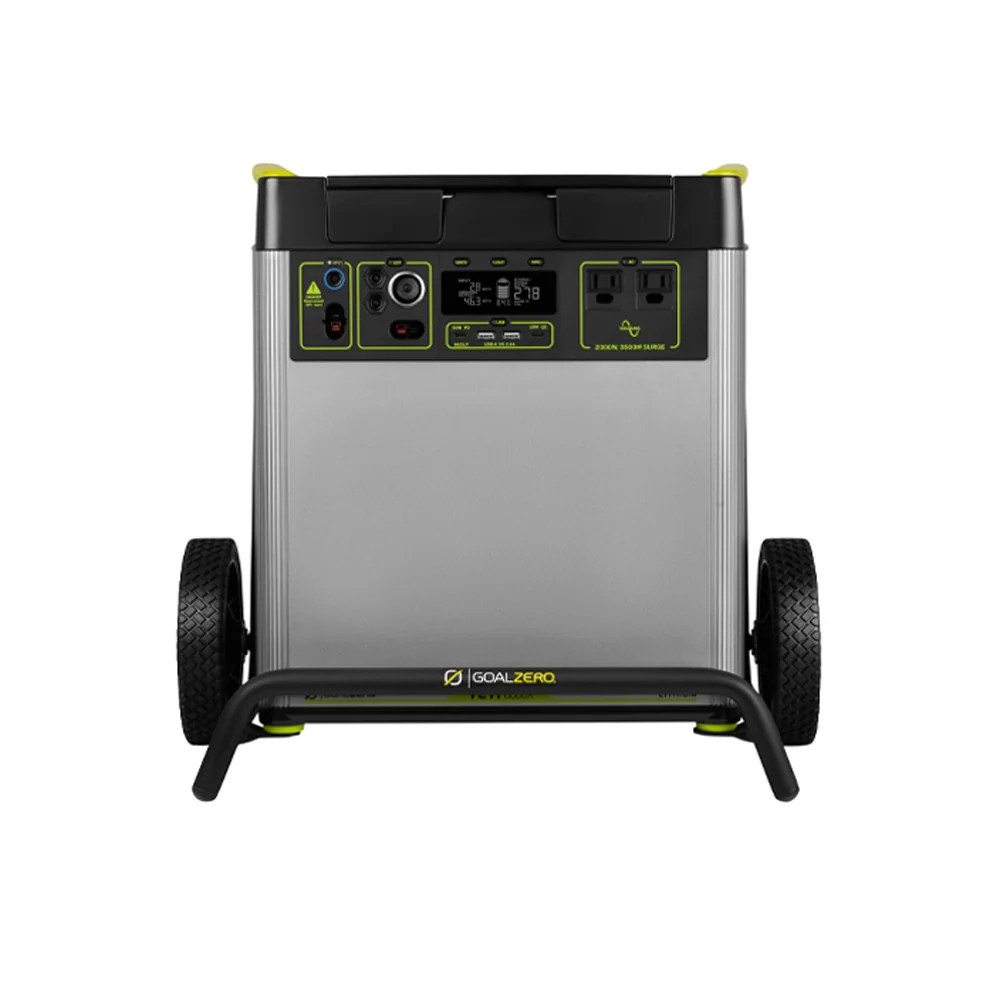
$3,999.95 · direct from Goal Zero
Last checked 8 hours ago. Prices move — check before you buy.
Spec deltas
The Premium 200 V2 costs $1,549 and holds 2,074Wh; the Yeti 6000X costs $4,000 and holds 6,071Wh. That looks like a clean more-money-more-battery trade, and it isn't, because the first pack is rated for 6,000 cycles and the second for 500. Run those to their ratings and the small box delivers roughly four times the total energy of the big one.
Most of the rest of the spec sheet runs the same direction. The BLUETTI is 53.4 lbs to the Yeti's 106, takes 1,000W of solar to its 600W, lists a UPS mode where the Yeti lists none, carries four AC outlets to its two, and pushes 100W of USB-C to its 60W. The Yeti answers with the one thing that can't be argued away: 5,160Wh of usable energy against 1,763Wh, both figures after the same flat 85% derate.
So the decision is narrow, and it's about a single day rather than a spec sheet. Can you reach your next recharge inside 1,763Wh? If you can, the Premium 200 V2 wins on price, weight, lifespan, refill speed and outlets, and nothing the Yeti does closes that. If you can't, the Yeti is the only one of these two that finishes the day, and the honest next move is to look at what else 6,071Wh buys in a modern LFP pack before you accept a 500-cycle rating.
What the Numbers Reveal
Each conclusion stated first — the numbers behind it on one line, the full analysis below.
rated cycles
Spread the coverage across the same lives and the two prices stop being comparable at all. Four years on the BLUETTI works out to $387 a warranty year; two years on the Yeti works out to $2,000. Eleven times the cost per delivered kilowatt-hour is not a gap that ports, an app or a US mailing address close, and there is no accessory on either brand's site that sells you cycles.
Yeti 6000X: $4,000 for 6,071Wh, the lower price per nameplate watt-hour of the twoPremium 200 V2: $1,549 for 2,073.6Wh, the higher price per nameplate watt-hourRated cycles: 6,000 on the Premium 200 V2, 500 on the Yeti 6000XWarranty terms: up to 4 years on the Premium 200 V2, 2 years on the Yeti 6000X
Why it mattersIf this unit gets cycled regularly rather than sitting on standby, the Yeti's price isn't a premium for more battery. It's a premium for less energy.
solar input
A multi-day outage is a cycle of drain and refill, not one long drain, so what decides day three is how fast the pack comes back. The BLUETTI turns around in a morning and can do it again tomorrow; the Yeti needs most of a clear day to replace one evening, or the twelve hours on the wall that an outage isn't offeringB3. And only the BLUETTI can sit between the wall and your gear and hand the load over without anyone noticing the grid left, rated at no worse than 15ms.
8-Hour Blackout: the Yeti 6000X ends the night at 32% used with 3,515Wh banked; the Premium 200 V2 ends at 93% with 118Wh left, about 7% of a second nightSolar input ceiling: 1,000W on the Premium 200 V2, 600W on the Yeti 6000XA full Yeti 6000X refill runs about 12 hours on its included 600W AC chargerB3Only the Premium 200 V2 lists a UPS mode, rated at no worse than 15ms
Why it mattersIf your outages last an evening, or last three days and you own panels, the BLUETTI is the better blackout unit. If they last three overcast days with no generator, the Yeti's bank is the only thing here that answers.
weight
Those two failures are not the same size. The BLUETTI's 337Wh gap is about twenty minutes of full-rated sun against its 1,000W ceiling, or one appliance you decide to leave at home. The Yeti's gap is 106 lbs, and no panel, cart or discount turns that into 53.4. A shortfall you can charge your way out of is an inconvenience; a weight you can't lift is a category.
Weekend Camping needs 2,100Wh: the Premium 200 V2 covers about 84% of it and stops 337Wh shortThe Yeti 6000X has 5,160Wh usable, nearly two and a half times what the weekend asks, and weighs 106 lbs against the BLUETTI's 53.4Solar input ceiling: 1,000W on the Premium 200 V2
Why it mattersCampers and tailgaters can stop reading and take the BLUETTI. The only buyer the Yeti's weight doesn't rule out is the one whose portable power station never actually goes anywhere.
The recharge side is worse than the cycle count. Replacing 4,685Wh a day through a 600W ceiling is nearly eight hours of full-rated sun, every day, on a roof that doesn't carry that much panel. So the van buyer is asking the Yeti to do the single job that burns its rated life fastest, using the slowest charge path on the page. The BLUETTI isn't in this argument at all: it covers 38% of the day and stops.
Van Life Daily needs 4,685Wh: the Premium 200 V2 is 2,922Wh short at 38% covered; the Yeti 6000X finishes at 91% used with 475Wh spareAt one cycle a day the rated packs reach their limits in 16.4 years (6,000 cycles) and 1.4 years (500 cycles)Yeti 6000X solar input ceiling: 600W
Why it mattersFull-time van dwellers should buy neither. That load wants a wired LFP house bank with alternator and roof-solar charging, not a box on the floor.
The specific dimensions that decide these two units — everything else is a tie.
Lifetime Value
Selected because: The cheaper unit here is also the one that delivers roughly four times the total energy over its rated life, which is the whole argument in one line.
cost / lifetime kWh
Weekend use is the pattern most of these boxes actually get, and it's where the two diverge to the point of absurdity: 57.7 years of weekends on the BLUETTI's rating against 4.8 on the Yeti's, which prices a weekend at 7 cents against $2.28. Nobody keeps a power station for 58 years, and that's the point. One of these numbers is a ceiling you'll never reach. The other is a countdown you will.
Two honest qualifiers. A cycle rating isn't a death date: past it a pack still works at roughly 80% of its original capacity, which on the Yeti means about 4,857WhB4. And cycles don't compare across sizes, because one cycle moves 2,074Wh on the BLUETTI and 6,071Wh on the Yeti, which is exactly why the fair unit of measure is total energy delivered rather than years survived.
Your Life, Your Pick
Selected because: The Yeti 6000X takes three of the six load profiles and the Premium 200 V2 one, so it's worth seeing exactly which days the extra capacity pays for itself.
The scorecard flatters the Yeti, and it's worth knowing why: all six profiles ask how much energy one day needs, and the Yeti has nearly three times as much of it. Give it the blackout, the workday and the van day. Two of those it wins with thousands of watt-hours untouched, including 4,250Wh still sitting in the pack at the end of a remote workday, which is capacity you bought and never reached.
Only three of these rows are genuinely a contest about capacity. The tailgate goes to the BLUETTI because 106 lbs doesn't get to a tailgate, the weekend goes to nobody, and the CPAP night is so easy for both that it has to be decided on other grounds. Strip those out and you're left with a blackout, a workday and a van day, two of which the BLUETTI also finishes, just with less left over.
Portability & Form Factor
Selected because: 53.4 lbs against 106 lbs settles two of these six scenarios before capacity gets a vote.
weight
53.4 lbs is a lift you do alone, out of a trunk, and never think about again. 106 lbs is two people, a plan, and a spot on the basement floor you'll resent if you picked it badly, which is why the Yeti arrives with a roll cartB2. Independent write-ups describe it as a semi-stationary power hub rather than a portable one, and the catalogue flags it the same wayB2.
That one fact does more work on this page than the capacity gap does. A unit that doesn't travel can't be a camping unit, a tailgate unit or a jobsite unit no matter how much energy it holds, which narrows the Yeti's real audience to a single scene: one fixed spot in a house, plugged into the loads that matter, moved approximately never. If that's your scene, the weight costs you nothing. If it isn't, it ends the conversation.
What the Specs Don't Tell You
Selected because: Seven flags fire on this pair, and the two that change what a unit can do are the UPS mode only the BLUETTI lists and a surge ceiling that runs opposite to the surge ratio.
rated cycles
The one flag here that changes what a unit can do is the UPS mode, and only the BLUETTI lists one: it can sit between the wall and your router, your desktop or your CPAP and hand over to battery at no worse than 15ms. The Yeti's spec sheet lists no UPS mode at all, so anything plugged into it rides out a grid drop only as far as your reaction time, and a desktop with an open file doesn't get a reaction time.
The surge numbers are worth reading twice, because the ratio and the ceiling point different ways. The Yeti keeps more headroom above its own rating (1.8x against 1.4x), but the BLUETTI holds the higher absolute peak at 3,900W against 3,500W, and the higher continuous figure at 2,700W against 2,000W. A compressor draws the watts it draws at switch-on; it doesn't consult anyone's ratio. On raw starting ability the smaller box is the stronger one, which is not the sentence anyone expects on a page where the other unit is three times the battery.
Growth Path
Selected because: The Premium 200 V2 is sealed at 2,074Wh, and expansion is the one structural card the Yeti 6000X holds.
solar input
Here is the case against the pick. The Premium 200 V2 is sealed at 2,074Wh with no expansion port, so the number you buy is the number you keep, and outgrowing it means buying a second unit rather than a battery. The Yeti takes Goal Zero expansion batteries on top of a 6,071Wh base, and at that size the path leads somewhere real: partial-home backup, which neither box is out of the crate.
Two things temper it. Expanding a 106 lb semi-stationary base gives you an installation, not a bigger portable, and there are better-priced ways to buy a home battery than starting from this one. And whatever you bolt on, the base pack keeps its 500-cycle rating, so expansion sells you more watt-hours per cycle without selling you more cycles. If you know your needs are climbing toward whole-house, that's an argument for a different aisle, not for this Yeti.
Strengths & trade-offs
BLUETTI Premium 200 V2
Strengths
- +Costs $2,451 less
- +Lighter by 52.6 lb
- +Higher AC output
- +Longer warranty
- +Faster solar charging
- +Rated for 6,000 charge cycles — much longer battery lifespan
Trade-offs
- –Sealed capacity — the Yeti 6000X can add batteries to grow past 2,073.6Wh; this one can't.
Goal Zero Yeti 6000X
Strengths
- +Larger battery capacity
Trade-offs
- –Substantially more expensive (+$2,451) than the Premium 200 V2.
- –Significantly heavier (+52.6 lbs), making it harder to move.
- –Weaker inverter (-700W) limits appliance compatibility.
- –Very heavy unit that may be difficult for one person to lift.
- –Shorter-lived battery — rated for 500 charge cycles vs the Premium 200 V2's 6,000, so it wears out sooner.
Will It Power Your Gear?
Scenario math and per-appliance runtimes, modeled from the spec record.
Scenario verdicts
We ran the math on six real-world scenarios. Here's which unit survives your actual life.
SCN-01 · 2 nights · needs 2,100Wh
Weekend Camping
Two nights off-grid with essential comfort
Neither unit
Nobody wins this one, and the two failures aren't the same kind. The Premium 200 V2 gets about 84% of the way through a 2,100Wh weekend and stops 337Wh short, which is a third of an hour of good sun against its 1,000W input, or one appliance you leave at home. The Yeti 6000X has energy to spare and weighs 106 lbs, so unless the campsite is your driveway it isn't coming. Trim the plan and take the BLUETTI.
Battery budget usedlower = more headroom
LOAD Phone Charger 15W×6h · LED Lights 40W×8h · Box Fan 75W×14h · CPAP Machine 40W×16h
SCN-02 · 8 hours · needs 1,645Wh
8-Hour Blackout
Keep the essentials running through a night without power
Yeti 6000X
Both reach morning. Only the Yeti 6000X reaches the morning after that, ending the night at 32% used with 3,515Wh banked, roughly two more nights like it. The Premium 200 V2 finishes at 93% with 118Wh, about 7% of a second night, so it survives the outage you expected rather than the one that keeps going. The counterweight sits on the recharge side: 1,000W of solar input against 600W means that if day two has sun, the small pack is full again while the big one is still filling.
Battery budget usedlower = more headroom
LOAD Fridge 150W×8h · Router + Modem 20W×8h · LED Lights (4 bulbs) 40W×6h · Phone Charger 15W×3h
SCN-03 · 8 hours · needs 320Wh
CPAP Overnight
Sleep therapy without interruption — the #1 medical use case
Either unit
Both cover the night on 320Wh without noticing, 18% of the Premium 200 V2 and 6% of the Yeti 6000X, so capacity decides nothing and the tiebreak is what happens an arm's length from your pillow. The Premium 200 V2 is the only one listing a UPS mode, rated no worse than 15ms, so a grid blip doesn't turn into an alarm at the worst hour. It's also the only one publishing a noise figure, which isn't proof the Yeti is louder, only that you'd be buying a fan you haven't heard.
Battery budget usedlower = more headroom
LOAD CPAP Machine 40W×8h
SCN-04 · 8 hours · needs 910Wh
Remote Workday
Full work day off-grid without power anxiety
Yeti 6000X
The Yeti 6000X clears the workday at 18% used, banking 4,250Wh — late work, extra calls, or a second laptop charge without arithmetic. The Premium 200 V2 at 52% also finishes, with 853Wh of slack for the unplanned.
Battery budget usedlower = more headroom
LOAD Laptop 60W×8h · External Monitor 30W×8h · Router + Modem 20W×8h · Phone Charger 15W×2h
SCN-05 · 4 hours · needs 670Wh
Tailgate Party
Game day power for the crew
Premium 200 V2
The Yeti 6000X at 106 lbs is not a take-along — it rolls off a truck bed if it travels at all, so this scenario belongs to the Premium 200 V2 by default — and it earns it, covering the 670Wh with 1,093Wh to spare. Capacity was never the Yeti 6000X's problem here; getting to a tailgate was.
Battery budget usedlower = more headroom
LOAD Blender 400W×0.5h · LED TV (55") 80W×4h · Bluetooth Speaker 15W×4h · Phone Charger (×3) 45W×2h
SCN-06 · 24 hours · needs 4,685Wh
Van Life Daily
A full day of mobile living — the ultimate endurance test
Yeti 6000X
The Yeti 6000X is the only one that finishes the day, at 91% used with 475Wh left; the Premium 200 V2 is 2,922Wh short of the 4,685Wh a van day needs and isn't in the conversation. Read the win alongside the 600W input, though: replacing 4,685Wh a day through a 600W ceiling is nearly eight hours of full-rated sun, every day, which is more roof than most vans have. Winning this row and living this way are different achievements.
Battery budget usedlower = more headroom
LOAD Mini-Fridge 150W×24h · Laptop 60W×4h · Phone Charger 15W×3h · LED Lights 40W×5h · Fan 75W×8h
The Load Test
RUNTIME = (Wh × 0.85) ÷ LOAD
None of the scenarios above exactly yours? Build it. Toggle what you'd plug in; both units are tested against the combined draw.
Essentials
Comfort & Convenience
High-Draw Appliances
Test duration
8h
Continuous draw
205W
Projected runtime
For this load: Yeti 6000X runs 25.2h vs 8.6h.
$3,999.95 list · direct from Goal Zero
Modeled from the spec record — same math as the tables below. Methodology
Runtime by appliance
Real-world runtime estimates for common appliances, modeled at 85% inverter efficiency.¹
Essentials
The basics you need runningscale 0–344hComfort & Convenience
Makes off-grid life actually enjoyablescale 0–68.8hHigh-Draw Appliances
These reveal the real limitsscale 0–5.2h¹ Runtime = (capacity × 0.85) ÷ appliance watts. Within each group, all bars share one time scale (the group's longest runtime), so lengths are comparable across appliances; identical runtimes collapse into a single blue/orange bar. Actual runtime varies with battery age, temperature, and simultaneous loads — see methodology.
Conclusion
September 13, 2026
Verdict: the Premium 200 V2
Take the Premium 200 V2. It costs $1,549 against $4,000, weighs 53.4 lbs against 106, is rated for 6,000 cycles against 500, lists the only UPS mode of the two, and accepts 1,000W of solar against 600W. The Yeti's answer to all of that is capacity, and the capacity is real: 5,160Wh usable against 1,763Wh after the same flat 85% derate, which is why it takes the blackout, the workday and the van day outright. But what you are actually buying is kilowatt-hours, and over the rated life of each pack these two price them eleven times apart. Buy the Yeti only if you need more than 1,763Wh before the next recharge and the unit will live in one spot for years being cycled rarely. If you need that much energy every single day, buy neither and put the money into a modern LFP bank of the Yeti's size.
Editor-assigned confidence, based on cited owner research and spec analysis.
List prices as of September 13, 2026. The links below open BLUETTI's and Goal Zero's current prices.
$1,549.00 · direct from BLUETTI
Last checked 8 hours ago. Prices move — check before you buy.
or check the Yeti 6000X price$3,999.95 list
Written by Gunner Gustafson, Whole-Home Backup Tester · Station Arena Test Desk · Updated September 13, 2026
Measured Data
Benchmark scores and the full spec record, side by side.
Benchmark scores
Not rated for both units (minimum threshold unmet): UPS, RV Living, CPAP, Tailgating, Apartment Balcony.
Full specifications
ᵈ Derived: price ÷ rated capacity. See the data behind our comparisons →
Comparison ToolAdd more power stations, side by sideOpen Tool →How these numbers are produced
Numeric verification
Every figure on this page traces to our spec database or arithmetic on it — no estimated numbers.
Owner claims
Statements about owner experience are cited to published reviews — see Sources & Research Notes below.
Runtime model
Runtime = (rated capacity × 0.85 inverter efficiency) ÷ device wattage. Solar recharge estimates assume panels deliver 70% of rated output. Cold weather, battery age, and stacked loads reduce real-world results.
Power Score
Computed from 14 published spec dimensions, weighted per use-case bench. Higher is better; a unit must meet a bench's minimum threshold to be rated.
See the full weight table and data sourcing on our methodology page →Class ranking (the star rating)
Each unit's star score is a category ranking, not customer reviews — no buyer opinions feed it. We score every station on size-independent quality (value, output, portability, endurance, ports, warranty, and more), then percentile-rank it against the other units in its capacity class, so a class-leading compact unit and a class-leading whole-home unit can both earn 5★. Here, Premium 200 V2 rates 3.4/5 (8th percentile of 26 Large-class units), and Yeti 6000X rates 3.3/5 (1st percentile of 16 Home Backup-class units).
How the class ranking is computed →Test Notes & Caveats
Hidden gotchas and advantages we spotted that you won't find on the product page.
Yeti 6000X: 106 lbs Is a Commitment
At 106 lbs, this is a two-person lift. Plan your placement carefully. Once it's set up, you won't want to move it. It's a semi-permanent appliance. Pick your spot.
The BLUETTI's Ceiling Is the Number on the Box
Sealed at 2,074Wh with no expansion port: the capacity you buy is the capacity you keep, and outgrowing it means buying a second unit rather than a battery. That's the one genuine argument against the pick on this page, and it's worth sitting with before you spend. The Yeti 6000X does take expansion batteries on a 6,071Wh base, and at that scale the path points at partial-home backup. Note what expansion doesn't buy, though: the base pack keeps its 500-cycle rating, so you gain watt-hours per cycle and not cycles.
Surge Power: Ratio and Ceiling Disagree
The Yeti 6000X holds the higher surge-to-continuous ratio (1.8× vs 1.4×), but the Premium 200 V2 holds the higher absolute surge ceiling — 3,900W against 3,500W. These measure different things. The ratio says how much headroom an inverter keeps above its own rating; the ceiling says how big a startup spike it can actually swallow. A motor draws a number of watts at switch-on, not a multiple of someone else's rating, so on raw starting ability the Premium 200 V2 is the stronger unit here — while the Yeti 6000X is the one running further below its own limit at steady state.
Only the Premium 200 V2 Can Sit Inline
The Premium 200 V2 lists a UPS mode rated at no worse than 15ms, enough for a router, a desktop or a CPAP through a grid blip. Read that figure as a published ceiling rather than a measured result; the fussiest PC power supplies sit right at that line. The Yeti 6000X's spec sheet lists no UPS mode, so whatever is plugged into it during an outage stays down until somebody notices and moves the plug. In the middle of the night, that somebody is you.
Four Years and Two Years Aren't the Same Kind of Number
The Premium 200 V2's 4 years is a maximum standard term, and BLUETTI's coverage comes with conditions attached: it varies with where you buy and whether you register, so read the terms for your own purchase channel rather than the headline figure. Goal Zero's 2 years on the Yeti 6000X is plainer, and it isn't conditioned on registering the unit. The longer coverage still belongs to the BLUETTI. The honest phrasing is up to four years with strings against two without them.
Battery Lifespan in Real Years
The Premium 200 V2 is rated for 6,000 cycles vs 500. In real life: at daily use, that's 16.4 vs 1.4 years. At weekend use (twice a week), it's 58 vs 5 years. One caution reading years across different sizes: a cycle is 2,074Wh on the Premium 200 V2 and 6,071Wh on the Yeti 6000X, so count lifetime energy — roughly 12,442 kWh against 3,036 kWh over the rated life. After hitting the cycle limit, the battery doesn't die — it drops to ~80% of original capacity, which is still very usable.
One Published Number, One Silence
The Premium 200 V2 publishes a noise figure and the Yeti 6000X publishes none, which is a hole in the paperwork rather than evidence about the fans. Published figures in this category are usually best-case floors measured in a quiet mode, so even the number that exists is a spec-sheet claim and not a measurement of your living room. If the unit is going in a bedroom or beside a CPAP, the only honest move is to find a hands-on account of the Yeti before you commit.
Full record above — the Test Desk pick is the Premium 200 V2.
Check Premium 200 V2 price →or check the Yeti 6000X priceOwnership Analysis
What happens after you buy — true cost of ownership, brand trust, and growth potential.
Lifetime value
Service lifeyears at one full cycle per day
Lifetime energy delivered
Cost per delivered kWh
│ warranty ends · Reaching the cycle rating means ~80% capacity remains — degraded, not dead.
Analyst note
The Premium 200 V2 wins on both sticker price and long-term value. At $0.12/kWh over its lifetime, it's meaningfully cheaper to own. Clear value winner.
Delivers each lifetime kWh for $1.20 less — check the Premium 200 V2 price →
Brand trust
BLUETTI
Ecosystem
The broadest lineup in the category, 15-20+ models from the budget AC2A up to the Apex 300 flagship, plus things nobody else builds: sodium-ion cold-weather units, vehicle solar hubs, balcony storage.
Support
The weak point, and the real risk in buying BLUETTI at all. It's email-led with China-timezone delays, and outcomes swing from efficient to weeks of runaround, including being offered a discount on a new unit in place of a repair. Buying direct rather than through a reseller tends to produce better outcomes, which is worth factoring into where you click.
Community
Active and growing, with a dedicated Reddit following and the second-highest engagement in the category. That matters more than it sounds when you're troubleshooting on a Sunday night.
App experience
Rated 4.5/5 iOS and Android — tied for best app experience in the category. V3.0 UI redesign was well-received.
Unique strength
Some of the best capacity per dollar available anywhere, and LFP across the whole lineup. One caution: rated cycle life is not uniform and does not climb with the model name. It varies within a single range, so check the figure for the specific model instead of assuming the family's best number.
Worth knowing
Older and discontinued units can become unrepairable, with no spare-parts policy on some models. The app is the best in the category, 4.5/5 on both platforms.
Goal Zero
Ecosystem
Focused rather than sprawling: the current 6th-gen Yeti and Yeti Pro lines, the previous-generation X series this unit belongs to, Sherpa banks below the 100Wh tier, and a genuinely integrated set of coolers, panels and vehicle kits.
Support
Historically the premium answer in this category and no longer clearly that. Long waits, unanswered email and tickets that sit for weeks undercut the argument that the price buys you better help when something breaks.
Community
Small and loyal, strongest in overlanding and preparedness circles. The official forums were shut down, so the knowledge that used to sit in one searchable place is now scattered.
App experience
Rated 4.4/5 iOS (~1,200 ratings) but recent reviews skew negative — recurring connectivity issues, crashes, and stability problems.
Unique strength
The brand that started this category, US-based in Salt Lake City under NRG Energy, with ruggedized designs and an accessory ecosystem that actually connects. If you already own Yeti-Ready gear, that counts for something real.
Worth knowing
Usually the priciest brand per watt-hour, and this X series is a previous generation competing with faster-moving LFP rivals. The iOS app rates 4.4/5, and its recent trend runs downward on connectivity and stability.
Analyst note
Neither brand's support is a reason to choose it, which is unusual enough to say out loud. BLUETTI's is the most inconsistent in the space, and Goal Zero's has drifted down from the standard that used to justify its prices. If you buy the BLUETTI, buy it direct: that's the cheapest thing you can do to improve your odds if something goes wrong. If you buy the Goal Zero, buy it because the unit fits one fixed spot in your house, not because the badge promises a better phone call.
Growth path
Premium 200 V2
FIXED CAPACITYFixed at 2,074Wh — a sealed, complete system rather than a starting point. There's no expansion port, so that figure is the ceiling: check it against your longest unplugged stretch before you buy.
Accepts up to 1,000W of solar. Enough for a serious multi-panel array.
Adequate ports for most setups, but heavy users may want a power strip.
Yeti 6000X
EXPANDABLESupports Goal Zero expansion batteries, so you can add capacity later without replacing the base unit — useful if your needs may climb past 6,071Wh.
Accepts up to 600W of solar. Suitable for a 1-2 panel setup.
Adequate ports for most setups, but heavy users may want a power strip.
Expansion batteries are Goal Zero-specific. You're investing in the Goal Zero ecosystem.
Realistic full solar rechargeat 70% of rated panel output — see methodology
Analyst note
The Premium 200 V2 is sealed at 2,074Wh, which is fine if that covers you. The Yeti 6000X starts at 6,071Wh and can grow beyond it with Goal Zero expansion batteries — real headroom the Premium 200 V2 doesn't have if your needs climb toward partial-home backup.
What Owners Report
Patterns from published owner reports and long-term reviews — every claim cited to its source below.
BLUETTI Premium 200 V2
Field data on this exact SKU is thin, and the reason is worth stating: most of the long-term hands-on coverage that exists was written about its Elite 200 V2 sibling and was deliberately excluded from our research to avoid conflating two models that share a battery but not a channelA0. What remains is retailer-page material about ordering, packing and delivery rather than years of useA2A3A4, plus one buyer's read that the Premium is the same machine as the Elite with different software limitsA1. Treat all of it as a starting point, not a verdict on reliability.
The performance coverage that does exist is about charging, and it lines up with the spec sheet. Independent testing puts the unit at 80% state of charge in roughly an hour on turbo and full in under two hours from the wallA6, with real-world solar harvest landing near 70% of a panel's rated wattage in average conditionsA5. Plan the 1,000W solar ceiling as a ceiling, in other words, and the fast wall charge as the thing you'll actually lean on.
“This is the slightly higher specced version of the Elite 200 v2. The only difference is probably in the software limitations.”
Sources
backuppowerhub.com
Goal Zero Yeti 6000X
Reviews of the 6000X don't argue with each other so much as circle the same three facts: NMC cells rated 500 cycles to 80%B1, about 106 lbs with a roll cart in the box because nobody expects you to carry itB2, and a full refill that takes twelve hours on the included 600W chargerB3. Our own research note on the unit puts it more bluntly, calling it an older NMC design at a structural disadvantage to LFPB0.
One write-up does the arithmetic the rest step around: at the end of the rated life the 6,071Wh pack is working at roughly 4,857WhB4. Note what this ledger is, though: review coverage rather than long-term owner testimonyB0, so it tells you what the unit is and very little about how it ages in a basement.
“Weighs about 106 lbs — not portable for most people; designed as a semi-stationary power hub, and comes with a roll cart.”
Sources
poweredportablesolar.com · bestgeneratorsolar.com · shopsolarkits.com · bhphotovideo.com · poweraic.com
Sources & Research Notes
Every owner claim in this report is traceable to a published source. The bracketed references above resolve here.
Recurring owner themes
- Buyers who purchased the Premium 200 V2 through the retailer's storefront consistently describe the ordering, packaging, and delivery experience as smooth and well-communicated. [Premium 200 V2 · 3 entries]
- Independent charging-performance write-ups report the Premium 200 V2's turbo AC recharge and solar input behaving close to BLUETTI's stated figures, with solar harvest efficiency landing a bit below the panel's rated wattage in real conditions. [Premium 200 V2 · 2 entries]
- Large NMC capacity but a crippling 500-cycle rating, very heavy (~106 lbs), and slow charging are the recurring points. [Yeti 6000X · 3 entries]
- A1
“This is the slightly higher specced version of the Elite 200 v2. The only difference is probably in the software limitations.”
Outbound Power — customer review on BLUETTI Premium 200 V2 product page · unknown · [mixed]
- A2
“I'm glad to hear your BLUETTI Premium 200 V2 arrived safely, packaged well, and already powering up nicely... once you have it fully set up in your van with the charger.”
Outbound Power — retailer reply paraphrasing a customer review (product page) · unknown · [positive]
- A3
“Excellent service with excellent pricing. By far the best price I could find on the battery. Delivery arrived in perfect condition.”
Outbound Power — customer review on BLUETTI Premium 200 V2 product page · unknown · [positive]
- A4
“Saving $90, fast processing, and clear communication — that's exactly the kind of experience we strive to deliver every time.”
Outbound Power — retailer reply paraphrasing a customer review (product page) · unknown · [positive]
- A5
“Efficiency data suggests real-world solar harvest lands around 70% of rated panel capacity in average conditions.”
backuppowerhub.com — "BLUETTI Premium 200 V2 Review: Is the $750 Premium Upgrade Worth It?" · 2026-04 (page_age) · [mixed]
- A6
“Charge time data confirms the unit reaches 80% state-of-charge in roughly an hour at full turbo, with a full cycle completing in under two hours from the wall.”
backuppowerhub.com — "BLUETTI Premium 200 V2 Review: Is the $750 Premium Upgrade Worth It?" · 2026-04 (page_age) · [positive]
- B1
“Uses lithium NMC cells with a 6,071Wh capacity but a cycle life of only 500 cycles to 80% — not high compared to competing LFP models.”
poweredportablesolar.com / bestgeneratorsolar.com — Yeti 6000X review · 2026 · [negative]
- B2
“Weighs about 106 lbs — not portable for most people; designed as a semi-stationary power hub, and comes with a roll cart.”
shopsolarkits.com / bhphotovideo.com — Yeti 6000X review · 2026 · [mixed]
- B3
“A 2,000W pure sine inverter peaking to 3,500W, fully rechargeable in 12 hours with the included 600W AC charger.”
bestgeneratorsolar.com / poweraic.com — Yeti 6000X review · 2026 · [mixed]
- B4
“After 500 cycles capacity drops to ~80%, so the 6,071Wh battery effectively becomes ~4,857Wh — a structural NMC disadvantage vs LFP.”
poweredportablesolar.com — Yeti 6000X review · 2026 · [negative]
Research compiled September 13, 2026.
Who Should Buy Which
Buy the Premium 200 V2 if you…
- →You want one box that covers a long evening, a full workday or a tailgate, comes out of the car without a second pair of hands, and is still the same unit after a decade of weekends.
- →You want a router, a desktop or a CPAP to ride out a grid blip without noticing. This is the only one of the two with a listed UPS mode, rated at no worse than 15ms.
- →You own panels. A 1,000W solar ceiling refills this pack inside a morning, which is what makes 2,074Wh behave like a much larger battery across a multi-day outage.
Buy the Yeti 6000X if you…
- →Your unit lives in one place permanently and gets cycled a handful of times a year: a standby bank for outages that run past a single evening, where 5,160Wh usable and 3,515Wh still in reserve after an eight-hour night is exactly the point.
- →You need more than 1,763Wh before the next recharge and you aren't carrying it anywhere. That is the whole case for it, and it's a real one.
- →Even then, the price has to reflect a 500-cycle NMC pack rather than a modern LFP one. At more than twice the BLUETTI's price, it doesn't.
If neither fits
If you need 4,685Wh a day, every day, which is what full-time van life, off-grid living or a jobsite that runs on this thing looks like, buy neither. The BLUETTI can't finish that day and the Yeti can't survive that schedule. What you want is a wired LFP bank sized to the load, charging from an alternator and roof solar, and a box you never lift at all.
The Bottom Line
Take the Premium 200 V2. The Yeti 6000X holds nearly three times the energy and wins the days that are purely about energy, but it's rated for 500 cycles against 6,000, and across the rated life of each pack that works out to eleven times the cost per kilowatt-hour delivered. No feature closes a gap that size. Not the expansion port, not the US address, not the capacity you never reach on a workday.
The one line that should stop you is the day you can't finish. If your longest unplugged stretch truly needs more than 1,763Wh, the BLUETTI doesn't get there, and no amount of cycle life rescues a battery that ran out before bedtime. In that case don't settle for the Yeti either: put the money into a modern LFP pack in its size class and get the capacity and the cycles together. Everyone else buys the cheaper one, carries it with one hand, and stops thinking about it.
Frequently Asked Questions
Answers drawn from the spec record and cited owner research.
Is the Goal Zero Yeti 6000X worth the extra money over the BLUETTI Premium 200 V2?
Only if you need more energy in one unbroken stretch than the BLUETTI's 1,763Wh usable, and only if the unit will sit still. The Yeti holds 6,071Wh against 2,074Wh and takes three of our six load profiles on capacity alone. But it's rated for 500 cycles against 6,000, so over the rated life of each pack the BLUETTI delivers roughly four times the total energy, and the battery that looks cheaper per watt-hour on the shelf is the expensive one per kilowatt-hour used.
Which one is better for a CPAP?
The BLUETTI, and not because of capacity. A CPAP is about 40W for eight hours, so 320Wh a night, which is 18% of the BLUETTI and 6% of the Yeti. Both coast. The BLUETTI wins on the two things that matter an arm's length from your pillow: it's the only one with a listed UPS mode, so a grid blip doesn't become an alarm, and it's the only one that publishes a noise figure at all. That published figure is a spec-sheet claim rather than a measurement, and Goal Zero's silence isn't evidence the Yeti is loud. It just means there's nothing to hold it to.
Will the BLUETTI Premium 200 V2 start a big motor load like a fridge or a pump?
It's the better of the two at it, which is the opposite of what the capacities suggest. The BLUETTI peaks at 3,900W and runs 2,700W continuous; the Yeti peaks at 3,500W and runs 2,000W. A startup spike is a number of watts, not a multiple of the inverter's own rating, so the higher absolute ceiling is what matters when a compressor kicks. Check your appliance's actual startup draw against 3,900W and 3,500W rather than trusting either unit's headroom ratio.
How fast does each one recharge?
The BLUETTI reaches 80% in about an hour on turbo and fills in under two hours from the wall, and it accepts 1,000W of solar against the Yeti's 600W. A full Yeti refill runs about twelve hours on its included 600W charger. In a multi-day outage that gap outweighs capacity: the small pack can be turned around more than once in a day, and the big one gets one attempt at it.
Can I expand the Yeti 6000X, and does that settle the comparison?
Yes, it takes Goal Zero expansion batteries on top of its 6,071Wh, and the BLUETTI has no expansion port at all. It doesn't settle it. Adding capacity to a 106 lb semi-stationary base builds a home-backup installation rather than a bigger portable, and the base pack keeps its 500-cycle rating no matter what you add, so you gain watt-hours per cycle and not cycles. If whole-home backup is where you're heading, shop that category directly.
Where to buy
BLUETTI Premium 200 V2Pick
$1,549.00
$1,549.00 · direct from BLUETTI
Last checked 8 hours ago. Prices move — check before you buy.
Goal Zero Yeti 6000X
$3,999.95
$3,999.95 · direct from Goal Zero
Last checked 8 hours ago. Prices move — check before you buy.
Prices may vary by retailer and are subject to change.