Head-to-head test
BLUETTI Elite 200 V2 vs DJI Power 1000 V2
Double the battery for $200 more, from the unit that was already cheaper per watt-hour, so the DJI's real case isn't price at all, it's the twenty-two pounds you never have to lift.
Full profiles: BLUETTI Elite 200 V2 → · DJI Power 1000 V2 →

Written by Ian SchneiderUpdated
Solar & Off-Grid Tester, Station Arena Test Desk
Spec deltas
Both boxes run a 2,600W inverter, so the money is going somewhere else: $899 buys 2,073.6Wh from the Elite 200 V2, and $699 buys 1,024Wh from the Power 1000 V2. Two hundred dollars, and the battery roughly doubles.
That capacity is the difference between finishing a bad night and not. Our eight-hour blackout profile asks for 1,645Wh; after the flat 15% conversion allowance we apply to every unit, the Elite has 1,763Wh to give and ends with 118Wh spare, while the DJI runs out 775Wh short, a little past halfway. It also misses a remote workday by 40Wh, close enough that skipping one appliance fixes it, which is a calculation you'd be doing every morning.
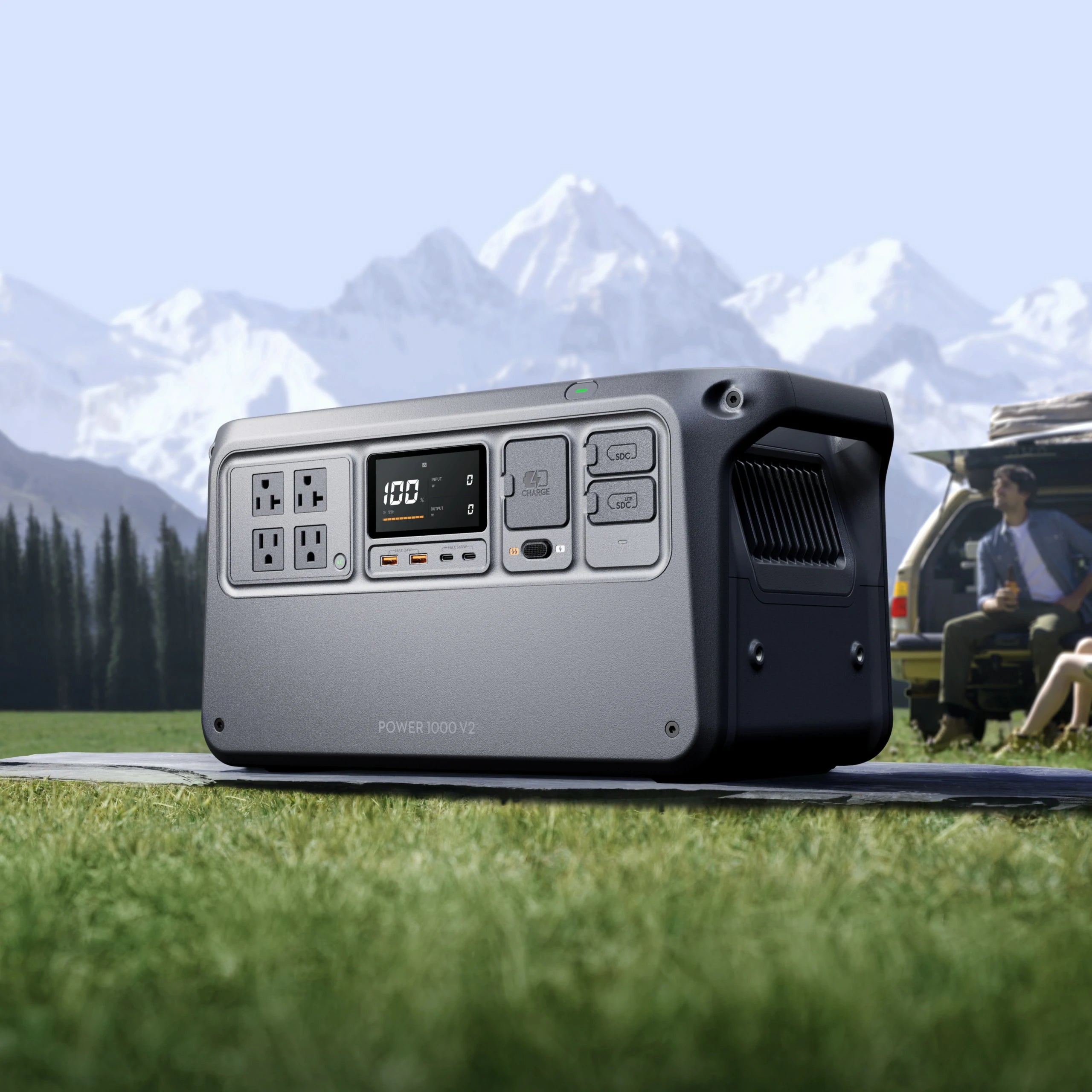
The Power 1000 V2's answer is that you can pick it up. 31.3 lbs is a suitcase you carry to the gate; 53.4 lbs is two hands, bent knees and a decision about stairs, and one tester griped about fumbling with a 50-plus-pound box in the dark because there's no light on itA3. If this unit's life is trunk to tailgate, that argument wins. If it's a basement running a fridge through a storm, it doesn't.
What the Numbers Reveal
Each conclusion stated first — the numbers behind it on one line, the full analysis below.
rated cycles
Multiply by the rated life and the gap widens instead of closing. Six thousand cycles of 2,073.6Wh is roughly 12,442 kWh through the Elite against 4,096 kWh through the DJI, which prices them at seven cents and seventeen cents per lifetime kilowatt-hour. The cheaper unit is the expensive battery.
Elite 200 V2: $899 for 2,073.6Wh, rated 6,000 cyclesPower 1000 V2: $699 for 1,024Wh, rated 4,000 cyclesBoth units run the same 2,600W inverter
Why it mattersIf price is the axis you're actually deciding on, price picks the Elite.
That turns a spec comparison into a shopping list. Refilling the Elite from the sun costs panels. Refilling the DJI from the sun costs panels plus an adapter one tester found hard to justify against the price of the panels themselvesB6. For an off-grid stretch, the figure that matters isn't input watts, it's how much you have to buy before the first watt arrives.
Elite 200 V2 accepts 1,000W of solar input through the unit itselfDJI ships no built-in solar charge controller on the Power 1000 V2, so solar runs through a separate proprietary adapterOne tester put that adapter at $329 and measured 600W through it, with panels bringing the pairing close to $1,000B6
Why it mattersPrice the whole solar path before you compare these two, because only one of them is finished out of the box.
Capacity
The expansion also competes with everything else you might add, because it takes one of only two SDC ports, the same ports the solar adapter wants. One tester noted that filling both leaves nowhere to hang the 12-volt cigarette outletB7. The Elite answers those questions with sockets already bolted to the case: four AC, a 12V car socket, a 30A RV outlet.
Power 1000 V2 takes DJI expansion batteries and starts at 1,024Wh; the Elite 200 V2 is sealed at 2,073.6WhThe Power 1000 V2 has two SDC ports, shared between an expansion battery and the solar adapterB7Elite 200 V2 carries four AC outlets, a 12V car socket and a 30A RV outlet on the case; the Power 1000 V2 has two AC outlets
Why it mattersBuy the DJI for expandability only if you're confident you'll pass 2,074Wh, because below that line you're paying to add what the Elite ships with.
What has been measured is the other kind of quiet: standby. The Elite sits at 9.5W doing nothingA5 while the DJI sits near 18W, which is its whole smaller battery in two and a half daysB8. On actual sound, testers consistently describe the DJI as near-silent, one of them noticing the fans by a faint warm plasticky smell before hearing themB1B2. So the DJI is probably the quieter machine and definitely the thirstier one at rest.
CPAP Overnight needs about 320Wh, which is 18% of the Elite 200 V2 and 37% of the Power 1000 V2 after the flat 15% conversion allowanceElite 200 V2 publishes 16dB as a best-case spec-sheet figure; DJI publishes no noise figure for the Power 1000 V2Measured standby draw: about 9.5W on the Elite, the lowest one lab had recorded at this sizeA5, against about 18W on the DJI, enough to flatten it in roughly two and a half days untouchedB8
Why it mattersIf it lives plugged in next to a bed, the DJI is the better noise bet; if it waits in a closet for the next outage, the Elite is the one still full when you need it.
The specific dimensions that decide these two units — everything else is a tie.
Your Life, Your Pick
Selected because: The Elite takes three of the six load profiles outright, both cover the CPAP night, and neither covers the two biggest. The usable-Wh gap, 1,763 against 870, is doing all of it.
The DJI clears every light row on this page and then falls off a cliff. A CPAP night uses 37% of it and game day 77%, but the eight-hour blackout is a 775Wh miss and the remote workday a 40Wh one, and those two failures are nothing alike. The first is the wrong size of unit. The second is a rounding error you could manage around, since its 1,024Wh nameplate clears the 910Wh day and only the conversion allowance tips it under.
Watch what the Elite's wins actually cost, though. It finishes the blackout with 118Wh in hand, a margin measured in one more hour of a lamp and a modem rather than in comfort, and on the two biggest lists it misses too: 2,922Wh short of a van-life day, 337Wh short of a weekend camp. There's also one card the DJI holds here and never gets to play, a published 4,400W peak against the Elite's 3,900W, when the heaviest startup in these six profiles draws 400W. This is a pair of units for a night or a day, not a week.
Lifetime Value
Selected because: The same conclusion from two directions: 6,000 rated cycles against 4,000, and seven cents a lifetime kilowatt-hour against seventeen.
cost / lifetime kWh
The sticker is the only place the DJI is cheaper. Two hundred dollars more buys about 1,050Wh more battery, which works out to less per watt-hour than either unit charges across its whole pack, so you get a volume discount for spending more.
Then the cycle rating compounds it. Seven cents a lifetime kilowatt-hour against seventeen is the figure to carry off this page: whatever the DJI saves you at checkout, it charges back every time you refill it. Decide on money and the $699 unit is the expensive one.
Portability & Form Factor
Selected because: The DJI weighs 31.3 lbs against the Elite's 53.4, and this is the one line on the page where it wins without an argument.
weight
Twenty-two pounds is the DJI's entire case, and it's a better case than the number looks. The Elite is a two-person-optional, definitely-not-on-stairs lift; the DJI is a grab-it-and-go. Where it gets undercut is the handles, which sit on the sides, and one tester found that makes even 31 lbs feel unbalanced in one handB11. Light, then, rather than weightless: both are a one-person carry, but only one is a one-arm carry.
Growth Path
Selected because: The DJI's first expansion battery mostly buys back capacity the Elite ships with, because it starts at 1,024Wh against 2,073.6Wh.
solar input
Expandability reads like a trump card and behaves like a catch-up mechanism here. The DJI starts at 1,024Wh, half the Elite's 2,073.6Wh, so the first battery you bolt on is largely buying back what the sealed unit already included, and it goes into one of only two SDC ports, the same ones the solar adapter needsB7. Past 2,074Wh the DJI is the only one of the two that can follow you, which is a real advantage for anyone who knows they're headed there. Short of that, you're paying for the option to reach a number you could have bought outright.
Brand Trust
Selected because: One of these brands has the widest catalogue in the category and the most inconsistent support in it; the other has a global repair network and one year of power-station history.
The two risks here aren't the same shape. BLUETTI's is service: the broadest catalogue in the category attached to the most inconsistent support in it, with the longer warranty term conditional on buying direct and registering, so do both. DJI's is history: a repair network with genuine credibility from the drone business, one year of power stations inside it, and no warranty term on record for this unit at all, which means trusting a reputation rather than a document. Neither risk overturns a two-to-one capacity gap. Both are arguments for buying direct and working the unit hard while you can still send it back.
Strengths & trade-offs
BLUETTI Elite 200 V2
Strengths
- +Larger battery capacity
- +Rated for 6,000 charge cycles — much longer battery lifespan
Trade-offs
- –Significantly heavier (+22.1 lbs), making it harder to move.
DJI Power 1000 V2
Strengths
- +Costs $200 less
- +Lighter by 22.1 lb
- +Faster solar charging
Trade-offs
- –Shorter-lived battery — rated for 4,000 charge cycles vs the Elite 200 V2's 6,000, so it wears out sooner.
Will It Power Your Gear?
Scenario math and per-appliance runtimes, modeled from the spec record.
Scenario verdicts
We ran the math on six real-world scenarios. Here's which unit survives your actual life.
SCN-01 · 2 nights · needs 2,100Wh
Weekend Camping
Two nights off-grid with essential comfort
Neither unit
Neither unit finishes this list. The Elite covers about 84% of the 2,100Wh, 337Wh short, which is trimmable if you'll drop one item. The DJI covers 41%, which isn't a trim, it's a different trip. Read the row as partial cover on both sides: enough for the essentials on the list, not the whole list, and no reason by itself to pick either box.
Battery budget usedlower = more headroom
LOAD Phone Charger 15W×6h · LED Lights 40W×8h · Box Fan 75W×14h · CPAP Machine 40W×16h
SCN-02 · 8 hours · needs 1,645Wh
8-Hour Blackout
Keep the essentials running through a night without power
Elite 200 V2
The DJI covers about 53% of this night and then the fridge is on its own, 870Wh usable against the 1,645Wh the profile asks for, 775Wh short. The Elite finishes with 118Wh left, which isn't a comfortable margin either; it's roughly one more hour of a lamp and a modem. Both switch to battery in no worse than 10ms, so the lights never flicker on either. Only one of them is still working at hour eight.
Battery budget usedlower = more headroom
LOAD Fridge 150W×8h · Router + Modem 20W×8h · LED Lights (4 bulbs) 40W×6h · Phone Charger 15W×3h
SCN-03 · 8 hours · needs 320Wh
CPAP Overnight
Sleep therapy without interruption — the #1 medical use case
Either unit
A CPAP is about 40W for eight hours, so this is 320Wh and both sleep through it without noticing, 18% of the Elite and 37% of the DJI. Capacity isn't the spec that matters here; the fan eighteen inches from your head is. The Elite's 16dB is a best-case sheet figure and DJI publishes nothing at all for this model, so no number on the table settles it. Decide on weight, price, and a return window you'd actually use.
Battery budget usedlower = more headroom
LOAD CPAP Machine 40W×8h
SCN-04 · 8 hours · needs 910Wh
Remote Workday
Full work day off-grid without power anxiety
Elite 200 V2
The DJI misses this by 40Wh, which is almost funny: its 1,024Wh nameplate clears the 910Wh day outright, and the flat 15% conversion allowance we apply to every unit is what tips it under. Skip one small appliance and it finishes. You'd be running that arithmetic every morning, though, and the Elite ends the same day with 853Wh untouched.
Battery budget usedlower = more headroom
LOAD Laptop 60W×8h · External Monitor 30W×8h · Router + Modem 20W×8h · Phone Charger 15W×2h
SCN-05 · 4 hours · needs 670Wh
Tailgate Party
Game day power for the crew
Elite 200 V2
Both run game day without thinking about it, and the Elite holds more back, 38% used against 77%. That's reserve, not experience. The load here is light and the number your arms register is 31.3 lbs from the trunk against 53.4. If tailgating is genuinely the whole use case, this is the row where the lighter unit loses on paper and wins in the parking lot.
Battery budget usedlower = more headroom
LOAD Blender 400W×0.5h · LED TV (55") 80W×4h · Bluetooth Speaker 15W×4h · Phone Charger (×3) 45W×2h
SCN-06 · 24 hours · needs 4,685Wh
Van Life Daily
A full day of mobile living — the ultimate endurance test
Neither unit
Neither unit covers this scenario's 4,685Wh: the Elite 200 V2 comes up 2,922Wh short (about 38% covered), the Power 1000 V2 3,815Wh (19%). This is well outside what either unit is for; the right answer here is a larger station, not a choice between these two.
Battery budget usedlower = more headroom
LOAD Mini-Fridge 150W×24h · Laptop 60W×4h · Phone Charger 15W×3h · LED Lights 40W×5h · Fan 75W×8h
The Load Test
RUNTIME = (Wh × 0.85) ÷ LOAD
None of the scenarios above exactly yours? Build it. Toggle what you'd plug in; both units are tested against the combined draw.
Essentials
Comfort & Convenience
High-Draw Appliances
Test duration
8h
Continuous draw
205W
Projected runtime
For this load: Elite 200 V2 runs 8.6h vs 4.2h.
$899 list · direct from BLUETTI
Planning for more than this? Describe your whole setup and get it sized →
Modeled from the spec record — same math as the tables below. Methodology
Runtime by appliance
Real-world runtime estimates for common appliances, modeled at 85% inverter efficiency.¹
Essentials
The basics you need runningscale 0–117.5hComfort & Convenience
Makes off-grid life actually enjoyablescale 0–23.5hHigh-Draw Appliances
These reveal the real limitsscale 0–1.8h¹ Runtime = (capacity × 0.85) ÷ appliance watts. Within each group, all bars share one time scale (the group's longest runtime), so lengths are comparable across appliances; identical runtimes collapse into a single blue/orange bar. Actual runtime varies with battery age, temperature, and simultaneous loads — see methodology.
Conclusion
September 13, 2026
Verdict: the BLUETTI Elite 200 V2
Take the Elite 200 V2. It doubles the battery for $200, runs the same 2,600W inverter, and covers both loads the DJI can't finish: the eight-hour blackout and the remote workday. Over the rated life it moves roughly three times the energy, at seven cents a lifetime kilowatt-hour against seventeen. Two things argue against it and neither moves the verdict. It's sealed at 2,073.6Wh, and it weighs 53.4 lbs. If one of those is the thing you actually care about, because you know your needs will pass 2,074Wh or because you'll be carrying this several times a week, then the DJI is the right buy and the $200 stays in your pocket.
Editor-assigned confidence, based on cited owner research and spec analysis.
List prices as of September 13, 2026. The links below open BLUETTI's and DJI's current prices.
$899.00 · direct from BLUETTI
Last checked 16 days ago. Prices move — check before you buy.
or check the Power 1000 V2 price$699.00 list
Written by Ian Schneider, Solar & Off-Grid Tester · Station Arena Test Desk · Updated September 13, 2026
Black Friday · 38 days out
Prices to beat:Elite 200 V2 $849Power 1000 V2 $699
The lowest we have recorded for each. We have never seen the Power 1000 V2 discounted, so any real cut on it would be a first.
Measured Data
Benchmark scores and the full spec record, side by side.
Benchmark scores
Not rated for both units (minimum threshold unmet): Camping.
Full specifications
ᵈ Derived: price ÷ rated capacity. See the data behind our comparisons →
Comparison ToolAdd more power stations, side by sideOpen Tool →How these numbers are produced
Numeric verification
Every figure on this page traces to our spec database or arithmetic on it — no estimated numbers.
Owner claims
Statements about owner experience are cited to published reviews — see Sources & Research Notes below.
Runtime model
Runtime = (rated capacity × 0.85 inverter efficiency) ÷ device wattage. Solar recharge estimates assume panels deliver 70% of rated output. Cold weather, battery age, and stacked loads reduce real-world results.
Power Score
Computed from 14 published spec dimensions, weighted per use-case bench. Higher is better; a unit must meet a bench's minimum threshold to be rated.
See the full weight table and data sourcing on our methodology page →Class ranking (the star rating)
Each unit's star score is a category ranking, not customer reviews — no buyer opinions feed it. We score every station on size-independent quality (value, output, portability, endurance, ports, warranty, and more), then percentile-rank it against the other units in its capacity class, so a class-leading compact unit and a class-leading whole-home unit can both earn 5★. Here, Elite 200 V2 rates 4.5/5 (68th percentile of 26 Large-class units), and Power 1000 V2 rates 4.9/5 (92nd percentile of 27 Everyday-class units).
How the class ranking is computed →Test Notes & Caveats
Hidden gotchas and advantages we spotted that you won't find on the product page.
The Elite 200 V2 can't grow
What you buy is the ceiling. The Elite is sealed at 2,073.6Wh with no expansion port, so the day your needs pass that figure, your upgrade is a second unit. The DJI can take expansion batteries, which sounds like the answer until you see where it starts: 1,024Wh, so the first battery you add is largely spent reaching the capacity the Elite ships with. Expansion only pulls ahead past 2,074Wh. If you know you're headed there, that's the one reason on this page to pause.
Elite 200 V2: Power Lifting to 3,900W
The Elite 200 V2 has BLUETTI's Power Lifting mode, which runs a resistive appliance rated up to 3,900W from its 2,600W inverter. It does that by delivering less power than the appliance asks for, not more than the inverter has: the heater still works, it just heats more slowly. Two things follow. BLUETTI scopes the mode to purely resistive loads — a heater, a kettle, an incandescent lamp — so it does nothing for a fridge compressor, a pump or a power tool, and this record publishes no surge figure at all, so read the mode as a resistive-load feature rather than as starting ability. And it is not a reason to size down, because running a load that big from 2,074Wh is a short session either way. Genuinely useful if a heater or a kettle is why you're buying; beside the point otherwise. The Power 1000 V2 publishes no equivalent.
Warranty: No Difference
Both units carry the same 5-year warranty, so coverage isn't a tiebreaker here. Both figures are maximums rather than guarantees: BLUETTI's depends on buying direct from BLUETTI or registering the unit, since reseller purchases carry a shorter term; DJI's on buying from DJI's own store, which is where the full five years is advertised. Worth saying because the per-dollar framing can suggest otherwise: the Power 1000 V2 works out at 7.2 years of cover per $1,000 spent against the Elite 200 V2's 5.6, but that spread is the price gap, not the terms.
What 6,000 cycles buys, and what it doesn't
Rated cycles aren't rated years, and the trap is comparing the counts across two different battery sizes. A cycle on the Elite moves 2,073.6Wh and a cycle on the DJI moves 1,024Wh, so 6,000 against 4,000 understates the distance. Count energy instead: roughly 12,442 kWh through one over its rated life against 4,096 kWh through the other. And nothing dies at the cycle limit. The pack steps down to about 80% of original capacity and keeps working, which is why the rating is a milestone rather than an expiry date.
The Power 1000 V2 doesn't publish a noise figure
There's no decibel number for this model, and the ones in circulation belong to other units in DJI's line. Don't lend them to this one. The absence isn't evidence it's loud; it means there's nothing to hold DJI to. And the figure on the other side isn't a measurement either, because the Elite's 16dB is a spec-sheet best case under a light load rather than what you'll hear while it fast-charges. For a bedroom, treat the noise question as open on both sides and buy where you can send it back.
Full record above — the Test Desk pick is the Elite 200 V2.
Check Elite 200 V2 price →or check the Power 1000 V2 priceOwnership Analysis
What happens after you buy — true cost of ownership, brand trust, and growth potential.
Lifetime value
Service lifeyears at one full cycle per day
Lifetime energy delivered
Cost per delivered kWh
│ warranty ends · Reaching the cycle rating means ~80% capacity remains — degraded, not dead.
Analyst note
The Power 1000 V2 is cheaper to buy, but the Elite 200 V2 is cheaper to own. At $0.07/kWh over its lifetime vs $0.17/kWh, the Elite 200 V2's higher cycle life and capacity make each dollar go further over the years.
Delivers each lifetime kWh for $0.10 less — check the Elite 200 V2 price →
Brand trust
BLUETTI
Ecosystem
One of the broadest lineups — 15-20+ models from budget (AC2A) to flagship portable (Apex 300, 2764.8Wh). Includes specialized products: vehicle solar hubs, sodium-ion cold-weather units, and balcony storage systems.
Support
This is the risk you're accepting. BLUETTI runs the most inconsistent support in the category: email-first, on China time, with outcomes that range from quick and clean to weeks of runaround and offers of a discount on a new unit in place of a repair. Buying direct rather than through a reseller improves how that tends to go, and it's also what unlocks the full term, up to five years registered and direct against two through a reseller.
Community
Active and growing — Reddit r/bluetti has a dedicated community. Second-largest after EcoFlow in engagement.
App experience
Rated 4.5/5 iOS and Android — tied for best app experience in the category. V3.0 UI redesign was well-received.
Unique strength
Some of the best capacity per dollar in the catalogue, in a lineup broad enough to include sodium-ion cold-weather units and dual solar-plus-alternator vehicle hubs. Cycle life is a per-model check rather than a per-range one: it spans 2,500 on the small units to 6,000, and it varies inside the Elite range itself instead of tracking it, so read it off the model you're buying.
Worth knowing
Older and discontinued units can become unrepairable, since there's no spare-parts policy covering some models. That matters more than it sounds on a page like this one: a 6,000-cycle battery can outlive the support that services it.
DJI
Ecosystem
Five power stations since 2024, and the naming is a trap. The original Power 1000 is still sold alongside the V2 and they aren't the same unit. Expansion batteries fit the V2 and the Power 2000, not the earlier Power 1000 or the Power 500. Check which revision a listing actually ships before you click buy.
Support
The repair network is real and inherited from the drone business, with global service centres and a good reputation behind them. What's short is the power-station track record inside that network, and there's no warranty term on record for this unit, so you're trusting the company's history rather than a published commitment.
Community
There's no power-station community to search yet. Questions land in a drone forum of a quarter-million people who mostly don't own one of these, so there isn't much accumulated chatter to check a hunch against before you buy.
App experience
Rated 3.5/5 iOS and Android (DJI Home app ratings reflect entire DJI ecosystem including drones/cameras, not power-station-specific). Users report the on-device screen is more reliable than the app.
Unique strength
Runs quiet — 23-30dB published on most of the range (manufacturer best-case figures), at the quiet end of the category; our record carries no figure for the Power 1000 V2. Fast wall charging, quickest on the Power 1000 V2 at ~56 min — that figure is the V2's, not the whole line's. 700+ battery patents from drone R&D. SDC ports for ultra-fast DJI drone charging. Premium industrial design and build quality. LFP batteries rated for 4,000+ cycles.
Worth knowing
Solar has no controller in the box and runs through a separate proprietary adapter. The SDC ports that make DJI-to-DJI charging so fast are proprietary too, so that speed mostly pays off for people who already own DJI gear.
Analyst note
You're choosing between a company with the best capacity per dollar in the category and the worst support reputation in it, and a company with a decade of hardware credibility and one year of power-station history. Neither of those overturns the specs. Both are reasons to buy direct, register the unit, and lean on it hard before the return window closes.
Growth path
Elite 200 V2
FIXED CAPACITYFixed at 2,074Wh — a sealed, complete system rather than a starting point. There's no expansion port, so that figure is the ceiling: check it against your longest unplugged stretch before you buy.
Accepts up to 1,000W of solar. Enough for a serious multi-panel array.
Adequate ports for most setups, but heavy users may want a power strip.
Power 1000 V2
EXPANDABLESupports DJI expansion batteries, so you can add capacity later without replacing the base unit — useful if your needs may climb past 1,024Wh.
Accepts up to 1,200W of solar. Enough for a serious multi-panel array.
Adequate ports for most setups, but heavy users may want a power strip.
Expansion batteries are DJI-specific. You're investing in the DJI ecosystem.
Realistic full solar rechargeat 70% of rated panel output — see methodology
Analyst note
Don't read the Power 1000 V2's expandability as a straight win here: it starts at 1,024Wh, below the Elite 200 V2's 2,074Wh, so a first expansion battery largely buys back capacity the Elite 200 V2 already includes. It only pulls ahead if you'd grow past 2,074Wh — short of that, the Elite 200 V2's larger fixed capacity is the simpler value.
What Owners Report
Patterns from published owner reports and long-term reviews — every claim cited to its source below.
BLUETTI Elite 200 V2
The Elite 200 V2's field record is short and comes from reviewers rather than long-term owners, because the V2 is recent and nobody has lived with one for years yetA0. What exists is unusually well measured. One lab recorded 94% efficiency, the highest it had logged in a portable stationA6, and a 9.5W standby draw, the lowest it had seen at this sizeA5, then pushed the unit past its 2,600W inverter rating and held a 3,000W surge for over two minutesA7. A home-lab tester ran an entire outage on it without losing a machineA8, and a van build used it as a weekly energy bank to cover the days the panels weren't producingA1.
The complaints are small and repeat. There's no built-in light, which one tester discovered while wrestling a 50-plus-pound box in the darkA3, and the app and surrounding ecosystem lag behind what Anker and EcoFlow shipA4. The recurring summary is that it's practical rather than flashy, and strong value at its US price if less so converted abroadA10A11.
“It bridged the solar gap when panels weren't producing, effectively acting as a weekly "energy bank" I could fill up and live off.”
Sources
thevanconversion.com · thesolarlab.com · storagereview.com · dustinabbott.net · nsmb.com
DJI Power 1000 V2
The Power 1000 V2's reports come from professional testers rather than owner forums, because no Reddit thread specific to the V2 surfaced, so read them as expert bench notes rather than crowd sentimentB0. The consistent finding is quiet: one reviewer couldn't hear the fan even at full-speed charging around 1,400WB1, and another said the giveaway was a faint warm plasticky smell rather than any noise, with the app confirming internal temperatures stayed normalB2. Build quality gets the same treatment, described as premium enough to leave out in an officeB3.
The friction is all in the accessories. Solar needs a proprietary $329 adapter that one tester measured at 600W, with panels taking the pairing close to $1,000B6, and the two SDC ports that adapter and any expansion battery share leave nothing over for extras like the 12-volt outletB7. The AC charging cable is a non-standard C19 that most people won't have a spare ofB5, standby draw measured about 18W, enough to flatten the pack in roughly two and a half days sitting untouchedB8, and the side-mounted handles make a 31 lb one-handed carry feel unbalancedB11. The compensation is the wall charge: empty to full in 56 minutesB4.
“The fan barely makes a sound even during full-speed charging around 1,400-1,450W — one of the quietest power stations in its class, nearly silent under normal loads.”
Sources & Research Notes
Every owner claim in this report is traceable to a published source. The bracketed references above resolve here.
Recurring owner themes
- Multiple independent reviewers report the near-instant UPS switchover works reliably for continuous device uptime during outages. [Elite 200 V2 · 2 entries]
- Reviewers who measured it independently found best-in-class efficiency and very low idle power draw for a unit of this size. [Elite 200 V2 · 2 entries]
- Owners/testers praise real-world off-grid runtime — charging e-bikes, running fridges, powering laptops/appliances for extended periods. [Elite 200 V2 · 3 entries]
- The two consistent nitpicks are the missing built-in light/flashlight and an app/ecosystem experience that lags behind Anker and EcoFlow. [Elite 200 V2 · 2 entries]
- Value proposition is repeatedly framed as 'practical rather than flashy' — strong price-to-spec ratio, though less competitive outside the US market. [Elite 200 V2 · 2 entries]
- Quiet operation is the standout, consistently praised across independent reviewers, though a couple of testers separately noticed a faint smell when the fans do spin up. [Power 1000 V2 · 2 entries]
- Charging is dramatically faster than the original Power 1000, but real-world charging setups bring their own friction: a non-standard AC cable and, for solar, an expensive proprietary adapter with limited throughput. [Power 1000 V2 · 3 entries]
- The two shared SDC expansion ports are a recurring bottleneck — using them for an expansion battery or solar accessory can leave no capacity for other add-ons. [Power 1000 V2 · 2 entries]
- UPS switchover speed and overall build quality are the two things independent reviewers most directly credit as concrete improvements over the original Power 1000. [Power 1000 V2 · 2 entries]
- A1
“It bridged the solar gap when panels weren't producing, effectively acting as a weekly "energy bank" I could fill up and live off.”
thevanconversion.com — BLUETTI Elite 200 V2 In-Depth Review: The Best Portable Power Station for Vanlife? · 2026-04 · [positive]
- A3
“For a 50+ pound unit that requires two hands to carry, it's frustrating to fumble around in the dark with a flashlight and heavy power station.”
thesolarlab.com — Bluetti Elite 200 V2 Review: A Solid Comeback? · unknown · [negative]
- A4
“It still lacks the refinement and ecosystem support that we've recently seen from EcoFlow and Anker, and the app experience could definitely be improved.”
thesolarlab.com — Bluetti Elite 200 V2 Review: A Solid Comeback? · unknown · [negative]
- A5
“Even the idle power draw was impressive, coming in at just 9.5W per hour, which is also the lowest we've seen on a unit this size.”
thesolarlab.com — Bluetti Elite 200 V2 Review: A Solid Comeback? · unknown · [positive]
- A6
“The efficiency came in at 94%, which is the highest we've ever seen in a portable power station.”
thesolarlab.com — Bluetti Elite 200 V2 Review: A Solid Comeback? · unknown · [positive]
- A7
“Even when we pushed the thing beyond its inverter's 2,600W limit, it was able to sustain a 3,000W surge for over 2 minutes.”
thesolarlab.com — Bluetti Elite 200 V2 Review: A Solid Comeback? · unknown · [positive]
- A8
“The BLUETTI Elite 200 V2 kept everything operational throughout the entire outage. It's not merely a backup solution; it provides true resilience to the home lab.”
storagereview.com — Portable Power Meets Lab-Grade Reliability: BLUETTI Elite 200 V2 Review · 2025-04 · [positive]
- A10
“The Elite 200 V2 isn't sexy…but it sure is practical! It's the most powerful portable unit I've tested.”
dustinabbott.net — Bluetti Elite 200 V2 Portable Power Station Review · 2025-03 · [positive]
- A11
“Strong value at $899 USD | 1599 CDN not as competitive.”
dustinabbott.net — Bluetti Elite 200 V2 Portable Power Station Review · 2025-03 · [mixed]
- B1
“The fan barely makes a sound even during full-speed charging around 1,400-1,450W — one of the quietest power stations in its class, nearly silent under normal loads.”
DroneXL / Haye Kesteloo (Medium mirror) — DJI Power 1000 V2 Review: 2,600W Output In A Package That Won't Wake The Neighbors · 2026-01 · [positive]
- B2
“It's easier to notice when the fans are on by a faint, warm, plasticky smell rather than by sound; a separate reviewer likewise noted an unusual electronics smell on first use but confirmed via the app that internal temperature stayed normal.”
T3 — I tested the DJI Power 1000 v2, and it's the best power station upgrade you shouldn't ignore (month-long test) / corroborated by Android Authority — DJI Power 1000 V2 review · 2026 · [mixed]
- B3
“DJI gear tends to feel really premium — nothing feels cheap or fragile, and it wouldn't look out of place in an office or studio.”
T3 — I tested the DJI Power 1000 v2, and it's the best power station upgrade you shouldn't ignore · 2026 · [positive]
- B4
“Can be recharged from empty to full in 56 minutes — your lunch break, or maybe while cooking dinner.”
GadgetGuy (Australia) — DJI Power 1000 V2 power station review · 2026 · [positive]
- B5
“The non-standard C19 AC charging cable is just asking to get lost, since most people won't have a spare on hand the way they would for a common C13 cable.”
Android Authority — DJI Power 1000 V2 review: Mobile power for drone lovers and more · 2026 · [negative]
- B6
“Solar charging is where things get a little odd: the $329 adapter only allows 600W of solar input despite '1.8kW' branding on the box; pairing solar panels with the adapter runs close to $1,000, which is extremely difficult to justify.”
TheSolarLab — DJI Power 1000 V2 Review: A Quieter, Faster Upgrade? · 2026 · [negative]
- B7
“You only get two SDC expansion ports, and if both are occupied (e.g. an expansion battery plus an MPPT solar accessory) that leaves no spare socket for something like the 12-volt cigarette outlet — described as really odd and potentially annoying in real-world use.”
TheSolarLab — DJI Power 1000 V2 Review: A Quieter, Faster Upgrade? · 2026 · [negative]
- B8
“Idle/standby consumption was measured at roughly 18 watts in testing, enough to drain the battery in about two and a half days if left connected with nothing else drawing power.”
TheSolarLab — DJI Power 1000 V2 Review: A Quieter, Faster Upgrade? · 2026 · [mixed]
- B11
“Side-positioned handles make one-handed carrying feel very unbalanced at just over 31 lbs.”
Android Authority — DJI Power 1000 V2 review: Mobile power for drone lovers and more · 2026 · [negative]
Research compiled September 13, 2026.
Who Should Buy Which
Buy the Elite 200 V2 if you…
- →You want the box in the basement that carries the fridge and the modem through an eight-hour outage and still has something left at sunrise.
- →You're going to plug in panels. The Elite's 1,000W of solar goes into a port that's already on the unit, with no adapter to buy, lose or justify.
- →You need more than two AC outlets, or a 12V car socket, or the 30A RV plug. All three are on the case.
- →It will mostly live in one place. In a basement, a closet or a van that doesn't shift it daily, 53.4 lbs stops being a spec and starts being furniture.
Buy the Power 1000 V2 if you…
- →You'll be lifting this constantly: out of a trunk, over a tailgate, down a dock. 31.3 lbs is a one-arm job and 53.4 isn't.
- →Your loads are small and your recharge window is short. A workday of laptops and camera batteries, then an hour at a wall outlet gets you back to fullB4.
- →You already own DJI gear and want the SDC fast-charge path for drone batteries, which is the one advantage here that no spec on the Elite touches.
- →You want to run a laptop off a single cable at 140W, where the Elite's USB-C tops out at 100W.
If neither fits
If your day looks like the van-life profile, 4,685Wh, neither of these is the answer: the Elite covers about 38% of it and the DJI 19%, so what you want is a larger station or a wired house battery, not the better of these two. The same goes if you're planning a weekend camp off a 2,100Wh list and aren't willing to trim it, because the Elite gets to roughly 84% of that, which covers the essentials on the list and not the list.
The Bottom Line
Take the Elite 200 V2. Two hundred dollars is the whole of the DJI's argument, and what it buys you is the smaller battery, the shorter rated life and the more expensive kilowatt-hour, about three times over by the time both packs reach their rated end. The cheaper box is the expensive battery, and no port, app or adapter on this page closes that.
The DJI keeps one card and it's a good one: you can carry it with one hand. If this unit is going to spend its life being lifted, trunk to tailgate, dock to boat, site to site, then the weight is worth more to you than anything else we've compared and you should buy it without a second thought. Everyone else is buying a battery, and the Elite is the better battery. Go get the Elite.
Frequently Asked Questions
Answers drawn from the spec record and cited owner research.
Is the DJI Power 1000 V2 quieter than the BLUETTI Elite 200 V2?
Nobody can answer that from the spec sheets. The Elite publishes 16dB, which is a best-case sheet figure under a light load rather than a measurement, and DJI publishes no figure for this model, so the numbers you'll find quoted for the line belong to its other units. What field testing exists describes the DJI as near-silent even while charging hard. If bedroom quiet is your deciding factor, buy on those reports and a return window, not on the one number that happens to be printed.
Can the DJI Power 1000 V2 run a house through an 8-hour power outage?
Not the version of an outage we model. That profile needs 1,645Wh and the Power 1000 V2 has 870Wh usable after the flat 15% conversion allowance, so it stops about 775Wh short, a little past halfway. The Elite 200 V2 finishes it with 118Wh left. Both hand over to battery in no worse than 10ms, so neither will blink your router; only one is still working at hour eight.
Is the BLUETTI Elite 200 V2 worth $200 more than the DJI Power 1000 V2?
Yes, on capacity alone. The $200 buys about 1,050Wh more (2,073.6Wh against 1,024Wh), which is cheaper per watt-hour than anything else on either price tag. Add the cycle rating, 6,000 against 4,000, and the Elite delivers roughly 12,442 kWh over its rated life against 4,096 kWh, at seven cents a lifetime kilowatt-hour against seventeen. The DJI is the cheaper purchase and the more expensive battery.
Does the DJI Power 1000 V2 work with solar panels?
Yes, but not directly. There's no solar charge controller in the unit, so solar runs through a separate proprietary adapter, and one tester put that adapter at $329 with 600W measured through it, and panels taking the pairing close to $1,000. The Elite 200 V2 takes 1,000W of solar through a port it already has. That's the difference between buying panels and buying panels plus the thing that lets you use them.
Is the DJI Power 1000 V2's expandability better than the Elite 200 V2's fixed capacity?
Only past 2,074Wh. The DJI starts at 1,024Wh, so the first expansion battery is mostly spent catching up to where the Elite starts, and it occupies one of the two SDC ports that the solar adapter also needs. If you're confident you'll outgrow 2,074Wh, the DJI is the only one of the two that can follow you there. If you're not, you're paying for a route to a number you could have bought on day one.
Brand matchup
BLUETTI vs DJI: measured across every matchup →Where to buy

BLUETTI Elite 200 V2Pick
$899.00
$899.00 · direct from BLUETTI
Last checked 16 days ago. Prices move — check before you buy.
DJI Power 1000 V2
$699.00
$699.00 · direct from DJI
Last checked 16 days ago. Prices move — check before you buy.
Prices may vary by retailer and are subject to change.