Head-to-head test
BLUETTI Apex 300 vs Jackery Explorer 3000 v2
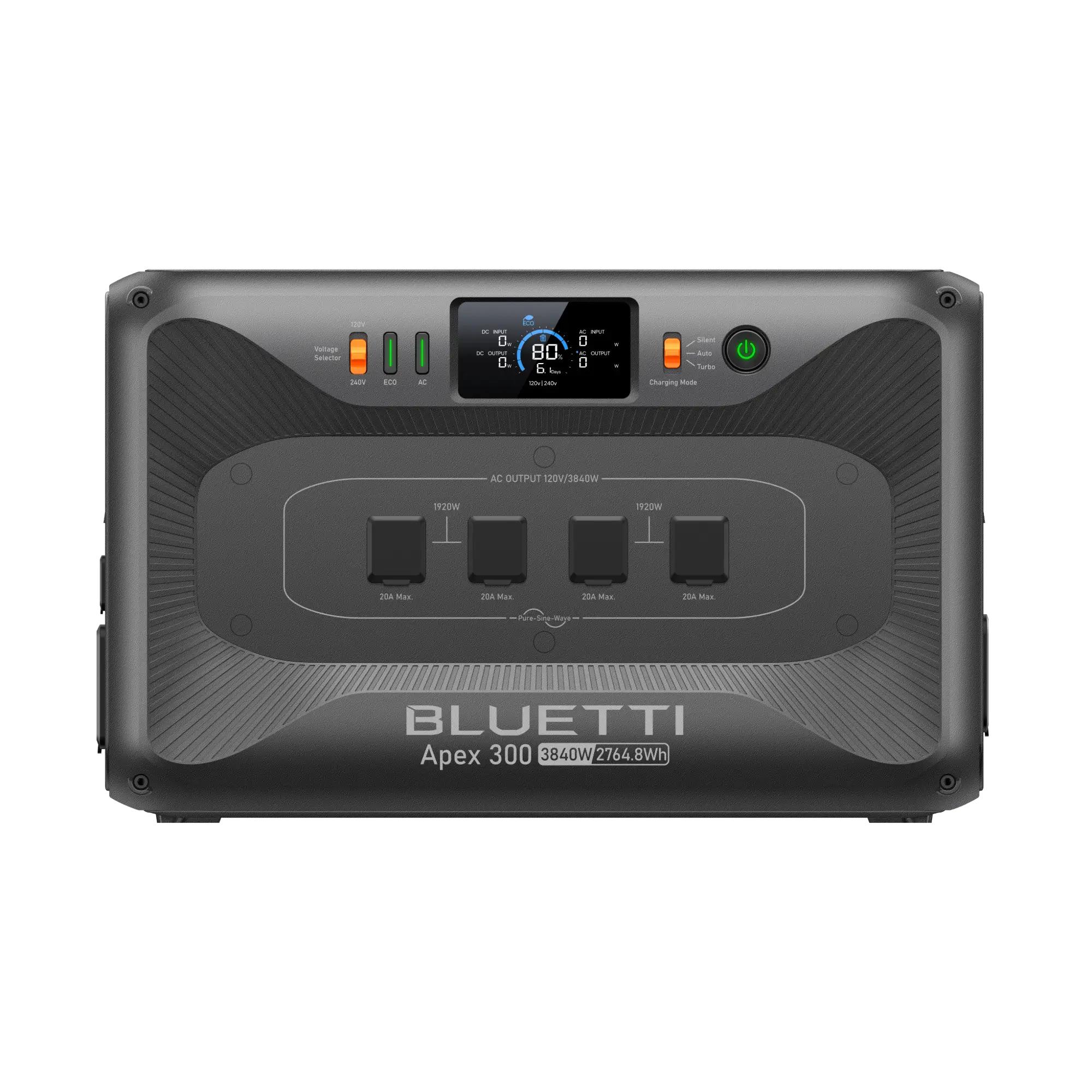
The Apex 300 is $700 cheaper, swallows 2.4 times the solar, and out-powers the Jackery on the spec sheet, but it weighs 83.78 pounds to the Jackery's 59.52, so this comes down to one question: how often does the box have to move?
Full profiles: BLUETTI Apex 300 → · Jackery Explorer 3000 v2 →

Written by Gunner GustafsonUpdated
Whole-Home Backup Tester, Station Arena Test Desk
Spec deltas
The BLUETTI Apex 300 undercuts the Jackery Explorer 3000 v2 by $700 and out-specs it almost everywhere that isn't the scale: $1,799 to $2,499, 3,840W of output to 3,600W, a 2,400W solar ceiling against 1,000W, and a 10ms UPS cutover to the Jackery's 20ms. On the spec sheet this looks like a rout.
Then you weigh them. The Apex is 83.78 pounds; the Jackery is 59.52. That's not a portability footnote — 24 pounds is the difference between a lift you brace for and one you don't. A reviewer said the Apex was so heavy they could hardly move it a few feet or lift it onto a tableA8; the Jackery's reviewer carried it from room to room without, in their words, a trip to the chiropractorB1.
So the matchup isn't really Apex versus Jackery on power. It's how often the unit leaves the spot you set it down. Sitting still, in home backup, an RV bay, or a job site, the Apex is more machine for $700 less and it's the pick. If it travels every weekend, those 24 pounds and a sore back tilt it to the Jackery, and you decide whether the Apex's specs are worth carrying the difference.
What the Numbers Reveal
Each conclusion stated first — the numbers behind it on one line, the full analysis below.
At 83.78 pounds it's a braced, two-hand lift before you've plugged anything in, and even sited, its face carries no DC or USB, so those arrive on an add-on hubA7A11. The Jackery gives you 59.52 pounds you move easily alone and its ports on the unit. For a box that lives in a utility closet none of that bites; for one that rides to a campsite, all of it does.
Apex 300 weighs 83.78 lb; Jackery weighs 59.52 lbA reviewer could hardly carry the Apex more than a few feet or lift it onto a tableA8The Apex's DC and USB ports live on a separate powered hub you bolt on after the factA7A11
Why it mattersIf the unit will ever be carried by one person, stop reading specs and take the Jackery.
solar input
That's the difference between topping up over lunch and giving away most of a solar day, and the Jackery makes it worse by locking you to its own DC8020 panels unless you buy an adapterB3B10, while the Apex takes standard panels at more than double the wattage. In a multi-day outage or an off-grid week, recharge speed is the survival spec, and it's lopsided.
Apex 300 accepts 2,400W of solar; Jackery accepts 1,000WApex capacity is 2,764.8Wh; Jackery is 3,072WhReviewers consistently flag the Jackery's proprietary DC8020 solar socket, which needs an adapter for third-party panelsB3B10
Why it mattersSolar-first and off-grid buyers get a genuinely faster, more flexible refill from the Apex, if they can site its weight.
Capacity
So the Apex's first expansion battery is spent catching up to a capacity the Jackery already ships with. Expandability only turns into a real lead once you climb past 3,072Wh; below that, you're paying to add a port that buys back ground the Jackery never gave up. If your needs top out near 3kWh, the sealed Jackery is the simpler version of the same thing.
The Apex 300 is expandable; the Jackery is sealed at 3,072WhThe Apex's own base capacity is 2,764.8Wh, which is 307Wh below the Jackery's
Why it mattersOnly buyers who know they'll grow past 3,072Wh should price the Apex's expansion as a win; everyone else can ignore it.
The specific dimensions that decide these two units — everything else is a tie.
Portability & Form Factor
Selected because: 83.78 lb vs 59.52 lb is a 24-lb gap and the main decision axis on this page.
weight
This is where most of the matchup lives. 83.78 pounds against 59.52 is a 24-pound gap, and on a unit with no wheels it lands entirely in your hands and back. The Apex ships with handles and a splittable batteryA6, which reviewers say is what makes it manageable, though one still couldn't lift it onto a tableA8. The Jackery you carry in one trip. If your use case has stairs, a tailgate, or a trunk in it, weigh those 24 pounds against every other Apex advantage.
PowerScore Breakdown
Selected because: 4,936 vs 4,507 undersells the Apex's output/surge/solar dominance for $700 less.
overall power score
Our PowerScore puts the Apex at 4,936 to the Jackery's 4,507, and for once the composite undersells the winner. The Apex carries more output (3,840W vs 3,600W), a bigger surge (7,680W vs 7,200W), more than double the solar input, and a faster UPS cutover, and it does all of it for $700 less. The Jackery's honest answers are a slightly larger battery (3,072Wh vs 2,764.8Wh) and a higher cycle rating (4,000 vs 3,500). Those are real, but they're a capacity-and-longevity edge, not a power one, and the Apex's expansion port erases the capacity gap for anyone willing to add a battery.
Lifetime Value
Selected because: cheaperToOwn is p1 but only by a penny ($0.19 vs $0.20) — the Jackery's cycles/capacity nearly close its price gap; surface that honestly.
The cheaper unit to buy is also, just barely, the cheaper unit to own: $0.19 per lifetime kilowatt-hour on the Apex against $0.20 on the Jackery. Don't over-read that penny. It's close because the Jackery's larger battery and 4,000-cycle rating claw back most of its price premium over the life of the pack; it delivers more total energy, 12,288 kilowatt-hours to the Apex's 9,677, before it's spent. The Apex wins the sticker by $700 and edges the lifetime math. Neither is the expensive-to-own unit here, which means price at the register, not cost over time, is where this gets decided.
Growth Path
Selected because: The expandability head-fake: Apex base (2,764.8Wh) sits below the Jackery's fixed 3,072Wh.
solar input
Read the Apex's expandability with clear eyes. It's a real feature: you can add batteries and climb toward whole-home territory the sealed Jackery can't reach. But its base sits at 2,764.8Wh, below the Jackery's 3,072Wh, so the first battery you bolt on is buying back capacity the Jackery already included. The expansion only starts winning past 3,072Wh. If you can name the load that pushes you there, the Apex is the platform. If you can't, the Jackery's fixed pack is the same 3kWh without the upsell.
Brand Trust
Selected because: Cross-brand: BLUETTI value + inconsistent support vs Jackery recognition + weakest app.
BLUETTI's pitch is value and breadth, one of the widest lineups in the category and the best capacity-per-dollar going, which is exactly what the Apex's sticker shows. The cost is support: it's the most inconsistent in the space, heavily email-based with timezone lag, and buying direct tends to go better than through a reseller. Jackery is the opposite trade. It's the most recognized name on the shelf, sold everywhere from Costco to Best Buy, with the return safety net that brings, but its app is the weakest of the majors and its support draws similar complaints. You're choosing between BLUETTI's value-with-a-support-gamble and Jackery's premium-for-familiarity.
Strengths & trade-offs
BLUETTI Apex 300
Strengths
- +Higher AC output
- +Faster solar charging
- +Rated for 6,000 charge cycles — much longer battery lifespan
Trade-offs
- –Significantly heavier (+24.3 lbs), making it harder to move.
- –Very heavy unit that may be difficult for one person to lift.
Jackery Explorer 3000 v2
Strengths
- +Lighter by 24.3 lb
- +Larger battery capacity
Trade-offs
- –Shorter-lived battery — rated for 4,000 charge cycles vs the Apex 300's 6,000, so it wears out sooner.
Will It Power Your Gear?
Scenario math and per-appliance runtimes, modeled from the spec record.
Scenario verdicts
We ran the math on six real-world scenarios. Here's which unit survives your actual life.
SCN-01 · 2 nights · needs 2,100Wh
Weekend Camping
Two nights off-grid with essential comfort
Either unit
Both handle two nights comfortably. The Apex 300 uses 89% and the Explorer 3000 v2 uses 80%. With this little difference, pick based on weight and portability instead. The lighter unit wins for car camping.
Battery budget usedlower = more headroom
LOAD Phone Charger 15W×6h · LED Lights 40W×8h · Box Fan 75W×14h · CPAP Machine 40W×16h
SCN-02 · 8 hours · needs 1,645Wh
8-Hour Blackout
Keep the essentials running through a night without power
Either unit
Both survive the blackout with similar margin, and both list a UPS mode — compare their stated switchover classes, and remember those are manufacturer ratings, not measurements.
Battery budget usedlower = more headroom
LOAD Fridge 150W×8h · Router + Modem 20W×8h · LED Lights (4 bulbs) 40W×6h · Phone Charger 15W×3h
SCN-03 · 8 hours · needs 320Wh
CPAP Overnight
Sleep therapy without interruption — the #1 medical use case
Either unit
A CPAP night is about 320Wh, a rounding error against either battery, so the Apex sits near 14% used and the Jackery near 12%. Both coast the night with days of margin. Two feet from your head the deciding spec is fan noise, and neither gives a clean answer: the Apex is rated 45dB and the Jackery publishes no figure at all. If silence at 3 a.m. is the priority, that's a reason to look outside this pair.
Battery budget usedlower = more headroom
LOAD CPAP Machine 40W×8h
SCN-04 · 8 hours · needs 910Wh
Remote Workday
Full work day off-grid without power anxiety
Either unit
Both power your workstation all day without strain. The Explorer 3000 v2 lists 100W of USB-C for direct laptop charging; the Apex 300 carries no USB-C at all, so a laptop there goes through the inverter and you are carrying its brick.
Battery budget usedlower = more headroom
LOAD Laptop 60W×8h · External Monitor 30W×8h · Router + Modem 20W×8h · Phone Charger 15W×2h
SCN-05 · 4 hours · needs 670Wh
Tailgate Party
Game day power for the crew
Either unit
Both handle game day easily. Since capacity isn't the deciding factor, weight is: at 59.5 lbs the Explorer 3000 v2 is the easier carry, but it is no longer sold, so the Apex 300 is the one to plan around. Fan noise under load is worth a listen too — it's audible in the lulls between songs.
Battery budget usedlower = more headroom
LOAD Blender 400W×0.5h · LED TV (55") 80W×4h · Bluetooth Speaker 15W×4h · Phone Charger (×3) 45W×2h
SCN-06 · 24 hours · needs 4,685Wh
Van Life Daily
A full day of mobile living — the ultimate endurance test
Neither unit
A full van-life day runs about 4,685Wh, and neither box gets there; each covers roughly half. This is the scenario that argues for the Apex's expansion port, since it's the only one of the two that can bolt on the extra battery to close the gap. If daily off-grid living is the goal, plan on the Apex plus a battery, or step up a class entirely.
Battery budget usedlower = more headroom
LOAD Mini-Fridge 150W×24h · Laptop 60W×4h · Phone Charger 15W×3h · LED Lights 40W×5h · Fan 75W×8h
The Load Test
RUNTIME = (Wh × 0.85) ÷ LOAD
None of the scenarios above exactly yours? Build it. Toggle what you'd plug in; both units are tested against the combined draw.
Essentials
Comfort & Convenience
High-Draw Appliances
Test duration
8h
Continuous draw
205W
Projected runtime
For this load: Explorer 3000 v2 runs 12.7h vs 11.5h.
Planning for more than this? Describe your whole setup and get it sized →
Modeled from the spec record — same math as the tables below. Methodology
Runtime by appliance
Real-world runtime estimates for common appliances, modeled at 85% inverter efficiency.¹
Essentials
The basics you need runningscale 0–174.1hComfort & Convenience
Makes off-grid life actually enjoyablescale 0–34.8hHigh-Draw Appliances
These reveal the real limitsscale 0–2.6h¹ Runtime = (capacity × 0.85) ÷ appliance watts. Within each group, all bars share one time scale (the group's longest runtime), so lengths are comparable across appliances; identical runtimes collapse into a single blue/orange bar. Actual runtime varies with battery age, temperature, and simultaneous loads — see methodology.
Conclusion
July 18, 2026
Verdict: the Apex 300
Buy the Apex 300 if it's going to sit still. For $1,799 against the Jackery's $2,499 it gives you more output (3,840W vs 3,600W), a 2,400W solar ceiling to the Jackery's 1,000W, a faster 10ms UPS cutover, room to expand, and a hair lower cost to own at $0.19 per lifetime kilowatt-hour against $0.20. Then you go to pick it up. At 83.78 pounds it's a braced, two-hand lift, and one reviewer could barely move it a few feetA8; the Jackery is 59.52 pounds, the kind of unit its reviewer carried room to roomB1. So the split is clear enough: for home or RV backup that gets set down and left, the Apex is more machine for less money. If you'll be carrying it often, the Jackery's 24 fewer pounds can be worth the $700, and you take it instead.
Today the Apex 300 is $1,499, $200 under its typical $1,699. The verdict weighs typical prices, not today's. Prices checked 16 days ago.
Editor-assigned confidence, based on cited owner research and spec analysis.
List prices as of July 18, 2026. The links below open BLUETTI's current price.
$1,499.00 · direct from BLUETTI
down from $1,699 · 12% below usual
Last checked 16 days ago. Prices move — check before you buy.
Written by Gunner Gustafson, Whole-Home Backup Tester · Station Arena Test Desk · Updated July 18, 2026
Black Friday · 38 days out
Price to beat:Apex 300 $1,499
The lowest we have recorded. A Black Friday price above it is a sale this unit has already had.
Measured Data
Benchmark scores and the full spec record, side by side.
Benchmark scores
Not rated for both units (minimum threshold unmet): Tailgating, Apartment Balcony.
Full specifications
ᵈ Derived: price ÷ rated capacity. See the data behind our comparisons →
Comparison ToolAdd more power stations, side by sideOpen Tool →How these numbers are produced
Numeric verification
Every figure on this page traces to our spec database or arithmetic on it — no estimated numbers.
Owner claims
Statements about owner experience are cited to published reviews — see Sources & Research Notes below.
Runtime model
Runtime = (rated capacity × 0.85 inverter efficiency) ÷ device wattage. Solar recharge estimates assume panels deliver 70% of rated output. Cold weather, battery age, and stacked loads reduce real-world results.
Power Score
Computed from 14 published spec dimensions, weighted per use-case bench. Higher is better; a unit must meet a bench's minimum threshold to be rated.
See the full weight table and data sourcing on our methodology page →Class ranking (the star rating)
Each unit's star score is a category ranking, not customer reviews — no buyer opinions feed it. We score every station on size-independent quality (value, output, portability, endurance, ports, warranty, and more), then percentile-rank it against the other units in its capacity class, so a class-leading compact unit and a class-leading whole-home unit can both earn 5★. Here, Apex 300 rates 4.9/5 (92nd percentile of 26 Large-class units), and Explorer 3000 v2 rates 3.8/5 (28th percentile of 26 Large-class units).
How the class ranking is computed →Test Notes & Caveats
Hidden gotchas and advantages we spotted that you won't find on the product page.
84 pounds is a lift you brace for
The Apex weighs 83.78 pounds, about 24 more than the Jackery's 59.52. That's a two-hand job, and an easier one with a second person. It ships with handles and a splittable battery to help, and splitting it is the honest answer to stairs. If your plan involves a tailgate or a trunk every weekend, weigh those pounds against the price.
Apex 300: 45dB Published
45dB is about as loud as a running refrigerator. It is BLUETTI's own rating rather than a reading on a shared bench — makers differ on whether they quote a best case or a figure under load, so treat it as a starting point rather than what you would hear at a bedside. For most people, fan noise around 45dB and up is where sleep starts to suffer.
Sealed at 3,072Wh, and mostly fine
The Jackery can't take expansion batteries; what you buy is the ceiling. Against most rivals that's a genuine knock, but here it's softer than it looks, because the Apex's expansion starts below the Jackery's capacity, so you'd add a battery just to reach where the Jackery already sits. Fixed at 3,072Wh is only a problem if your loads are climbing past it, and if they are, this isn't the pair to shop.
Apex 300: Power Lifting to 7,680W
The Apex 300 has BLUETTI's Power Lifting mode, which runs a resistive appliance rated up to 7,680W from its 3,840W inverter. It does that by delivering less power than the appliance asks for, not more than the inverter has: the heater still works, it just heats more slowly. Two things follow. BLUETTI scopes the mode to purely resistive loads — a heater, a kettle, an incandescent lamp — so it does nothing for a fridge compressor, a pump or a power tool, and this record publishes no surge figure at all, so read the mode as a resistive-load feature rather than as starting ability. And it is not a reason to size down, because running a load that big from 2,765Wh is a short session either way. Genuinely useful if a heater or a kettle is why you're buying; beside the point otherwise. The Explorer 3000 v2 publishes no equivalent.
10ms vs 20ms: both ride through a blink
The Apex switches to battery in 10 milliseconds against the Jackery's 20, and both clear the window a desktop or router needs to survive an outage without rebooting. It's a real edge for the Apex on paper, but not one most home setups will ever feel. Sensitive gear that already lives on a UPS is the only place the faster cutover earns its keep.
Warranty: No Difference
Both units carry the same 5-year warranty, so coverage isn't a tiebreaker here. Both figures are maximums rather than guarantees: BLUETTI's depends on buying direct from BLUETTI or registering the unit, since reseller purchases carry a shorter term; Jackery's on registering the unit with Jackery, which is what extends the base term to the full period.
Battery Lifespan in Real Years
The Apex 300 is rated for 6,000 cycles vs 4,000. In real life: at daily use, that's 16.4 vs 11 years. At weekend use (twice a week), it's 58 vs 38 years. After hitting the cycle limit, the battery doesn't die — it drops to ~80% of original capacity, which is still very usable.
One number missing
The Apex publishes a 45dB rating; the Jackery lists no noise figure at all. That doesn't make the Jackery loud, and it may well be quieter, but it does mean you're buying the pricier unit with less information about how it sounds in a quiet room. For a bedside or office placement, a disclosed number beats a blank.
Full record above — the Test Desk pick is the Apex 300.
Check Apex 300 price →Ownership Analysis
What happens after you buy — true cost of ownership, brand trust, and growth potential.
Lifetime value
Service lifeyears at one full cycle per day
Lifetime energy delivered
Cost per delivered kWh
│ warranty ends · Reaching the cycle rating means ~80% capacity remains — degraded, not dead.
Analyst note
The Explorer 3000 v2 is no longer sold, so there is no price to work its cost per kWh from, and this comparison doesn't quote one. On what you can actually buy today, the Apex 300 works out at $0.10/kWh over its rated life. If you already own the Explorer 3000 v2, the hardware comparison still holds: over its rated life the Apex 300 delivers about 16,589 kWh and the Explorer 3000 v2 about 12,288 kWh.
Brand trust
BLUETTI
Ecosystem
One of the broadest lineups in power, 15 to 20-plus models from pocket units to flagships like the Apex, plus oddballs like sodium-ion cold-weather stations and vehicle solar hubs.
Support
The weak spot. Support is the most inconsistent in the category, heavily email-based with timezone lag, and buying direct from BLUETTI tends to produce better outcomes than going through a reseller.
Community
Active and growing — Reddit r/bluetti has a dedicated community. Second-largest after EcoFlow in engagement.
App experience
Rated 4.5/5 iOS and Android — tied for best app experience in the category. V3.0 UI redesign was well-received.
Unique strength
Best capacity-per-dollar in the market. The Apex's low sticker for its power section is the whole brand argument in one unit.
Worth knowing
Customer support inconsistency is the #1 risk factor. Older/discontinued units may become unrepairable — no spare parts policy for some models. Some reports of erratic communication from support agents.
Jackery
Ecosystem
A dozen-plus models across the Explorer and HomePower lines, sold through more retail doors than anyone: Costco, Home Depot, Best Buy, Amazon.
Support
US-based support but widely criticized. Reddit reports describe slow/dismissive responses, scripted AI agents, strict receipt requirements for warranty claims, and refurbished replacements for clearly defective units. Strongly recommended: buy from Costco or Amazon for return protection.
Community
Smallest community of the major brands — Reddit r/Jackery has ~2,000 members. YouTube presence is solid due to brand recognition.
App experience
Rated 2.3-3.3/5 iOS and Android — the weakest app experience of the major brands. Multiple confusing apps (Jackery app vs Jackery Home) and mandatory login even offline.
Unique strength
Name recognition and retail reach. It's the safe, familiar pick you can buy in person and return easily.
Worth knowing
The app is the weakest of the major brands, and this exact SKU has reportedly been succeeded by the HomePower 3000, so check whether you're buying current stock.
Analyst note
BLUETTI sells value and breadth with a support lottery attached; Jackery sells familiarity and the easiest return counter in the business, at a premium and with a lackluster app. Buy direct and stay put, and BLUETTI's price is hard to argue with. Value being able to walk a unit back into a store, and Jackery earns some of its markup.
Growth path
Apex 300
EXPANDABLESupports BLUETTI expansion batteries, so you can add capacity later without replacing the base unit — useful if your needs may climb past 2,765Wh.
Accepts up to 2,400W of solar. Enough for a serious multi-panel array.
Limited ports. You'll likely need a power strip or splitter.
Expansion batteries are BLUETTI-specific. You're investing in the BLUETTI ecosystem.
Explorer 3000 v2
FIXED CAPACITYFixed at 3,072Wh — a sealed, complete system rather than a starting point. There's no expansion port, so that figure is the ceiling: check it against your longest unplugged stretch before you buy.
Accepts up to 1,000W of solar. Enough for a serious multi-panel array.
Adequate ports for most setups, but heavy users may want a power strip.
Realistic full solar rechargeat 70% of rated panel output — see methodology
Analyst note
Growth only counts if you can still buy in, and the Explorer 3000 v2 is no longer sold (Jackery points owners to the HomePower 3000). That leaves the Apex 300: it starts at 2,765Wh and takes BLUETTI expansion batteries, so the ceiling moves if your needs do. The Explorer 3000 v2's fixed 3,072Wh still matters if you already own one, but it isn't a reason to pick it over the Apex 300.
What Owners Report
Patterns from published owner reports and long-term reviews — every claim cited to its source below.
BLUETTI Apex 300
The Apex 300 is new enough that the field record is mostly professional reviewers and early adopters rather than years of owners, so treat it as early days. The recurring theme in what exists is firmware: owners repeatedly report updates that left the unit stuck in Backup mode, threw an E004 charging error, or dropped the Bluetooth and Home Assistant connectionA1A2A3A4. The other steady note is the ports, where reviewers flag that the face has no DC or USB, so you buy a powered hub after the fact to get themA7A11, and linking two units means another pricey accessoryA12. On the upside, one reviewer found the fans relatively tame for the classA5, and the modular battery at least makes the weight easier to shuffle into placeA6.
“I was using Bluetti-bt until the latest Bluetti firmware update. I then started having disconnects.”
Jackery Explorer 3000 v2
The Jackery's story is portability that overdelivers and a couple of honest limits. Its T3 reviewer led with the thing the spec can't convey: at 59.52 pounds it's light enough to carry room to room, which for a 3kWh unit genuinely surprised themB1, and they couldn't find a household appliance it wouldn't run short of a Miele ovenB2. The limits are specific. It isn't expandableB4, its app trails EcoFlow'sB5, and reviewers consistently flag that its DC8020 solar socket won't take third-party panels without an adapter Jackery doesn't includeB3B10. Worth knowing that this SKU has reportedly already been succeeded by Jackery's HomePower 3000, so the stock you find may be on its way out.
“This particular model is most definitely a lot lighter — and smaller — than anything else I've seen with this level of performance...I can actually carry it from room to room without a visit to the chiropractor.”
Sources & Research Notes
Every owner claim in this report is traceable to a published source. The bracketed references above resolve here.
Recurring owner themes
- Multiple owners report firmware updates causing app glitches, mode-lock issues, error codes, or Bluetooth/Home Assistant disconnects shortly after updating. [Apex 300 · 4 entries]
- Reviewers consistently flag the lack of built-in USB/DC ports as a design tradeoff requiring costly add-on accessories (Hub D1, Hub A1). [Apex 300 · 4 entries]
- The unit's extreme weight (~85 lbs) is repeatedly described as making it barely 'portable' and hard to carry alone. [Apex 300 · 2 entries]
- Two independent reviewers (T3, TechRadar) both flag Jackery's proprietary DC8020 solar input as a real limitation — no third-party panel compatibility without a separate adapter. [Explorer 3000 v2 · 2 entries]
- Real-world portability and appliance coverage repeatedly beat expectations for a 3kWh-class unit, but the trade-offs are a high price and no expansion-battery option. [Explorer 3000 v2 · 4 entries]
- Owners confirm strong sustained runtime on moderate loads (10+ hours on a fridge) but warn that high-draw items like portable heaters deplete the battery quickly. [Explorer 3000 v2 · 2 entries]
- A1
“I updated my Apex 300 to the latest firmware yesterday. Now it's stuck in 'Backup' mode... Now when I go into the app to try to change it back, it flashes to...”
BLUETTI Community forum — 'Apex 300 stuck in Backup mode after last firmware update' · 2025-11 · [negative]
- A2
“When the system reached 97% charge, I decided to install the firmware updates. After the update completed, the charging stopped and I received Error 004.”
BLUETTI Community forum — 'Error E004 Apex 300' · 2025-11 · [negative]
- A3
“I was using Bluetti-bt until the latest Bluetti firmware update. I then started having disconnects.”
GitHub bluetti-official/bluetti-home-assistant issue #95 — 'APEX 300 and Hub A! now working' · 2026-05 · [mixed]
- A4
“Problem is every time I connect to the power station it shows that I still have an update, and I need to tap to upgrade which then tells me I am up to date.”
BLUETTI Community forum — 'Check For Update App issue' · 2025-09 · [negative]
- A5
“Some units sound like small jet engines under load, but the Apex 300's fans are relatively tame.”
Techspective — 'Bluetti Apex 300 with B300K Review' · 2025-09 · [positive]
- A6
“It's heavy, no question, but the handles and modular battery design make it manageable.”
Techspective — 'Bluetti Apex 300 with B300K Review' · 2025-09 · [mixed]
- A7
“Not having DC or USB ports on the face is a tradeoff. The Hub D1 solves the problem—but it's an additional $300 accessory that you then have to bolt on after the fact.”
Techspective — 'Bluetti Apex 300 with B300K Review' · 2025-09 · [negative]
- A8
“In fact, it's so heavy I can hardly carry it more than a few feet at a time and have been unable to lift it onto a table.”
T3 — 'Bluetti Apex 300 review: transform your off-grid life' · 2025-11 · [negative]
- A11
“That Bluetti D1 Power Hub that gives you your DC and USB ports costs about $300, which is a steep price for what you're getting.”
TheSolarLab — 'Bluetti Apex 300 Review: Cheap, Practical Home Backup?' · unknown · [negative]
- A12
“Say you want to connect multiple Apex 300 power stations together, you'll need to buy the Bluetti Hub A1 Parallel Box, which retails for around $699!”
TheSolarLab — 'Bluetti Apex 300 Review: Cheap, Practical Home Backup?' · unknown · [negative]
- B1
“This particular model is most definitely a lot lighter — and smaller — than anything else I've seen with this level of performance...I can actually carry it from room to room without a visit to the chiropractor.”
T3 — "Jackery Explorer 3000 V2 review: at last, a high-output portable power station that I can actually lift" · 2026 · [positive]
- B2
“I have yet to find an appliance in my home that it's incapable of running (except for their Miele oven).”
T3 — "Jackery Explorer 3000 V2 review: at last, a high-output portable power station that I can actually lift" · 2026 · [positive]
- B3
“I'm also disappointed that it isn't compatible with any other type of third-party solar panel, and Jackery doesn't include any kind of adaptor.”
T3 — "Jackery Explorer 3000 V2 review: at last, a high-output portable power station that I can actually lift" · 2026 · [negative]
- B4
“The Explorer 3000 V2 isn't expandable by adding extra battery packs — though the reviewer notes this doesn't affect their own personal usage.”
T3 — "Jackery Explorer 3000 V2 review: at last, a high-output portable power station that I can actually lift" · 2026 · [mixed]
- B5
“App not as slick as EcoFlow's.”
T3 — "Jackery Explorer 3000 V2 review: at last, a high-output portable power station that I can actually lift" · 2026 · [negative]
- B10
“Jackery opted to use a DC8020 connector and socket, which requires adapters for other solar panel connectors.”
TechRadar — "Jackery Explorer 3000 v2 portable power station review" · unknown · [negative]
Research compiled July 18, 2026.
Who Should Buy Which
Buy the Apex 300 if you…
- →The home or RV backup buyer who sets it down once: 83.78 pounds stops mattering when the unit never moves, and you pocket the $700.
- →The solar or off-grid user: 2,400W of input refills it in about an hour of strong sun and takes standard panels, neither of which the Jackery can match.
- →The buyer who'll actually grow past 3,072Wh: the expansion port is real headroom once you're above the Jackery's fixed ceiling.
- →Anyone chasing the most output and surge per dollar: 3,840W and a 7,680W surge for $1,799.
Buy the Explorer 3000 v2 if you…
- →Anyone who carries it often: 59.52 pounds you move in one trip, against 83.78 you brace for.
- →The buyer who wants ports on the unit itself, with nothing to bolt on to get DC and USB.
- →The set-it-and-forget-it home user who values the 4,000-cycle rating and the widest retail return network in the category.
- →The shopper who wants a name they can buy in person and walk back into a store.
If neither fits
If your real target is the 4,685Wh van-life day, neither box finishes it; each covers about half. Budget two units or a bigger expandable platform. And if you want portable, 3kWh, and cheap all at once, that unit isn't on this page; something in the 2kWh class hauls easier and costs less than either of these.
The Bottom Line
The Apex 300 is the better box for less money as long as it holds still: $1,799 to $2,499, more output, more than double the solar, a faster UPS, and an expansion path, all for $700 under the Jackery. For home backup, an RV bay, or a job site where you install it once and forget it, that's the pick and it isn't especially close.
The whole case for the Jackery fits in one number: 59.52 pounds against 83.78. If the unit moves often, up stairs, into a trunk, out to a campsite, those 24 pounds land on you every time, and they can be worth the $700. Decide how often it travels, and you've mostly decided which to buy.
Frequently Asked Questions
Answers drawn from the spec record and cited owner research.
Is the BLUETTI Apex 300 or the Jackery Explorer 3000 v2 the better buy?
The Apex, unless you have to carry it. It's $1,799 to the Jackery's $2,499, with more output, more than double the solar input, a faster UPS, and room to expand, so it's more machine for $700 less. The catch is 83.78 pounds against the Jackery's 59.52. For a unit that mostly stays put, buy the Apex; for one that travels every weekend, the Jackery's 24-pound advantage can be worth the premium.
Why does the Apex 300 weigh so much more?
It packs a bigger power section, 3,840W of output, a 7,680W surge, and a 2,400W solar ceiling, plus expandable architecture, and all of that adds mass. The result is 83.78 pounds, a genuine two-hand lift; one reviewer said they could barely move it a few feet. The Jackery reaches 59.52 pounds by staying sealed and capping solar at 1,000W. You're trading portability for power in both directions.
Does the Apex 300's expandability make it the smarter long-term pick?
Only if you'll actually grow past 3,072Wh. The Apex starts at 2,764.8Wh, below the Jackery's fixed 3,072Wh, so your first expansion battery mostly buys back capacity the Jackery already includes. Past 3kWh the expansion becomes real headroom the sealed Jackery can't match. Short of that, it's a feature you paid for and won't use.
Which one is better for solar charging?
The Apex, clearly. It accepts 2,400W of solar to the Jackery's 1,000W and takes standard panels, so a full recharge is about an hour of strong sun versus most of a morning. The Jackery uses a proprietary DC8020 socket that needs an adapter for third-party panels and caps at 1,000W. For off-grid or multi-day use, the Apex refills far faster and with cheaper panels.
Brand matchup
BLUETTI vs Jackery: measured across every matchup →Where to buy
BLUETTI Apex 300Pick
$1,499.00
$1,499.00 · direct from BLUETTI
down from $1,699 · 12% below usual
Last checked 16 days ago. Prices move — check before you buy.

Jackery Explorer 3000 v2
Now sold as the HomePower 3000
Prices may vary by retailer and are subject to change.