Head-to-head test
BLUETTI Apex 200 + B500K vs BLUETTI Apex 300 + 2×B300K
The Apex 300 stack buys 614Wh and a dual-voltage outlet with a third box, 55 lb more and a smaller solar input, so unless the house needs split-phase power the two-box Apex 200 + B500K is the better system.
Black Friday · 23 days out
Price to beat:Apex 300 + 2×B300K $3,699
We have never seen it discounted, so any real cut would be a first.
Full profiles: BLUETTI Apex 300 + 2×B300K →
Written by Gunner GustafsonUpdated
Whole-Home Backup Tester, Station Arena Test Desk
Spec deltas

Gunner’s take
Whole-Home Backup Tester
The Apex 300 + 2×B300K is three boxes: an 83.78 lb base with two B300K batteries stacked under itA21. The Apex 200 + B500K does the job in two, a base and one larger battery, and the whole system weighs 55 lb less.
That third box buys 614Wh. It's real capacity, and it's small next to what the Apex 300 gives up to carry it. Its solar input tops out at 2,400W against 3,000W, and it has no high-voltage input for panels a long way from the houseA5A16. Its USB and 12V ports arrive only with the Hub D1B18.
What the Apex 300 has and the Apex 200 never will is a 120/240V 50A outletB18. The Apex 200 is 120V only, and BLUETTI itself sends dual-voltage buyers to the Apex 300A2. If nothing in your house needs that outlet, I'd buy the Apex 200 + B500K.
What the Numbers Reveal
Each conclusion stated first — the numbers behind it on one line, the full analysis below.
solar input
A blog that rounds up Apex 300 owner complaints names the 60V solar ceiling as the most common oneB8, and one owner says BLUETTI couldn't show him an Apex 300 charging above 1,200WB2. The Apex 200's high-voltage input takes panels wired in series, which stacks their voltage so a long cable run wastes less of the power, and it needs no Solar X 4K in betweenA5A16.
Apex 300 + 2×B300K: 8,294.4Wh behind 2,400W of solar inputApex 200 + B500K: 7,680Wh behind 3,000W of solar inputApex 300 solar inputs top out at 60VA16Apex 200 high-voltage input: 2,000W at 60 to 280VA5
Why it mattersIf your plan is to ride out a long outage on solar, the Apex 200 bundle refills faster and asks for less hardware on the wall.
weight
An Apex 300 owner who wants to charge a laptop over USB-C or run a 12V fridge ends up buying the hub, and owners and reviewers both flag it as the cost nobody mentioned up frontB10B17. The Apex 200 has those ports on the baseA4. Add the hub and the Apex 300 stack becomes four pieces of hardware against two.
Apex 300 + 2×B300K: 213.9 lb across three boxesApex 200 + B500K: 158.7 lb across two boxesApex 300 USB and 12V ports need the Hub D1, a $300 accessoryB17Apex 200 base: two USB-C, two USB-A, a 12V car outlet and a 12V/30A Anderson portA4
Why it mattersIf small DC loads are part of your outage, price the Apex 300 stack with its hub included before comparing.
continuous output
One owner keeps an Apex 300 in the back of a plug-in hybrid and charges the car at 3.3KW from its 240V outlet when he stopsB5. The Apex 200 can't take that job at all, because it's 120V onlyA2. A well pump or an electric dryer puts you in the same place.
Apex 300 + 2×B300K: 3,840W with a 120/240V 50A outletB18Apex 200 + B500K: 3,600W, 120V onlyA2One owner charges a plug-in hybrid at 3.3KW from the Apex 300's 240V outputB5
Why it mattersAnyone with a 240V load on the list should buy the Apex 300 stack and stop reading; everyone else would be paying for an outlet they never useA2.
The specific dimensions that decide these two units — everything else is a tie.
Portability & Form Factor
Selected because: Three boxes against two, and 55 lb more system weight on the Apex 300 side.
weight
Neither system is ever one lift. The Apex 200 + B500K is a 59.5 lb base on a 99.2 lb battery, while the Apex 300 stack starts from an 83.78 lb base and adds two batteries under itA21.
One reviewer judged the Apex 300 base too big and heavy for most people to carry aloneB12. The Apex 200 base has a handle on each sideA8, and it's the one I'd carry out to a truck for a weekend while the batteries stay in the garage.
PowerScore Breakdown
Selected because: The Apex 300 stack scores higher, mostly on dual-voltage output that only some houses need.
overall power score
The Apex 300 stack is the higher-scoring of the two, and its inverter is why: 3,840W and a 120/240V outlet against the Apex 200's 3,600W at 120VB18A2. The Apex 200 reaches 3,600W only with a battery attached, which this bundle always hasA22.
Neither bundle has a published surge rating. If a well pump's start-up is the worry, get BLUETTI's answer in writing before you buy either.
Your Life, Your Pick
Selected because: Both carry every home scenario; the van-life row shows how much of each bank a heavy day eats.
Every home scenario passes on both with plenty left over. Van life is the row that shows the banks working: a heavy day uses 72% of the Apex 200 bundle's usable energy and 66% of the Apex 300 stack's.
Both get through that day. The Apex 200's larger solar input is what refills it faster before the next one.
Lifetime Value
Selected because: Same cycle rating and the same cost per lifetime kWh, so the extra spend buys capacity rather than years.
cost / lifetime kWh
Both are rated for 6,000 cycles and come out at $0.06 and $0.07 per lifetime kWh. At a cycle a day either one runs 16.4 years. The Apex 300 stack's extra spend buys capacity and an outlet, and no extra years.
Strengths & trade-offs
BLUETTI Apex 200 + B500K
Strengths
- +Costs $900 less
- +Lighter by 55.2 lb
- +Faster solar charging
Trade-offs
- –Very heavy unit that may be difficult for one person to lift.
BLUETTI Apex 300 + 2×B300K
Strengths
- +Larger battery capacity
- +Higher AC output
- +Longer warranty
Trade-offs
- –Substantially more expensive (+$900) than the Apex 200 + B500K.
- –Significantly heavier (+55.2 lbs), making it harder to move.
- –Very heavy unit that may be difficult for one person to lift.
Will It Power Your Gear?
Scenario math and per-appliance runtimes, modeled from the spec record.
Scenario verdicts
We ran the math on six real-world scenarios. Here's which unit survives your actual life.
SCN-01 · 2 nights · needs 2,100Wh
Weekend Camping
Two nights off-grid with essential comfort
Neither unit
Scoring these two at a campsite is a category error: neither travels — the Apex 200 + B500K is 158.7 lbs and the Apex 300 + 2×B300K 213.9 lbs, and at those weights they roll off a truck bed if they go anywhere at all. The 2,100Wh here is trivial for either — it's the going that doesn't happen. If you need power away from the building, you're shopping the wrong class.
Battery budget usedlower = more headroom
LOAD Phone Charger 15W×6h · LED Lights 40W×8h · Box Fan 75W×14h · CPAP Machine 40W×16h
SCN-02 · 8 hours · needs 1,645Wh
8-Hour Blackout
Keep the essentials running through a night without power
Either unit
Both survive the blackout with similar margin, and both list a UPS mode — compare their stated switchover classes, and remember those are manufacturer ratings, not measurements.
Battery budget usedlower = more headroom
LOAD Fridge 150W×8h · Router + Modem 20W×8h · LED Lights (4 bulbs) 40W×6h · Phone Charger 15W×3h
SCN-03 · 8 hours · needs 320Wh
CPAP Overnight
Sleep therapy without interruption — the #1 medical use case
Either unit
A CPAP is about 40W for eight hours, so both of these cover the night several times over — capacity isn't the question here. What would separate them is fan noise, but Apex 200 + B500K doesn't publish a figure, so there's nothing to hold it to. Buy on price, weight, and whether you can live with a fan you haven't heard.
Battery budget usedlower = more headroom
LOAD CPAP Machine 40W×8h
SCN-04 · 8 hours · needs 910Wh
Remote Workday
Full work day off-grid without power anxiety
Either unit
Both power your workstation all day without strain. The Apex 200 + B500K lists 140W of USB-C for direct laptop charging; the Apex 300 + 2×B300K carries no USB-C at all, so a laptop there goes through the inverter and you are carrying its brick.
Battery budget usedlower = more headroom
LOAD Laptop 60W×8h · External Monitor 30W×8h · Router + Modem 20W×8h · Phone Charger 15W×2h
SCN-05 · 4 hours · needs 670Wh
Tailgate Party
Game day power for the crew
Neither unit
Scoring these two at a tailgate is a category error: neither travels — the Apex 200 + B500K is 158.7 lbs and the Apex 300 + 2×B300K 213.9 lbs, and at those weights they roll off a truck bed if they go anywhere at all. The 670Wh here is trivial for either — it's the going that doesn't happen. If you need power away from the building, you're shopping the wrong class.
Battery budget usedlower = more headroom
LOAD Blender 400W×0.5h · LED TV (55") 80W×4h · Bluetooth Speaker 15W×4h · Phone Charger (×3) 45W×2h
SCN-06 · 24 hours · needs 4,685Wh
Van Life Daily
A full day of mobile living — the ultimate endurance test
Either unit
Both get through a heavy day on the road with energy to spare, using 72% of the Apex 200 bundle and 66% of the Apex 300 stack. The tiebreak is refill: the Apex 200 takes 600W more solar to recover between days.
Battery budget usedlower = more headroom
LOAD Mini-Fridge 150W×24h · Laptop 60W×4h · Phone Charger 15W×3h · LED Lights 40W×5h · Fan 75W×8h
The Load Test
RUNTIME = (Wh × 0.85) ÷ LOAD
None of the scenarios above exactly yours? Build it. Toggle what you'd plug in; both units are tested against the combined draw.
Essentials
Comfort & Convenience
High-Draw Appliances
Test duration
8h
Continuous draw
205W
Projected runtime
For this load: Apex 300 + 2×B300K runs 34.4h vs 31.8h.
$3,699 list · direct from BLUETTI
Planning for more than this? Describe your whole setup and get it sized →
Modeled from the spec record — same math as the tables below. Methodology
Runtime by appliance
Real-world runtime estimates for common appliances, modeled at 85% inverter efficiency.¹
Essentials
The basics you need runningscale 0–470hComfort & Convenience
Makes off-grid life actually enjoyablescale 0–94hHigh-Draw Appliances
These reveal the real limitsscale 0–7.1h¹ Runtime = (capacity × 0.85) ÷ appliance watts. Within each group, all bars share one time scale (the group's longest runtime), so lengths are comparable across appliances; identical runtimes collapse into a single blue/orange bar. Actual runtime varies with battery age, temperature, and simultaneous loads — see methodology.
Conclusion
November 4, 2026
Verdict: the BLUETTI Apex 200 + B500K
Buy the Apex 200 + B500K unless something in your house needs 240VA2. The Apex 300 + 2×B300K holds 614Wh more, but it gets there with three boxes instead of two, 55 lb more to place, a 2,400W solar ceiling against 3,000W, and no USB or 12V ports without a $300 hubB17. Both are rated for 6,000 cycles and cost $0.06 and $0.07 per lifetime kWh, so the $900 gap pays for capacity and an outlet while longevity stays a draw. If a well pump or a dryer has to run, the Apex 300's 120/240V outlet is the reason to pay itB18.
Editor-assigned confidence, based on cited owner research and spec analysis.
List prices as of November 4, 2026. The links below open BLUETTI's current price.
$2,799.00 · direct from BLUETTI
or check the Apex 300 + 2×B300K price$3,689.00 list
Written by Gunner Gustafson, Whole-Home Backup Tester · Station Arena Test Desk · Updated November 4, 2026
Measured Data
Benchmark scores and the full spec record, side by side.
Benchmark scores
Full specifications
ᵈ Derived: price ÷ rated capacity. See the data behind our comparisons →
Comparison ToolAdd more power stations, side by sideOpen Tool →How these numbers are produced
Numeric verification
Every figure on this page traces to our spec database or arithmetic on it — no estimated numbers.
Owner claims
Statements about owner experience are cited to published reviews — see Sources & Research Notes below.
Runtime model
Runtime = (rated capacity × 0.85 inverter efficiency) ÷ device wattage. Solar recharge estimates assume panels deliver 70% of rated output. Cold weather, battery age, and stacked loads reduce real-world results.
Power Score
Computed from 14 published spec dimensions, weighted per use-case bench. Higher is better; a unit must meet a bench's minimum threshold to be rated.
See the full weight table and data sourcing on our methodology page →Class ranking (the star rating)
Each unit's star score is a category ranking, not customer reviews — no buyer opinions feed it. We score every station on size-independent quality (value, output, portability, endurance, ports, warranty, and more), then percentile-rank it against the other units in its capacity class, so a class-leading compact unit and a class-leading whole-home unit can both earn 5★. Here, Apex 200 + B500K rates 3.6/5 (18th percentile of 39 Whole-Home / Off-Grid-class units), and Apex 300 + 2×B300K rates 3.4/5 (8th percentile of 39 Whole-Home / Off-Grid-class units).
How the class ranking is computed →Test Notes & Caveats
Hidden gotchas and advantages we spotted that you won't find on the product page.
Two Boxes Against Three
Neither system is ever one lift. The Apex 200 bundle is two boxes, a base on one battery; the Apex 300 stack is three, a base on two. The 55 lb difference is paid once, getting the heavier stack into place, and then you need floor space for a third box.
Apex 300 + 2×B300K: 45dB Published
45dB is about as loud as a running refrigerator. It is BLUETTI's own rating rather than a reading on a shared bench — makers differ on whether they quote a best case or a figure under load, so treat it as a starting point rather than what you would hear at a bedside. For most people, fan noise around 45dB and up is where sleep starts to suffer.
Apex 300 + 2×B300K: Power Lifting to 7,680W
The Apex 300 + 2×B300K has BLUETTI's Power Lifting mode, which runs a resistive appliance rated up to 7,680W from its 3,840W inverter. It does that by delivering less power than the appliance asks for, not more than the inverter has: the heater still works, it just heats more slowly. Two things follow. BLUETTI scopes the mode to purely resistive loads — a heater, a kettle, an incandescent lamp — so it does nothing for a fridge compressor, a pump or a power tool, and this record publishes no surge figure at all, so read the mode as a resistive-load feature rather than as starting ability. And it is not a reason to size down, because running a load that big from 8,294Wh is a short session either way. Genuinely useful if a heater or a kettle is why you're buying; beside the point otherwise. Our record for the Apex 200 + B500K carries no Power Lifting figure, so check BLUETTI's own spec sheet before reading this as something the Apex 200 + B500K lacks.
UPS Switchover: ≤10ms vs ≤15ms
Both list a UPS mode, at different rated speeds. The Apex 300 + 2×B300K is rated ≤10ms — quick enough on paper that desktop PCs and routers should ride through, treating that as the rating it is. The Apex 200 + B500K is rated ≤15ms — fine on paper for routers and most electronics; the fussiest PC power supplies sit right at this line. If a computer with unsaved work is the thing being protected, the stated class is worth the attention; nothing here is a lab result.
Apex 200 + B500K: Noise Level Not Disclosed
The Apex 300 + 2×B300K publishes its noise level (45dB); the Apex 200 + B500K doesn't publish one. That isn't evidence the Apex 200 + B500K is louder — it means there's no figure to hold it to, and no way to compare the two on this without hearing them. If you're buying for a bedroom, a CPAP, or an apartment, treat the Apex 300 + 2×B300K's 45dB as the only published number on the table — a spec-sheet figure, not a measurement — and look for hands-on reports of the Apex 200 + B500K before deciding.
Full record above — the Test Desk pick is the Apex 200 + B500K.
Check Apex 200 + B500K price →or check the Apex 300 + 2×B300K priceOwnership Analysis
What happens after you buy — true cost of ownership, brand trust, and growth potential.
Lifetime value
Service lifeyears at one full cycle per day
Lifetime energy delivered
Cost per delivered kWh
│ warranty ends · Reaching the cycle rating means ~80% capacity remains — degraded, not dead.
Analyst note
Both units have similar long-term ownership costs ($0.06/kWh vs $0.07/kWh). The price difference is what you see on the sticker — neither is a hidden bargain or rip-off. One thing to know reading the table: both carry the same 6,000-cycle rating, so the lifetime rows are sticker price and capacity in disguise — the wear horizon is identical and decides nothing here.
Growth path
Apex 200 + B500K
EXPANDABLESupports BLUETTI expansion batteries, so you can add capacity later without replacing the base unit — useful if your needs may climb past 7,680Wh.
Accepts up to 3,000W of solar. Enough for a serious multi-panel array.
Adequate ports for most setups, but heavy users may want a power strip.
Expansion batteries are BLUETTI-specific. You're investing in the BLUETTI ecosystem.
Apex 300 + 2×B300K
EXPANDABLESupports BLUETTI expansion batteries, so you can add capacity later without replacing the base unit — useful if your needs may climb past 8,294Wh.
Accepts up to 2,400W of solar. Enough for a serious multi-panel array.
Limited ports. You'll likely need a power strip or splitter.
Expansion batteries are BLUETTI-specific. You're investing in the BLUETTI ecosystem.
Realistic full solar rechargeat 70% of rated panel output — see methodology
Analyst note
Both expand, so neither locks you out of growth — decide on capacity, price, and the rest, not the expansion checkbox.
What Owners Report
Patterns from published owner reports and long-term reviews — every claim cited to its source below.
BLUETTI Apex 200 + B500K
Nobody outside BLUETTI has used an Apex 200 yet, so there is no field record for this sideA0. What exists is BLUETTI's own page and our arithmetic on it, and the arithmetic already doubts one claim: 45 minutes to 80% from the wall would average about 2,700W, nearly twice what a 15A household outlet suppliesA6A7. BLUETTI's 1.6 hours through a 30A campground cable is the number I'd plan onA6.
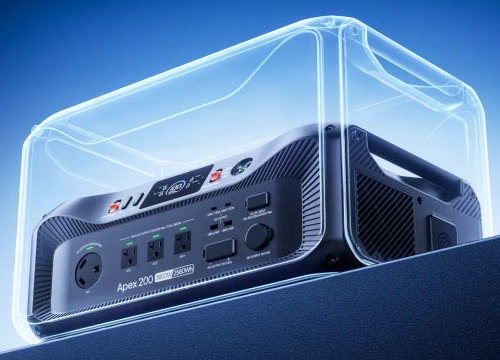
“2,560 Wh of LFP (lithium iron phosphate) cells, rated 6,000+ cycles to 70% of capacity. The badge on the unit in BLUETTI's own render reads 3600W | 2560Wh.”
Sources
bluettipower.com
BLUETTI Apex 300 + 2×B300K
The Apex 300 is young, and no owner report runs past about six monthsB0. Owners running several units together report them charging from the grid at different rates, one at full and another at half, which BLUETTI support called normalB1B3. Support experiences split: one owner waited weeks for an RMA approval, and a roundup of forum reports describes service anywhere from helpful to absentB4B11.
The better news is practical. One reviewer ran essentials for more than a full day on an Apex 300 with a B300KB16, and a van owner who priced a DIY system found the Apex 300 came in at about the same moneyB6.
“For me the 240V output is great. I can stick it in the back of my PHEV and use the 240V output to charge at 3.3KW when I stop.”
Sources
bluettipower.com
Sources & Research Notes
Every owner claim in this report is traceable to a published source. The bracketed references above resolve here.
Recurring owner themes
- No owner or reviewer reports exist yet: every entry is BLUETTI's own coming-soon page, spec table or store listing, or our own arithmetic on them. [Apex 200 + B500K · 22 entries]
- When multiple Apex 300 units (as in this 2x-B300K configuration) are charged together, owners report state-of-charge sync problems and solar input capped far below the advertised rating, which Bluetti support has called 'normal' behavior. [Apex 300 + 2×B300K · 3 entries]
- Customer/RMA support experience is inconsistent — some owners report smooth help, others describe multi-week delays and unresponsive tickets. [Apex 300 + 2×B300K · 2 entries]
- The base unit's 60V solar input ceiling and a firmware bug that drops solar detection (requiring an unplug/replug) are the two most-cited technical gripes among solar-focused owners. [Apex 300 + 2×B300K · 2 entries]
- Because the Apex 300 ships with no built-in DC/USB ports, owners and reviewers alike flag the mandatory ~$300 Hub D1 accessory as an unexpected added cost. [Apex 300 + 2×B300K · 2 entries]
- Despite being marketed as 'portable,' the unit's weight (~38kg/85lb base alone, more with B300K batteries) leads multiple sources to describe it as effectively a stationary/semi-permanent installation rather than something carried around. [Apex 300 + 2×B300K · 2 entries]
- A2
“AC output 3,200 W continuous on its own, 3,600 W once an expansion battery is attached. 120 V only; BLUETTI's FAQ sends buyers who need 120/240 V to the Apex 300.”
BLUETTI Apex 200 coming-soon page, bluettipower.com/pages/apex-200-expandable-power-station (read 2026-10-19, rechecked 2026-10-31) · 2026-10-19 · [mixed]
- A4
“DC: two USB-C (100 W and 140 W), two USB-A 15 W, a 12 V/10 A car outlet and a 12 V/30 A Anderson port, all on the base unit.”
Specification table on BLUETTI's Apex 200 page, published as an image (read 2026-10-19) · 2026-10-19 · [positive]
- A5
“Solar input up to 3,000 W: 2,000 W through a high-voltage MC4 input accepting 60–280 V, plus 1,000 W through a low-voltage XT60 input. BLUETTI quotes about 50 minutes to 80% with both inputs at full output.”
BLUETTI Apex 200 coming-soon page, bluettipower.com/pages/apex-200-expandable-power-station (read 2026-10-19, rechecked 2026-10-31) · 2026-10-19 · [positive]
- A6
“Wall charging: three modes (Silent, Standard, Turbo); Turbo is quoted at 45 minutes to 80%, with no starting charge stated. Campground charging to 100% in about 1.6 hours through a TT-30 or NEMA 14-50 charging cable.”
BLUETTI Apex 200 coming-soon page, bluettipower.com/pages/apex-200-expandable-power-station (read 2026-10-19, rechecked 2026-10-31) · 2026-10-19 · [mixed]
- A7
“80% of 2,560 Wh is 2,048 Wh. Delivered in 45 minutes from empty that averages about 2,700 W, nearly twice what a 15 A, 120 V wall outlet supplies (1,440 W), and faster than BLUETTI's own 1.6 hours through a 30 A campground cable. Treat the 45 minutes as unconfirmed until BLUETTI says where it starts and what circuit it needs.”
Power Station Arena arithmetic on BLUETTI's published figures (our reading, not a maker statement) · 2026-10-19 · [negative]
- A8
“Weight 59.5 lb (27 kg), two built-in handles, one each side; size 530 × 326 × 211 mm (20.9 × 12.8 × 8.3 in).”
BLUETTI Apex 200 coming-soon page, bluettipower.com/pages/apex-200-expandable-power-station (read 2026-10-19, rechecked 2026-10-31) / Specification table on BLUETTI's Apex 200 page, published as an image (read 2026-10-19) · 2026-10-19 · [mixed]
- A9
“Expansion: up to six B300K or B500K batteries per unit, which BLUETTI puts at 33.28 kWh with six B500Ks (7.68 kWh with one). Two or three Apex 200 systems link through BLUETTI's Hub A1 for up to 6,000 W and 99.84 kWh.”
BLUETTI Apex 200 coming-soon page, bluettipower.com/pages/apex-200-expandable-power-station (read 2026-10-19, rechecked 2026-10-31) · 2026-10-19 · [positive]
- A16
“The Apex 300's solar inputs top out at 60 V, so an array a long cable run from the house either loses power in the cable or needs BLUETTI's $699 Solar X 4K. The Apex 200's 60–280 V high-voltage input takes the same panels wired for more volts and less current, in the base unit.”
BLUETTI Apex 200 coming-soon page, bluettipower.com/pages/apex-200-expandable-power-station (read 2026-10-19, rechecked 2026-10-31) / BLUETTI Apex 300 specifications / Power Station Arena arithmetic on BLUETTI's published figures (our reading, not a maker statement) · 2026-10-31 · [positive]
- A17
“Battery sharing between an Apex 200 and an Apex 300 is not documented. BLUETTI's page covers Apex 200 units linking to each other through the Hub A1 and parallel cables, and says nothing about the two models cabled together.”
BLUETTI Apex 200 coming-soon page, bluettipower.com/pages/apex-200-expandable-power-station (read 2026-10-19, rechecked 2026-10-31) · 2026-10-31 · [mixed]
- A19
“Operating pitch on BLUETTI's page: a fridge through an outage and an RV at the campsite from the same unit, with the same B300K and B500K batteries as the Apex 300 so later purchases carry over.”
BLUETTI Apex 200 coming-soon page, bluettipower.com/pages/apex-200-expandable-power-station (read 2026-10-19, rechecked 2026-10-31) · 2026-10-19 · [positive]
- A21
“A B500K weighs about 99.2 lb by BLUETTI's Apex 300 bundle weights (bundle minus the 83.78 lb base). This system is two boxes: the 59.5 lb Apex 200 and one B500K stacked under it; the catalogue weight is the total, never one lift.”
Power Station Arena arithmetic on BLUETTI's published figures (our reading, not a maker statement) (BLUETTI catalogue rows 59–63) · 2026-10-31 · [mixed]
- A22
“With an expansion battery attached the Apex 200's AC output rises from 3,200 W to 3,600 W, by BLUETTI's page.”
BLUETTI Apex 200 coming-soon page, bluettipower.com/pages/apex-200-expandable-power-station (read 2026-10-19, rechecked 2026-10-31) · 2026-10-19 · [positive]
- B1
“When the units are charging from the grid they charge at different rates and not together... you may have one at 100% and one at 50%.”
DIY Solar Power Forum — thread 'Bluetti Apex 300 problems' · 2025-09 · [negative]
- B2
“I have requested a short video from Bluetti showing an APEX 300 actually charging more than 1200 watts. They have been unable to produce one.”
DIY Solar Power Forum — thread 'Bluetti Apex 300 problems' · 2025-09 · [negative]
- B3
“Bluetti support says this is normal... This makes them a bad choice for off grid applications.”
DIY Solar Power Forum — thread 'Bluetti Apex 300 problems' · 2025-09 · [negative]
- B4
“It has taken me 2 weeks of troubleshooting with them and a week to get an RMA approval... I have asked for updates with NO response 48 hours later.”
DIY Solar Power Forum — thread 'Apex 300 Support issues' · 2025-11 · [negative]
- B5
“For me the 240V output is great. I can stick it in the back of my PHEV and use the 240V output to charge at 3.3KW when I stop.”
DIY Solar Power Forum — thread 'Bluetti Apex 300 launched today… anyone have thoughts?' (page 2) · 2025-05 · [positive]
- B6
“It came in just shy of £1500... Pricing up a similar system from scratch with similar capacity, solar charger, split charger, smart shunt, inverter ect was all coming in at a similar if not slightly higher price.”
VW T6 Transporter Forum — thread 'Bluetti Apex 300' · 2025-07 · [positive]
- B8
“The 60V solar limit is the most common and vociferous complaint, with users calling it "misleading" and a "joke".”
BIKMAN TECH blog aggregating user/forum reports — 'Bluetti APEX 300 - Everything You Need to Know' · 2025-11 · [negative]
- B10
“widespread frustration over the "unbundling" strategy and the "hidden cost" of the Hub D1 for "missing" DC/USB ports.”
BIKMAN TECH blog aggregating user/forum reports — 'Bluetti APEX 300 - Everything You Need to Know' · 2025-11 · [negative]
- B11
“Customer support is dangerously polarized. User experiences range from "great" and "helpful" to "notoriously non-existent" and "a disaster".”
BIKMAN TECH blog aggregating user/forum reports — 'Bluetti APEX 300 - Everything You Need to Know' · 2025-11 · [mixed]
- B12
“it weighs in at 38kg, and is probably much too big and heavy for most people to carry alone.”
Trusted Reviews — 'Bluetti Apex 300 Review' · 2025-10 · [mixed]
- B16
“With some portable power stations, I'd have to ration power more carefully, but with this system, I could run essentials for more than a full day if I needed to.”
Techspective — 'Bluetti Apex 300 with B300K Review' · 2025-09 · [positive]
- B17
“Not having DC or USB ports on the face is a tradeoff. The Hub D1 solves the problem—but it's an additional $300 accessory that you then have to bolt on after the fact.”
Techspective — 'Bluetti Apex 300 with B300K Review' · 2025-09 · [mixed]
- B18
“BLUETTI spec table for the Apex 300: four 20 A AC outlets, one NEMA TT-30R (120 V, 30 A) and one NEMA 14-50R (120/240 V, 50 A), 3,840 W max in total; the two 100 W USB-C, two USB-A and 12 V ports require the Hub D1, sold separately.”
bluettipower.com — Apex 300 tech specs (checked 2026-10-04) · 2026-10-04 · [mixed]
Research compiled November 4, 2026.
Who Should Buy Which
Buy the Apex 200 + B500K if you…
- →Your outage list is a fridge, a freezer, lights and the internet on ordinary outlets, and you'd rather find room for two boxes than three.
- →Your panels are a long cable run from the house and you want to wire them for high voltage without buying a converterA5A16.
- →You want USB-C and a 12V Anderson port on the base, with no hub to add laterA4.
Buy the Apex 300 + 2×B300K if you…
- →A well pump, an electric dryer or a car charger on your list needs 240V, and only the Apex 300's 14-50R outlet supplies itB18.
- →You want the most stored energy of these two and have a permanent spot in the garage for three boxes.
- →You want a warranty term on paper today. BLUETTI has not published one for the Apex 200.
If neither fits
If you want the house to switch over without running a single cord, price a hardwired home battery installed at your panel. If you need power at a campsite, both of these stay home; a single-box portable is the right shelf.
The Bottom Line
The Apex 300 + 2×B300K asks for a third box, 55 lb more, a smaller solar input and a hub for its USB ports, and gives back 614Wh and a dual-voltage outlet. For a house that runs on ordinary outlets, that trade goes the wrong way. I'd buy the Apex 200 + B500K and keep the $900.
The one buyer who should ignore all of that has a 240V load to runB18. For them the Apex 300 stack is the only choice of the twoB18.
Frequently Asked Questions
Answers drawn from the spec record and cited owner research.
Is the Apex 300 + 2×B300K worth it over the Apex 200 + B500K?
Only if you need 240V. The Apex 300 stack holds 614Wh more and adds a 120/240V outlet. It is also three boxes instead of two, 55 lb heavier as a system, and takes 2,400W of solar against 3,000W.
Does the Apex 200 + B500K have 240V output?
No. The Apex 200 is 120V only, and BLUETTI points buyers who need 120/240V to the Apex 300.
Do the Apex 200 and Apex 300 use the same batteries?
Yes. Both take BLUETTI's B300K and B500K expansion batteries. The Apex 200 takes up to six, which BLUETTI puts at 33.28 kWh with six B500Ks. BLUETTI hasn't documented cabling an Apex 200 to an Apex 300 to share them.
Does the Apex 300 have USB-C ports?
Not on the base. Its USB and 12V ports come with the Hub D1, which one reviewer describes as a $300 add-on. The Apex 200 has two USB-C ports, rated 140W and 100W, built into the base.
Where to buy
BLUETTI Apex 200 + B500KPick
$2,799.00
$2,799.00 · direct from BLUETTI

BLUETTI Apex 300 + 2×B300K
$3,689.00
$3,689.00 · direct from BLUETTI
Last checked 11 hours ago. Prices move — check before you buy.
Prices may vary by retailer and are subject to change.