Head-to-head test
Anker SOLIX S2000 vs Jackery Explorer 1500 v2
At the same $700, the Anker gives you 474 more watt-hours, two and a half times the cycle life, and enough capacity to finish the eight-hour blackout the Jackery taps out of, and the Jackery's only answer is 3.7 fewer pounds and 500W more output.
Full profiles: Anker SOLIX S2000 → · Jackery Explorer 1500 v2 →

Written by Ian SchneiderUpdated
Solar & Off-Grid Tester, Station Arena Test Desk
Spec deltas
The Anker SOLIX S2000 and the Jackery Explorer 1500 v2 cost within a dollar of each other, $700 against $700, and for that same money the Anker holds 474 more watt-hours: 2,010Wh against 1,536. It's also rated for 10,000 cycles against 4,000 and costs three cents per lifetime kilowatt-hour against eleven. Matching price tags, very different amounts of battery behind them.
That capacity gap shows up exactly where it counts. The standard eight-hour blackout needs about 1,645Wh; the Anker's 2,010 clears it, and the Jackery's 1,536 stops short. The Anker also takes the workday and tailgate scenarios on reserve the Jackery has already spent, and its composite score sits nearly 900 points ahead, 4,417 against 3,518. For the same money, one of these is a 2kWh unit and the other isn't.
The Jackery earns its keep on two specs. It's the lightest 1.5kWh station there is at 32 pounds, 3.7 under the Anker, and its 2,000W inverter beats the Anker's 1,500W by 500W. Both are real, and both come from it being a smaller-capacity box. If you want the lightest unit or need that output, the Jackery is a fine one. If you want the most battery and life for $700, it's asking the same price for less.
What the Numbers Reveal
Each conclusion stated first — the numbers behind it on one line, the full analysis below.
continuous output
Capacity you paid the same for is capacity that shows up when it counts. The blackout needs about 1,645Wh; the Anker's 2,010 covers it and the Jackery's 1,536 doesn't. Same money, and only one of them gets you through the night the grid is down.
S2000 is $700; Jackery 1500 v2 is $700S2000 holds 2,010Wh; Jackery holds 1,536Wh8-hour blackout needs about 1,645Wh; the Anker clears it and the Jackery falls short
Why it mattersIf backup is any part of why you're buying, the Anker takes this outright, because it covers a load the Jackery can't at the same price.
rated cycles
When the sticker prices match, cost-to-own comes down entirely to lifespan and capacity, and the Anker leads on both. Eleven cents isn't expensive on its own, but against three cents for the same money, the Jackery is the pricier box to live with by a wide margin.
S2000 rated for 10,000 cycles; Jackery for 4,000S2000 lifetime cost is $0.03 per kWh; Jackery is $0.11Both priced at about $700
Why it mattersFor the same $700, the buyer optimizing for value takes the Anker without much of an argument.
weight
That's the honest trade. The Jackery is the lightest 1.5kWh box made, and its 2,000W inverter clears a load the Anker's 1,500W won't. But you buy those with 474 fewer watt-hours, at the same price. The lighter unit is lighter partly because there's less battery inside it.
Jackery 1500 v2 is 32 lb; S2000 is 35.7 lbJackery inverter is 2,000W; S2000 is 1,500WJackery holds 1,536Wh; S2000 holds 2,010Wh
Why it mattersIf you specifically want the lightest unit or need 2,000W of output, the Jackery earns it; if you want the most battery and life for $700, it doesn't.
The specific dimensions that decide these two units — everything else is a tie.
Lifetime Value
Selected because: Same price, but three cents vs eleven per lifetime kWh and 10,000 vs 4,000 cycles is the Anker's headline.
cost / lifetime kWh
Same sticker, different economics. Both land at about $700, but the Anker pairs that price with a 10,000-cycle rating against the Jackery's 4,000, so its energy works out to three cents per lifetime kilowatt-hour against eleven. When the prices match, this is the number that separates them, and it isn't close.
It compounds with capacity. The Anker isn't just rated to last longer, it holds 474 more watt-hours while doing it, so every cycle moves more energy at a lower lifetime cost. Eleven cents is a fair number for a 1.5kWh unit; it's just the expensive side of this particular matchup.
Your Life, Your Pick
Selected because: The Anker outright wins the blackout, workday, and tailgate; the smaller Jackery can't finish the blackout.
This is where the capacity gap stops being a spec and starts being a result. The standard eight-hour blackout needs about 1,645Wh, and the Anker's 2,010 clears it while the Jackery's 1,536 comes up short, at the same price. The Anker also wins the workday and the tailgate, finishing each with reserve the Jackery has already burned through.
The two only tie where the load is small enough not to matter, like a CPAP night that uses a fraction of either battery, and both fall short of a full weekend of camping. But across the scenarios that actually split them, the Anker wins every one. For matching money, that's about as one-sided as this grid gets.
PowerScore Breakdown
Selected because: 4,417 vs 3,518 is a near-900-point gap, the widest on any S2000 page, and it's real.
overall power score
The composite scores are the widest gap on any S2000 comparison: 4,417 for the Anker against 3,518 for the Jackery, nearly 900 points. That's not a scoring quirk, it's the capacity, cycle life, and switchover advantages stacking up in one number.
The Jackery claws back a piece of it on output, a 2,000W inverter against the Anker's 1,500, which is the one line where it leads. But output is a single spec, and it's carrying a battery two-thirds the Anker's size at the same price. The score gap is honest: this is a 2kWh unit against a 1.5kWh one.
Portability & Form Factor
Selected because: The Jackery's genuine edge: 3.7 pounds lighter, the lightest 1.5kWh station, but on less battery.
weight
The Jackery's real prize is weight. At 32 pounds it's the lightest 1.5kWh LFP station on the market, and it undercuts the Anker by 3.7 pounds. If the single most important thing is how little you carry, the Jackery wins that cleanly, and it's a genuinely portable box.
The catch is what those 3.7 pounds cost: 474 fewer watt-hours and most of the cycle life, for the same price. The Anker, for its part, saves weight the wrong way for a carry, since it skips a proper one-hand handle. So the Jackery is both lighter and easier to grip, and still the smaller battery. Weight buyers lean Jackery; everyone else pockets the capacity.
Brand Trust
Selected because: Cross-brand: Anker's app and test record vs Jackery's retail reach and weak app.
Anker brings parent-brand trust, one of the best-rated apps in the category, and a clean early test record, which is rare for a unit this new. The caution is that SOLIX-specific support has drifted toward scripted agents and slower resolutions on heavy units.
Jackery's strength is retail reach, buy it at Costco, Home Depot, or Amazon and return it easily, which is the recommended path, because its own warranty service draws criticism and its app is the weakest of the majors. Between the two, Anker takes the software and the test record; Jackery takes availability and the lightest body in the class.
Strengths & trade-offs
Anker SOLIX S2000
Strengths
- +Costs $249 less
- +Larger battery capacity
- +Rated for 10,000 charge cycles — much longer battery lifespan
Trade-offs
- –No major technical downsides compared to rival.
Jackery Explorer 1500 v2
Strengths
- +Lighter by 3.7 lb
- +Higher AC output
Trade-offs
- –Substantially more expensive (+$249) than the SOLIX S2000.
- –Shorter-lived battery — rated for 4,000 charge cycles vs the SOLIX S2000's 10,000, so it wears out sooner.
Will It Power Your Gear?
Scenario math and per-appliance runtimes, modeled from the spec record.
Scenario verdicts
We ran the math on six real-world scenarios. Here's which unit survives your actual life.
SCN-01 · 2 nights · needs 2,100Wh
Weekend Camping
Two nights off-grid with essential comfort
Neither unit
Neither unit covers this scenario's 2,100Wh: the SOLIX S2000 comes up 392Wh short (about 81% covered), the Explorer 1500 v2 794Wh (62%). Either gets you most of the way, so this is a scenario you plan around rather than one you should rule them out for.
Battery budget usedlower = more headroom
LOAD Phone Charger 15W×6h · LED Lights 40W×8h · Box Fan 75W×14h · CPAP Machine 40W×16h
SCN-02 · 8 hours · needs 1,645Wh
8-Hour Blackout
Keep the essentials running through a night without power
SOLIX S2000
The Anker clears the standard eight-hour blackout and the Jackery doesn't, at the same price. It's the cleanest result on the page: the load needs about 1,645Wh, the Anker's 2,010 covers it, and the Jackery's 1,536 stops short. If backup is the job, this scenario alone decides it.
Battery budget usedlower = more headroom
LOAD Fridge 150W×8h · Router + Modem 20W×8h · LED Lights (4 bulbs) 40W×6h · Phone Charger 15W×3h
SCN-03 · 8 hours · needs 320Wh
CPAP Overnight
Sleep therapy without interruption — the #1 medical use case
Either unit
A CPAP is about 40W for eight hours, so both of these cover the night several times over — capacity isn't the question here. Both happen to list 30dB — two makers' own figures landing on the same number rather than a measured tie — so there is nothing in the noise column to separate them either. Buy whichever is cheaper or easier to carry.
Battery budget usedlower = more headroom
LOAD CPAP Machine 40W×8h
SCN-04 · 8 hours · needs 910Wh
Remote Workday
Full work day off-grid without power anxiety
SOLIX S2000
Both run a laptop, monitor, and Starlink through a workday, but the Anker does it on more reserve, finishing with capacity the Jackery has already spent. For the same money, the bigger battery is the one that isn't watching the gauge by late afternoon.
Battery budget usedlower = more headroom
LOAD Laptop 60W×8h · External Monitor 30W×8h · Router + Modem 20W×8h · Phone Charger 15W×2h
SCN-05 · 4 hours · needs 670Wh
Tailgate Party
Game day power for the crew
SOLIX S2000
Both handle game day; the SOLIX S2000 keeps more in reserve (39% used vs 51%). Tailgating is a light load, though, so the number you'll feel is weight: 32 lbs for the Explorer 1500 v2 against 35.7 lbs for the SOLIX S2000, from the trunk to the setup spot.
Battery budget usedlower = more headroom
LOAD Blender 400W×0.5h · LED TV (55") 80W×4h · Bluetooth Speaker 15W×4h · Phone Charger (×3) 45W×2h
SCN-06 · 24 hours · needs 4,685Wh
Van Life Daily
A full day of mobile living — the ultimate endurance test
Neither unit
Neither unit covers this scenario's 4,685Wh: the SOLIX S2000 comes up 2,977Wh short (about 36% covered), the Explorer 1500 v2 3,379Wh (28%). Treat this as partial cover — enough for the essentials in it, not the whole list.
Battery budget usedlower = more headroom
LOAD Mini-Fridge 150W×24h · Laptop 60W×4h · Phone Charger 15W×3h · LED Lights 40W×5h · Fan 75W×8h
The Load Test
RUNTIME = (Wh × 0.85) ÷ LOAD
None of the scenarios above exactly yours? Build it. Toggle what you'd plug in; both units are tested against the combined draw.
Essentials
Comfort & Convenience
High-Draw Appliances
Test duration
8h
Continuous draw
205W
Projected runtime
For this load: SOLIX S2000 runs 8.3h vs 6.4h.
Sold on Amazon
Planning for more than this? Describe your whole setup and get it sized →
Modeled from the spec record — same math as the tables below. Methodology
Runtime by appliance
Real-world runtime estimates for common appliances, modeled at 85% inverter efficiency.¹
Essentials
The basics you need runningscale 0–113.9hComfort & Convenience
Makes off-grid life actually enjoyablescale 0–22.8hHigh-Draw Appliances
These reveal the real limitsscale 0–1.7h¹ Runtime = (capacity × 0.85) ÷ appliance watts. Within each group, all bars share one time scale (the group's longest runtime), so lengths are comparable across appliances; identical runtimes collapse into a single blue/orange bar. Actual runtime varies with battery age, temperature, and simultaneous loads — see methodology.
Conclusion
July 18, 2026
Verdict: the SOLIX S2000
The two units cost within a dollar of each other, $700 against $700, and for that same money the Anker SOLIX S2000 holds 474 more watt-hours, 2,010Wh against 1,536, is rated for 10,000 cycles against 4,000, and costs three cents per lifetime kilowatt-hour against eleven. The extra capacity isn't academic: the Anker rides out the standard eight-hour blackout and wins the workday and tailgate scenarios, while the smaller Jackery falls short of the blackout. The composite score is far apart, 4,417 against 3,518. The Jackery Explorer 1500 v2 has two genuine edges: it's 3.7 pounds lighter at 32 pounds, the lightest in its class, and its 2,000W inverter tops the Anker's 1,500W by 500W. If you specifically want the lightest box or need that output, it's a defensible buy. For almost everyone else, at the same price, the Anker is more battery, more life, and more capable.
Today the Explorer 1500 v2 is $849, $100 under its typical $949. The verdict weighs typical prices, not today's. Prices checked 16 days ago.
Editor-assigned confidence, based on cited owner research and spec analysis.
List prices as of July 18, 2026. The links below open Anker's and Jackery's current prices.
Sold on Amazon · today’s price is on the listing
or check the Explorer 1500 v2 price$849.00 list
Written by Ian Schneider, Solar & Off-Grid Tester · Station Arena Test Desk · Updated July 18, 2026
Black Friday · 38 days out
Price to beat:Explorer 1500 v2 $699
The lowest we have recorded. A Black Friday price above it is a sale this unit has already had.
Measured Data
Benchmark scores and the full spec record, side by side.
Benchmark scores
Not rated for both units (minimum threshold unmet): RV Living, Food Truck.
Full specifications
ᵈ Derived: price ÷ rated capacity. See the data behind our comparisons →
Comparison ToolAdd more power stations, side by sideOpen Tool →How these numbers are produced
Numeric verification
Every figure on this page traces to our spec database or arithmetic on it — no estimated numbers.
Owner claims
Statements about owner experience are cited to published reviews — see Sources & Research Notes below.
Runtime model
Runtime = (rated capacity × 0.85 inverter efficiency) ÷ device wattage. Solar recharge estimates assume panels deliver 70% of rated output. Cold weather, battery age, and stacked loads reduce real-world results.
Power Score
Computed from 14 published spec dimensions, weighted per use-case bench. Higher is better; a unit must meet a bench's minimum threshold to be rated.
See the full weight table and data sourcing on our methodology page →Class ranking (the star rating)
Each unit's star score is a category ranking, not customer reviews — no buyer opinions feed it. We score every station on size-independent quality (value, output, portability, endurance, ports, warranty, and more), then percentile-rank it against the other units in its capacity class, so a class-leading compact unit and a class-leading whole-home unit can both earn 5★. Here, SOLIX S2000 rates 5.0/5 (99th percentile of 26 Large-class units), and Explorer 1500 v2 rates 3.8/5 (31st percentile of 27 Everyday-class units).
How the class ranking is computed →Test Notes & Caveats
Hidden gotchas and advantages we spotted that you won't find on the product page.
10ms vs 20ms Switchover
Both switch to battery fast enough to protect a desktop or router, but the Anker's 10ms line-interactive handoff beats the Jackery's 20ms standby. Neither will reboot your gear in a normal outage; the Anker just leaves more margin before anything connected notices.
Warranty: No Difference
Both units carry the same 5-year warranty, so coverage isn't a tiebreaker here. The Explorer 1500 v2's figure is a maximum rather than a guarantee — it depends on registering the unit with Jackery, which is what extends the base term to the full period. Worth saying because the per-dollar framing can suggest otherwise: the SOLIX S2000 works out at 7.1 years of cover per $1,000 spent against the Explorer 1500 v2's 5.3, but that spread is the price gap, not the terms.
10,000 Cycles vs 4,000
Same LFP chemistry, and at the same price, very different rated lifespan. The Anker is built to cycle two and a half times as long, which is why its energy costs three cents per kWh against eleven. For matching sticker prices, that's the gap that decides cost-to-own.
Full record above — the Test Desk pick is the SOLIX S2000.
Check SOLIX S2000 price →or check the Explorer 1500 v2 priceOwnership Analysis
What happens after you buy — true cost of ownership, brand trust, and growth potential.
Lifetime value
Service lifeyears at one full cycle per day
Lifetime energy delivered
Cost per delivered kWh
│ warranty ends · Reaching the cycle rating means ~80% capacity remains — degraded, not dead.
Analyst note
The SOLIX S2000 wins on both sticker price and long-term value. At $0.03/kWh over its lifetime, it's meaningfully cheaper to own. Clear value winner.
Delivers each lifetime kWh for $0.12 less — check the SOLIX S2000 price →
Brand trust
Anker
Ecosystem
7-8 SOLIX portable power stations across C-series (compact) and F-series (flagship), plus the X1 home energy system
Support
US-based support. Historically known for incredible no-hassle replacements, but recent reports describe AI-driven support agents giving generic responses and complex return logistics for heavy units (hazmat shipping). The Anker brand reputation is still strong, but SOLIX-specific support quality is trending down.
Community
Moderate — active Reddit (r/Anker, r/AnkerSOLIXCommunity) and growing. Benefits from Anker's massive consumer electronics brand awareness.
App experience
Rated 4.5/5 iOS (~1,100 ratings) · 4.3/5 Android
Unique strength
Parent-brand trust, a top-rated app, and a clean early test record that's rare for a new unit.
Worth knowing
SOLIX-specific support has slipped toward scripted agents and slower resolutions on heavy units.
Jackery
Ecosystem
12-15+ models across Explorer (portable) and HomePower (home backup) series, plus SolarSaga panel ecosystem and innovative form factors
Support
US-based support but widely criticized. Reddit reports describe slow/dismissive responses, scripted AI agents, strict receipt requirements for warranty claims, and refurbished replacements for clearly defective units. Strongly recommended: buy from Costco or Amazon for return protection.
Community
Smallest community of the major brands — Reddit r/Jackery has ~2,000 members. YouTube presence is solid due to brand recognition.
App experience
Rated 2.3-3.3/5 iOS and Android — the weakest app experience of the major brands. Multiple confusing apps (Jackery app vs Jackery Home) and mandatory login even offline.
Unique strength
Buy-it-anywhere retail reach across Costco, Home Depot, and Amazon with an easy return window, plus a class-leading light 1.5kWh design.
Worth knowing
The app is the weakest of the majors and warranty service draws criticism, so lean on the retailer, not the support line.
Analyst note
Jackery brings the lighter box and buy-it-return-it availability; Anker brings more capacity, far longer life, and the better app for the same price. Unless you specifically want the smaller, lighter unit, the S2000 wins this one.
Growth path
SOLIX S2000
FIXED CAPACITYFixed at 2,010Wh — a sealed, complete system rather than a starting point. There's no expansion port, so that figure is the ceiling: check it against your longest unplugged stretch before you buy.
Accepts up to 400W of solar. Suitable for a 1-2 panel setup.
Adequate ports for most setups, but heavy users may want a power strip.
Explorer 1500 v2
FIXED CAPACITYFixed at 1,536Wh, with no expansion — so size it for your needs up front rather than planning to add capacity later.
Accepts up to 400W of solar. Suitable for a 1-2 panel setup.
Adequate ports for most setups, but heavy users may want a power strip.
Realistic full solar rechargeat 70% of rated panel output — see methodology
Analyst note
Neither expands, and that's no knock on either — each is a complete unit at a fixed size. Buy the capacity that covers your needs now (the SOLIX S2000 gives you the larger ceiling); you can't add to either later.
What Owners Report
Patterns from published owner reports and long-term reviews — every claim cited to its source below.
Anker SOLIX S2000
Run the S2000 hard enough to hear it and two independent reviewers reported the same thing: at idle it's silent, and the fans only wake under a heavy load or the fastest charge modeA1A2. Standby draw is a couple of watts, measured, not estimatedA3A4, and the Anker app is the more polished of the two control surfacesA11. It's a brand-new unit, so there's no six-months-later owner report yet, only early hands-on testing, but that testing is clean.
The rest of the field notes build trust: a full recharge from a wall outlet in under two hoursA5, a fridge and kitchen gear run for more than 60 hours on a chargeA12, and a 10ms switchover that carried connected equipment through a simulated outage without a flickerA9A10. The one steady complaint is physical, a missing one-hand carry handle that makes the 35.7-pound box more awkward than its weight suggestsA7A8. One tester also caught a faint warm-electronics smell in the first hours that faded within a dayA6.
“Fans only spin up under real load or fast charging, and at idle the unit is silent.”
Sources
ess-news.com · geardiary.com
Jackery Explorer 1500 v2
The Explorer 1500 v2 has a clear identity: it's the value pick of the 1.5kWh class, and reviewers back that up. It's called the lightest 1.5kWh LFP station going, right around 32 poundsB1, with a genuinely useful seven-output layout, three AC outlets plus dual USB-C and a DC car portB2. At $700 it's rated the lightest, fastest-charging, lowest cost-per-watt unit in its class, with a full charge in a bit over an hourB3, and one review put it near the top for buyers who don't need rugged or waterproof gearB4. None of that is in dispute; it's simply built around a smaller battery than the Anker at the same price.
“The world's lightest 1.5kWh LFP power station at about 32 lbs — class-leading weight is one of its defining features.”
Sources
backuppowerhub.com · jackery.com · portablepowernerd.com
Sources & Research Notes
Every owner claim in this report is traceable to a published source. The bracketed references above resolve here.
Recurring owner themes
- Two independent hands-on reviews both found near-silent idle operation, with fans spinning up only under heavy load or the fastest charging mode. [SOLIX S2000 · 2 entries]
- OptiSave's low-idle-draw claim held up under independent testing, with both reviewers separately measuring single-digit-watt standby draw. [SOLIX S2000 · 2 entries]
- Both reviewers praised fast, reliable UPS switchover that connected electronics didn't notice. [SOLIX S2000 · 2 entries]
- Despite otherwise solid build quality, reviewers from two different outlets independently flagged the single/absent carry handle as awkward for one-person transport. [SOLIX S2000 · 2 entries]
- Class-leading light weight, a versatile 7-port layout, fast ~64-minute charging, and the lowest cost-per-watt in its class are the consistent praise. [Explorer 1500 v2 · 3 entries]
- A1
“Fans only spin up under real load or fast charging, and at idle the unit is silent.”
ess-news.com — Anker Solix S2000 review: 2 kWh power station built for the long haul · 2026-05 · [positive]
- A2
“The fans only spin up when pulling a heavy load or using the fastest charging mode — otherwise it stays very quiet.”
geardiary.com — Anker SOLIX S2000 Review · 2026-07 · [positive]
- A3
“Charged fully, disconnected from wall power with AC output enabled and no loads attached, then monitored for 10 hours: state of charge dropped only to 99%, implying about 2W average draw — matching Anker's spec.”
ess-news.com — Anker Solix S2000 review: 2 kWh power station built for the long haul · 2026-05 · [positive]
- A4
“With AC ports on but unused, consumption is about 6W; with everything disabled it drops to just 2W.”
geardiary.com — Anker SOLIX S2000 Review · 2026-07 · [positive]
- A5
“Real-world recharge from a standard 20-amp household circuit hit 80% in roughly 1.2 hours and full capacity in about 1.7 hours, matching the manufacturer's claims.”
ess-news.com — Anker Solix S2000 review: 2 kWh power station built for the long haul · 2026-05 · [positive]
- A6
“Under sustained AC load in a small, closed home office there was a slight warm-electronics smell within a few feet of the unit during the first several hours of operation; it faded after one day with no safety concern.”
ess-news.com — Anker Solix S2000 review: 2 kWh power station built for the long haul · 2026-05 · [mixed]
- A7
“At 35.7 lbs the weight is manageable but noticeable — a second handle would be welcome for carrying it up stairs.”
ess-news.com — Anker Solix S2000 review: 2 kWh power station built for the long haul · 2026-05 · [mixed]
- A8
“Lacks a dedicated handle for carrying with one hand, making transport less convenient despite the relatively compact 35.7 lb weight.”
geardiary.com — Anker SOLIX S2000 Review · 2026-07 · [negative]
- A9
“In a simulated outage, connected office equipment rode through the switchover without interruption.”
ess-news.com — Anker Solix S2000 review: 2 kWh power station built for the long haul · 2026-05 · [positive]
- A10
“A 10ms switchover time means a computer or internet router won't even flicker if the grid goes down.”
geardiary.com — Anker SOLIX S2000 Review · 2026-07 · [positive]
- A11
“The Anker app is the more polished entry in this category, with clear navigation and sensible defaults.”
ess-news.com — Anker Solix S2000 review: 2 kWh power station built for the long haul · 2026-05 · [positive]
- A12
“Easily powered a fridge and various kitchen gadgets for over 60 hours without needing a recharge.”
geardiary.com — Anker SOLIX S2000 Review · 2026-07 · [positive]
- B1
“The world's lightest 1.5kWh LFP power station at about 32 lbs — class-leading weight is one of its defining features.”
backuppowerhub.com / jackery.com — Explorer 1500 v2 review · 2026 · [positive]
- B2
“Seven simultaneous outputs is genuinely useful: three AC outlets cover larger appliances, dual USB-C ports support fast charging for phones and laptops, and the DC car output handles 12V accessories without burning an AC outlet.”
portablepowernerd.com / backuppowerhub.com — Explorer 1500 v2 review · 2026 · [positive]
- B3
“At $699 it's the lightest, fastest-charging, and lowest cost-per-watt 1.5kWh LFP station on the market, undercutting comparable LFP units, with a roughly 64-minute full charge.”
backuppowerhub.com — Explorer 1500 v2 review · 2026 · [positive]
- B4
“Earns 8.7/10; for buyers who don't need rugged or waterproof features, it's the most cost-efficient path to serious LFP capacity in 2026.”
backuppowerhub.com / portablepowernerd.com — Explorer 1500 v2 review · 2026 · [positive]
Research compiled July 18, 2026.
Who Should Buy Which
Buy the SOLIX S2000 if you…
- →You want the most battery and the longest life for $700: a full 2,010Wh at 10,000 cycles and three cents per kWh, with the capacity to finish an eight-hour blackout.
- →Backup is part of the plan, where the Anker's 2,010Wh clears the standard blackout the Jackery's 1,536 comes up short of, for the same money.
Buy the Explorer 1500 v2 if you…
- →You specifically want the lightest unit, 32 pounds against 35.7, and a smaller 1.5kWh box fits your loads better than a full 2kWh.
- →You need the 2,000W inverter for a load over 1,500W, the one spec where the Jackery clears something the Anker can't.
If neither fits
If you're after a full weekend of camping near 2,100Wh or van-life daily draw around 4,685Wh, both fall short once you count usable energy, and the smaller Jackery further short. That load wants a bigger class than either of these.
The Bottom Line
At the same $700, the S2000 is simply more unit: 474 more watt-hours, two and a half times the cycle life, three cents a kilowatt-hour against eleven, and enough capacity to finish the eight-hour blackout the Jackery can't. Its composite score sits nearly 900 points ahead for a reason.
The Jackery Explorer 1500 v2 is a good 1.5kWh station, the lightest in its class and a strong value inside it, so if you want that smaller, lighter box or need its 2,000W output, buy it without regret. But dollar for dollar against the Anker, it's asking the same price for less battery and less life. Unless weight is the whole point, take the Anker.
Frequently Asked Questions
Answers drawn from the spec record and cited owner research.
Anker SOLIX S2000 or Jackery Explorer 1500 v2?
For almost everyone, the Anker. It costs a dollar more, $700 against $700, and for that you get 474 more watt-hours, 10,000 cycles against 4,000, and three cents per lifetime kWh against eleven. The Jackery makes sense only if you want the lighter 1.5kWh box or need its 2,000W output.
They're basically the same price, so what's the real difference?
Capacity and lifespan. The Anker holds 2,010Wh to the Jackery's 1,536 and is rated for 10,000 cycles against 4,000, so for the same $700 it's more battery that lasts far longer. The Jackery counters with 3.7 pounds less weight and 500W more output, and that's the whole trade.
Which one handles a blackout better?
The Anker, and for the price it isn't close. A standard eight-hour blackout needs about 1,645Wh; the Anker's 2,010Wh clears it and the Jackery's 1,536Wh falls short. At the same money, only one of the two rides out the full night.
Is the Jackery's lighter weight worth it?
Only if weight is your top priority. At 32 pounds it's the lightest 1.5kWh station there is, 3.7 pounds under the Anker, but you give up 474 watt-hours and most of the cycle life to save them. For most buyers the extra capacity matters more than 3.7 pounds.
Is the Anker quiet enough to sleep near without a published noise rating?
By the testing, yes. Anker doesn't print a dB figure, but two independent reviews found it near-silent at idle with fans that only wake under load or fast charging. The Jackery lists 30 dBA, but a CPAP draws too little to spin either unit's fans anyway.
Where to buy
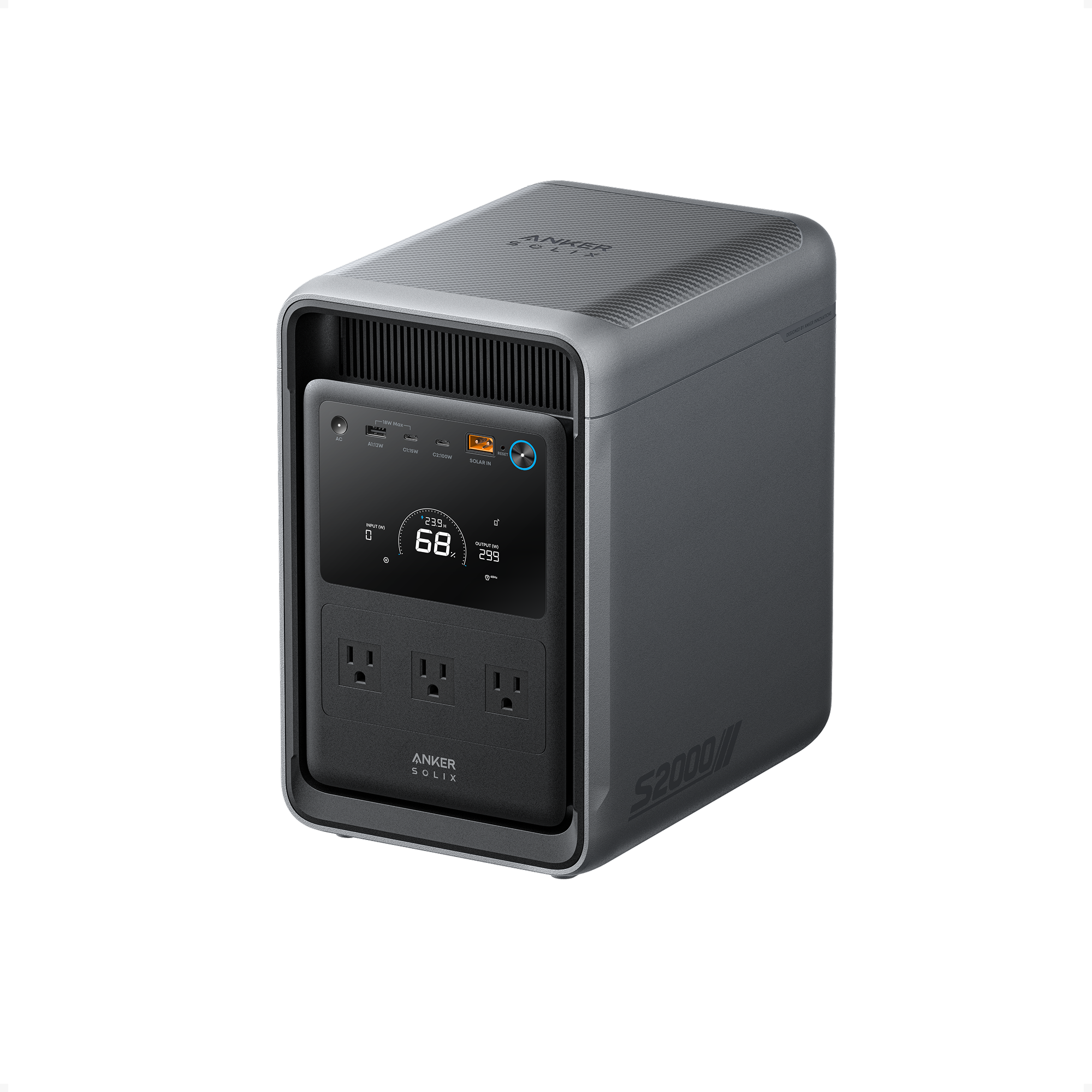
Anker SOLIX S2000Pick
Sold on Amazon · today’s price is on the listing

Jackery Explorer 1500 v2
$849.00
$849.00 · direct from Jackery
down from $949 · 11% below usual
Last checked 16 days ago. Prices move — check before you buy.
Prices may vary by retailer and are subject to change.