Head-to-head test
Anker SOLIX S2000 vs DJI Power 1000 V2
At the same money the DJI starts bigger loads and the Anker finishes longer nights, and only one of those ever comes up in an actual blackout.
Full profiles: Anker SOLIX S2000 → · DJI Power 1000 V2 →

Written by Ian SchneiderUpdated
Solar & Off-Grid Tester, Station Arena Test Desk
Spec deltas
$1 separates these two, so this was never a question about which is cheaper. It's a question about what the same money should buy: 2,010Wh behind a 1,500W inverter, or 1,024Wh behind a 2,600W one. Anker sells you the battery. DJI sells you the inverter.
The DJI wins the output columns outright, and it matters less than it looks. Its peak ceiling is 4,400W against the S2000's 3,000W, but read the ratios and the flattery reverses: the Anker publishes peak at exactly double its own rating, while the DJI's sits about 1.7 times above its. The heaviest switch-on demand in any scenario here is 400W, and both units start it without noticing. Two real numbers, pointing at opposite units, deciding nothing.
Take the S2000. The Power 1000 V2's 2,600W inverter is wired to 870Wh of usable energy, which is about twenty minutes at full tilt, and the nights people buy these boxes for are decided in watt-hours rather than watts. Buy the DJI when you have a load over 1,500W you need to run briefly, when you already own DJI gear, or when 4.4 lbs of carrying weight decides things for you.
What the Numbers Reveal
Each conclusion stated first — the numbers behind it on one line, the full analysis below.
continuous output
That division is the whole trade. The output advantage applies to appliances you use in bursts; the energy deficit applies to the ordinary all-day draw, where a 910Wh workday tips the DJI under by 40Wh and the S2000 clears the same day with 798Wh untouched. Buying the bigger inverter here means buying the smaller battery it's bolted to.
Power 1000 V2: 2,600W rated continuous output, 1,024Wh capacity, 870Wh usable after the flat 15% allowanceSOLIX S2000: 1,500W rated continuous output, 2,010Wh capacity, 1,708Wh usableRemote Workday needs 910Wh: the DJI finishes 40Wh short, the S2000 with 798Wh to spare
Why it mattersIf the 2,600W figure is why you're looking at the DJI, price an expansion battery into it before you decide, because the base unit can't sustain for long what its inverter can start.
In the concrete, both ceilings sit several times above anything on this page. What you run into first is the outlet strip: five AC sockets against two, which is the difference between plugging the household essentials straight in and hunting for a power strip in the dark.
SOLIX S2000: 3,000W peak on a 1,500W rating, exactly 2xPower 1000 V2: 4,400W peak on a 2,600W rating, about 1.7xAcross all six scenarios the heaviest startup demand is 400W, and both units start every oneAC outlets: five on the S2000, two on the Power 1000 V2
Why it mattersAnyone choosing on surge alone should ignore both columns here and shop on outlet count and continuous rating instead.
A backup unit has to survive the waiting before it does the working, and the DJI loses at both ends of that sentence, since it is also the one that stops 775Wh short of the eight-hour blackout the S2000 finishes with 63Wh in reserve.
Both units are rated for switchover no worse than 10ms, and independent testers confirmed connected gear rode through it on eachA9A10B9S2000 measured about 2W at idle and about 6W with AC ports enabled but unusedA3A4Power 1000 V2 measured roughly 18W idle, enough to flatten itself in about two and a half daysB8
Why it mattersIf the unit's job is to sit charged in a closet until the grid fails, this is settled: the Anker, and two weeks between top-ups instead of two and a half days.
solar input
Solar is the one place the DJI's recharge advantage is real, and it's the place it costs most to collect. Even derated to the 600W its adapter actually passes, it refills 1,024Wh in under two hours, against the five hours of strong sun the S2000 needs to push 2,010Wh through a 400W input. That edge is genuine for anyone off-grid for days, and it is sold separately at $329 before a single panelB6.
Power 1000 V2 refills empty to full in 56 minutesB4S2000 reaches 80% in about 1.2 hours and full in about 1.7 hours from a 20-amp household circuitA5Solar input: 1,200W on the DJI's spec sheet against 400W on the S2000DJI's solar adapter costs $329 and passes only 600W despite the 1.8kW branding on the box, with panels to buy on top of thatB6
Why it mattersOff-grid for a week with panels, the DJI's charging story is worth paying for. Plugged into a wall overnight, you're paying for a headline.
The specific dimensions that decide these two units — everything else is a tie.
Your Life, Your Pick
Selected because: The two units split on energy rather than watts: the Power 1000 V2 misses the eight-hour blackout by 775Wh and the remote workday by 40Wh, and the S2000 covers both.
The Power 1000 V2 doesn't win a single row here, and two of the six come down to under 100Wh either way. The blackout is the one to read twice: 1,645Wh of overnight load against 1,708Wh usable is a pass with 63Wh in hand, which is thin enough to respect rather than celebrate. The DJI lands 775Wh from finishing, a little over half the night covered, and that isn't a gap you trim your way out of.
The workday row is the honest near-miss. The DJI's nameplate 1,024Wh clears a 910Wh day on paper, and the flat 15% usable allowance applied to every unit on this site is what drops it to 870Wh and tips it under by 40Wh. Cut one small appliance across the day and it finishes. That's the shape of the whole page: the DJI keeps arriving just barely short of things the S2000 covers without being asked.
Lifetime Value
Selected because: The same money buys roughly 20,096 kWh over the S2000's rated life against 4,096 kWh, because 10,000 rated cycles of 2,010Wh is a different purchase from 4,000 of 1,024Wh.
cost / lifetime kWh
Cycle counts read like a spec-sheet footnote until you multiply them by the battery they're attached to. At least 10,000 cycles of 2,010Wh is roughly 20,096 kWh through the S2000 over its rated life. The DJI's 4,000 cycles of 1,024Wh is 4,096 kWh. Nearly five times the energy, for $1 more, from the unit that is also the cheaper of the two per watt-hour.
At a cycle a day that's 27.4 years against 11, and nobody is planning that far ahead. What the number actually buys is indifference: you can cycle the S2000 hard, daily, for a decade and never think about cell count. Hitting the rated limit isn't death either. It's a drop to about 80% of original capacity, which is still a working power station.
What the Specs Don't Tell You
Selected because: Two spec-sheet numbers mislead here: the surge figures point at opposite units, and only one of these stations publishes a noise level at all.
rated cycles
Two numbers on this page describe surge, and they point at opposite units. The S2000 keeps exactly double its rating in reserve. The DJI keeps about seven-tenths, off a much higher rating, which leaves it the taller absolute ceiling at 4,400W against 3,000W. An appliance draws watts at switch-on, not a multiple of anyone's spec, so the DJI is the stronger starter in principle. In practice the biggest switch-on load anywhere on this page is 400W, and the argument ends there.
The noise card is the more useful one, and it's useful for what it doesn't say. The S2000 publishes 30dB, a manufacturer's best-case floor rather than a measurement, and the Power 1000 V2 publishes nothing at all. That isn't evidence it's louder. It's the absence of a figure to hold it to, which is worth something only if the box is going to live in a bedroom.
Growth Path
Selected because: The DJI's expansion batteries only pull ahead past 2,010Wh, which is where the sealed S2000 starts.
solar input
Expandability reads like a free win for the DJI until you check where it starts from. The first SDC battery largely buys back the 2,010Wh the S2000 includes in the box, so you're paying a second time to reach where the Anker begins. Past 2,010Wh it becomes a real advantage, and the only upgrade path on this page.
The S2000's ceiling is the number on its label, and that's the honest catch against our pick. Outgrow 2,010Wh and your move is a second unit. Measure your longest unplugged stretch against that figure once, carefully, before you buy, because it's the one decision here you can't revisit later.
Portability & Form Factor
Selected because: Just 4.4 lbs apart at 31.3 and 35.7 lbs, so how each one is carried matters more here than what it weighs.
weight
The 4.4 lb spread between 31.3 and 35.7 lbs is the smallest real difference on this page, and both units spend it badly. Reviewers at two different outlets flagged the S2000's missing one-hand grip as awkward on stairsA7A8, and the DJI's side-mounted handles were called unbalanced for one-handed carrying at just over 31 lbsB11.
So the weight column is closer to a coin flip than the digits suggest, and you'll feel it in your fingers rather than your back. Loading a trunk twice a week, go hold both. Living in a closet waiting for the grid to fail, skip this section entirely.
Strengths & trade-offs
Anker SOLIX S2000
Strengths
- +Larger battery capacity
- +Rated for 10,000 charge cycles — much longer battery lifespan
Trade-offs
- –Weaker inverter (-1,100W) limits appliance compatibility.
DJI Power 1000 V2
Strengths
- +Costs $1 less
- +Lighter by 4.4 lb
- +Higher AC output
- +Faster solar charging
Trade-offs
- –Shorter-lived battery — rated for 4,000 charge cycles vs the SOLIX S2000's 10,000, so it wears out sooner.
Will It Power Your Gear?
Scenario math and per-appliance runtimes, modeled from the spec record.
Scenario verdicts
We ran the math on six real-world scenarios. Here's which unit survives your actual life.
SCN-01 · 2 nights · needs 2,100Wh
Weekend Camping
Two nights off-grid with essential comfort
Neither unit
Neither unit finishes a full weekend. The S2000 gets 81% of the way through 2,100Wh and stops 392Wh short; the Power 1000 V2 covers 41%. Read this as the essentials covered and the extras cut, and if the whole list is non-negotiable, the answer is a bigger station rather than the better of these two.
Battery budget usedlower = more headroom
LOAD Phone Charger 15W×6h · LED Lights 40W×8h · Box Fan 75W×14h · CPAP Machine 40W×16h
SCN-02 · 8 hours · needs 1,645Wh
8-Hour Blackout
Keep the essentials running through a night without power
SOLIX S2000
The S2000 finishes the night with 63Wh left out of 1,708Wh usable, which is a pass worth respecting rather than celebrating. The Power 1000 V2 stops 775Wh short, a little over half the night covered. This is the row that decides the page, and it decides it on watt-hours rather than watts.
Battery budget usedlower = more headroom
LOAD Fridge 150W×8h · Router + Modem 20W×8h · LED Lights (4 bulbs) 40W×6h · Phone Charger 15W×3h
SCN-03 · 8 hours · needs 320Wh
CPAP Overnight
Sleep therapy without interruption — the #1 medical use case
Either unit
Both cover a 40W breathing machine for eight hours without noticing, the S2000 using 19% of itself and the Power 1000 V2 37%, so capacity settles nothing. The tiebreak is the fan running beside your pillow, and only one of these publishes a noise level at all. Anker's 30dB is a best-case floor rather than a measurement, but it's the only number on the table.
Battery budget usedlower = more headroom
LOAD CPAP Machine 40W×8h
SCN-04 · 8 hours · needs 910Wh
Remote Workday
Full work day off-grid without power anxiety
SOLIX S2000
The DJI misses by 40Wh, which is the most annoying kind of miss. Its nameplate 1,024Wh clears a 910Wh workday, and the flat 15% usable allowance every unit on this site gets is what drops it to 870Wh and tips it under. Cut one appliance from the day and it finishes. The S2000 covers the same day with 798Wh untouched, which is the difference between planning your afternoon and not thinking about it.
Battery budget usedlower = more headroom
LOAD Laptop 60W×8h · External Monitor 30W×8h · Router + Modem 20W×8h · Phone Charger 15W×2h
SCN-05 · 4 hours · needs 670Wh
Tailgate Party
Game day power for the crew
SOLIX S2000
Both handle game day; the SOLIX S2000 keeps more in reserve (39% used vs 77%). Tailgating is a light load, though, so the number you'll feel is weight: 31.3 lbs for the Power 1000 V2 against 35.7 lbs for the SOLIX S2000, from the trunk to the setup spot.
Battery budget usedlower = more headroom
LOAD Blender 400W×0.5h · LED TV (55") 80W×4h · Bluetooth Speaker 15W×4h · Phone Charger (×3) 45W×2h
SCN-06 · 24 hours · needs 4,685Wh
Van Life Daily
A full day of mobile living — the ultimate endurance test
Neither unit
Neither unit covers this scenario's 4,685Wh: the SOLIX S2000 comes up 2,977Wh short (about 36% covered), the Power 1000 V2 3,815Wh (19%). This is well outside what either unit is for; the right answer here is a larger station, not a choice between these two.
Battery budget usedlower = more headroom
LOAD Mini-Fridge 150W×24h · Laptop 60W×4h · Phone Charger 15W×3h · LED Lights 40W×5h · Fan 75W×8h
The Load Test
RUNTIME = (Wh × 0.85) ÷ LOAD
None of the scenarios above exactly yours? Build it. Toggle what you'd plug in; both units are tested against the combined draw.
Essentials
Comfort & Convenience
High-Draw Appliances
Test duration
8h
Continuous draw
205W
Projected runtime
For this load: SOLIX S2000 runs 8.3h vs 4.2h.
Sold on Amazon
Planning for more than this? Describe your whole setup and get it sized →
Modeled from the spec record — same math as the tables below. Methodology
Runtime by appliance
Real-world runtime estimates for common appliances, modeled at 85% inverter efficiency.¹
Essentials
The basics you need runningscale 0–113.9hComfort & Convenience
Makes off-grid life actually enjoyablescale 0–22.8hHigh-Draw Appliances
These reveal the real limitsscale 0–1.7h¹ Runtime = (capacity × 0.85) ÷ appliance watts. Within each group, all bars share one time scale (the group's longest runtime), so lengths are comparable across appliances; identical runtimes collapse into a single blue/orange bar. Actual runtime varies with battery age, temperature, and simultaneous loads — see methodology.
Conclusion
September 19, 2026
Verdict: the Anker SOLIX S2000
Buy the SOLIX S2000. It holds 2,010Wh against 1,024Wh for $1 more, and capacity is what settles the two rows that separate these units: it covers the 1,645Wh eight-hour blackout with 63Wh still in reserve while the Power 1000 V2 stops 775Wh short, and it covers a 910Wh remote workday with 798Wh spare while the DJI lands 40Wh under. Rated for at least 10,000 cycles on the larger pack, it also carries roughly 20,096 kWh through its rated life against 4,096 kWh. The DJI earns the nod in three cases: you have a specific load over 1,500W to run in bursts, you already own DJI gear that charges off its SDC ports, or you recharge from sun for days rather than from a wall overnight. Its 4,400W peak ceiling is real, and nothing on this page asks for it.
Editor-assigned confidence, based on cited owner research and spec analysis.
List prices as of September 19, 2026. The links below open Anker's and DJI's current prices.
Sold on Amazon · today’s price is on the listing
or check the Power 1000 V2 price$699.00 list
Written by Ian Schneider, Solar & Off-Grid Tester · Station Arena Test Desk · Updated September 19, 2026
Black Friday · 38 days out
Price to beat:Power 1000 V2 $699
We have never seen it discounted, so any real cut would be a first.
Measured Data
Benchmark scores and the full spec record, side by side.
Benchmark scores
Not rated for both units (minimum threshold unmet): RV Living, Food Truck.
Full specifications
ᵈ Derived: price ÷ rated capacity. See the data behind our comparisons →
Comparison ToolAdd more power stations, side by sideOpen Tool →How these numbers are produced
Numeric verification
Every figure on this page traces to our spec database or arithmetic on it — no estimated numbers.
Owner claims
Statements about owner experience are cited to published reviews — see Sources & Research Notes below.
Runtime model
Runtime = (rated capacity × 0.85 inverter efficiency) ÷ device wattage. Solar recharge estimates assume panels deliver 70% of rated output. Cold weather, battery age, and stacked loads reduce real-world results.
Power Score
Computed from 14 published spec dimensions, weighted per use-case bench. Higher is better; a unit must meet a bench's minimum threshold to be rated.
See the full weight table and data sourcing on our methodology page →Class ranking (the star rating)
Each unit's star score is a category ranking, not customer reviews — no buyer opinions feed it. We score every station on size-independent quality (value, output, portability, endurance, ports, warranty, and more), then percentile-rank it against the other units in its capacity class, so a class-leading compact unit and a class-leading whole-home unit can both earn 5★. Here, SOLIX S2000 rates 5.0/5 (99th percentile of 26 Large-class units), and Power 1000 V2 rates 4.9/5 (92nd percentile of 27 Everyday-class units).
How the class ranking is computed →Test Notes & Caveats
Hidden gotchas and advantages we spotted that you won't find on the product page.
The S2000's ceiling is its label
Our pick is the sealed one, so here's the catch in full. The S2000 is fixed at 2,010Wh with no expansion port, while the Power 1000 V2 can add SDC batteries. That only pays off past 2,010Wh, because the first expansion battery mostly buys back capacity the S2000 includes at the same price. Measure your longest unplugged stretch against 2,010Wh once before you buy, since it's the one thing here you can't add later.
Surge: two numbers, opposite directions
The Power 1000 V2 holds the taller ceiling at 4,400W against 3,000W, and it is genuinely the better starter, because a motor pulls watts at switch-on rather than a multiple of somebody's rating. The S2000 holds the wider proportional headroom, exactly double its own 1,500W rating against about 1.7 times for the DJI, so it's the one running furthest below its limit at steady state. Both are true, and neither decides anything here: the heaviest switch-on demand in any scenario on this page is 400W, and both units start it.
Warranty: No Difference
Both units carry the same 5-year warranty, so coverage isn't a tiebreaker here. The Power 1000 V2's figure is a maximum rather than a guarantee — it depends on buying from DJI's own store, which is where the full five years is advertised.
Battery Lifespan in Real Years
The SOLIX S2000 is rated for 10,000 cycles vs 4,000. In real life: at daily use, that's 27.4 vs 11 years. At weekend use (twice a week), it's 96 vs 38 years. One caution reading years across different sizes: a cycle is 2,010Wh on the SOLIX S2000 and 1,024Wh on the Power 1000 V2, so count lifetime energy — roughly 20,096 kWh against 4,096 kWh over the rated life. After hitting the cycle limit, the battery doesn't die — it drops to ~80% of original capacity, which is still very usable.
Power 1000 V2: Noise Level Not Disclosed
The SOLIX S2000 publishes its noise level (30dB); the Power 1000 V2 doesn't publish one. That isn't evidence the Power 1000 V2 is louder — it means there's no figure to hold it to, and no way to compare the two on this without hearing them. If you're buying for a bedroom, a CPAP, or an apartment, treat the SOLIX S2000's 30dB as the only published number on the table — a spec-sheet figure, not a measurement — and look for hands-on reports of the Power 1000 V2 before deciding.
Full record above — the Test Desk pick is the SOLIX S2000.
Check SOLIX S2000 price →or check the Power 1000 V2 priceOwnership Analysis
What happens after you buy — true cost of ownership, brand trust, and growth potential.
Lifetime value
Service lifeyears at one full cycle per day
Lifetime energy delivered
Cost per delivered kWh
│ warranty ends · Reaching the cycle rating means ~80% capacity remains — degraded, not dead.
Analyst note
The Power 1000 V2 is cheaper to buy, but the SOLIX S2000 is cheaper to own. At $0.03/kWh over its lifetime vs $0.17/kWh, the SOLIX S2000's higher cycle life and capacity make each dollar go further over the years.
Delivers each lifetime kWh for $0.14 less — check the SOLIX S2000 price →
Brand trust
Anker
Ecosystem
Seven or eight SOLIX stations across the compact C-series and flagship F-series, plus the X1 home energy system, so the S2000 sits inside a real range rather than standing alone.
Support
US-based, and historically the most no-hassle replacement service in the category. Recent reports describe AI-driven first-line agents giving generic answers, and returning a heavy unit means hazmat shipping logistics. The Anker name is still the safer bet here, but SOLIX-specific service quality is trending the wrong way.
Community
Moderate and growing, with active subreddits riding on Anker's consumer-electronics name recognition.
App experience
Rated 4.5/5 iOS (~1,100 ratings) · 4.3/5 Android
Unique strength
InfiniPower cell longevity and some of the strongest dollars-per-watt-hour in the catalogue at this size. The app rates 4.5/5 on iOS across roughly 1,100 ratings.
Worth knowing
Firmware updates have removed features without warning, and the expansion ecosystem is smaller than EcoFlow's.
DJI
Ecosystem
A 2024 entrant with five models so far, and a naming trap worth knowing: the original Power 1000 is still sold alongside this V2. Check which revision a listing actually ships before you buy.
Support
DJI's global repair network from the drone business, which is a genuine asset, applied to a product line with almost no power-station track record.
Community
No dedicated power-station community yet. Discussion happens inside r/dji, where the audience came for drones.
App experience
Rated 3.5/5 iOS and Android (DJI Home app ratings reflect entire DJI ecosystem including drones/cameras, not power-station-specific). Users report the on-device screen is more reliable than the app.
Unique strength
700-plus battery patents out of drone R&D, SDC ports that fast-charge DJI gear, and a range published at the quiet end of the category, though our record carries no noise figure for this particular model.
Worth knowing
No built-in solar charge controller, so solar runs through a proprietary adapter. The app rates 3.5/5, and that score covers DJI's whole ecosystem rather than the power stations; testers report the on-device screen is the more reliable interface anyway.
Analyst note
Neither brand is the risk on this page. Anker has the deeper power-station history and the better-rated app; DJI has the deeper hardware pedigree and the thinner power-specific record, with five years of warranty on both sides. The thing to check before you click buy is the revision on the DJI listing, since the older Power 1000 is still on sale under almost the same name.
Growth path
SOLIX S2000
FIXED CAPACITYFixed at 2,010Wh — a sealed, complete system rather than a starting point. There's no expansion port, so that figure is the ceiling: check it against your longest unplugged stretch before you buy.
Accepts up to 400W of solar. Suitable for a 1-2 panel setup.
Adequate ports for most setups, but heavy users may want a power strip.
Power 1000 V2
EXPANDABLESupports DJI expansion batteries, so you can add capacity later without replacing the base unit — useful if your needs may climb past 1,024Wh.
Accepts up to 1,200W of solar. Enough for a serious multi-panel array.
Adequate ports for most setups, but heavy users may want a power strip.
Expansion batteries are DJI-specific. You're investing in the DJI ecosystem.
Realistic full solar rechargeat 70% of rated panel output — see methodology
Analyst note
Don't read the Power 1000 V2's expandability as a straight win here: it starts at 1,024Wh, below the SOLIX S2000's 2,010Wh, so a first expansion battery largely buys back capacity the SOLIX S2000 already includes. It only pulls ahead if you'd grow past 2,010Wh — short of that, the SOLIX S2000's larger fixed capacity is the simpler value.
What Owners Report
Patterns from published owner reports and long-term reviews — every claim cited to its source below.
Anker SOLIX S2000
Field data on the S2000 is early by definitionA0. It launched in June 2026, so there are no long-term owner threads yet, and what exists comes from two independent outlets that ran genuine hands-on tests rather than press-kit rewritesA0. Both landed on the same finding about noise: the fans sit idle until you give it a heavy load or the fastest charging mode, and otherwise it's effectively silentA1A2. Both also separately measured single-digit standby draw, around 2W with everything off and about 6W with AC enabled and unusedA3A4.
The complaints are consistent and small. Two outlets independently flagged the carry handle as the weak point, manageable at 35.7 lbs but awkward up stairs without a second gripA7A8. One reviewer noticed a warm-electronics smell in a small closed office through the first several hours of sustained load, which faded after a day with no safety concernA6. On the jobs it's bought for it delivered: a simulated outage whose switchover the connected office gear didn't registerA9A10, a full refill from a 20-amp household circuit in about 1.7 hoursA5, and a fridge plus kitchen gadgets carried past 60 hours on one chargeA12.
“Fans only spin up under real load or fast charging, and at idle the unit is silent.”
Sources
ess-news.com · geardiary.com
DJI Power 1000 V2
The Power 1000 V2 has more coverage than the S2000, but it's professional-tester coverage rather than owner chatterB0. Five independent outlets ran hands-on tests, one of them over a month, and repeated searches turned up no organic forum threads about the V2 as distinct from the original Power 1000B0. The consistent praise is for quiet: the fan is barely audible even charging at around 1,400 to 1,450W, putting it at the quiet end of the categoryB1. Build quality gets the same treatment, premium enough not to look out of place in an officeB3, and the faster switchover is the improvement reviewers credit most directly over the originalB9.
The friction is all in the accessories. The AC charging cable is a non-standard C19 that nobody keeps a spare of, unlike a common C13B5. The solar adapter runs $329 and passes only 600W despite the 1.8kW branding, and the panels are a separate bill on top of itB6. The two SDC ports are shared, so an expansion battery plus a solar accessory leaves nothing for the 12-volt outletB7. Standby draw measured roughly 18W, enough to flatten the pack in about two and a half days sitting idleB8. And one tester noticed the same faint warm-plastic smell the Anker reviewer did, with app-confirmed normal internal temperaturesB2.
“The fan barely makes a sound even during full-speed charging around 1,400-1,450W — one of the quietest power stations in its class, nearly silent under normal loads.”
Sources & Research Notes
Every owner claim in this report is traceable to a published source. The bracketed references above resolve here.
Recurring owner themes
- Two independent hands-on reviews both found near-silent idle operation, with fans spinning up only under heavy load or the fastest charging mode. [SOLIX S2000 · 2 entries]
- OptiSave's low-idle-draw claim held up under independent testing, with both reviewers separately measuring single-digit-watt standby draw. [SOLIX S2000 · 2 entries]
- Both reviewers praised fast, reliable UPS switchover that connected electronics didn't notice. [SOLIX S2000 · 2 entries]
- Despite otherwise solid build quality, reviewers from two different outlets independently flagged the single/absent carry handle as awkward for one-person transport. [SOLIX S2000 · 2 entries]
- Quiet operation is the standout, consistently praised across independent reviewers, though a couple of testers separately noticed a faint smell when the fans do spin up. [Power 1000 V2 · 2 entries]
- Charging is dramatically faster than the original Power 1000, but real-world charging setups bring their own friction: a non-standard AC cable and, for solar, an expensive proprietary adapter with limited throughput. [Power 1000 V2 · 3 entries]
- The two shared SDC expansion ports are a recurring bottleneck — using them for an expansion battery or solar accessory can leave no capacity for other add-ons. [Power 1000 V2 · 2 entries]
- UPS switchover speed and overall build quality are the two things independent reviewers most directly credit as concrete improvements over the original Power 1000. [Power 1000 V2 · 2 entries]
- A1
“Fans only spin up under real load or fast charging, and at idle the unit is silent.”
ess-news.com — Anker Solix S2000 review: 2 kWh power station built for the long haul · 2026-05 · [positive]
- A2
“The fans only spin up when pulling a heavy load or using the fastest charging mode — otherwise it stays very quiet.”
geardiary.com — Anker SOLIX S2000 Review · 2026-07 · [positive]
- A3
“Charged fully, disconnected from wall power with AC output enabled and no loads attached, then monitored for 10 hours: state of charge dropped only to 99%, implying about 2W average draw — matching Anker's spec.”
ess-news.com — Anker Solix S2000 review: 2 kWh power station built for the long haul · 2026-05 · [positive]
- A4
“With AC ports on but unused, consumption is about 6W; with everything disabled it drops to just 2W.”
geardiary.com — Anker SOLIX S2000 Review · 2026-07 · [positive]
- A5
“Real-world recharge from a standard 20-amp household circuit hit 80% in roughly 1.2 hours and full capacity in about 1.7 hours, matching the manufacturer's claims.”
ess-news.com — Anker Solix S2000 review: 2 kWh power station built for the long haul · 2026-05 · [positive]
- A6
“Under sustained AC load in a small, closed home office there was a slight warm-electronics smell within a few feet of the unit during the first several hours of operation; it faded after one day with no safety concern.”
ess-news.com — Anker Solix S2000 review: 2 kWh power station built for the long haul · 2026-05 · [mixed]
- A7
“At 35.7 lbs the weight is manageable but noticeable — a second handle would be welcome for carrying it up stairs.”
ess-news.com — Anker Solix S2000 review: 2 kWh power station built for the long haul · 2026-05 · [mixed]
- A8
“Lacks a dedicated handle for carrying with one hand, making transport less convenient despite the relatively compact 35.7 lb weight.”
geardiary.com — Anker SOLIX S2000 Review · 2026-07 · [negative]
- A9
“In a simulated outage, connected office equipment rode through the switchover without interruption.”
ess-news.com — Anker Solix S2000 review: 2 kWh power station built for the long haul · 2026-05 · [positive]
- A10
“A 10ms switchover time means a computer or internet router won't even flicker if the grid goes down.”
geardiary.com — Anker SOLIX S2000 Review · 2026-07 · [positive]
- A12
“Easily powered a fridge and various kitchen gadgets for over 60 hours without needing a recharge.”
geardiary.com — Anker SOLIX S2000 Review · 2026-07 · [positive]
- B1
“The fan barely makes a sound even during full-speed charging around 1,400-1,450W — one of the quietest power stations in its class, nearly silent under normal loads.”
DroneXL / Haye Kesteloo (Medium mirror) — DJI Power 1000 V2 Review: 2,600W Output In A Package That Won't Wake The Neighbors · 2026-01 · [positive]
- B2
“It's easier to notice when the fans are on by a faint, warm, plasticky smell rather than by sound; a separate reviewer likewise noted an unusual electronics smell on first use but confirmed via the app that internal temperature stayed normal.”
T3 — I tested the DJI Power 1000 v2, and it's the best power station upgrade you shouldn't ignore (month-long test) / corroborated by Android Authority — DJI Power 1000 V2 review · 2026 · [mixed]
- B3
“DJI gear tends to feel really premium — nothing feels cheap or fragile, and it wouldn't look out of place in an office or studio.”
T3 — I tested the DJI Power 1000 v2, and it's the best power station upgrade you shouldn't ignore · 2026 · [positive]
- B4
“Can be recharged from empty to full in 56 minutes — your lunch break, or maybe while cooking dinner.”
GadgetGuy (Australia) — DJI Power 1000 V2 power station review · 2026 · [positive]
- B5
“The non-standard C19 AC charging cable is just asking to get lost, since most people won't have a spare on hand the way they would for a common C13 cable.”
Android Authority — DJI Power 1000 V2 review: Mobile power for drone lovers and more · 2026 · [negative]
- B6
“Solar charging is where things get a little odd: the $329 adapter only allows 600W of solar input despite '1.8kW' branding on the box; pairing solar panels with the adapter runs close to $1,000, which is extremely difficult to justify.”
TheSolarLab — DJI Power 1000 V2 Review: A Quieter, Faster Upgrade? · 2026 · [negative]
- B7
“You only get two SDC expansion ports, and if both are occupied (e.g. an expansion battery plus an MPPT solar accessory) that leaves no spare socket for something like the 12-volt cigarette outlet — described as really odd and potentially annoying in real-world use.”
TheSolarLab — DJI Power 1000 V2 Review: A Quieter, Faster Upgrade? · 2026 · [negative]
- B8
“Idle/standby consumption was measured at roughly 18 watts in testing, enough to drain the battery in about two and a half days if left connected with nothing else drawing power.”
TheSolarLab — DJI Power 1000 V2 Review: A Quieter, Faster Upgrade? · 2026 · [mixed]
- B9
“The 10ms switchover is twice as fast as the original Power 1000, making it ideal for home offices, computers, networking gear, and studio setups.”
DroneXL / Haye Kesteloo (Medium mirror) — DJI Power 1000 V2 Review: 2,600W Output In A Package That Won't Wake The Neighbors · 2026-01 · [positive]
- B11
“Side-positioned handles make one-handed carrying feel very unbalanced at just over 31 lbs.”
Android Authority — DJI Power 1000 V2 review: Mobile power for drone lovers and more · 2026 · [negative]
Research compiled September 19, 2026.
Who Should Buy Which
Buy the SOLIX S2000 if you…
- →The person whose power station's real job is waiting. It holds its charge for roughly two weeks at the 6W standby draw testers measuredA4, switches over fast enough that the router doesn't blinkA9A10, and finishes an eight-hour outage with 63Wh still in the tank.
- →Anyone running a work-from-home day off battery. A 910Wh day leaves 798Wh in reserve, so a long outage never becomes a decision about whether to charge the laptop or keep the fridge cold.
- →The buy-once buyer. At least 10,000 rated cycles on 2,010Wh is roughly 20,096 kWh of throughput, and five AC outlets mean the essentials plug straight in without a strip between them.
Buy the Power 1000 V2 if you…
- →The person with one appliance over 1,500W and a short reason to run it. The 2,600W inverter and the 4,400W ceiling are the only ones here that will start and hold it, for as long as 870Wh of usable energy lasts.
- →Anyone who already flies DJI drones. The SDC ports fast-charge DJI batteries, an advantage that exists only if you already own the gear it's aimed at.
- →Anyone refilling from sun for days rather than from a wall overnight, and willing to pay $329 for the adapter to do itB6. Even at the 600W that adapter actually passes, it refills faster than the Anker's 400W input can.
If neither fits
If your list looks like the van-life row at 4,685Wh a day, or a full weekend camp at 2,100Wh, neither of these finishes it. The S2000 gets about 36% and 81% of the way; the DJI 19% and 41%. That calls for a bigger station, not the better of these two. And if you came here sizing for a well pump or a shop compressor, both of these are built around household appliances, and neither peak figure changes that.
The Bottom Line
Same money, and one of these boxes holds twice the energy while the other pushes more watts. The watts matter for about twenty minutes at a time. The energy matters on the night the grid goes down, which is the night the S2000 finishes with 63Wh in hand and the Power 1000 V2 stops 775Wh short of the end of it. Nearly five times the lifetime energy is the tiebreaker nobody needed, and it's there anyway.
Buy the DJI if you've got a load over 1,500W, a drone that charges off its SDC ports, or a week of sun and no wall socket. Otherwise take the S2000, and take it knowing its ceiling is the number on the label, because that's the one part of this you can't fix later.
Frequently Asked Questions
Answers drawn from the spec record and cited owner research.
Is the DJI Power 1000 V2's 2,600W output worth giving up half the battery?
Only if you have a specific load between 1,500W and 2,600W and a short reason to run it. That inverter is wired to 870Wh of usable energy, so a full-tilt 2,600W draw lasts about twenty minutes. For the loads people actually run for hours, the S2000's 2,010Wh is the spec that finishes the job.
Which is better for home backup, the Anker SOLIX S2000 or the DJI Power 1000 V2?
The SOLIX S2000, on two counts. It covers a 1,645Wh eight-hour outage with 63Wh to spare while the Power 1000 V2 stops 775Wh short, and it barely drains itself while it waits, measured at about 2W idle and 6W with AC enabled against roughly 18W on the DJI. Both switch over in no worse than 10ms, so neither will drop your router.
Can the Anker SOLIX S2000 run a refrigerator?
Yes, and for a long stretch. One reviewer ran a fridge plus assorted kitchen gadgets past 60 hours on a single charge. It also keeps a full 1,500W of headroom above its own 1,500W continuous rating for startup spikes, and the heaviest switch-on load in any scenario modelled on this page is 400W, which both units start without trouble.
Which one is quieter?
You can't answer that from the spec sheets, because only Anker publishes a figure and 30dB is a best-case floor rather than a measurement. Field testing says both are quiet: the S2000's fans stay off until heavy load or fast charging, and the DJI was described as barely audible even while charging at around 1,400 to 1,450W. If it's sleeping beside you, the S2000 is the one with a number attached to it.
Can I expand the DJI Power 1000 V2 past the S2000's capacity?
Yes, using DJI's SDC expansion batteries, but the first one mostly buys back the 2,010Wh the S2000 already includes for the same money. It only becomes an advantage past 2,010Wh. Worth knowing before you plan on it: there are only two SDC ports and they're shared with accessories, so an expansion battery plus a solar adapter leaves nothing for the 12-volt outlet.
Brand matchup
Anker SOLIX vs DJI: measured across every matchup →Where to buy
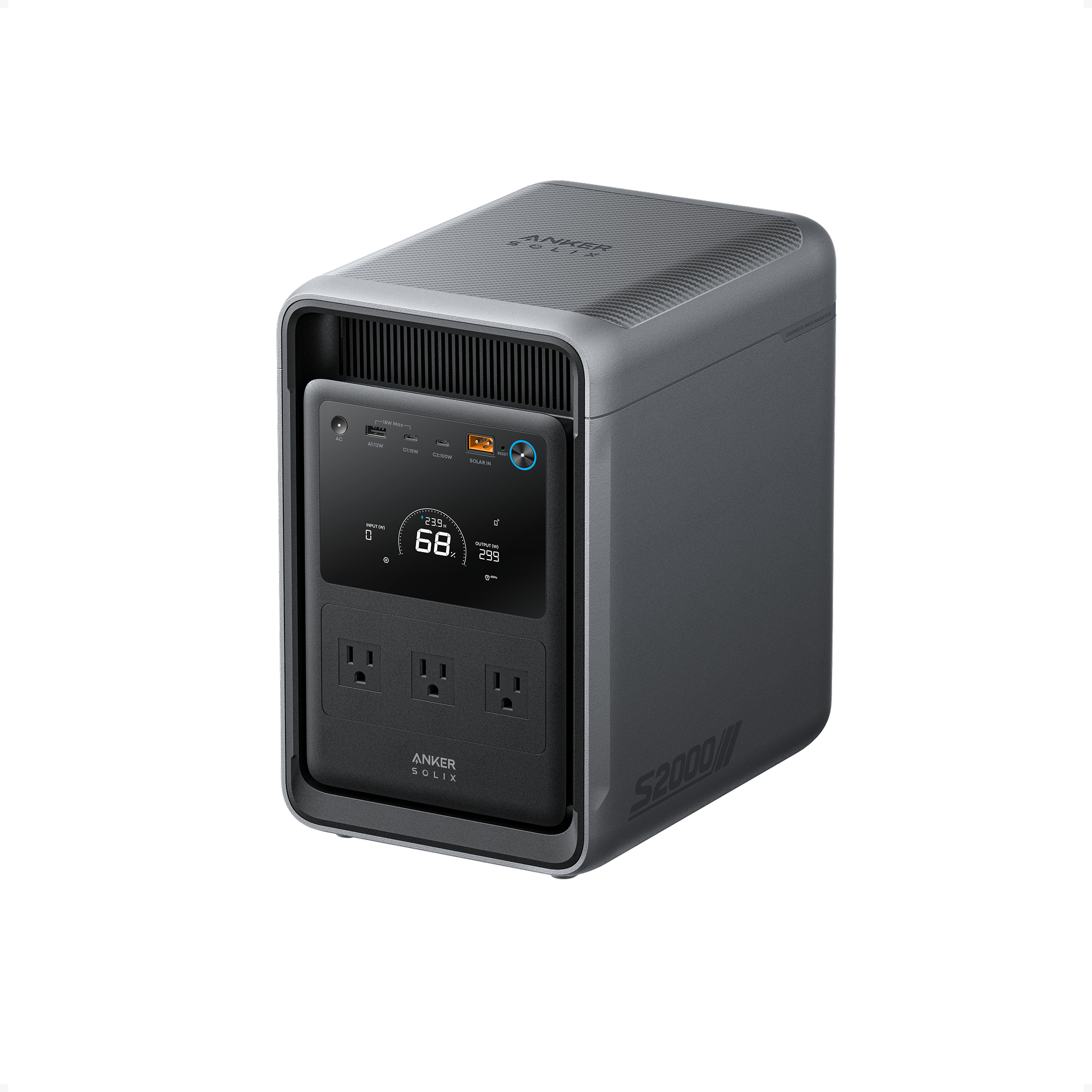
Anker SOLIX S2000Pick
Sold on Amazon · today’s price is on the listing

DJI Power 1000 V2
$699.00
$699.00 · direct from DJI
Last checked 16 days ago. Prices move — check before you buy.
Prices may vary by retailer and are subject to change.