Head-to-head test
Anker SOLIX S2000 vs DJI Power 1000
The DJI hits harder and the Anker lasts longer, and since DJI has already replaced this revision with the Power 1000 V2, the only live version of "hits harder" isn't the unit on this page.
Full profiles: Anker SOLIX S2000 → · DJI Power 1000 →

Written by Ian SchneiderUpdated
Solar & Off-Grid Tester, Station Arena Test Desk
Spec deltas
DJI has replaced the Power 1000 with the Power 1000 V2, so this comparison has one live candidate. The original hasn't vanished — retailers may still be clearing stock, and a unit already in someone's garage is still a good unit — but it is no longer what DJI builds, which is why this page shows no price for it. The specs below are still true and still worth comparing. Only one of them is a recommendation.
On paper the two barely overlap. The SOLIX S2000 carries 2,010Wh and pushes 1,500W; the Power 1000 carries 1,024Wh and pushes 2,200W. One is a large tank with a modest tap, the other a strong tap on a small tank, and the strong tap empties its tank in about the time it takes to reheat dinner and do the dishes.
Across the six scenarios this site models, the S2000 wins three outright, the Power 1000 wins one, and neither covers the other two. Where the Anker wins, it wins on energy. Where the DJI wins, the margin is a published quietness rating that the two makers arrive at by different methods — which tells you how thin the DJI's best row actually is.
What the Numbers Reveal
Each conclusion stated first — the numbers behind it on one line, the full analysis below.
continuous output
That collapses the peak column into a tiebreaker that never gets used — the biggest surge anything on this page asks for is 400W, and both clear it without effort. What's left is continuous output, 2,200W against 1,500W, and the DJI can only spend that for so long: 870Wh usable divided by 2,200W is a bit under half an hour. The Anker holds its own 1,500W ceiling for roughly seventy minutes (1,708Wh usable divided by 1,500W), and it does that with 2,010Wh behind it against the DJI's 1,024Wh.
SOLIX S2000: 1,500W rated output, 3,000W published peakPower 1000: 2,200W rated output, 4,400W published peakAcross all six modelled scenarios the largest startup peak is 400W, and both units start and sustain every onePower 1000 usable energy is 870Wh after the flat 15% allowance applied to every unit here
Why it mattersIf you need a big draw for a short burst, the DJI's shape is right and the live version of it is the Power 1000 V2. If you need a moderate draw for a long stretch — which is what a blackout and a workday both are — the extra energy beats the extra 700W every time.
solar input
Refill is the one place the DJI's spec sheet looks decisive and isn't. At 800W of solar input it takes back its full 1,024Wh in under an hour and a half of strong sun, while the S2000 needs about five hours at 400W to refill 2,010Wh — an entire good solar day. But the DJI refills to a number that already failed the night, 775Wh short of it. Speed doesn't rescue a tank that's the wrong size, and from a wall outlet the point is moot: the Anker is back to 80% in roughly 1.2 hoursA5.
8-Hour Blackout needs 1,645Wh; the S2000 has 1,708Wh usable and finishes with 63Wh spareS2000 solar input is 400W against the Power 1000's 800WS2000 capacity is 2,010Wh; Power 1000 capacity is 1,024WhA 20-amp household circuit refilled the S2000 to 80% in roughly 1.2 hours and to full in about 1.7 hoursA5
Why it mattersIf you're buying for multi-day outages, buy the bigger tank and know where your wall socket or generator is. If you're buying for solar-only resilience, both of these are under-sized and you should be shopping a class up.
rated cycles
A cycle rating only pays out if you know which battery you bought, and that's exactly where the DJI gets slippery right now. A listing that says "Power 1000" may ship the original or the V2, and everything on this page describes the original. Buying the older revision from residual retail stock means inheriting the 4,000-cycle pack on a model the maker has moved past — which is a defensible thing to do at a clearance price and an indefensible one at the old sticker.
S2000 rated for 10,000 cycles; Power 1000 rated for 4,000A cycle is 2,010Wh on the S2000 and 1,024Wh on the Power 1000, so lifetime energy is roughly 20,096 kWh against 4,096 kWhDJI has superseded the Power 1000 with the Power 1000 V2, and both revisions are in circulation
Why it mattersAnyone still shopping a DJI listing should confirm the revision before they compare anything else. Anyone shopping the Anker is picking a model, not a model and a lottery.
The specific dimensions that decide these two units — everything else is a tie.
Runtime: Will It Power Your Gear?
Selected because: 2,010Wh against 1,024Wh and 1,500W against 2,200W — these two units disagree about whether energy or power is the point.
continuous output
Both units hold their rated output until the battery says otherwise, and that's the whole separation. The S2000 has 1,708Wh usable after the flat 15% allowance this site applies to every unit, which is roughly seventy minutes at its full 1,500W. The Power 1000 has 870Wh, which at 2,200W is a bit under half an hour. Faster horse, shorter track.
There's a nice accident in the field reports here: the DJI's fans only become noticeable past 1,500WB1, which is precisely where the Anker stops. The load that makes one of them audible is the load the other one won't take. That is the cleanest statement of the trade on this page — you can have the extra 700W of headroom, or you can have nearly twice the energy behind it, 2,010Wh against 1,024Wh, and a box that never has to work that hard to deliver it.
Your Life, Your Pick
Selected because: Three of the six modelled rows go to the S2000, one to the Power 1000, and two to neither; the margins are where this page is actually decided.
Two of the six rows go to nobody, and those are the honest ones. Van life wants 4,685Wh a day and the S2000 covers about 36% of it; weekend camping wants 2,100Wh and it covers about 81%. Neither of these is a van's power system, and no reading of the peak column changes that.
The row worth staring at is the remote workday, where the Power 1000 misses by 40Wh. Its nameplate 1,024Wh actually clears the 910Wh the day needs — the flat 15% allowance is what tips it under. Trim one small load and it finishes. That is the DJI's problem in miniature: it does the job right up until it runs out of the thing it has least of. The S2000 ends the same day with 798Wh spare and five AC outlets to spread the day's plugs across, against the DJI's two.
Lifetime Value
Selected because: 10,000 rated cycles against 4,000, which works out to close to five times the lifetime energy once you account for the different cycle sizes.
Normalise the cycle ratings for size and the gap stops being a matter of taste. A cycle moves 2,010Wh on the Anker and 1,024Wh on the DJI, so 10,000 against 4,000 becomes roughly 20,096 kWh of rated lifetime energy against 4,096 — close to five times. Neither pack dies at the limit, either; it settles to about 80% of original capacity and keeps going.
Daily cycling is where that actually bites: 27.4 years against 11. If this is a cabin or a rig that draws the pack down most days, the Anker is still working through a second decade while the DJI has reached its rated limit. Use it twice a week and the numbers turn comic — 96 years against 38 — at which point the cycle rating has stopped being a buying criterion and the rest of the page has to decide it.
Brand Trust
Selected because: One of these models has two revisions in circulation under nearly the same name, so knowing which one a listing ships matters more here than brand loyalty does.
The most useful sentence on this page for a DJI shopper is a housekeeping one: check the revision. DJI came into power stations in 2024 from the drone business and has already shipped a second version of this exact model, so a listing that just says "Power 1000" can be either machine, and every spec here describes the original. Two other DJI-specific things are worth knowing before the badge does the deciding — there's no built-in solar charge controller, so solar needs a separate proprietary adapter, and the SDC fast-charge ports only pay off if you already own DJI gear.
The Anker side has its own asterisk and it belongs here rather than buried. The support operation that built the brand's name on no-hassle replacements isn't quite the one that answers on SOLIX now: AI-first agents, and a return on a 35.7 lb unit that ships as hazmat. That's not a reason to buy the other one, which has no live listing to return to. It is a reason to buy from a retailer whose own return policy you'd be happy to use.
Strengths & trade-offs
Anker SOLIX S2000
Strengths
- +Larger battery capacity
- +Rated for 10,000 charge cycles — much longer battery lifespan
Trade-offs
- –Weaker inverter (-700W) limits appliance compatibility.
DJI Power 1000
Strengths
- +Lighter by 7 lb
- +Higher AC output
- +Faster solar charging
Trade-offs
- –Shorter-lived battery — rated for 4,000 charge cycles vs the SOLIX S2000's 10,000, so it wears out sooner.
Will It Power Your Gear?
Scenario math and per-appliance runtimes, modeled from the spec record.
Scenario verdicts
We ran the math on six real-world scenarios. Here's which unit survives your actual life.
SCN-01 · 2 nights · needs 2,100Wh
Weekend Camping
Two nights off-grid with essential comfort
Neither unit
Neither unit covers this scenario's 2,100Wh: the SOLIX S2000 comes up 392Wh short (about 81% covered), the Power 1000 1,230Wh (41%). Treat this as partial cover — enough for the essentials in it, not the whole list.
Battery budget usedlower = more headroom
LOAD Phone Charger 15W×6h · LED Lights 40W×8h · Box Fan 75W×14h · CPAP Machine 40W×16h
SCN-02 · 8 hours · needs 1,645Wh
8-Hour Blackout
Keep the essentials running through a night without power
SOLIX S2000
The S2000 finishes the eight hours with 63Wh of its 1,708Wh usable still in the tank. That's a pass with nothing behind it — under 4 percent. One night, fine; plan on two and what you're really planning is a recharge, so know where the refill comes from before the outage explains it to you. The Power 1000 ends the same night 775Wh short, a little over half the list covered.
Battery budget usedlower = more headroom
LOAD Fridge 150W×8h · Router + Modem 20W×8h · LED Lights (4 bulbs) 40W×6h · Phone Charger 15W×3h
SCN-03 · 8 hours · needs 320Wh
CPAP Overnight
Sleep therapy without interruption — the #1 medical use case
Either unit
Capacity settles nothing here. The night runs about 320Wh, and the smaller unit still ends it with 550Wh in hand, so both of these are several nights of CPAP whatever the percentages say. The row goes to the Power 1000 on published quietness, and each maker arrives at that rating its own way, so treat it as a prompt to find hands-on reports rather than a gap you can count on hearing. The part a CPAP buyer can actually act on: the unit this row favours is the one DJI has already replaced.
Battery budget usedlower = more headroom
LOAD CPAP Machine 40W×8h
SCN-04 · 8 hours · needs 910Wh
Remote Workday
Full work day off-grid without power anxiety
SOLIX S2000
The Power 1000 comes up just short — it needs 910Wh and has 870Wh usable, a 40Wh gap (its nameplate 1,024Wh actually clears this — the flat 15% conversion allowance is what tips it under). Trim that much — one small appliance's worth across the day — and it finishes. The SOLIX S2000 covers it outright with 798Wh to spare.
Battery budget usedlower = more headroom
LOAD Laptop 60W×8h · External Monitor 30W×8h · Router + Modem 20W×8h · Phone Charger 15W×2h
SCN-05 · 4 hours · needs 670Wh
Tailgate Party
Game day power for the crew
SOLIX S2000
Game day asks 670Wh and a 400W peak, which is a light afternoon for both. So the tailgate comes down to the walk from the car — 28.7 lbs for the Power 1000, 35.7 lbs for the S2000. The Anker still takes the row on reserve, 39% used against 77%, but the seven pounds is the part you'd actually feel, and it goes the other way. Credit where it's due.
Battery budget usedlower = more headroom
LOAD Blender 400W×0.5h · LED TV (55") 80W×4h · Bluetooth Speaker 15W×4h · Phone Charger (×3) 45W×2h
SCN-06 · 24 hours · needs 4,685Wh
Van Life Daily
A full day of mobile living — the ultimate endurance test
Neither unit
Neither unit covers this scenario's 4,685Wh: the SOLIX S2000 comes up 2,977Wh short (about 36% covered), the Power 1000 3,815Wh (19%). This is well outside what either unit is for; the right answer here is a larger station, not a choice between these two.
Battery budget usedlower = more headroom
LOAD Mini-Fridge 150W×24h · Laptop 60W×4h · Phone Charger 15W×3h · LED Lights 40W×5h · Fan 75W×8h
The Load Test
RUNTIME = (Wh × 0.85) ÷ LOAD
None of the scenarios above exactly yours? Build it. Toggle what you'd plug in; both units are tested against the combined draw.
Essentials
Comfort & Convenience
High-Draw Appliances
Test duration
8h
Continuous draw
205W
Projected runtime
For this load: SOLIX S2000 runs 8.3h vs 4.2h.
Sold on Amazon
Planning for more than this? Describe your whole setup and get it sized →
Modeled from the spec record — same math as the tables below. Methodology
Runtime by appliance
Real-world runtime estimates for common appliances, modeled at 85% inverter efficiency.¹
Essentials
The basics you need runningscale 0–113.9hComfort & Convenience
Makes off-grid life actually enjoyablescale 0–22.8hHigh-Draw Appliances
These reveal the real limitsscale 0–1.7h¹ Runtime = (capacity × 0.85) ÷ appliance watts. Within each group, all bars share one time scale (the group's longest runtime), so lengths are comparable across appliances; identical runtimes collapse into a single blue/orange bar. Actual runtime varies with battery age, temperature, and simultaneous loads — see methodology.
Conclusion
September 19, 2026
Verdict: the Anker SOLIX S2000
Take the SOLIX S2000, and take it on energy rather than on availability, though availability settles it anyway. It holds 2,010Wh to the Power 1000's 1,024Wh, wins three of the six modelled scenarios outright to the DJI's one, and is rated for 10,000 cycles against 4,000 — close to five times the lifetime energy once you account for the different cycle sizes. The DJI's real advantage is 2,200W of continuous output against 1,500W, and it is a narrow one: with 870Wh usable, it can hold that output for a bit under half an hour. DJI has superseded this unit with the Power 1000 V2, so if the higher output is genuinely what you need, shop that instead of the original. For a blackout, a work-from-anywhere day, or a weekend where the job is hours rather than watts, the Anker is the machine.
Editor-assigned confidence, based on cited owner research and spec analysis.
List prices as of September 19, 2026. The links below open Anker's current price.
Sold on Amazon · today’s price is on the listing
Written by Ian Schneider, Solar & Off-Grid Tester · Station Arena Test Desk · Updated September 19, 2026
Measured Data
Benchmark scores and the full spec record, side by side.
Benchmark scores
Not rated for both units (minimum threshold unmet): RV Living, Food Truck.
Full specifications
ᵈ Derived: price ÷ rated capacity. See the data behind our comparisons →
Comparison ToolAdd more power stations, side by sideOpen Tool →How these numbers are produced
Numeric verification
Every figure on this page traces to our spec database or arithmetic on it — no estimated numbers.
Owner claims
Statements about owner experience are cited to published reviews — see Sources & Research Notes below.
Runtime model
Runtime = (rated capacity × 0.85 inverter efficiency) ÷ device wattage. Solar recharge estimates assume panels deliver 70% of rated output. Cold weather, battery age, and stacked loads reduce real-world results.
Power Score
Computed from 14 published spec dimensions, weighted per use-case bench. Higher is better; a unit must meet a bench's minimum threshold to be rated.
See the full weight table and data sourcing on our methodology page →Class ranking (the star rating)
Each unit's star score is a category ranking, not customer reviews — no buyer opinions feed it. We score every station on size-independent quality (value, output, portability, endurance, ports, warranty, and more), then percentile-rank it against the other units in its capacity class, so a class-leading compact unit and a class-leading whole-home unit can both earn 5★. Here, SOLIX S2000 rates 5.0/5 (99th percentile of 26 Large-class units), and Power 1000 rates 4.3/5 (58th percentile of 27 Everyday-class units).
How the class ranking is computed →Test Notes & Caveats
Hidden gotchas and advantages we spotted that you won't find on the product page.
SOLIX S2000: Fixed Capacity
The SOLIX S2000 is sealed at 2,010Wh, and that is the ceiling. Normally the counterpoint would be that the Power 1000 can add expansion batteries, but that isn't a live option here: the Power 1000 is no longer sold, and DJI points owners to the Power 1000 V2. For a new purchase the expansion question doesn't arise between these two, so the SOLIX S2000's fixed 2,010Wh is simply what you get.
UPS Switchover: ≤10ms vs ≤20ms
Both list a UPS mode, at different rated speeds. The SOLIX S2000 is rated ≤10ms — quick enough on paper that desktop PCs and routers should ride through, treating that as the rating it is. The Power 1000 is rated ≤20ms — fine on paper for routers and most electronics; the fussiest PC power supplies sit right at this line. If a computer with unsaved work is the thing being protected, the stated class is worth the attention; nothing here is a lab result.
Warranty: Same Five Years, Different Odds of Collecting
Both units carry a five-year warranty, so on paper coverage is a wash and no tiebreaker at all. The difference is where the unit comes from. DJI advertises the full five years through its own store, and its own store has moved on to the Power 1000 V2 — so a Power 1000 found in a retailer's remaining stock comes with whatever term that seller honours, which may not be the headline number. The Anker's five years cover a model still in the range, which means a claim is a repair or replacement of something the maker is still building and still stocks parts for. Read the printed term on the listing in front of you rather than assuming the figure on this page is the one you'd get.
Battery Lifespan in Real Years
The SOLIX S2000 is rated for 10,000 cycles vs 4,000. In real life: at daily use, that's 27.4 vs 11 years. At weekend use (twice a week), it's 96 vs 38 years. One caution reading years across different sizes: a cycle is 2,010Wh on the SOLIX S2000 and 1,024Wh on the Power 1000, so count lifetime energy — roughly 20,096 kWh against 4,096 kWh over the rated life. After hitting the cycle limit, the battery doesn't die — it drops to ~80% of original capacity, which is still very usable.
Full record above — the Test Desk pick is the SOLIX S2000.
Check SOLIX S2000 price →Ownership Analysis
What happens after you buy — true cost of ownership, brand trust, and growth potential.
Lifetime value
Service lifeyears at one full cycle per day
Lifetime energy delivered
Cost per delivered kWh
│ warranty ends · Reaching the cycle rating means ~80% capacity remains — degraded, not dead.
Analyst note
The Power 1000 is no longer sold, so there is no price to work its cost per kWh from, and this comparison doesn't quote one. On what you can actually buy today, the SOLIX S2000 works out at $0.03/kWh over its rated life. If you already own the Power 1000, the hardware comparison still holds: over its rated life the SOLIX S2000 delivers about 20,096 kWh and the Power 1000 about 4,096 kWh.
Brand trust
Anker
Ecosystem
7-8 SOLIX portable power stations across C-series (compact) and F-series (flagship), plus the X1 home energy system
Support
US-based support. Historically known for incredible no-hassle replacements, but recent reports describe AI-driven support agents giving generic responses and complex return logistics for heavy units (hazmat shipping). The Anker brand reputation is still strong, but SOLIX-specific support quality is trending down.
Community
Moderate — active Reddit (r/Anker, r/AnkerSOLIXCommunity) and growing. Benefits from Anker's massive consumer electronics brand awareness.
App experience
Rated 4.5/5 iOS (~1,100 ratings) · 4.3/5 Android
Unique strength
Parent brand trust from Anker's consumer electronics dominance. InfiniPower technology for long cycle life. Strong $/Wh value in the mid-size and larger units — the S2000, F2600 and C1000 are among the better buys per watt-hour in the catalog.
Worth knowing
Support quality appears to be declining from its historically excellent level. Firmware updates have removed features without warning. Expansion ecosystem is smaller than EcoFlow's.
DJI
Ecosystem
New entrant (2024) — five power station models to date: Power 500, Power 1000 (since superseded by the V2 but still sold), Power 1000 V2, Power 1000 Mini, Power 2000. Buying a "Power 1000" listing? Check which revision it actually ships.
Support
Leveraging DJI's established global support and repair center network from the drone business. Generally positive reputation inherited from drone operations, but limited power-station-specific track record.
Community
No dedicated power station community yet. Discussions happen within r/dji (~250K members, mostly drone users). Very small power-specific presence on Facebook and forums.
App experience
Rated 3.5/5 iOS and Android (DJI Home app ratings reflect entire DJI ecosystem including drones/cameras, not power-station-specific). Users report the on-device screen is more reliable than the app.
Unique strength
Runs quiet — 23-30dB published on most of the range (manufacturer best-case figures), at the quiet end of the category; our record carries no figure for the Power 1000 V2. Fast wall charging, quickest on the Power 1000 V2 at ~56 min — that figure is the V2's, not the whole line's. 700+ battery patents from drone R&D. SDC ports for ultra-fast DJI drone charging. Premium industrial design and build quality. LFP batteries rated for 4,000+ cycles.
Worth knowing
A recent entrant to power stations, arriving long after the established players, so there is less long-term field data than for EcoFlow, Jackery or BLUETTI — though DJI brings a deep hardware track record from drones. No built-in solar charge controller (requires a separate proprietary adapter). SDC ports are proprietary to the DJI ecosystem, so their fast-charging advantage mostly benefits people who already own DJI gear. Battery expansion is available on the newer Power 2000 and Power 1000 V2, but not on the earlier Power 1000 or Power 500 — check the specific model.
Analyst note
Anker has been building these for years and runs seven or eight SOLIX stations across its range; DJI came in from drones in 2024 and has already put out a second revision of this exact model. Neither fact is a knock — DJI's hardware pedigree is real and the industrial design shows it. But it changes what you check before you buy. With Anker you're choosing a model. With DJI's Power 1000 you're choosing a model and a revision, and only one of those two revisions is what the company currently makes.
Growth path
SOLIX S2000
FIXED CAPACITYFixed at 2,010Wh — a sealed, complete system rather than a starting point. There's no expansion port, so that figure is the ceiling: check it against your longest unplugged stretch before you buy.
Accepts up to 400W of solar. Suitable for a 1-2 panel setup.
Adequate ports for most setups, but heavy users may want a power strip.
Power 1000
EXPANDABLESupports DJI expansion batteries, so you can add capacity later without replacing the base unit — useful if your needs may climb past 1,024Wh.
Accepts up to 800W of solar. Suitable for a 1-2 panel setup.
Adequate ports for most setups, but heavy users may want a power strip.
Expansion batteries are DJI-specific. You're investing in the DJI ecosystem.
Realistic full solar rechargeat 70% of rated panel output — see methodology
Analyst note
Growth only counts if you can still buy in, and the Power 1000 is no longer sold (DJI points owners to the Power 1000 V2). That leaves the SOLIX S2000: it is sealed at 2,010Wh, so buy the size that covers you now. The Power 1000's expandability still matters if you already own one, but it isn't a reason to pick it over the SOLIX S2000.
What Owners Report
Patterns from published owner reports and long-term reviews — every claim cited to its source below.
Anker SOLIX S2000
Field data on the S2000 is genuinely early: our research found no long-term owner threads, forum history or six-months-later reports, because the unit only launched in June 2026A0. What exists is two independent hands-on tests rather than press-kit repetitionA0, so read everything below as weeks of use, not seasons.
The consistent finding across both is that it stays quiet unless you make it work — fans spin up under heavy load or the fastest charging mode and otherwise the unit is effectively silentA1A2. Standby draw held up under separate measurement too: about 6W with AC ports live but unused, dropping to roughly 2W with outputs off, and a fully charged unit left alone for ten hours lost a single percentA3A4. One reviewer ran a fridge and assorted kitchen gadgets past 60 hours on a chargeA12, and a wall recharge hit 80% in about 1.2 hours from a standard 20-amp circuitA5. The UPS behaviour was checked rather than assumed — connected office gear rode through a simulated cut without interruptionA9A10.
The complaint both outlets landed on independently is the carry handle, or the lack of a good one: 35.7 lbs is a manageable weight badly served by the grip, and moving it up stairs is where you noticeA7A8. One reviewer also caught a faint warm-electronics smell in a closed office during the first hours of sustained load, which faded within a dayA6. Neither is a dealbreaker; both are the kind of thing you'd rather hear before delivery.
“Fans only spin up under real load or fast charging, and at idle the unit is silent.”
Sources
ess-news.com · geardiary.com
DJI Power 1000
The Power 1000 has the deeper review record of the two, and it is consistent: quiet operation and dependable output are the recurring themes, with a following among drone pilots and campersB0B1B4. Reviewers place it among the quietest in its class under normal loads, with sound only becoming noticeable past 1,500W and reading as a soft whoosh rather than a whineB1.
Output holds up outside the spec sheet, which matters given that output is this unit's whole argument. One test ran it at 2,400W — above its 2,200W rating — for twenty minutes with no shutdown and no racketB2. Wall charging came in around 70 minutes to full and about 50 minutes to 80%, with the fan barely audible at full speedB3. Over a week of camping it carried a 45W compressor fridge alongside phones, laptops and lightsB4. Note that our ledger describes the base Power 1000, not the V2 that replaced itB0 — another reason to confirm which revision a listing ships.
“Whisper-quiet operation — one of the quietest power stations in its class, nearly silent under normal loads; sound only becomes noticeable past 1,500W, and even then it's a soft whoosh rather than the high-pitched whirring you'd get from BLUETTI or EcoFlow.”
Sources
thesolarlab.com · trailandkale.com · offgridbenchmark.com · superfashion.us · dronexl.co
Sources & Research Notes
Every owner claim in this report is traceable to a published source. The bracketed references above resolve here.
Recurring owner themes
- Two independent hands-on reviews both found near-silent idle operation, with fans spinning up only under heavy load or the fastest charging mode. [SOLIX S2000 · 2 entries]
- OptiSave's low-idle-draw claim held up under independent testing, with both reviewers separately measuring single-digit-watt standby draw. [SOLIX S2000 · 2 entries]
- Both reviewers praised fast, reliable UPS switchover that connected electronics didn't notice. [SOLIX S2000 · 2 entries]
- Despite otherwise solid build quality, reviewers from two different outlets independently flagged the single/absent carry handle as awkward for one-person transport. [SOLIX S2000 · 2 entries]
- Standout quiet operation (quieter than EcoFlow/BLUETTI), robust real-world output above its rating, and appeal to drone pilots and campers are the consistent themes. [Power 1000 · 3 entries]
- A1
“Fans only spin up under real load or fast charging, and at idle the unit is silent.”
ess-news.com — Anker Solix S2000 review: 2 kWh power station built for the long haul · 2026-05 · [positive]
- A2
“The fans only spin up when pulling a heavy load or using the fastest charging mode — otherwise it stays very quiet.”
geardiary.com — Anker SOLIX S2000 Review · 2026-07 · [positive]
- A3
“Charged fully, disconnected from wall power with AC output enabled and no loads attached, then monitored for 10 hours: state of charge dropped only to 99%, implying about 2W average draw — matching Anker's spec.”
ess-news.com — Anker Solix S2000 review: 2 kWh power station built for the long haul · 2026-05 · [positive]
- A4
“With AC ports on but unused, consumption is about 6W; with everything disabled it drops to just 2W.”
geardiary.com — Anker SOLIX S2000 Review · 2026-07 · [positive]
- A5
“Real-world recharge from a standard 20-amp household circuit hit 80% in roughly 1.2 hours and full capacity in about 1.7 hours, matching the manufacturer's claims.”
ess-news.com — Anker Solix S2000 review: 2 kWh power station built for the long haul · 2026-05 · [positive]
- A6
“Under sustained AC load in a small, closed home office there was a slight warm-electronics smell within a few feet of the unit during the first several hours of operation; it faded after one day with no safety concern.”
ess-news.com — Anker Solix S2000 review: 2 kWh power station built for the long haul · 2026-05 · [mixed]
- A7
“At 35.7 lbs the weight is manageable but noticeable — a second handle would be welcome for carrying it up stairs.”
ess-news.com — Anker Solix S2000 review: 2 kWh power station built for the long haul · 2026-05 · [mixed]
- A8
“Lacks a dedicated handle for carrying with one hand, making transport less convenient despite the relatively compact 35.7 lb weight.”
geardiary.com — Anker SOLIX S2000 Review · 2026-07 · [negative]
- A9
“In a simulated outage, connected office equipment rode through the switchover without interruption.”
ess-news.com — Anker Solix S2000 review: 2 kWh power station built for the long haul · 2026-05 · [positive]
- A10
“A 10ms switchover time means a computer or internet router won't even flicker if the grid goes down.”
geardiary.com — Anker SOLIX S2000 Review · 2026-07 · [positive]
- A12
“Easily powered a fridge and various kitchen gadgets for over 60 hours without needing a recharge.”
geardiary.com — Anker SOLIX S2000 Review · 2026-07 · [positive]
- B1
“Whisper-quiet operation — one of the quietest power stations in its class, nearly silent under normal loads; sound only becomes noticeable past 1,500W, and even then it's a soft whoosh rather than the high-pitched whirring you'd get from BLUETTI or EcoFlow.”
thesolarlab.com / trailandkale.com — DJI Power 1000 review · 2026 · [positive]
- B2
“Tested at 2,400W — slightly above its 2,200W output rating — for 20 minutes and handled it without loud noise or automatic shut-offs.”
offgridbenchmark.com / superfashion.us — DJI Power 1000 review · 2026 · [positive]
- B3
“AC charging takes about 70 minutes from 0% to 100% (about 50 minutes to 80%), and during full-speed charging the fan barely makes a sound.”
thesolarlab.com — DJI Power 1000 review · 2026 · [positive]
- B4
“Over a week-long camping trip it powered a 45W compressor fridge, phones, laptops, and LED lights; it's also a favorite of drone pilots for fast-charging DJI batteries while running other devices.”
offgridbenchmark.com / dronexl.co — DJI Power 1000 review · 2026 · [positive]
Research compiled September 19, 2026.
What Owners Actually Report
Drawn from 151 comments on independent review channels — not from retailer reviews, which skew to the first week of ownership. Each line is our summary of one commenter's claim, linked to the original. We record what they said, including where it contradicts the spec sheet.
Anker SOLIX S2000
27 claims from 20 comments · 8 from owners · 4 with figures
- Price & value
- 5 · 5% negative
- Runtime
- 5 · 0% negative
- Solar input
- 4 · 42% negative
- Size & weight
- 1 · 0% negative
- Other
- 5 · 38% negative
What owners complain about
First-boot firmware update needs wifi but powers off connected devices, so it can't back a router.
UPS switchoverowner1 agreedsource →
Output voltage visibly dropped around 30% state of charge, which he says is not good.
Build qualitysource →
Only a single 400W solar input instead of dual 500W inputs is a drawback.
Solar input3 agreedsource →
What owners praise
Bought two Anker S2000s direct at $600 each plus tax for 2 kWh apiece.
Price & valuemeasuredowner3 agreedsource →
S2000 weighs 10 lb less than his AC180 while carrying nearly twice the capacity.
Size & weightmeasuredowner3 agreedsource →
With a 420W panel it stayed at 100% most of the day while running a fridge.
Solar inputmeasuredownersource →
DJI Power 1000
200 claims from 131 comments · 98 from owners · 31 with figures
- Price & value
- 33 · 11% negative
- Charging
- 22 · 20% negative
- Solar input
- 28 · 52% negative
- App & firmware
- 27 · 79% negative
- Other
- 20 · 53% negative
What owners complain about
Bought and tested it: 140W is out of the USB-C port's league.
Chargingmeasuredowner9 agreedsource →
The 400W MPPT modules run hot and throttle solar watts until he added copper heatsinks.
Build qualitymeasuredowner5 agreedsource →
Says the inverter draws about 50W, which DJI never mentions but which decides real autonomy.
Idle drainmeasuredowner1 agreedsource →
What owners praise
Ordered one on Amazon for under $400 in a November deal.
Price & valuemeasuredowner11 agreedsource →
SDC ports charge Mavic 3 batteries about 50% faster than the 120V fast charger; USB-C rated 140W.
Chargingmeasuredowner5 agreedsource →
Confirms DJI's quietness claim while charging is not exaggerated.
Noiseowner38 agreedsource →
Claims are weighted by how specific they are, whether the commenter owns the unit, and how many readers agreed. Comments that mention a product under a rival's review count for more, because the commenter had no reason to be there. This is what buyers report, not our test results — for measurements we ran ourselves, see the methodology.
Who Should Buy Which
Buy the SOLIX S2000 if you…
- →You're buying for the night the grid drops and the fridge, the router, two lamps and a laptop all need somewhere to plug in. Five AC outlets, 1,708Wh usable, and a UPS rated no worse than 10ms — put the desktop behind it and keep typing.
- →You cycle it hard: a cabin, a job site, an off-grid setup that pulls the pack down most days. 10,000 rated cycles is 27.4 years of daily use, and that's the spec that puts a decade and a half between these two.
- →You want one box for the whole weekend and you're honest that it won't cover all of it. The S2000 handles about 81% of the modelled camping list, so you'll trim something — but you'll trim it once, not rewrite the list.
Buy the Power 1000 if you…
- →You already own one. Nothing here is a reason to replace it: 1,024Wh, 2,200W continuous, a five-year term, and one independent test that held it at 2,400W for twenty minutes without complaintB2. Keep using it.
- →You genuinely need 2,200W continuous in a 28.7 lb box, which is a different machine from the Anker and a legitimate thing to want. That shape is still being made — it's called the Power 1000 V2. Buy the current revision rather than hunting leftovers of this one.
- →You're a DJI drone pilot who wants the SDC fast-charge ports in the same box as your camp power. Same answer: shop the revision, not this listing.
If neither fits
If the whole job is a CPAP, close this tab and buy something much smaller — the night is about 320Wh, and even the smaller of these two finishes it with 550Wh still in hand, which means you'd be paying for roughly three times the battery the job needs. And if it's van life at 4,685Wh a day, you're in the wrong weight class entirely: that's a larger station or a proper house bank, not a choice between these two.
The Bottom Line
Take the SOLIX S2000. It holds nearly twice the energy, it's rated for two and a half times the cycles, and it's the only one of the two its maker is still building. The DJI's advantage is real and it is narrow: 2,200W of continuous output against 1,500W, spendable for a bit under half an hour before the battery taps out. Every other row on this page is the Anker's, or nobody's.
If what you actually need is that 2,200W, don't go hunting the original — the live version of that machine is the Power 1000 V2. For everyone else, the S2000 is the bigger tank, the longer-lived pack, the one with five AC outlets instead of two, and the one whose warranty is attached to a product still in production. Go get the Anker.
Frequently Asked Questions
Answers drawn from the spec record and cited owner research.
Is the DJI Power 1000 discontinued?
It's been superseded, which isn't quite the same thing. DJI replaced it with the Power 1000 V2, so the original is no longer what DJI builds, though retailers may still be working through stock and a unit you already own is unaffected. The thing to avoid is choosing the older revision over the one the maker currently sells and supports.
Which one starts a bigger appliance?
The DJI, on paper: 4,400W peak against the Anker's 3,000W. Both figures are exactly double each unit's continuous rating, so neither has more proportional headroom than the other. In practice it decides nothing here — the heaviest startup surge in any of the six scenarios on this page is 400W, and both units start and sustain all six. If you have a specific high-surge tool in mind, check it against the 1,500W and 2,200W continuous ratings first, because that's the wall you'll actually hit.
Will either one run my fridge through an overnight outage?
A fridge on its own, yes, comfortably — one reviewer ran a fridge plus kitchen gadgets past 60 hours on the S2000, and the Power 1000 carried a 45W compressor fridge for a week of camping alongside other loads. The full blackout list is a different question. The modelled eight-hour outage needs 1,645Wh; the S2000 covers it with 63Wh to spare and the Power 1000 lands 775Wh short, a little over half the night.
Can I add a second battery to either of these?
No, and on these two that's less of a criticism than it sounds. Both are sealed at their rated size, 2,010Wh and 1,024Wh, so what you buy is the ceiling on day one. Size it against your longest unplugged stretch, because the upgrade path on either unit is a second unit.
Is the Anker S2000 quiet enough to sleep next to?
Two independent hands-on tests both found the fans only spin up under heavy load or the fastest charging mode, with the unit effectively silent otherwise. A CPAP draws about 40W, which is nowhere near the load that wakes the fans, and measured standby with AC live was about 6W. Ignore the published decibel figures when you compare these: both makers publish them their own way, so the two numbers aren't measuring the same thing and the difference between them isn't something you can count on hearing.
Brand matchup
Anker SOLIX vs DJI: measured across every matchup →Where to buy
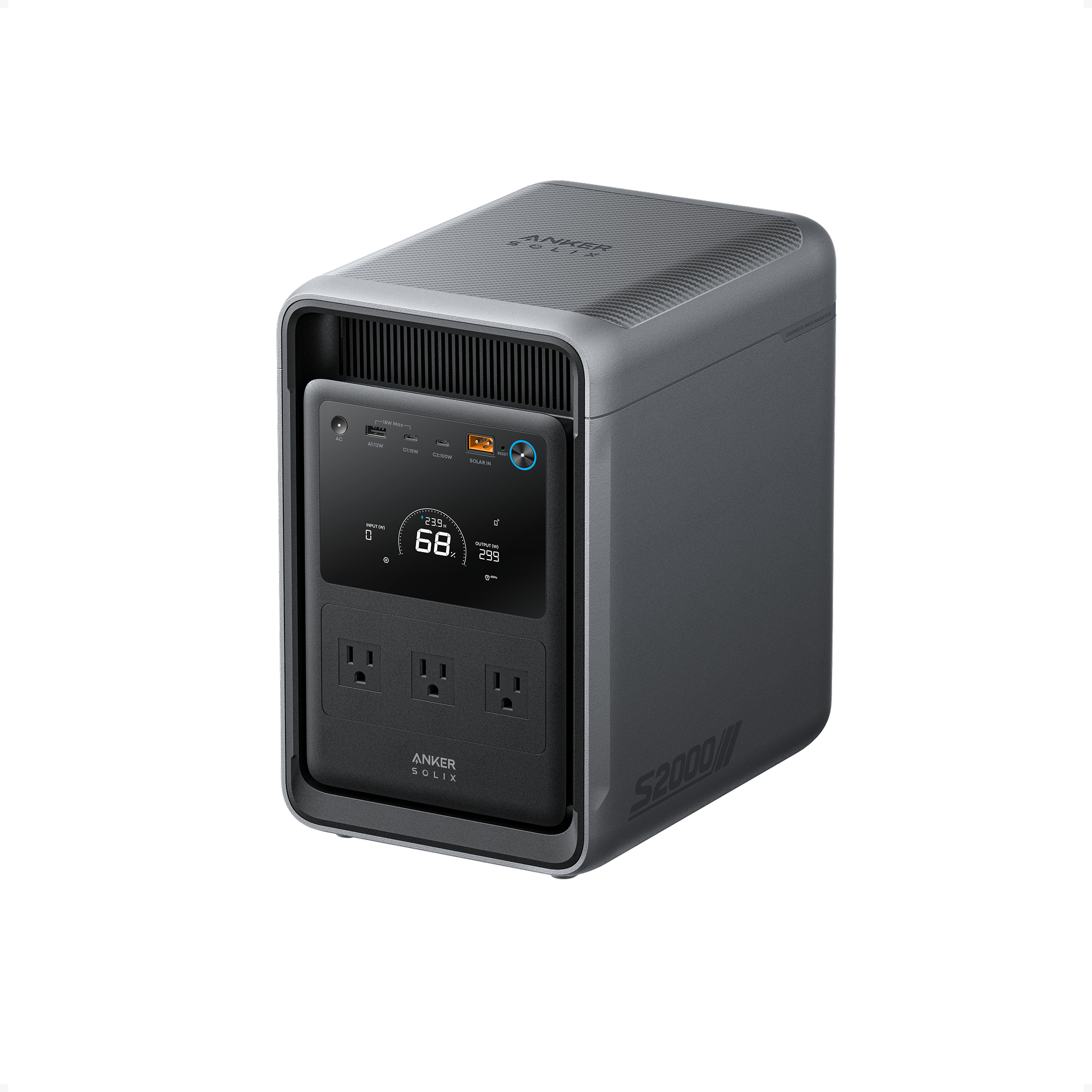
Anker SOLIX S2000Pick
Sold on Amazon · today’s price is on the listing

DJI Power 1000
Superseded — buy the V2
Prices may vary by retailer and are subject to change.