Head-to-head test
Anker SOLIX S2000 vs BLUETTI AC200L
The BLUETTI AC200L is the only one here that expands past 2kWh, and it's the stronger outlet at 2,400W. But the Anker SOLIX S2000 is $199 cheaper, 26.7 lbs lighter, rated for more than three times the cycles, and skips the AC200L's documented WiFi headache. Unless you truly need to grow the battery, the newer Anker wins going away.
Full profiles: Anker SOLIX S2000 → · BLUETTI AC200L →

Written by Gunner GustafsonUpdated
Whole-Home Backup Tester, Station Arena Test Desk
Spec deltas
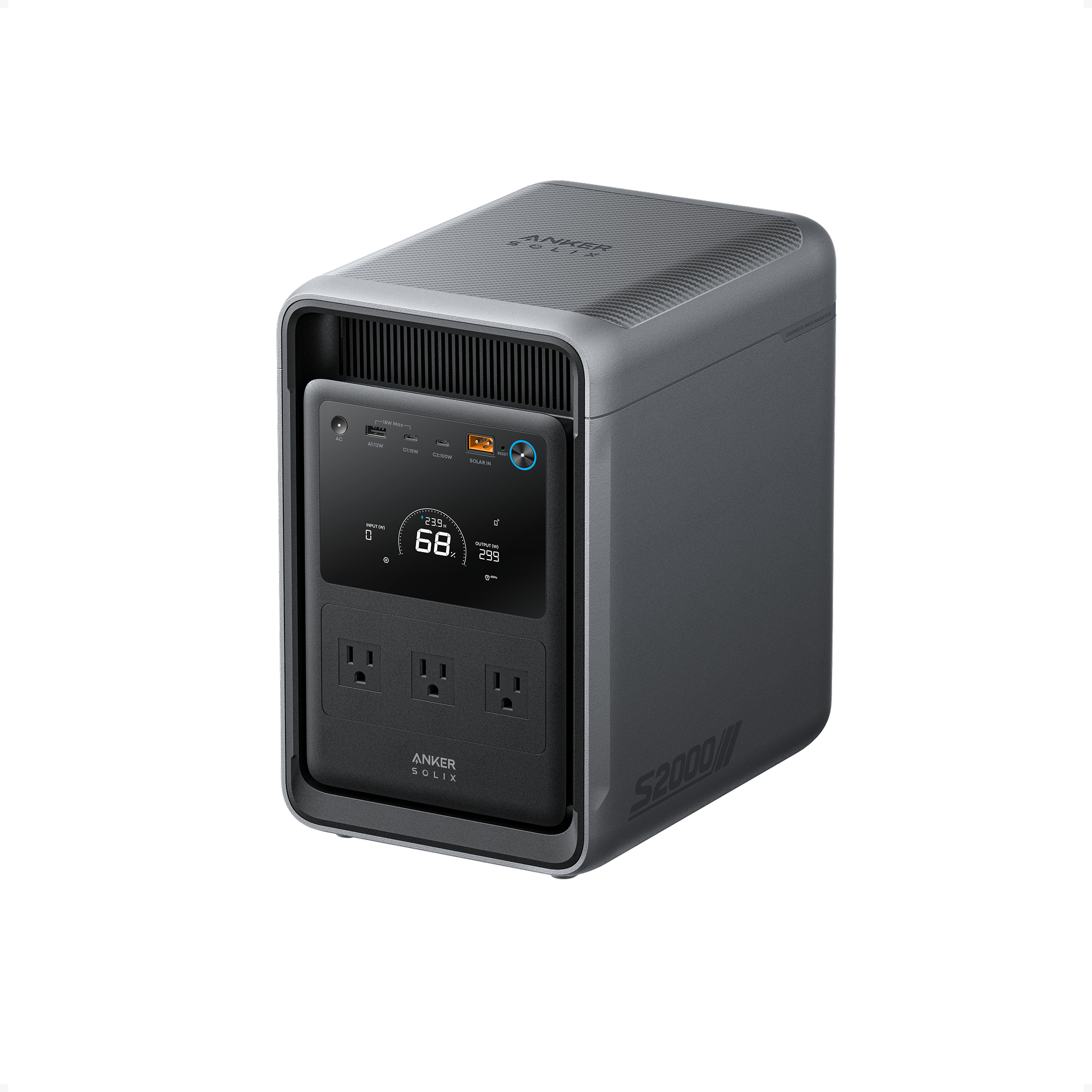
The Anker SOLIX S2000 is $199 cheaper than the BLUETTI AC200L ($700 to $899), 26.7 lbs lighter, and rated for more than three times the charge cycles — and it still covers every everyday load the AC200L does. On the spec sheet this isn't close.
The AC200L answers with two genuine advantages. It expands: pair it with BLUETTI battery packs and it grows past its 2,048Wh base, where the S2000 is sealed at 2,010Wh for good. And it's the stronger outlet, 2,400W to the S2000's 1,500W, with 1,200W of solar input to the S2000's 400W for faster off-grid refills.
Everywhere else, the newer Anker is the easier unit to live with. It weighs 35.7 lbs to the AC200L's 62.4, switches over in 10ms rather than 20, and runs silent at idleA1 where the AC200L is rated 50dB under load. Its app connects, too — the AC200L's WiFi and cloud login are one of the most repeated complaints its owners fileB2B3. The S2000 is six weeks old, so its 10,000-cycle rating is still a promise, but the early field notes are clean.
What the Numbers Reveal
Each conclusion stated first — the numbers behind it on one line, the full analysis below.
cost / lifetime kWh
The S2000 costs $199 less and its 10,000-cycle rating delivers 20,096 kWh over its life to the AC200L's 6,144 — so it works out to $0.03 per lifetime kWh against $0.15, roughly five times cheaper per unit of energy.
S2000 $700 vs the AC200L's $899S2000 rated 10,000 cycles vs the AC200L's 3,000S2000 $0.03 per lifetime kWh vs the AC200L's $0.15
Why it mattersOn lifetime economics this isn't a contest; the AC200L has to win on something the S2000 can't do.
Neither base covers a van-life day (about 4,685Wh) on its own, but the AC200L can bolt on battery packs to get there while the sealed S2000 tops out at 2,010Wh forever.
AC200L accepts BLUETTI expansion batteries past its 2,048Wh basethe S2000 is sealed at 2,010Wh with no expansion porta van-life day needs about 4,685Wh, more than double either base
Why it mattersIf your needs are heading toward partial-home or off-grid backup past 2kWh, the AC200L's expansion is the single reason to pay more.
weight
The S2000 is 26.7 lbs lighter to move, switches to battery twice as fast at 10ms, and runs near-silent, while the AC200L is a 62-lb unit rated 50dB under load with a fan and relay owners hear cycling at idleB1.
S2000 weighs 35.7 lbs vs the AC200L's 62.4 lbsS2000 hands off in 10ms vs the AC200L's 20msthe AC200L is rated 50dB under load with a fan and PV relay that cycle at idleB1
Why it mattersFor a home office, a bedroom, or anyone who lifts it, the S2000 is quieter, faster, and easier to carry.
The S2000's app is the more polished of the twoA11, while the AC200L's connectivity is a documented owner headache — failed WiFi pairing, cloud drop-offs, and practical monitoring only within about 30 feet of BluetoothB2B14.
the S2000's app is called the more polished in the categoryA11the AC200L has failed WiFi pairing and cloud disconnects, with monitoring practically limited to Bluetooth rangeB2B14both are pitched partly for home backup you'd check remotely
Why it mattersIf you'll monitor a backup unit from another room or another town, the S2000 is the one that actually reports in.
The specific dimensions that decide these two units — everything else is a tie.
Lifetime Value
Selected because: $199 cheaper and roughly five times cheaper to own — the whole story in one line.
cost / lifetime kWh
This is the comparison in one number: cost to own. Both are about 2kWh, but the S2000 is rated for 10,000 cycles to the AC200L's 3,000, so it delivers 20,096 kWh over its life against 6,144. At a $199 lower price, that's $0.03 per lifetime kWh versus $0.15 — the S2000 stores energy at roughly a fifth of the cost.
The caveat, stated plainly: the S2000 is six weeks old, so 10,000 cycles is a rating, not yet a track record. The AC200L's 3,000-cycle figure is well established, and one owner measured its capacity essentially intact after six months of useB16. Even discounting the S2000's rating heavily, though, a $199 lower price on a longer-warranted unit is a value gap the AC200L can't close.
What the Specs Don't Tell You
Selected because: Cycle life, UPS speed, weight, and noise all break toward the S2000; only expansion and the S2000's undisclosed noise cut back.
rated cycles
Stack the spec-sheet gotchas and nearly all of them lean S2000. UPS: it switches in 10ms to the AC200L's 20ms, the line-interactive-versus-standby line that matters for sensitive electronics. Noise: the AC200L is rated 50dB under load and owners report a fan and PV relay that cycle on and off at idleB1, where the S2000 is near-silentA1A2. Weight: 35.7 lbs to 62.4. Warranty: same 5 years, but cheaper per year on the S2000, $140 to $180.
Two gotchas cut the other way, and they're worth naming. The S2000 is sealed — its fixed-capacity flag is real, and the AC200L's ability to expand is a genuine edge if you'll use it. And the S2000 doesn't publish a noise number at all; it earns its quiet reputation from two reviews rather than a specA1A2. Honest trade, but a small one against the pile in the S2000's favor.
Portability & Form Factor
Selected because: 26.7 lbs is a one-person-versus-two-person difference.
weight
Twenty-six and a half pounds is the difference between a carry and a chore. The S2000 is 35.7 lbs — a one-person lift, if an imperfect one — while the AC200L is 62.4, a genuine two-hands, bend-your-knees unit that reviewers note has no wheels to helpB17. If it lives on a shelf and never moves, the gap is academic; the moment you carry it to a truck or down to a basement, it's decisive.
The S2000 isn't flawless here — two reviewers wanted a better one-hand handle for stairsA7A8 — but it's carrying 27 fewer pounds, and that wins. Neither has wheels, so for either one your back is the transport; the S2000 just asks less of it.
Growth Path
Selected because: Expansion is the AC200L's single genuine advantage and worth stating plainly.
solar input
Here's the AC200L's one clean win. It accepts BLUETTI expansion batteries, so it can grow past its 2,048Wh base into a much larger bank without replacing the unit — real headroom for someone creeping toward partial-home backup. The S2000 is sealed at 2,010Wh: what you buy is what you keep, for good.
Whether that matters is a question about your future, not your present. Both cover a blackout, a workday, a fridge overnight; neither covers a van-life day alone. If you're confident 2kWh is your ceiling, the S2000's sealed design costs you nothing. If you can see yourself adding capacity in a year, the AC200L is the only one of the two that lets you.
Brand Trust
Selected because: Cross-brand: Anker's app and support against BLUETTI's value and documented AC200L WiFi trouble.
Cross-brand, the story tracks the hardware. Anker brings a trusted electronics name and the more polished app of the twoA11, with historically no-hassle support — though SOLIX-specific service is reportedly slipping toward AI-agent replies and awkward hazmat returns on heavy units.
BLUETTI offers the best capacity-per-dollar and the broadest catalog anywhere, but its support is the most inconsistent in the space, and the AC200L is a live example — its WiFi and cloud troubles are among the most-filed owner complaints, and support reportedly asked one owner to ship a heavy battery back over an app bugB2B3. Buying direct tends to go better. Anker for the app and the name; BLUETTI for value, if you won't need to call anyone.
Strengths & trade-offs
Anker SOLIX S2000
Strengths
- +Costs $199 less
- +Lighter by 26.7 lb
- +Rated for 10,000 charge cycles — much longer battery lifespan
Trade-offs
- –Weaker inverter (-900W) limits appliance compatibility.
- –Sealed capacity — the AC200L can add batteries to grow past 2,009.6Wh; this one can't.
BLUETTI AC200L
Strengths
- +Larger battery capacity
- +Higher AC output
- +Faster solar charging
Trade-offs
- –Significantly heavier (+26.7 lbs), making it harder to move.
- –Shorter-lived battery — rated for 3,000 charge cycles vs the SOLIX S2000's 10,000, so it wears out sooner.
Will It Power Your Gear?
Scenario math and per-appliance runtimes, modeled from the spec record.
Scenario verdicts
We ran the math on six real-world scenarios. Here's which unit survives your actual life.
SCN-01 · 2 nights · needs 2,100Wh
Weekend Camping
Two nights off-grid with essential comfort
Neither unit
Two nights wants about 2,100Wh and neither base quite covers it — the S2000 at 123%, the AC200L at 121%. Close enough that a little sun closes it. If you'll carry it to the site, the 26.7-lb-lighter S2000 is the far easier haul; if you'd rather add a battery pack than ration power, only the AC200L can.
Battery budget usedlower = more headroom
LOAD Phone Charger 15W×6h · LED Lights 40W×8h · Box Fan 75W×14h · CPAP Machine 40W×16h
SCN-02 · 8 hours · needs 1,645Wh
8-Hour Blackout
Keep the essentials running through a night without power
Either unit
Both cover a full 8-hour blackout on one charge — 96% of the S2000's usable capacity, 94% of the AC200L's — with little to spare. On a single charge it's a wash. The tiebreakers are the S2000's faster 10ms UPS for sensitive gear and its lighter body if you're moving it into place; the AC200L's edge only shows once you've expanded it for a longer outage.
Battery budget usedlower = more headroom
LOAD Fridge 150W×8h · Router + Modem 20W×8h · LED Lights (4 bulbs) 40W×6h · Phone Charger 15W×3h
SCN-03 · 8 hours · needs 320Wh
CPAP Overnight
Sleep therapy without interruption — the #1 medical use case
Either unit
A CPAP uses about 320Wh overnight, under a fifth of either battery, so runtime is irrelevant. What matters is the noise 18 inches from your head: the S2000 is near-silent at idle, while the AC200L has a fan and PV relay that cycle on and off at rest. For undisturbed sleep, the S2000 is the safer bedside pick.
Battery budget usedlower = more headroom
LOAD CPAP Machine 40W×8h
SCN-04 · 8 hours · needs 910Wh
Remote Workday
Full work day off-grid without power anxiety
Either unit
Both power your workstation all day without strain, and their USB-C output is a wash — pick on weight, ports, or price.
Battery budget usedlower = more headroom
LOAD Laptop 60W×8h · External Monitor 30W×8h · Router + Modem 20W×8h · Phone Charger 15W×2h
SCN-05 · 4 hours · needs 670Wh
Tailgate Party
Game day power for the crew
Either unit
Both handle game day easily. Since capacity isn't the deciding factor, weight is: at 35.7 lbs the SOLIX S2000 is the one you'll be glad you brought. Fan noise under load is worth a listen too — it's audible in the lulls between songs.
Battery budget usedlower = more headroom
LOAD Blender 400W×0.5h · LED TV (55") 80W×4h · Bluetooth Speaker 15W×4h · Phone Charger (×3) 45W×2h
SCN-06 · 24 hours · needs 4,685Wh
Van Life Daily
A full day of mobile living — the ultimate endurance test
Neither unit
A van-life day wants about 4,685Wh, more than double either base. This is the scenario the AC200L is built for: add expansion packs and it scales toward that number, while the sealed S2000 stays at 2,010Wh. If van life is the plan, the AC200L's growth path is the reason to choose it here.
Battery budget usedlower = more headroom
LOAD Mini-Fridge 150W×24h · Laptop 60W×4h · Phone Charger 15W×3h · LED Lights 40W×5h · Fan 75W×8h
The Load Test
RUNTIME = (Wh × 0.85) ÷ LOAD
None of the scenarios above exactly yours? Build it. Toggle what you'd plug in; both units are tested against the combined draw.
Essentials
Comfort & Convenience
High-Draw Appliances
Test duration
8h
Continuous draw
205W
Projected runtime
Dead heat — both run this 205W load for roughly 8.3h. Pick on price, weight, or ports.
Planning for more than this? Describe your whole setup and get it sized →
Modeled from the spec record — same math as the tables below. Methodology
Runtime by appliance
Real-world runtime estimates for common appliances, modeled at 85% inverter efficiency.¹
Essentials
The basics you need runningscale 0–116.1hComfort & Convenience
Makes off-grid life actually enjoyablescale 0–23.2hHigh-Draw Appliances
These reveal the real limitsscale 0–1.7h¹ Runtime = (capacity × 0.85) ÷ appliance watts. Within each group, all bars share one time scale (the group's longest runtime), so lengths are comparable across appliances; identical runtimes collapse into a single blue/orange bar. Actual runtime varies with battery age, temperature, and simultaneous loads — see methodology.
Conclusion
July 18, 2026
Verdict: the SOLIX S2000, on Power Score margin
The Anker SOLIX S2000, comfortably. Same 2kWh class, but it's $199 cheaper ($700 vs $899), 26.7 lbs lighter (35.7 vs 62.4), and rated for 10,000 cycles to the AC200L's 3,000 — which makes it roughly five times cheaper to own, $0.03 per lifetime kWh against $0.15. It hands off to battery in 10ms to the AC200L's 20ms, runs near-silent at idleA1A2, and its app is the polished one where the AC200L's WiFi and cloud login are a repeated owner complaintB2B3B14. The AC200L's real card is that it expands: it can grow past 2,048Wh with BLUETTI battery packs, and the sealed S2000 can't. It also pushes more output (2,400W vs 1,500W) and takes more solar (1,200W vs 400W). If you know your needs will climb toward partial-home backup, that expansion is the one reason to pay $199 more and haul 27 extra pounds. For everyone else, the S2000 is cheaper, lighter, quieter, longer-rated, and less hassle.
Editor-assigned confidence, based on cited owner research and spec analysis.
List prices as of July 18, 2026. The links below open Anker's and BLUETTI's current prices.
Sold on Amazon · today’s price is on the listing
or check the AC200L price$899.00 list
Written by Gunner Gustafson, Whole-Home Backup Tester · Station Arena Test Desk · Updated July 18, 2026
Black Friday · 38 days out
Price to beat:AC200L $899
We have never seen it discounted, so any real cut would be a first.
Measured Data
Benchmark scores and the full spec record, side by side.
Benchmark scores
Not rated for both units (minimum threshold unmet): RV Living, CPAP, Food Truck, Camping.
Full specifications
ᵈ Derived: price ÷ rated capacity. See the data behind our comparisons →
Comparison ToolAdd more power stations, side by sideOpen Tool →How these numbers are produced
Numeric verification
Every figure on this page traces to our spec database or arithmetic on it — no estimated numbers.
Owner claims
Statements about owner experience are cited to published reviews — see Sources & Research Notes below.
Runtime model
Runtime = (rated capacity × 0.85 inverter efficiency) ÷ device wattage. Solar recharge estimates assume panels deliver 70% of rated output. Cold weather, battery age, and stacked loads reduce real-world results.
Power Score
Computed from 14 published spec dimensions, weighted per use-case bench. Higher is better; a unit must meet a bench's minimum threshold to be rated.
See the full weight table and data sourcing on our methodology page →Class ranking (the star rating)
Each unit's star score is a category ranking, not customer reviews — no buyer opinions feed it. We score every station on size-independent quality (value, output, portability, endurance, ports, warranty, and more), then percentile-rank it against the other units in its capacity class, so a class-leading compact unit and a class-leading whole-home unit can both earn 5★. Here, SOLIX S2000 rates 5.0/5 (99th percentile of 26 Large-class units), and AC200L rates 3.9/5 (36th percentile of 26 Large-class units).
How the class ranking is computed →Test Notes & Caveats
Hidden gotchas and advantages we spotted that you won't find on the product page.
62 Pounds and No Wheels vs 36 You Can Carry
The AC200L weighs 62.4 lbs to the S2000's 35.7 — nearly 27 pounds more — and neither ships with wheels, so both come down to a lift. At 35.7 lbs the S2000 is an imperfect but real one-person carry; at 62.4 the AC200L is a knees-bent, two-hands job that's awkward to reposition in the dark. If the unit lives in one place its weight is academic. If it moves between a truck, a garage, and a campsite, the S2000 is the one your back will thank you for.
AC200L: 50dB Published
50dB is about as loud as moderate rainfall. The SOLIX S2000 is rated 30dB — lower, but published by a different maker measuring its own way, so the two figures are not a like-for-like gap. For most people, fan noise around 45dB and up is where sleep starts to suffer.
The S2000's Real Limit: It's Sealed
Here's the honest mark against the S2000, and it's the AC200L's best argument. The S2000 is a sealed 2,010Wh unit with no expansion port — what you buy is the ceiling, permanently. The AC200L accepts BLUETTI battery packs and can grow well past its 2,048Wh base into partial-home-backup territory. For most buyers, 2kWh is plenty and this never bites. But if you can see your needs climbing, the AC200L's ability to add capacity is the one thing the cheaper, lighter S2000 simply cannot match.
AC200L: Power Lifting to 3,600W
The AC200L has BLUETTI's Power Lifting mode, which runs a resistive appliance rated up to 3,600W from its 2,400W inverter. It does that by delivering less power than the appliance asks for, not more than the inverter has: the heater still works, it just heats more slowly. Two things follow. BLUETTI scopes the mode to purely resistive loads — a heater, a kettle, an incandescent lamp — so it does nothing for a fridge compressor, a pump or a power tool; for motor loads the figure to read is the AC200L's separate 3,600W surge peak, not this one. And it is not a reason to size down, because running a load that big from 2,048Wh is a short session either way. Genuinely useful if a heater or a kettle is why you're buying; beside the point otherwise. The SOLIX S2000 publishes no equivalent.
Surge Power: Ratio and Ceiling Disagree
The SOLIX S2000 holds the higher surge-to-continuous ratio (2× vs 1.5×), but the AC200L holds the higher absolute surge ceiling — 3,600W against 3,000W. These measure different things. The ratio says how much headroom an inverter keeps above its own rating; the ceiling says how big a startup spike it can actually swallow. A motor draws a number of watts at switch-on, not a multiple of someone else's rating, so on raw starting ability the AC200L is the stronger unit here — while the SOLIX S2000 is the one running further below its own limit at steady state.
10ms vs 20ms — Line-Interactive vs Standby
The S2000 switches from grid to battery in 10ms; the AC200L takes 20ms. Both are fast enough to keep most desktops and routers alive through an outage, but the tighter 10ms window is the line-interactive class that's friendlier to very sensitive electronics, where 20ms is standby-grade and could risk a flicker on the fussiest gear. It's a small edge, but it's one more everyday spec where the newer, cheaper unit quietly leads.
Warranty: No Difference
Both units carry the same 5-year warranty, so coverage isn't a tiebreaker here. The AC200L's figure is a maximum rather than a guarantee — it depends on buying direct from BLUETTI or registering the unit, since reseller purchases carry a shorter term. Worth saying because the per-dollar framing can suggest otherwise: the SOLIX S2000 works out at 7.1 years of cover per $1,000 spent against the AC200L's 5.6, but that spread is the price gap, not the terms.
10,000 Cycles vs 3,000 — a Fifth of the Cost
The S2000 is rated for 10,000 charge cycles to the AC200L's 3,000 — more than three times the full charge-and-drain trips. Combined with its $199 lower price, that's why it stores energy at about $0.03 per lifetime kWh against the AC200L's $0.15, roughly a fifth of the cost. The fair caveat is that the S2000 is brand-new, so 10,000 cycles is a rating rather than a proven result; the AC200L's 3,000 is well established. Even so, the value math starts so lopsided that the field would have to badly undershoot the rating to change the verdict.
Full record above — the Test Desk pick is the SOLIX S2000.
Check SOLIX S2000 price →or check the AC200L priceOwnership Analysis
What happens after you buy — true cost of ownership, brand trust, and growth potential.
Lifetime value
Service lifeyears at one full cycle per day
Lifetime energy delivered
Cost per delivered kWh
│ warranty ends · Reaching the cycle rating means ~80% capacity remains — degraded, not dead.
Analyst note
The SOLIX S2000 wins on both sticker price and long-term value. At $0.03/kWh over its lifetime, it's meaningfully cheaper to own. Clear value winner.
Delivers each lifetime kWh for $0.12 less — check the SOLIX S2000 price →
Brand trust
Anker
Ecosystem
Seven or eight SOLIX stations across compact C-series and flagship F-series, plus the X1 home system — a tight, legible lineup next to BLUETTI's dozens of models.
Support
US-based and backed by Anker's electronics reputation, but SOLIX-specific service is reportedly cooling from its old no-hassle standard, with AI-agent replies and fiddly hazmat returns on the heavy units.
Community
Moderate — active Reddit (r/Anker, r/AnkerSOLIXCommunity) and growing. Benefits from Anker's massive consumer electronics brand awareness.
App experience
Rated 4.5/5 iOS (~1,100 ratings) · 4.3/5 Android
Unique strength
A trusted parent brand, the more polished app in this matchup, and InfiniPower cells behind the headline 10,000-cycle rating that drives the S2000's low lifetime cost.
Worth knowing
Some firmware updates have removed features without notice, and the expansion ecosystem is narrower than EcoFlow's — though against a sealed unit here, breadth isn't the axis.
BLUETTI
Ecosystem
Among the widest catalogs in the category — budget units up through 3kWh-plus flagships, sodium-ion cold-weather models, and vehicle solar hubs — with an expansion path the AC200L taps directly.
Support
The most inconsistent support in the space, email-based with timezone delays. The AC200L is the cautionary case: WiFi and cloud-login complaints are among its most common, and buying direct tends to produce better outcomes than third-party.
Community
Active and growing — Reddit r/bluetti has a dedicated community. Second-largest after EcoFlow in engagement.
App experience
Rated 4.5/5 iOS and Android — tied for best app experience in the category. V3.0 UI redesign was well-received.
Unique strength
Best capacity-per-dollar in the market, full LFP standardization, and the flexibility to grow a base unit into a much larger bank.
Worth knowing
Support inconsistency is the number-one risk, the AC200L's connectivity is a documented weak point, and some discontinued models can become unrepairable.
Analyst note
Anker sells a connected, polished, long-rated unit from a name you already trust, and asks you to accept a sealed ceiling. BLUETTI sells capacity-per-dollar and a genuine growth path, and asks you to accept the category's most uneven support and, on the AC200L specifically, real WiFi headaches. If you want the box that's quieter, lighter, and reports in reliably, that's Anker; if you want the one that can grow past 2kWh and you'll rarely need to call, that's BLUETTI.
Growth path
SOLIX S2000
FIXED CAPACITYFixed at 2,010Wh — a sealed, complete system rather than a starting point. There's no expansion port, so that figure is the ceiling: check it against your longest unplugged stretch before you buy.
Accepts up to 400W of solar. Suitable for a 1-2 panel setup.
Adequate ports for most setups, but heavy users may want a power strip.
AC200L
EXPANDABLESupports BLUETTI expansion batteries, so you can add capacity later without replacing the base unit — useful if your needs may climb past 2,048Wh.
Accepts up to 1,200W of solar. Enough for a serious multi-panel array.
Adequate ports for most setups, but heavy users may want a power strip.
Expansion batteries are BLUETTI-specific. You're investing in the BLUETTI ecosystem.
Realistic full solar rechargeat 70% of rated panel output — see methodology
Analyst note
The SOLIX S2000 is sealed at 2,010Wh, which is fine if that covers you. The AC200L starts at 2,048Wh and can grow beyond it with BLUETTI expansion batteries — real headroom the SOLIX S2000 doesn't have if your needs climb toward partial-home backup.
What Owners Report
Patterns from published owner reports and long-term reviews — every claim cited to its source below.
Anker SOLIX S2000
The S2000's early reviews open on how little you notice it. Two independent testers found it silent at idle, the fans waking only under a heavy load or the fastest charging modeA1A2, and both measured its standby draw in single-digit watts — around 2W with everything off, 6W with the AC ports liveA3A4. The app drew specific praise as the more polished entry in the category, with clear navigation and sensible defaultsA11.
Beyond that it does the quiet-competent things well: a full recharge from a wall outlet in under two hoursA5, a 10ms switchover that connected office gear rode through without a flickerA9A10, and over 60 hours running a fridge and kitchen gadgets on one chargeA12. The recurring knock is the handle — at 35.7 lbs it's compact for 2kWh but lacks a good one-hand grip for stairsA7A8. It's weeks of data, not years, but it's a clean start.
“Fans only spin up under real load or fast charging, and at idle the unit is silent.”
Sources
ess-news.com · geardiary.com
BLUETTI AC200L
The AC200L's owner record splits cleanly: strong on measured performance, weak on connectivity. Hands-on testers clocked its UPS faster than the 20ms specB7, ran a full-size refrigerator for 32 hours on a chargeB9, and one checked the battery health after six months and found it essentially intactB16. As raw hardware it delivers what BLUETTI promises.
The complaints cluster around software and handling. Owners report failed WiFi pairing, cloud logins that drop when they're away from home, and no way to monitor it beyond Bluetooth rangeB2B3B14, plus a fan and PV relay that cycle at idleB1. And at 62.4 lbs with no wheels, it's a two-person-adjacent unit to repositionB17. Buying direct from BLUETTI reportedly smooths the support experience, but the connectivity gripes are the ones that recur.
“The BLUETTI app works well to give one all of the relevant info on a BLUETTI power system...after almost a year of use...the account for logging into the app is not the same as the BLUETTI web account.”
Sources
reviews.matanich.co · portablepowernerd.com · backuppowerhub.com
Sources & Research Notes
Every owner claim in this report is traceable to a published source. The bracketed references above resolve here.
Recurring owner themes
- Two independent hands-on reviews both found near-silent idle operation, with fans spinning up only under heavy load or the fastest charging mode. [SOLIX S2000 · 2 entries]
- OptiSave's low-idle-draw claim held up under independent testing, with both reviewers separately measuring single-digit-watt standby draw. [SOLIX S2000 · 2 entries]
- Both reviewers praised fast, reliable UPS switchover that connected electronics didn't notice. [SOLIX S2000 · 2 entries]
- Despite otherwise solid build quality, reviewers from two different outlets independently flagged the single/absent carry handle as awkward for one-person transport. [SOLIX S2000 · 2 entries]
- App/WiFi connectivity is a recurring pain point — owners report failed WiFi pairing, cloud disconnects, and no remote (non-Bluetooth) monitoring option. [AC200L · 4 entries]
- Fan/relay cycling behavior gets mixed reports: some owners flag frequent on/off cycling at idle/solar cutover, while a hands-on tester measured the fans as relatively quiet under load. [AC200L · 2 entries]
- UPS switchover is fast and reliable in practical tests, but reviewers note the 20ms spec (vs newer 10ms competitors) could risk flicker for very sensitive electronics. [AC200L · 2 entries]
- Independent runtime/capacity and cycle-health tests have generally matched or come close to the advertised 2048Wh rating and cycle-life claims. [AC200L · 3 entries]
- Weight and lack of wheels/accessory-integration quirks are recurring physical/practical gripes despite otherwise positive reception. [AC200L · 2 entries]
- A1
“Fans only spin up under real load or fast charging, and at idle the unit is silent.”
ess-news.com — Anker Solix S2000 review: 2 kWh power station built for the long haul · 2026-05 · [positive]
- A2
“The fans only spin up when pulling a heavy load or using the fastest charging mode — otherwise it stays very quiet.”
geardiary.com — Anker SOLIX S2000 Review · 2026-07 · [positive]
- A3
“Charged fully, disconnected from wall power with AC output enabled and no loads attached, then monitored for 10 hours: state of charge dropped only to 99%, implying about 2W average draw — matching Anker's spec.”
ess-news.com — Anker Solix S2000 review: 2 kWh power station built for the long haul · 2026-05 · [positive]
- A4
“With AC ports on but unused, consumption is about 6W; with everything disabled it drops to just 2W.”
geardiary.com — Anker SOLIX S2000 Review · 2026-07 · [positive]
- A5
“Real-world recharge from a standard 20-amp household circuit hit 80% in roughly 1.2 hours and full capacity in about 1.7 hours, matching the manufacturer's claims.”
ess-news.com — Anker Solix S2000 review: 2 kWh power station built for the long haul · 2026-05 · [positive]
- A7
“At 35.7 lbs the weight is manageable but noticeable — a second handle would be welcome for carrying it up stairs.”
ess-news.com — Anker Solix S2000 review: 2 kWh power station built for the long haul · 2026-05 · [mixed]
- A8
“Lacks a dedicated handle for carrying with one hand, making transport less convenient despite the relatively compact 35.7 lb weight.”
geardiary.com — Anker SOLIX S2000 Review · 2026-07 · [negative]
- A9
“In a simulated outage, connected office equipment rode through the switchover without interruption.”
ess-news.com — Anker Solix S2000 review: 2 kWh power station built for the long haul · 2026-05 · [positive]
- A10
“A 10ms switchover time means a computer or internet router won't even flicker if the grid goes down.”
geardiary.com — Anker SOLIX S2000 Review · 2026-07 · [positive]
- A11
“The Anker app is the more polished entry in this category, with clear navigation and sensible defaults.”
ess-news.com — Anker Solix S2000 review: 2 kWh power station built for the long haul · 2026-05 · [positive]
- A12
“Easily powered a fridge and various kitchen gadgets for over 60 hours without needing a recharge.”
geardiary.com — Anker SOLIX S2000 Review · 2026-07 · [positive]
- B1
“I own a AC200L (US)...one is the common PV relay clicking at sunset/sunrise and the other is the fan turning on for 25 seconds every 60 seconds or so.”
BLUETTI Community forum — 'ac200L PV relay and fan turning on every minute' · 2024-05 · [negative]
- B2
“WIFI WIFI! I can't get my new AC200L to log into my WIFI network. Have reached out to company they keep telling me to do the same things I have already done.”
BLUETTI Community forum — 'AC200L trouble' · 2025-11 · [negative]
- B3
“The IOS app for my AC200L will disconnect from the cloud on a consistent basis when I'm away from my home network...wants me to return the 65lb battery for an app issue.”
BLUETTI Community forum — 'AC200L IOS app Cloud login not working' · 2025-03 · [negative]
- B7
“It's advertised to switch from wall power to battery power within 20 milliseconds, but I measured it at just 13.1 milliseconds! This is one of the fastest UPS modes I've seen.”
Lifenhancer — 'Bluetti AC200L Review' · 2024-03 · [positive]
- B9
“I then tested how long the AC200L would run a full-size refrigerator. Starting at 100% charge, it powered the refrigerator for 32 hours and still had 7% of the capacity remaining.”
Lifenhancer — 'Bluetti AC200L Review' · 2024-03 · [positive]
- B14
“The lack of Wi-Fi is our biggest gripe...with the AC200L, you need to be within Bluetooth range (about 30 feet practically). For home backup use where you might be away when an outage hits, this is a real limitation.”
portablepowernerd.com — 'Bluetti AC200L Tested: 4-Month Honest Review' · 2026-02 · [negative]
- B16
“I checked the battery health in the Bluetti app six months later in September. After 183 full cycles the capacity read 97% of original.”
GridFree Guide — 'The Workhorse Standard: Bluetti AC200L Review' · 2026-04 · [positive]
- B17
“the unit's 62.4 lbs weight with no integrated wheels makes repositioning awkward. Users with mobility constraints or who need to move the unit frequently will want to factor that in.”
backuppowerhub.com — 'Bluetti AC200L Review: Expandable Power Station Worth It' · 2026 (approx, '3 weeks ago' at time of search) · [negative]
Research compiled July 18, 2026.
What Owners Actually Report
Drawn from 47 comments on independent review channels — not from retailer reviews, which skew to the first week of ownership. Each line is our summary of one commenter's claim, linked to the original. We record what they said, including where it contradicts the spec sheet.
Anker SOLIX S2000
27 claims from 20 comments · 8 from owners · 4 with figures
- Price & value
- 5 · 5% negative
- Runtime
- 5 · 0% negative
- Solar input
- 4 · 42% negative
- Size & weight
- 1 · 0% negative
- Other
- 5 · 38% negative
What owners complain about
First-boot firmware update needs wifi but powers off connected devices, so it can't back a router.
UPS switchoverowner1 agreedsource →
Output voltage visibly dropped around 30% state of charge, which he says is not good.
Build qualitysource →
Only a single 400W solar input instead of dual 500W inputs is a drawback.
Solar input3 agreedsource →
What owners praise
Bought two Anker S2000s direct at $600 each plus tax for 2 kWh apiece.
Price & valuemeasuredowner3 agreedsource →
S2000 weighs 10 lb less than his AC180 while carrying nearly twice the capacity.
Size & weightmeasuredowner3 agreedsource →
With a 420W panel it stayed at 100% most of the day while running a fridge.
Solar inputmeasuredownersource →
BLUETTI AC200L
41 claims from 27 comments · 30 from owners · 12 with figures
- Solar input
- 6 · 0% negative
- Price & value
- 6 · 0% negative
- Build quality
- 5 · 5% negative
- Charging
- 4 · 17% negative
- Runtime
- 2 · 43% negative
What owners complain about
His Nomadic X2 air conditioner would drain the 2048Wh AC200L in about an hour.
Runtimemeasuredownersource →
His crosscut saw plus dust collector keeps kicking off the 2400W inverter.
Inverter & surgeownersource →
So heavy it took two people to move; not something he would carry around.
Size & weightownersource →
What owners praise
Runs everything else on the AC200L, which uses very little idle consumption.
Idle drainowner11 agreedsource →
Recharges from 65% to full by 1pm on a portable 350W array, so he stopped tracking it.
Solar inputmeasuredownerafter 2 months4 agreedsource →
Just bought an AC200L for $1200 and calls it much better price-to-performance than solid state.
Price & valuemeasuredowner2 agreedsource →
Claims are weighted by how specific they are, whether the commenter owns the unit, and how many readers agreed. Comments that mention a product under a rival's review count for more, because the commenter had no reason to be there. This is what buyers report, not our test results — for measurements we ran ourselves, see the methodology.
Who Should Buy Which
Buy the SOLIX S2000 if you…
- →You want the better all-around value — $199 cheaper, roughly five times cheaper to own ($0.03 vs $0.15 per lifetime kWh), same 5-year warranty.
- →You'll carry it or keep it near you: 35.7 lbs, a 10ms UPS, and near-silent idleA1 beat the AC200L on every count that touches daily use.
- →You want an app that connects — the S2000's is the polished oneA11, the AC200L's WiFi is a documented headacheB2.
Buy the AC200L if you…
- →You know you'll outgrow 2kWh — the AC200L expands with BLUETTI packs and the sealed S2000 can't, the one thing worth paying more for.
- →You need the stronger outlet or faster solar: 2,400W output and 1,200W of input to the S2000's 1,500W and 400W.
- →The unit will stay put, so its 62.4 lbs and lack of wheels don't bite, and you'll monitor it up closeB14.
If neither fits
If a single 2kWh base has to cover a full weekend of camping (about 2,100Wh) or a van-life day (nearly 4,700Wh), neither is enough alone — the S2000 can't expand at all, and even the AC200L needs added packs to get there. And if you only run a CPAP and a laptop, both are more unit and more weight than the job calls for; look at a 1kWh station.
The Bottom Line
The Anker SOLIX S2000 wins this one clearly. It's $199 cheaper, 26.7 lbs lighter, rated for more than three times the cycles at roughly a fifth of the cost per lifetime kWh, switches over faster, runs quieter, and skips the WiFi headaches AC200L owners keep filingB2. For the loads people actually buy a 2kWh unit to cover, it does the job for less money and less hassle.
The BLUETTI AC200L earns a look in exactly one case: you'll outgrow 2kWh. It's the only one of the two that expands, and it brings more output and more solar for the buyer moving toward partial-home backup. If that's you, the extra $199 and 27 pounds buy real headroom. If it isn't, the S2000 is the smarter, lighter, longer-lived box, and it isn't close.
Frequently Asked Questions
Answers drawn from the spec record and cited owner research.
Anker SOLIX S2000 or BLUETTI AC200L — which should I buy?
The S2000 for almost everyone. It's $199 cheaper, 26.7 lbs lighter, rated for 10,000 cycles to the AC200L's 3,000 (about five times cheaper to own), switches over faster, and runs quieter. Buy the AC200L only if you'll expand past 2kWh — it accepts BLUETTI battery packs and the sealed S2000 doesn't — or if you specifically need its 2,400W output or 1,200W of solar.
Does the AC200L's expandability make it the better buy?
Only if you'll actually use it. The AC200L can grow past its 2,048Wh base with BLUETTI expansion batteries, which the sealed 2,010Wh S2000 cannot — genuinely useful if you're heading toward partial-home or extended off-grid backup. But if 2kWh covers you, you're paying $199 more and carrying 27 extra pounds for a door you'll never open. Most buyers should size the base to their needs and take the cheaper, lighter S2000.
Why is the newer S2000 cheaper but rated to last longer?
Different battery targets. The S2000 uses Anker's InfiniPower cells rated for 10,000 cycles, where the AC200L is rated for 3,000 — so even at a $199 lower price the S2000 delivers far more lifetime energy, about 20,096 kWh to 6,144. The one honest caveat is age: the S2000 launched about six weeks ago, so that 10,000-cycle number is a manufacturer rating the field hasn't confirmed, while the AC200L's is proven.
Which is better for a quiet home office or bedroom?
The S2000. It doesn't publish a noise spec, but two independent reviews found it silent at idle with fans that only spin up under heavy load. The AC200L is rated 50dB under load, and owners specifically flag a fan and PV relay that cycle on and off at idle — the kind of intermittent noise that's hardest to ignore two feet away. Its faster 10ms UPS also keeps a desktop alive more cleanly than the AC200L's 20ms.
Where to buy
Anker SOLIX S2000Pick
Sold on Amazon · today’s price is on the listing

BLUETTI AC200L
$899.00
$899.00 · direct from BLUETTI
Last checked 16 days ago. Prices move — check before you buy.
Prices may vary by retailer and are subject to change.