Head-to-head test
Anker SOLIX C800 Plus vs Jackery HomePower 1000 Plus v2
Twenty dollars is the entire gap between these two, and it buys 600W more inverter and 2,000W more surge — the difference between a station that shrugs at a motor start and one that's working at its limit.
Full profiles: Anker SOLIX C800 Plus → · Jackery HomePower 1000 Plus v2 →

Written by Ian SchneiderUpdated
Solar & Off-Grid Tester, Station Arena Test Desk
Spec deltas
Buy the HomePower 1000 Plus v2. It's $669 to the SOLIX C800 Plus's $649, and for that difference you get 256 more watt-hours, 600 more watts of continuous inverter, and 2,000 more watts of surge. It also weighs slightly less, 23.8 lb against 24, which means the more capable box is the easier one to carry out to the truck.
The capacity gap is the obvious part and the smaller part. The real story is startup. The Anker's inverter runs 1,200W and peaks at 1,600W, leaving 400W of room above its rating, and that 400W is the whole margin for anything with a motor in it. Fridge compressors, well pumps, circular saws and shop vacs spike two to three times their running draw for a fraction of a second when they kick on. The Jackery leaves 1,800W of room for the same moment.
Here's the catch, and it's real. The Jackery was announced 2026-08-27 and everything known about it comes from two launch-window hands-ons on supplied samplesB0B18. That sounds damning until you check the other side of the table: no owner threads surfaced for the C800 Plus either, so its evidence is professional reviews as wellA0. Neither of these has aged in public. You're buying specs and a week of testing, which is why the specs had better be good.
What the Numbers Reveal
Each conclusion stated first — the numbers behind it on one line, the full analysis below.
continuous output
The Jackery has been taken above its 1,800W continuous rating and drained to 1% without dramaB12, ran a 12,000 BTU window air conditioner long enough that the tester got bored and moved onB13, and washed laundry and ran a dishwasher on the wayB14B15. The one thing that made it flinch was a 14-inch bandsaw's startup near the 3,600W ceiling, and it recovered and ran the saw anywayB1. That is a unit operating inside its margin. The Anker's testers reached its ceiling on countertop appliancesA10.
SOLIX C800 Plus: 1,200W continuous against a 1,600W peak, so 400W of startup headroomHomePower 1000 Plus v2: 1,800W continuous against a 3,600W peak, a 2x surge ratio against the Anker's 1.3xReviewers found the Anker short on power for heavier kitchen appliances like kettles and some coffee machinesA10
Why it mattersIf anything on your list has a compressor, a pump or a trigger, the twenty dollars stops being a choice.
Capacity
Stack the workday on top and the two misses stop being the same kind of miss: 257Wh means restructuring the day, 40Wh means closing the laptop twenty minutes early. And the Anker charges eighty-five cents a watt-hour to do it, against sixty-five. It's the smaller battery, it runs out first, and it costs more per unit of what you're buying.
768Wh derates to 653Wh usable under the site's flat 85% allowance; 1,024Wh derates to 870WhTailgate Party wants 670Wh: the Anker finishes 17Wh short, the Jackery clears it with 200Wh spareRemote Workday wants 910Wh: the Anker is 257Wh short, the Jackery 40Wh
Why it mattersAnyone whose real day lands between 650 and 900Wh — working out of a truck, running a tailgate, riding out a long evening — is picking the wrong box to save twenty dollars.
That's worth knowing precisely so you know which parts are soft. The quiet-fan claim is one tester's impression of a low-frequency hum under heavy startup loads, not a meter readingB3. The UPS switchover figure is a rating repeated, not a stopwatch resultB10. Where one source's spec table disagrees with Jackery's own manual, we threw out the sourceB11. What survives that filter is still two independent people putting real loads through the thing and finding roomB2B12B13.
No owner threads surfaced for the C800 Plus; its ledger is built from professional review sitesA0The HomePower 1000 Plus v2 has two hands-on write-ups, no owner data, and both units were supplied by JackeryB0B18One of those two write-ups carries a spec table with the non-Plus sibling's figures in itB11
Why it mattersBuy this on the specs and the week of testing, not on a reputation neither unit has earned. If a proven track record is the thing you actually want, shop something a year older.
The specific dimensions that decide these two units — everything else is a tie.
What the Specs Don't Tell You
Selected because: The surge card decides this page: 3,600W against 1,600W, and a 2x inverter headroom ratio against 1.3x.
rated cycles
Read the surge card first and the rest of them second. A 1.3x ratio means the Anker's inverter has almost nothing in reserve at the instant a motor spins up, and that instant is the only part of a fridge's life that stresses a power station. Everything after the first half-second is a 100W load either box would carry all night.
The UPS row is softer than it looks in both directions. One is rated no worse than 10ms and the other no worse than 20ms, and nobody has put either on a scope. Both ratings are inside the range a router or a NAS will ride through; if what's plugged in is a desktop with unsaved work, the tighter rating is the safer bet, but you're betting on a spec sheet, not a measurement.
Your Life, Your Pick
Selected because: The Anker misses the tailgate by 17Wh and the workday by 257Wh; the Jackery clears one and lands 40Wh short of the other.
Four of the six scenarios come back as neither, and that's the useful finding here. Van life wants 4,685Wh and an 8-hour blackout wants 1,645Wh; these are 768Wh and 1,024Wh boxes. What they do is triage — the fridge, the router, the phones, a lamp — and the Jackery does more of it, covering 53% of the blackout against the Anker's 40%.
Where it gets decided is the middle. The tailgate is a 17Wh miss for the Anker, which is nothing, and the workday is a 257Wh miss, which is a real change of plans. The Jackery clears the first with 200Wh spare and comes within 40Wh of the second. One of these boxes finishes the day; the other keeps asking you to shorten it.
Lifetime Value
Selected because: Eighty-five cents a watt-hour against sixty-five, on a twenty-dollar price difference.
cost / lifetime kWh
Eleven cents a lifetime kilowatt-hour against twenty-eight is the shape of it, and both figures assume the cycle ratings are directly comparable. They aren't quite. Manufacturers choose the capacity-retention threshold they quote to, and Jackery quotes this one to a more forgiving threshold than its rivals use, so 6,000 against 3,000 is a real advantage but not a clean doubling.
Strip the cycle math out entirely and the Jackery still wins the money. It's 65 cents a watt-hour on the day you buy it against 85, on a unit that also carries the bigger inverter and the higher surge ceiling. The longevity is upside, not the argument.
Brand Trust
Selected because: Anker's app rates 4.5/5 on iOS against Jackery's 2.3-3.3, and support quality is a live question at both companies.
Anker's app is the better piece of software by a distance, 4.5/5 on iOS against Jackery's 2.3-3.3, with multiple apps carrying the Jackery name and a login required even when you're standing next to the unit. That gap would matter more if the app were optional. On the Jackery, emergency charging lives only in the appB4, and one tester who liked how quickly it paired still didn't love that a hardware function needed a phoneB5.
The support picture is unflattering on both sides and shaped differently. Anker's reputation for no-argument replacements is fading, and returning a heavy unit means hazmat freight. Jackery's warranty process is the paperwork-strict one. What Jackery has instead is shelf space at Costco, Home Depot, Best Buy and Amazon, and a retailer's return window is far easier to invoke than a warranty claim. On a SKU announced this recently, buy it somewhere you can walk it back.
Strengths & trade-offs
Anker SOLIX C800 Plus
Strengths
- +Costs $20 less
Trade-offs
- –Weaker inverter (-600W) limits appliance compatibility.
- –Sealed capacity — the HomePower 1000 Plus v2 can add batteries to grow past 768Wh; this one can't.
- –Shorter-lived battery — rated for 3,000 charge cycles vs the HomePower 1000 Plus v2's 6,000, so it wears out sooner.
Jackery HomePower 1000 Plus v2
Strengths
- +Lighter by 0.2 lb
- +Larger battery capacity
- +Higher AC output
- +Faster solar charging
- +Rated for 6,000 charge cycles — much longer battery lifespan
Trade-offs
- –No major technical downsides compared to rival.
Will It Power Your Gear?
Scenario math and per-appliance runtimes, modeled from the spec record.
Scenario verdicts
We ran the math on six real-world scenarios. Here's which unit survives your actual life.
SCN-01 · 2 nights · needs 2,100Wh
Weekend Camping
Two nights off-grid with essential comfort
Neither unit
Neither unit covers this scenario's 2,100Wh: the SOLIX C800 Plus comes up 1,447Wh short (about 31% covered), the HomePower 1000 Plus v2 1,230Wh (41%). Treat this as partial cover — enough for the essentials in it, not the whole list.
Battery budget usedlower = more headroom
LOAD Phone Charger 15W×6h · LED Lights 40W×8h · Box Fan 75W×14h · CPAP Machine 40W×16h
SCN-02 · 8 hours · needs 1,645Wh
8-Hour Blackout
Keep the essentials running through a night without power
Neither unit
Neither of these is a blackout box for the whole list. Eight hours of this load wants 1,645Wh; the Anker covers about 40% of it and the Jackery 53%. What you're really buying is triage — the fridge, the router, the phones, one lamp — and 217Wh of extra usable capacity moves that line without moving it far. If the goal is the house not noticing the outage, the answer is a bigger station, not a choice between these two.
Battery budget usedlower = more headroom
LOAD Fridge 150W×8h · Router + Modem 20W×8h · LED Lights (4 bulbs) 40W×6h · Phone Charger 15W×3h
SCN-03 · 8 hours · needs 320Wh
CPAP Overnight
Sleep therapy without interruption — the #1 medical use case
Either unit
A CPAP pulls about 40W, so one night costs roughly 320Wh and both of these coast through it with the percentages as a formality. The real question is the second night. Two nights is 640Wh, and the Anker has 653Wh usable, so it arrives at breakfast with 13Wh left, which is a dead battery with extra steps. The Jackery finishes the same two nights with 230Wh in reserve, enough to keep a phone and a lamp going while you work out the third. Neither one reaches three nights unassisted.
Battery budget usedlower = more headroom
LOAD CPAP Machine 40W×8h
SCN-04 · 8 hours · needs 910Wh
Remote Workday
Full work day off-grid without power anxiety
Neither unit
This scenario needs 910Wh and neither unit quite finishes it. The HomePower 1000 Plus v2 lands within 5% of it — close enough that trimming one appliance, or accepting a shorter evening, gets you there on the day.
Battery budget usedlower = more headroom
LOAD Laptop 60W×8h · External Monitor 30W×8h · Router + Modem 20W×8h · Phone Charger 15W×2h
SCN-05 · 4 hours · needs 670Wh
Tailgate Party
Game day power for the crew
HomePower 1000 Plus v2
The Anker loses this by 17Wh, which is about as narrow as a miss gets. Its 768Wh nameplate clears the 670Wh list easily and it's the flat 15% conversion allowance that tips it under, so skipping one warming tray finishes the afternoon. The Jackery covers the same list outright with 200Wh spare, and the 400W of startup draw in it barely registers against a 3,600W surge ceiling. Buy the one that doesn't make you do arithmetic in a parking lot.
Battery budget usedlower = more headroom
LOAD Blender 400W×0.5h · LED TV (55") 80W×4h · Bluetooth Speaker 15W×4h · Phone Charger (×3) 45W×2h
SCN-06 · 24 hours · needs 4,685Wh
Van Life Daily
A full day of mobile living — the ultimate endurance test
Neither unit
Neither unit covers this scenario's 4,685Wh: the SOLIX C800 Plus comes up 4,032Wh short (about 14% covered), the HomePower 1000 Plus v2 3,815Wh (19%). This is well outside what either unit is for; the right answer here is a larger station, not a choice between these two.
Battery budget usedlower = more headroom
LOAD Mini-Fridge 150W×24h · Laptop 60W×4h · Phone Charger 15W×3h · LED Lights 40W×5h · Fan 75W×8h
The Load Test
RUNTIME = (Wh × 0.85) ÷ LOAD
None of the scenarios above exactly yours? Build it. Toggle what you'd plug in; both units are tested against the combined draw.
Essentials
Comfort & Convenience
High-Draw Appliances
Test duration
8h
Continuous draw
205W
Projected runtime
For this load: HomePower 1000 Plus v2 runs 4.2h vs 3.2h.
$669 list · direct from Jackery
Planning for more than this? Describe your whole setup and get it sized →
Modeled from the spec record — same math as the tables below. Methodology
Runtime by appliance
Real-world runtime estimates for common appliances, modeled at 85% inverter efficiency.¹
Essentials
The basics you need runningscale 0–58hComfort & Convenience
Makes off-grid life actually enjoyablescale 0–11.6hHigh-Draw Appliances
These reveal the real limitsscale 0–0.9h¹ Runtime = (capacity × 0.85) ÷ appliance watts. Within each group, all bars share one time scale (the group's longest runtime), so lengths are comparable across appliances; identical runtimes collapse into a single blue/orange bar. Actual runtime varies with battery age, temperature, and simultaneous loads — see methodology.
Conclusion
September 7, 2026
Verdict: the HomePower 1000 Plus v2
Take the HomePower 1000 Plus v2. At $669 against $649 it gives up nothing and gains everything that decides these purchases: 1,024Wh instead of 768Wh, an 1,800W inverter instead of 1,200W, a 3,600W surge ceiling instead of 1,600W, 400W of solar input instead of 300W, and 140W of USB-C instead of 100W. It even weighs a fraction less at 23.8 lb against 24. Two independent testers ran it hard for about a week each and found headroom rather than limits: shop tools, a 12,000 BTU window air conditioner, a dishwasher, and one deliberate push past the 1,800W continuous rating all the way down to 1%B2B12B13B15. The honest caveat is that a week is all anybody has. This unit was announced 2026-08-27 and there is no owner data on it at allB0, and its two write-ups were done on samples the company suppliedB18. But the SOLIX C800 Plus has no owner threads either, so its record is professional reviews tooA0 — and those reviewers kept running into its 768Wh ceilingA5A10A12. Neither unit has a track record. Only one of them has the numbers.
Editor-assigned confidence, based on cited owner research and spec analysis.
List prices as of September 7, 2026. The links below open Anker's and Jackery's current prices.
$669.00 · direct from Jackery
Last checked 16 days ago. Prices move — check before you buy.
or check the SOLIX C800 Plus price$649.00 list
Written by Ian Schneider, Solar & Off-Grid Tester · Station Arena Test Desk · Updated September 7, 2026
Black Friday · 38 days out
Prices to beat:SOLIX C800 Plus $649HomePower 1000 Plus v2 $669
We have never seen either discounted, so any real cut would be a first.
Measured Data
Benchmark scores and the full spec record, side by side.
Benchmark scores
Not rated for both units (minimum threshold unmet): RV Living, Home Backup, Food Truck.
Full specifications
ᵈ Derived: price ÷ rated capacity. See the data behind our comparisons →
Comparison ToolAdd more power stations, side by sideOpen Tool →How these numbers are produced
Numeric verification
Every figure on this page traces to our spec database or arithmetic on it — no estimated numbers.
Owner claims
Statements about owner experience are cited to published reviews — see Sources & Research Notes below.
Runtime model
Runtime = (rated capacity × 0.85 inverter efficiency) ÷ device wattage. Solar recharge estimates assume panels deliver 70% of rated output. Cold weather, battery age, and stacked loads reduce real-world results.
Power Score
Computed from 14 published spec dimensions, weighted per use-case bench. Higher is better; a unit must meet a bench's minimum threshold to be rated.
See the full weight table and data sourcing on our methodology page →Class ranking (the star rating)
Each unit's star score is a category ranking, not customer reviews — no buyer opinions feed it. We score every station on size-independent quality (value, output, portability, endurance, ports, warranty, and more), then percentile-rank it against the other units in its capacity class, so a class-leading compact unit and a class-leading whole-home unit can both earn 5★. Here, SOLIX C800 Plus rates 3.8/5 (32nd percentile of 20 Compact-class units), and HomePower 1000 Plus v2 rates 4.7/5 (85th percentile of 27 Everyday-class units).
How the class ranking is computed →Test Notes & Caveats
Hidden gotchas and advantages we spotted that you won't find on the product page.
Both dB Numbers Are Floors
45dB against 30dB is the paper gap and the Anker is the higher of the two, but neither figure is a measurement. Each is the quietest state its own manufacturer could publish, and the Jackery's comes from a silent mode rather than from the unit under load. Nobody outside the two companies has metered them at the same wattage. If you're sleeping two feet from it, read the 15dB as a statement of intent, not a result.
Expansion: More Hours, Not More Watts
The Jackery's growth path is real and narrower than it sounds. Adding a battery pack adds watt-hours; it does not lift the 1,800W continuous ceiling, so whatever the base unit won't run, the expanded one won't run either. The cable is a proprietary Jackery part sold separately. What you're buying is a longer evening, not a longer appliance list — still the right trade at this size, but worth knowing before you plan a house around it. The Anker, sealed at 768Wh, is simply what it is on day one.
Surge Power: Inverter Quality Indicator
The HomePower 1000 Plus v2 has a 2× surge-to-continuous ratio vs the SOLIX C800 Plus's 1.3×, and the higher absolute ceiling with it — 3,600W against 1,600W. At 2× it clears the 2× rule of thumb for absorbing motor startups — fridges, AC compressors and power tools briefly draw 2-3× their rated wattage. What decides whether a given motor starts is the ceiling, not the ratio: the SOLIX C800 Plus still surges to 1,600W, so check the startup draw of the heaviest thing you plan to run against that figure rather than assuming it trips.
UPS Switchover: ≤10ms vs ≤20ms
Both list a UPS mode, at different rated speeds. The HomePower 1000 Plus v2 is rated ≤10ms — quick enough on paper that desktop PCs and routers should ride through, treating that as the rating it is. The SOLIX C800 Plus is rated ≤20ms — fine on paper for routers and most electronics; the fussiest PC power supplies sit right at this line. If a computer with unsaved work is the thing being protected, the stated class is worth the attention; nothing here is a lab result.
Same Five Years, Different Paperwork
The headline terms match, so this isn't a tiebreaker. But the Jackery's five years is three plus two more you have to register for, so register it the week it arrives or the coverage you compared isn't the coverage you own.
Cycle Ratings Aren't a Common Yardstick
Twice the cycles is the headline and it points the right way, but the two numbers aren't measured to the same finish line. Each manufacturer picks the capacity-retention threshold it quotes to, and Jackery quotes this one to a more forgiving threshold than its rivals use. Read 6,000 against 3,000 as meaningfully longer-lived rather than as exactly double. Either way the battery doesn't die at the number; it just starts holding less.
Full record above — the Test Desk pick is the HomePower 1000 Plus v2.
Check HomePower 1000 Plus v2 price →or check the SOLIX C800 Plus priceOwnership Analysis
What happens after you buy — true cost of ownership, brand trust, and growth potential.
Lifetime value
Service lifeyears at one full cycle per day
Lifetime energy delivered
Cost per delivered kWh
│ warranty ends · Reaching the cycle rating means ~80% capacity remains — degraded, not dead.
Analyst note
The SOLIX C800 Plus is cheaper to buy, but the HomePower 1000 Plus v2 is cheaper to own. At $0.11/kWh over its lifetime vs $0.28/kWh, the HomePower 1000 Plus v2's higher cycle life and capacity make each dollar go further over the years.
Delivers each lifetime kWh for $0.17 less — check the HomePower 1000 Plus v2 price →
Brand trust
Anker
Ecosystem
7-8 SOLIX portable power stations across C-series (compact) and F-series (flagship), plus the X1 home energy system
Support
US-based, and historically the reason people bought Anker at all: replacements arrived without an argument. That's drifting toward scripted first-line responses, and sending a heavy unit back means hazmat freight rather than a prepaid label.
Community
Moderate — active Reddit (r/Anker, r/AnkerSOLIXCommunity) and growing. Benefits from Anker's massive consumer electronics brand awareness.
App experience
Rated 4.5/5 iOS (~1,100 ratings) · 4.3/5 Android
Unique strength
The app is the best-rated of the two by a wide margin at 4.5/5 on iOS, and it's the channel firmware arrives through.
Worth knowing
Firmware updates on SOLIX hardware have removed features without warning before. Worth knowing on a unit you'll be updating through a phone.
Jackery
Ecosystem
12-15+ models across Explorer (portable) and HomePower (home backup) series, plus SolarSaga panel ecosystem and innovative form factors
Support
US-based and the paperwork-strict one: keep the receipt. The practical hedge is Jackery's own distribution, because a retailer's return window is far easier to invoke than a warranty claim.
Community
Smallest community of the major brands — Reddit r/Jackery has ~2,000 members. YouTube presence is solid due to brand recognition.
App experience
Rated 2.3-3.3/5 iOS and Android — the weakest app experience of the major brands. Multiple confusing apps (Jackery app vs Jackery Home) and mandatory login even offline.
Unique strength
Widest retail footprint of any brand in this category — Costco, Home Depot, Best Buy, Amazon — which is exactly what you want behind a SKU this new.
Worth knowing
The app is the weak point of the line at 2.3-3.3, with more than one app carrying the Jackery name and a login required even offline.
Analyst note
Anker has the better app and a fading support reputation. Jackery has the worse app and a much wider shelf. On a unit this new, the shelf is worth more than the app: buy it somewhere you can carry it back through the door.
Growth path
SOLIX C800 Plus
FIXED CAPACITYFixed at 768Wh, with no expansion — so size it for your needs up front rather than planning to add capacity later.
Accepts up to 300W of solar. Limited to a single portable panel.
Adequate ports for most setups, but heavy users may want a power strip.
HomePower 1000 Plus v2
EXPANDABLESupports Jackery expansion batteries, so you can add capacity later without replacing the base unit — useful if your needs may climb past 1,024Wh.
Accepts up to 400W of solar. Suitable for a 1-2 panel setup.
Adequate ports for most setups, but heavy users may want a power strip.
Expansion batteries are Jackery-specific. You're investing in the Jackery ecosystem.
Realistic full solar rechargeat 70% of rated panel output — see methodology
Analyst note
The SOLIX C800 Plus is sealed at 768Wh, which is fine if that covers you. The HomePower 1000 Plus v2 starts at 1,024Wh and can grow beyond it with Jackery expansion batteries — though at this size expansion means longer runtimes on the same loads, not a path to home backup. More hours, not more house.
What Owners Report
Patterns from published owner reports and long-term reviews — every claim cited to its source below.
Anker SOLIX C800 Plus
There is no owner record for the C800 Plus specifically. Targeted searches across the prepping, van, solar and CPAP forums turned up nothing for the Plus as distinct from the plain C800, so everything below comes from hands-on professional reviews rather than people who paid for oneA0. Nobody has reported back at six months.
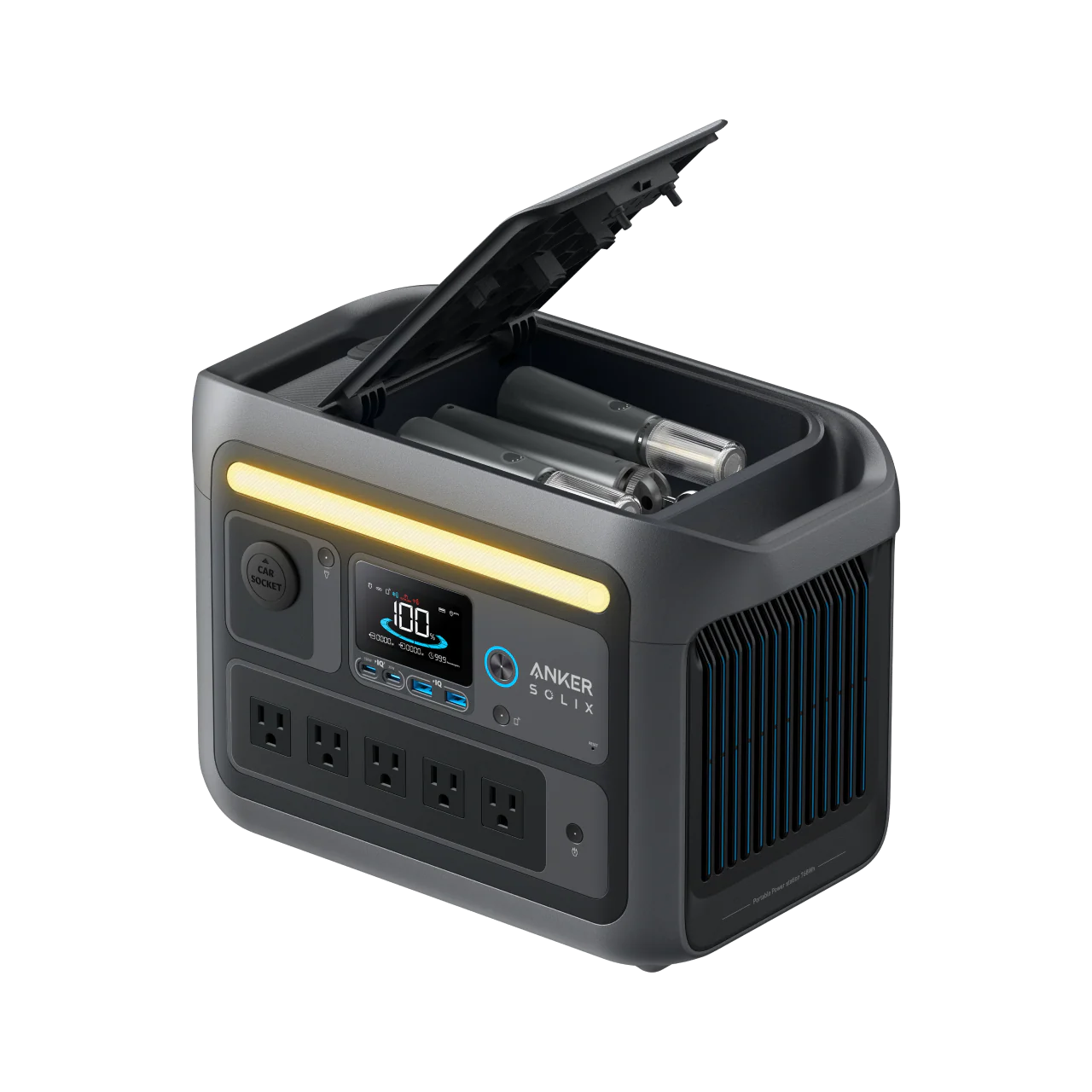
The consistent complaint is the fan. One tester found it unavoidable and obvious in a quiet house once the room went above 80F with a sustained 1,030W drawA1; another called it manageable at arm's length during fast chargingA11. The consistent praise is the app, which handles remote monitoring and delivers firmware, and drew no connectivity complaints from anyoneA7A15. The recurring worry is size: reviewers flagged 768Wh as the unit's limiting spec against heavier appliances and against same-priced rivalsA5A10A12, even while a fridge and freezer together took only about 10% of the battery across eight hoursA6. And the light pole splits people. One tester stopped packing lanterns after the first weekA14; another thought it was over the top and noted the cables now have nowhere to liveA2A3.
“The pole light felt is a little over the top and unnecessary.”
Sources
dustinabbott.net
Jackery HomePower 1000 Plus v2
Everything known about this unit is a launch-window first impression. It was announced 2026-08-27, no owner posts exist anywhere, and the only two genuine hands-on accounts are about a week each, on samples Jackery suppliedB0B18. No one has timed the UPS switchover, timed a wall charge, metered the fan, or seen it in the cold.
Within that limit, the two testers agree on the important thing: the inverter has real headroom. Shop lights, a standing sander and an old drill press ran without complaintB2; a 12,000 BTU window air conditioner ran for hoursB13; laundry, a rice cooker, a blender and a dishwasher all went through itB14B15; and one tester pushed above the 1,800W continuous rating and took the pack to 1%B12. The single stumble was a 14-inch bandsaw's startup surge near the 3,600W ceiling, which it recovered fromB1. Fan behavior was described as a low-frequency hum rather than a whine under those loadsB3, though that's an impression, not a measurement.
The gripes are all peripheral and all worth knowing before you buy. Emergency charging is app-only with no button for itB4. The solar inputs use Jackery's DC8020 connectors rather than XT60, so panels you already own need an adapterB6. And if expansion is the plan, the cable is proprietary and runs $70 on top of the packB7. One caution on sourcing: one of the two write-ups carries a spec table with the non-Plus sibling's figures in it, so we've used it for character and not for a single numberB11.
“The power station finally blinked when I attempted to run a 14-inch bandsaw, where the surge wattage must have gotten close to the 3,600W maximum it's rated for. Even still, the unit recovered and got the saw humming along.”
Sources
gearjunkie.com · cleantechnica.com · gearbrain.com
Sources & Research Notes
Every owner claim in this report is traceable to a published source. The bracketed references above resolve here.
Recurring owner themes
- Fan noise is consistently reported as noticeable during fast AC charging or high sustained wattage, though most reviewers call it 'manageable' rather than a dealbreaker. [SOLIX C800 Plus · 2 entries]
- The companion app is repeatedly praised for remote monitoring/control and firmware delivery, with no reviewers reporting connectivity or crash complaints. [SOLIX C800 Plus · 3 entries]
- 768Wh capacity is flagged by multiple reviewers as the unit's main limitation for heavy appliances and against same-price competitors, even though real-world light loads (fridge, gadgets) performed well. [SOLIX C800 Plus · 4 entries]
- The signature 'Plus' camping-light pole/torches are polarizing: some reviewers call the feature genuinely useful and a lantern-replacement, others call it an unnecessary gimmick that sacrifices the C800's cable-storage cubby. [SOLIX C800 Plus · 3 entries]
- Two independent week-long hands-on tests both found the 1,800W inverter has real headroom: shop tools, a 12,000 BTU window AC, a dishwasher and kitchen appliances all ran without strain, and one reviewer pushed past the 1,800W rating and drained to 1%. [HomePower 1000 Plus v2 · 5 entries]
- The only load that made the unit stumble was a 14-inch bandsaw's startup surge, which it recovered from; nothing else in either test approached the surge ceiling. [HomePower 1000 Plus v2 · 2 entries]
- The Jackery app pairs easily and adds remote control, timers and time-of-use scheduling, but Emergency Charging is app-only with no hardware control, which the reviewer called a friction point. [HomePower 1000 Plus v2 · 2 entries]
- Both reviewers rated portability and the fold-down handle a genuine advantage at roughly 24 lb, though one wanted a shoulder strap for carrying it any distance. [HomePower 1000 Plus v2 · 2 entries]
- Buying into the expansion path carries caveats reviewers flagged independently: a $70 proprietary expansion cable, and expansion that adds kWh without lifting the 1,800W continuous ceiling. [HomePower 1000 Plus v2 · 2 entries]
- GearJunkie's spec table and pros list carry figures that match the non-Plus HomePower 1000 v2 (three AC outlets, USB-C 100W, 1,500W sustained, 4,000+ cycles, 23 lb 6.4 oz), while CleanTechnica's independently stated figures match Jackery's manual (four outlets, 1,800W/3,600W, 6,000 cycles, 23.8 lb). Do not adjudicate specs from GearJunkie. [HomePower 1000 Plus v2 · 2 entries]
- Everything available is a launch-window first impression on a supplied sample after about a week. No timed UPS switchover, no timed wall-charge, no measured dB, no idle drain, no cold weather, no longevity. [HomePower 1000 Plus v2 · 3 entries]
- A1
“Once the temperature rose above 80F with a 1,030 average wattage, the fan noise was unavoidable and quite present in a quiet house.”
How-To Geek — 'Anker Solix C800 Plus Review: A Power Station Prepared to Illuminate Nighttime' · 2024-03 · [negative]
- A2
“The pole light felt is a little over the top and unnecessary.”
How-To Geek — 'Anker Solix C800 Plus Review: A Power Station Prepared to Illuminate Nighttime' · 2024-03 · [mixed]
- A3
“As it is, there's nowhere to keep the cords when not using them.”
How-To Geek — 'Anker Solix C800 Plus Review: A Power Station Prepared to Illuminate Nighttime' · 2024-03 · [negative]
- A5
“My lone concern on this front is whether or not the battery capacity is sufficient.”
DustinAbbott.net — 'Anker Solix C800 Plus Power Station Review' · 2024-03 · [mixed]
- A6
“I connected the Anker and in 8 hours, my frig/freezer used 10% of the power.”
The Gadgeteer — 'Anker SOLIX C800 Plus power station review' · 2024-04 · [positive]
- A7
“My other power stations do not have a companion phone app. But after the first trip, I saw how this feature would come in handy.”
The Gadgeteer — 'Anker SOLIX C800 Plus power station review' · 2024-04 · [positive]
- A10
“it doesn't have the outright storage or power to tackle more heavy duty appliances like kettles or some coffee machines.”
Trusted Reviews — 'Anker SOLIX C800 Plus Review: A great camping companion' · 2024-04 · [negative]
- A11
“The fan does ramp up during fast charging, but the noise is manageable at roughly arm's length.”
The Power Pick — 'Anker SOLIX C800 Plus Review: Camping Lights Meet Serious Power' · 2026-02 · [mixed]
- A12
“The 768Wh capacity sits in an awkward middle ground. It is significantly less than the 1,024Wh offered by the EcoFlow DELTA 3 Plus at the same $649 price.”
The Power Pick — 'Anker SOLIX C800 Plus Review: Camping Lights Meet Serious Power' · 2026-02 · [negative]
- A14
“We stopped packing separate lanterns after the first week, streamlining our camping setup noticeably.”
BackupPowerHub — 'Anker SOLIX C800 Plus Review: Best Mid-Range with Camping Lights' (45-day, 8-trip field test) · 2026 (article ~1 week old at time of research) · [positive]
- A15
“Through the app, you can easily install firmware updates that may include performance enhancements, bug fixes, or new functionalities.”
Greener Ideal — 'Anker SOLIX C800 Plus Portable Power Station Review' · 2024-08 · [positive]
- B1
“The power station finally blinked when I attempted to run a 14-inch bandsaw, where the surge wattage must have gotten close to the 3,600W maximum it's rated for. Even still, the unit recovered and got the saw humming along.”
gearjunkie.com — "Can It Run a Bandsaw? Testing the Jackery HomePower 1000 Plus V2 in an Off-Grid Shop: Review" (Nick Belcaster) · 2026-08 · [mixed]
- B2
“Four LED shop lights easily ran off the HomePower 1000 Plus V2. The heavy lifting started when I revved up a standing sander, and then again when powering my ancient Craftsman drill press.”
gearjunkie.com — "Can It Run a Bandsaw? Testing the Jackery HomePower 1000 Plus V2 in an Off-Grid Shop: Review" (Nick Belcaster) · 2026-08 · [positive]
- B3
“Even under those heavy startup loads, fan noise remained surprisingly subdued. Cooling fans kick in quickly under sustained high draws, but they maintain a low-frequency hum rather than a whine, allowing you to work nearby or keep it running in a living area without distraction.”
gearjunkie.com — "Can It Run a Bandsaw? Testing the Jackery HomePower 1000 Plus V2 in an Off-Grid Shop: Review" (Nick Belcaster) · 2026-08 · [positive]
- B4
“The ability to emergency charge the unit is a real boon, but it's only available to use through the Jackery app. Not the worst thing in the world, but requiring the app to toggle some functionality doesn't excite me.”
gearjunkie.com — "Can It Run a Bandsaw? Testing the Jackery HomePower 1000 Plus V2 in an Off-Grid Shop: Review" (Nick Belcaster) · 2026-08 · [negative]
- B5
“I found the Jackery app to pair quickly and to be easy to use. From the app, you can control the unit remotely, including toggling ports on and off and setting timers for when you would like certain appliances to come on and off.”
gearjunkie.com — "Can It Run a Bandsaw? Testing the Jackery HomePower 1000 Plus V2 in an Off-Grid Shop: Review" (Nick Belcaster) · 2026-08 · [positive]
- B6
“Jackery's choice to use the DC8020 ports instead of industry-standard XT60/XT60i connections makes things just a little harder for those who make a lot of power from the sun... it does mean adapting whatever is coming out of your panel.”
gearjunkie.com — "Can It Run a Bandsaw? Testing the Jackery HomePower 1000 Plus V2 in an Off-Grid Shop: Review" (Nick Belcaster) · 2026-08 · [negative]
- B7
“Those considering buying the Home Power 1000 Plus V2 with the intention of expanding it down the road should be aware: the expansion cable from Jackery is a proprietary design and will run you $70.”
gearjunkie.com — "Can It Run a Bandsaw? Testing the Jackery HomePower 1000 Plus V2 in an Off-Grid Shop: Review" (Nick Belcaster) · 2026-08 · [negative]
- B10
“With a UPS transfer time of sub-10 milliseconds, the HP 1000 Plus V2 will easily keep things like routers and refrigerator pumps running even when the power drops out unexpectedly.”
gearjunkie.com — "Can It Run a Bandsaw? Testing the Jackery HomePower 1000 Plus V2 in an Off-Grid Shop: Review" (Nick Belcaster). NOTE: asserted, not timed by the reviewer; Jackery's own manual states 10ms, not sub-10ms. · 2026-08 · [positive]
- B11
“Specs table: "Ports: USB-C 30W, USB-C 100W, USB-A 18W, 3 AC plugs, 1 car"; "Weight 23 lbs., 6.4 oz."; Pros: "Better sustained AC output of 1,500W"; body: "Rated for roughly 4,000+ charge cycles before dropping to 70% capacity."”
gearjunkie.com — "Can It Run a Bandsaw? Testing the Jackery HomePower 1000 Plus V2 in an Off-Grid Shop: Review" (Nick Belcaster). DATA-INTEGRITY FLAG, not owner commentary. · 2026-08 · [mixed]
- B12
“The battery also seems to be conservatively rated, having already taken it to a little above the 1800 W continuous rating and run the capacity all the way down to 1%.”
cleantechnica.com — "Jackery Adds Capability & Expandability To New HomePower 1000 Plus v2 Portable Battery" (Larry Evans) · 2026-08 · [positive]
- B13
“I ran a 12,000 BTU Midea U window air conditioner for hours... However, it offered so little challenge to the battery that I got bored and tried it on something else.”
cleantechnica.com — "Jackery Adds Capability & Expandability To New HomePower 1000 Plus v2 Portable Battery" (Larry Evans) · 2026-08 · [positive]
- B14
“I washed a load of laundry with our compact washing machine, but it didn't present much of a challenge. In the kitchen, I used it with my rice cooker and Vitamix blender, and the battery didn't break a sweat.”
cleantechnica.com — "Jackery Adds Capability & Expandability To New HomePower 1000 Plus v2 Portable Battery" (Larry Evans) · 2026-08 · [positive]
- B15
“I just ran my dishwasher on normal mode with the battery and, while water heating is energy intensive, the HomePower 1000 Plus v2 seems up to the task.”
cleantechnica.com — "Jackery Adds Capability & Expandability To New HomePower 1000 Plus v2 Portable Battery" (Larry Evans) · 2026-08 · [positive]
- B18
“I received a HomePower 1000 Plus v2 last week for evaluation and haven't had the ability to test it fully yet... Jackery supplied me with the main unit, without the accompanying solar panels or expansion batteries.”
cleantechnica.com — "Jackery Adds Capability & Expandability To New HomePower 1000 Plus v2 Portable Battery" (Larry Evans). Reviewer's own disclosure of sample supply and limited test scope. · 2026-08 · [mixed]
- B19
“Capacity expansion does not raise the main unit's 1,800W continuous output. [The base model is] better suited to keeping selected essentials running than backing up an entire house.”
gearbrain.com — "Jackery HomePower 1000 Plus V2: What Buyers Should Know" (Mark Westlake). NOTE: GearBrain explicitly states it has NOT conducted hands-on testing; this is editorial analysis of the spec sheet, not field experience. · 2026-08 · [mixed]
Research compiled September 7, 2026.
Who Should Buy Which
Buy the SOLIX C800 Plus if you…
- →The camper who genuinely wants the light pole. The detachable torches are the reason this model exists, and at least one tester stopped packing separate lanterns entirely after a week of tripsA14. If that solves a real problem in your setup, it's the one thing the Jackery has no answer to.
- →The buyer whose whole load list is phones, laptops, lights and a fridge, who has already checked that 653Wh usable covers the night, and who wants the better-rated app on the box.
Buy the HomePower 1000 Plus v2 if you…
- →Anyone with a motor on the list. A fridge in an outage, a window AC in a heat wave, a shop vac or a table saw at the far end of the driveway — the 3,600W surge ceiling is the spec you're actually buying, and it's been tested against real tools rather than a spreadsheetB1B2.
- →The person working out of a truck or a camper whose day lands near 900Wh. Coming up 40Wh short beats coming up 257Wh short, and the extra 217Wh of usable capacity is the whole difference between finishing and rationing.
- →The buyer who wants room to grow later. The packs add hours rather than watts, so plan them as a longer evening and not a bigger appliance list, and budget the $70 proprietary cable alongside themB7.
If neither fits
Skip both if you're shopping for house backup or full-time van power. Van life in this comparison wants 4,685Wh and an eight-hour blackout wants 1,645Wh; the bigger of these two boxes covers 19% and 53% of those. That's a triage battery, not a backup system. If the goal is the whole house not noticing the outage, you want a substantially larger station with a proper expansion stack, and you want to size it before you buy rather than after.
The Bottom Line
The HomePower 1000 Plus v2 wins on every axis that decides a purchase at this size, and it wins them for the price of a tank of gas. More battery, half again the inverter, more than double the surge ceiling, more solar in, faster USB-C, and a fraction lighter to carry. The surge number is the one to hold onto: 400W of startup headroom versus 1,800W is what separates a station that starts a compressor from one that's asking everything it has to do it.
The fair warning is that this Jackery is new enough that its whole public record is two people testing it for a week. But the alternative isn't a well-documented unit — it's a sealed 768Wh box whose own reviewers kept bumping into its ceiling. Register the warranty the week it arrives so the fifth year exists, buy it somewhere with an easy return window, and get the bigger one.
Frequently Asked Questions
Answers drawn from the spec record and cited owner research.
Is the Jackery HomePower 1000 Plus v2 worth $20 more than the Anker SOLIX C800 Plus?
Yes, and it isn't close. Twenty dollars buys 256 more watt-hours, 600 more watts of continuous output, 2,000 more watts of surge, 100 more watts of solar input and 40 more watts of USB-C charging, on a unit that weighs marginally less. There is no spec on this page where the Anker's price advantage buys you anything back.
Can either of these run a refrigerator during a power outage?
Both will run one; the question is how long and how confidently it starts. A tester ran a fridge and freezer off the Anker for eight hours and used about 10% of the battery, so running cost is low on either unit. Starting is where they differ: the Anker's 1,600W peak leaves 400W above its rating for the compressor's inrush, while the Jackery's 3,600W peak leaves 1,800W. For an eight-hour outage in this comparison's load profile, neither covers the full list — the Anker gets to about 40% of it and the Jackery 53%.
Can the Jackery HomePower 1000 Plus v2 run a window air conditioner?
One tester ran a 12,000 BTU window unit off it for hours and found it so undemanding that he went looking for a harder load. That's a single launch-window test rather than a pattern, but it's consistent with the 1,800W continuous rating and with the same tester pushing the unit above that rating and down to 1% state of charge. Expect a meaningful chunk of the 1,024Wh per hour on a unit that size, so treat it as a few hours of relief, not a night.
Does adding an expansion battery to the Jackery make it more powerful?
No. Expansion adds watt-hours; it does not raise the 1,800W continuous ceiling, so any appliance the base unit refuses to run, the expanded one refuses too. Budget for the extras as well: the expansion cable is a proprietary Jackery part sold separately at $70. Think of the packs as a longer evening rather than a bigger appliance list.
Which one is quieter?
On paper the Jackery, at a listed 30dB against the Anker's 45dB, but neither number is a measurement. Both are manufacturer best-case floors, the Jackery's from a silent mode, and nobody outside the two companies has metered them at the same load. The field impressions run the same direction: the Anker's fan was called unavoidable in a quiet house above 80F at around 1,030W and manageable at arm's length while fast charging, while the Jackery's was described as a low-frequency hum under heavy startup loads.
Where to buy
Anker SOLIX C800 Plus
$649.00
$649.00 · direct from Anker
Last checked 16 days ago. Prices move — check before you buy.

Jackery HomePower 1000 Plus v2Pick
$669.00
$669.00 · direct from Jackery
Last checked 16 days ago. Prices move — check before you buy.
Prices may vary by retailer and are subject to change.