Head-to-head test
Anker SOLIX C300X vs Anker SOLIX C800
Anker SOLIX C300X vs Anker SOLIX C800: Buy the C800 unless you're certain your loads stay small. The C800 outruns the C300X on nearly every axis and, once the lifetime math is in, costs less to own than its bigger sticker suggests; the one thing the C300X wins is the part where you actually pick it up and carry it.
Full profiles: Anker SOLIX C300X → · Anker SOLIX C800 →

Written by Wenny ZhengUpdated
Portable Power Tester, Station Arena Test Desk
Spec deltas
Twice the price buys 2.7 times the battery, and that math runs the whole comparison. The C800 stores 768 watt-hours to the C300X's 288, and because both packs are rated for the same 3,000 cycles, the bigger unit ends up cheaper to feed over its life: $0.26 per lifetime kilowatt-hour against $0.35. The one that looks expensive on the shelf is the one that costs less to own.
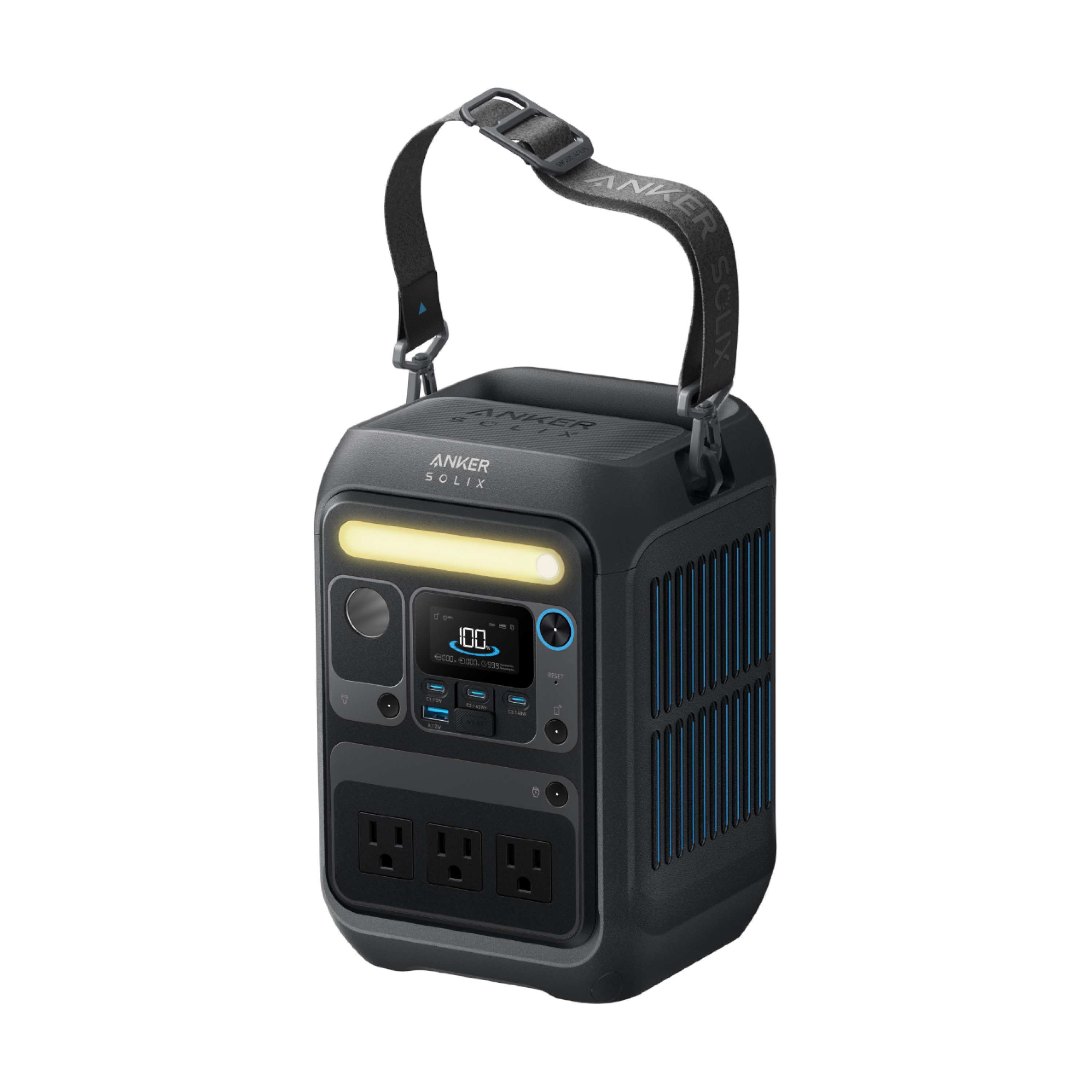
The C300X's case is everything outside that spec-sheet duel. It weighs 9 pounds to the C800's 23.8, so you pluck it off a shelf one-handed while the C800 is a set-it-down-and-leave-it load. It runs near-silentA4, pushes 140W out its USB-C port where the C800 stops at 100W, and costs $300 less. For phones, a laptop, and a light, that's the whole argument, and it's a good one.
So buy by your load list, not by the star ratings. If everything you plug in draws under 300 watts and lives inside 288 watt-hours, take the C300X and enjoy carrying it. The moment that list grows a coffee maker, a space heater, or a humidified CPAP, only the C800 finishes the job, and it happens to be the better value too. When you can't tell which camp you're in, the unit with headroom is the safer buy.
What the Numbers Reveal
Each conclusion stated first — the numbers behind it on one line, the full analysis below.
Capacity
Across those 3,000 cycles the C800 moves 2,304 kilowatt-hours to the C300X's 864, and it does it about nine cents per kilowatt-hour cheaper. The gap between the two price tags is buying capacity, not margin.
C800 costs $599 (last listed price), C300X costs $300 at purchaseC800 stores 768Wh, C300X stores 288Whboth packs rated for 3,000 cyclescost per lifetime kWh: C800 $0.26, C300X $0.35
Why it mattersIf you'll actually cycle the bigger battery, the C800 is the value pick; if your loads would leave it half-full, you're paying for kilowatt-hours you never spend and the C300X is the smarter money.
continuous output
The C800's 1,200W inverter ran a 1,000W coffee maker for 42 minutes and briefly pushed a 1,500W heaterB3B8, loads the C300X can't switch on at all. So the choice between them isn't only how many hours you get, it's whether half your list is even eligible.
C300X: 300W continuous, 600W surgeC800: 1,200W continuous, 1,600W surgeTailgate 400W peak: C300X starts it but can't hold it, C800 within 17Wh of covering itC800 ran a 1,000W coffee maker 42 minB3 and briefly a 1,500W heater 25 minB8
Why it mattersAnyone whose must-run list includes one 1,000W appliance can stop comparing runtimes and buy the C800; the C300X isn't in that race.
That 45dB is a loud-case floor, not a bedside one. At a 40W CPAP draw a reviewer heard no fan on the C800 at allB7, so the noise gap you'd buy the C300X to avoid never shows up, and the C800 is the unit that actually lasts until morning.
CPAP night models 320Wh at a 40W drawC300X has 245 usable Wh (75Wh short); C800 covers it with 333Wh to sparelisted noise floors: C300X 25dB, C800 45dBa reviewer measured zero fan noise on the C800 under 500WB7
Why it mattersA humidifier-on CPAP user should take the C800; the C300X only suits a lighter, humidifier-off machine, and even then it's cutting the night close.
solar input
A 140W USB-C output fast-charges a 16-inch laptop straight off the port where the C800 stops at 100W, and the sub-10ms transfer that held a computer, router and CPAP through a pulled plugA7 makes the C300X the better desk-side backup for exactly the sub-300W setup its 288 watt-hours was sized for.
C300X USB-C tops out at 140W, C800 at 100WC300X UPS rated no worse than 10ms, C800 no worse than 20msa reviewer pulled the AC plug on a running computer, router, modem and CPAP with no flickerA7
Why it mattersFor a home-office backup running a laptop, monitor and router, the C300X isn't the compromise, it's the better-matched unit, at $300 less.
The specific dimensions that decide these two units — everything else is a tie.
Runtime: Will It Power Your Gear?
Selected because: It comes down to what each size actually runs: the C300X's 288Wh covers devices and a laptop, while the C800's 768Wh reaches into small appliances above 300 watts.
continuous output
The number that matters isn't the headline watt-hours, it's what drops off your list at each size. The C300X ran a 60W laptop about four hours and a 50W mini-fridge roughly five and a half in testingA9, which is a full afternoon of desk work or a cooler held cold through a ballgame. Its ceiling is a wall socket's worth of gear and nothing with a heating element. The C800's 768Wh doesn't just add hours, it adds the whole class of loads above 300 watts: a 1,000W coffee maker ran 42 minutes on it, a 1,500W heater 25B3B8. If your loads all sit under 300 watts you're choosing runtime; if even one doesn't, the C800 is the only one that turns it on.
Your Life, Your Pick
Selected because: The scenario table shows where the two split and where neither is enough, from a CPAP night the C800 finishes to a 2,100Wh camping weekend that beats both.
Read the scenario table and the first thing that jumps out is how much of it is short for both units: a 2,100Wh camping weekend, a 1,645Wh eight-hour blackout, a 4,685Wh van day, none of it fits in either box. These aren't a whole-house pair, and if that's your job, both are the wrong size. Where they genuinely part ways is the middle band. The C800 finishes a CPAP night with 333 watt-hours to spare and lands within 17 of a full tailgate, while the C300X's clean win is the small stuff, the 100Wh afternoon of phones and a speaker where its 9 pounds is the only spec that matters. Match the row to your real week before you match the unit.
Lifetime Value
Selected because: The C800's larger battery makes it cheaper per lifetime kilowatt-hour despite costing twice as much up front, provided you cycle the capacity.
The cost-to-own math inverts the price tag, but you have to earn the inversion. Both packs carry the same 3,000-cycle rating, so the C800's lower cost per lifetime kilowatt-hour is simple division: more capacity spread over the same lifespan. The catch is that the discount only exists if you spend the capacity. Habitually draw a C300X's worth out of the C800, 288 watt-hours of its 768, and you've paid $599 (last listed price) to cycle what $300 would have. The per-kilowatt-hour win is real for the buyer who fills it and imaginary for the one who doesn't.
Portability & Form Factor
Selected because: Weight is the C300X's whole case: 9 pounds you carry one-handed against the C800's two-handed 23.8.
weight
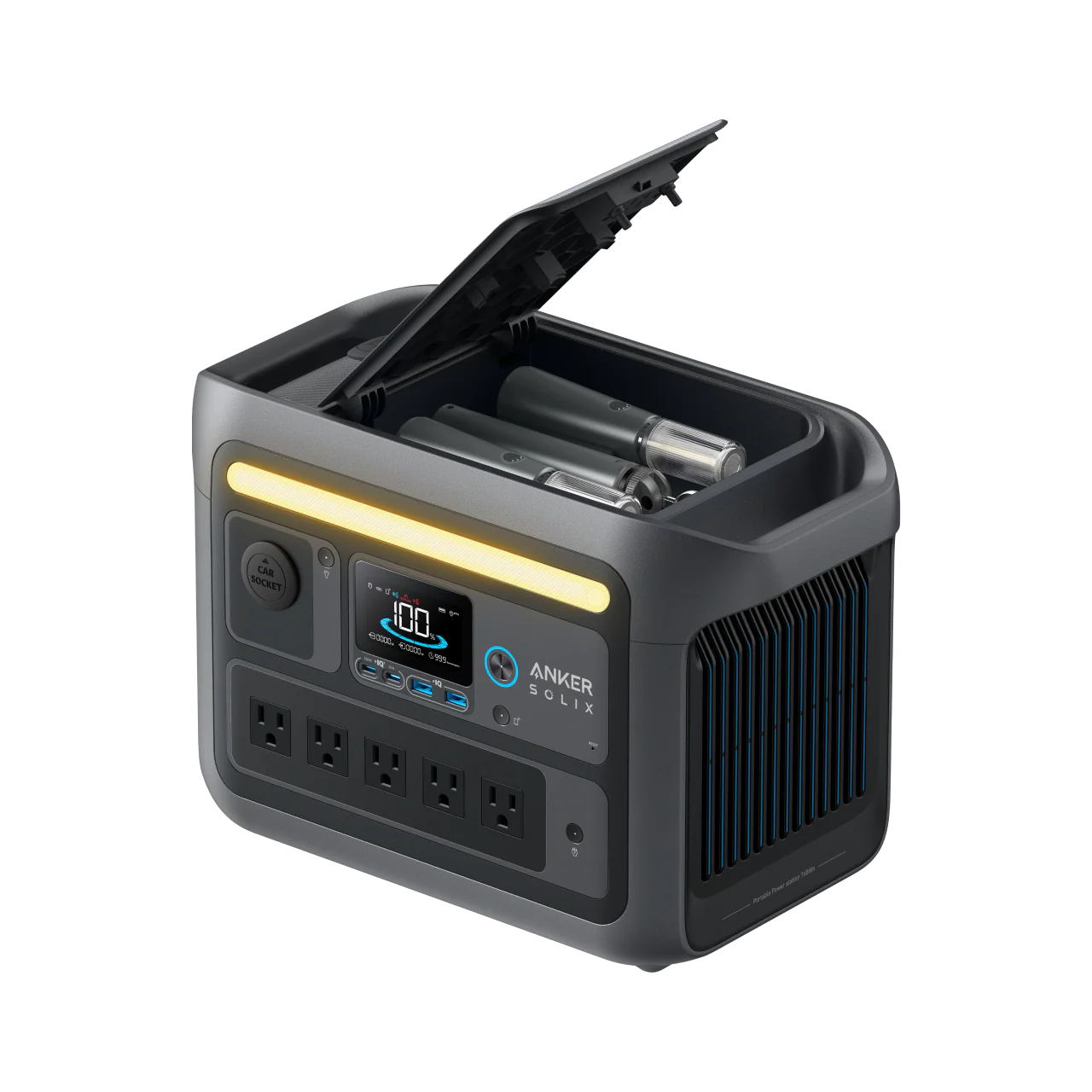
Two fingers versus two hands and a bent back, that's the weight gap in the terms that matter. The C300X goes where you go, and a reviewer reported its handle showed no wear after dozens of trunk loadsA12. The C800 is the other ergonomic story: a compact but genuinely heavy box one tester called too heavy to carry far on footB12, the kind of unit you set down once and leave. Both take a beating well, the C800 shrugging off a tailgate-height drop onto gravelB1, but neither carries an IP weather rating, so an outdoor C800 is one you keep coveredB2. If your use involves walking with the thing, that alone settles it for the C300X.
What the Specs Don't Tell You
Selected because: The fine print splits cleanly, the C300X taking the tighter UPS class and quiet floor, the C800 the higher 1,600W surge ceiling.
Run down the fine print and two of the three flags actually point the smaller unit's way. The C300X holds the tighter UPS class, rated no worse than 10ms against the C800's 20, plus the lower noise floor, and it stays near-silent even when pushedA4. The C800's counter is the flag that moves motors: a 1,600W surge ceiling against 600W, which is what decides whether a compressor or a power tool actually starts. The warranty column is a tie at five years each, so it breaks nothing. Read together, the gotchas just restate the whole page in miniature: the C300X is the better desk companion, the C800 the better appliance-starter.
Strengths & trade-offs
Anker SOLIX C300X
Strengths
- +Lighter by 14.8 lb
Trade-offs
- –Weaker inverter (-900W) limits appliance compatibility.
Anker SOLIX C800
Strengths
- +Larger battery capacity
- +Higher AC output
- +Faster solar charging
Trade-offs
- –Significantly heavier (+14.8 lbs), making it harder to move.
Will It Power Your Gear?
Scenario math and per-appliance runtimes, modeled from the spec record.
Scenario verdicts
We ran the math on seven real-world scenarios. Here's which unit survives your actual life.
SCN-01 · 2 nights · needs 2,100Wh
Weekend Camping
Two nights off-grid with essential comfort
Neither unit
Neither unit covers this scenario's 2,100Wh: the SOLIX C300X comes up 1,855Wh short (about 12% covered), the SOLIX C800 1,447Wh (31%). This is well outside what either unit is for; the right answer here is a larger station, not a choice between these two.
Battery budget usedlower = more headroom
LOAD Phone Charger 15W×6h · LED Lights 40W×8h · Box Fan 75W×14h · CPAP Machine 40W×16h
SCN-02 · 8 hours · needs 1,645Wh
8-Hour Blackout
Keep the essentials running through a night without power
Neither unit
Neither unit covers this scenario's 1,645Wh: the SOLIX C300X comes up 1,400Wh short (about 15% covered), the SOLIX C800 992Wh (40%). This is well outside what either unit is for; the right answer here is a larger station, not a choice between these two.
Battery budget usedlower = more headroom
LOAD Fridge 150W×8h · Router + Modem 20W×8h · LED Lights (4 bulbs) 40W×6h · Phone Charger 15W×3h
SCN-03 · 8 hours · needs 320Wh
CPAP Overnight
Sleep therapy without interruption — the #1 medical use case
SOLIX C800
The C800 is the pick here, and not for the reason the noise spec suggests. At the 40W this models, the C300X runs down around hour six of an eight-hour night, 75 watt-hours short of the finish. The C800 covers the whole night with 333 to spare, and at a draw this low its fan has no reason to spin. Capacity closes this one, not decibels.
Battery budget usedlower = more headroom
LOAD CPAP Machine 40W×8h
SCN-04 · 8 hours · needs 910Wh
Remote Workday
Full work day off-grid without power anxiety
Neither unit
Neither unit covers this scenario's 910Wh: the SOLIX C300X comes up 665Wh short (about 27% covered), the SOLIX C800 257Wh (72%). Treat this as partial cover — enough for the essentials in it, not the whole list.
Battery budget usedlower = more headroom
LOAD Laptop 60W×8h · External Monitor 30W×8h · Router + Modem 20W×8h · Phone Charger 15W×2h
SCN-05 · 4 hours · needs 670Wh
Tailgate Party
Game day power for the crew
Neither unit
Call it a near miss for the C800 and a no for the C300X. The C800 lands 17 watt-hours short of the 670Wh this needs, one phone charge from a clean pass, close enough that trimming a single device gets you there. The C300X has a harder problem than capacity: it starts the 400W peak but can't hold it, because its 300W continuous rating takes over the moment the surge fades. One is a rounding error away; the other is the wrong size for the load.
Battery budget usedlower = more headroom
LOAD Blender 400W×0.5h · LED TV (55") 80W×4h · Bluetooth Speaker 15W×4h · Phone Charger (×3) 45W×2h
SCN-06 · 24 hours · needs 4,685Wh
Van Life Daily
A full day of mobile living — the ultimate endurance test
Neither unit
Neither unit covers this scenario's 4,685Wh: the SOLIX C300X comes up 4,440Wh short (about 5% covered), the SOLIX C800 4,032Wh (14%). This is well outside what either unit is for; the right answer here is a larger station, not a choice between these two.
Battery budget usedlower = more headroom
LOAD Mini-Fridge 150W×24h · Laptop 60W×4h · Phone Charger 15W×3h · LED Lights 40W×5h · Fan 75W×8h
SCN-07 · an afternoon · needs 100Wh
Afternoon Off-Grid
Phones and a speaker at the park, beach, or campsite — the small-unit job description
Either unit
This row is here for the SOLIX C300X's class of job: phones and a speaker, 100Wh across an afternoon. Both cover it — the SOLIX C300X finishes at 41% used, and the SOLIX C800 barely notices it. For this job the SOLIX C800's extra capacity is dead weight, not headroom; at 9 lbs the SOLIX C300X is the one you'll be glad you brought.
Battery budget usedlower = more headroom
LOAD Phone Charger (×2) 30W×2h · Bluetooth Speaker 10W×4h
The Load Test
RUNTIME = (Wh × 0.85) ÷ LOAD
None of the scenarios above exactly yours? Build it. Toggle what you'd plug in; both units are tested against the combined draw.
Essentials
Comfort & Convenience
High-Draw Appliances
Test duration
8h
Continuous draw
205W
Projected runtime
For this load: SOLIX C800 runs 3.2h vs 1.2h.
Planning for more than this? Describe your whole setup and get it sized →
Modeled from the spec record — same math as the tables below. Methodology
Runtime by appliance
Real-world runtime estimates for common appliances, modeled at 85% inverter efficiency.¹
Essentials
The basics you need runningscale 0–43.5hComfort & Convenience
Makes off-grid life actually enjoyablescale 0–8.7hHigh-Draw Appliances
These reveal the real limitsscale 0–0.7h¹ Runtime = (capacity × 0.85) ÷ appliance watts. Within each group, all bars share one time scale (the group's longest runtime), so lengths are comparable across appliances; identical runtimes collapse into a single blue/orange bar. Actual runtime varies with battery age, temperature, and simultaneous loads — see methodology.
Conclusion
August 30, 2026
Verdict withdrawn: the SOLIX C800 is no longer sold
We picked the SOLIX C800, but it's been discontinued (Anker now points buyers to the SOLIX C800X). The SOLIX C300X is still on sale, but that alone doesn't make it our pick. The comparison below is still accurate if you own either one.
Editor-assigned confidence, based on cited owner research and spec analysis.
Written by Wenny Zheng, Portable Power Tester · Station Arena Test Desk · Updated August 30, 2026
Black Friday · 38 days out
Price to beat:SOLIX C300X $300
We have never seen it discounted, so any real cut would be a first.
Measured Data
Benchmark scores and the full spec record, side by side.
Benchmark scores
Not rated for both units (minimum threshold unmet): Solar Generator.
Full specifications
ᵈ Derived: price ÷ rated capacity. See the data behind our comparisons →
Comparison ToolAdd more power stations, side by sideOpen Tool →How these numbers are produced
Numeric verification
Every figure on this page traces to our spec database or arithmetic on it — no estimated numbers.
Owner claims
Statements about owner experience are cited to published reviews — see Sources & Research Notes below.
Runtime model
Runtime = (rated capacity × 0.85 inverter efficiency) ÷ device wattage. Solar recharge estimates assume panels deliver 70% of rated output. Cold weather, battery age, and stacked loads reduce real-world results.
Power Score
Computed from 14 published spec dimensions, weighted per use-case bench. Higher is better; a unit must meet a bench's minimum threshold to be rated.
See the full weight table and data sourcing on our methodology page →Class ranking (the star rating)
Each unit's star score is a category ranking, not customer reviews — no buyer opinions feed it. We score every station on size-independent quality (value, output, portability, endurance, ports, warranty, and more), then percentile-rank it against the other units in its capacity class, so a class-leading compact unit and a class-leading whole-home unit can both earn 5★. Here, SOLIX C300X rates 4.6/5 (74th percentile of 24 Personal-class units), and SOLIX C800 rates 4.1/5 (47th percentile of 20 Compact-class units).
How the class ranking is computed →Test Notes & Caveats
Hidden gotchas and advantages we spotted that you won't find on the product page.
SOLIX C800: 45dB Published
45dB is about as loud as a running refrigerator. The SOLIX C300X is rated 25dB — lower, but the two ratings need not describe the same operating regime even within one maker's own range, so the two figures are not a like-for-like gap. For most people, fan noise around 45dB and up is where sleep starts to suffer.
The Ratio Flatters the Wrong Unit
The C300X wears the higher surge-to-continuous ratio, 2x against 1.3x, and it sounds like a win until you remember appliances draw watts, not ratios. What actually starts a compressor or a power tool is the absolute ceiling, and there the C800's 1,600W towers over the C300X's 600W. The ratio only tells you the C300X idles further below its own limit at steady state. On the question that decides it, can it start the thing, the C800 is the stronger unit.
10ms vs 20ms: Who Actually Cares
Both list a UPS mode; the C300X is rated no worse than 10ms, the C800 no worse than 20. For a laptop the difference is academic, since the laptop has its own battery and rides through either. It matters for a desktop with unsaved work or a stubborn PC power supply, the kind of load that sits right at the 20ms line, and there the C300X's tighter rating is the one to want. Neither figure is a lab result, just a rated class.
Warranty: No Difference
Both units carry the same 5-year warranty, so coverage isn't a tiebreaker here.
Ownership Analysis
What happens after you buy — true cost of ownership, brand trust, and growth potential.
Lifetime value
Service lifeyears at one full cycle per day
Lifetime energy delivered
Cost per delivered kWh
│ warranty ends · Reaching the cycle rating means ~80% capacity remains — degraded, not dead.
Analyst note
The SOLIX C800 is no longer sold, so there is no price to work its cost per kWh from, and this comparison doesn't quote one. On what you can actually buy today, the SOLIX C300X works out at $0.35/kWh over its rated life. If you already own the SOLIX C800, the hardware comparison still holds: over its rated life the SOLIX C300X delivers about 864 kWh and the SOLIX C800 about 2,304 kWh. One thing to know reading the table: both carry the same 3,000-cycle rating, so the lifetime rows are sticker price and capacity in disguise — the wear horizon is identical and decides nothing here.
Growth path
SOLIX C300X
FIXED CAPACITYFixed at 288Wh, with no expansion — so size it for your needs up front rather than planning to add capacity later.
Accepts up to 100W of solar. Limited to a single portable panel.
Adequate ports for most setups, but heavy users may want a power strip.
SOLIX C800
FIXED CAPACITYFixed at 768Wh, with no expansion — so size it for your needs up front rather than planning to add capacity later.
Accepts up to 300W of solar. Limited to a single portable panel.
Adequate ports for most setups, but heavy users may want a power strip.
Realistic full solar rechargeat 70% of rated panel output — see methodology
Analyst note
Growth only counts if you can still buy in, and the SOLIX C800 is no longer sold (Anker points owners to the SOLIX C800X). That leaves the SOLIX C300X: it is sealed at 288Wh, so buy the size that covers you now. The SOLIX C800's fixed 768Wh still matters if you already own one, but it isn't a reason to pick it over the SOLIX C300X.
What Owners Report
Patterns from published owner reports and long-term reviews — every claim cited to its source below.
Anker SOLIX C300X
Hands-on reviewers line up on the C300X being quiet and quick to charge. One called it near-silent even pushed to its limitsA4, and AC charging matched spec in testing, 80% in 49 minutes and full in about an hourA8. A plug-pull test kept a computer, router, modem and CPAP running with no flicker, exactly the UPS behavior the rating promisesA7. Runtime came in honest too, a 60W laptop for about four hours and roughly 22 phone charges per fillA9.
The documented complaints are narrow and cluster in the app-and-charging pipeline: a Bluetooth pairing dropout that blocks monitoring until you re-pairA1, and one owner whose pack refused to charge past 25%A2. The field record here is thin, two hands-on reviews plus a single quoted owner, with no Reddit or YouTube owner threads surfacingA0.
“The unit was confirmed to shut itself off when charging very low-draw devices like headphones or a smartwatch — an intended power-saving cutoff rather than a defect, but one that catches owners off guard.”
Sources
teqclub.com · thesolarlab.com · backuppowerhub.com
Anker SOLIX C800
Field data on the plain C800 is thinner still, and worth flagging: no genuine owner-forum threads turned up, so what follows is reviewer-tester experience rather than long-run owner consensusB0. Within that, reviewers are consistent on speed and grunt. A full recharge landed in 58 minutes on the 600W adapterB9, a 1,000W coffee maker ran 42 minutesB3, and one tester briefly pushed a 1,500W space heater past the 1,200W rating for 25 minutes before it throttledB8.
The recurring cautions are physical. At about 23 pounds a tester judged it too heavy to carry far on footB12, and it has no IP weather rating, so keep it covered outdoorsB2. On the reassurance side, it holds a 4.7-star rating across 692 retailer reviews and survived a tailgate-height drop onto gravel with only scuffingB10B1.
“We dropped it from a tailgate (30 inches) onto gravel—only minor scuffing, no damage.”
Sources
backuppowerhub.com · portablepowergeek.co.uk · batteryskills.com · batteryessence.com · toolsandtoys.net · bikmantech.com
Sources & Research Notes
Every owner claim in this report is traceable to a published source. The bracketed references above resolve here.
Recurring owner themes
- Independent hands-on reviewers found the C300X near-silent at its rated 300W load, though one test noted the fan becoming noticeably audible under a heavier transient/overload draw. [SOLIX C300X · 2 entries]
- AC charging and UPS switchover both performed at or better than spec in hands-on testing — fast wall recharge and an imperceptible transfer that kept a computer, router, and CPAP running through a pulled plug. [SOLIX C300X · 2 entries]
- The most concrete owner-reported defects both sit in the app/charging pipeline: a Bluetooth pairing dropout that blocks monitoring, and a specific report of the battery refusing to charge past 25%. [SOLIX C300X · 2 entries]
- Build quality/chassis is repeatedly called solid and drop-resistant, but reviewers flag the lack of an IP weather rating as a real-world caveat for outdoor use. [SOLIX C800 · 3 entries]
- The 58-minute AC fast-recharge is the single most-mentioned standout feature, praised as faster than rivals like the Jackery 700. [SOLIX C800 · 2 entries]
- Reviewers note the unit can briefly exceed its 1200W rating for heavy appliances, but caution it can't sustain full-size continuous loads like a full-size fridge. [SOLIX C800 · 2 entries]
- Long 5-year warranty and strong retailer star ratings are cited as reassurance/value signals. [SOLIX C800 · 2 entries]
- Weight (~23-24 lbs) is repeatedly flagged as a downside relative to lighter rivals despite the compact footprint. [SOLIX C800 · 2 entries]
- A1
“Users reported trouble connecting the C300X to the Anker app, which blocked monitoring power usage and changing settings; re-pairing by "forgetting" the device in Bluetooth settings and reconnecting through the app usually fixed it.”
teqclub.com — "Solving Common Anker C300X Problems" · unknown · [negative]
- A2
“My Anker solix c300x Portable Power Station will not accept charge more than 25%.”
teqclub.com — "Solving Common Anker C300X Problems" (quoted owner comment) · unknown · [negative]
- A4
“This unit is impressively quiet. Even with the internal fans running when we pushed it to its limits, the C300X makes virtually no noise.”
thesolarlab.com — "Anker C300X Power Station Review" · 2026 · [positive]
- A7
“Pulling the AC plug mid-use while a computer, router, modem, and CPAP machine were running, the computer stayed on without interruption — no screen flicker, no system hiccup.”
backuppowerhub.com — "Anker SOLIX C300X Review" · 2026 · [positive]
- A8
“AC charging to 80% took 49 minutes in testing, matching the advertised claim; full charge landed at 65 minutes. A 100W solar panel took 3 hours 15 minutes, and 12V car charging took about 6.5 hours.”
backuppowerhub.com — "Anker SOLIX C300X Review" · 2026 · [positive]
- A9
“A 60W laptop ran 4 hours 15 minutes before hitting 20% battery; a 50W mini fridge ran 5 hours 30 minutes continuous; the unit was good for about 22 full phone charges or 9 drone-battery cycles per depletion.”
backuppowerhub.com — "Anker SOLIX C300X Review" · 2026 · [positive]
- A12
“The C300X feels premium in a way many budget power stations don't; the carry handle showed no wear or flex after dozens of trunk loads.”
backuppowerhub.com — "Anker SOLIX C300X Review" · 2026 · [positive]
- B1
“We dropped it from a tailgate (30 inches) onto gravel—only minor scuffing, no damage.”
backuppowerhub.com — Anker SOLIX C800 Review: Best Budget Power Station? · 2025-12 · [positive]
- B2
“However, the C800 lacks IP weather rating. Keep it covered when camping.”
backuppowerhub.com — Anker SOLIX C800 Review: Best Budget Power Station? · 2025-12 · [negative]
- B3
“A 1,000W coffee maker ran 42 minutes straight.”
backuppowerhub.com — Anker SOLIX C800 Review: Best Budget Power Station? · 2025-12 · [positive]
- B7
“Zero fan noise under 500W loads, unlike louder competitors (e.g., Bluetti EB55). Only a mild hum at max load.”
batteryskills.com — Anker SOLIX C800 Portable Power Station Review · 2025-10 · [positive]
- B8
“Powered a 1500W space heater (surpassing its 1200W rating) for 25 minutes before throttling—unexpectedly robust for its size.”
batteryskills.com — Anker SOLIX C800 Portable Power Station Review · 2025-10 · [positive]
- B9
“Achieved a full charge in 58 minutes using a 600W AC adapter (matching Anker's claim), while competitors like the Jackery 700 take 2+ hours.”
batteryskills.com — Anker SOLIX C800 Portable Power Station Review · 2025-10 · [positive]
- B10
“Holds a 4.7-star rating from 692 Amazon reviews and ranks #81 in Outdoor Generators.”
batteryessence.com — Anker SOLIX C800 Portable Power Station 768Wh Review (retailer review summary) · 2026-03 · [positive]
- B12
“At 23.15 lbs (10.5 kg), this is too heavy for carrying far on foot. For hiking, a smaller, lighter power bank under 5 lbs is a better fit.”
batteryessence.com — Anker SOLIX C800 Portable Power Station 768Wh Review · 2026-03 · [negative]
Research compiled August 30, 2026.
Who Should Buy Which
Buy the SOLIX C300X if you…
- →You run devices, not appliances: phones, a laptop, a tablet, a CPAP on its lighter humidifier-off setting, a light. That list fits inside 288 watt-hours, and you'd rather carry it one-handed than set down a heavier box.
- →You want a desk-side backup for a laptop, monitor and router. The 140W USB-C port and the sub-10ms rated transfer suit that job, and a reviewer pulled the plug on exactly that setup with no flickerA7.
- →You're spending $300, not $599 (last listed price), and you don't want to pay for capacity you'll never cycle.
Buy the SOLIX C800 if you…
- →Your must-run list includes anything past 300 watts: a 1,000W coffee maker, a kettle, a microwave, a space heater. The C300X's inverter won't start them, and a reviewer ran both the coffee maker and the heater on the C800B3B8.
- →You want one battery to cover a humidifier-on CPAP overnight with margin, and to reach about 72% of a modeled remote workday rather than the quarter the C300X manages.
- →You want the most energy per dollar and the lower cost per lifetime kilowatt-hour, and you'll actually cycle 768 watt-hours.
If neither fits
If you're sizing for a real emergency, a 1,645Wh eight-hour blackout or a 2,100Wh camping weekend, neither of these finishes it. Both tap out well short, so skip the pair and step up to a 1,000Wh-plus station instead.
The Bottom Line
The C800 is the more capable power station and, once the lifetime math is in, the cheaper one to own, because its higher sticker buys capacity you can cycle rather than margin. It starts appliances the C300X can't switch on and finishes a CPAP night the C300X comes up short on. On raw capability there isn't much of an argument.
The C300X's answer is real but narrow: light, quiet, a faster laptop port, three hundred dollars saved. If your load list is phones, a laptop and a light, buy the little one and enjoy carrying it. The day that list grows a coffee maker or a humidifier, you're buying the C800 anyway, so if you can't call it, buy the one with headroom first.
Frequently Asked Questions
Answers drawn from the spec record and cited owner research.
Is the Anker C800 worth twice the price of the C300X?
Yes, if you'll cycle the capacity. It stores 2.7 times the energy at the same 3,000-cycle rating, so it works out cheaper per lifetime kilowatt-hour: the higher sticker is buying capacity, not markup. If your loads never top the C300X's 245 usable watt-hours, you won't see that value and the smaller unit is the smarter spend.
Can the Anker C300X run a CPAP all night?
Only a low-draw one. A humidifier-on CPAP pulling about 40W (the 320Wh night the engine models) runs the C300X down around hour six of eight, 75 watt-hours short of the finish. A humidifier-off machine fits inside its 245 usable watt-hours; the C800 covers either, with 333 watt-hours to spare.
Will the C300X run a coffee maker or a space heater?
No. Its inverter caps at 300W continuous (600W surge), so a 1,000W coffee maker or a 1,500W heater won't start, battery level aside. The C800's 1,200W inverter ran a 1,000W coffee maker for 42 minutes and briefly pushed a 1,500W heater in testing.
Which is the better home-office battery backup?
For a laptop, monitor and router, the C300X is the better-matched pick: a 140W USB-C port, a transfer rated no worse than 10ms, and a reviewer who pulled the plug on exactly that setup with no flicker. Step up to the C800 only if you're also backing up a printer, a mini-fridge, or anything drawing over 300 watts.
How long do these last, and are they reliable?
Both are rated for 3,000 charge cycles and carry a 5-year warranty, so longevity isn't a tiebreaker. The C800 holds a 4.7-star rating across 692 retailer reviews; the C300X's few documented complaints cluster in app pairing and one report of a unit refusing to charge past 25%. Field data on both is limited to review testing rather than long-term owner threads.
Where to buy
Anker SOLIX C300X
$299.99
$299.99 · direct from Anker
Last checked 16 days ago. Prices move — check before you buy.
Anker SOLIX C800
No longer sold
Prices may vary by retailer and are subject to change.