Head-to-head test
Anker SOLIX C1000 vs Jackery HomePower 3000
The cheaper unit sells the more expensive watt-hour, so this settles on one question: does your worst day fit inside 898 usable watt-hours?
Full profiles: Anker SOLIX C1000 → · Jackery HomePower 3000 →

Written by Gunner GustafsonUpdated
Whole-Home Backup Tester, Station Arena Test Desk
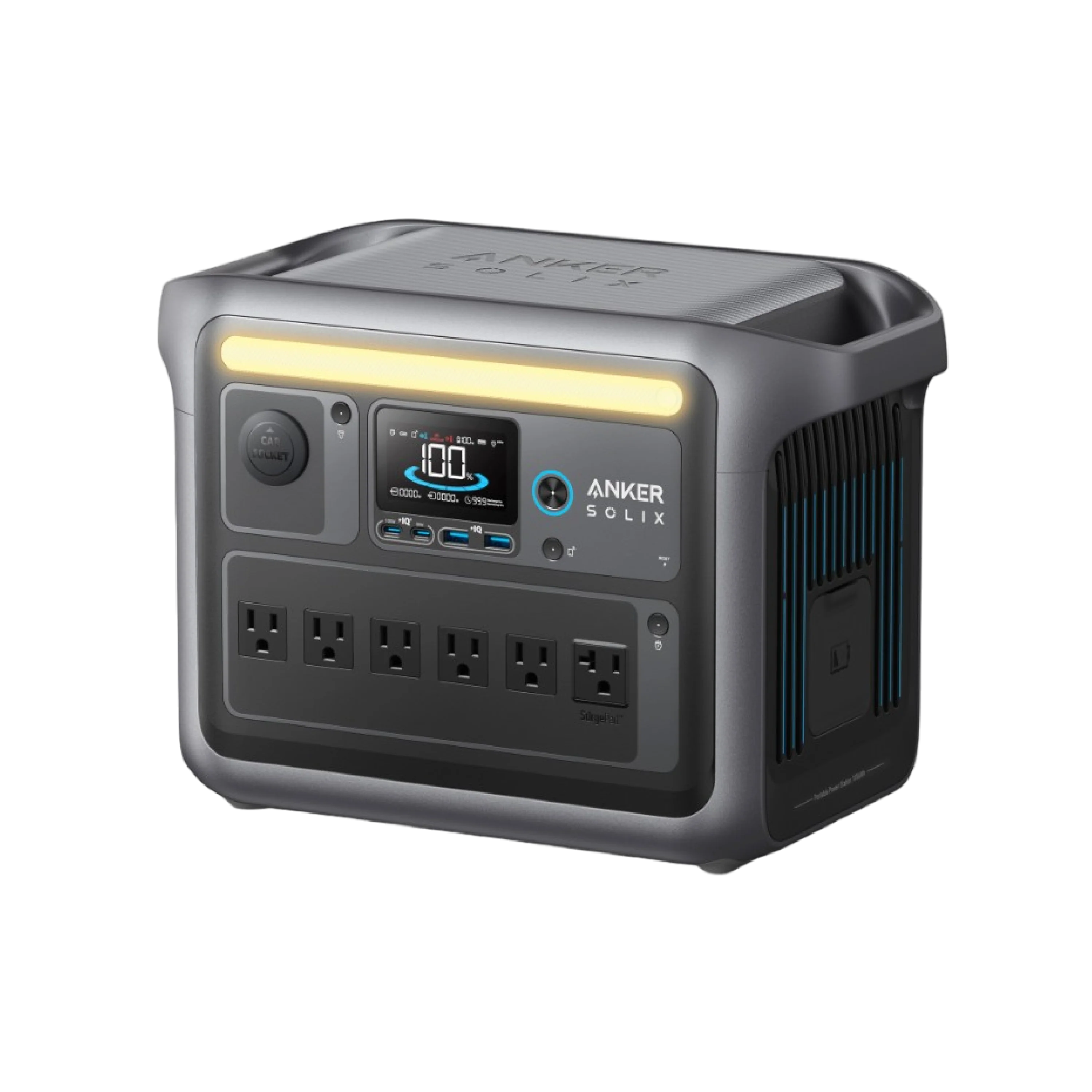
$599.99 · direct from Anker
Last checked 1 day ago. Prices move — check before you buy.

$1,499.00 · direct from Jackery
Last checked 1 day ago. Prices move — check before you buy.
Spec deltas
$449 buys 1,056Wh. $1,399 buys 3,072Wh. Divide it out and the expensive box is the bargain: 39 cents a watt-hour against 43. The HomePower 3000 costs 2.7 times as much and holds 2.9 times as much, which means the price gap here is quantity, not markup.
Where that stops being an accounting point is the usable figure. Nameplate isn't what you get. Derate for the inverter and the C1000 has 898Wh in hand, the Jackery 2,611Wh. An eight-hour blackout draws 1,645Wh in our model, so the small unit gets you just past the halfway mark and then it's a flashlight.
Take the HomePower 3000 if it's going to live in the house. Take the C1000 if you'll be carrying it. 28.4 lbs against 59.52 is the difference between one hand and both knees, and if your worst case is a laptop, a router and some lights, the extra $950 buys headroom you'll never touch.
What the Numbers Reveal
Each conclusion stated first — the numbers behind it on one line, the full analysis below.
Capacity
Cycle ratings widen it instead of closing it. 1,056Wh across 3,000 cycles is 3,168 kWh over the C1000's life; 3,072Wh across 4,000 cycles is 12,288 kWh. That's nearly four times the energy for 2.7 times the money, or 10 cents a lifetime kilowatt-hour against 14. The C1000 is the cheaper purchase and the more expensive electricity.
SOLIX C1000: $449 for 1,056WhHomePower 3000: $1,399 for 3,072Wh$449 divided by 1,056Wh is 43 cents per watt-hour; $1,399 divided by 3,072Wh is 39 cents
Why it mattersAnyone shopping the C1000 as the value pick should know it isn't one on a per-watt-hour basis. Its real arguments are the cash you keep today and the weight you don't carry.
Then the floor drops out. The blackout and the weekend are roughly double what the C1000 holds usable, and there's no rationing that turns 898Wh into 1,645Wh. The shortfall isn't a gentle slope across the scenarios, it's a cliff with one day of desk work balanced on the edge of it.
C1000: 1,056Wh nameplate, 898Wh usable after inverter deratingA remote workday draws 910WhAn eight-hour blackout draws 1,645Wh and a camping weekend draws 2,100Wh
Why it mattersIf your worst case is a single workday, the $950 saving is real money for a coin-flip risk. If your worst case is an overnight outage or a weekend away, the C1000 doesn't get there and no amount of discipline fixes it.
And the tank grows while the engine doesn't. Adding batteries lifts stored energy but leaves the 1,800W inverter and its 2,400W peak exactly where they were, so an expanded C1000 still switches on the same appliances a stock one does. The HomePower 3000's 3,600W and 7,200W are fixed too, but they're fixed higher.
C1000 accepts Anker expansion batteries; HomePower 3000 is sealedC1000 base capacity is 1,056Wh against the HomePower 3000's fixed 3,072Wh, a gap of 2,016WhC1000 inverter: 1,800W continuous, 2,400W surge
Why it mattersIf your reason for picking the C1000 is that you'll grow into it later, that only pays off past 3,072Wh, and you should price the whole stack against $1,399 before you commit to the path.
solar input
In a multi-day outage that changes the shape of the day. The C1000 holds about half of the 1,645Wh an eight-hour evening draws, so panels are refilling it to be spent again the same night. The Jackery banks two of those evenings in a single charge, off the same sunlight.
C1000: 1,056Wh capacity, 600W maximum solar inputHomePower 3000: 3,072Wh capacity, 1,400W maximum solar input1,056Wh over 600W and 3,072Wh over 1,400W both land near two hours at full rated input
Why it mattersAnyone buying panels alongside the station should compare input watts before capacity. The unit that refills faster than you drain it is the one that turns a two-day outage into a non-event.
The specific dimensions that decide these two units — everything else is a tie.
Your Life, Your Pick
Selected because: Two of the six loads we model sit above the C1000's 898Wh usable and a third clears it by 12Wh, so this is where the $950 either justifies itself or doesn't.
The interesting scenario isn't the one the C1000 loses badly, it's the one it nearly wins. A remote workday draws 910Wh and the C1000 has 898Wh usable. Twelve watt-hours, about 1%, decided by how many times you top up your phone before five o'clock.
Then the floor drops out. An eight-hour blackout draws 1,645Wh and a camping weekend 2,100Wh, both roughly double what the small unit holds. The HomePower 3000 takes the blackout at 63% used and the weekend at 80%. Both units cover a CPAP night and a tailgate comfortably, so if that's your whole list the C1000 is the entire answer. Van life is the honest loss for both: 4,685Wh a day, and even the Jackery reaches only about 56% of it.
Lifetime Value
Selected because: The $1,399 unit delivers energy at 10 cents a lifetime kilowatt-hour against the $449 unit's 14, which is the opposite of what the sticker suggests.
cost / lifetime kWh
Cycle counts are where the money argument stops being close. 1,056Wh times 3,000 cycles is 3,168 kWh over the C1000's working life; 3,072Wh times 4,000 cycles is 12,288 kWh. Nearly four times the energy for 2.7 times the price is how a $1,399 unit ends up cheaper than a $449 one per unit delivered.
Cycled daily that's 8.2 years against 11, and neither figure is the one most people should plan around. On a weekend rhythm both horizons run into the decades, and both units will be retired for being old rather than worn out. Buy on what you need this year. The lifetime math only settles which one is overpriced, and it isn't the big one.
Portability & Form Factor
Selected because: 28.4 lbs against 59.52 is the C1000's strongest card and the only spec on this page where the gap runs its way.
weight
Thirty-one pounds is the difference, and it's the kind you feel on the third trip from the car. 28.4 lbs is a one-hand carry to a picnic table. 59.52 lbs is both hands, straight back, and a decision made in advance about where it lands.
In fairness, 60 lbs for 3 kWh is unusually good. Reviewers call it the smallest and lightest 3kWh station going, one-person portable at around 60 lbs and narrow enough at 16.4 inches to fit places rivals won'tB1. That's a genuine compliment paid to a 60 lb object. If the unit is going to sit in a basement next to the panel it's irrelevant, and if it's going in and out of a truck bed every weekend the C1000 wins this outright.
Growth Path
Selected because: The C1000 expands and the HomePower 3000 doesn't, but it starts 2,016Wh below the Jackery's fixed ceiling, so the first battery mostly buys back ground.
solar input
Expandability sounds like the C1000's trump card until you check where each unit starts. The Jackery's sealed ceiling is 3,072Wh. The C1000's floor is 1,056Wh. The first expansion battery you buy is mostly catching up to a machine that already shipped with the capacity, which is an odd way to spend an upgrade.
It also only moves one number. Extra batteries don't lift the 1,800W inverter or the 2,400W peak, so the expanded C1000 starts exactly what the stock one starts. Expandability is worth paying for when the expanded ceiling beats the rival's. Here it does that only past 3,072Wh, and a buyer with that plan should be pricing the full stack, not the entry unit.
What the Specs Don't Tell You
Selected because: Warranty, USB-C and UPS switchover come out identical, which leaves surge headroom and one undisclosed noise figure as the only cards in play.
rated cycles
Three rows come out dead level, which is worth saying out loud because a comparison table makes everything look like a contest. Both carry five-year warranties. Both cap USB-C at 100W. Both switch over in 20 milliseconds, and on the Jackery that was measured in a real grid-drop test rather than quotedB4. None of those three should move a dollar in either direction.
Surge headroom isn't level. The C1000 rates 1,800W continuous and 2,400W peak, a cushion of 1.33x. The HomePower 3000 rates 3,600W and 7,200W, a clean 2x. Compressors in fridges and air conditioners don't ask politely at startup, they pull a large multiple of their running draw for an instant, and the cushion is what decides whether the appliance switches on at all rather than whether it runs. Reviewers report the C1000 handles virtually any household appliance short of central AC and an electric dryerA4, which fits 2,400W exactly, and 2,400W is also where it stops.
Strengths & trade-offs
Anker SOLIX C1000
Strengths
- +Costs $950 less
- +Lighter by 31.1 lb
Trade-offs
- –Weaker inverter (-1,800W) limits appliance compatibility.
- –Shorter-lived battery — rated for 3,000 charge cycles vs the HomePower 3000's 4,000, so it wears out sooner.
Jackery HomePower 3000
Strengths
- +Larger battery capacity
- +Higher AC output
- +Faster solar charging
- +Rated for 4,000 charge cycles — much longer battery lifespan
Trade-offs
- –Substantially more expensive (+$950) than the SOLIX C1000.
- –Significantly heavier (+31.1 lbs), making it harder to move.
Will It Power Your Gear?
Scenario math and per-appliance runtimes, modeled from the spec record.
Scenario verdicts
We ran the math on six real-world scenarios. Here's which unit survives your actual life.
SCN-01 · 2 nights · needs 2,100Wh
Weekend Camping
Two nights off-grid with essential comfort
HomePower 3000
The SOLIX C1000 doesn't finish — 898Wh usable against the 2,100Wh this needs leaves it 1,202Wh short, about 43% of the scenario covered. The HomePower 3000 covers it with 511Wh to spare.
Battery budget usedlower = more headroom
LOAD Phone Charger 15W×6h · LED Lights 40W×8h · Box Fan 75W×14h · CPAP Machine 40W×16h
SCN-02 · 8 hours · needs 1,645Wh
8-Hour Blackout
Keep the essentials running through a night without power
HomePower 3000
1,645Wh over eight hours against 898Wh usable in the C1000. It gets you just past the halfway mark and then it's a flashlight. The HomePower 3000 finishes the outage at 63% used, which is the difference between a night where the fridge stays a fridge and a night spent choosing what to unplug.
Battery budget usedlower = more headroom
LOAD Fridge 150W×8h · Router + Modem 20W×8h · LED Lights (4 bulbs) 40W×6h · Phone Charger 15W×3h
SCN-03 · 8 hours · needs 320Wh
CPAP Overnight
Sleep therapy without interruption — the #1 medical use case
Either unit
About 40W for eight hours, 320Wh, and both units treat that as a light night: 36% of the C1000's usable energy, 12% of the Jackery's. Capacity decides nothing here. Noise would, except neither figure is worth leaning on, since Jackery quotes 30 dB and Anker publishes nothing, and one rating describes the quiet moment rather than the loud one. At 40W you're nowhere near either inverter's rating, so buy on price and weight and treat the fan as unresolved.
Battery budget usedlower = more headroom
LOAD CPAP Machine 40W×8h
SCN-04 · 8 hours · needs 910Wh
Remote Workday
Full work day off-grid without power anxiety
HomePower 3000
910Wh of desk work against 898Wh usable. The C1000 misses by twelve watt-hours, about 1%, which is the difference between finishing the day and finishing most of it. The HomePower 3000 does the same day at 35% used. The question isn't whether the small unit can do a workday, it's whether you want the last hour riding on how often you charged your phone.
Battery budget usedlower = more headroom
LOAD Laptop 60W×8h · External Monitor 30W×8h · Router + Modem 20W×8h · Phone Charger 15W×2h
SCN-05 · 4 hours · needs 670Wh
Tailgate Party
Game day power for the crew
HomePower 3000
Both units cover game day. 670Wh is 75% of the C1000's usable energy and 26% of the Jackery's, and reserve you never touch isn't worth carrying, so this comes down to the walk from the car: 28.4 lbs in one hand or 59.52 lbs in two, a 31 lb difference, several times, in the dark, on the way back.
Battery budget usedlower = more headroom
LOAD Blender 400W×0.5h · LED TV (55") 80W×4h · Bluetooth Speaker 15W×4h · Phone Charger (×3) 45W×2h
SCN-06 · 24 hours · needs 4,685Wh
Van Life Daily
A full day of mobile living — the ultimate endurance test
Neither unit
4,685Wh a day beats both of these. The C1000 covers about 19% of it and the HomePower 3000 about 56%, and no amount of careful loading closes a gap that size. This is the scenario that tells you you're shopping a tier too low. Buy one larger station rather than the better of two small ones.
Battery budget usedlower = more headroom
LOAD Mini-Fridge 150W×24h · Laptop 60W×4h · Phone Charger 15W×3h · LED Lights 40W×5h · Fan 75W×8h
The Load Test
RUNTIME = (Wh × 0.85) ÷ LOAD
None of the scenarios above exactly yours? Build it. Toggle what you'd plug in; both units are tested against the combined draw.
Essentials
Comfort & Convenience
High-Draw Appliances
Test duration
8h
Continuous draw
205W
Projected runtime
For this load: HomePower 3000 runs 12.7h vs 4.4h.
$1,399 list · direct from Jackery
Modeled from the spec record — same math as the tables below. Methodology
Runtime by appliance
Real-world runtime estimates for common appliances, modeled at 85% inverter efficiency.¹
Essentials
The basics you need runningscale 0–174.1hComfort & Convenience
Makes off-grid life actually enjoyablescale 0–34.8hHigh-Draw Appliances
These reveal the real limitsscale 0–2.6h¹ Runtime = (capacity × 0.85) ÷ appliance watts. Within each group, all bars share one time scale (the group's longest runtime), so lengths are comparable across appliances; identical runtimes collapse into a single blue/orange bar. Actual runtime varies with battery age, temperature, and simultaneous loads — see methodology.
Conclusion
August 9, 2026
Verdict: the HomePower 3000, on Power Score margin
Buy the HomePower 3000 if this is a house unit. It covers the loads people actually buy backup power for and loses only on weight and cash up front. Our eight-hour blackout model draws 1,645Wh; the Jackery finishes it at 63% used while the C1000's 898Wh usable covers just over half. It does that while costing less per watt-hour ($1,399 over 3,072Wh is 39 cents, against $449 over 1,056Wh at 43) and less per lifetime kilowatt-hour (10 cents against 14, on 4,000 cycles against 3,000). The C1000 isn't a bad buy, it's a smaller one. At $449 and 28.4 lbs it's the right answer for a workday, a campsite, or a trunk, and it comes within 12Wh of a full remote workday on its own. But no amount of careful rationing turns 898Wh into 1,645Wh, and that's the gap the extra $950 closes.
Editor-assigned confidence, based on cited owner research and spec analysis.
List prices as of August 9, 2026. The links below open Anker's and Jackery's current prices.
$1,499.00 · direct from Jackery
Last checked 1 day ago. Prices move — check before you buy.
or check the SOLIX C1000 price$599.99 list
Written by Gunner Gustafson, Whole-Home Backup Tester · Station Arena Test Desk · Updated August 9, 2026
Measured Data
Benchmark scores and the full spec record, side by side.
Benchmark scores
Not rated for both units (minimum threshold unmet): CPAP, Camping.
Full specifications
ᵈ Derived: price ÷ rated capacity. See the data behind our comparisons →
Comparison ToolAdd more power stations, side by sideOpen Tool →How these numbers are produced
Numeric verification
Every figure on this page traces to our spec database or arithmetic on it — no estimated numbers.
Owner claims
Statements about owner experience are cited to published reviews — see Sources & Research Notes below.
Runtime model
Runtime = (rated capacity × 0.85 inverter efficiency) ÷ device wattage. Solar recharge estimates assume panels deliver 70% of rated output. Cold weather, battery age, and stacked loads reduce real-world results.
Power Score
Computed from 14 published spec dimensions, weighted per use-case bench. Higher is better; a unit must meet a bench's minimum threshold to be rated.
See the full weight table and data sourcing on our methodology page →Class ranking (the star rating)
Each unit's star score is a category ranking, not customer reviews — no buyer opinions feed it. We score every station on size-independent quality (value, output, portability, endurance, ports, warranty, and more), then percentile-rank it against the other units in its capacity class, so a class-leading compact unit and a class-leading whole-home unit can both earn 5★. Here, SOLIX C1000 rates 4.7/5 (81st percentile of 27 Everyday-class units), and HomePower 3000 rates 4.7/5 (84th percentile of 26 Large-class units).
How the class ranking is computed →Test Notes & Caveats
Hidden gotchas and advantages we spotted that you won't find on the product page.
Fixed at 3,072Wh, and That's Fine
The HomePower 3000 has no expansion port, which reads as a limitation right up until you check where the expandable rival starts. The C1000's base is 1,056Wh, so its first expansion battery largely buys back ground the Jackery already covers, and it leaves the 1,800W inverter and 2,400W surge ceiling untouched. A sealed ceiling only counts against a unit when it's lower than the alternative's. This one sits 2,016Wh higher.
Surge Headroom: 1.33x Against 2x
The C1000 rates 1,800W continuous and 2,400W peak. The HomePower 3000 rates 3,600W and 7,200W. That's a 1.33x cushion against a clean 2x, and the cushion is the spec that decides whether a compressor starts rather than whether it runs, because motors pull a large multiple of their running draw for an instant at switch-on. Continuous ratings tell you what a unit can sustain. The peak tells you what it will agree to turn on.
Warranty: A Dead Heat
Five years each, so this row settles nothing. Divide the sticker by the term and you get $90 a year for the C1000 against $240 for the HomePower 3000, but that's the price gap wearing a different hat rather than a difference in coverage. What varies between these two isn't how long you're covered, it's how each company behaves when you call, and that's a brand question rather than a spec one.
Battery Lifespan in Real Years
The HomePower 3000 is rated for 4,000 cycles vs 3,000. In real life: at daily use, that's 11 vs 8.2 years. At weekend use (twice a week), it's 38 vs 29 years. One caution reading years across different sizes: a cycle is 3,072Wh on the HomePower 3000 and 1,056Wh on the SOLIX C1000, so count lifetime energy — roughly 12,288 kWh against 3,168 kWh over the rated life. After hitting the cycle limit, the battery doesn't die — it drops to ~80% of original capacity, which is still very usable.
Anker Publishes No Noise Figure
There's no decibel rating for the C1000, so there's nothing to hold Anker to. Read that as a disclosure gap rather than proof of a loud unit, and extend the same caution to Jackery's quoted 30 dB, because a single number describes a single operating condition and manufacturers pick the kind one. Load matters more than the rating either way: fans work when a unit is refilling fast or running near its limit, and stay out of your evening when it isn't.
Full record above — the Test Desk pick is the HomePower 3000.
Check HomePower 3000 price →or check the SOLIX C1000 priceOwnership Analysis
What happens after you buy — true cost of ownership, brand trust, and growth potential.
Lifetime value
Service lifeyears at one full cycle per day
Lifetime energy delivered
Cost per delivered kWh
│ warranty ends · Reaching the cycle rating means ~80% capacity remains — degraded, not dead.
Analyst note
The SOLIX C1000 is cheaper to buy, but the HomePower 3000 is cheaper to own. At $0.11/kWh over its lifetime vs $0.14/kWh, the HomePower 3000's higher cycle life and capacity make each dollar go further over the years.
Brand trust
Anker
Ecosystem
7-8 SOLIX portable power stations across C-series (compact) and F-series (flagship), plus the X1 home energy system
Support
US-based, and the brand's historic standard was no-hassle replacement. The current SOLIX experience is less consistent, with AI-first agents on first contact and hazmat return logistics on the heavier units. The reputation is running a little ahead of the service.
Community
Moderate — active Reddit (r/Anker, r/AnkerSOLIXCommunity) and growing. Benefits from Anker's massive consumer electronics brand awareness.
App experience
Rated 4.5/5 iOS (~1,100 ratings) · 4.3/5 Android
Unique strength
Anker's consumer-electronics track record carries into SOLIX, and the line is generally priced well per watt-hour across the catalog. Worth noting that in this particular matchup the C1000's 43 cents a watt-hour is the higher of the two.
Worth knowing
Firmware updates have removed features without warning, and the expansion ecosystem is smaller than EcoFlow's. Neither is a reason to skip the C1000. Both are reasons to buy the capacity you need now rather than the capacity you intend to bolt on later.
Jackery
Ecosystem
12-15+ models across Explorer (portable) and HomePower (home backup) series, plus SolarSaga panel ecosystem and innovative form factors
Support
US-based and the weak spot: scripted responses, strict receipt requirements on warranty claims, and refurbished replacements offered against clearly faulty units. The practical workaround is to buy from a retailer with its own return policy and never need Jackery's.
Community
Smallest community of the major brands — Reddit r/Jackery has ~2,000 members. YouTube presence is solid due to brand recognition.
App experience
Rated 2.3-3.3/5 iOS and Android — the weakest app experience of the major brands. Multiple confusing apps (Jackery app vs Jackery Home) and mandatory login even offline.
Unique strength
The widest retail distribution in the category, through Costco, Home Depot, Best Buy and Amazon, which turns into a real feature the day a warranty claim becomes a return instead.
Worth knowing
The app is the weakest of the major brands, with more than one app under the same name and a mandatory login even when you're standing next to the unit. This model runs LFP cells rated at 4,000 cycles, but a couple of older Jackery models still ship NMC with shorter lives, so check the cycle rating on whatever you actually add to the cart.
Analyst note
Anker is the stronger brand and Jackery is the stronger distribution. If something goes wrong you'd rather be holding an Anker receipt; if you want the option of walking a 60 lb box back into a store, you'd rather have bought the Jackery at Costco. Neither support organisation is a reason to change your pick here, because the capacity gap between these two is far larger than the service gap.
Growth path
SOLIX C1000
EXPANDABLESupports Anker expansion batteries, so you can add capacity later without replacing the base unit — useful if your needs may climb past 1,056Wh.
Accepts up to 600W of solar. Suitable for a 1-2 panel setup.
Generous port selection supports complex multi-device setups.
Expansion batteries are Anker-specific. You're investing in the Anker ecosystem.
HomePower 3000
FIXED CAPACITYFixed at 3,072Wh — a sealed, complete system rather than a starting point. There's no expansion port, so that figure is the ceiling: check it against your longest unplugged stretch before you buy.
Accepts up to 1,400W of solar. Enough for a serious multi-panel array.
Adequate ports for most setups, but heavy users may want a power strip.
Realistic full solar rechargeat 70% of rated panel output — see methodology
Analyst note
Don't read the SOLIX C1000's expandability as a straight win here: it starts at 1,056Wh, below the HomePower 3000's 3,072Wh, so a first expansion battery largely buys back capacity the HomePower 3000 already includes. It only pulls ahead if you'd grow past 3,072Wh — short of that, the HomePower 3000's larger fixed capacity is the simpler value.
What Owners Report
Patterns from published owner reports and long-term reviews — every claim cited to its source below.
Anker SOLIX C1000
A year of use, roughly 97% of original capacity still there, and a 30-day stint as a home-office UPS that rode out seven brief outages without dropping a machine or losing dataA2. That's the most valuable entry in the C1000's file because it's the one that took a year to produce. Reviewers also credit fast AC recharge, strong short-burst inverter behaviour, sane size and weight for a 1kWh unit, and app monitoring that's actually worth openingA3, and note it runs virtually any household appliance short of central AC or an electric dryerA4.
The consistent knock is the fan. It spins up audibly during fast charging or heavy output near the unit's limit, comparable to a desktop computer at speed, and goes nearly silent under light loads below about 500WA1. So it's loud precisely when you're refilling it and quiet precisely when you're asleep next to it, which is the better way round for that particular flaw to fall.
“One reviewer used their unit for over a year with zero issues and minimal battery degradation — about 97% of original capacity. In a 30-day home-office UPS test it handled 7 brief outages with no equipment shutdowns or data loss.”
Sources
outdoorgearlab.com · lifenhancer.com · rvoutfitting.com · outdoortechlab.com · wattsontheroof.com · technerdo.com · teqclub.com
Jackery HomePower 3000
Jackery's field record is the quiet argument here: owner communities report the lowest rate of failures and warranty claims among the major brandsB2. Backup testing supports the spec sheet rather than undercutting it, with a standard refrigerator kept running for nearly two days, a 55-inch TV for around 30 hours, and a grid-to-battery switchover measured under 20 millisecondsB4.
The other thing reviewers keep returning to is the packaging. Cell-to-body construction gets 3 kWh into a 16.4-inch-wide box one person can carry at around 60 lbsB1, and the LFP cells are rated near 4,000 cyclesB3, which is the number our lifetime math runs on. There's less long-horizon evidence here than on the C1000: what exists is reviewer testing rather than multi-year ownershipB1B4.
“Described as the world's lightest and smallest 3kWh power station thanks to an advanced cell-to-body (CTB) design — one person can carry it at around 60 lbs, and its compact 16.4-inch width fits spaces that reject rivals.”
Sources
backuppowerhub.com · jackery.com · poweredthrough.com · thesolarlab.com · poweraic.com · tipselite3s.com
Sources & Research Notes
Every owner claim in this report is traceable to a published source. The bracketed references above resolve here.
Recurring owner themes
- Fan noise under fast charging or heavy load is the consistent knock; otherwise strong reliability, fast recharge, and practical size earn broad praise. [SOLIX C1000 · 3 entries]
- Standout compactness and light weight for a 3kWh unit, Jackery's low failure/warranty-claim record, and dependable LFP home-backup performance are the praise. [HomePower 3000 · 3 entries]
- A1
“Fan noise is the single most common complaint — the fans spin up audibly during fast charging or heavy output near the unit's limit, comparable to a desktop computer fan at speed. Under light loads (below ~500W) it's nearly silent.”
outdoorgearlab.com / lifenhancer.com — Anker SOLIX C1000 review · 2026 · [negative]
- A2
“One reviewer used their unit for over a year with zero issues and minimal battery degradation — about 97% of original capacity. In a 30-day home-office UPS test it handled 7 brief outages with no equipment shutdowns or data loss.”
rvoutfitting.com / outdoortechlab.com — Anker SOLIX C1000 long-term notes · 2026 · [positive]
- A3
“Nails the fundamentals: fast AC recharge, strong inverter performance for short bursts, practical size and weight for a 1kWh unit, and genuinely useful app monitoring.”
wattsontheroof.com / technerdo.com — Anker SOLIX C1000 review · 2026 · [positive]
- A4
“Handles virtually any household appliance except central AC and electric dryers; a popular 'sweet spot' 1kWh unit for RV and home backup.”
rvoutfitting.com / teqclub.com — Anker SOLIX C1000 review · 2026 · [positive]
- B1
“Described as the world's lightest and smallest 3kWh power station thanks to an advanced cell-to-body (CTB) design — one person can carry it at around 60 lbs, and its compact 16.4-inch width fits spaces that reject rivals.”
backuppowerhub.com / jackery.com — HomePower 3000 review · 2026 · [positive]
- B2
“Jackery maintains the lowest rate of reported failures and warranty claims among the major brands in owner communities.”
poweredthrough.com / backuppowerhub.com — Jackery reliability · 2026 · [positive]
- B3
“Uses LiFePO4 chemistry with strong thermal stability; Jackery and reviewers rate the cells at roughly 4,000 cycles — notably higher than the figure in some spec listings, so treat lower cycle numbers with caution.”
thesolarlab.com / poweraic.com — HomePower 3000 review · 2026 · [positive]
- B4
“Solid home backup — kept a standard refrigerator running for nearly two days and a 55-inch TV for around 30 hours, with a grid-to-battery UPS switchover measured under 20 milliseconds.”
backuppowerhub.com / tipselite3s.com — HomePower 3000 review · 2026 · [positive]
Research compiled August 9, 2026.
Who Should Buy Which
Buy the SOLIX C1000 if you…
- →Your worst case is a workday. Laptop, monitor, router, a couple of phone top-ups: 898Wh usable covers that to within about 1%, and $449 covers it without a conversation.
- →You carry it. Campsite, tailgate, truck bed, up a flight of stairs. 28.4 lbs is a one-hand lift and the Jackery is emphatically not.
- →You want a desk-side UPS more than a house battery. Switchover is 20 milliseconds, and one reviewer ran it as exactly that for a month across seven outages without a single shutdownA2.
- →$449 is the budget and stretching to $1,399 would hurt. Nothing on this page justifies borrowing to close the gap.
Buy the HomePower 3000 if you…
- →You're buying for the house. An eight-hour outage draws 1,645Wh and this finishes it at 63% used, so the fridge stays a fridge and nobody stands in the kitchen deciding what to unplug.
- →You camp for a weekend without a refill. 2,100Wh, 80% used, done.
- →You have panels. 1,400W of input refills 3,072Wh in roughly the clock time the C1000 needs for a third as much, so a two-day outage stops being a rationing exercise.
- →You want the cheaper watt-hour and you can pay for it up front rather than per unit of energy for the next decade.
If neither fits
If you're running a van or a full-time off-grid setup at 4,685Wh a day, close this tab cheerfully. The C1000 covers about 19% of that and the HomePower 3000 about 56%, and paying twice to still fall short is the most expensive way to buy power. You want one larger station, or a dedicated house battery and inverter, not the better of these two.
The Bottom Line
Take the HomePower 3000. Nearly four times the lifetime energy for 2.7 times the price is the whole argument, and the rest of the page falls out of the same place: 2,611Wh usable covers the loads people actually buy backup power for, and 898Wh covers about half of them.
The C1000's case is real, and it's narrow. It's 31 lbs lighter, it's $950 cheaper today, and it's twelve watt-hours from a full remote workday. If that's your week, buy it and don't look back. If there's a refrigerator on your list, the small unit will spend the outage doing arithmetic you don't want to be doing at nine o'clock at night.
Frequently Asked Questions
Answers drawn from the spec record and cited owner research.
Is the Jackery HomePower 3000 worth $950 more than the Anker SOLIX C1000?
If you need more than about 900 watt-hours in one stretch, yes, and it isn't close. Per watt-hour the Jackery is the cheaper unit: $1,399 over 3,072Wh is 39 cents, against 43 cents for $449 over 1,056Wh. The $950 buys quantity at a discount rather than a premium. If your loads genuinely fit inside the C1000, though, it buys headroom you'll never use.
Can the Anker SOLIX C1000 run a refrigerator during a power outage?
It will run one, but not through a long outage. Reviewers report it handles virtually any household appliance except central AC and electric dryers, and 1,800W continuous is far more than a fridge needs to run. The limit is energy rather than power: 898Wh usable against the 1,645Wh our eight-hour blackout model draws. The HomePower 3000 kept a standard fridge going for nearly two days in testing.
Does the C1000's expandability make it the better long-term buy?
Only if you plan to pass 3,072Wh. The C1000 starts at 1,056Wh, so the first expansion battery is largely buying capacity the HomePower 3000 already includes, and it doesn't raise the 1,800W inverter or the 2,400W surge ceiling. Expansion adds fuel, not engine. Below that threshold the Jackery's fixed capacity is the simpler and cheaper way to own the same watt-hours.
Which one is quieter to sleep next to?
Neither has a number you should decide on. Jackery quotes 30 dB and Anker publishes no figure at all, and a single decibel rating describes one operating condition, usually a flattering one. Load is the useful guide: a CPAP pulls about 40W, a small fraction of either inverter's rating, and the C1000 is reported near-silent below roughly 500W. At that draw neither unit has a reason to work its fan.
Can either one power a van or off-grid living full time?
No. Full-time van use runs 4,685Wh a day in our model, and the C1000 covers about 19% of that while the HomePower 3000 covers about 56%. Both are day-and-a-bit units rather than house systems. If that's the plan, budget for a larger station or a dedicated battery bank instead of stacking either of these into the gap.
Where to buy
Anker SOLIX C1000
$599.99
$599.99 · direct from Anker
Last checked 1 day ago. Prices move — check before you buy.
Jackery HomePower 3000Pick
$1,499.00
$1,499.00 · direct from Jackery
Last checked 1 day ago. Prices move — check before you buy.
Prices may vary by retailer and are subject to change.