Head-to-head test
Anker SOLIX C1000 vs BLUETTI 2×EP900 + 8×B500
These aren't two answers to the same question: one is a 28-pound box you carry to the tailgate, the other is a 1,178-pound battery an electrician bolts to your breaker panel, so the only decision here is whether you're buying a power station or a whole-home installation.
Full profiles: Anker SOLIX C1000 →

Written by Gunner GustafsonUpdated
Whole-Home Backup Tester, Station Arena Test Desk
Spec deltas
The Anker SOLIX C1000 is $449; the BLUETTI 2×EP900 + 8×B500 is $35,196, roughly 78 times the price for about 38 times the energy (39,680Wh against 1,056Wh). These two aren't competing for the same buyer, and pretending they are does you no favors.
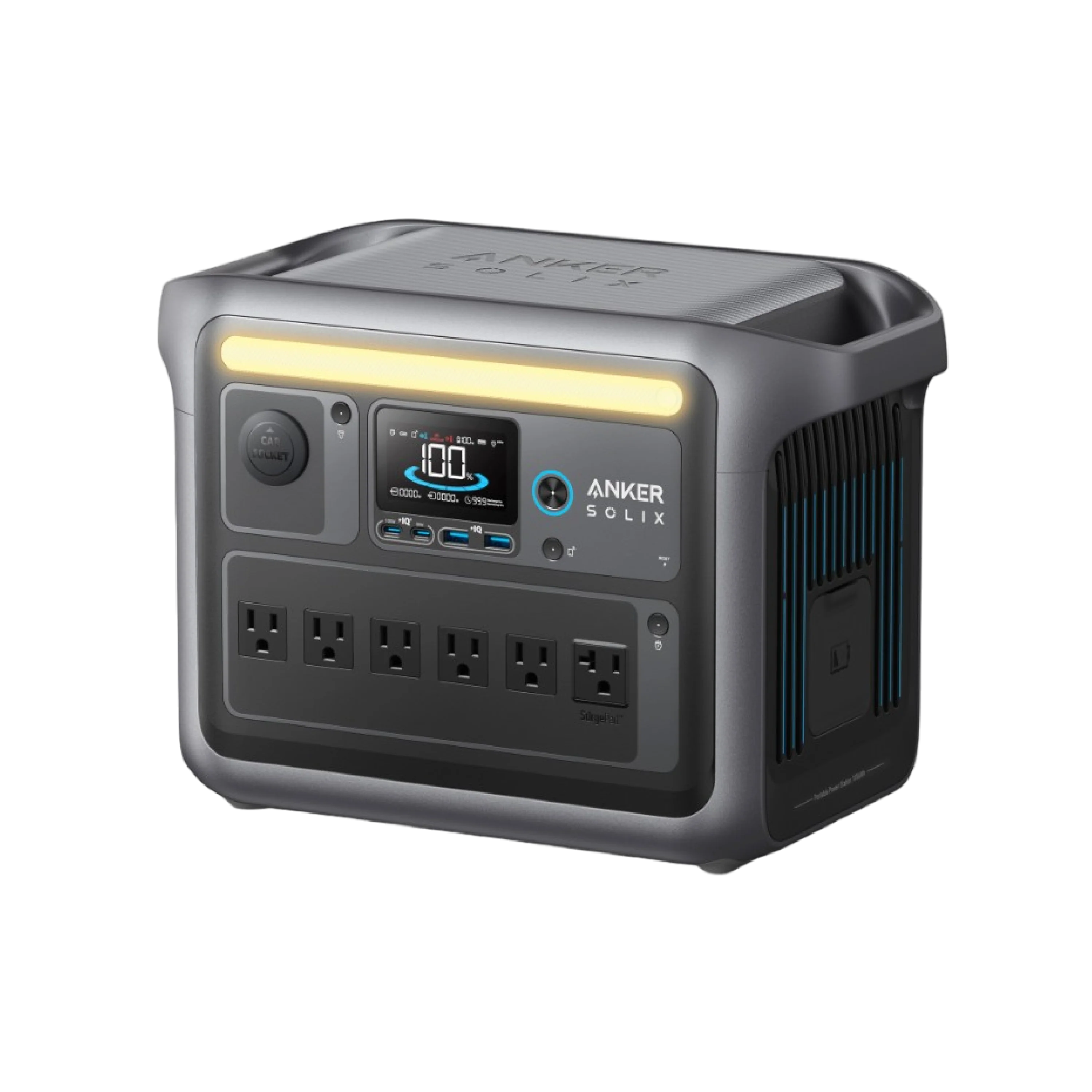
The C1000 weighs 28 pounds and has outlets on the front. The BLUETTI weighs 1,178 pounds, has no sockets on the box at all, and feeds a subpanel your electrician wires in. One rides in a trunk; the other arrives on a pallet and becomes part of the house. That single fact explains the scenario grid better than any capacity number: the C1000 wins the tailgate by default because the BLUETTI physically can't come, and the BLUETTI wins the long blackout because the C1000 runs out of energy before it's 55% of the way through.
For the person landing here with two tabs open, the answer is the C1000. It's cheaper to own, it's portable, and it does what a power station is bought to do. The BLUETTI is the right call only if you're wiring your whole house for days off-grid, in which case you weren't really choosing between these at all. And if your need sits in the middle, a full day powering a van or a campsite, neither of these is your unit.
What the Numbers Reveal
Each conclusion stated first — the numbers behind it on one line, the full analysis below.
cost / lifetime kWh
You're not paying a premium for a worse deal. You're paying about $34,700 more up front to move the same 14-cent-per-kilowatt-hour economics from one-appliance scale to whole-house-for-a-decade scale. That buys a different tier of infrastructure, not a better power station.
Anker C1000: $449 for 1,056WhBLUETTI stack: $35,196 for 39,680Whcost per lifetime kWh: $0.14 (C1000) vs $0.15 (BLUETTI)lifetime energy: 3,168 kWh vs 238,080 kWh over rated life
Why it mattersIf you don't have a whole-house-for-days problem, the extra $34,700 buys capacity you'll never reach, and the C1000 gives you the identical per-kilowatt-hour economics at a price you'd actually spend.
weight
They fail in mirror image. One can't go; the other can't finish. The two 'neither' verdicts, weekend camping and van life, come from opposite directions: the BLUETTI has the energy but is bolted to the building, and the C1000 travels but covers only 43% and 19% of those days.
C1000: 28.4 lbs, portable, outlets on the boxBLUETTI stack: 1,178 lbs, hardwired to the electrical panel, no socketsC1000 usable energy about 898WhTailgate handed to the C1000 by default; 8-Hour Blackout needs 1,645Wh and Van Life needs 4,685Wh, both of which the C1000 falls short on
Why it mattersIf your need is a real day of power somewhere other than a wired-up wall, neither of these is the answer; you want a mid-size portable that sits between a 1kWh box and a home installation.
That endurance is inseparable from the install. It's 1,178 pounds, wired to a subpanel, warranted 10 years because it's meant to be part of the house for a decade. For the buyer who wants the grid gone for days, the C1000 isn't a smaller version of this; it's a flashlight next to a generator.
BLUETTI stack: 39,680Wh, 18,000W output, 6,000 cycles, 16.4 years at daily use8-Hour Blackout: BLUETTI finishes with 32,083Wh to spare, C1000 is 747Wh shortBLUETTI: 1,178 lbs, hardwired, 10-year warranty, $35,196
Why it mattersIf you're planning whole-home solar backup, stop comparing this to portables and buy the BLUETTI or its class; if you're not, its 39,680Wh is capacity you're paying for and can't use.
The specific dimensions that decide these two units — everything else is a tie.
Portability & Form Factor
Selected because: One unit weighs 28 pounds and travels; the other weighs 1,178 pounds and is wired to your panel. That split decides more here than any spec.
weight
You pick up the C1000. At 28 pounds it's a hand-on-each-side lift into a trunk, and the outlets are right there on the front. The BLUETTI 2×EP900 + 8×B500 is 1,178 pounds and has no outlets at all; it wires into a subpanel, and an electrician is the person who touches it. That's the whole difference in a sentence: one is a product you use, the other is infrastructure you install.
So 'which is more portable' isn't a close call, it's a category line. If the thing you're buying needs to ride to a campsite or sit on a kitchen counter during an outage, only one of these was ever eligible.
Your Life, Your Pick
Selected because: It's the clearest read on two units that fail in opposite directions: the C1000 can't finish a big day on its 898Wh usable, and the BLUETTI can't leave the house.
The two units lose for opposite reasons, and the scenario grid only makes sense once you see it. Anywhere that requires leaving the building, the tailgate, the BLUETTI simply isn't there, and the C1000 wins by walkover, then earns it anyway by covering the 670Wh with 228Wh to spare. Anywhere that requires real endurance, the eight-hour blackout at 1,645Wh or van life at 4,685Wh, the C1000's 898Wh usable taps out early while the BLUETTI barely registers the draw.
Two scenarios come back 'neither,' from opposite directions: weekend camping and van life both want more energy than the C1000 holds and more mobility than the BLUETTI has. Only the CPAP night is a genuine tie, since about 40W for eight hours is nothing to either of them. One can't go; the other can't finish; and the overlap where both actually serve you is smaller than the price gap implies.
Lifetime Value
Selected because: The surprise hiding under a 78-times price gap: over their rated lives both land near 14 to 15 cents per kilowatt-hour, so 'expensive' here means scale, not waste.
cost / lifetime kWh
Spread $35,196 across the 238,080 kWh the BLUETTI is rated to deliver over its life and it comes to about 15 cents a kilowatt-hour; the C1000's $449 over 3,168 kWh comes to about 14. Once you've seen that, the $35,000 stops reading as a markup, because the two units bank energy at almost the same cost. The BLUETTI just makes you buy a decade of it in a single afternoon.
The catch is where the money sits. On weekend use the C1000 amortizes to about 4 cents a day; the BLUETTI, with its capital spent up front on capacity most owners will never fully cycle, works out to $1.67. Cheapest per lifetime kilowatt-hour and priciest per day owned isn't a contradiction. It's what paying now for energy you'll sip over 16 years looks like.
Growth Path
Selected because: The C1000's expandability looks like the equalizer and isn't; its first add-on battery only buys back capacity the 39,680Wh BLUETTI already ships.
solar input
The C1000 can take expansion batteries, and on most comparison pages that would be a quiet win. Not here. It starts at 1,056Wh, so the first add-on battery you bolt on mostly buys back capacity the BLUETTI already includes in its 39,680Wh. You'd have to keep stacking well past 39,680Wh before expandability put you ahead, and a 1kWh-class buyer never gets close. The BLUETTI, meanwhile, is sealed at 39,680Wh not as a limitation but because it's already a complete system. Fixed capacity only counts against a unit when the fixed number is small.
Strengths & trade-offs
Anker SOLIX C1000
Strengths
- +Costs $34,747 less
- +Lighter by 1,149.6 lb
Trade-offs
- –Weaker inverter (-16,200W) limits appliance compatibility.
- –Shorter-lived battery — rated for 3,000 charge cycles vs the 2×EP900 + 8×B500's 6,000, so it wears out sooner.
BLUETTI 2×EP900 + 8×B500
Strengths
- +Larger battery capacity
- +Higher AC output
- +Longer warranty
- +Faster solar charging
- +Rated for 6,000 charge cycles — much longer battery lifespan
Trade-offs
- –Substantially more expensive (+$34,747) than the SOLIX C1000.
- –Significantly heavier (+1,149.6 lbs), making it harder to move.
- –Very heavy unit that may be difficult for one person to lift.
Will It Power Your Gear?
Scenario math and per-appliance runtimes, modeled from the spec record.
Scenario verdicts
We ran the math on six real-world scenarios. Here's which unit survives your actual life.
SCN-01 · 2 nights · needs 2,100Wh
Weekend Camping
Two nights off-grid with essential comfort
Neither unit
A powered weekend needs about 2,100Wh, and neither unit delivers one, for opposite reasons. The BLUETTI has the energy many times over but it's wired to your house and doesn't come camping. The C1000 comes along happily and then covers about 43% of the weekend on its 898Wh usable before it's flat. One can't go; the other can't finish. For this trip you want a mid-size portable that neither of these is.
Battery budget usedlower = more headroom
LOAD Phone Charger 15W×6h · LED Lights 40W×8h · Box Fan 75W×14h · CPAP Machine 40W×16h
SCN-02 · 8 hours · needs 1,645Wh
8-Hour Blackout
Keep the essentials running through a night without power
2×EP900 + 8×B500
The SOLIX C1000 doesn't finish — 898Wh usable against the 1,645Wh this needs leaves it 747Wh short, about 55% of the scenario covered. The 2×EP900 + 8×B500 covers it with 32,083Wh to spare.
Battery budget usedlower = more headroom
LOAD Fridge 150W×8h · Router + Modem 20W×8h · LED Lights (4 bulbs) 40W×6h · Phone Charger 15W×3h
SCN-03 · 8 hours · needs 320Wh
CPAP Overnight
Sleep therapy without interruption — the #1 medical use case
Either unit
A CPAP is about 40W for eight hours, so both units cover the night without noticing and capacity decides nothing. What would decide it is fan noise 18 inches from your head at 3 a.m., and here the tie holds awkwardly: the BLUETTI lists a best-case 50dB, while the C1000 publishes no figure at all. So it comes down to price, weight, and whether you're comfortable sleeping next to a fan you haven't heard. For a CPAP alone, spending $35,196 to find out isn't the move.
Battery budget usedlower = more headroom
LOAD CPAP Machine 40W×8h
SCN-04 · 8 hours · needs 910Wh
Remote Workday
Full work day off-grid without power anxiety
2×EP900 + 8×B500
The SOLIX C1000 comes up just short — it needs 910Wh and has 898Wh usable, a 12Wh gap (its nameplate 1,056Wh actually clears this — the flat 15% conversion allowance is what tips it under). Trim that much — one small appliance's worth across the day — and it finishes. The 2×EP900 + 8×B500 covers it outright with 32,818Wh to spare.
Battery budget usedlower = more headroom
LOAD Laptop 60W×8h · External Monitor 30W×8h · Router + Modem 20W×8h · Phone Charger 15W×2h
SCN-05 · 4 hours · needs 670Wh
Tailgate Party
Game day power for the crew
SOLIX C1000
This one belongs to the C1000 before the specs even matter: the BLUETTI is bolted to your electrical panel and physically can't attend a tailgate. But the C1000 doesn't win only by forfeit; it actually covers the 670Wh with 228Wh to spare, at 28 pounds you can set on the tailgate itself. Capacity was never the BLUETTI's problem here. Getting to the parking lot was.
Battery budget usedlower = more headroom
LOAD Blender 400W×0.5h · LED TV (55") 80W×4h · Bluetooth Speaker 15W×4h · Phone Charger (×3) 45W×2h
SCN-06 · 24 hours · needs 4,685Wh
Van Life Daily
A full day of mobile living — the ultimate endurance test
Neither unit
Neither gives you a powered van: the 2×EP900 + 8×B500 has the energy but is wired to the building, and the SOLIX C1000 covers about 19% of the 4,685Wh. One can't go; the other can't finish.
Battery budget usedlower = more headroom
LOAD Mini-Fridge 150W×24h · Laptop 60W×4h · Phone Charger 15W×3h · LED Lights 40W×5h · Fan 75W×8h
The Load Test
RUNTIME = (Wh × 0.85) ÷ LOAD
None of the scenarios above exactly yours? Build it. Toggle what you'd plug in; both units are tested against the combined draw.
Essentials
Comfort & Convenience
High-Draw Appliances
Test duration
8h
Continuous draw
205W
Projected runtime
For this load: 2×EP900 + 8×B500 runs 164.5h vs 4.4h.
$35,196 list · direct from BLUETTI
Planning for more than this? Describe your whole setup and get it sized →
Modeled from the spec record — same math as the tables below. Methodology
Runtime by appliance
Real-world runtime estimates for common appliances, modeled at 85% inverter efficiency.¹
Essentials
The basics you need runningscale 0–2248.5hComfort & Convenience
Makes off-grid life actually enjoyablescale 0–449.7hHigh-Draw Appliances
These reveal the real limitsscale 0–33.7h¹ Runtime = (capacity × 0.85) ÷ appliance watts. Within each group, all bars share one time scale (the group's longest runtime), so lengths are comparable across appliances; identical runtimes collapse into a single blue/orange bar. Actual runtime varies with battery age, temperature, and simultaneous loads — see methodology.
Conclusion
August 30, 2026
Verdict: the Anker SOLIX C1000
For anyone who'd actually put these two in the same cart, buy the Anker SOLIX C1000. At $449 and 28 pounds it's the one you can carry, it covers the everyday jobs a power station is bought for, and over its rated life it costs about 14 cents a kilowatt-hour against the BLUETTI stack's 15 cents, the same economics at a price you'd actually pay. The 2×EP900 + 8×B500 is a real product, but it's a $35,196, 1,178-pound whole-home energy system wired to your electrical panel, not a box you choose off a comparison page. It wins for exactly one buyer: the homeowner already planning a permitted, electrician-installed solar backup who wants the grid to disappear for days. If that isn't you, the C1000 was the only real option on this page.
Editor-assigned confidence, based on cited owner research and spec analysis.
List prices as of August 30, 2026. The links below open Anker's and BLUETTI's current prices.
Sold on Amazon · today’s price is on the listing
or check the 2×EP900 + 8×B500 price$35,196.00 list
Written by Gunner Gustafson, Whole-Home Backup Tester · Station Arena Test Desk · Updated August 30, 2026
Measured Data
Benchmark scores and the full spec record, side by side.
Benchmark scores
Not rated for both units (minimum threshold unmet): UPS, RV Living, CPAP, Solar Generator, Tailgating, Apartment Balcony, Camping.
Full specifications
ᵈ Derived: price ÷ rated capacity. See the data behind our comparisons →
Comparison ToolAdd more power stations, side by sideOpen Tool →How these numbers are produced
Numeric verification
Every figure on this page traces to our spec database or arithmetic on it — no estimated numbers.
Owner claims
Statements about owner experience are cited to published reviews — see Sources & Research Notes below.
Runtime model
Runtime = (rated capacity × 0.85 inverter efficiency) ÷ device wattage. Solar recharge estimates assume panels deliver 70% of rated output. Cold weather, battery age, and stacked loads reduce real-world results.
Power Score
Computed from 14 published spec dimensions, weighted per use-case bench. Higher is better; a unit must meet a bench's minimum threshold to be rated.
See the full weight table and data sourcing on our methodology page →Class ranking (the star rating)
Each unit's star score is a category ranking, not customer reviews — no buyer opinions feed it. We score every station on size-independent quality (value, output, portability, endurance, ports, warranty, and more), then percentile-rank it against the other units in its capacity class, so a class-leading compact unit and a class-leading whole-home unit can both earn 5★. Here, SOLIX C1000 rates 4.7/5 (81st percentile of 27 Everyday-class units), and 2×EP900 + 8×B500 rates 4.9/5 (96th percentile of 29 Whole-Home / Off-Grid-class units).
How the class ranking is computed →Test Notes & Caveats
Hidden gotchas and advantages we spotted that you won't find on the product page.
2×EP900 + 8×B500: 1,178 lbs Is a Commitment
At 1,178 lbs, this is an installed system: an electrician mounts it at the electrical panel and its weight matters exactly once. It backs up the building — it was never going to be carried anywhere.
2×EP900 + 8×B500: 50dB Published
50dB is about as loud as moderate rainfall. It is BLUETTI's own rating rather than a reading on a shared bench — makers differ on whether they quote a best case or a figure under load, so treat it as a starting point rather than what you would hear at a bedside. For most people, fan noise around 45dB and up is where sleep starts to suffer.
Expandable Isn't the Trump Card It Looks Like
The C1000 takes expansion batteries and the BLUETTI is sealed, which sounds like a point for the Anker until you do the subtraction. The C1000 starts at 1,056Wh, so the first battery you bolt on mostly buys back ground the BLUETTI already covers in its 39,680Wh. Sealed capacity is only a knock when the sealed number is small, and 39,680Wh is not small.
UPS Switchover: ≤10ms vs ≤20ms
Both list a UPS mode, at different rated speeds. The 2×EP900 + 8×B500 is rated ≤10ms — quick enough on paper that desktop PCs and routers should ride through, treating that as the rating it is. The SOLIX C1000 is rated ≤20ms — fine on paper for routers and most electronics; the fussiest PC power supplies sit right at this line. If a computer with unsaved work is the thing being protected, the stated class is worth the attention; nothing here is a lab result.
Warranty: 10 Years vs 5
The 2×EP900 + 8×B500 is covered for 10 years against the SOLIX C1000's 5 years. The cheaper SOLIX C1000 does buy more warranty per dollar (11.1 years per $1,000 against 0.3), but that is a statement about price, not about coverage — if a fault appears in year 6, only one of these is still covered. An underrated factor if you're keeping this unit for years.
Battery Lifespan in Real Years
The 2×EP900 + 8×B500 is rated for 6,000 cycles vs 3,000. In real life: at daily use, that's 16.4 vs 8.2 years. At weekend use (twice a week), it's 58 vs 29 years. One caution reading years across different sizes: a cycle is 39,680Wh on the 2×EP900 + 8×B500 and 1,056Wh on the SOLIX C1000, so count lifetime energy — roughly 238,080 kWh against 3,168 kWh over the rated life. After hitting the cycle limit, the battery doesn't die — it drops to ~80% of original capacity, which is still very usable.
The C1000's Missing Number
Full disclosure on our own pick: the C1000 ships without a published noise rating, so the one spec we can't hand you is how loud it gets. The BLUETTI's 50dB is a best-case sheet figure rather than a measurement, but at least it's a figure. If you're buying for a bedroom or a nursery, close that gap with hands-on listening before you commit; it's the single thing about the C1000 we can't quantify for you.
Full record above — the Test Desk pick is the SOLIX C1000.
Check SOLIX C1000 price →or check the 2×EP900 + 8×B500 priceOwnership Analysis
What happens after you buy — true cost of ownership, brand trust, and growth potential.
Lifetime value
Service lifeyears at one full cycle per day
Lifetime energy delivered
Cost per delivered kWh
│ warranty ends · Reaching the cycle rating means ~80% capacity remains — degraded, not dead.
Analyst note
Both units have similar long-term ownership costs ($0.14/kWh vs $0.15/kWh). The price difference is what you see on the sticker — neither is a hidden bargain or rip-off.
Brand trust
Anker
Ecosystem
7-8 SOLIX portable power stations across C-series (compact) and F-series (flagship), plus the X1 home energy system
Support
Anker's support is US-based and was long the category's gold standard for no-hassle replacements, though its SOLIX-line service has been slipping toward AI-scripted first responses and clumsy return logistics on heavy units. At $449, though, a warranty claim is an inconvenience, not a financial event.
Community
Moderate — active Reddit (r/Anker, r/AnkerSOLIXCommunity) and growing. Benefits from Anker's massive consumer electronics brand awareness.
App experience
Rated 4.5/5 iOS (~1,100 ratings) · 4.3/5 Android
Unique strength
Parent brand trust from Anker's consumer electronics dominance. InfiniPower technology for long cycle life. Strong $/Wh value in the mid-size and larger units — the S2000, F2600 and C1000 are among the better buys per watt-hour in the catalog.
Worth knowing
The C1000 is one of the better dollars-per-watt-hour buys in Anker's own SOLIX lineup, which is a big part of why it's the pick here.
BLUETTI
Ecosystem
One of the broadest lineups — 15-20+ models from budget (AC2A) to flagship portable (Apex 300, 2764.8Wh). Includes specialized products: vehicle solar hubs, sodium-ion cold-weather units, and balcony storage systems.
Support
BLUETTI's support is the most inconsistent in the category: heavily email-based, subject to timezone delays, and hit-or-miss on complex cases. Buying direct from BLUETTI tends to produce noticeably better outcomes than third-party channels. On a $35,196 system you expect to lean on for a decade, that inconsistency is the single biggest thing to weigh, and it's a strong argument for buying direct and keeping every record.
Community
Active and growing — Reddit r/bluetti has a dedicated community. Second-largest after EcoFlow in engagement.
App experience
Rated 4.5/5 iOS and Android — tied for best app experience in the category. V3.0 UI redesign was well-received.
Unique strength
Among the best capacity-to-price ratios available — several Elite and Apex units are the lowest $/Wh in the catalog. Widest product diversity including industry-firsts like sodium-ion cold-weather units and dual solar+alternator vehicle hubs. LFP across the rest of the range, though rated cycle life spans 2,500 (EB3A) to 6,000, and it varies WITHIN the Elite range rather than tracking it — the Elite 300 and Elite 200 V2 are rated 6,000 while the Elite 30 V2, Elite 10 Mini, Elite 320 and Elite 400 are rated 3,000+ and the Elite 100 V2 4,000+, so check the specific model. Dual-voltage (120V/240V) in flagships.
Worth knowing
The stack's appeal is exactly BLUETTI's strength as a brand: some of the best capacity-per-dollar in the category and a genuinely deep ESS lineup. The risk is all downstream, in service.
Analyst note
Two different bets. With the C1000 you're risking $449 on a brand whose support is slipping but whose downside is small. With the BLUETTI you're risking $35,196 on a brand whose support is the category's least predictable, mitigated but not erased by buying direct. Size the support question to the check you're writing.
Growth path
SOLIX C1000
EXPANDABLESupports Anker expansion batteries, so you can add capacity later without replacing the base unit — useful if your needs may climb past 1,056Wh.
Accepts up to 600W of solar. Suitable for a 1-2 panel setup.
Generous port selection supports complex multi-device setups.
Expansion batteries are Anker-specific. You're investing in the Anker ecosystem.
2×EP900 + 8×B500
FIXED CAPACITYFixed at 39,680Wh — a sealed, complete system rather than a starting point. There's no expansion port, so that figure is the ceiling: check it against your longest unplugged stretch before you buy.
Accepts up to 18,000W of solar. Enough for a serious multi-panel array.
Limited ports. You'll likely need a power strip or splitter.
Realistic full solar rechargeat 70% of rated panel output — see methodology
Analyst note
Don't read the SOLIX C1000's expandability as a straight win here: it starts at 1,056Wh, below the 2×EP900 + 8×B500's 39,680Wh, so a first expansion battery largely buys back capacity the 2×EP900 + 8×B500 already includes. It only pulls ahead if you'd grow past 39,680Wh — short of that, the 2×EP900 + 8×B500's larger fixed capacity is the simpler value.
What Owners Report
Patterns from published owner reports and long-term reviews — every claim cited to its source below.
Anker SOLIX C1000
Field reports on the C1000 are consistent and mostly reassuring. The recurring knock is fan noise: it spins up audibly during fast charging or heavy output near the unit's ceiling, and is close to silent below about 500WA1. Reliability holds up where it's been tracked, with one reviewer running a unit for over a year at roughly 97% of original capacity, and a 30-day home-office UPS test riding out seven brief outages with no shutdowns or lost dataA2. The rest of the coverage is the boring-good kind: fast AC recharge, strong short-burst inverter behavior, useful app monitoring, and enough output to run anything short of central AC or an electric dryerA3A4.
“One reviewer used their unit for over a year with zero issues and minimal battery degradation — about 97% of original capacity. In a 30-day home-office UPS test it handled 7 brief outages with no equipment shutdowns or data loss.”
Sources
outdoorgearlab.com · lifenhancer.com · rvoutfitting.com · outdoortechlab.com · wattsontheroof.com · technerdo.com · teqclub.com
BLUETTI 2×EP900 + 8×B500
For this exact BLUETTI configuration, field data is thin, and it's worth saying so plainly: two EP900 inverters and eight B500 batteries is an installer product, and almost no long-term owner reports exist for this specific stackB0. What's out there is mostly prospective buyers and one installer mid-project, and that installer hit compatibility and documentation gaps wiring a dual-EP900 setup to the AT1 Smart Panel, including manuals that didn't match between the EP900 and the larger EP13KB3B4. A recurring worry in the forums is real-world behavior in temperature extremes versus the marketing, especially heat and sub-freezing cold on an outdoor installB7B8. And one prospective buyer captured the mood: on paper it's a dream, but the open question is BLUETTI's support if something goes wrongB1. Treat all of this as preliminary, not a verdict.
“on paper it's a dream but who knows with Bluetti tech support?”
Sources
diysolarforum.com · community.bluettipower.co
Sources & Research Notes
Every owner claim in this report is traceable to a published source. The bracketed references above resolve here.
Recurring owner themes
- Fan noise under fast charging or heavy load is the consistent knock; otherwise strong reliability, fast recharge, and practical size earn broad praise. [SOLIX C1000 · 3 entries]
- Prospective buyers are drawn to the modular multi-EP900/B500 stacking concept for whole-home backup but express skepticism about real-world reliability versus marketing claims, especially in temperature extremes. [2×EP900 + 8×B500 · 3 entries]
- Installers report unresolved technical/documentation gaps specific to multi-unit (dual EP900) configurations, including mismatched manuals between EP900 and the larger EP13K system. [2×EP900 + 8×B500 · 3 entries]
- Mixed views on customer support: some report fast, helpful responses while others question whether support can handle a complex multi-unit install. [2×EP900 + 8×B500 · 2 entries]
- A1
“Fan noise is the single most common complaint — the fans spin up audibly during fast charging or heavy output near the unit's limit, comparable to a desktop computer fan at speed. Under light loads (below ~500W) it's nearly silent.”
outdoorgearlab.com / lifenhancer.com — Anker SOLIX C1000 review · 2026 · [negative]
- A2
“One reviewer used their unit for over a year with zero issues and minimal battery degradation — about 97% of original capacity. In a 30-day home-office UPS test it handled 7 brief outages with no equipment shutdowns or data loss.”
rvoutfitting.com / outdoortechlab.com — Anker SOLIX C1000 long-term notes · 2026 · [positive]
- A3
“Nails the fundamentals: fast AC recharge, strong inverter performance for short bursts, practical size and weight for a 1kWh unit, and genuinely useful app monitoring.”
wattsontheroof.com / technerdo.com — Anker SOLIX C1000 review · 2026 · [positive]
- A4
“Handles virtually any household appliance except central AC and electric dryers; a popular 'sweet spot' 1kWh unit for RV and home backup.”
rvoutfitting.com / teqclub.com — Anker SOLIX C1000 review · 2026 · [positive]
- B1
“on paper it's a dream but who knows with Bluetti tech support?”
diysolarforum.com — 'Bluetti EP900' thread · 2023-04 · [mixed]
- B3
“I recently purchased and just installed the AT1 Smart Panel, after I was told by Bluetti Engineering that it was compatible with a dual EP900 setup”
community.bluettipower.com — 'Dual EP900 and AT1 installation issues' · 2025-12 · [negative]
- B4
“However during the setup I noticed differences in the EP900 layout to the EP13K, and cannot f...”
community.bluettipower.com — 'Dual EP900 and AT1 installation issues' · 2025-12 · [negative]
- B7
“Sunshine on it, it'll get hot. 110-118f las vegas or CA desert temps, good luck... Sub freezing temps, good luck.”
diysolarforum.com — 'Bluetti EP900 to Power your House' · 2023-04 · [negative]
- B8
“It may have temperature protections, or even internal heat, but if you need to use it in real heat, or real cold... I wouldn't count on it if it's installed outside. Imho, Bluetti marketing is quite unrealistic.”
diysolarforum.com — 'Bluetti EP900 to Power your House' · 2023-04 · [negative]
Research compiled August 30, 2026.
Who Should Buy Which
Buy the SOLIX C1000 if you…
- →Buy the C1000 if you want one box you can actually carry and use: a tailgate, a road trip, car camping, or a CPAP or fridge through a short outage on an extension cord. It's the first power station for someone who wants $449, 28 pounds, and enough output for anything short of central AC or an electric dryerA4. If you're unsure how much power station you need, this is the low-regret amount.
Buy the 2×EP900 + 8×B500 if you…
- →Buy the 2×EP900 + 8×B500 only if you're commissioning whole-home backup and mean it: 39,680Wh and 18,000W wired into your electrical panel by an electrician, meant to carry the house through multi-day outages and warranted 10 years to do it. This is a homeowner with a permitted solar-backup project and a $35,196 budget already in hand, not someone cross-shopping portable power stations.
If neither fits
Skip both if your need lives in the middle: a full day of real power somewhere with no wall to wire into. The C1000 can't finish a weekend campsite (2,100Wh) or a van day (4,685Wh) on its 898Wh usable, and the BLUETTI can't come with you. That buyer wants a mid-size 2 to 5kWh portable, an EcoFlow Delta-class or BLUETTI AC200-class unit, not a 1kWh box or a whole-home installation. And anyone weighing these two purely on price is comparing a scooter to a school bus: decide what job you're hiring for first, and the right unit is obvious.
The Bottom Line
The verdict is really a fork in the road. If you can carry it, you want the C1000: $449, 28 pounds, cheaper to own at about 14 cents a lifetime kilowatt-hour, and actually present for the tailgate and the outage on your kitchen counter. If you're wiring your house for days off-grid, you want the BLUETTI stack, and the C1000 was never in the running. What almost nobody needs is to choose between them, because they fail in mirror image: one can't go, the other can't finish.
For the reader this page actually represents, two tabs open and a power station to buy, it's the Anker C1000. Spend the $34,700 you'd save on a second battery or a nicer trip, and revisit the whole-home question the day you're actually calling an electrician.
Frequently Asked Questions
Answers drawn from the spec record and cited owner research.
Is the Anker SOLIX C1000 or the BLUETTI EP900 system better for whole-home backup?
The BLUETTI, and it isn't close. Its 39,680Wh wired into your electrical panel can carry a house through multi-day outages; the C1000's 1,056Wh you carry room to room covers an appliance or two. But whole-home backup here means an electrician, a subpanel, and $35,196, so if that's the project the C1000 was never really a candidate.
Can the Anker C1000 back up my whole house during an outage?
No, not the whole house. It has about 898Wh usable, which covers a CPAP overnight or a fridge for several hours, but that's only about 55% of a typical 8-hour essentials load (1,645Wh). Run one or two critical circuits off it by extension cord and it's genuinely useful; expect it to power the whole panel and it's the wrong tool.
Why does the BLUETTI cost so much more per watt-hour?
Up front it's about 89 cents per watt-hour against the C1000's 43. But over their rated lives the two nearly tie, about 15 cents versus 14 cents per lifetime kilowatt-hour, because the BLUETTI is rated for 6,000 cycles on far more capacity. You're paying for scale and a decade of whole-home energy, not for worse value per unit stored.
The C1000 is expandable, so doesn't that let it catch the BLUETTI on capacity?
Not in any practical sense. The C1000 starts at 1,056Wh, so its first expansion battery mostly buys back capacity the BLUETTI already includes in 39,680Wh. Expandability only pulls you ahead once you'd grow past 39,680Wh, and a buyer shopping a 1kWh unit is nowhere near that.
Which is quieter for running a CPAP overnight?
Both handle a CPAP easily, since it's about 40W for eight hours and a rounding error for either. The BLUETTI publishes a best-case 50dB figure; the C1000 publishes no noise number at all, though reviewers describe it as near-silent below about 500W, which is well above a CPAP's draw. Neither is likely to keep you up, but only one of them tells you in advance.
Where to buy
Anker SOLIX C1000Pick
Sold on Amazon · today’s price is on the listing

BLUETTI 2×EP900 + 8×B500
$35,196.00
$35,196.00 · direct from BLUETTI
Last checked 77 days ago. Prices move — check before you buy.
Prices may vary by retailer and are subject to change.