Solar · EcoFlow
Solar panels for the EcoFlow DELTA 3 Ultra
 Written by Ian Schneider·Solar & Off-Grid Tester
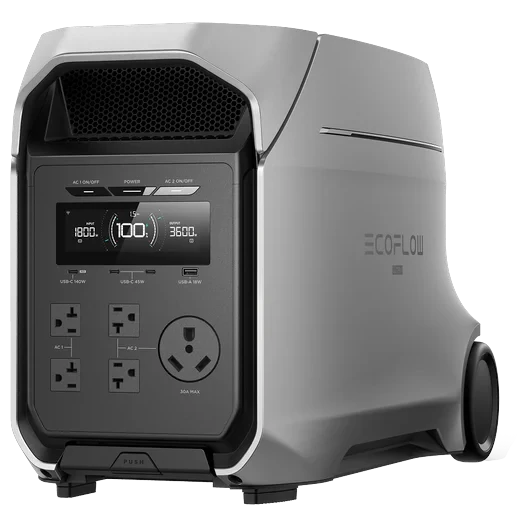
EcoFlow sells two stations called DELTA 3 Ultra, and this page is about the plain one. Its manual, model EF-DL-H01-3U, lists a single Solar/DC input port: 11 to 60 volts, 18 amps, 800 W. The Ultra Plus has two of those ports and takes 1600 W between them, and EcoFlow's series page opens on the Plus by default. The 1600 W figure that turns up in searches belongs to that one.
Voltage is the easy part. Thirty-one of the forty-one panels we track publish a voltage, eight of them EcoFlow's own, and every one sits under 60. The hard part is 800 W against a 3072 Wh battery. Nothing we track fills that input. The closest is two of Renogy's 590 W rigid panels at 787 W, and the battery is full in a little under four hours of good sun.
One 200 W folding panel gives about 144 W and needs about twenty-one hours. That is a lot of sun for one panel to catch. 72.1 pounds is a two-handed carry, and I wouldn't do it twice a day to chase the sun across the deck. At the cabin I'd bolt two rigid panels to the shed roof, run the cable in through the wall, and check the battery on Sunday night.
- The door
- 11–60 V
- Its width
- 800 W
- Plug
- Full battery, best case
- ~3.8 h
The door
Every panel we track, lined up at the DELTA 3 Ultra's solar input
The chart lines up every panel we track by the voltage printed on its label. That figure is Voc, the open-circuit voltage, the most a panel can push with nothing on the other end of the cable. The black line sits at 60 V, where the Ultra's manual stops. The tallest bar is Renogy's 590 W rigid at 52.63 V. Nothing reaches the line.
The pale cap on each bar is what a cold morning adds, about 10% at −10 °C. Cells put out more voltage when they are cold. On a morning like that on my deck I'd expect the Fluke to read a few volts over any label here. Even with its cap on, the Renogy 590 W clears 60 with room.
The bars are single panels. Put two in series, the positive lead of one into the negative of the next, and the pair reads as one tall bar with both voltages stacked. EcoFlow's wiring note says series raises voltage and the total has to stay under the maximum. Two Renogy 590s stacked that way would not.
Hover any bar for the panel's name. If your panel isn't among them, type its Voc into the field below and the chart draws it a bar of its own.
Swipe sideways for the whole line-up.
Hover or tap a bar for the panel’s name and its verdict.
- Fits through the door
- Too tall
- Extra height on a −10 °C morning
- Maker prints only the operating voltage; the real height is above the dashes
- 1Our pick: BLUETTI 350W
What we'd buy
The best solar panel for the DELTA 3 Ultra
Picked by the numbers on this station, not by brand.
Best value

About $1.59 for every watt it actually delivers here. 4 panels deliver 452 W.
Best to carry

144 W from a 8.82 lb panel, the most delivered watts per pound.
A day on solar
How long the DELTA 3 Ultra takes to charge on solar
A little under four hours, with the full 800 W coming in. No set we track quite delivers that. Two of Renogy's 590 W rigid panels come within a few watts, at 787 W, and three of Jackery's SolarSaga 500 X come in at 751 W. Either lands about where the tick is.
One folding panel is a different day. A 100 W panel gives about 72 W in real sun and needs about forty-three hours. A 200 W panel gives 144 W and needs about twenty-one. A good day has 3 to 6 hours of sun that strong, so the small panel is a week's work and the big one is most of a week.
A battery this size turns a solar day into a count of panels. Where you live and what month it is decide how many good days you get. The system builder works that out for your state.
Hours of good sun, from empty. Where you live and the month decide how many of those a day gives; the system builder works it out.
Every panel that fits
Solar panels compatible with the DELTA 3 Ultra
Thirty-one fit, eight of them EcoFlow's own. None plugs straight in. The manual never names the socket, so the list gives the cable where we know it and leaves it blank where we don't. For each panel: what one delivers in good sun, and the most the Ultra will take from a set. The sets run from two rigid panels to four folding ones. Sorted by delivered watts.
 Renogy 590W N-Type Bifacial Solar Panel (RSP590DCT-144)590 W · rigid · 58.4 lb · $495 · 52.63 VPlug: Renogy doesn't name the plug. Check the lead before buying a cableOne panel: 425 W in good sun
 Jackery SolarSaga 500 X (JS-500A)500 W · portable · 23.15 lb · $999 · 48.5 VPlug: Jackery doesn't name the plug. Check the lead before buying a cableOne panel: 360 W in good sun
 Anker SOLIX 440W Rigid Solar Panel440 W · rigid · 46.3 lb · $450 · 39.16 VPlug: Anker SOLIX doesn't name the plug. Check the lead before buying a cableOne panel: 317 W in good sun
 EcoFlow 400W Portable Solar Panel400 W · portable · 35.3 lb · $699 · 48 VPlug: EcoFlow doesn't name the plug. Check the lead before buying a cableOne panel: 288 W in good sun
 EcoFlow 400W Rigid Solar Panel400 W · rigid · 48.1 lb · $800 · 37.1 VPlug: EcoFlow doesn't name the plug. Check the lead before buying a cableOne panel: 288 W in good sun
 BLUETTI 350W Solar Panel (PV350)350 W · portable · 32.4 lb · $649 · 44 VPlug: BLUETTI doesn't name the plug. Check the lead before buying a cableOne panel: 252 W in good sun
 Renogy 320W N-Type Solar Panel (RSP320DC-BK)320 W · rigid · 32.9 lb · $300 · 43.82 VPlug: Renogy doesn't name the plug. Check the lead before buying a cableOne panel: 230 W in good sun
 EcoFlow NextGen 220W Bifacial Portable Solar Panel220 W · portable · 15.4 lb · $449 · 21.5 VPlug: EcoFlow doesn't name the plug. Check the lead before buying a cableOne panel: 158 W in good sun
- 200 WBLUETTI PV200 (200W Solar Panel)200 W · portable · 17.15 lb · 24.6 VPlug: BLUETTI doesn't name the plug. Check the lead before buying a cableOne panel: 144 W in good sunBest with up to 4: 4 panels → 576 W, full in ~5.3 h2 in series × 2 strings
- Eco-Worthy 200W Flexible HJT Solar Panel 18V ETFE 18BB (GW-L02AM200HJT2)200 W · flexible · 8.05 lb · $180 · 29.1 VPlug: Eco-Worthy doesn't name the plug. Check the lead before buying a cableOne panel: 144 W in good sun
 Jackery SolarSaga 200W Solar Panel (JS-200E)200 W · portable · 14.33 lb · $429 · 22 VPlug: Jackery doesn't name the plug. Check the lead before buying a cableOne panel: 144 W in good sun
- Renogy 200W Portable Solar Panel Blanket (RPP200SB-SE)200 W · portable · 8.82 lb · $240 · 19.6 VPlug: Renogy doesn't name the plug. Check the lead before buying a cableOne panel: 144 W in good sun
 Renogy 200W N-Type Solar Panel (RSP200DC)200 W · rigid · 23.4 lb · $180 · 37.44 VPlug: Renogy doesn't name the plug. Check the lead before buying a cableOne panel: 144 W in good sun
 Rich Solar MEGA 200 Portable Briefcase Solar Panel (RS-X200B)200 W · portable · 26 lb · $400 · 22.2 VPlug: Rich Solar doesn't name the plug. Check the lead before buying a cableOne panel: 144 W in good sun
 Eco-Worthy 195W N-Type 18BB Bifacial Solar Panel (GW-L02M195NTM)195 W · rigid · 20.2 lb · $130 · 21.2 VPlug: Eco-Worthy doesn't name the plug. Check the lead before buying a cableOne panel: 140 W in good sun
 EcoFlow NextGen 160W Portable Solar Panel160 W · portable · 12.3 lb · $369 · 21.3 VPlug: EcoFlow doesn't name the plug. Check the lead before buying a cableOne panel: 115 W in good sun
 EcoFlow 125W Bifacial Modular Solar Panel125 W · rigid · 9.26 lb · $249 · 50 VPlug: EcoFlow doesn't name the plug. Check the lead before buying a cableOne panel: 90 W in good sun
 EcoFlow 110W Portable Solar Panel110 W · portable · 8.8 lb · $259 · 21.8 VPlug: EcoFlow doesn't name the plug. Check the lead before buying a cableOne panel: 79 W in good sun
 BLUETTI PV100 FX Flexible Solar Panel | 100W100 W · flexible · 4.85 lb · $165 · 41.4 VPlug: BLUETTI doesn't name the plug. Check the lead before buying a cableOne panel: 72 W in good sun
 BLUETTI SP100L Solar Panel | 100W100 W · portable · 10.91 lb · $249 · 24.62 VPlug: BLUETTI doesn't name the plug. Check the lead before buying a cableOne panel: 72 W in good sun
 Jackery SolarSaga 100 Air (JS-100H)100 W · portable · 7.05 lb · $299 · 29.7 VPlug: Jackery doesn't name the plug. Check the lead before buying a cableOne panel: 72 W in good sun
 Jackery SolarSaga 100 Light (JS-100G)100 W · flexible · 4.52 lb · $179 · 24.8 VPlug: Jackery doesn't name the plug. Check the lead before buying a cableOne panel: 72 W in good sun
 Jackery SolarSaga 100 Prime Solar Panel (JS-100E)100 W · portable · 13.23 lb · $199 · 22.7 VPlug: Jackery doesn't name the plug. Check the lead before buying a cableOne panel: 72 W in good sun
 Renogy 100W N-Type Lightweight Portable Solar Panel Suitcase (COMPACT-SUITCASE 100 / RSP100LSC)100 W · portable · 8.82 lb · $145 · 21.6 VPlug: Renogy doesn't name the plug. Check the lead before buying a cableOne panel: 72 W in good sun
- 100 WRenogy 100W Monocrystalline Solar Panel (RNG-100D, earlier generation)100 W · rigid · 16.5 lb · 22.5 VPlug: Renogy doesn't name the plug. Check the lead before buying a cableOne panel: 72 W in good sunBest with up to 4: 4 panels → 288 W, full in ~10.7 h2 in series × 2 strings
 Rich Solar MEGA 100 Portable Briefcase Solar Panel (RS-X100B)100 W · portable · 15.7 lb · $200 · 22.8 VPlug: Rich Solar doesn't name the plug. Check the lead before buying a cableOne panel: 72 W in good sunBest with up to 4: 4 panels → 288 W, full in ~10.7 h2 in series × 2 strings
 Jackery SolarSaga 80W Solar Panel (SolarSaga 80, JS-80A)80 W · portable · 11.24 lb · $249 · 28.5 VPlug: Jackery doesn't name the plug. Check the lead before buying a cableOne panel: 58 W in good sun
 BLUETTI SORA 60 Solar Panel | 60W60 W · portable · 3.09 lb · $129 · 27.5 VPlug: BLUETTI doesn't name the plug. Check the lead before buying a cableOne panel: 43 W in good sun
 EcoFlow 60W Portable Solar Panel60 W · portable · 4.41 lb · 25.6 VPlug: EcoFlow doesn't name the plug. Check the lead before buying a cableOne panel: 43 W in good sunBest with up to 4: 4 panels → 173 W, full in ~17.8 h2 in series × 2 strings
 EcoFlow 45W Portable Solar Panel45 W · portable · 3.09 lb · $99 · 25.6 VPlug: EcoFlow doesn't name the plug. Check the lead before buying a cableOne panel: 32 W in good sun
 Jackery SolarSaga 40 Air (JS-40C)42 W · portable · 1.98 lb · $129 · 26 VPlug: Jackery doesn't name the plug. Check the lead before buying a cableOne panel: 30 W in good sun
Own a panel that isn't in the line-up?
Type its voltage into the door chart above for the height test, then put the rest of the label into the panel checker, already set to the DELTA 3 Ultra, for current and plug too. Or build the whole system to see how it keeps up where you live.
The plain answers
How long does the DELTA 3 Ultra take to charge on solar?
One 100 W panel delivers about 72 W in good sun and refills the 3072 Wh battery from empty in about 42.7 hours.
One 200 W panel delivers about 144 W in good sun and refills the 3072 Wh battery from empty in about 21.3 hours.
At its 800 W solar limit it refills in about 3.8 hours. More panel watts than that won't charge it any faster.
A day gives three to six hours of sun that good, depending on season and place, so one 100 W panel takes 8 to 15 days to fill it. The system builder works it out for your state and month.
What adapter does the DELTA 3 Ultra need for solar?
Every panel we track needs a cable to reach its input.
31 panels don't have a named plug from their maker, so check the lead before you buy a cable.
Can you use non-EcoFlow solar panels with the DELTA 3 Ultra?
Yes. What decides it is the panel's voltage and plug, not the brand. 23 panels from Renogy, Jackery, Anker SOLIX, BLUETTI, Eco-Worthy and Rich Solar work with it, as long as the panel stays under 60 V on a cold morning and starts above 11 V.
The strongest single panels here are the Renogy 590W N-Type Bifacial (425 W delivered) and the Jackery SolarSaga 500 X (360 W delivered).
Can you connect two solar panels to the DELTA 3 Ultra?
Yes, joined into one input with a series or parallel cable.
Don't wire two BLUETTI PV100 FX Flexible panels in series: together they would pass its 60 V limit. Parallel them instead.
Past 800 W delivered, more panels only help on cloudy days.
What is the DELTA 3 Ultra's solar input?
Solar/DC input port: 11–60 V, up to 18 A, 800 W.
Input limits from EcoFlow's documents, checked 2026-09-18 (source). Delivered watts assume 72% of the panel's rating in good sun.