Head-to-head test
Goal Zero Yeti 300 vs Goal Zero Yeti 6000X
Goal Zero Yeti 300 vs Goal Zero Yeti 6000X: The Yeti 6000X takes all six load profiles on this page because all six are larger than 297Wh, and the Yeti 300 owns the value column because 4,000 cycles against 500 is what decides cost per kilowatt-hour delivered. Neither fact beats the other; they answer different questions.
Full profiles: Goal Zero Yeti 300 → · Goal Zero Yeti 6000X →

Written by Gunner GustafsonUpdated
Whole-Home Backup Tester, Station Arena Test Desk
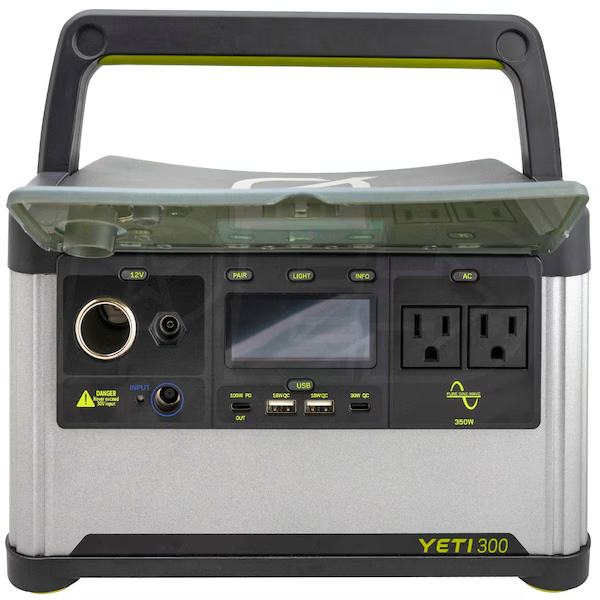
$349.95 · direct from Goal Zero
Last checked 1 day ago. Prices move — check before you buy.
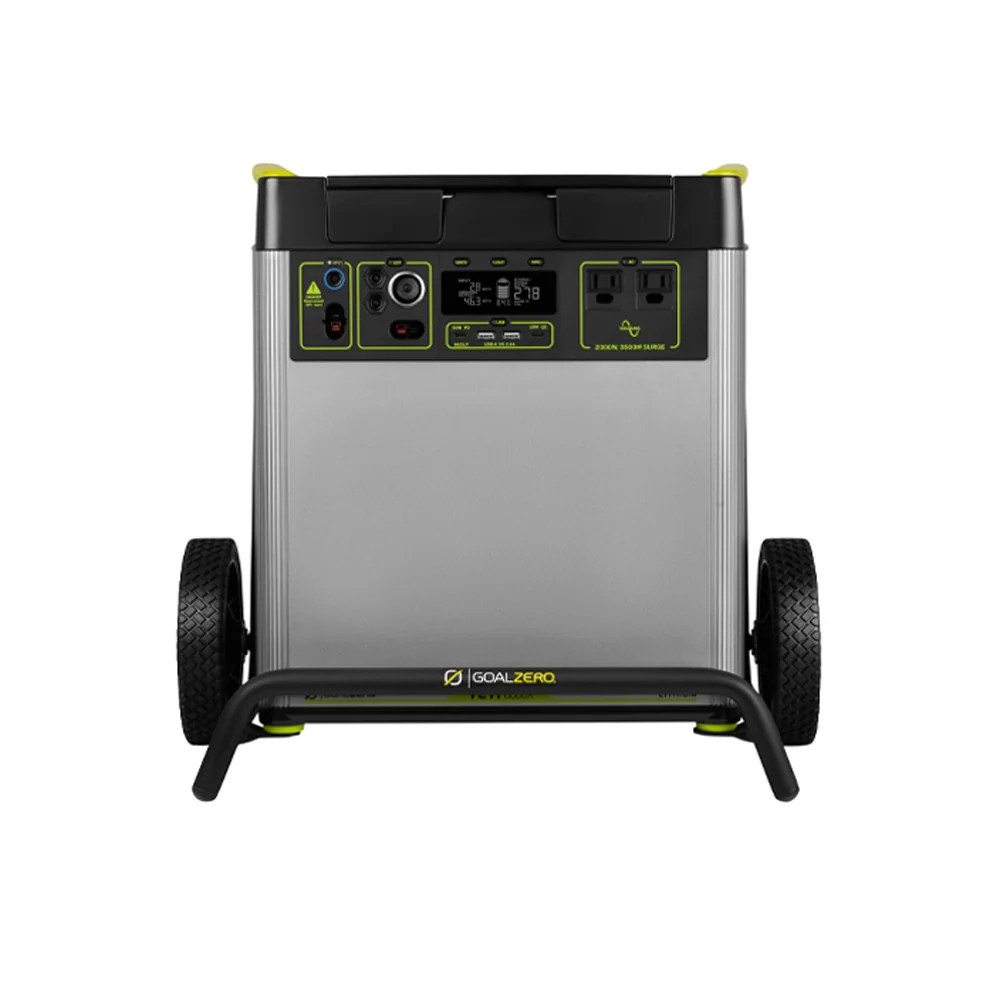
$3,999.95 · direct from Goal Zero
Last checked 1 day ago. Prices move — check before you buy.
Spec deltas
The Yeti 6000X holds twenty times the battery of the Yeti 300 and costs eleven times as much, and across the life of the two packs it delivers about two and a half times the energy: 3,036 kWh against 1,188 kWh. Those three ratios never reconcile. The cycle column is where the difference goes, and nobody who has looked at it cross-shops these two on value.
297Wh is about 250Wh once it has been through the inverter, and every one of the six load profiles on this page is bigger than that. Including the smallest. A CPAP overnight is 320Wh, and the 300 doesn't finish it. It isn't short on the demanding jobs and comfortable on the easy ones; it's short on the easiest one there is.
So the 6000X sweeps the scenario board, and that tells you almost nothing about whether to buy it. Owning it costs about four and a half times as much per kilowatt-hour delivered, in a pack rated for 500 cycles and covered for two years. Buy the 300 if your list fits inside it. Buy the 6000X if your list doesn't and you'll cycle it rarely. If your list doesn't fit and you'll drain it every day, close this tab and shop LFP at this capacity.
What the Numbers Reveal
Each conclusion stated first — the numbers behind it on one line, the full analysis below.
rated cycles
Per watt-hour on the shelf the 6000X is the bargain, $0.66 against $1.18. Per kilowatt-hour actually delivered over the pack's life it's $1.32 against $0.29, so the cheaper-looking battery sells the most expensive energy on this page by a factor of about four and a half.
Yeti 300: 297Wh at $350, rated 4,000 cyclesYeti 6000X: 6,071Wh at $4,000, rated 500 cyclesLifetime energy delivered: 1,188 kWh for the 300, 3,036 kWh for the 6000X
Why it mattersIf you're reaching for the 6000X because it looks like more value per watt-hour, you read the wrong column.
Its ceiling is really two ceilings. About 250 usable watt-hours caps what it can carry through a night, and 600W caps what it can start at all, which means calling it the small one undersells the gap. There are jobs on this page it cannot begin.
CPAP Overnight, the smallest profile on this board, needs 320WhYeti 300 capacity is 297Wh, roughly 250Wh usable after inverter lossesYeti 300's surge ceiling is 600W, and the Tailgate Party profile is flagged as a peak it cannot start
Why it mattersIf your plan includes an all-night load or a hard startup surge, stop reading the 300 as the budget version of the 6000X. It's a different appliance.
Which makes it a standby unit wearing a full-time unit's spec sheet. Charge it, park it, pull it out for outages and it serves for years. Live off it in a van and you've bought a $4,000 battery with about a year and a half in it.
Yeti 6000X: 500 cycles, 2-year warrantyAt one cycle a day, that's about 1.4 years of pack lifeAfter 500 cycles the 6,071Wh pack is delivering closer to 4,857WhB4Van Life Daily draws 4,685Wh, or 91% of the 6000X's pack, every day
Why it mattersAnyone planning to cycle daily should treat 500 as the real denominator under the price tag and price modern LiFePO4 at this capacity instead.
solar input
So off-grid the two behave in opposite ways. The 300 is a small tank you can refill most mornings, while the 6000X is a large tank you mostly can't refill from panels, which turns its capacity into a countdown rather than a supply.
Yeti 300: 13.7 lbs, 297Wh, 200W maximum solar inputYeti 6000X: 106 lbs, 6,071Wh, 600W maximum solar inputFull AC recharge on the 6000X takes 12 hours with the included 600W chargerB3
Why it mattersIf your backup plan runs on sun rather than a wall outlet, size the 6000X to the whole event, not to a single day of it.
The specific dimensions that decide these two units — everything else is a tie.
Your Life, Your Pick
Selected because: Every one of the six load profiles here is larger than the Yeti 300's 297Wh, including the 320Wh CPAP night, which is the entire class question in one column.
The sweep isn't a performance result, it's a tape measure. Every profile on this board, from the 320Wh CPAP night up to the 4,685Wh van day, is larger than what the 300 can hold, so it loses all six for one identical reason and the percentages only record how badly.
Read the 6000X's column the other way and one number should give you pause. It covers a van day at 91% of its pack, which sounds like a fit until you notice that fitting means a full cycle every single day. The scenario it wins most impressively is the one that would consume it fastest.
Lifetime Value
Selected because: Up front the 6000X is the cheaper battery per watt-hour, $0.66 against $1.18; across 500 cycles versus 4,000 it becomes the far more expensive one to own.
cost / lifetime kWh
Every dollar figure in this section inverts once you multiply by cycles, and that inversion is the only arithmetic on the page that changes anybody's mind. The 6000X's shelf price per watt-hour is the better one. Its price per watt-hour you will actually use, across everything the pack will ever deliver, is the worse one by a wide margin.
Which also means the two units punish an overbuy differently. Buy more 300 than you need and the mistake costs a few hundred dollars and leaves you a box that still charges phones eleven years from now. Buy more 6000X than you need and the mistake is $4,000 sitting in a room, handing you the most expensive kilowatt-hours on this page whether or not you ever needed the size.
Portability & Form Factor
Selected because: 13.7 lbs against 106 lbs is the difference between a box you carry and a box that picks a room and stays in it.
weight
One of these lives wherever you set it down and the other picks a room. 13.7 lbs is a one-hand carry in an IP54 shell with rubberized corners and a handle reviewers rate as genuinely well builtA2, the kind of thing that rides in a truck bed without ceremony. 106 lbs is a two-person lift, and the honest way to think about it is furniture.
That reframes what the weight actually costs you. A unit you can't reposition can't follow the problem: it won't move out to the garage for an afternoon and back to the bedroom at night, and it isn't getting lent to a neighbor. If the box needs to travel, 106 lbs made that decision for you before capacity got a vote.
What the Specs Don't Tell You
Selected because: Five flags fire on this pair, including the two nobody checks at this price: a 2-year warranty against 5, and a 25ms transfer against 10ms.
rated cycles
Two of the five flags on this pair run against the expensive unit in places nobody inspects at $4,000. Transfer to battery is 25ms on the 6000X and 10ms on the 300, and the warranty is two years against five. The small box is the quicker UPS and the better-backed purchase, which is not the direction anyone expects these arrows to point.
The weight and cycle-life flags are the two that will actually shape ownership, and they compound. A 106 lb unit is one you install rather than carry, an installed unit gets used often, and often is precisely the usage pattern a 500-cycle pack handles worst.
Strengths & trade-offs
Goal Zero Yeti 300
Strengths
- +Costs $3,650 less
- +Lighter by 92.3 lb
- +Longer warranty
- +Rated for 4,000 charge cycles — much longer battery lifespan
Trade-offs
- –Weaker inverter (-1,650W) limits appliance compatibility.
- –Sealed capacity — the Yeti 6000X can add batteries to grow past 297Wh; this one can't.
Goal Zero Yeti 6000X
Strengths
- +Larger battery capacity
- +Higher AC output
- +Faster solar charging
Trade-offs
- –Substantially more expensive (+$3,650) than the Yeti 300.
- –Significantly heavier (+92.3 lbs), making it harder to move.
- –Very heavy unit that may be difficult for one person to lift.
- –Shorter-lived battery — rated for 500 charge cycles vs the Yeti 300's 4,000, so it wears out sooner.
Will It Power Your Gear?
Scenario math and per-appliance runtimes, modeled from the spec record.
Scenario verdicts
We ran the math on seven real-world scenarios. Here's which unit survives your actual life.
SCN-01 · 2 nights · needs 2,100Wh
Weekend Camping
Two nights off-grid with essential comfort
Neither unit
A 2,100Wh weekend costs the 6000X 41% of its pack and leaves it margin for a third day. The 300 would need eight of itself to match that, which isn't a shortfall you close by rationing carefully.
Battery budget usedlower = more headroom
LOAD Phone Charger 15W×6h · LED Lights 40W×8h · Box Fan 75W×14h · CPAP Machine 40W×16h
SCN-02 · 8 hours · needs 1,645Wh
8-Hour Blackout
Keep the essentials running through a night without power
Yeti 6000X
The 6000X gives up about a third of its battery to cover 1,645Wh and is still two-thirds full when the lights come back. The 300 would need six and a half of itself, so its role in an outage is keeping devices alive, not keeping the house running.
Battery budget usedlower = more headroom
LOAD Fridge 150W×8h · Router + Modem 20W×8h · LED Lights (4 bulbs) 40W×6h · Phone Charger 15W×3h
SCN-03 · 8 hours · needs 320Wh
CPAP Overnight
Sleep therapy without interruption — the #1 medical use case
Yeti 6000X
One night is 320Wh. The 6000X spends 6% of its pack on it, so a single charge carries roughly sixteen nights. The 300 holds 297Wh and doesn't reach morning. This is the smallest job on the page and it's still too big for it.
Battery budget usedlower = more headroom
LOAD CPAP Machine 40W×8h
SCN-04 · 8 hours · needs 910Wh
Remote Workday
Full work day off-grid without power anxiety
Yeti 6000X
A full day of work off the grid runs 910Wh, which is 18% of the 6000X and three and a half Yeti 300s. If the plan is running an entire desk from one box until the sun goes down, the 300 isn't sized for the day.
Battery budget usedlower = more headroom
LOAD Laptop 60W×8h · External Monitor 30W×8h · Router + Modem 20W×8h · Phone Charger 15W×2h
SCN-05 · 4 hours · needs 670Wh
Tailgate Party
Game day power for the crew
Neither unit
This is the one where the 300 doesn't merely run short, it won't start the party: its 600W surge ceiling sits under the peak this profile demands, so the failure is instantaneous rather than gradual. The 6000X starts everything and spends 13% of its pack on the afternoon.
Battery budget usedlower = more headroom
LOAD Blender 400W×0.5h · LED TV (55") 80W×4h · Bluetooth Speaker 15W×4h · Phone Charger (×3) 45W×2h
SCN-06 · 24 hours · needs 4,685Wh
Van Life Daily
A full day of mobile living — the ultimate endurance test
Yeti 6000X
4,685Wh a day is 91% of the 6000X's pack, so it fits, barely, with nothing held in reserve. Fitting means a full cycle every single day out of a 500-cycle rating, which is the fastest way there is to spend this unit. The 300 isn't in this conversation.
Battery budget usedlower = more headroom
LOAD Mini-Fridge 150W×24h · Laptop 60W×4h · Phone Charger 15W×3h · LED Lights 40W×5h · Fan 75W×8h
SCN-07 · an afternoon · needs 100Wh
Afternoon Off-Grid
Phones and a speaker at the park, beach, or campsite — the small-unit job description
Either unit
This row is here for the Yeti 300's class of job: phones and a speaker, 100Wh across an afternoon. Both cover it — the Yeti 300 finishes at 40% used, and the Yeti 6000X barely notices it. For this job the Yeti 6000X's extra capacity is dead weight, not headroom; take the Yeti 300 at 13.7 lbs and leave the rest at home.
Battery budget usedlower = more headroom
LOAD Phone Charger (×2) 30W×2h · Bluetooth Speaker 10W×4h
The Load Test
RUNTIME = (Wh × 0.85) ÷ LOAD
None of the scenarios above exactly yours? Build it. Toggle what you'd plug in; both units are tested against the combined draw.
Essentials
Comfort & Convenience
High-Draw Appliances
Test duration
8h
Continuous draw
205W
Projected runtime
For this load: Yeti 6000X runs 25.2h vs 1.2h.
$3,999.95 list · direct from Goal Zero
Modeled from the spec record — same math as the tables below. Methodology
Runtime by appliance
Real-world runtime estimates for common appliances, modeled at 85% inverter efficiency.¹
Essentials
The basics you need runningscale 0–344hComfort & Convenience
Makes off-grid life actually enjoyablescale 0–68.8hHigh-Draw Appliances
These reveal the real limitsscale 0–5.2h¹ Runtime = (capacity × 0.85) ÷ appliance watts. Within each group, all bars share one time scale (the group's longest runtime), so lengths are comparable across appliances; identical runtimes collapse into a single blue/orange bar. Actual runtime varies with battery age, temperature, and simultaneous loads — see methodology.
Conclusion
August 1, 2026
Verdict: the Yeti 6000X, on Power Score margin
Calling a winner here would be a category error. The Yeti 6000X takes all six load profiles on this page because all six are larger than 297Wh, and the Yeti 300 owns the value column because 4,000 cycles against 500 is what decides cost per kilowatt-hour delivered. Neither fact beats the other; they answer different questions. So do this instead: total the watt-hours of one real night's loads. Under about 250 usable watt-hours, buy the 300 at $350 and keep the $3,650 you didn't spend on the $4,000 unit. Over it, you need the bigger class, and the 6000X is the only member of that class on this page. It's worth buying if you'll cycle it a few dozen times a year, and worth shopping around if you'll cycle it daily.
Editor-assigned confidence, based on cited owner research and spec analysis.
Written by Gunner Gustafson, Whole-Home Backup Tester · Station Arena Test Desk · Updated August 1, 2026
Measured Data
Benchmark scores and the full spec record, side by side.
Benchmark scores
Not rated for both units (minimum threshold unmet): UPS, Home Backup, CPAP, Tailgating, Food Truck, Apartment Balcony, Camping.
Full specifications
ᵈ Derived: price ÷ rated capacity. See the data behind our comparisons →
Comparison ToolAdd more power stations, side by sideOpen Tool →How these numbers are produced
Numeric verification
Every figure on this page traces to our spec database or arithmetic on it — no estimated numbers.
Owner claims
Statements about owner experience are cited to published reviews — see Sources & Research Notes below.
Runtime model
Runtime = (rated capacity × 0.85 inverter efficiency) ÷ device wattage. Solar recharge estimates assume panels deliver 70% of rated output. Cold weather, battery age, and stacked loads reduce real-world results.
Power Score
Computed from 14 published spec dimensions, weighted per use-case bench. Higher is better; a unit must meet a bench's minimum threshold to be rated.
See the full weight table and data sourcing on our methodology page →Class ranking (the star rating)
Each unit's star score is a category ranking, not customer reviews — no buyer opinions feed it. We score every station on size-independent quality (value, output, portability, endurance, ports, warranty, and more), then percentile-rank it against the other units in its capacity class, so a class-leading compact unit and a class-leading whole-home unit can both earn 5★. Here, Yeti 300 rates 3.7/5 (24th percentile of 22 Personal-class units), and Yeti 6000X rates 3.3/5 (1st percentile of 16 Home Backup-class units).
How the class ranking is computed →Test Notes & Caveats
Hidden gotchas and advantages we spotted that you won't find on the product page.
106 lbs Picks a Room
13.7 lbs is a one-hand carry. 106 lbs is a two-person lift or a hand truck, and once it's positioned it stays positioned. Decide where this unit is going to live before you buy it, because that decision is close to permanent.
Fixed at 297Wh, and That's the Honest Way to Buy It
The 300 can't grow, but nobody buys a 297Wh box planning to turn it into house backup. What's printed on it is what you own, and shopping it that way is the correct approach. The 6000X's expansion batteries are real headroom if your loads are climbing toward partial-home backup, which is also the only situation in which that headroom is worth paying for.
Only the Yeti 300 Lists a UPS Mode
The Yeti 300 can sit between the wall and your gear and hand it to battery when the grid drops — rated ≤20ms — fine on paper for routers and most electronics; the fussiest PC power supplies sit right at this line. Worth it for a router or a modem — not a CPAP: at 252Wh usable it can bridge the flicker but cannot run the night. The Yeti 6000X's spec sheet lists no UPS mode, so anything plugged into it rides an outage only as far as your reaction time.
Two Years at $2,000 a Year
The 6000X carries a 2-year warranty and the 300 a 5-year one, which works out to $2,000 per covered year against $70. Warranty length rarely decides a purchase on its own, but it's a fair read on how much of each pack's life Goal Zero is willing to stand behind.
500 Cycles Against 4,000
Cycled once a day, the 6000X reaches the end of its 500-cycle rating in about 1.4 years, while the 300's 4,000 cycles take roughly eleven years to spend. That single number decides whether the big unit is a bargain or an expensive mistake, and it turns entirely on how often you'll actually drain it.
Ownership Analysis
What happens after you buy — true cost of ownership, brand trust, and growth potential.
Lifetime value
Service lifeyears at one full cycle per day
Lifetime energy delivered
Cost per delivered kWh
│ warranty ends · Reaching the cycle rating means ~80% capacity remains — degraded, not dead.
Analyst note
The Yeti 300 wins on both sticker price and long-term value. At $0.29/kWh over its lifetime, it's meaningfully cheaper to own. Clear value winner. One caution on the lifespan row: the Yeti 300 takes longer to reach its cycle rating, but a cycle moves a different amount of energy on each unit — the Yeti 6000X still delivers more over its shorter horizon (3,036 vs 1,188 kWh). Years measure wear, not usefulness.
Growth path
Yeti 300
FIXED CAPACITYFixed at 297Wh, with no expansion — so size it for your needs up front rather than planning to add capacity later.
Accepts up to 200W of solar. Limited to a single portable panel.
Adequate ports for most setups, but heavy users may want a power strip.
Yeti 6000X
EXPANDABLESupports Goal Zero expansion batteries, so you can add capacity later without replacing the base unit — useful if your needs may climb past 6,071Wh.
Accepts up to 600W of solar. Suitable for a 1-2 panel setup.
Adequate ports for most setups, but heavy users may want a power strip.
Expansion batteries are Goal Zero-specific. You're investing in the Goal Zero ecosystem.
Realistic full solar rechargeat 70% of rated panel output — see methodology
Analyst note
The Yeti 300 is sealed at 297Wh, which is fine if that covers you. The Yeti 6000X starts at 6,071Wh and can grow beyond it with Goal Zero expansion batteries — real headroom the Yeti 300 doesn't have if your needs climb toward partial-home backup.
What Owners Report
Patterns from published owner reports and long-term reviews — every claim cited to its source below.
Goal Zero Yeti 300
The field record on the 300 is reviewer-grade rather than long-term-owner-grade, which is what you'd expect from a recent unit. What exists is consistent: a LiFePO4 pack rated past 4,000 cyclesA1, an IP54 shell with rubberized corners and a sturdy handle, and a 0 to 100% recharge in 50 minutesA2. Nobody has lived with one for five years yet, so treat the longevity claim as a rating, not a track record.
The limits turn up in the same reviews. The 297Wh pack gets called out as light-duty work, four to six hours on a laptop or twenty to thirty phone charges, and one reviewer put a coffee maker on it and watched it shut down after two minutesA3. The recurring complaint isn't reliability. It's arithmetic: the price stings for the capacityA4.
“A 297Wh LiFePO4 pack behind a 350W pure sine inverter (600W surge), rated 4,000 cycles — Goal Zero backs it with a long service life rather than raw output.”
Sources
goalzero.com · batteryskills.com · campingsolar.us · trailandkale.com · the-gadgeteer.com
Goal Zero Yeti 6000X
Reviewers keep returning to the same number on the 6000X, and it isn't the capacity. It's 500 cycles to 80%, flagged repeatedly as low against LFP competitorsB1B4, with the consequence spelled out plainly: once you arrive there, the 6,071Wh pack is delivering something closer to 4,857WhB4. That's structural, and no firmware update reaches it.
The rest of the field commentary is about living with the size. It gets described as semi-stationary rather than portable at about 106 lbs, and it ships with a roll cart because it has toB2. A full AC recharge is 12 hours on the included 600W chargerB3, so refilling it is an overnight commitment rather than a coffee break.
“Weighs about 106 lbs — not portable for most people; designed as a semi-stationary power hub, and comes with a roll cart.”
Sources
poweredportablesolar.com · bestgeneratorsolar.com · shopsolarkits.com · bhphotovideo.com · poweraic.com
Sources & Research Notes
Every owner claim in this report is traceable to a published source. The bracketed references above resolve here.
Recurring owner themes
- Modern LFP (4,000+ cycles), IP54 ruggedness, and fast charging are the praise; small capacity and high price are the caveats. [Yeti 300 · 3 entries]
- Large NMC capacity but a crippling 500-cycle rating, very heavy (~106 lbs), and slow charging are the recurring points. [Yeti 6000X · 3 entries]
- A1
“A 297Wh LiFePO4 pack behind a 350W pure sine inverter (600W surge), rated 4,000 cycles — Goal Zero backs it with a long service life rather than raw output.”
goalzero.com / batteryskills.com — Yeti 300 review · 2026 · [positive]
- A2
“At 13.7 lbs, meets IP54 for dust and water resistance, with top-tier build quality — rubberized corners and a sturdy handle; recharges 0-100% in 50 minutes.”
campingsolar.us / trailandkale.com — Yeti 300 review · 2026 · [positive]
- A3
“The 297Wh capacity limits it to lighter-duty use — 4-6 hours on a laptop or 20-30 phone charges — and it struggled near its 300W limit, shutting down after 2 minutes with a coffee maker.”
batteryskills.com — Yeti 300 review · 2026 · [mixed]
- A4
“A modern LFP (not NMC) rugged compact unit, though at $349.95 the price stings for the capacity.”
the-gadgeteer.com — Yeti 300 review · 2026 · [mixed]
- B1
“Uses lithium NMC cells with a 6,071Wh capacity but a cycle life of only 500 cycles to 80% — not high compared to competing LFP models.”
poweredportablesolar.com / bestgeneratorsolar.com — Yeti 6000X review · 2026 · [negative]
- B2
“Weighs about 106 lbs — not portable for most people; designed as a semi-stationary power hub, and comes with a roll cart.”
shopsolarkits.com / bhphotovideo.com — Yeti 6000X review · 2026 · [mixed]
- B3
“A 2,000W pure sine inverter peaking to 3,500W, fully rechargeable in 12 hours with the included 600W AC charger.”
bestgeneratorsolar.com / poweraic.com — Yeti 6000X review · 2026 · [mixed]
- B4
“After 500 cycles capacity drops to ~80%, so the 6,071Wh battery effectively becomes ~4,857Wh — a structural NMC disadvantage vs LFP.”
poweredportablesolar.com — Yeti 6000X review · 2026 · [negative]
Research compiled August 1, 2026.
Who Should Buy Which
Buy the Yeti 300 if you…
- →Your evening load is a laptop, a couple of phones, camera batteries and some string lights, comfortably under 250 usable watt-hours. That's the 300's entire job, and it does it for roughly eleven years of daily cycling.
- →You want a box that goes where the problem is: a truck bed, a canoe portage, a folding table at a jobsite. 13.7 lbs in an IP54 shellA2 makes it luggage rather than furniture.
- →You already run a bigger system and want a small, fast-recharging second battery for the tent or the guest room instead of more capacity concentrated in one place.
Buy the Yeti 6000X if you…
- →You've measured a real event load somewhere between the 1,645Wh of an eight-hour blackout and the 4,685Wh of a full van day, and you want one box to cover it rather than a relay of small ones.
- →The unit will live in one spot. A basement, a garage shelf, an RV bay. You're at peace with the fact that moving it is a scheduled activity involving another person.
- →You'll cycle it occasionally rather than daily. A few dozen deep discharges a year keeps a 500-cycle pack in service for years instead of about a year and a half.
If neither fits
If you need 6,071Wh and you're going to use it every day, both of these are the wrong purchase: the 300 can't reach the number, and the 6000X's 500-cycle pack is spent inside two years of that duty. Shop a modern LiFePO4 unit at this capacity instead, which is exactly the comparison reviewers already make against the 6000X and the one it losesB1. And if you landed here wanting 'the 300 but bigger,' the answer is a mid-size unit that sits between these two. A $4,000 jump to clear a 320Wh CPAP night is the most expensive possible way to solve that problem.
The Bottom Line
There's no winner here because there's no contest. One of these is an appliance you carry and the other is equipment you install, and the line between them is about 250 usable watt-hours. Under that line, the 300 sells the cheapest energy on this page and is still working eleven years into daily use. Over it, the 300 doesn't get partial credit. It simply can't.
What that doesn't mean is that the 6000X is automatically right above the line. Twenty times the battery buying two and a half times the lifetime energy is the entire story of a 500-cycle pack, and it's a story that gets worse the more you use it. Cycle it a few dozen times a year and it's a solid piece of stationary backup. Cycle it daily and you've bought about a year and a half of battery for $4,000. Measure the load first. The number settles this, not the badge.
Frequently Asked Questions
Answers drawn from the spec record and cited owner research.
Will the Yeti 300 run a CPAP all night?
No. A CPAP overnight comes to 320Wh on this site's load profile, and the Yeti 300 holds 297Wh, which is about 250Wh once inverter losses are taken off. You'd wake up to a dead unit before the night was over. The Yeti 6000X covers that same night on 6% of its pack, so one charge carries roughly sixteen of them.
The Yeti 6000X is cheaper per watt-hour, so why does this page call it the expensive one?
Because price per watt-hour measures the shelf, not the ownership. On the shelf the 6000X is $0.66 per watt-hour against the 300's $1.18. But it's rated for 500 cycles and the 300 for 4,000, so total energy across the pack's life comes to 3,036 kWh versus 1,188 kWh: about two and a half times the energy for eleven times the price. Divide price by lifetime energy and the big unit's kilowatt-hours cost roughly four and a half times as much.
Could I just buy several Yeti 300s instead of one Yeti 6000X?
Not usefully. The 300 isn't expandable and its battery isn't swappable, so several of them remain several separate boxes with separate outlets rather than one pool of energy. Matching 6,071Wh would take twenty of them, which is $7,000 at $350 each, nearly twice the price of the 6000X. Two or three 300s make sense as independent boxes in different rooms, not as a substitute for one large one.
How long does the Yeti 6000X take to recharge?
Twelve hours from empty on the included 600W AC charger. Solar is slower than the 600W input figure suggests: 6,071Wh at a 600W ceiling is about ten hours of full-rated sun, and real days don't hold full rating for ten hours. Plan on the wall outlet as the primary refill and treat panels as a way to slow the drain rather than reverse it.
Which one is the better backup for a desk setup that can't blink?
The Yeti 300, on transfer speed. It switches over in 10ms against the 6000X's 25ms, the one specification where the $350 unit beats the $4,000 one outright. The catch is that it holds 297Wh, so it rides out flickers and short cuts rather than working through a real outage. If you need to keep working for hours, the 6000X is the one that can, and its slower switch is the price of admission.
Where to buy
Goal Zero Yeti 300
$349.95
$349.95 · direct from Goal Zero
Last checked 1 day ago. Prices move — check before you buy.
Goal Zero Yeti 6000X
$3,999.95
$3,999.95 · direct from Goal Zero
Last checked 1 day ago. Prices move — check before you buy.
Prices may vary by retailer and are subject to change.