Head-to-head test
Goal Zero Sherpa 100AC vs Goal Zero Yeti 300
Goal Zero Sherpa 100AC vs Goal Zero Yeti 300: at 94.7Wh the Sherpa clears the 100Wh airline carry-on limit and the Yeti 300's 297Wh does not, while the Yeti is rated for 4,000 cycles against 500 and holds 350W of output against 100W. Take the Yeti 300 unless the battery has to fly with you.
Full profiles: Goal Zero Sherpa 100AC → · Goal Zero Yeti 300 →

Written by Wenny ZhengUpdated
Portable Power Tester, Station Arena Test Desk
Spec deltas
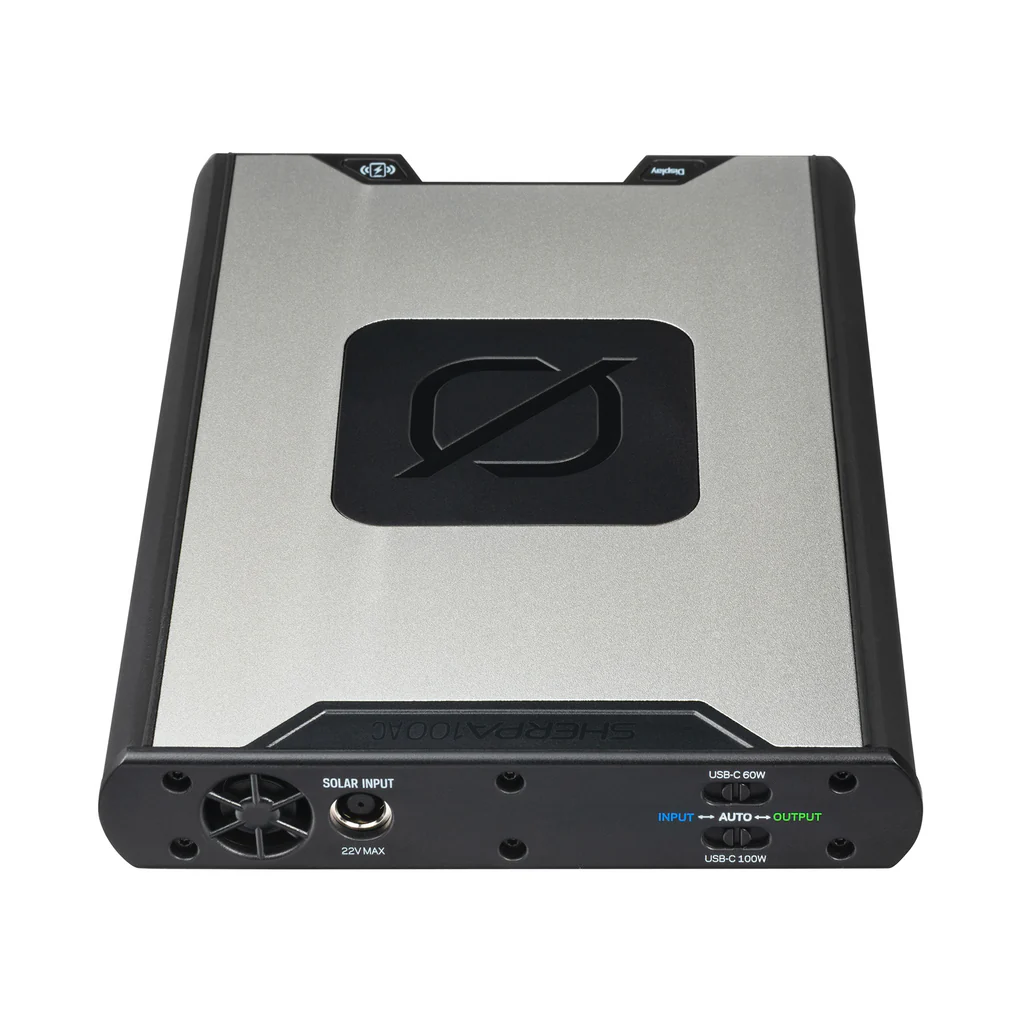
Goal Zero sells both of these a hundred dollars apart, and only one of them is a power station. The Sherpa 100AC is a travel bank with a real 100W AC outlet bolted to itA1. The Yeti 300 is a small station that happens to be light enough to carry one-handed. That difference is the page: the question isn't which is better built, it's whether your battery has to clear airport security.
Everywhere the airline rule doesn't reach, the Yeti 300 takes it for $100 more. Two AC outlets instead of one, a 12V car socket against no 12V socket at all, 200W of solar input against 60W, and a UPS mode the Sherpa's spec sheet doesn't list. The part buyers miss is that the larger unit is also the cheaper one to own, and it isn't close.
One warning before either purchase. These are the two smallest units in our catalogue, and every full-size job we model defeats both of them. Our eight-hour blackout profile wants 1,645Wh; the Yeti holds 252Wh of usable energy. If your list has a fridge on it, a coffee maker, or a CPAP that has to run until morning, you're on the wrong page and you want a station several times this size.
What the Numbers Reveal
Each conclusion stated first — the numbers behind it on one line, the full analysis below.
Capacity
You can't buy both properties, because they're one number pointing in two directions. The Yeti clears that afternoon with more than half its charge untouched and will never be allowed in a cabin. No feature on either unit resolves that; the limit is doing it, and the limit doesn't negotiate.
Sherpa 100AC: 94.7Wh, under the 100Wh FAA carry-on limit, which is why it's airline-approvedA1Afternoon Off-Grid, the lightest profile we model, needs 100Wh; after the flat 85% usable derate the Sherpa has 80Wh, leaving it 20Wh shortYeti 300: 297Wh, which finishes that same afternoon with 152Wh spare and sits nearly three times over the 100Wh limit
Why it mattersIf the battery flies, buy the Sherpa and plan on topping it up every night. If it doesn't, the carry-on rule is someone else's problem and the Yeti is simply the better battery.
rated cycles
The unit with fewer cycles also spends them faster for identical work: that same laptop charge is nearly half a Sherpa cycle and about a seventh of a Yeti one. So the real-world spread is wider than 500 against 4,000 already looks. Neither pack dies at its limit, both settle near 80% of original capacity and keep going, but a battery that reaches 80% while still under warranty is a consumable with a warranty card.
Sherpa 100AC: 500 rated cycles, two-year warranty, about 1.4 years of rated life at daily cyclingYeti 300: 4,000 rated cycles, five-year warranty, 11 years at daily cyclingone full laptop charge drew 45% of the Sherpa's batteryA3, and a Yeti cycle is 297Wh against the Sherpa's 94.7Wh
Why it mattersAnyone charging a laptop off this thing daily should read the Sherpa as a travel accessory with a service life, not as a power station they'll keep.
continuous output
One reviewer pushing the Yeti near its rated ceiling had it shut down after two minutes with a coffee makerB3, which is the calibration worth keeping: the extra output buys margin on laptops, lights, phones and a router. It doesn't buy a new class of appliance. Nothing with a heating element or a compressor runs on either of these, and more capacity wouldn't change that.
Sherpa 100AC: 100W continuous, 150W surgeYeti 300: 350W continuous, 600W surgeour blackout profile pulls a 150W peak; the tailgate profile pulls 400W
Why it mattersIf a kettle, a fridge or a space heater is why you're shopping, stop comparing these two and go find a station whose continuous rating starts where the Yeti's stops.
solar input
So solar speed isn't the discriminator here, solar yield is: the same hour and a half of sun banks three times the energy in the Yeti. The Sherpa's answer is a cable rather than a panel. It refills off the same USB-C brick that charges your laptopA3, which is one less thing to pack, and that convenience is worth more on a trip than input watts are.
Sherpa 100AC: 60W solar input into 94.7WhYeti 300: 200W solar input into 297Whthe Sherpa takes a charge from a USB-C source with no separate wall plugA3; the Yeti goes 0 to 100% in 50 minutesB2
Why it mattersSolar buyers should compare what comes back per sunny afternoon instead of comparing input ratings. Travelers should count chargers.
The specific dimensions that decide these two units — everything else is a tie.
Runtime: Will It Power Your Gear?
Selected because: Because 94.7Wh and 297Wh aren't two sizes of the same thing: one is about two laptop charges, the other is most of a working day.
continuous output
One full laptop charge costs the Sherpa about 45% of its batteryA3, so the honest count is two charges and then you're looking for an outlet. The Yeti 300 runs a laptop for four to six hours, or handles twenty to thirty phone chargesB3. Refills are the unit that matters at this size, not watt-hours.
Here's what's genuinely equal, and it's why the Sherpa isn't embarrassed in this matchup: both push 100W out of USB-C, so a laptop charges at the same speed off either one. The Sherpa isn't a slower version of the Yeti, it's a shorter one. If your day needs exactly one top-up, that's the difference between something in your bag and something in your trunk.
Portability & Form Factor
Selected because: 2.1 lbs against 13.7 lbs is the one axis the Sherpa 100AC wins, and the airline rule is why winning it can matter.
weight
2.1 lbs against 13.7 lbs is six and a half times, and it's the difference between a battery you forget you packed and a battery you decide to bring. The Sherpa lives in a laptop bag with a 15W wireless pad on its top faceA2. The Yeti is an easy one-hand carry from the house to the car, which is fine right up until the trip involves an airline.
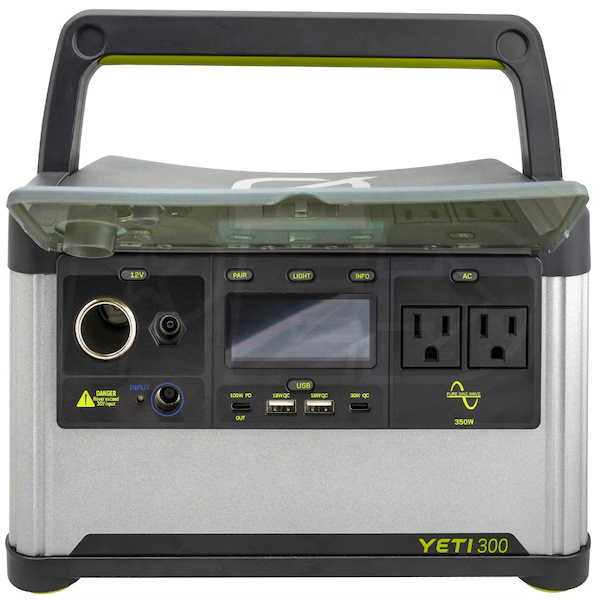
What the Yeti gives back for the weight is a unit built to sit outside: IP54 dust and water resistance, rubberized corners, a handle that means itB2. Goal Zero doesn't publish a rating like that across its whole line, so don't assume the Sherpa matches it and don't assume it fails it either. What the record supports is simpler: one of these was designed for a bag, the other for a campsite.
Lifetime Value
Selected because: The $100 you save buying the Sherpa 100AC comes back out of your pocket over the life of the pack.
cost / lifetime kWh
$5.28 per lifetime kilowatt-hour on the Sherpa against $0.29 on the Yeti. That is the cost of keeping them, it's the widest spread anywhere on this page, and it only needs saying once: the cheaper box is the expensive one.
Shift to weekend use and the arithmetic turns into calendar time, about five years of rated life on the Sherpa against thirty-eight on the Yeti. Nobody keeps a battery for thirty-eight years, and that's the point. On the Yeti, the cycle rating stops being the thing that ends the unit's life. On the Sherpa it's the first thing that will.
Your Life, Your Pick
Selected because: Six of the seven jobs we model defeat both units, and seeing which ones is how you learn you need a bigger station.
Six of the seven jobs come back as neither, and that's the grid being honest rather than the units being bad. These profiles are calibrated for full-size stations: 2,100Wh for a weekend of camping, 4,685Wh for a day of van life. Two units this small were never in that conversation, and pretending otherwise would be how you end up disappointed on a Friday night.
The row that stings is the CPAP night, because it looks survivable and isn't. The Yeti gets most of the way there and then stops, which on a CPAP isn't a shorter night, it's the machine quitting while you're asleep. The only row either unit finishes is the afternoon off-grid one, and only the Yeti finishes it.
What the Specs Don't Tell You
Selected because: All four flags on this pair fire in the Yeti 300's favor, which is most of why the on-the-ground verdict isn't close.
rated cycles
Four flags fire on this pair and all four land on the same side, which is unusual enough to be the finding in itself: no app control on the Sherpa, no UPS mode on its spec sheet, two years of warranty against five, and an eighth of the rated cycles. When every independent check points the same way you can stop weighing them against each other and just read the direction.
One thing no flag can tell you: neither unit has a published noise figure, and our research on both turned up no fan-noise report in either directionA0B0. That's an absence of data, not a clean bill of health. If you're considering either of these because it will sit near your head at night, the capacity numbers have already answered you before noise gets a say.
Strengths & trade-offs
Goal Zero Sherpa 100AC
Strengths
- +Costs $100 less
- +Lighter by 11.6 lb
Trade-offs
- –Lacks smartphone app control for remote monitoring.
- –Shorter-lived battery — rated for 500 charge cycles vs the Yeti 300's 4,000, so it wears out sooner.
Goal Zero Yeti 300
Strengths
- +Larger battery capacity
- +Higher AC output
- +Longer warranty
- +Faster solar charging
- +Rated for 4,000 charge cycles — much longer battery lifespan
Trade-offs
- –Substantially more expensive (+$100) than the Sherpa 100AC.
- –Significantly heavier (+11.6 lbs), making it harder to move.
Will It Power Your Gear?
Scenario math and per-appliance runtimes, modeled from the spec record.
Scenario verdicts
We ran the math on seven real-world scenarios. Here's which unit survives your actual life.
SCN-01 · 2 nights · needs 2,100Wh
Weekend Camping
Two nights off-grid with essential comfort
Neither unit
Neither unit covers this scenario's 2,100Wh: the Sherpa 100AC comes up 2,020Wh short (about 4% covered), the Yeti 300 1,848Wh (12%). This is well outside what either unit is for; the right answer here is a larger station, not a choice between these two.
Battery budget usedlower = more headroom
LOAD Phone Charger 15W×6h · LED Lights 40W×8h · Box Fan 75W×14h · CPAP Machine 40W×16h
SCN-02 · 8 hours · needs 1,645Wh
8-Hour Blackout
Keep the essentials running through a night without power
Neither unit
The Sherpa 100AC can start the 150W peak but not hold it — 150W of surge gets it going, then the 100W continuous rating takes over, so capacity never gets a say. This is the wrong size of unit for the job rather than a close call. The Yeti 300 doesn't have the energy either — 252Wh usable against 1,645Wh, 1,393Wh short — so neither route works.
Battery budget usedlower = more headroom
LOAD Fridge 150W×8h · Router + Modem 20W×8h · LED Lights (4 bulbs) 40W×6h · Phone Charger 15W×3h
SCN-03 · 8 hours · needs 320Wh
CPAP Overnight
Sleep therapy without interruption — the #1 medical use case
Neither unit
Neither unit covers this scenario's 320Wh: the Sherpa 100AC comes up 240Wh short (about 25% covered), the Yeti 300 68Wh (79%). On a CPAP that is not a shorter night — the machine stops when the battery does, partway through it. Neither is a bedside backup at this size.
Battery budget usedlower = more headroom
LOAD CPAP Machine 40W×8h
SCN-04 · 8 hours · needs 910Wh
Remote Workday
Full work day off-grid without power anxiety
Neither unit
Neither unit covers this scenario's 910Wh: the Sherpa 100AC comes up 830Wh short (about 9% covered), the Yeti 300 658Wh (28%). This is well outside what either unit is for; the right answer here is a larger station, not a choice between these two.
Battery budget usedlower = more headroom
LOAD Laptop 60W×8h · External Monitor 30W×8h · Router + Modem 20W×8h · Phone Charger 15W×2h
SCN-05 · 4 hours · needs 670Wh
Tailgate Party
Game day power for the crew
Neither unit
Neither unit can hold the 400W peak this scenario needs — the Sherpa 100AC on its 100W continuous rating, the Yeti 300 on its 350W, so capacity never gets a say. This is the wrong size of unit for the job rather than a close call.
Battery budget usedlower = more headroom
LOAD Blender 400W×0.5h · LED TV (55") 80W×4h · Bluetooth Speaker 15W×4h · Phone Charger (×3) 45W×2h
SCN-06 · 24 hours · needs 4,685Wh
Van Life Daily
A full day of mobile living — the ultimate endurance test
Neither unit
The Sherpa 100AC can start the 150W peak but not hold it — 150W of surge gets it going, then the 100W continuous rating takes over, so capacity never gets a say. This is the wrong size of unit for the job rather than a close call. The Yeti 300 doesn't have the energy either — 252Wh usable against 4,685Wh, 4,433Wh short — so neither route works.
Battery budget usedlower = more headroom
LOAD Mini-Fridge 150W×24h · Laptop 60W×4h · Phone Charger 15W×3h · LED Lights 40W×5h · Fan 75W×8h
SCN-07 · an afternoon · needs 100Wh
Afternoon Off-Grid
Phones and a speaker at the park, beach, or campsite — the small-unit job description
Yeti 300
This is the one row either unit can even attempt, and the Sherpa 100AC misses it by 20Wh. A 100Wh afternoon against 80Wh of usable energy is the whole irony of this matchup: staying under 100Wh is what makes the Sherpa airline-legal, and it's what makes it run out with the sun still up. The Yeti 300 finishes with 152Wh in reserve, which is the difference between planning the afternoon around the battery and forgetting it's there.
Battery budget usedlower = more headroom
LOAD Phone Charger (×2) 30W×2h · Bluetooth Speaker 10W×4h
The Load Test
RUNTIME = (Wh × 0.85) ÷ LOAD
None of the scenarios above exactly yours? Build it. Toggle what you'd plug in; both units are tested against the combined draw.
Essentials
Comfort & Convenience
High-Draw Appliances
Test duration
8h
Continuous draw
205W
Projected runtime
Only the Yeti 300 can start this 205W load.
Sold on Amazon
Planning for more than this? Describe your whole setup and get it sized →
Modeled from the spec record — same math as the tables below. Methodology
Runtime by appliance
Real-world runtime estimates for common appliances, modeled at 85% inverter efficiency.¹
Essentials
The basics you need runningscale 0–16.8hComfort & Convenience
Makes off-grid life actually enjoyablescale 0–3.4hHigh-Draw Appliances
These reveal the real limits¹ Runtime = (capacity × 0.85) ÷ appliance watts. Within each group, all bars share one time scale (the group's longest runtime), so lengths are comparable across appliances; identical runtimes collapse into a single blue/orange bar. Actual runtime varies with battery age, temperature, and simultaneous loads — see methodology.
Conclusion
September 13, 2026
Verdict: the Yeti 300, on Power Score margin
Take the Yeti 300 unless the unit has to fly. For $100 more you get roughly three times the energy, three and a half times the continuous output, a 12V car socket the Sherpa doesn't have, a listed UPS mode, and a pack rated for 4,000 cycles under five years of warranty instead of 500 under two. It is also the cheaper of the two to own by a wide margin, which is the part buyers miss when they compare shelf prices. None of that makes the Sherpa 100AC a bad product; it makes it a different one. At 2.1 lbs and 94.7Wh it sits under the airline carry-on limitA1, it charges a laptop at the same 100W the Yeti manages, and it refills from the USB-C brick already in your bagA3. If your battery lives in a carry-on, buy it deliberately. If it lives in a car, a tent, or beside a router, the Yeti is the only sensible pick.
Editor-assigned confidence, based on cited owner research and spec analysis.
List prices as of September 13, 2026. The links below open Goal Zero's current price.
Sold on Amazon · today’s price is on the listing
or check the Sherpa 100AC price$249.95 list
Written by Wenny Zheng, Portable Power Tester · Station Arena Test Desk · Updated September 13, 2026
Black Friday · 38 days out
Price to beat:Sherpa 100AC $250
We have never seen it discounted, so any real cut would be a first.
Measured Data
Benchmark scores and the full spec record, side by side.
Benchmark scores
Not rated for both units (minimum threshold unmet): UPS, CPAP, Solar Generator, Tailgating, Apartment Balcony, Camping.
Full specifications
ᵈ Derived: price ÷ rated capacity. See the data behind our comparisons →
Comparison ToolAdd more power stations, side by sideOpen Tool →How these numbers are produced
Numeric verification
Every figure on this page traces to our spec database or arithmetic on it — no estimated numbers.
Owner claims
Statements about owner experience are cited to published reviews — see Sources & Research Notes below.
Runtime model
Runtime = (rated capacity × 0.85 inverter efficiency) ÷ device wattage. Solar recharge estimates assume panels deliver 70% of rated output. Cold weather, battery age, and stacked loads reduce real-world results.
Power Score
Computed from 14 published spec dimensions, weighted per use-case bench. Higher is better; a unit must meet a bench's minimum threshold to be rated.
See the full weight table and data sourcing on our methodology page →Class ranking (the star rating)
Each unit's star score is a category ranking, not customer reviews — no buyer opinions feed it. We score every station on size-independent quality (value, output, portability, endurance, ports, warranty, and more), then percentile-rank it against the other units in its capacity class, so a class-leading compact unit and a class-leading whole-home unit can both earn 5★. Here, Sherpa 100AC rates 3.3/5 (1st percentile of 24 Personal-class units), and Yeti 300 rates 3.7/5 (22nd percentile of 24 Personal-class units).
How the class ranking is computed →Test Notes & Caveats
Hidden gotchas and advantages we spotted that you won't find on the product page.
No App on the Sherpa, and It Barely Matters
App control earns its keep when the unit lives in a basement or under a van bench and you want the battery level without making the trip. The Sherpa 100AC is 2.1 lbs in your bag, so checking it costs a glance rather than a walk. The Yeti 300 at 13.7 lbs is the one more likely to be parked somewhere out of reach, which is exactly where its app and its low-battery alerts start paying for themselves.
Only the Yeti 300 Lists a UPS Mode
The Yeti 300 can sit between the wall and your gear and hand it to battery when the grid drops — rated ≤20ms — fine on paper for routers and most electronics; the fussiest PC power supplies sit right at this line. Worth it for a router or a modem — not a CPAP: at 252Wh usable it can bridge the flicker but cannot run the night. The Sherpa 100AC's spec sheet lists no UPS mode, so anything plugged into it rides an outage only as far as your reaction time.
Two Years Against Five, No Registration Required
The Sherpa 100AC carries two years and the Yeti 300 carries five, and Goal Zero doesn't make either term conditional on registering the unit. No form to remember, no receipt to file away. Spread across the purchase price that's $125 per covered year on the Sherpa against $70 on the Yeti, which makes this the rare case where the more expensive box is also the cheaper promise.
Five Hundred Cycles Against Four Thousand
A cycle isn't the same unit of work on these two: 94.7Wh on the Sherpa 100AC, 297Wh on the Yeti 300. Count energy instead of cycles and the rated lives land at roughly 47 kWh against 1,188 kWh, the widest gap anywhere on this comparison. Cycled daily, the Sherpa reaches its rating in about a year and a half; the Yeti takes eleven years to get there. Neither pack dies at the limit, mind. A cell that hits its cycle count settles around 80% of its original capacity and keeps working.
Full record above — the Test Desk pick is the Yeti 300.
Check Yeti 300 price →or check the Sherpa 100AC priceOwnership Analysis
What happens after you buy — true cost of ownership, brand trust, and growth potential.
Lifetime value
Service lifeyears at one full cycle per day
Lifetime energy delivered
Cost per delivered kWh
│ warranty ends · Reaching the cycle rating means ~80% capacity remains — degraded, not dead.
Analyst note
The Sherpa 100AC is cheaper to buy, but the Yeti 300 is cheaper to own. At $0.29/kWh over its lifetime vs $5.28/kWh, the Yeti 300's higher cycle life and capacity make each dollar go further over the years.
Delivers each lifetime kWh for $4.99 less — check the Yeti 300 price →
Growth path
Sherpa 100AC
FIXED CAPACITYFixed at 95Wh, with no expansion — so size it for your needs up front rather than planning to add capacity later.
Accepts up to 60W of solar. Limited to a single portable panel.
Limited ports. You'll likely need a power strip or splitter.
Yeti 300
FIXED CAPACITYFixed at 297Wh, with no expansion — so size it for your needs up front rather than planning to add capacity later.
Accepts up to 200W of solar. Limited to a single portable panel.
Adequate ports for most setups, but heavy users may want a power strip.
Realistic full solar rechargeat 70% of rated panel output — see methodology
Analyst note
Neither expands, and that's no knock on either — each is a complete unit at a fixed size. Buy the capacity that covers your needs now (the Yeti 300 gives you the larger ceiling); you can't add to either later.
What Owners Report
Patterns from published owner reports and long-term reviews — every claim cited to its source below.
Goal Zero Sherpa 100AC
The field record on the Sherpa 100AC is thin, and what exists comes from reviewers rather than long-term ownersA0. It's consistent and unusually specific, though: 94.7Wh under the FAA's 100Wh limit with a genuine 100W AC outlet for laptop chargers, camera cradles and small lampsA1; about 2 lbs, with 15W wireless charging and a footprint that disappears into a laptop bagA2; a 100W USB-C port that took a laptop from 10% to 100% in 90 minutes while spending 45% of the bank, and that refills from a USB-C source with no separate wall plugA3. Photographers and traveling creatives are who keeps turning up in the coverageA4.
No failure shows up anywhere in the record, and neither does two years of daily use, so on durability we have a spec sheet and not much elseA0.
“A 94.7Wh power bank — under the 100Wh FAA flight limit, so it's airline-approved — with a 100W AC port for laptop chargers, camera cradles, or small lamps.”
Sources
campingsolar.us · matadornetwork.com · gearjunkie.com · shotkit.com · packandtrail.com · the-gadgeteer.com
Goal Zero Yeti 300
The Yeti 300 reads as the more carefully built of the two: IP54 dust and water resistance, rubberized corners, a sturdy handle, and 0 to 100% in 50 minutesB2, all behind a 350W pure sine inverter with 600W of surge on a pack rated for 4,000 cyclesB1. It's a 6th-generation LFP unit rather than the older NMC X-series, which matters if you're reading older Yeti reviews and wondering why the cycle numbers look so differentB0.
The catch, volunteered: pushed near its rated ceiling, one reviewer had it shut down after two minutes with a coffee maker, and 297Wh means four to six hours on a laptop or twenty to thirty phone charges and then nothingB3. One reviewer also thought $350 stings for that capacityB4, and on capacity alone that's fair. What you're buying is cycles, ruggedness and the inverter, not watt-hours.
“A 297Wh LiFePO4 pack behind a 350W pure sine inverter (600W surge), rated 4,000 cycles — Goal Zero backs it with a long service life rather than raw output.”
Sources
goalzero.com · batteryskills.com · campingsolar.us · trailandkale.com · the-gadgeteer.com
Sources & Research Notes
Every owner claim in this report is traceable to a published source. The bracketed references above resolve here.
Recurring owner themes
- Airline-legal 94.7Wh, a real 100W AC port, wireless charging, and 2-lb travel portability are the standout points. [Sherpa 100AC · 3 entries]
- Modern LFP (4,000+ cycles), IP54 ruggedness, and fast charging are the praise; small capacity and high price are the caveats. [Yeti 300 · 3 entries]
- A1
“A 94.7Wh power bank — under the 100Wh FAA flight limit, so it's airline-approved — with a 100W AC port for laptop chargers, camera cradles, or small lamps.”
campingsolar.us / matadornetwork.com — Sherpa 100AC review · 2026 · [positive]
- A2
“Weighs just 2 lbs and adds best-in-class 15W wireless charging; a tiny, elegant unit that fits in a laptop bag.”
gearjunkie.com / shotkit.com — Sherpa 100AC review · 2026 · [positive]
- A3
“Its 100W USB-C port charged a laptop from 10% to 100% in 90 minutes, drawing 45% from the Sherpa's battery, and it recharges from a USB-C source with no separate wall plug.”
packandtrail.com — Sherpa 100AC review · 2026 · [positive]
- A4
“A versatile travel power pack for cameras, laptops, and phones — ideal for digital nomads and outdoor creatives.”
the-gadgeteer.com — Sherpa 100AC review · 2026 · [positive]
- B1
“A 297Wh LiFePO4 pack behind a 350W pure sine inverter (600W surge), rated 4,000 cycles — Goal Zero backs it with a long service life rather than raw output.”
goalzero.com / batteryskills.com — Yeti 300 review · 2026 · [positive]
- B2
“At 13.7 lbs, meets IP54 for dust and water resistance, with top-tier build quality — rubberized corners and a sturdy handle; recharges 0-100% in 50 minutes.”
campingsolar.us / trailandkale.com — Yeti 300 review · 2026 · [positive]
- B3
“The 297Wh capacity limits it to lighter-duty use — 4-6 hours on a laptop or 20-30 phone charges — and it struggled near its 300W limit, shutting down after 2 minutes with a coffee maker.”
batteryskills.com — Yeti 300 review · 2026 · [mixed]
- B4
“A modern LFP (not NMC) rugged compact unit, though at $349.95 the price stings for the capacity.”
the-gadgeteer.com — Yeti 300 review · 2026 · [mixed]
Research compiled September 13, 2026.
Who Should Buy Which
Buy the Sherpa 100AC if you…
- →You fly for work. The Sherpa is airline-approved at 94.7WhA1 and the Yeti flatly isn't, so for the photographer, consultant or engineer who lands somewhere, works all afternoon and charges in a hotel that night, this is the only one of the two that's even an option.
- →You want one brick for everything. A 100W USB-C port in both directions means the charger already in your bag refills itA3, and the wireless pad on top means your phone never needs its own cableA2.
- →You need an AC outlet occasionally rather than continuously. A camera battery cradle, a small lamp, a laptop's own power brick on the 100W outlet: that's the job this was built for.
Buy the Yeti 300 if you…
- →It rides in a car. Campsite, trailhead, tailgate, the back of a wagon. 13.7 lbs is a one-hand carry and IP54 means a surprise shower isn't an emergencyB2.
- →A full working day away from a wall. Four to six hours of laptop, or your phone and a partner's phone many times overB3, with 350W of headroom left for a fan or a small projector.
- →The router that must not blink. This is the only one of the two that lists a UPS mode, rated no worse than 20ms, which covers a modem and a router through a flicker or a brief cut.
- →You intend to keep it. Four thousand cycles and five years of coverage mean the pack won't be the thing that ends this unit's life.
If neither fits
Anyone whose real list has a compressor or a heating element on it. The tailgate profile alone needs a 400W peak and neither inverter will hold it, so a fridge, a kettle or a space heater ends the conversation before capacity ever comes up. Buy one class up and skip this pair entirely. And if the honest truth is that you need a phone and a tablet topped up twice on a long day, a plain USB power bank does that for a fraction of the Sherpa's price, with no inverter to pay for.
The Bottom Line
Take the Yeti 300. Same brand, $100 more, and what the money buys is the pack that outlives its own warranty instead of the one that reaches its rated life inside it, plus the output, the ports and the UPS mode. The lifetime-cost arithmetic reaches the same verdict from a completely different direction, which is usually how you know a call is safe.
The exception is real and it's narrow. If this battery flies with you, the Sherpa 100AC is the only one of the two allowed in the cabin, and a 2.1-lb bank that refills off your laptop charger is a genuinely good thing to ownA3. Just buy it knowing what it is: a travel accessory with a service life, not a small power station. If it stays on the ground, get the Yeti.
Frequently Asked Questions
Answers drawn from the spec record and cited owner research.
Can I take the Goal Zero Sherpa 100AC or the Yeti 300 on a plane?
The Sherpa 100AC, yes. At 94.7Wh it sits under the FAA's 100Wh ceiling for batteries carried in the cabin, which is precisely why Goal Zero built it to that number. The Yeti 300's 297Wh is nearly three times the limit, so it isn't going in a carry-on. Confirm with your carrier before you travel, since airlines layer their own rules on top of the federal one.
Will the Yeti 300 run a CPAP all night?
No. Our overnight profile needs 320Wh and the Yeti has 252Wh of usable energy after the flat 85% derate we apply to every unit, so it comes up 68Wh short and quits before morning. Its UPS mode, rated no worse than 20ms, is a promise about routers and modems rather than about a machine you're asleep next to. For CPAP use, buy a unit that covers the whole night with margin to spare.
Is the Yeti 300 worth $100 more than the Sherpa 100AC?
If it isn't flying, yes, and not mainly because it's bigger. You're buying 4,000 rated cycles against 500 and five years of warranty against two, which is why it works out far cheaper per unit of energy delivered across its life. If it is flying, that extra $100 buys you a battery you aren't allowed to bring.
Which one is quieter?
Nobody can tell you, us included. Goal Zero publishes no decibel figure for either unit, and our research on both turned up no fan-noise report in either direction. Treat that as missing data rather than evidence of a quiet unit. If noise matters because the thing will sit near your bed, note that the capacity numbers already rule both out for an overnight medical load.
Can either one run a coffee maker or a microwave?
No. The Sherpa holds 100W continuously, which covers a laptop charger and a lamp. The Yeti holds 350W, and one reviewer pushing it near that ceiling had it shut down after two minutes with a coffee maker. Anything with a heating element wants an inverter that starts where these two stop.
Where to buy
Goal Zero Sherpa 100AC
$249.95
$249.95 · direct from Goal Zero
Last checked 16 days ago. Prices move — check before you buy.
Goal Zero Yeti 300Pick
Sold on Amazon · today’s price is on the listing
Prices may vary by retailer and are subject to change.