Head-to-head test
Goal Zero Sherpa 100AC vs Goal Zero Yeti 200X
Goal Zero Sherpa 100AC vs Goal Zero Yeti 200X: the Yeti holds 187Wh to the Sherpa's 94.7Wh, takes twice the solar input, adds a 12V socket, and costs less. Buy the Yeti unless the unit has to fit in a carry-on or charge a laptop at 100W, which only the 2.1-lb Sherpa does.
Full profiles: Goal Zero Sherpa 100AC → · Goal Zero Yeti 200X →

Written by Wenny ZhengUpdated
Portable Power Tester, Station Arena Test Desk
Spec deltas
The Yeti 200X costs $30 less (on last listed prices) than the Sherpa 100AC and carries almost exactly twice the battery, 187Wh against 94.7Wh. It also holds 120W continuous where the Sherpa holds 100W, swallows 120W of solar where the Sherpa takes 60W, and puts a 12V socket on the front for camp gear. One unit winning on price and on every capacity number usually ends a comparison.
This one turns on a single figure: 94.7. That sits under the 100Wh ceiling that keeps a lithium pack in a carry-on, and 187Wh does notA1A0. Add the weight, 2.1 lbs against 5, and the Sherpa stops being a small power station and becomes a large power bank with a wall socket on it. Same aisle, different product.
So the call is easy once you know where the thing lives. Car, closet, campsite: Yeti 200X. Overhead bin: Sherpa 100AC. One warning before you spend anything, though. These are the two smallest units in our catalogue, and every full-size job we model comes back 'neither'. A weekend of camping, an eight-hour blackout, a CPAP night, a remote workday: all of them want a bigger station than either of these.
What the Numbers Reveal
Each conclusion stated first — the numbers behind it on one line, the full analysis below.
Capacity
What the premium actually buys is 2.9 lbs off your shoulder, a 100W USB-C port instead of a 60W one, a wireless pad, and a pack small enough to flyA1A2. Every one of those is a travel feature. Nothing in the Sherpa's price makes it better at sitting still.
Sherpa 100AC: 94.7Wh of battery for $250Yeti 200X: 187Wh for $220 (last listed price)both packs are rated for 500 cycles and both carry a 2-year warranty
Why it mattersIf the unit is going to live in a vehicle, a garage, or beside a router, the Yeti 200X wins before you read another line.
weight
That makes the Sherpa the only one of the two that can come into the cabin with you, and it tops up from the same USB-C charger already in the bag for the laptopA3. The Yeti is 5 lbs that stays on the ground, and a capacity advantage is worth nothing on a battery that couldn't make the trip.
Sherpa 100AC: 94.7Wh, 2.1 lbs, under the 100Wh limit that keeps a lithium pack in a carry-onA1Yeti 200X: 187Wh, 5 lbsthe Sherpa refills from a USB-C source with no separate wall brickA3
Why it mattersPhotographers, and anyone whose off-grid weekend starts with a boarding pass, should stop comparing watt-hours and buy the Sherpa.
So the real choice inside a laptop bag is two fast charges or four slow ones. For a single travel day, where you plug in over lunch and want the machine full before boarding, 100W into a 94.7Wh pack is the better tool. Across three days with no outlet, the extra refills matter more than the speed of any one of them.
the Sherpa's USB-C tops out at 100W; the Yeti's at 60Wone measured refill took a laptop from 10% to 100% in 90 minutes and cost 45% of the Sherpa's batteryA3the Yeti holds 187Wh to the Sherpa's 94.7Wh, near enough exactly twice
Why it mattersDay-trippers and one-nighters take the Sherpa. Anyone going a long weekend between wall outlets takes the Yeti.
continuous output
And what comes out is more flexible. Twelve-volt camp gear runs straight off the Yeti's socket instead of through an inverter, while everything on the Sherpa has to be converted to AC or USB first. On a camp table the Yeti holds twice as much, refills just as fast, and wastes less of it on conversion.
Sherpa 100AC: 94.7Wh capacity, 60W maximum solar inputYeti 200X: 187Wh capacity, 120W maximum solar inputthe Yeti has a 12V socket; the Sherpa's outputs are AC and USB only
Why it mattersIf you're charging from a panel rather than a wall, treat the capacity gap as free and take it.
The specific dimensions that decide these two units — everything else is a tie.
Portability & Form Factor
Selected because: 2.1 lbs against 5, and only the Sherpa's 94.7Wh pack sits under the 100Wh airline limit.
weight
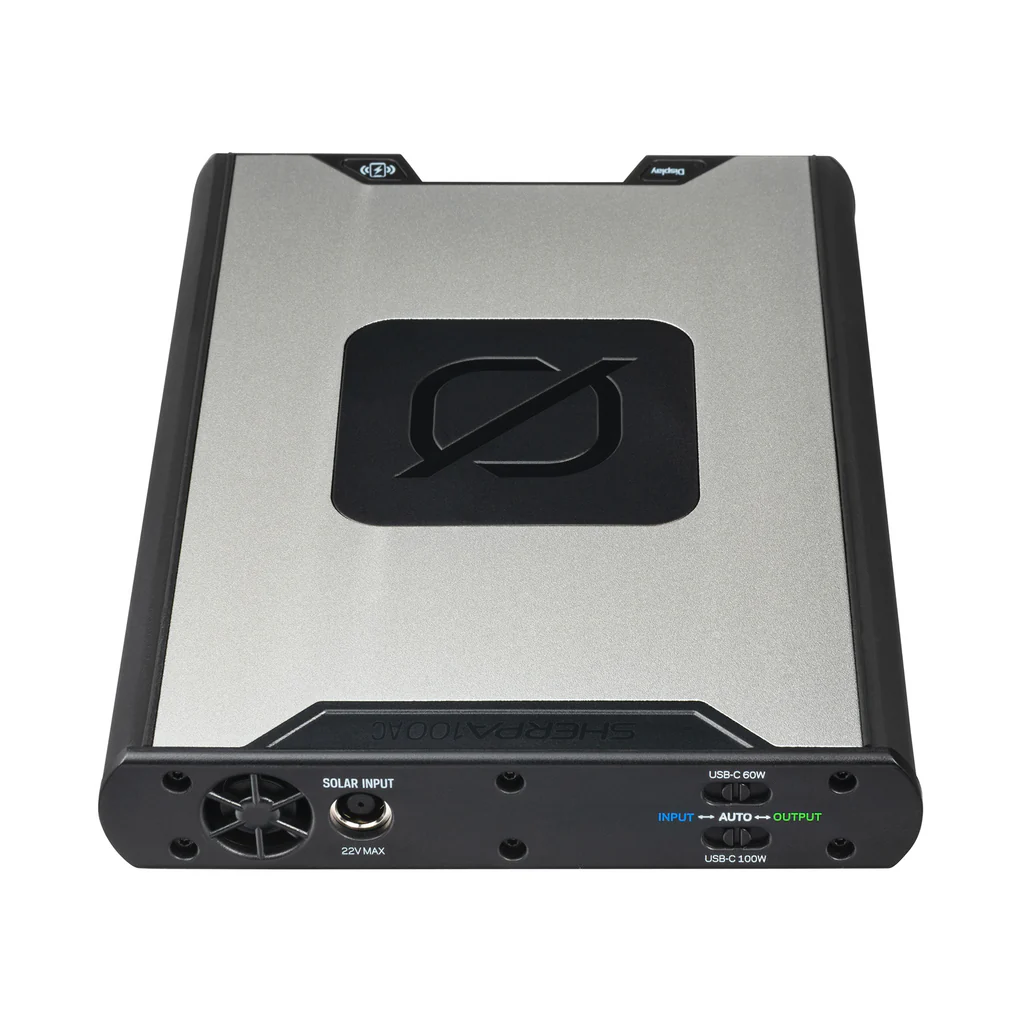
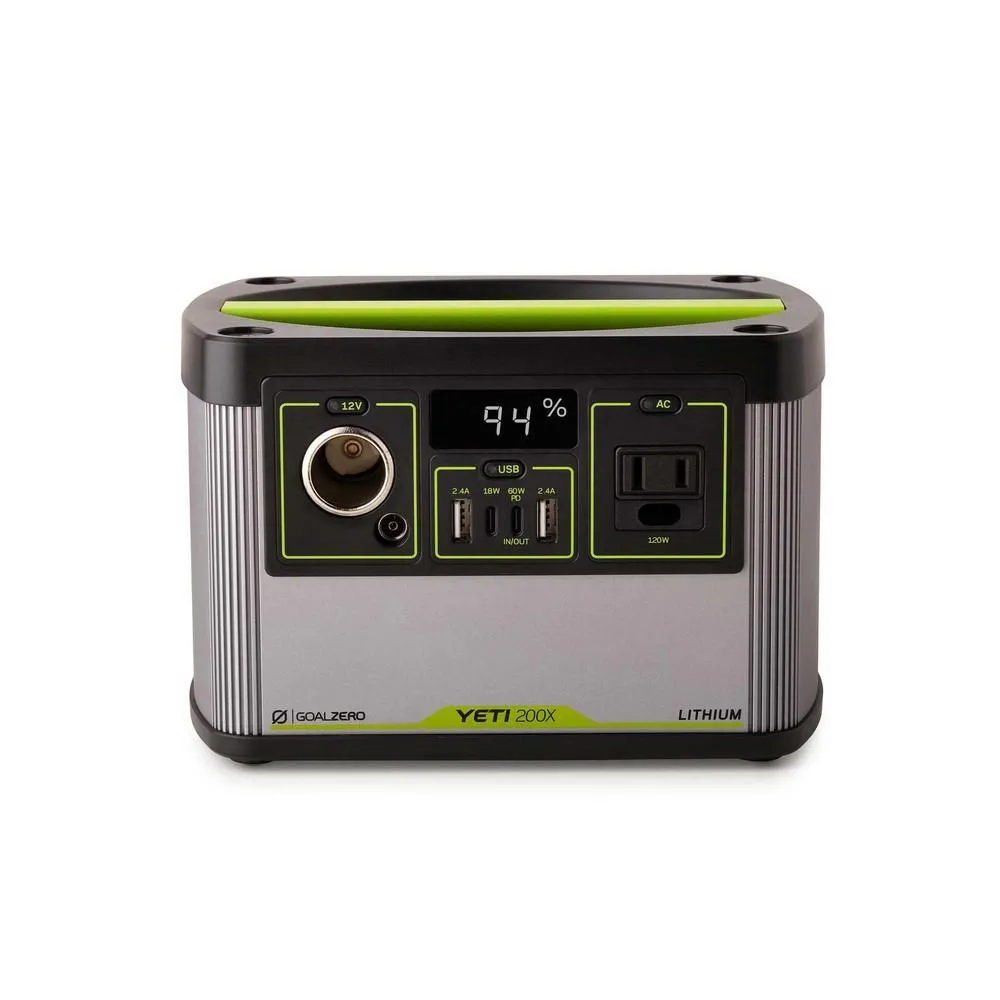
Three pounds is the difference between a thing you carry and a thing you fetch. The Sherpa vanishes into a laptop sleeve at 2.1 lbs and has a 15W wireless pad on its top face, so the phone charges by being set down on itA2. The Yeti 200X is 5 lbs in a 7.9 x 5.1 x 5.1-inch blockB2, which is nothing in a trunk and noticeable on a shoulder by the second mile.
The harder line is the 100Wh one. The Sherpa was built to land just under the carry-on limit at 94.7WhA1, and the Yeti's 187Wh is nearly twice it. If you fly, this section is the entire comparison and you can stop reading here.
Lifetime Value
Selected because: The cheaper unit is also the bigger one: $220 (last listed price) for 187Wh against $250 for 94.7Wh, on identical 500-cycle ratings.
$2.35 per lifetime kilowatt-hour for the Yeti, $5.28 for the Sherpa. Both packs are rated for the same 500 cycles, so that spread is not one unit outliving the other. It's the same money buying a smaller battery, and it's the plainest number on the page.
The honest other side: the Sherpa's price isn't irrational, it's specific. You're paying for a 100W USB-C port rather than a 60W one, a wireless pad, and 2.9 lbs you never have to liftA2A3. That is a travel premium, priced about right for travel. If you aren't travelling, you're paying it for nothing.
Your Life, Your Pick
Selected because: Six of the seven jobs we model come back 'neither', which is the most useful thing this page can tell you.
Six of the seven jobs here come back 'neither', and that's the honest size of these units rather than a mark against them. A weekend of camping asks for 2,100Wh; the Yeti has 159Wh usable after the flat 85% derate applied to every unit on this site, the Sherpa 80Wh. Two of the failures aren't even about capacity. The blackout profile wants a sustained 150W and the tailgate 400W, and a 100W or 120W inverter can't hold either, so the batteries never get consulted.
One row does resolve, and it's the smallest: a 100Wh afternoon of laptop and phone. The Yeti finishes it with 59Wh in reserve, the Sherpa stops 20Wh from the end. That's the true shape of this matchup. These are devices for loads that fit on a picnic table, and the Yeti covers more of them.
Growth Path
Selected because: Neither unit expands, so the capacity you pick now is the capacity you own: 94.7Wh or 187Wh.
solar input
Neither unit expands, and at this size that's no more a flaw than a kettle not being a stove. Each is a complete sealed thing, 94.7Wh or 187Wh, for as long as you own it. The only decision left is which ceiling you buy, and one of these ceilings is twice the height of the other at the lower price.
So buy for the worst night you actually expect rather than the average one. If the honest list is a phone, a camera battery, a laptop and a light, both work and the Yeti leaves headroom for the days you misjudge. If the list has a CPAP or a fridge on it, no ceiling here is high enough.
Strengths & trade-offs
Goal Zero Sherpa 100AC
Strengths
- +Lighter by 2.9 lb
Trade-offs
- –Lacks smartphone app control for remote monitoring.
Goal Zero Yeti 200X
Strengths
- +Larger battery capacity
- +Higher AC output
- +Faster solar charging
Trade-offs
- –Lacks smartphone app control for remote monitoring.
Will It Power Your Gear?
Scenario math and per-appliance runtimes, modeled from the spec record.
Scenario verdicts
We ran the math on seven real-world scenarios. Here's which unit survives your actual life.
SCN-01 · 2 nights · needs 2,100Wh
Weekend Camping
Two nights off-grid with essential comfort
Neither unit
Neither unit covers this scenario's 2,100Wh: the Sherpa 100AC comes up 2,020Wh short (about 4% covered), the Yeti 200X 1,941Wh (8%). This is well outside what either unit is for; the right answer here is a larger station, not a choice between these two.
Battery budget usedlower = more headroom
LOAD Phone Charger 15W×6h · LED Lights 40W×8h · Box Fan 75W×14h · CPAP Machine 40W×16h
SCN-02 · 8 hours · needs 1,645Wh
8-Hour Blackout
Keep the essentials running through a night without power
Neither unit
Neither unit can hold the 150W peak this scenario needs — the Sherpa 100AC on its 100W continuous rating, the Yeti 200X on its 120W, so capacity never gets a say. This is the wrong size of unit for the job rather than a close call.
Battery budget usedlower = more headroom
LOAD Fridge 150W×8h · Router + Modem 20W×8h · LED Lights (4 bulbs) 40W×6h · Phone Charger 15W×3h
SCN-03 · 8 hours · needs 320Wh
CPAP Overnight
Sleep therapy without interruption — the #1 medical use case
Neither unit
Neither unit covers this scenario's 320Wh: the Sherpa 100AC comes up 240Wh short (about 25% covered), the Yeti 200X 161Wh (50%). On a CPAP that is not a shorter night — the machine stops when the battery does, partway through it. Neither is a bedside backup at this size.
Battery budget usedlower = more headroom
LOAD CPAP Machine 40W×8h
SCN-04 · 8 hours · needs 910Wh
Remote Workday
Full work day off-grid without power anxiety
Neither unit
Neither unit covers this scenario's 910Wh: the Sherpa 100AC comes up 830Wh short (about 9% covered), the Yeti 200X 751Wh (17%). This is well outside what either unit is for; the right answer here is a larger station, not a choice between these two.
Battery budget usedlower = more headroom
LOAD Laptop 60W×8h · External Monitor 30W×8h · Router + Modem 20W×8h · Phone Charger 15W×2h
SCN-05 · 4 hours · needs 670Wh
Tailgate Party
Game day power for the crew
Neither unit
Neither unit can hold the 400W peak this scenario needs — the Sherpa 100AC on its 100W continuous rating, the Yeti 200X on its 120W, so capacity never gets a say. This is the wrong size of unit for the job rather than a close call.
Battery budget usedlower = more headroom
LOAD Blender 400W×0.5h · LED TV (55") 80W×4h · Bluetooth Speaker 15W×4h · Phone Charger (×3) 45W×2h
SCN-06 · 24 hours · needs 4,685Wh
Van Life Daily
A full day of mobile living — the ultimate endurance test
Neither unit
Neither unit can hold the 150W peak this scenario needs — the Sherpa 100AC on its 100W continuous rating, the Yeti 200X on its 120W, so capacity never gets a say. This is the wrong size of unit for the job rather than a close call.
Battery budget usedlower = more headroom
LOAD Mini-Fridge 150W×24h · Laptop 60W×4h · Phone Charger 15W×3h · LED Lights 40W×5h · Fan 75W×8h
SCN-07 · an afternoon · needs 100Wh
Afternoon Off-Grid
Phones and a speaker at the park, beach, or campsite — the small-unit job description
Yeti 200X
A hundred watt-hours across an afternoon is a laptop, a phone and a speaker, and it's the one job on this page that actually resolves. The Yeti 200X finishes it with 59Wh in reserve. The Sherpa 100AC gets roughly four-fifths of the way and stops 20Wh from the end, which in practice means the last stretch runs on your laptop's own battery. Smallest job here, and still only one of them completes it.
Battery budget usedlower = more headroom
LOAD Phone Charger (×2) 30W×2h · Bluetooth Speaker 10W×4h
The Load Test
RUNTIME = (Wh × 0.85) ÷ LOAD
None of the scenarios above exactly yours? Build it. Toggle what you'd plug in; both units are tested against the combined draw.
Essentials
Comfort & Convenience
High-Draw Appliances
Test duration
8h
Continuous draw
205W
Projected runtime
Neither unit can start 205W continuous — the ceiling here is the Yeti 200X's 120W.
Planning for more than this? Describe your whole setup and get it sized →
Modeled from the spec record — same math as the tables below. Methodology
Runtime by appliance
Real-world runtime estimates for common appliances, modeled at 85% inverter efficiency.¹
Essentials
The basics you need runningscale 0–10.6hComfort & Convenience
Makes off-grid life actually enjoyablescale 0–2.1hHigh-Draw Appliances
These reveal the real limits¹ Runtime = (capacity × 0.85) ÷ appliance watts. Within each group, all bars share one time scale (the group's longest runtime), so lengths are comparable across appliances; identical runtimes collapse into a single blue/orange bar. Actual runtime varies with battery age, temperature, and simultaneous loads — see methodology.
Conclusion
September 13, 2026
Verdict withdrawn: the Yeti 200X is no longer sold
We picked the Yeti 200X, but it's been discontinued (Goal Zero now points buyers to the Yeti 300). The Sherpa 100AC is still on sale, but that alone doesn't make it our pick. The comparison below is still accurate if you own either one.
Editor-assigned confidence, based on cited owner research and spec analysis.
Written by Wenny Zheng, Portable Power Tester · Station Arena Test Desk · Updated September 13, 2026
Black Friday · 38 days out
Price to beat:Sherpa 100AC $250
We have never seen it discounted, so any real cut would be a first.
Measured Data
Benchmark scores and the full spec record, side by side.
Benchmark scores
Not rated for both units (minimum threshold unmet): Apartment Balcony.
Full specifications
ᵈ Derived: price ÷ rated capacity. See the data behind our comparisons →
Comparison ToolAdd more power stations, side by sideOpen Tool →How these numbers are produced
Numeric verification
Every figure on this page traces to our spec database or arithmetic on it — no estimated numbers.
Owner claims
Statements about owner experience are cited to published reviews — see Sources & Research Notes below.
Runtime model
Runtime = (rated capacity × 0.85 inverter efficiency) ÷ device wattage. Solar recharge estimates assume panels deliver 70% of rated output. Cold weather, battery age, and stacked loads reduce real-world results.
Power Score
Computed from 14 published spec dimensions, weighted per use-case bench. Higher is better; a unit must meet a bench's minimum threshold to be rated.
See the full weight table and data sourcing on our methodology page →Class ranking (the star rating)
Each unit's star score is a category ranking, not customer reviews — no buyer opinions feed it. We score every station on size-independent quality (value, output, portability, endurance, ports, warranty, and more), then percentile-rank it against the other units in its capacity class, so a class-leading compact unit and a class-leading whole-home unit can both earn 5★. Here, Sherpa 100AC rates 3.3/5 (1st percentile of 24 Personal-class units), and Yeti 200X rates 3.4/5 (9th percentile of 24 Personal-class units).
How the class ranking is computed →Test Notes & Caveats
Hidden gotchas and advantages we spotted that you won't find on the product page.
Warranty: two years each, no paperwork
Both units carry the same 2-year term, and Goal Zero doesn't make it conditional on registering the product, so there's no hidden coverage advantage on either side and nothing to claim by filling in a form. Warranty can't break this tie. Decide on capacity, weight and price.
Ownership Analysis
What happens after you buy — true cost of ownership, brand trust, and growth potential.
Lifetime value
Service lifeyears at one full cycle per day
Lifetime energy delivered
Cost per delivered kWh
│ warranty ends · Reaching the cycle rating means ~80% capacity remains — degraded, not dead.
Analyst note
The Yeti 200X is no longer sold, so there is no price to work its cost per kWh from, and this comparison doesn't quote one. On what you can actually buy today, the Sherpa 100AC works out at $5.28/kWh over its rated life. If you already own the Yeti 200X, the hardware comparison still holds: over its rated life the Sherpa 100AC delivers about 47 kWh and the Yeti 200X about 94 kWh. One thing to know reading the table: both carry the same 500-cycle rating, so the lifetime rows are sticker price and capacity in disguise — the wear horizon is identical and decides nothing here.
Growth path
Sherpa 100AC
FIXED CAPACITYFixed at 95Wh, with no expansion — so size it for your needs up front rather than planning to add capacity later.
Accepts up to 60W of solar. Limited to a single portable panel.
Limited ports. You'll likely need a power strip or splitter.
Yeti 200X
FIXED CAPACITYFixed at 187Wh, with no expansion — so size it for your needs up front rather than planning to add capacity later.
Accepts up to 120W of solar. Limited to a single portable panel.
Limited ports. You'll likely need a power strip or splitter.
Realistic full solar rechargeat 70% of rated panel output — see methodology
Analyst note
Growth only counts if you can still buy in, and the Yeti 200X is no longer sold (Goal Zero points owners to the Yeti 300). That leaves the Sherpa 100AC: it is sealed at 95Wh, so buy the size that covers you now. The Yeti 200X's fixed 187Wh still matters if you already own one, but it isn't a reason to pick it over the Sherpa 100AC.
What Owners Report
Patterns from published owner reports and long-term reviews — every claim cited to its source below.
Goal Zero Sherpa 100AC
Field material on the Sherpa 100AC is review-desk material rather than long-term ownership: a handful of recent write-ups, no year-in reportsA0A4. What they agree on is the travel case. It's a 94.7Wh pack with a real 100W AC outlet for a laptop charger or a camera cradle, small enough to be airline-legalA1, 2.1 lbs, with 15W wireless charging on the lidA2.
The most useful measurement anyone has published: a laptop from 10% to 100% in 90 minutes, costing 45% of the pack, and the Sherpa itself refills from a USB-C source with no separate wall brickA3. That last detail is what sells it to people who already resent how many chargers they pack.
“A 94.7Wh power bank — under the 100Wh FAA flight limit, so it's airline-approved — with a 100W AC port for laptop chargers, camera cradles, or small lamps.”
Sources
campingsolar.us · matadornetwork.com · gearjunkie.com · shotkit.com · packandtrail.com · the-gadgeteer.com
Goal Zero Yeti 200X
The Yeti 200X reads as well-liked and accurately labelled: 5 lbs, Goal Zero's lightest station, a 7.9 x 5.1 x 5.1-inch block, with a port set (AC, 12V, USB-A, 60W USB-C PD) that suits overlanding and car camping and keeps lights and phones going for daysB2B3. Reviewers are clear-eyed about the ceiling too: it's 187Wh of Li-NMC rated for 500 cycles to 80%B1.
The one recurring reservation is chemistry rather than build: the 200X is an older NMC design in a market that has moved to LFP, and that is where its 500-cycle number comes fromB1B4B0. Worth keeping straight, because it gets muddled constantly: that rating belongs to this unit, not to Goal Zero's newer LFP Yetis, which are a different pack with different figures.
“A 187Wh Li-ion NMC battery rated for 500 lifecycles to 80%, with a 120W AC inverter.”
Sources
walmart.com · pcworld.com · forbes.com · the-gadgeteer.com · geardiary.com · bhphotovideo.com · bestbuy.com
Sources & Research Notes
Every owner claim in this report is traceable to a published source. The bracketed references above resolve here.
Recurring owner themes
- Airline-legal 94.7Wh, a real 100W AC port, wireless charging, and 2-lb travel portability are the standout points. [Sherpa 100AC · 3 entries]
- Ultra-light (5 lb) and well-connected for small gear, but tiny NMC capacity (187Wh) with 500-cycle chemistry. [Yeti 200X · 3 entries]
- A1
“A 94.7Wh power bank — under the 100Wh FAA flight limit, so it's airline-approved — with a 100W AC port for laptop chargers, camera cradles, or small lamps.”
campingsolar.us / matadornetwork.com — Sherpa 100AC review · 2026 · [positive]
- A2
“Weighs just 2 lbs and adds best-in-class 15W wireless charging; a tiny, elegant unit that fits in a laptop bag.”
gearjunkie.com / shotkit.com — Sherpa 100AC review · 2026 · [positive]
- A3
“Its 100W USB-C port charged a laptop from 10% to 100% in 90 minutes, drawing 45% from the Sherpa's battery, and it recharges from a USB-C source with no separate wall plug.”
packandtrail.com — Sherpa 100AC review · 2026 · [positive]
- A4
“A versatile travel power pack for cameras, laptops, and phones — ideal for digital nomads and outdoor creatives.”
the-gadgeteer.com — Sherpa 100AC review · 2026 · [positive]
- B1
“A 187Wh Li-ion NMC battery rated for 500 lifecycles to 80%, with a 120W AC inverter.”
walmart.com / pcworld.com — Yeti 200X review · 2026 · [mixed]
- B2
“Weighs just 5 pounds — Goal Zero's lightest power station — measuring only 7.9 x 5.1 x 5.1 inches.”
forbes.com / the-gadgeteer.com — Yeti 200X review · 2026 · [positive]
- B3
“Perfect for overlanding or car camping, with a good port selection (USB-A, USB-C, 60W USB-C PD, AC, 12V) and rapid charge times, keeping critical gear like lights and phones running for days.”
geardiary.com / bhphotovideo.com — Yeti 200X review · 2026 · [positive]
- B4
“Priced at $299.95 with a 24-month warranty; an older NMC design in a market shifting to LFP.”
bestbuy.com — Yeti 200X · 2026 · [mixed]
Research compiled September 13, 2026.
Who Should Buy Which
Buy the Sherpa 100AC if you…
- →You fly with your power. 94.7Wh clears the carry-on limit and 187Wh doesn'tA1, and that one line outranks every other number here.
- →Your bag already holds a laptop and two camera batteries, and you want one brick that fills all of it fast. The Sherpa's 100W USB-C is the quickest port on this page, and the phone charges by being set on the lidA2A3.
- →You want the thing you carry to be forgettable. 2.1 lbs in a laptop sleeve is forgettable. 5 lbs on a shoulder is not.
Buy the Yeti 200X if you…
- →The unit lives in a vehicle. Once it's in the back nobody cares that it's 5 lbs, and 187Wh with a 12V socket is the better camp-table battery.
- →You top up from a solar panel across a long weekend. Same hour-and-a-half refill as the Sherpa at rated input, twice the battery to put it into.
- →You want the most watt-hours per dollar available at this size and you aren't flying anywhere. That's this one, and it's also the cheaper one.
If neither fits
If your list includes a CPAP overnight, a fridge, a kettle or riding out a blackout, close this page. Our CPAP profile needs 320Wh and the bigger of these two has 159Wh usable. The eight-hour blackout profile needs 1,645Wh and a sustained 150W that neither inverter can deliver, so no amount of patience gets you through the night. You want a station with a four-figure watt-hour rating and an inverter measured in thousands of watts rather than hundreds. Buying either of these for that job means buying twice.
The Bottom Line
Take the Yeti 200X. It's the cheaper of the two and holds nearly twice as much, it carries more continuous watts, it accepts twice the solar, and it's rated for exactly the same 500 cycles, so nothing on the durability side closes the gap. The Sherpa's entire case is 2.1 lbs and a pack that squeezes under the airline limit, and if neither of those is on your list you are paying more for less.
Which is the honest way to end it. Buy the Sherpa 100AC if the trip involves a boarding pass or you need 100W out of a USB-C port. Buy the Yeti 200X for everything that happens within driving distance. And if you came here to keep a CPAP or a fridge alive, buy neither, go up a size, and don't do this twice.
Frequently Asked Questions
Answers drawn from the spec record and cited owner research.
Can you take the Goal Zero Sherpa 100AC on a plane?
Yes, and that's most of why it exists. At 94.7Wh it sits under the 100Wh limit for lithium packs in a carry-on. The Yeti 200X's 187Wh is nearly double that, which makes it a ground-only unit no matter how much more battery it has.
Will the Yeti 200X run a CPAP overnight?
No. Our CPAP profile needs 320Wh and the 200X has 159Wh usable after the standard 85% derate, so it's 161Wh short. That doesn't buy a shorter night, either: the machine stops when the battery does, somewhere in the middle of it. A bedside CPAP backup needs a station several times this size.
Which one is better for charging a laptop?
The Sherpa, on speed. Its USB-C delivers 100W against the Yeti's 60W, and one measured refill took a laptop from 10% to 100% in 90 minutes for 45% of the pack. The Yeti wins on how many refills you get, since it holds 187Wh to the Sherpa's 94.7Wh. It just hands them over more slowly.
Is the Goal Zero warranty longer if I register the product?
No. Both the Sherpa 100AC and the Yeti 200X carry a 2-year warranty, and Goal Zero doesn't make that term conditional on registering. Coverage is a wash between them, so decide on capacity, weight and price instead.
Which one is quieter?
Unknown, and we'd rather say so than guess. Goal Zero publishes no decibel figure for either unit, so any number you find comparing the two is somebody's estimate. Treat the silence as missing data rather than proof that either one is quiet.
Where to buy
Goal Zero Sherpa 100AC
$249.95
$249.95 · direct from Goal Zero
Last checked 16 days ago. Prices move — check before you buy.
Goal Zero Yeti 200X
No longer sold
Prices may vary by retailer and are subject to change.