Head-to-head test
EcoFlow DELTA 2 Max vs EcoFlow DELTA Pro 3
They cost the identical $0.15 per lifetime kilowatt-hour, so the $1,750 gap between them buys pure capacity, not a better deal — and the DELTA 2 Max already runs out of that capacity (121% of a camping weekend's need) in the exact scenario type it's for.
Full profiles: EcoFlow DELTA 2 Max → · EcoFlow DELTA Pro 3 →

Written by Gunner GustafsonUpdated
Whole-Home Backup Tester, Station Arena Test Desk
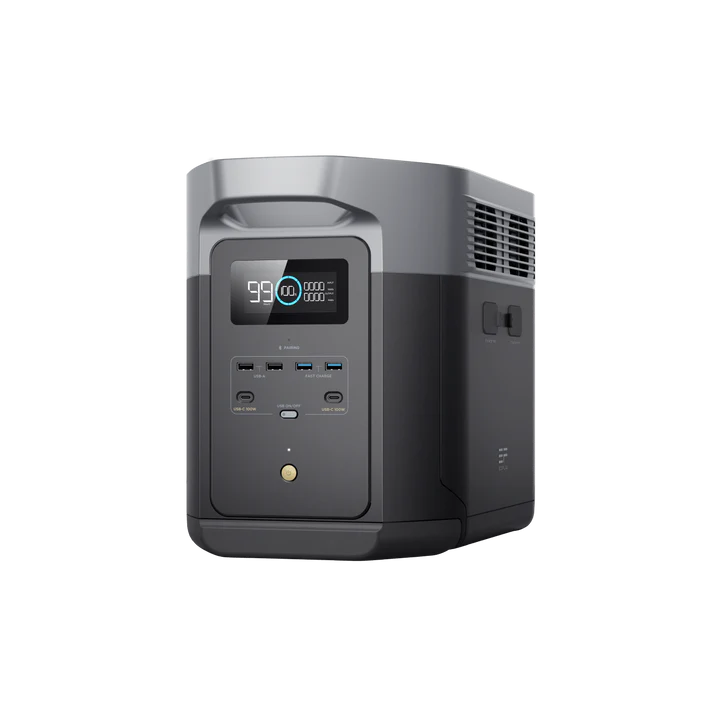
$1,049.00 · direct from EcoFlow
Last checked 1 day ago. Prices move — check before you buy.
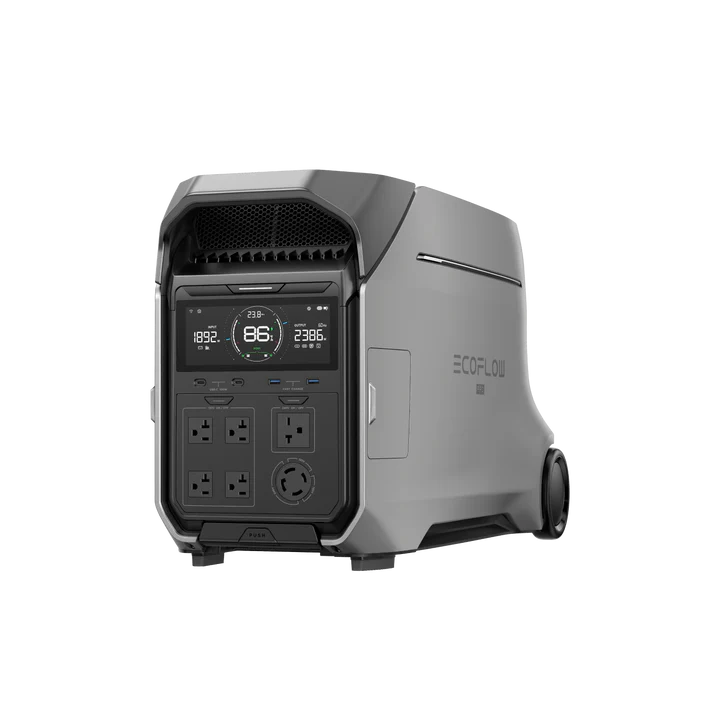
$2,799.00 · direct from EcoFlow
Last checked 1 day ago. Prices move — check before you buy.
Spec deltas
The EcoFlow DELTA Pro 3 wins every scenario on this page except the one where winning doesn't matter. At $2,799 against the DELTA 2 Max's $1,049 — a $1,750 gap — that sounds like the DELTA 2 Max's argument. It isn't. Both units cost the identical $0.15 per lifetime kilowatt-hour, so that $1,750 isn't buying a better deal. It's buying capacity, plain and simple.
Weight looks like it should flip that story. The DELTA 2 Max is 50.7 lbs, light enough for one person to muscle out of a trunk. The DELTA Pro 3 is 112.4 lbs, more than double, a genuine two-person or dolly job. But haul the light one to a weekend campout and you're the one improvising a recharge halfway through: that trip needs 2,100Wh, which is 121% of what the DELTA 2 Max holds, while the DELTA Pro 3 uses just 60% of its tank. Carry the heavier box once instead of babysitting the lighter one's battery icon all weekend.
The one real exception is an overnight CPAP. Both units clear it so far under capacity — 18% for the DELTA 2 Max, 9% for the DELTA Pro 3 — that it's a genuine coin flip, and the cheaper, lighter unit wins it on price. Outside that single scenario, this isn't close: pick based on how much power you'll actually draw, not on which box is easier to carry to the car.
What the Numbers Reveal
Each conclusion stated first — the numbers behind it on one line, the full analysis below.
rated cycles
That reframes the whole comparison. This isn't 'which one is the smarter buy' — they're economically identical per watt-hour. It's 'how much of that capacity will you actually draw,' and the DELTA 2 Max is already over its own tank (121%) on an ordinary camping weekend, the exact kind of trip these units get bought for.
DELTA 2 Max: $1,049, $0.15 cost per lifetime kWh across 6,144 total lifetime kWh (2,048Wh times 3,000 cycles)DELTA Pro 3: $2,799, $0.15 cost per lifetime kWh across 16,384 total lifetime kWh (4,096Wh times 4,000 cycles)Weekend Camping needs 2,100Wh: DELTA 2 Max uses 121% of capacity, DELTA Pro 3 uses 60%
Why it mattersAnyone comparing these two on value is asking the wrong question. Ask how many watt-hours your weekend actually needs, not which unit is the better deal — per kilowatt-hour, they're the same deal.
weight
Weight decides the walk from the trunk. Capacity decides the rest of the day. At Tailgate Party the DELTA 2 Max is left with 62% headroom (100 minus 38) against the DELTA Pro 3's 81% (100 minus 19) — the heavier box is the one you're not rationing.
DELTA 2 Max weighs 50.7 lbs, DELTA Pro 3 weighs 112.4 lbs — 61.7 lbs heavier (112.4 minus 50.7)Weekend Camping (needs 2,100Wh): DELTA 2 Max 121% of capacity, DELTA Pro 3 60%Tailgate Party (needs 670Wh): DELTA 2 Max 38%, DELTA Pro 3 19%
Why it mattersDon't pick the lighter unit for a trip where you'll actually draw real power all day. You're trading one easier carry for a dead battery partway through.
Neither number alone is disqualifying — 94% still clears the load, and 20ms is fast enough for most gear. But stacked together, the DELTA 2 Max gives you less energy margin and a slower handoff on the same outage, while the DELTA Pro 3 has room on both.
8-Hour Blackout needs 1,645Wh: DELTA 2 Max uses 94% of capacity, DELTA Pro 3 uses 47%DELTA 2 Max switches over in 20ms (standby), DELTA Pro 3 in 10ms (line-interactive)
Why it mattersIf the load includes anything you don't want to reboot mid-blackout — a desktop, a router, a medical device — weigh the margin and the switchover speed together, not separately. That combination favors the DELTA Pro 3.
At weekend use, the gap barely matters: 28.8 years against 38.5 years both outlive any reasonable ownership horizon. Cycle life only becomes a real differentiator for daily users, who'll actually approach those cycle counts before something else about the unit becomes the limiting factor.
DELTA 2 Max: 3,000 cycles, 8.2 years at daily use, 28.8 years at weekend useDELTA Pro 3: 4,000 cycles, 11 years at daily use, 38.5 years at weekend useBoth carry a 5-year warranty; cost per warranty year is $190 for the DELTA 2 Max, $480 for the DELTA Pro 3
Why it mattersDaily users should credit the DELTA Pro 3's extra years. Weekend or occasional users shouldn't pay $290 more per warranty year ($480 minus $190) for a durability gap they'll never approach.
The specific dimensions that decide these two units — everything else is a tie.
Lifetime Value
Selected because: Both cost the identical $0.15 per lifetime kWh, which removes 'value' as the deciding factor and reframes the $1,750 gap as pure capacity.
Sticker price: $1,049 for the DELTA 2 Max, $2,799 for the DELTA Pro 3, a $1,750 gap. Run the ownership math and the story changes completely. Both cost $0.15 per lifetime kilowatt-hour — the DELTA 2 Max across 6,144 total lifetime kWh (2,048Wh times 3,000 cycles), the DELTA Pro 3 across 16,384 (4,096Wh times 4,000 cycles). Per watt-hour delivered over the unit's life, they're the same product at a bigger scale.
Priced per warranty year, the gap reappears, because the warranty term is identical (5 years) but the price isn't: $190 a year for the DELTA 2 Max against $480 for the DELTA Pro 3. That's the honest way to describe the difference. Not 'the DELTA Pro 3 is a worse deal' — it costs $290 more a year for capacity you have to actually need.
Your Life, Your Pick
Selected because: DELTA Pro 3 wins every scenario where they differ, including camping and blackout scenarios the DELTA 2 Max literally can't finish; only CPAP ties and Van Life Daily beats both.
The DELTA Pro 3 wins every scenario where the two units differ. Weekend Camping needs 2,100Wh: 121% of the DELTA 2 Max's capacity, so it can't finish, against 60% for the DELTA Pro 3. The 8-Hour Blackout needs 1,645Wh — 94% for the DELTA 2 Max, real but tight, against 47% for the DELTA Pro 3. Remote Workday and Tailgate Party follow the same pattern: both units clear them, but the DELTA Pro 3 does it with roughly double the margin (26% against 52%, and 19% against 38%).
CPAP Overnight is the exception. 320Wh is 18% of the DELTA 2 Max and 9% of the DELTA Pro 3, trivial for either, which makes it a genuine tie — break it on price. Van Life Daily beats both outright at 269% and 135% of capacity. That's not a comparison between these two units; it's a sign you need more capacity than either offers standalone.
Portability & Form Factor
Selected because: 112.4 lbs vs 50.7 lbs looks like it should favor the DELTA 2 Max, but the scenario data shows the opposite — worth addressing head-on rather than letting the reader assume.
weight
50.7 lbs is below the point where most people ask for help lifting something out of a trunk. 112.4 lbs, more than double, is not — it's a two-person lift or a cart, no way around it. On that spec alone, the DELTA 2 Max is the easier unit to own.
But easier to carry and easier to own for a weekend aren't the same claim. The DELTA 2 Max needs 121% of its capacity to cover a 2,100Wh camping weekend; it can't finish the trip. The DELTA Pro 3 uses 60%. Carry the heavier box into the campsite once, and you're not the one recharging mid-weekend.
What the Specs Don't Tell You
Selected because: UPS speed and cycle life both add real, non-obvious support for the DELTA Pro 3; weight is the one flag that cuts the other way.
rated cycles
Four of the five flags on this pair point the same direction. The DELTA Pro 3 switches over in 10ms against the DELTA 2 Max's 20ms — both fast enough for most gear, but the margin costs nothing extra. It's rated for 4,000 cycles against 3,000, though at daily use that's only 2.8 more years (11 minus 8.2), a real but not enormous edge. Both carry an identical 5-year warranty, so the DELTA Pro 3's extra expected life sits entirely outside that term.
The one flag that cuts the other way is weight: 112.4 lbs is genuinely a commitment, and it's the honest asterisk on the DELTA Pro 3 pick. Surge headroom is a wash. The DELTA 2 Max clears 4,800W against its 2,400W rating (2.0 times) and the DELTA Pro 3 clears 6,000W against 4,000W (1.5 times) — different ratios, but both comfortably exceed the surge a compressor or motor pulls at startup. Neither is the one that fails to start your fridge.
Growth Path
Selected because: Neither base unit clears Van Life Daily (269%/135% of capacity needed), so expansion is load-bearing for that buyer, not optional — and the DELTA Pro 3's 2,000W solar ceiling is the stronger base to build from.
solar input
Both units accept EcoFlow's expansion batteries, so neither is a dead end. But the DELTA Pro 3's solar ceiling is 2,000W against the DELTA 2 Max's 1,000W, double the panels you can feed into it as the bank grows — the real difference in an off-grid build.
That matters most for the one scenario neither wins outright. Van Life Daily needs 4,685Wh, which is 269% of the DELTA 2 Max's capacity and 135% of the DELTA Pro 3's — both fail as single units. If that's your actual daily number, you're not choosing between these two as-is. You're choosing which one to build an expansion setup around, and the DELTA Pro 3's higher solar ceiling makes it the better base to expand from.
Strengths & trade-offs
EcoFlow DELTA 2 Max
Strengths
- +Costs $1,750 less
- +Lighter by 61.7 lb
Trade-offs
- –Weaker inverter (-1,600W) limits appliance compatibility.
- –Shorter-lived battery — rated for 3,000 charge cycles vs the DELTA Pro 3's 4,000, so it wears out sooner.
EcoFlow DELTA Pro 3
Strengths
- +Larger battery capacity
- +Higher AC output
- +Faster solar charging
- +Rated for 4,000 charge cycles — much longer battery lifespan
Trade-offs
- –Substantially more expensive (+$1,750) than the DELTA 2 Max.
- –Significantly heavier (+61.7 lbs), making it harder to move.
- –Very heavy unit that may be difficult for one person to lift.
Will It Power Your Gear?
Scenario math and per-appliance runtimes, modeled from the spec record.
Scenario verdicts
We ran the math on six real-world scenarios. Here's which unit survives your actual life.
SCN-01 · 2 nights · needs 2,100Wh
Weekend Camping
Two nights off-grid with essential comfort
Neither unit
A weekend needs 2,100Wh. That's 121% of the DELTA 2 Max's capacity — it can't finish the trip — against 60% for the DELTA Pro 3, which still has 40% left (100% minus the 60% used) when you pack up.
Battery budget usedlower = more headroom
LOAD Phone Charger 15W×6h · LED Lights 40W×8h · Box Fan 75W×14h · CPAP Machine 40W×16h
SCN-02 · 8 hours · needs 1,645Wh
8-Hour Blackout
Keep the essentials running through a night without power
DELTA Pro 3
1,645Wh is the ask. The DELTA 2 Max clears it, technically, but with only 6% of capacity to spare (94% used). The DELTA Pro 3 does the same eight hours at 47%, more than double the margin.
Battery budget usedlower = more headroom
LOAD Fridge 150W×8h · Router + Modem 20W×8h · LED Lights (4 bulbs) 40W×6h · Phone Charger 15W×3h
SCN-03 · 8 hours · needs 320Wh
CPAP Overnight
Sleep therapy without interruption — the #1 medical use case
Either unit
320Wh for a night is trivial for either unit — 18% of the DELTA 2 Max, 9% of the DELTA Pro 3. Call this one a genuine tie and decide it on price instead: the DELTA 2 Max costs $1,750 less for the same result here.
Battery budget usedlower = more headroom
LOAD CPAP Machine 40W×8h
SCN-04 · 8 hours · needs 910Wh
Remote Workday
Full work day off-grid without power anxiety
DELTA Pro 3
910Wh puts the DELTA 2 Max at 52% of capacity and the DELTA Pro 3 at 26%. Both finish the day; the DELTA Pro 3 just does it with double the cushion if the day runs long.
Battery budget usedlower = more headroom
LOAD Laptop 60W×8h · External Monitor 30W×8h · Router + Modem 20W×8h · Phone Charger 15W×2h
SCN-05 · 4 hours · needs 670Wh
Tailgate Party
Game day power for the crew
DELTA 2 Max
670Wh is 38% of the DELTA 2 Max and 19% of the DELTA Pro 3. Both make it through the afternoon — the DELTA Pro 3 just isn't watching the percentage while it does.
Battery budget usedlower = more headroom
LOAD Blender 400W×0.5h · LED TV (55") 80W×4h · Bluetooth Speaker 15W×4h · Phone Charger (×3) 45W×2h
SCN-06 · 24 hours · needs 4,685Wh
Van Life Daily
A full day of mobile living — the ultimate endurance test
Neither unit
4,685Wh a day is 269% of the DELTA 2 Max's capacity and 135% of the DELTA Pro 3's — both fail outright as standalone units. This is a job for an expansion battery setup, not a choice between these two on their own.
Battery budget usedlower = more headroom
LOAD Mini-Fridge 150W×24h · Laptop 60W×4h · Phone Charger 15W×3h · LED Lights 40W×5h · Fan 75W×8h
The Load Test
RUNTIME = (Wh × 0.85) ÷ LOAD
None of the scenarios above exactly yours? Build it. Toggle what you'd plug in; both units are tested against the combined draw.
Essentials
Comfort & Convenience
High-Draw Appliances
Test duration
8h
Continuous draw
205W
Projected runtime
For this load: DELTA Pro 3 runs 17h vs 8.5h.
$2,799 list · direct from EcoFlow
Modeled from the spec record — same math as the tables below. Methodology
Runtime by appliance
Real-world runtime estimates for common appliances, modeled at 85% inverter efficiency.¹
Essentials
The basics you need runningscale 0–232.1hComfort & Convenience
Makes off-grid life actually enjoyablescale 0–46.4hHigh-Draw Appliances
These reveal the real limitsscale 0–3.5h¹ Runtime = (capacity × 0.85) ÷ appliance watts. Within each group, all bars share one time scale (the group's longest runtime), so lengths are comparable across appliances; identical runtimes collapse into a single blue/orange bar. Actual runtime varies with battery age, temperature, and simultaneous loads — see methodology.
Conclusion
July 26, 2026
Verdict: the DELTA Pro 3, on Power Score margin
Buy the DELTA Pro 3 if your real use looks like a camping weekend, an extended blackout, a tailgate day, or a full remote workday — it wins every one of those scenarios, sometimes because the DELTA 2 Max can't finish the job at all (121% of capacity needed for a 2,100Wh camping weekend) and sometimes because it simply leaves more room to spare (19% used at a tailgate against 38%). It also switches over faster during an outage (10ms against 20ms) and is rated for 4,000 cycles against 3,000. None of that is a value argument: both units cost the identical $0.15 per lifetime kilowatt-hour, so the extra $1,750 and 61.7 lbs buy capacity and margin, not a discount you're missing by going smaller. If your heaviest real load is an overnight CPAP, skip the premium — both handle that scenario so far under capacity (18% against 9%) that it's a coin flip, and the DELTA 2 Max wins it on price alone.
Editor-assigned confidence, based on cited owner research and spec analysis.
List prices as of July 26, 2026. The links below open EcoFlow's current price.
$2,799.00 · direct from EcoFlow
Last checked 1 day ago. Prices move — check before you buy.
or check the DELTA 2 Max price$1,049.00 list
Written by Gunner Gustafson, Whole-Home Backup Tester · Station Arena Test Desk · Updated July 26, 2026
Measured Data
Benchmark scores and the full spec record, side by side.
Benchmark scores
Not rated for both units (minimum threshold unmet): UPS, CPAP, Tailgating, Apartment Balcony.
Full specifications
ᵈ Derived: price ÷ rated capacity. See the data behind our comparisons →
Comparison ToolAdd more power stations, side by sideOpen Tool →How these numbers are produced
Numeric verification
Every figure on this page traces to our spec database or arithmetic on it — no estimated numbers.
Owner claims
Statements about owner experience are cited to published reviews — see Sources & Research Notes below.
Runtime model
Runtime = (rated capacity × 0.85 inverter efficiency) ÷ device wattage. Solar recharge estimates assume panels deliver 70% of rated output. Cold weather, battery age, and stacked loads reduce real-world results.
Power Score
Computed from 14 published spec dimensions, weighted per use-case bench. Higher is better; a unit must meet a bench's minimum threshold to be rated.
See the full weight table and data sourcing on our methodology page →Class ranking (the star rating)
Each unit's star score is a category ranking, not customer reviews — no buyer opinions feed it. We score every station on size-independent quality (value, output, portability, endurance, ports, warranty, and more), then percentile-rank it against the other units in its capacity class, so a class-leading compact unit and a class-leading whole-home unit can both earn 5★. Here, DELTA 2 Max rates 3.8/5 (28th percentile of 26 Large-class units), and DELTA Pro 3 rates 4.0/5 (40th percentile of 16 Home Backup-class units).
How the class ranking is computed →Test Notes & Caveats
Hidden gotchas and advantages we spotted that you won't find on the product page.
112.4 lbs Is a Two-Person Job
The DELTA Pro 3 weighs 112.4 lbs against the DELTA 2 Max's 50.7 lbs — more than double, and past the point where most people move it alone. It's the one spec on this page that cuts against the DELTA Pro 3, and it's real: budget for a cart or a second set of hands, especially anywhere that isn't flat ground.
Both Clear Real Surge Loads, by Different Margins
The DELTA 2 Max clears 4,800W surge against its 2,400W rating (2.0 times); the DELTA Pro 3 clears 6,000W against 4,000W (1.5 times). Different ratios, but both comfortably exceed the startup surge of a typical fridge or AC compressor — neither is the one that fails to start your appliance.
Both Fast, One Faster
The DELTA Pro 3 switches over in 10ms (line-interactive) against the DELTA 2 Max's 20ms (standby). Both handoffs are quick enough that most connected electronics won't notice either one, but if you're running something genuinely sensitive, the margin costs nothing extra on the DELTA Pro 3.
Same Length, Different Yearly Cost
Both units carry an identical 5-year warranty. Spread the price over that term and it's $190 a year for the DELTA 2 Max against $480 for the DELTA Pro 3 — the same coverage window, a very different annual commitment.
More Cycles Matter Most If You Cycle Daily
The DELTA Pro 3 is rated for 4,000 cycles against the DELTA 2 Max's 3,000, which works out to 11 years of daily use against 8.2. At weekend use, the gap almost disappears — 38.5 years against 28.8 — both outlasting any realistic ownership horizon. Credit this spec only if you're actually cycling the battery daily.
Full record above — the Test Desk pick is the DELTA Pro 3.
Check DELTA Pro 3 price →or check the DELTA 2 Max priceOwnership Analysis
What happens after you buy — true cost of ownership, brand trust, and growth potential.
Lifetime value
Service lifeyears at one full cycle per day
Lifetime energy delivered
Cost per delivered kWh
│ warranty ends · Reaching the cycle rating means ~80% capacity remains — degraded, not dead.
Analyst note
Both units cost the same to own over their rated lives — $0.17/kWh each. Lifetime cost can't separate them, so decide on the sticker price and everything else.
Growth path
DELTA 2 Max
EXPANDABLESupports EcoFlow expansion batteries, so you can add capacity later without replacing the base unit — useful if your needs may climb past 2,048Wh.
Accepts up to 1,000W of solar. Enough for a serious multi-panel array.
Generous port selection supports complex multi-device setups.
Expansion batteries are EcoFlow-specific. You're investing in the EcoFlow ecosystem.
DELTA Pro 3
EXPANDABLESupports EcoFlow expansion batteries, so you can add capacity later without replacing the base unit — useful if your needs may climb past 4,096Wh.
Accepts up to 2,000W of solar. Enough for a serious multi-panel array.
Generous port selection supports complex multi-device setups.
Expansion batteries are EcoFlow-specific. You're investing in the EcoFlow ecosystem.
Realistic full solar rechargeat 70% of rated panel output — see methodology
Analyst note
Both expand, but the DELTA Pro 3's higher solar ceiling (2,000W vs 1,000W) gives it the stronger off-grid growth path — more panels can feed a bigger bank as it grows.
What Owners Report
Patterns from published owner reports and long-term reviews — every claim cited to its source below.
EcoFlow DELTA 2 Max
The recurring complaint on the DELTA 2 Max is fan noise. Owners report it can climb to around 52dB under heavy load or while charging, loud enough that reviewers recommend Quiet Charging mode — which trims noise by extending charge time — and giving it six inches of clearance for airflowA1. AC charging itself is genuinely fast: 0 to 80% in about 50 minutesA2.
On durability, six months of real use turned up no structural degradation, consistent with its 3,000-cycle LiFePO4 ratingA3. The overall read from coverage is a still-worth-buying, versatile unit with real caveats rather than a dudA4 — the noise complaint is the one to plan around, not a dealbreaker.
“Fast AC wall charging — 0 to 80% in about 50 minutes and a full charge in roughly 80 minutes.”
Sources
powerstationadvisor.com · pcworld.com · thesolarlab.com · protoolsadvisor.com · trailandkale.com
EcoFlow DELTA Pro 3
Coverage of the DELTA Pro 3 mostly confirms the spec sheet rather than surfacing new complaints: 4,096Wh, 4,000W continuous (6,000W with X-Boost), dual-voltage 120V/240V output, expandable to 48kWhB1. Charging is fast in practice too: 0 to 80% in about 50 minutes using up to 7,000W of inputB3.
What's notably absent is any fan-noise complaint parallel to the DELTA 2 Max's; reviewers call it a gold-standard whole-home backup unit for 2026 without flagging noise at allB4. Treat that as thinner field data rather than a clean bill of healthB1B4 — there just isn't the same volume of lived-in reporting on this unit yet.
“4,096Wh LFP battery with 4,000W continuous AC output (6,000W with X-Boost) and dual-voltage 120V/240V, expandable to 48kWh.”
Sources
ecoflow.com · amazon.com · homedepot.com · thepowerpick.com · outboundpower.com · techradar.com · thesolarlab.com
Sources & Research Notes
Every owner claim in this report is traceable to a published source. The bracketed references above resolve here.
Recurring owner themes
- Solid LFP durability, fast charging, and ecosystem/expandability are the praise; loud fans under heavy load or charging are the recurring complaint. [DELTA 2 Max · 3 entries]
- Huge 4,096Wh LFP capacity, 4,000W dual-voltage output, very fast charging, and big expandability are the standout praise; it's heavy at ~113 lbs. [DELTA Pro 3 · 2 entries]
- A1
“Fan noise is a significant issue — cooling fans can get loud, around 52 dB during heavy loads or charging; a Quiet Charging mode reduces noise but extends charge time, and giving it 6 inches of clearance helps airflow.”
powerstationadvisor.com / pcworld.com — DELTA 2 Max review · 2025-2026 · [negative]
- A2
“Fast AC wall charging — 0 to 80% in about 50 minutes and a full charge in roughly 80 minutes.”
thesolarlab.com / protoolsadvisor.com — DELTA 2 Max review · 2025-2026 · [positive]
- A3
“LiFePO4 chemistry rated for 3,000+ cycles to 80% with superior thermal stability; after 6 months of real use there was no structural degradation and it felt as solid as day one.”
powerstationadvisor.com / trailandkale.com — DELTA 2 Max review · 2025-2026 · [positive]
- A4
“Reviewers say it's still worth buying but with caveats — a versatile unit with expandability and ecosystem compatibility.”
thesolarlab.com / powerstationadvisor.com — DELTA 2 Max review · 2025-2026 · [mixed]
- B1
“4,096Wh LFP battery with 4,000W continuous AC output (6,000W with X-Boost) and dual-voltage 120V/240V, expandable to 48kWh.”
ecoflow.com / amazon.com — DELTA Pro 3 · 2026 · [positive]
- B3
“Multi-charge technology reaches 0-80% in about 50 minutes using up to 7,000W input, with a full charge in roughly 90 minutes; up to 2,600W solar.”
outboundpower.com / techradar.com — DELTA Pro 3 review · 2026 · [positive]
- B4
“Weighs about 113.5 lbs; reviewers call it a gold-standard whole-home backup unit for 2026.”
techradar.com / thesolarlab.com — DELTA Pro 3 review · 2026 · [positive]
Research compiled July 26, 2026.
What Owners Actually Report
Drawn from 105 comments on independent review channels — not from retailer reviews, which skew to the first week of ownership. Each line is our summary of one commenter's claim, linked to the original. We record what they said, including where it contradicts the spec sheet.
EcoFlow DELTA 2 Max
74 claims from 55 comments · 60 from owners · 20 with figures
- Runtime
- 13 · 0% negative
- Solar input
- 10 · 20% negative
- Price & value
- 11 · 45% negative
- Expandability
- 8 · 15% negative
- Noise
- 5 · 58% negative
What owners complain about
Its own MPPT is limited to a mere 60 VOC from solar panels.
Solar inputmeasuredowner19 agreedsource →
Delta 2 Max is promised at 30 dB but measured 42 dB in his hands.
Noisemeasuredowner5 agreedsource →
Got a 5kWh rival for less than he paid for a DELTA 2 Max with extra battery.
Price & valueowner17 agreedsource →
What owners praise
Feeding his lead-acid UPS from it stretches desktop runtime from 8 minutes to 4 hours.
Runtimemeasuredowner8 agreedsource →
Bought the Delta 2 Max for $899 on Black Friday; the Delta 2 was $399.
Price & valuemeasuredowner21 agreedsource →
Takes 500-1000W from a DIY 48V bank over XT60i, far cheaper than the official spare battery.
Expandabilitymeasuredowner19 agreedsource →
EcoFlow DELTA Pro 3
74 claims from 50 comments · 50 from owners · 22 with figures
- Charging
- 8 · 30% negative
- Runtime
- 7 · 0% negative
- Price & value
- 11 · 3% negative
- Expandability
- 7 · 97% negative
- Warranty & support
- 8 · 69% negative
What owners complain about
His DP3 can only charge from an external 120V source while outputting 240V.
Chargingowner7 agreedsource →
At almost 120 lb he would not call the DP3 portable.
Size & weightmeasuredowner3 agreedsource →
Regrets buying the DP3 over the F3800 because it lacks 240V passthrough.
Expandabilityowner4 agreedsource →
What owners praise
Recharges in about 70 minutes at 3400W from a 240V generator inlet.
Chargingmeasuredowner57 agreedsource →
Ran lights, fans, modem, fridge and a 1300W air conditioner through a 5-day hurricane outage.
Runtimemeasuredowner30 agreedsource →
Costco sells a DELTA Pro 3 twin pack at $4,999, dropping to $4,499 on sale.
Price & valuemeasuredowner6 agreedsource →
Claims are weighted by how specific they are, whether the commenter owns the unit, and how many readers agreed. Comments that mention a product under a rival's review count for more, because the commenter had no reason to be there. This is what buyers report, not our test results — for measurements we ran ourselves, see the methodology.
Who Should Buy Which
Buy the DELTA 2 Max if you…
- →Your heaviest real load is an overnight CPAP or light remote work under half capacity. Both units clear those with room to spare, so save $1,750 and carry 61.7 lbs less.
- →You want the lighter, one-person-liftable unit — 50.7 lbs against 112.4 — and your trips don't push past a few hundred watt-hours at a time.
Buy the DELTA Pro 3 if you…
- →You actually camp for a weekend, ride out a real multi-hour blackout, or run a full tailgate day. The DELTA 2 Max can't finish a 2,100Wh camping weekend (121% of capacity); the DELTA Pro 3 covers it at 60%.
- →You want faster switchover for sensitive electronics (10ms against 20ms) or more years of daily-use life (11 against 8.2), and you're fine carrying 112.4 lbs and paying the $1,750 premium in exchange.
If neither fits
If your real number is Van Life Daily's 4,685Wh, neither wins: that's 269% of the DELTA 2 Max's capacity and 135% of the DELTA Pro 3's, so both fail as standalone units. That's not a case for choosing between these two — it's a case for building an expansion setup around whichever you pick, or looking at a bigger base unit entirely.
The Bottom Line
These two cost the identical $0.15 per lifetime kilowatt-hour, so the $1,750 between them ($2,799 minus $1,049) isn't buying a better deal. It's buying capacity you either need or don't. The DELTA Pro 3 wins every scenario where that capacity gets tested: it's the only one of the two that finishes a 2,100Wh camping weekend without exceeding its own tank, and it clears the same 8-hour blackout at 47% of capacity against the DELTA 2 Max's tight 94%.
Buy the DELTA Pro 3 if your real use looks like any of that, and budget for its 112.4 lbs. Buy the DELTA 2 Max if the heaviest thing you're powering is an overnight CPAP — both clear that scenario so far under capacity it's a coin flip, and there's no reason to pay $1,750 extra to win a tie.
Frequently Asked Questions
Answers drawn from the spec record and cited owner research.
Is the EcoFlow DELTA Pro 3 worth $1,750 more than the DELTA 2 Max?
If your use is real camping weekends, blackouts, or tailgate days, yes — it wins every one of those scenarios, and in one case (Weekend Camping) the DELTA 2 Max literally can't finish the trip at 121% of its capacity. If your heaviest load is an overnight CPAP, no: both handle that at under a fifth of capacity, so save the $1,750.
Can the EcoFlow DELTA 2 Max power a full weekend of camping?
Not comfortably. A typical camping weekend needs 2,100Wh, which is 121% of the DELTA 2 Max's 2,048Wh capacity — it runs out before the trip's over. The DELTA Pro 3 covers the same weekend using 60% of its capacity.
How much heavier is the DELTA Pro 3 than the DELTA 2 Max?
61.7 lbs heavier — 112.4 lbs against 50.7 lbs (112.4 minus 50.7). That's the difference between a one-person lift and a genuine two-person or cart job.
Do the DELTA 2 Max and DELTA Pro 3 both support expansion batteries?
Yes, both accept EcoFlow expansion batteries. The DELTA Pro 3 has the stronger practical growth path, though, with a 2,000W solar ceiling against the DELTA 2 Max's 1,000W — useful if you're building toward a bigger off-grid setup.
Which EcoFlow unit is better for CPAP backup?
Functionally, it's a tie. An overnight CPAP needs about 320Wh — 18% of the DELTA 2 Max's capacity and 9% of the DELTA Pro 3's, trivial for either. Buy the DELTA 2 Max for this use case specifically; it's $1,750 cheaper for identical results.
Where to buy
EcoFlow DELTA 2 Max
$1,049.00
$1,049.00 · direct from EcoFlow
Last checked 1 day ago. Prices move — check before you buy.
EcoFlow DELTA Pro 3Pick
$2,799.00
$2,799.00 · direct from EcoFlow
Last checked 1 day ago. Prices move — check before you buy.
Prices may vary by retailer and are subject to change.