Head-to-head test
DJI Power 500 vs Goal Zero Yeti 700
Same 4,000-cycle battery on both, but the Power 500 costs $401 less, sustains double the continuous output, and refills from the sun in half the time — the Yeti 700's extra 165Wh can't buy its way past that.
Full profiles: DJI Power 500 → · Goal Zero Yeti 700 →

Written by Wenny ZhengUpdated
Portable Power Tester, Station Arena Test Desk

$299.00 · direct from DJI
Last checked 1 day ago. Prices move — check before you buy.
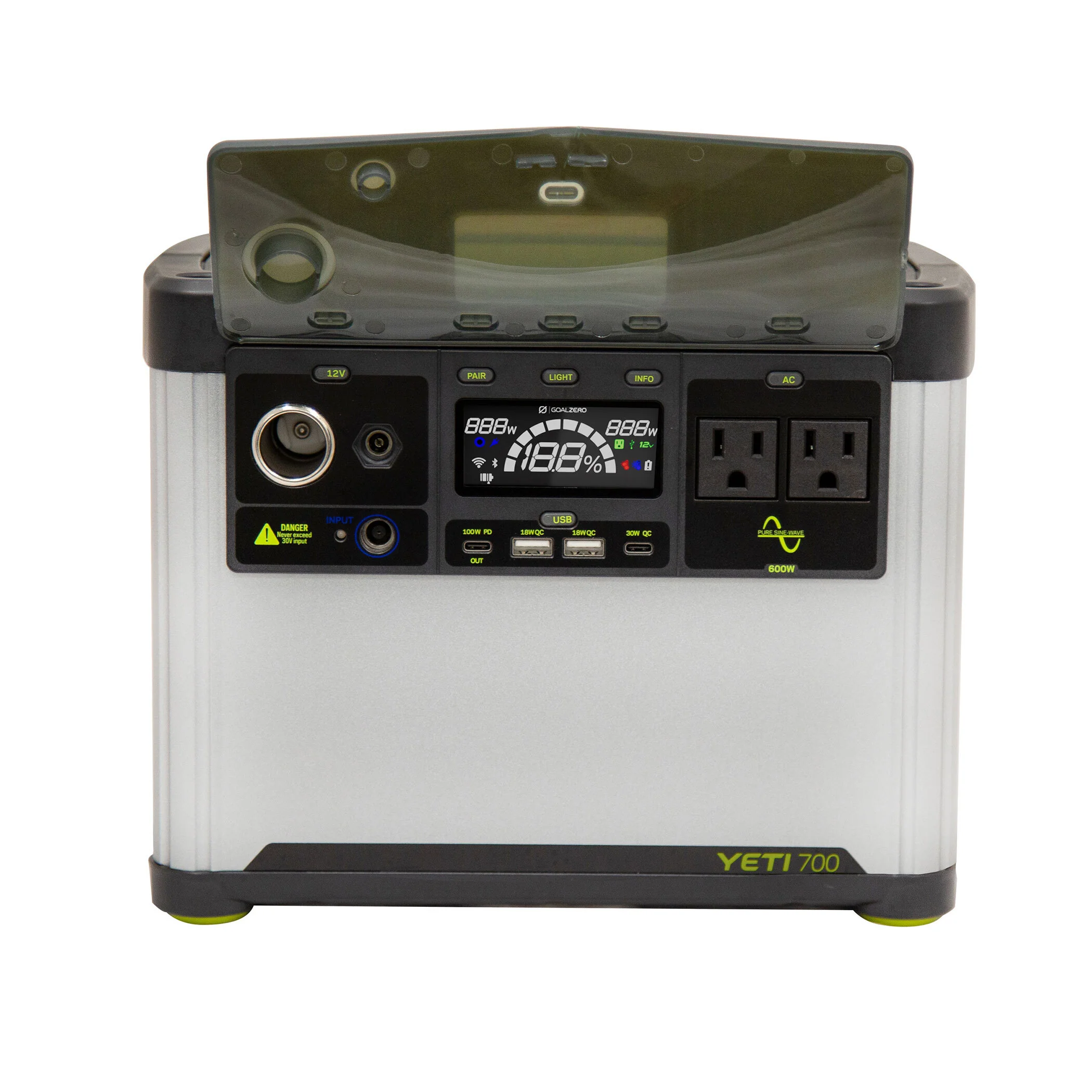
$699.95 · direct from Goal Zero
Last checked 1 day ago. Prices move — check before you buy.
Spec deltas
The Yeti 700 costs $401 more than the DJI Power 500 and gives you 165 extra watt-hours for it — 677Wh against 512Wh. That's the entire case for the more expensive unit, and it's a thin one.
Because on output, the Power 500 doubles it: 1,000W continuous against the Yeti's 600W. It refills faster too, 300W of solar input against 200W, so the smaller tank tops up quicker than the bigger one. And it's the only one of the two that publishes a noise rating at all — 25dB, versus a Yeti 700 that leaves the number blank.
The Yeti keeps two honest advantages worth naming up front: its inverter surges to 1,000W from a 600W baseline, real motor-starting headroom the DJI doesn't have, and it switches to battery in 10 milliseconds against the DJI's 20. Both are true. Neither is worth $401 on a unit that otherwise trails on capacity-per-dollar, output, solar, and noise.
What the Numbers Reveal
Each conclusion stated first — the numbers behind it on one line, the full analysis below.
Capacity
Spread across the 5-year warranty, that gap reads as $140 a year of ownership for the Yeti against $72 for the Power 500 — you're paying nearly double per covered year for a fifth more capacity you may never fully use, since both units fall short of every multi-hour job anyway.
Power 500: $299 for 512Wh on a 4,000-cycle batteryYeti 700: $700 for 677Wh on the same 4,000-cycle rating
Why it mattersA buyer choosing on price-per-watt-hour should stop here and take the DJI. The Yeti's capacity edge is real but small, and the premium attached to it isn't.
continuous output
For a load that draws hard and stays there — a 900W kettle, a microwave — the Power 500 sustains it and the Yeti, over its 600W continuous ceiling, can't. But for a fridge or pump that spikes at startup then settles low, the Yeti's 1.7× surge headroom is exactly the cushion the flat 1×-ratio DJI lacks.
Power 500: 1,000W continuous, 1,000W surge (a 1× ratio)Yeti 700: 600W continuous, 1,000W surge (a 1.7× ratio)
Why it mattersSustained high draws favor the DJI outright; motor-driven loads that surge-then-idle are the one place the Yeti's inverter earns its keep.
solar input
In the multi-day outage these units are actually bought for, recharge speed is a survival spec, not a convenience one — the DJI reclaims a full charge in a single good solar window and the Yeti is still drinking through a narrower straw well into the afternoon.
Power 500: 300W solar input on a 512Wh batteryYeti 700: 200W solar input on a 677Wh battery
Why it mattersAnyone leaning on solar during an outage should weight the DJI's input ceiling heavily; a camper with a wall outlet nearby won't feel it.
The specific dimensions that decide these two units — everything else is a tie.
Lifetime Value
Selected because: the Yeti costs $401 more and comes out costlier per lifetime kWh and per warranty year — the decisive axis
cost / lifetime kWh
Eighteen cents a lifetime kilowatt-hour for the Power 500 against twenty-six for the Yeti 700 — and unlike most value gaps, this one isn't built on a fantasy cycle horizon, because both batteries carry the same 4,000-cycle rating. The DJI is cheaper per unit of energy purely because it costs $401 less to buy.
Framed over the warranty you'll actually reach, it's $72 a year of coverage against $140. The Yeti's 165Wh of extra capacity is the only thing that money buys, and on units that both fall short of a real weekend or a real blackout, that reserve rarely gets spent.
PowerScore Breakdown
Selected because: double the continuous output on the cheaper unit; the surge-ratio nuance belongs here too
overall power score
The Power 500 sustains 1,000W where the Yeti sustains 600W, and that single number reshapes what each can actually run: a kettle, a small microwave, a heat gun all sit in the Power 500's comfort zone and above the Yeti's continuous ceiling.
Credit where it's due, though — the Yeti's inverter has the more flexible surge profile, bursting to 1,000W from its 600W base. If your loads are motors that spike and settle rather than resistive draws that just sit heavy, that headroom is the Yeti's real answer to the output gap.
What the Specs Don't Tell You
Selected because: surge ratio and UPS speed favor the Yeti, warranty and noise disclosure favor the DJI — an honest split
This is the fair-fight section, and it splits. The Yeti takes two flags: a higher surge-to-continuous ratio for starting motors, and a 10-millisecond switchover against the DJI's 20 — quicker protection for a desktop or router riding through a blip.
The DJI takes the other two, and they're the ones with dollars attached: nearly twice the warranty coverage per dollar spent, and an actual published noise number. Goal Zero doesn't disclose one for the Yeti 700, and brands that stay quiet about loudness are rarely quiet units.
Brand Trust
Selected because: DJI's newness versus Goal Zero's declining support and shuttered forums is material on a $350-700 buy
Goal Zero is the pioneer of this category and still the name overlanders trust, with a US base in Salt Lake City and IPX4-rugged hardware. But 2025-2026 has been rough on that reputation: support tickets going weeks unanswered, and the official community forums quietly shuttered, which stung long-time owners.
DJI is the newcomer, roughly two years into power stations with no dedicated community yet — but it inherits a global repair network built for its drone business, and it's innovating faster. Neither history is disqualifying. If US-based heritage and weatherproofing matter most, the Yeti still means something; if you want the more current engineering, the DJI is where the momentum is.
Strengths & trade-offs
DJI Power 500
Strengths
- +Costs $401 less
- +Lighter by 4.2 lb
- +Higher AC output
- +Faster solar charging
Trade-offs
- –No major technical downsides compared to rival.
Goal Zero Yeti 700
Strengths
- +Larger battery capacity
Trade-offs
- –Substantially more expensive (+$401) than the Power 500.
Will It Power Your Gear?
Scenario math and per-appliance runtimes, modeled from the spec record.
Scenario verdicts
We ran the math on six real-world scenarios. Here's which unit survives your actual life.
SCN-01 · 2 nights · needs 2,100Wh
Weekend Camping
Two nights off-grid with essential comfort
Neither unit
Neither unit covers this scenario's 2,100Wh: the Power 500 comes up 1,665Wh short (about 21% covered), the Yeti 700 1,525Wh (27%). This is well outside what either unit is for; the right answer here is a larger station, not a choice between these two.
Battery budget usedlower = more headroom
LOAD Phone Charger 15W×6h · LED Lights 40W×8h · Box Fan 75W×14h · CPAP Machine 40W×16h
SCN-02 · 8 hours · needs 1,645Wh
8-Hour Blackout
Keep the essentials running through a night without power
Neither unit
Neither unit covers this scenario's 1,645Wh: the Power 500 comes up 1,210Wh short (about 26% covered), the Yeti 700 1,070Wh (35%). Treat this as partial cover — enough for the essentials in it, not the whole list.
Battery budget usedlower = more headroom
LOAD Fridge 150W×8h · Router + Modem 20W×8h · LED Lights (4 bulbs) 40W×6h · Phone Charger 15W×3h
SCN-03 · 8 hours · needs 320Wh
CPAP Overnight
Sleep therapy without interruption — the #1 medical use case
Either unit
Both clear a CPAP night with room to spare — the Yeti's larger tank simply leaves more in reserve by sunrise. But this is the load you sleep two feet from, and the Power 500 is the only one here with a published 25dB rating. The Yeti's noise is undisclosed, and at that distance an unknown fan matters more than a bigger battery you won't drain.
Battery budget usedlower = more headroom
LOAD CPAP Machine 40W×8h
SCN-04 · 8 hours · needs 910Wh
Remote Workday
Full work day off-grid without power anxiety
Neither unit
Neither unit covers this scenario's 910Wh: the Power 500 comes up 475Wh short (about 48% covered), the Yeti 700 335Wh (63%). Treat this as partial cover — enough for the essentials in it, not the whole list.
Battery budget usedlower = more headroom
LOAD Laptop 60W×8h · External Monitor 30W×8h · Router + Modem 20W×8h · Phone Charger 15W×2h
SCN-05 · 4 hours · needs 670Wh
Tailgate Party
Game day power for the crew
Neither unit
Neither unit covers this scenario's 670Wh: the Power 500 comes up 235Wh short (about 65% covered), the Yeti 700 95Wh (86%) (its nameplate 677Wh actually clears this — the flat 15% conversion allowance is what tips it under). Either gets you most of the way, so this is a scenario you plan around rather than one you should rule them out for.
Battery budget usedlower = more headroom
LOAD Blender 400W×0.5h · LED TV (55") 80W×4h · Bluetooth Speaker 15W×4h · Phone Charger (×3) 45W×2h
SCN-06 · 24 hours · needs 4,685Wh
Van Life Daily
A full day of mobile living — the ultimate endurance test
Neither unit
Neither unit covers this scenario's 4,685Wh: the Power 500 comes up 4,250Wh short (about 9% covered), the Yeti 700 4,110Wh (12%). This is well outside what either unit is for; the right answer here is a larger station, not a choice between these two.
Battery budget usedlower = more headroom
LOAD Mini-Fridge 150W×24h · Laptop 60W×4h · Phone Charger 15W×3h · LED Lights 40W×5h · Fan 75W×8h
The Load Test
RUNTIME = (Wh × 0.85) ÷ LOAD
None of the scenarios above exactly yours? Build it. Toggle what you'd plug in; both units are tested against the combined draw.
Essentials
Comfort & Convenience
High-Draw Appliances
Test duration
8h
Continuous draw
205W
Projected runtime
For this load: Yeti 700 runs 2.8h vs 2.1h.
$699.95 list · direct from Goal Zero
Modeled from the spec record — same math as the tables below. Methodology
Runtime by appliance
Real-world runtime estimates for common appliances, modeled at 85% inverter efficiency.¹
Essentials
The basics you need runningscale 0–38.4hComfort & Convenience
Makes off-grid life actually enjoyablescale 0–7.7hHigh-Draw Appliances
These reveal the real limitsscale 0–0.4h¹ Runtime = (capacity × 0.85) ÷ appliance watts. Within each group, all bars share one time scale (the group's longest runtime), so lengths are comparable across appliances; identical runtimes collapse into a single blue/orange bar. Actual runtime varies with battery age, temperature, and simultaneous loads — see methodology.
Conclusion
July 16, 2026
Verdict: the Power 500
The Yeti 700 asks $700 against the Power 500's $299 and hands you 165 more watt-hours for the $401 gap — that's it. On everything else the cheaper unit is the stronger one: 1,000W of continuous output against 600W, 300W of solar input against 200W, a published 25dB noise figure against a Yeti that discloses none, and a lower cost per lifetime kilowatt-hour. The Yeti isn't without cards — its inverter carries real surge headroom the DJI lacks, and its switchover is twice as quick. But neither closes a $401 price gap on a unit that also does more. Take the Power 500 unless you specifically need the Yeti's weatherproof shell or its surge-friendly inverter.
Editor-assigned confidence, based on cited owner research and spec analysis.
List prices as of July 16, 2026. The links below open DJI's and Goal Zero's current prices.
$299.00 · direct from DJI
Last checked 1 day ago. Prices move — check before you buy.
or check the Yeti 700 price$699.95 list
Written by Wenny Zheng, Portable Power Tester · Station Arena Test Desk · Updated July 16, 2026
Measured Data
Benchmark scores and the full spec record, side by side.
Benchmark scores
Full specifications
ᵈ Derived: price ÷ rated capacity. See the data behind our comparisons →
Comparison ToolAdd more power stations, side by sideOpen Tool →How these numbers are produced
Numeric verification
Every figure on this page traces to our spec database or arithmetic on it — no estimated numbers.
Owner claims
Statements about owner experience are cited to published reviews — see Sources & Research Notes below.
Runtime model
Runtime = (rated capacity × 0.85 inverter efficiency) ÷ device wattage. Solar recharge estimates assume panels deliver 70% of rated output. Cold weather, battery age, and stacked loads reduce real-world results.
Power Score
Computed from 14 published spec dimensions, weighted per use-case bench. Higher is better; a unit must meet a bench's minimum threshold to be rated.
See the full weight table and data sourcing on our methodology page →Class ranking (the star rating)
Each unit's star score is a category ranking, not customer reviews — no buyer opinions feed it. We score every station on size-independent quality (value, output, portability, endurance, ports, warranty, and more), then percentile-rank it against the other units in its capacity class, so a class-leading compact unit and a class-leading whole-home unit can both earn 5★. Here, Power 500 rates 4.6/5 (74th percentile of 20 Compact-class units), and Yeti 700 rates 3.6/5 (16th percentile of 20 Compact-class units).
How the class ranking is computed →Test Notes & Caveats
Hidden gotchas and advantages we spotted that you won't find on the product page.
The Yeti's Inverter Has the Headroom Here
The Yeti 700 surges to 1,000W from a 600W continuous base — a 1.7x ratio that helps start fridges and pumps that spike at power-on. The Power 500 rates 1,000W both continuous and surge, a flat 1x, so it sustains more but bursts no higher than it already runs. For motor startup, the Yeti is the more forgiving of the two.
Nearly Double the Coverage Per Dollar
Same 5-year warranty on both, but the Power 500's lower price makes it $72 per covered year against the Yeti's $140. You're buying the same protection for roughly half the annual cost.
Only One of These Tells You How Loud It Is
The Power 500 publishes 25dB. The Yeti 700 lists no noise figure at all. If it's running near a bed or a desk, that missing number is a real unknown — and rarely a flattering one.
Full record above — the Test Desk pick is the Power 500.
Check Power 500 price →or check the Yeti 700 priceOwnership Analysis
What happens after you buy — true cost of ownership, brand trust, and growth potential.
Lifetime value
Service lifeyears at one full cycle per day
Lifetime energy delivered
Cost per delivered kWh
│ warranty ends · Reaching the cycle rating means ~80% capacity remains — degraded, not dead.
Analyst note
The Power 500 wins on both sticker price and long-term value. At $0.15/kWh over its lifetime, it's meaningfully cheaper to own. Clear value winner. One thing to know reading the table: both carry the same 4,000-cycle rating, so the lifetime rows are sticker price and capacity in disguise — the wear horizon is identical and decides nothing here.
Delivers each lifetime kWh for $0.11 less — check the Power 500 price →
Brand trust
DJI
Ecosystem
New entrant (2024) — five power station models to date: Power 500, Power 1000 (since superseded by the V2 but still sold), Power 1000 V2, Power 1000 Mini, Power 2000. Buying a "Power 1000" listing? Check which revision it actually ships.
Support
Leveraging DJI's established global support and repair center network from the drone business. Generally positive reputation inherited from drone operations, but limited power-station-specific track record.
Community
No dedicated power station community yet. Discussions happen within r/dji (~250K members, mostly drone users). Very small power-specific presence on Facebook and forums.
App experience
Rated 3.5/5 iOS and Android (DJI Home app ratings reflect entire DJI ecosystem including drones/cameras, not power-station-specific). Users report the on-device screen is more reliable than the app.
Unique strength
DJI brings hundreds of battery patents from its drone business, builds some of the quietest units in the category, and backs them with a global repair network already in place.
Worth knowing
It's only about two years into power stations, with no dedicated owner community yet and no expansion-battery ecosystem across its four models.
Goal Zero
Ecosystem
Focused — a compact current line (6th-gen Yeti and Yeti Pro series), the previous-gen X series now out of stock across every model on Goal Zero's own store (checked 2026-09-13: 200X, 500X, 1000X, 1500X, 3000X, 6000X, some listed only as open-box), so buying one new means finding retailer stock, Sherpa power banks for the under-100Wh tier, plus Alta coolers, Nomad/Ranger solar panels, and vehicle integration kits
Support
US-based company (Salt Lake City, owned by NRG Energy). Historically considered premium support, but 2025-2026 reports describe long wait times, unresponsive email communication, and tickets going unaddressed for weeks. The "premium support justifies premium pricing" argument is weakening.
Community
Small but loyal — strong following in overlanding and preparedness communities. Official community forums were recently shuttered, frustrating long-time users.
App experience
Rated 4.4/5 iOS (~1,200 ratings) but recent reviews skew negative — recurring connectivity issues, crashes, and stability problems.
Unique strength
Goal Zero is the category's pioneer, US-based, with genuinely rugged IPX4 hardware and a loyal overlanding following.
Worth knowing
Support quality has slid in 2025-2026 — long waits, unanswered tickets — and the official community forums were recently shuttered.
Analyst note
Goal Zero is the heritage pick with weatherproofing to match; DJI is the newer, faster-moving engineering backed by a large parent company's repair infrastructure. On a purchase this size, the DJI's momentum outweighs the Yeti's history for most buyers.
Growth path
Power 500
FIXED CAPACITYFixed at 512Wh, with no expansion — so size it for your needs up front rather than planning to add capacity later.
Accepts up to 300W of solar. Limited to a single portable panel.
Adequate ports for most setups, but heavy users may want a power strip.
Yeti 700
FIXED CAPACITYFixed at 677Wh, with no expansion — so size it for your needs up front rather than planning to add capacity later.
Accepts up to 200W of solar. Limited to a single portable panel.
Adequate ports for most setups, but heavy users may want a power strip.
Realistic full solar rechargeat 70% of rated panel output — see methodology
Analyst note
Neither expands, and that's no knock on either — each is a complete unit at a fixed size. Buy the capacity that covers your needs now (the Yeti 700 gives you the larger ceiling); you can't add to either later.
What Owners Report
Patterns from published owner reports and long-term reviews — every claim cited to its source below.
DJI Power 500
In testing the Power 500 ran a 905W load and briefly rode out a 1,500W spike above its own 1,000W rating, and reviewers found it more efficient than DJI's larger Power 1000A3. Its automotive-grade LFP cells are rated for 3,000 to 4,000 cycles, roughly a decade of everyday useA1, and at 16.1 lbs it's a comfortable one-hand carry out to the campsiteA2. The one honest gap: it ships with just a wall plug — no solar adapter, no car-charging cable in the box — so budget for those separately if you're not charging from an outletA4.
“A 512Wh LFP battery with up to 1,000W output; the automotive-grade LFP cells are rated up to 3,000-4,000 cycles for roughly a 10-year lifespan.”
Sources
dji.com · thesolarlab.com · techradar.com · views-sounds.com · t3.com
Goal Zero Yeti 700
The Yeti 700 is Goal Zero's 6th-generation compact unit: 677Wh of LiFePO4 rated for 4,000-plus cycles, good for daily use past ten yearsB1, wrapped in an IPX4 water-resistant shell built to take weather most units can'tB2. Field reviews frame it honestly as a quick-trip, device-charging companion — light and simple rather than powerfulB3. Nobody's calling it a workhorse, and Goal Zero publishes no noise figure for it, which is worth knowing before you set it next to where you sleep.
“A 6th-generation 677Wh compact power station on upgraded LiFePO4 chemistry rated for 4,000+ cycles — daily use for over 10 years.”
Sources
goalzero.com · amazon.com · campingsolar.us · outdoorgearlab.com
Sources & Research Notes
Every owner claim in this report is traceable to a published source. The bracketed references above resolve here.
Recurring owner themes
- Light, efficient LFP unit with strong real-world output and drone-pilot appeal; the caveat is minimal included accessories. [Power 500 · 3 entries]
- Modern LFP (4,000+ cycles), IPX4 ruggedness, and light, simple portability are the highlights; modest power and capacity. [Yeti 700 · 3 entries]
- A1
“A 512Wh LFP battery with up to 1,000W output; the automotive-grade LFP cells are rated up to 3,000-4,000 cycles for roughly a 10-year lifespan.”
dji.com / thesolarlab.com — Power 500 review · 2026 · [positive]
- A2
“Weighs only about 7.3 kg, making it easy to transport.”
dji.com / techradar.com — Power 500 review · 2026 · [positive]
- A3
“In testing it ran a 905W load and briefly handled a 1,500W surge above its 1,000W rating; reviewers found it outperformed the larger DJI Power 1000 in efficiency testing.”
thesolarlab.com / views-sounds.com — Power 500 review · 2026 · [positive]
- A4
“Reviews are positive overall, though one noted it ships with only a wall plug — no solar adapters or car-charging cables included.”
t3.com / techradar.com — Power 500 review · 2026 · [mixed]
- B1
“A 6th-generation 677Wh compact power station on upgraded LiFePO4 chemistry rated for 4,000+ cycles — daily use for over 10 years.”
goalzero.com / amazon.com — Yeti 700 · 2026 · [positive]
- B2
“Carries an IPX4 water-resistance rating and can handle extreme temperatures — a rugged, outdoor-ready design.”
goalzero.com / campingsolar.us — Yeti 700 review · 2026 · [positive]
- B3
“Ideal for quick camping trips and device charging — not the most powerful or capable, but lightweight and simple, appealing to portability-focused users.”
outdoorgearlab.com — Yeti 700 review · 2026 · [mixed]
Research compiled July 16, 2026.
Who Should Buy Which
Buy the Power 500 if you…
- →Anyone weighing these two on price who won't sacrifice output — you get double the continuous watts for $401 less
- →Solar-first buyers who want the fastest refill during an outage, on the unit with the 300W input ceiling
- →CPAP users and light sleepers who want a published, quiet 25dB rating instead of an undisclosed one
Buy the Yeti 700 if you…
- →Buyers running motor-driven loads that surge at startup, where the Yeti's 1.7x inverter headroom does real work
- →Overlanders who need the IPX4 weatherproof shell and value Goal Zero's US-based heritage
- →Anyone protecting always-on gear who wants the quicker 10-millisecond switchover
If neither fits
Anyone planning a genuine weekend campsite, an all-day blackout, or a fridge running for more than a few hours. Both units cap out under 700Wh — well short of those jobs — so look at a 1,000Wh-plus unit instead of paying up for either of these.
The Bottom Line
The Yeti 700 costs $401 more for 165Wh more, and loses on output, solar speed, noise disclosure, and cost per lifetime kilowatt-hour. Its inverter's surge headroom and quicker switchover are genuine, but they don't rewrite that math.
Take the Power 500. Reach for the Yeti only if you specifically need its weatherproof shell or you're starting motors that surge then settle — everything else on this page points the other way.
Frequently Asked Questions
Answers drawn from the spec record and cited owner research.
Is the DJI Power 500 or Goal Zero Yeti 700 the better value?
The Power 500, clearly. It costs $401 less, works out to 18 cents per lifetime kilowatt-hour against the Yeti's 26, and delivers double the continuous output. The Yeti's only advantage is 165Wh of extra capacity, and that reserve rarely gets used on units this size.
Which one can run higher-wattage appliances?
The Power 500 for sustained loads — it holds 1,000W continuous against the Yeti's 600W, so a kettle or microwave that would stall the Yeti runs fine. The Yeti has the edge only on motor startup surges, where its inverter briefly bursts to 1,000W from a 600W base.
Which charges faster from solar?
The DJI, and it isn't close. Its 300W solar input tops up 512Wh in under two hours of strong sun, while the Yeti's 200W input needs about three and a half hours for its 677Wh. During a multi-day outage, that recharge speed matters more than the capacity difference.
Why doesn't the Yeti 700 list a noise level?
Goal Zero simply doesn't publish one for this unit, while DJI rates the Power 500 at 25dB. It's not proof the Yeti is loud, but brands that skip the noise spec often have units they'd rather not quantify — worth investigating before running it near where you sleep.
Brand matchup
DJI vs Goal Zero: measured across every matchup →Where to buy
DJI Power 500Pick
$299.00
$299.00 · direct from DJI
Last checked 1 day ago. Prices move — check before you buy.
Goal Zero Yeti 700
$699.95
$699.95 · direct from Goal Zero
Last checked 1 day ago. Prices move — check before you buy.
Prices may vary by retailer and are subject to change.