Solar · BLUETTI
Solar panels for the BLUETTI Apex 300
 Written by Ian Schneider·Solar & Off-Grid Tester
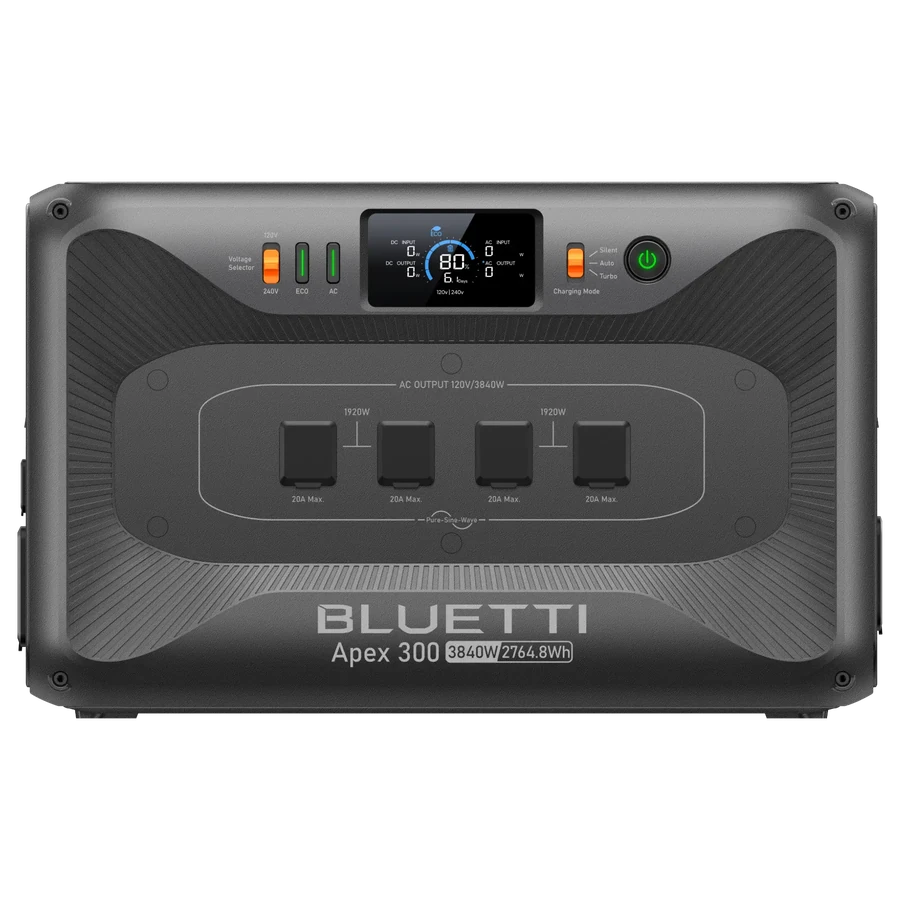
The Apex 300 has two solar sockets, and BLUETTI rates each one on its own: 1,200 W, 12 to 60 volts. Both are XT60s, the yellow two-pin DC plug, and the product page adds them up to 2,400 W. That is more solar input than any set of panels we track can fill.
Thirty-one of the forty-one panels we track publish a voltage, five of them BLUETTI's own, and all thirty-one sit under 60. That leaves weight and waiting. Four of Jackery's SolarSaga 500 X folders put 1440 W in and have the 2764.8 Wh battery full in a little under two hours of good sun. One 200 W folding panel gives about 144 W and needs a little over nineteen hours.
Two sockets are two places to put panels. At the cabin I'd give one to a pair of rigid panels on the south wall and the other to whatever folds, on the deck where the pine shadows arrive mid-afternoon. At 83.78 pounds the station itself stays by the door.
- The door
- 12–60 V
- Its width
- 2400 W
- Plug
- XT60
- Full battery, best case
- ~1.2 h
The door
Every panel we track, lined up at the Apex 300's solar input
Every panel we track with a published voltage, in a line by that figure. The figure is the open-circuit voltage, Voc on the back label, what a panel puts out in sun with nothing connected to it. The black line is 60 V. No bar reaches it.
The pale cap on each bar is what a −10 °C morning adds, about 10%. Cold raises a panel's voltage, so a label read in July understates a January one. The tallest bar, Renogy's 590 W rigid at 52.63 V, keeps its cap under the line. The one panel that plugs in with no cable at all, EcoFlow's 125 W modular rigid, is next at 50 V and clears too. On my deck in January I'd expect the meter to read over the label on every one of them. The cap is that morning drawn in ahead of time.
Point at any bar for its name. Type the Voc off your own panel into the box below and the chart draws it a bar of its own, cold cap included.
Swipe sideways for the whole line-up.
Hover or tap a bar for the panel’s name and its verdict.
- Fits through the door
- Too tall
- Extra height on a −10 °C morning
- Maker prints only the operating voltage; the real height is above the dashes
- 1Our pick: BLUETTI 350W
What we'd buy
The best solar panel for the Apex 300
Picked by the numbers on this station, not by brand.
Best value

About $1.67 for every watt it actually delivers here. 4 panels deliver 576 W.
A day on solar
How long the Apex 300 takes to charge on solar
The strip is a day of sun with a tick at the hour the battery is full. With both sockets at their full 2,400 W the tick would sit a little past the first hour. Nothing we track gets it there. Four of Renogy's 590 W rigid panels put it at a little over an hour and a half. Four Jackery SolarSaga 500 X folders land a little under two hours and fold flat for the drive home.
One folding panel on its own is a long wait. A 200 W panel gives about 144 W in real sun and needs a little over nineteen hours. A 100 W panel gives about 72 W and needs a little over thirty-eight. A good day has 3 to 6 hours of sun that strong, so call the 200 W panel most of a week and the 100 W panel two of them. The system builder turns those hours into days for your state and your month.
Hours of good sun, from empty. Where you live and the month decide how many of those a day gives; the system builder works it out.
Every panel that fits
Solar panels compatible with the Apex 300
Thirty-one fit, five of them BLUETTI's own. For each: the lead that reaches an XT60 socket, what one panel delivers in good sun, and the most the Apex 300 takes from a set of them across both sockets. Our catalogue lists this station's solar connector as MC4, the weatherproof pair of click-together plugs most panels end in, and on this station that is the panel end of the lead. Eleven want the MC4-to-XT60 lead, which BLUETTI sells and does not pack. The Jackery panels take an Anderson or DC8020 adapter instead, and EcoFlow's 125 W modular rigid plugs in with no lead at all. Sorted by delivered watts.
 Renogy 590W N-Type Bifacial Solar Panel (RSP590DCT-144)590 W · rigid · 58.4 lb · $495 · 52.63 VPlug: Renogy doesn't name the plug. Check the lead before buying a cableOne panel: 425 W in good sunBest with up to 4: 4 panels → 1700 W, full in ~1.6 h2 in parallel on each of 2 inputs
 Jackery SolarSaga 500 X (JS-500A)500 W · portable · 23.15 lb · $999 · 48.5 VPlug: Anderson → XT60 adapterOne panel: 360 W in good sunBest with up to 4: 4 panels → 1440 W, full in ~1.9 h2 in parallel on each of 2 inputs
 Anker SOLIX 440W Rigid Solar Panel440 W · rigid · 46.3 lb · $450 · 39.16 VPlug: MC4 → XT60 adapterOne panel: 317 W in good sunBest with up to 4: 4 panels → 1268 W, full in ~2.2 h2 in parallel on each of 2 inputs
 EcoFlow 400W Portable Solar Panel400 W · portable · 35.3 lb · $699 · 48 VPlug: EcoFlow doesn't name the plug. Check the lead before buying a cableOne panel: 288 W in good sunBest with up to 4: 4 panels → 1152 W, full in ~2.4 h2 in parallel on each of 2 inputs
 EcoFlow 400W Rigid Solar Panel400 W · rigid · 48.1 lb · $800 · 37.1 VPlug: EcoFlow doesn't name the plug. Check the lead before buying a cableOne panel: 288 W in good sunBest with up to 4: 4 panels → 1152 W, full in ~2.4 h2 in parallel on each of 2 inputs
 BLUETTI 350W Solar Panel (PV350)350 W · portable · 32.4 lb · $649 · 44 VPlug: MC4 → XT60 adapterOne panel: 252 W in good sunBest with up to 4: 4 panels → 1008 W, full in ~2.7 h2 in parallel on each of 2 inputs
 Renogy 320W N-Type Solar Panel (RSP320DC-BK)320 W · rigid · 32.9 lb · $300 · 43.82 VPlug: Renogy doesn't name the plug. Check the lead before buying a cableOne panel: 230 W in good sunBest with up to 4: 4 panels → 922 W, full in ~3 h2 in parallel on each of 2 inputs
 EcoFlow NextGen 220W Bifacial Portable Solar Panel220 W · portable · 15.4 lb · $449 · 21.5 VPlug: EcoFlow doesn't name the plug. Check the lead before buying a cableOne panel: 151 W in good sunBest with up to 4: 4 panels → 634 W, full in ~4.4 h2 in series on each of 2 inputs
- 200 WBLUETTI PV200 (200W Solar Panel)200 W · portable · 17.15 lb · 24.6 VPlug: MC4 → XT60 adapterOne panel: 144 W in good sunBest with up to 4: 4 panels → 576 W, full in ~4.8 h2 in series on each of 2 inputs
 Eco-Worthy 200W Flexible HJT Solar Panel 18V ETFE 18BB (GW-L02AM200HJT2)200 W · flexible · 8.05 lb · $180 · 29.1 VPlug: MC4 → XT60 adapterOne panel: 144 W in good sunBest with up to 4: 4 panels → 412 W, full in ~6.7 h2 in parallel on each of 2 inputs
 Jackery SolarSaga 200W Solar Panel (JS-200E)200 W · portable · 14.33 lb · $429 · 22 VPlug: DC8020 → XT60 adapterOne panel: 144 W in good sunBest with up to 4: 4 panels → 576 W, full in ~4.8 h2 in series on each of 2 inputs
 Renogy 200W N-Type Solar Panel (RSP200DC)200 W · rigid · 23.4 lb · $180 · 37.44 VPlug: Renogy doesn't name the plug. Check the lead before buying a cableOne panel: 144 W in good sunBest with up to 4: 4 panels → 576 W, full in ~4.8 h2 in parallel on each of 2 inputs
 Rich Solar MEGA 200 Portable Briefcase Solar Panel (RS-X200B)200 W · portable · 26 lb · $400 · 22.2 VPlug: MC4 → XT60 adapterOne panel: 144 W in good sunBest with up to 4: 4 panels → 576 W, full in ~4.8 h2 in series on each of 2 inputs
 Eco-Worthy 195W N-Type 18BB Bifacial Solar Panel (GW-L02M195NTM)195 W · rigid · 20.2 lb · $130 · 21.2 VPlug: MC4 → XT60 adapterOne panel: 140 W in good sunBest with up to 4: 4 panels → 562 W, full in ~4.9 h2 in series on each of 2 inputs
- Renogy 200W Portable Solar Panel Blanket (RPP200SB-SE)200 W · portable · 8.82 lb · $240 · 19.6 VPlug: MC4 → XT60 adapterOne panel: 138 W in good sunBest with up to 4: 4 panels → 576 W, full in ~4.8 h2 in series on each of 2 inputs
 EcoFlow NextGen 160W Portable Solar Panel160 W · portable · 12.3 lb · $369 · 21.3 VPlug: EcoFlow doesn't name the plug. Check the lead before buying a cableOne panel: 115 W in good sunBest with up to 4: 4 panels → 460 W, full in ~6 h2 in series on each of 2 inputs
 EcoFlow 125W Bifacial Modular Solar Panel125 W · rigid · 9.26 lb · $249 · 50 VPlug: Plugs straight inOne panel: 90 W in good sunBest with up to 4: 4 panels → 360 W, full in ~7.7 h2 in parallel on each of 2 inputs
 EcoFlow 110W Portable Solar Panel110 W · portable · 8.8 lb · $259 · 21.8 VPlug: EcoFlow doesn't name the plug. Check the lead before buying a cableOne panel: 79 W in good sunBest with up to 4: 4 panels → 316 W, full in ~8.7 h2 in series on each of 2 inputs
 BLUETTI PV100 FX Flexible Solar Panel | 100W100 W · flexible · 4.85 lb · $165 · 41.4 VPlug: MC4 → XT60 adapterOne panel: 72 W in good sunBest with up to 4: 4 panels → 288 W, full in ~9.6 h2 in parallel on each of 2 inputs
 BLUETTI SP100L Solar Panel | 100W100 W · portable · 10.91 lb · $249 · 24.62 VPlug: MC4 → XT60 adapterOne panel: 72 W in good sunBest with up to 4: 4 panels → 288 W, full in ~9.6 h2 in series on each of 2 inputs
 Jackery SolarSaga 100 Air (JS-100H)100 W · portable · 7.05 lb · $299 · 29.7 VPlug: DC8020 → XT60 adapterOne panel: 72 W in good sunBest with up to 4: 4 panels → 288 W, full in ~9.6 h2 in parallel on each of 2 inputs
 Jackery SolarSaga 100 Light (JS-100G)100 W · flexible · 4.52 lb · $179 · 24.8 VPlug: Anderson → XT60 adapterOne panel: 72 W in good sunBest with up to 4: 4 panels → 288 W, full in ~9.6 h2 in series on each of 2 inputs
 Jackery SolarSaga 100 Prime Solar Panel (JS-100E)100 W · portable · 13.23 lb · $199 · 22.7 VPlug: Anderson → XT60 adapterOne panel: 72 W in good sunBest with up to 4: 4 panels → 288 W, full in ~9.6 h2 in series on each of 2 inputs
 Renogy 100W N-Type Lightweight Portable Solar Panel Suitcase (COMPACT-SUITCASE 100 / RSP100LSC)100 W · portable · 8.82 lb · $145 · 21.6 VPlug: Renogy doesn't name the plug. Check the lead before buying a cableOne panel: 72 W in good sunBest with up to 4: 4 panels → 288 W, full in ~9.6 h2 in series on each of 2 inputs
- 100 WRenogy 100W Monocrystalline Solar Panel (RNG-100D, earlier generation)100 W · rigid · 16.5 lb · 22.5 VPlug: Renogy doesn't name the plug. Check the lead before buying a cableOne panel: 72 W in good sunBest with up to 4: 4 panels → 288 W, full in ~9.6 h2 in series on each of 2 inputs
 Rich Solar MEGA 100 Portable Briefcase Solar Panel (RS-X100B)100 W · portable · 15.7 lb · $200 · 22.8 VPlug: MC4 → XT60 adapterOne panel: 72 W in good sunBest with up to 4: 4 panels → 288 W, full in ~9.6 h2 in series on each of 2 inputs
 Jackery SolarSaga 80W Solar Panel (SolarSaga 80, JS-80A)80 W · portable · 11.24 lb · $249 · 28.5 VPlug: DC8020 → XT60 adapterOne panel: 58 W in good sunBest with up to 4: 4 panels → 230 W, full in ~12 h2 in parallel on each of 2 inputs
 BLUETTI SORA 60 Solar Panel | 60W60 W · portable · 3.09 lb · $129 · 27.5 VPlug: DC5521 → XT60 adapterOne panel: 43 W in good sunBest with up to 4: 4 panels → 172 W, full in ~16.1 h2 in parallel on each of 2 inputs
 EcoFlow 60W Portable Solar Panel60 W · portable · 4.41 lb · 25.6 VPlug: DC5521 → XT60 adapterOne panel: 43 W in good sunBest with up to 4: 4 panels → 172 W, full in ~16.1 h2 in series on each of 2 inputs
 EcoFlow 45W Portable Solar Panel45 W · portable · 3.09 lb · $99 · 25.6 VPlug: MC4 → XT60 adapterOne panel: 32 W in good sunBest with up to 4: 4 panels → 130 W, full in ~21.3 h2 in series on each of 2 inputs
 Jackery SolarSaga 40 Air (JS-40C)42 W · portable · 1.98 lb · $129 · 26 VPlug: DC8020 → XT60 adapterOne panel: 30 W in good sunBest with up to 4: 4 panels → 120 W, full in ~23 h2 in series on each of 2 inputs
Own a panel that isn't in the line-up?
Type its voltage into the door chart above for the height test, then put the rest of the label into the panel checker, already set to the Apex 300, for current and plug too. Or build the whole system to see how it keeps up where you live.
The plain answers
How long does the Apex 300 take to charge on solar?
One 100 W panel delivers about 72 W in good sun and refills the 2764.8 Wh battery from empty in about 38.4 hours.
One 200 W panel delivers about 144 W in good sun and refills the 2764.8 Wh battery from empty in about 19.2 hours.
At its 2400 W solar limit it refills in about 1.2 hours. More panel watts than that won't charge it any faster.
A day gives three to six hours of sun that good, depending on season and place, so one 100 W panel takes 7 to 13 days to fill it. The system builder works it out for your state and month.
What adapter does the Apex 300 need for solar?
None, if the panel's plug is XT60: EcoFlow 125W Bifacial Modular plugs straight in. No solar adapter comes in the Apex 300's box, so any other panel needs a cable bought separately.
The cables the other panels need: MC4 to XT60 (11 panels), DC8020 to XT60 (4 panels), Anderson to XT60 (3 panels) and DC5521 to XT60 (2 panels).
10 panels don't have a named plug from their maker, so check the lead before you buy a cable.
Can you use non-BLUETTI solar panels with the Apex 300?
Yes. What decides it is the panel's voltage and plug, not the brand. 26 panels from Renogy, Jackery, Anker SOLIX, EcoFlow, Eco-Worthy and Rich Solar work with it, as long as the panel stays under 60 V on a cold morning and starts above 12 V.
The strongest single panels here are the Renogy 590W N-Type Bifacial (425 W delivered) and the Jackery SolarSaga 500 X (360 W delivered).
Can you connect two solar panels to the Apex 300?
Yes. It has 2 solar inputs, so the simplest way is one panel on each.
Don't wire two BLUETTI PV100 FX Flexible panels in series: together they would pass its 60 V limit. Parallel them instead.
Past 2400 W delivered, more panels only help on cloudy days.
What is the Apex 300's solar input?
DC Input 1 (XT60PM-M): 12–60 V, up to 20 A, 1200 W. DC Input 2 (XT60PM-M): 12–60 V, up to 20 A, 1200 W. 2400 W across all inputs together.
Input limits from BLUETTI's documents, checked 2026-09-18 (source). Delivered watts assume 72% of the panel's rating in good sun.
Also worth reading