News · Solar · News analysis
California just legalized plug-in balcony solar. Here’s what a kit is worth in your state
Ten states have now passed laws letting renters and homeowners plug a small solar kit into an ordinary outlet. We ran NASA’s sun data for a panel hung on a railing in all 50. The savings follow the electric bill, not the sunshine.
 By Ian Schneider, Solar & Off-Grid Tester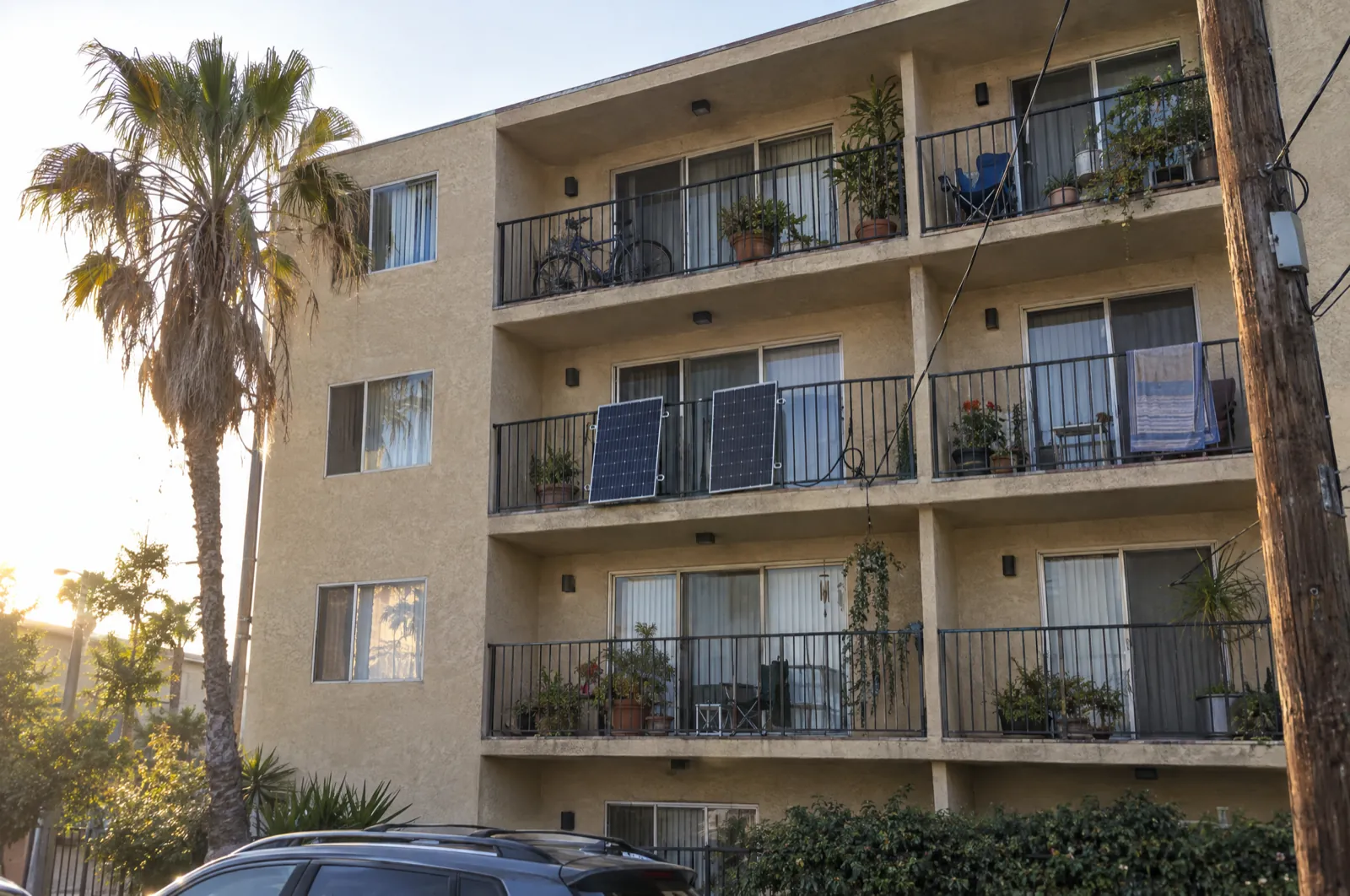
The short version · as of October 4, 2026
- California became the 10th state to allow plug-in solar on September 30. Its law takes effect January 1. Kits are already allowed in 6 states.
- An 800 W kit hung on a south-facing railing makes 585 to 972 kWh a year, depending on the state. For a typical home that is worth $65 to $208 a year.
- The savings follow the electric bill, not the sunshine. California, Hawaii and Maine come out on top. Utah, the state that started it, ranks 33rd of 51.
- On a railing, every state's best month falls outside summer. A railing panel typically gets 96% of a tilted panel's December sun, but only 44% of June's.
- A plug-in kit without a battery goes dark in a blackout, and a portable power station cannot legally feed your outlets. The legal version in all 50 states is panels charging a power station you plug things into.
What happened
California makes ten
On September 30, Governor Gavin Newsom signed SB 868. It lets Californians plug a small solar kit into an ordinary wall outlet without asking the utility first. The law takes effect January 1, 2027. It caps each home at 1,200 W of output, requires devices certified by UL or an equivalent lab, and bars utilities from charging fees or requiring permission. Unless lawmakers extend it, it expires at the start of 2030.[1]
The idea comes from Germany, where “balcony power plants” are a mass-market product. About 430,000 were registered there in 2025 alone.[19] Utah brought it to the US in 2025. Then came this year: pv magazine counts 35 states that considered a plug-in bill in 2026,[1] and Maine, Maryland, Vermont, Colorado, Connecticut, Virginia, New Hampshire and New Jersey signed theirs before California did.[4]
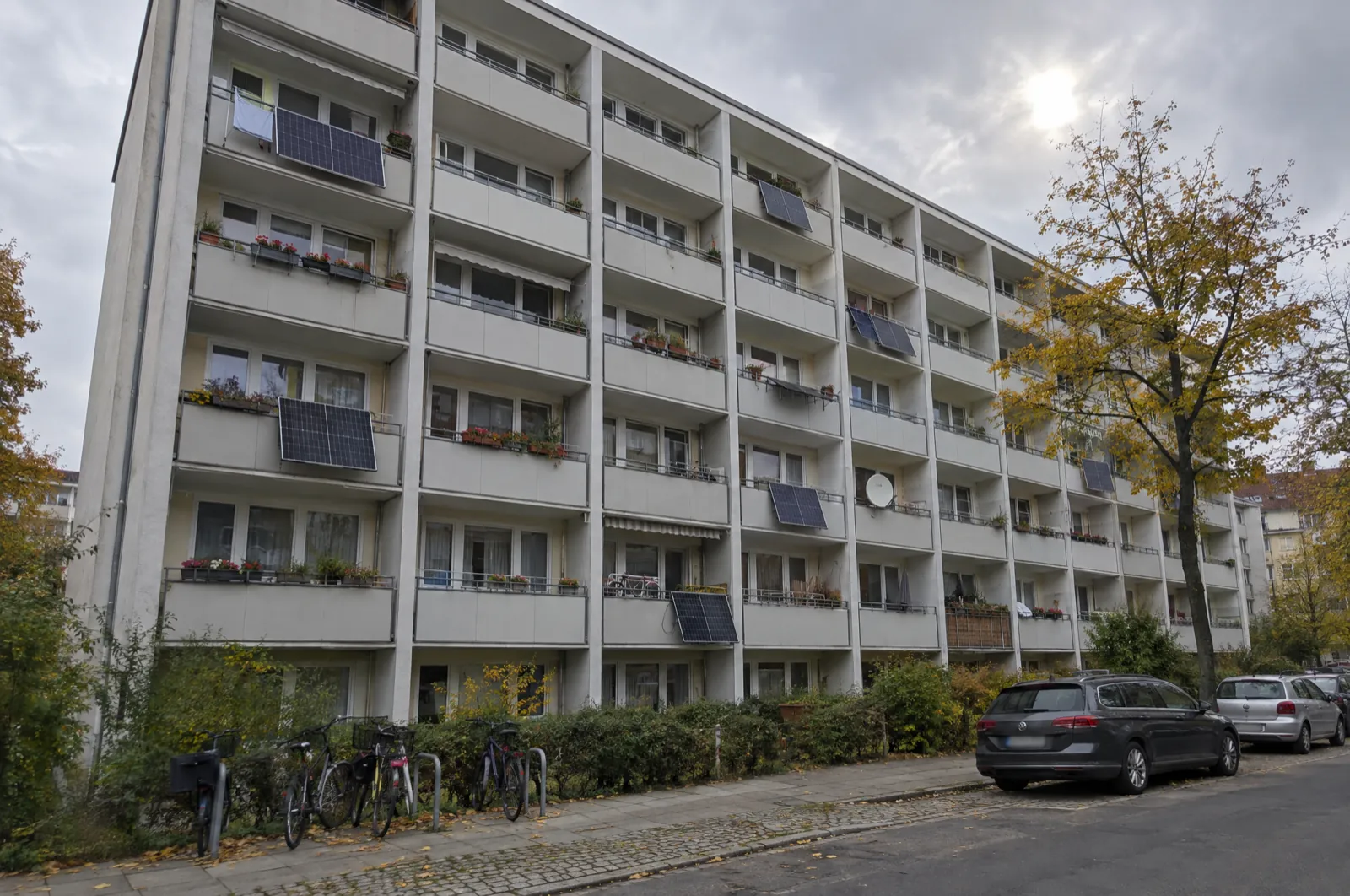
What these laws change is paperwork, not physics. Wiring a generator into a home's circuits normally means applying to the utility for interconnection, the process a rooftop installer goes through. The new laws waive that for small, certified kits.
May 2024
Germany raises its plug-in limit to 800 W and drops sign-up with the grid operator.[18]
May 7, 2025
Utah’s HB 340 takes effect: the first US law letting a small solar kit plug into a wall outlet.[2]
2025
Germany registers about 430,000 more plug-in units in a single year.[19]
Jan 8, 2026
UL launches certification to UL 3700, a safety outline written for plug-in solar.[5]
Apr–Sep 2026
Maine, Virginia, Colorado, Maryland, Connecticut, Vermont, New Hampshire and New Jersey sign laws.[4]
Jul 2026
The first microinverters certified to UL 3700 are announced, from Hoymiles and APsystems.[11]
Aug 27, 2026
Plug-in solar up to 800 W becomes legal in Great Britain.[15]
Sep 30, 2026
California signs SB 868 and becomes the 10th state. Its law takes effect January 1, 2027.[1]
The state desk
Is it allowed where you live, and what would a kit make there?
Pick a state. The output comes from NASA's 20-year sun record for a panel hanging straight down a south-facing railing, shown next to the same panel tilted toward the sun. The dollar figure assumes the home uses about 70% of what the kit makes as it makes it, at the state's average residential price.
- Allowed now
- Signed, takes effect later
- Passed, not yet signed
- Bill filed, has not passed
- No bill filed
California
Signed September 30, 2026. Takes effect January 1, 2027, up to 1,200 W per home.
Kits must be certified as plug-in solar systems by UL or an equivalent lab. They are exempt from interconnection rules and utility fees; the utility may ask for a simple online registration. The law expires January 1, 2030 unless it is extended. SB 868.
Source: California Legislature, SB 868
- On a south railing
- 896 kWh/yr
- ≈ $208 a year at 33.2¢
- Tilted toward the sun
- 1,504 kWh/yr
- ≈ $349 a year
About 4.8 years to pay back on a railing in California.
A round middle figure. Certified US kits are new and few, so expect to pay more than Europe does.
All 50 states and DC: an 800 W kit, ranked by what it saves on a railing
| State | Plug-in law | Power price | Railing kWh/yr | Saves/yr | Tilted kWh/yr | Payback at $1,000 |
|---|---|---|---|---|---|---|
| California | Signed | 33.2¢ | 896 | $208 | 1,504 | 4.8 yr |
| Hawaii | Bill filed | 46.0¢ | 626 | $202 | 1,457 | 5.0 yr |
| Maine | Allowed | 29.7¢ | 705 | $146 | 1,021 | 6.8 yr |
| Massachusetts | Bill filed | 30.1¢ | 692 | $146 | 1,035 | 6.8 yr |
| Rhode Island | Bill filed | 29.4¢ | 676 | $139 | 1,061 | 7.2 yr |
| Connecticut | Allowed | 28.8¢ | 672 | $136 | 1,038 | 7.4 yr |
| New York | Passed, unsigned | 29.3¢ | 657 | $134 | 999 | 7.5 yr |
| New Hampshire | Signed | 26.8¢ | 679 | $127 | 1,005 | 7.9 yr |
| District of Columbia | No bill | 24.5¢ | 697 | $120 | 1,088 | 8.3 yr |
| New Jersey | Signed | 23.6¢ | 677 | $112 | 1,042 | 8.9 yr |
| Alaska | Bill filed | 26.9¢ | 585 | $110 | 705 | 9.1 yr |
| Colorado | Allowed | 16.6¢ | 899 | $105 | 1,331 | 9.5 yr |
| Maryland | Allowed | 21.3¢ | 691 | $103 | 1,067 | 9.7 yr |
| Vermont | Allowed | 24.0¢ | 616 | $103 | 914 | 9.7 yr |
| Arizona | Bill filed | 15.4¢ | 936 | $101 | 1,571 | 9.9 yr |
| New Mexico | Bill filed | 14.8¢ | 972 | $101 | 1,559 | 9.9 yr |
| Pennsylvania | Bill filed | 20.9¢ | 666 | $97 | 1,016 | 10 yr |
| Michigan | Bill filed | 21.1¢ | 651 | $96 | 984 | 10 yr |
| Wisconsin | No bill | 19.0¢ | 716 | $95 | 1,040 | 11 yr |
| Nevada | No bill | 13.8¢ | 972 | $94 | 1,539 | 11 yr |
| Illinois | Bill filed | 19.2¢ | 684 | $92 | 1,029 | 11 yr |
| Delaware | Bill filed | 17.7¢ | 692 | $86 | 1,076 | 12 yr |
| Wyoming | Bill filed | 13.9¢ | 870 | $85 | 1,269 | 12 yr |
| Minnesota | Bill filed | 16.0¢ | 747 | $84 | 1,052 | 12 yr |
| Virginia | Signed | 16.7¢ | 716 | $84 | 1,127 | 12 yr |
| South Carolina | Bill filed | 16.0¢ | 736 | $83 | 1,196 | 12 yr |
| Indiana | Bill filed | 17.1¢ | 683 | $82 | 1,034 | 12 yr |
| Kansas | No bill | 15.2¢ | 775 | $82 | 1,194 | 12 yr |
| Ohio | Bill filed | 18.5¢ | 632 | $82 | 977 | 12 yr |
| Alabama | No bill | 16.6¢ | 696 | $81 | 1,158 | 12 yr |
| South Dakota | No bill | 14.3¢ | 811 | $81 | 1,159 | 12 yr |
| Texas | No bill | 16.1¢ | 709 | $80 | 1,232 | 13 yr |
| Utah | Allowed | 13.2¢ | 861 | $79 | 1,306 | 13 yr |
| Florida | No bill | 15.4¢ | 722 | $78 | 1,280 | 13 yr |
| Georgia | Bill filed | 15.2¢ | 713 | $76 | 1,182 | 13 yr |
| Montana | No bill | 13.8¢ | 789 | $76 | 1,118 | 13 yr |
| North Carolina | Bill filed | 14.9¢ | 731 | $76 | 1,171 | 13 yr |
| Mississippi | No bill | 15.3¢ | 692 | $74 | 1,177 | 14 yr |
| Iowa | Bill filed | 13.8¢ | 752 | $72 | 1,106 | 14 yr |
| Nebraska | No bill | 12.7¢ | 810 | $72 | 1,179 | 14 yr |
| Oregon | Bill filed | 15.3¢ | 668 | $72 | 1,044 | 14 yr |
| North Dakota | No bill | 12.2¢ | 822 | $70 | 1,110 | 14 yr |
| Oklahoma | Bill filed | 13.4¢ | 748 | $70 | 1,207 | 14 yr |
| Idaho | Bill filed | 12.8¢ | 770 | $69 | 1,154 | 15 yr |
| Kentucky | No bill | 14.4¢ | 682 | $69 | 1,074 | 15 yr |
| Washington | Bill filed | 14.3¢ | 690 | $69 | 1,022 | 15 yr |
| West Virginia | No bill | 15.4¢ | 640 | $69 | 1,007 | 15 yr |
| Missouri | Bill filed | 13.4¢ | 723 | $68 | 1,125 | 15 yr |
| Arkansas | No bill | 13.4¢ | 708 | $67 | 1,146 | 15 yr |
| Tennessee | No bill | 13.9¢ | 693 | $67 | 1,120 | 15 yr |
| Louisiana | No bill | 13.5¢ | 685 | $65 | 1,188 | 15 yr |
The money
The math works best where power is expensive, not where it is sunny
New Mexico has the strongest railing sun in the country: about 972 kWh a year from an 800 W kit. Yet it ranks 16th on savings, because a kilowatt-hour there costs 14.8¢. The kits pay back fastest where electricity is dearest: California, Hawaii, Maine, Massachusetts and Rhode Island.
That is why the first state is not the best one. In Utah, an 800 W railing kit saves about $79 a year at 13.2¢, so a $1,000 kit takes 13 years to earn back. The same kit in California, at 33.2¢, saves about $208 and pays back in 4.8 years. At the bottom of the table, Louisiana saves $65 a year.
These figures run lower than most online balcony-solar calculators, on purpose. Those usually assume panels tilted toward the sun and a home that uses every kilowatt-hour the kit makes. A balcony kit usually hangs flat on a railing, and a home without a battery uses about 70% of what it makes as it makes it. Tilted, with every kilowatt-hour used, the same 800 W kit in California would be worth about $499 a year.
What we found
A railing panel's best month is not June. In every state, it falls outside summer
A panel hung flat against a railing faces the horizon. That suits the low winter sun and wastes the high summer sun. NASA's 20-year record shows by how much. Across all 51 locations, a railing gets a median 96% of the December sunlight a tilted panel gets, but only 44% of June's. Over a full year it gets 65%.
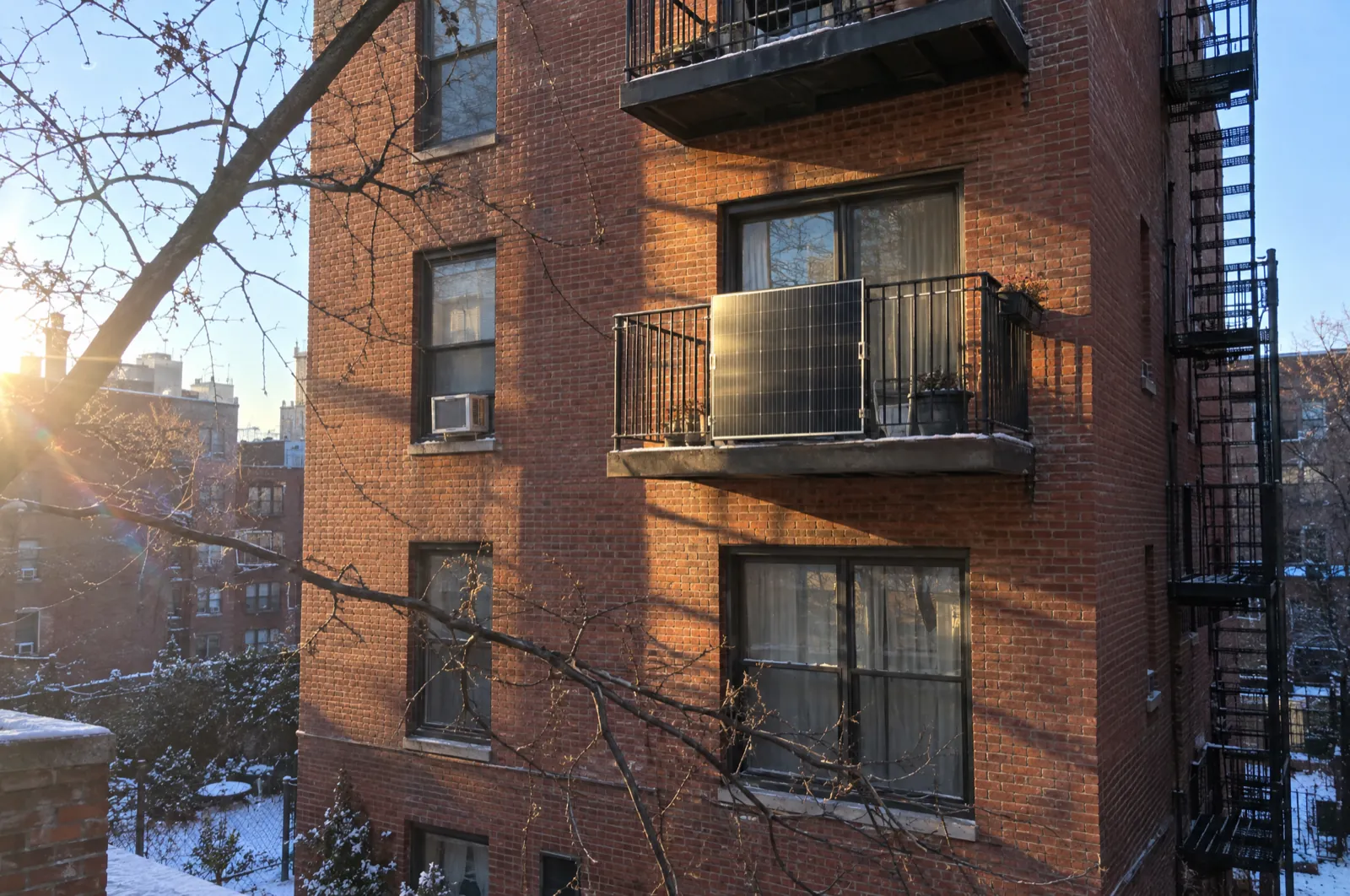
So a railing kit's output is flatter through the year than a rooftop's, and its best month falls outside May to August in all 51 locations. In both Utah and California it peaks in October.
Three things follow. If you can tilt the panels instead, on a floor stand or a patio, the same kit makes about 54% more a year. A balcony overhead costs a railing panel less than you might expect, because it mostly blocks the high summer sun the railing was already missing. And direction matters more than tilt: modelled for Berlin, a vertical panel facing east makes about half of what a tilted, south-facing one does.[20]
The catch
You only save what your home is using while the sun is out
A kit without a battery feeds the outlet it is plugged into. Whatever is running at that moment, the fridge, the router, the things on standby, uses that power first. The rest flows out to the grid, for nothing in most of these states. In Connecticut, without a net-metering meter, it is billed to you as usage. The UK government modelled an 800 W kit in an average home with no battery and found the home used 62% to 72% of what the kit made.[16] Germany's consumer agency puts a single 400 W railing module at about 280 kWh a year, of which about 200 kWh replaces grid power.[17] The dollar figures in this story use 70%.
A battery fixes that by saving the midday surplus for the evening. That is what the all-in-one balcony systems sell. The one we found on sale in the US, EcoFlow's STREAM Ultra, lists at $1,399, or $1,599 with its 1,200 W microinverter. For now, EcoFlow's page limits plug-and-play installation to Utah.[12] Check if it's on sale at EcoFlow
We may earn a commission if you buy through that link. It never changes what we report. How we make money.
Before you plug in
What the wattage cap is about, and what to check first
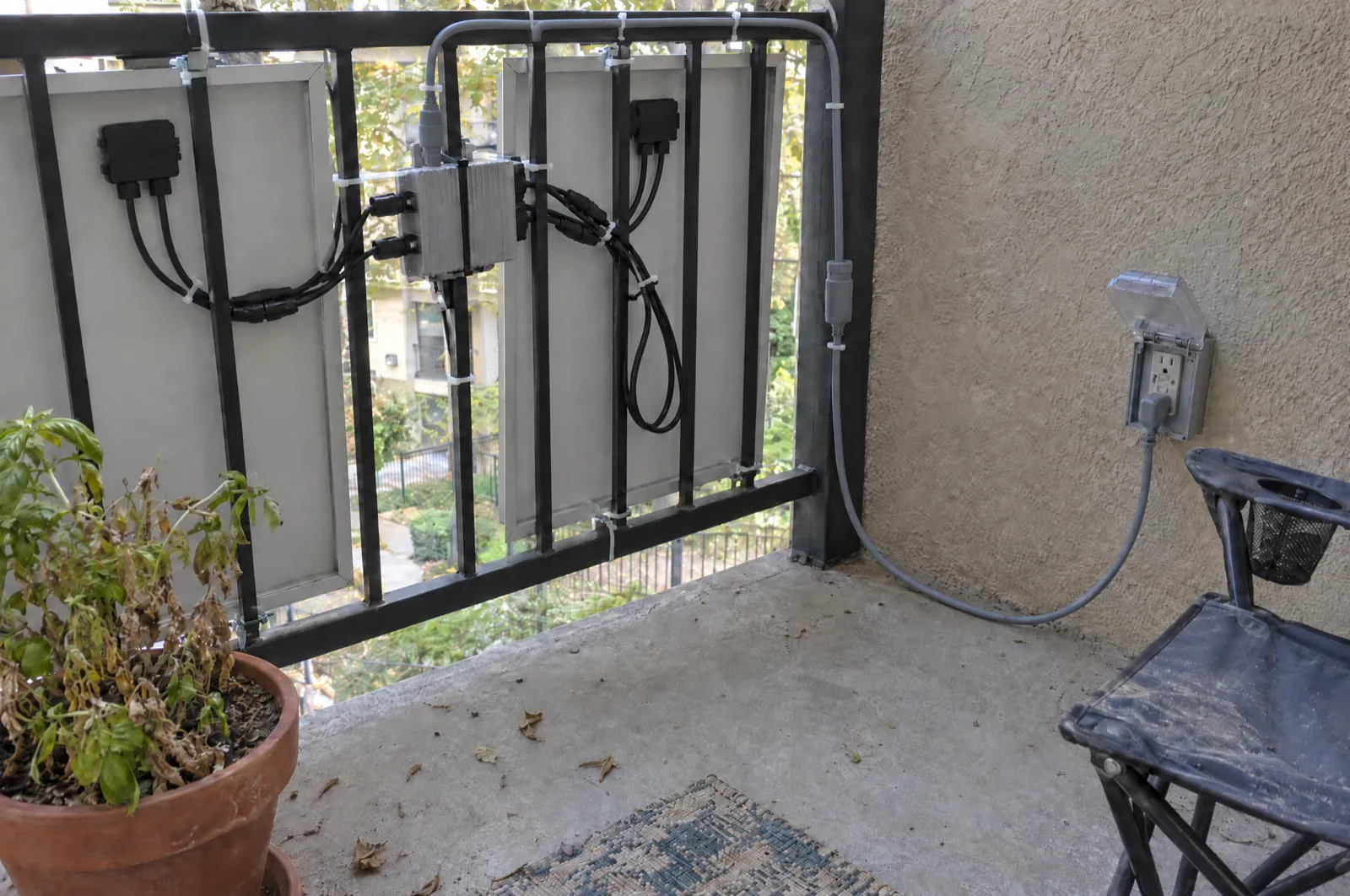
The caps are about the wiring in your walls. A household circuit has a breaker that limits what comes in from the grid. A plug-in kit pushes its own current in from the other end, and the breaker never sees it. At 120 volts, 1,200 W is 10 amps. If the kit sits between the breaker and a heavy load on the same circuit, the stretch of wire to that load can carry the breaker's full current plus the kit's. UL puts it plainly: combined current from the utility and the kit “can exceed conductor ratings without tripping the circuit breaker.”[7] The caps, the certification rules and UL 3700 are all written around that risk.
- Check the date, not just the law. Four of the ten states have signed laws that are not in effect yet: California, Virginia and New Hampshire on January 1, New Jersey on March 1.
- Read your state’s fine print. Maine wants an electrician and a dedicated circuit above 420 W. Maryland wants notice before you install. Vermont requires a smart meter. Connecticut bills exported power to you as usage unless you have a net-metering meter. Pick your state in the state desk above for the details.
- Buy a kit certified for plug-in use, and check which plug it uses. Vermont, Maine and New Jersey name UL 3700. UL told Vermont’s legislature that UL 3700 requires its own plug and receptacle, not an ordinary household outlet, so a certified kit may need an electrician to fit the outlet it plugs into.[6]
- Stay under the cap. It counts the AC output of everything plugged in at one home: 1,200 W in nine of the ten states, 1,920 W in Colorado.
- Pick the circuit with care. Use a circuit with little else on it, and never an extension cord or power strip. UL’s own warning: combined current from the grid and the kit “can exceed conductor ratings without tripping the circuit breaker.”[7]
- Ask before you hang anything. New Jersey protects renters and HOA residents who install one, Colorado voids HOA bans from January, and Vermont asks tenants to give the landlord 10 days’ notice. Elsewhere your lease or condo board still has a say, so get a yes in writing.
What you can do today, in any state
The legal version everywhere: panels and a power station
You don't need a law to put solar on a balcony. You need one to connect solar to your home's wiring. Panels that charge a portable power station never touch the wiring: you plug the fridge, the router or the laptop into the station instead. That is legal in all 50 states. It keeps running in a blackout, which a plug-in kit without a battery does not. And you can take it with you when you move.
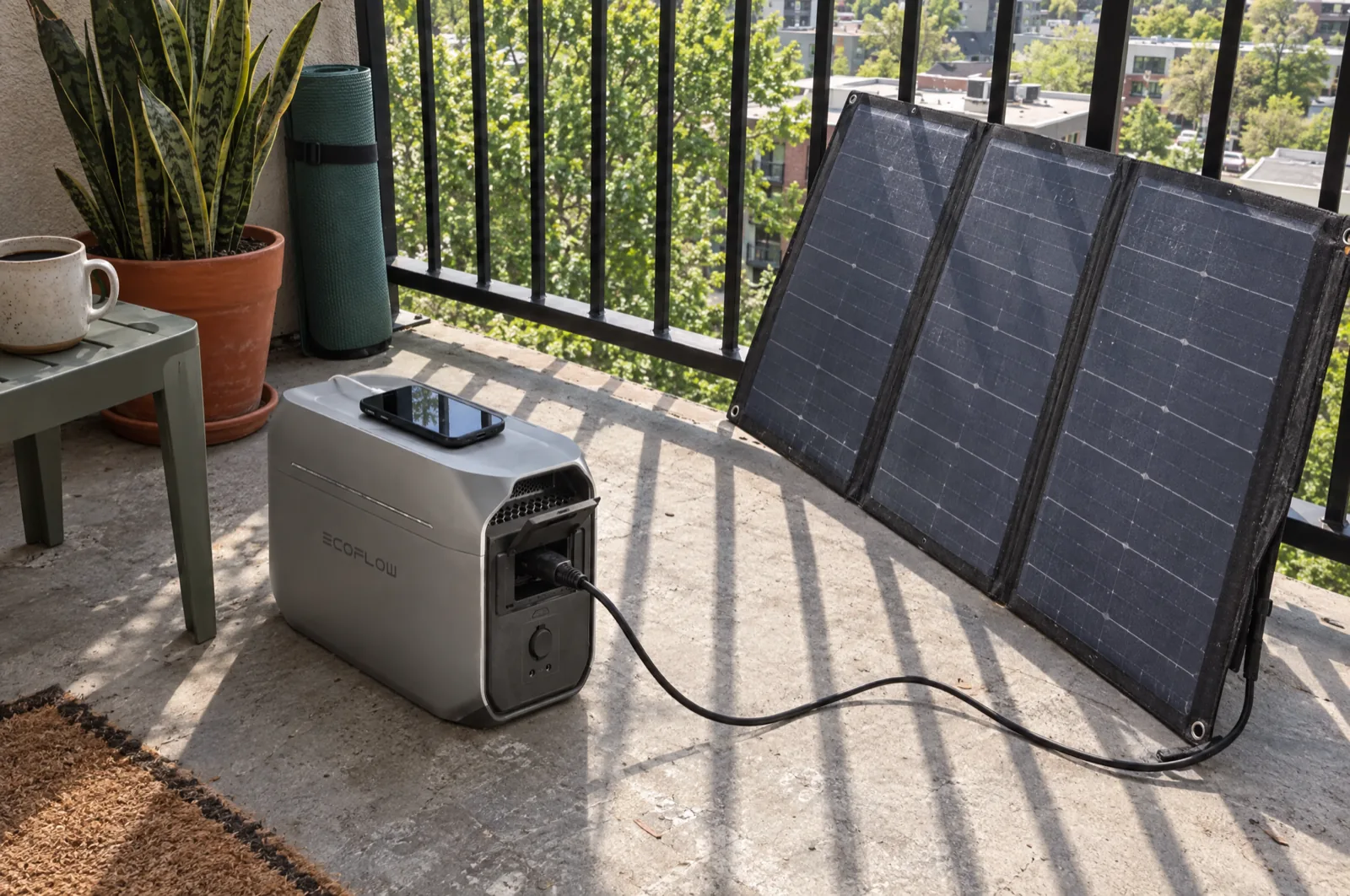
The trade-off is money and effort. You only save what you move onto the station by hand, and bought for the bill alone, a portable kit takes many years to pay back. Bought for the blackout, the panels are what keep the battery topped up when the grid can't. Our tools size both halves for your home and your state.
What to watch
What happens next
- New York. The SUNNY Act passed the Senate 62–0 in April and the Assembly in May, but as of October 4 it had not yet been delivered to the governor. It would take effect 90 days after signing.[3]
- The utilities. PG&E lobbied against California’s bill, citing safety and the risk that customers without panels end up paying more to maintain the grid, and says implementation details still need to be worked through.[9]
- January 1. California, Virginia and New Hampshire switch on together. The question is who ships certified kits to California first. EcoFlow’s product page still limits plug-and-play installation of its STREAM system to Utah.[12]
- The electrical code. The 2026 National Electrical Code does not recognize plug-in solar modules, and the next edition is 2029; New Jersey’s law already points to it. Until then, local inspectors and UL 3700’s special plug are where the friction will be.[8]
- The 2027 sessions. Bills that did not pass this year in states such as Pennsylvania, Illinois, Oregon and Washington can come back in January. Massachusetts still has to reconcile its House and Senate versions.[4]
- A US bridge for power stations. In Europe, EcoFlow’s PowerStream and BLUETTI’s Balco Transfer Hub let an ordinary power station feed a wall outlet legally. Nothing like that is sold in the US. EcoFlow says its US STREAM Microinverter works only with STREAM Ultra.[13]
Get one email when your state's rules change
And when a certified kit you can actually buy reaches the US. Nothing else.
By subscribing, you agree to our Privacy Policy. Unsubscribe anytime.
Reader questions
Questions readers ask
Is it allowed in my state?
As of October 4, 2026, plug-in kits are allowed in 6 states (Utah, Maine, Maryland, Vermont, Colorado and Connecticut) and signed into law but not yet in effect in 4 more (California, Virginia, New Hampshire and New Jersey). New York has passed a bill that is not yet signed. Pick your state in the state desk above for its terms.
California’s law is signed. When can I actually buy and plug in a kit there?
Not before January 1, 2027, when SB 868 takes effect; until then, a grid-tied kit plugged into an outlet is not covered by the new exemption. After that it comes down to hardware. The law asks for kits certified as plug-in solar systems, and as of early October only a handful of companies (Hoymiles, APsystems and Mango Power) had products certified to UL 3700. A nonprofit that sponsored the bill expects two more approvals by the end of the year, with products on shelves in 2027. UL 3700 also calls for its own plug and receptacle, so some setups will need an electrician. The off-grid route, panels charging a power station you plug things into, is legal today.[10]
Can I buy EcoFlow’s STREAM system in California now?
Not for plug-in use yet. EcoFlow’s US product page limits sale and plug-and-play installation of STREAM Ultra and its microinverter to Utah, though a note on the same page also names Maryland and Colorado. EcoFlow lists the microinverter as UL 1741-certified; California’s law asks for certification as a plug-in solar system, and EcoFlow has not said whether STREAM meets that bar. Check EcoFlow’s page after January 1.[12]
Will a plug-in kit keep my lights on in a blackout?
No. A grid-tied microinverter shuts itself off when the grid goes down, so it never sends power into a line a lineworker thinks is dead. EcoFlow says its own US microinverter will stop power output during a blackout. Only a kit with a battery and its own outlet can keep running what is plugged into that outlet.[13]
Can I plug my portable power station into a wall outlet to run the house?
No, and the makers say so. EcoFlow: “Never try to backfeed your home from a wall outlet. That’s dangerous and illegal.” A power station has no grid-tie inverter and no anti-islanding protection. In Europe a separate box (EcoFlow PowerStream, BLUETTI Balco Transfer Hub) bridges the two; neither is sold in the US.[14]
Do I get paid for the power I send back?
Plan on nothing. Utah, Maine, Vermont and New Jersey exclude these kits from net metering, and Vermont’s law says exported power “shall not be compensated.” In Connecticut it can cost you: without a net-metering meter, the excess is charged as usage. Every dollar figure in this story assumes exported power earns nothing.
How big a kit should I buy?
Size it to what your home uses in daylight, not to the cap. A fridge, a router and the things on standby run all day; that steady draw is what a kit without a battery actually replaces. Past that, extra panels mostly feed the grid for free, or worse in Connecticut.
Does it matter which way my balcony faces?
A lot. Modelled for Berlin with the EU’s PVGIS tool, a vertical panel facing south makes about 72% of what the same panel tilted at 35° makes; facing east, about half.[20]
How we did this
Method and sources
Sun: NASA POWER Climatology API vv2.10.0, parameter SI_TILTED_AVG_VERTICAL for the railing and SI_TILTED_AVG_LATITUDE for the tilted panel, 20-year Meteorological and Solar Monthly & Annual Climatologies (January 2001 - December 2020), at each state's 2020 Census centre of population.[21] Electricity prices: U.S. EIA, Electric Power Monthly, Table 5.6.B, residential, year-to-date through june 2026.[22] Losses: NREL PVWatts' defaults (14.08% system losses, 96% inverter efficiency), so 83% of the sunlight figure reaches the outlet.[23] A kit is 800 W of panels unless stated. Dollar figures assume the home uses 70% of what the kit makes as it makes it and is paid nothing for the rest. A tilted rooftop array would beat all of these figures. Shade, a deep overhang, or a railing facing east or west will fall short of them. The pictures in this story are illustrations we generated to show what these setups look like; none shows a real home or person, and the one product shown by name is drawn from our own photographs of it.
- [1]pv magazine USA (Ben Zientara), “Newsom signs California plug-in solar bill, establishing the nation’s largest balcony solar market”, October 1, 2026.
- [2]Utah Legislature, “HB 340, Solar Power Amendments (enrolled)”, 2025.
- [3]New York State Senate, “S8512C, the SUNNY Act”, read October 4, 2026.
- [4]Bright Saver (advocacy group), “Plug-in Solar Legislation Tracker”, read October 4, 2026.
- [5]UL Solutions, “UL Solutions debuts testing and certification framework for safer plug-in solar across the United States”, January 8, 2026.
- [6]UL Solutions (Ken Boyce), testimony to the Vermont House Energy committee on S.202, “Follow-up testimony”, April 14, 2026.
- [7]UL Solutions, “Safety considerations for plug-in photovoltaic (PIPV) systems”.
- [8]UL Solutions, The Code Authority, “Coordination between model codes and standards”.
- [9]Los Angeles Times (Blanca Begert), “Want solar but don’t own a roof? California just legalized plug-in panels, no permission required”, September 30, 2026.
- [10]Engadget (Steve Dent), “Balcony solar installations will soon be legal in America’s most populous state”, October 2, 2026.
- [11]Electrek, “First UL 3700 balcony solar microinverter (Hoymiles)”, July 20, 2026.
- [12]EcoFlow, “STREAM Ultra product page”, read October 4, 2026.
- [13]EcoFlow, “STREAM Microinverter product page and FAQ”, read October 4, 2026.
- [14]EcoFlow, “How to integrate a power station into home backup”, read October 4, 2026.
- [15]legislation.gov.uk, “Statutory Instrument 2026/848 (plug-in solar)”, in force August 27, 2026.
- [16]UK Department for Energy Security and Net Zero, “Plug-in solar consultation: analytical annex”, June 2026.
- [17]Verbraucherzentrale, “Steckersolar: Solarstrom vom Balkon direkt in die Steckdose”, July 24, 2026.
- [18]Verbraucherzentrale, “Gesetze und Normen für Steckersolar”, March 6, 2026.
- [19]Bundesnetzagentur, “Press release on 2025 renewable additions”, January 8, 2026.
- [20]European Commission JRC, “PVGIS 5.3, Berlin, 1 kWp, 14% losses (our queries by orientation)”, run October 4, 2026.
- [21]NASA Langley, “POWER climatology API (SI_TILTED_AVG_VERTICAL, SI_TILTED_AVG_LATITUDE)”, 2001–2020 means.
- [22]U.S. Energy Information Administration, “Electric Power Monthly, Table 5.6.B”, year to date through June 2026.
- [23]NREL, “PVWatts Calculator default losses”.