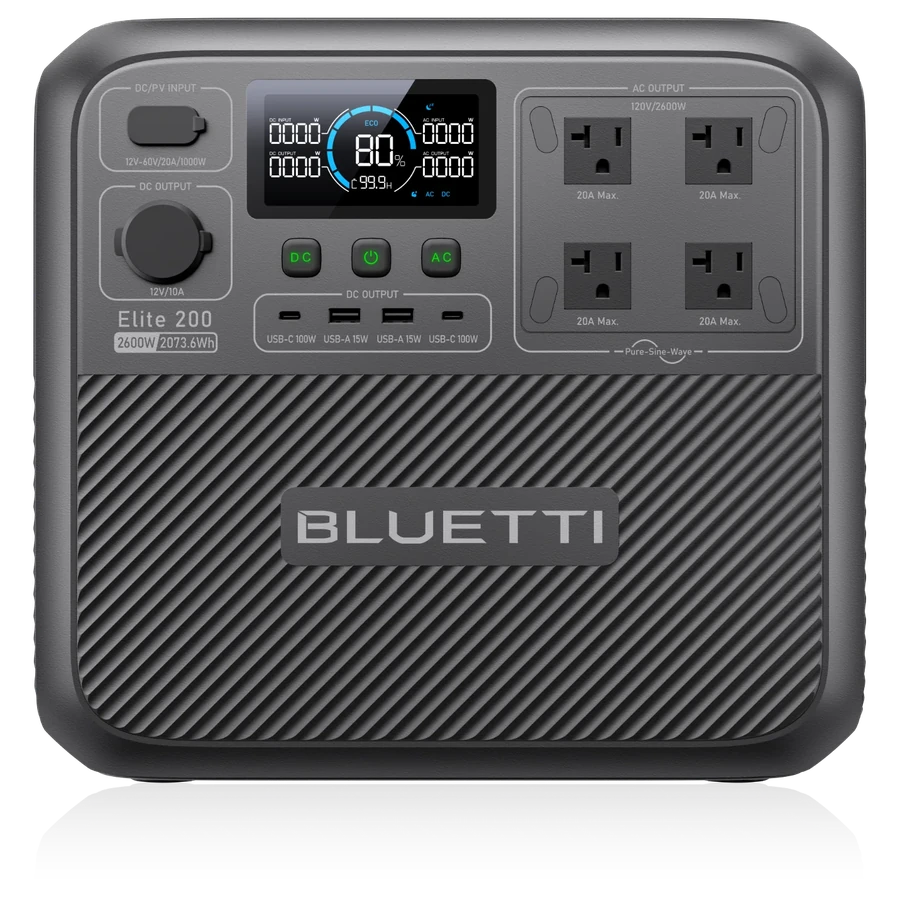
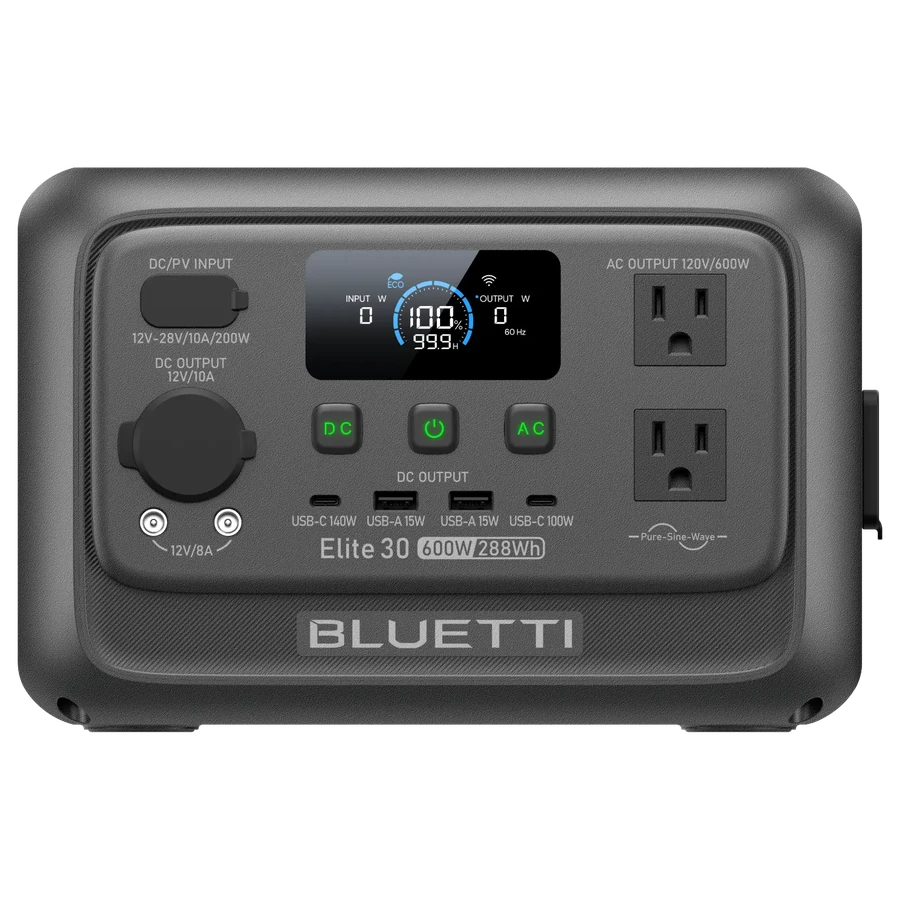
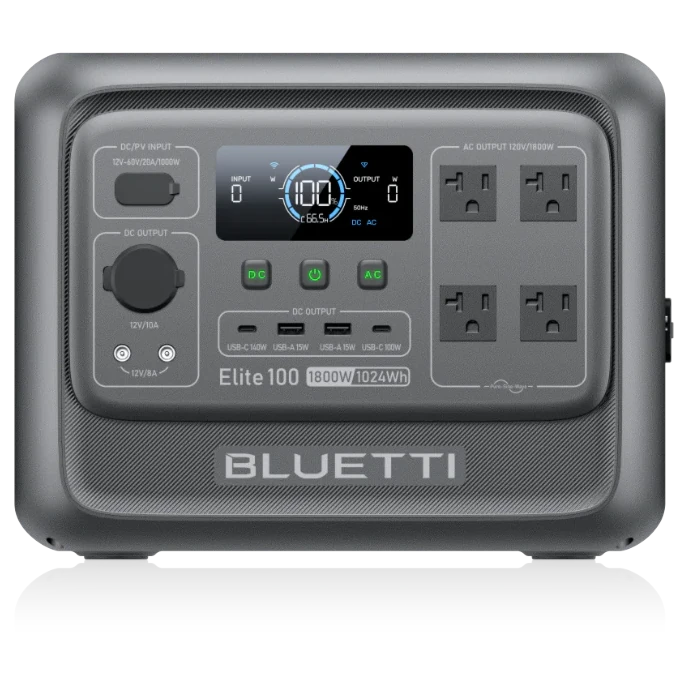
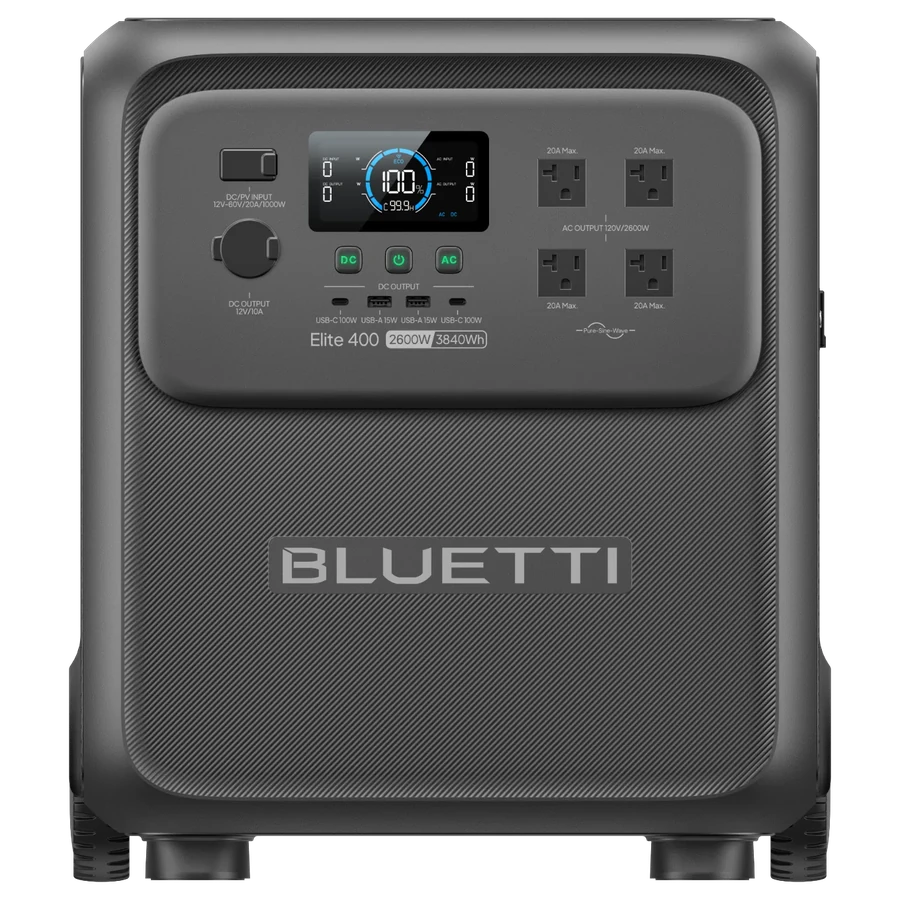
“Mini” costs output, not just volume, and you do not have to wait to check it. The one pair with everything published is on BLUETTI’s US store today: the Elite 100 mini at 1,004.8 Wh and 700 W for $429, beside the Elite 100 V2 at 1,024 Wh and 1,800 W for $499. The mini gives up 2% of the capacity and 61% of the rated output to save 1.4 lb and $70 — our arithmetic, BLUETTI’s numbers. The two unshipped units make the same trade in the same proportion. The Elite 30 mini keeps every watt-hour of the Elite 30 V2 and halves its inverter, 300 W against 600 W. The Elite 200 mini carries 3% less capacity than the Elite 200 V2 and 1,500 W against 2,600 W, a 42% cut. These are not shrunken V2s; they are the same battery classes behind smaller inverters, in smaller boxes — and the placard’s 3,000 W is Power Lifting, BLUETTI’s derated mode for resistive loads, not a surge figure that closes the gap.
BLUETTI’s own headline is “15–42% smaller by volume and 7–25% lighter than corresponding Elite V2 Series products”. Run the one checkable pair through it — 235 × 215 × 290 mm and 10.7 kg for the 100 mini against 320 × 215 × 250 mm and 11.5 kg for the 100 V2 — and the shipping mini comes out 14.8% smaller and 7.0% lighter (ours). That is the bottom of both ranges. So the 42% and the 25% belong to the 30 mini or the 200 mini, and neither has published dimensions; the 30 mini has not published a weight. The one saving we can put a number on is the 200 mini’s: 18.8 kg against the Elite 200 V2’s 53.4 lb is 12 lb, about 22% lighter (ours). The figure on the poster is the one nobody can check yet; the figure everyone can check is the small one.
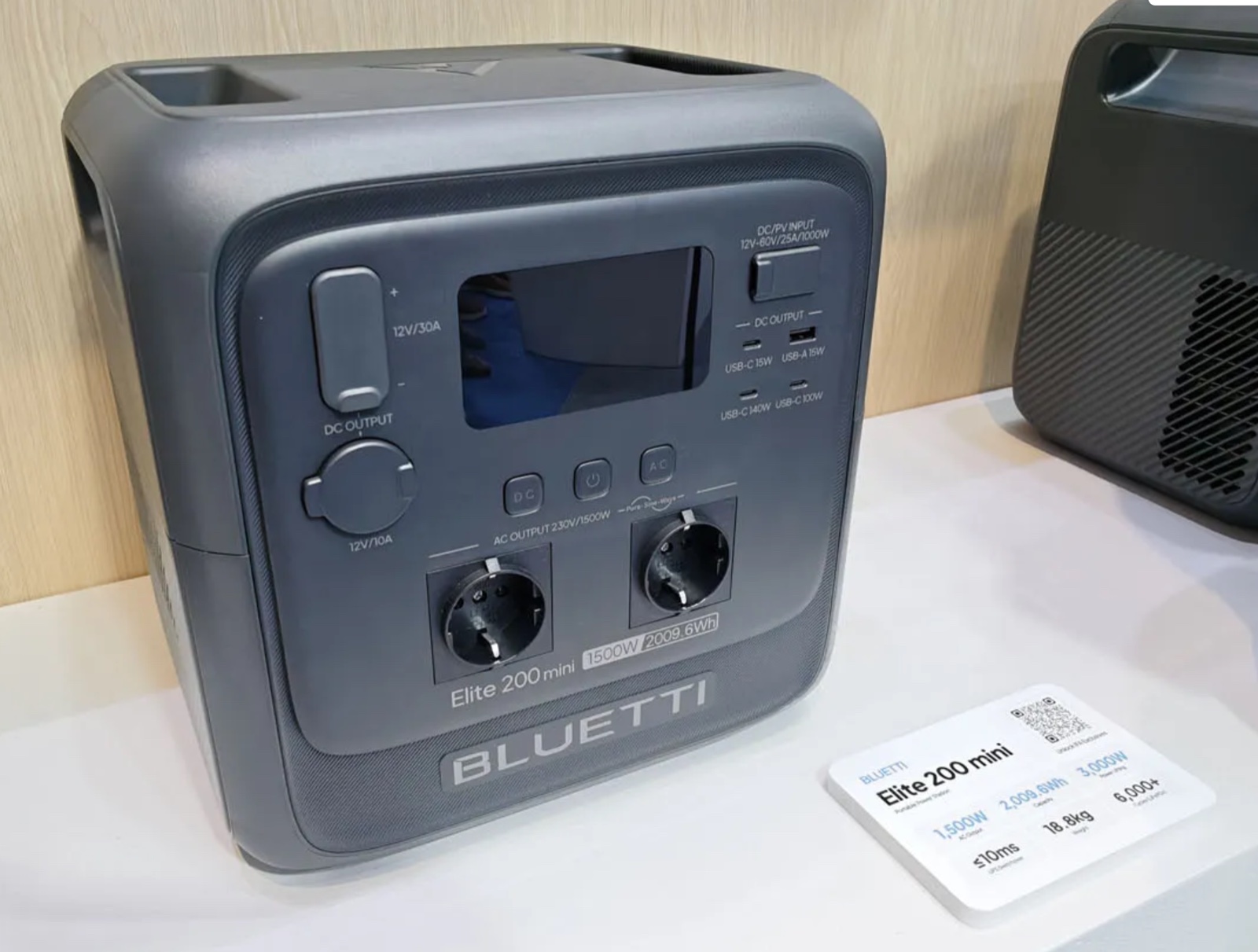
The second place the spec sheet tells on itself is BLUETTI’s own copy. The press release BLUETTI put out rates the Elite 200 mini at 1,600 W. The hardware says 1,500 W, four times over: moulded into the unit as a badge reading 1500W / 2009.6Wh, again in the legend AC OUTPUT 230V/1500W above its two Schuko sockets, on the spec placard beside it, and on the family slide. A regional-variant reading — 1,500 W for Europe, 1,600 W elsewhere — does not survive BLUETTI’s own stores, which list the same AC output for the Elite 200 V2, 100 V2 and 30 V2 in Europe as in the US. Nor has BLUETTI published 1,600 W anywhere it controls; it appears only in the press release, which the sites that ran it reproduced accurately. Plan around 1,500 W. If a spec sheet arrives at 1,600 W it narrows the output gap to the V2 from 42% to 38% (ours) and changes nothing else on this page.
Wait, or buy now? For the 200 mini the answer is already on the shelf. The Elite 200 V2 costs $899 today, with 3% more capacity and 1,100 W more inverter, and its whole penalty is 12 lb. The mini’s case rests on two numbers BLUETTI has not published — its price and its dimensions — plus a ship window of “Q4” with no region attached and no pre-order page to hold a place in. If the lift is what stopped you buying the V2, wait for the price and decide then. If it was anything else, buy the V2. For the 30 mini the answer is simpler: the Elite 30 V2 is the same 288 Wh at $239, twice the output, 10.3 lb, on sale now; the mini’s only argument is a weight and volume saving BLUETTI has not put a number on. What would change this verdict: a price that values 12 lb at less than 1,100 W, a US listing, and dimensions that put the 200 mini at the 42% end of BLUETTI’s range rather than the 15%.
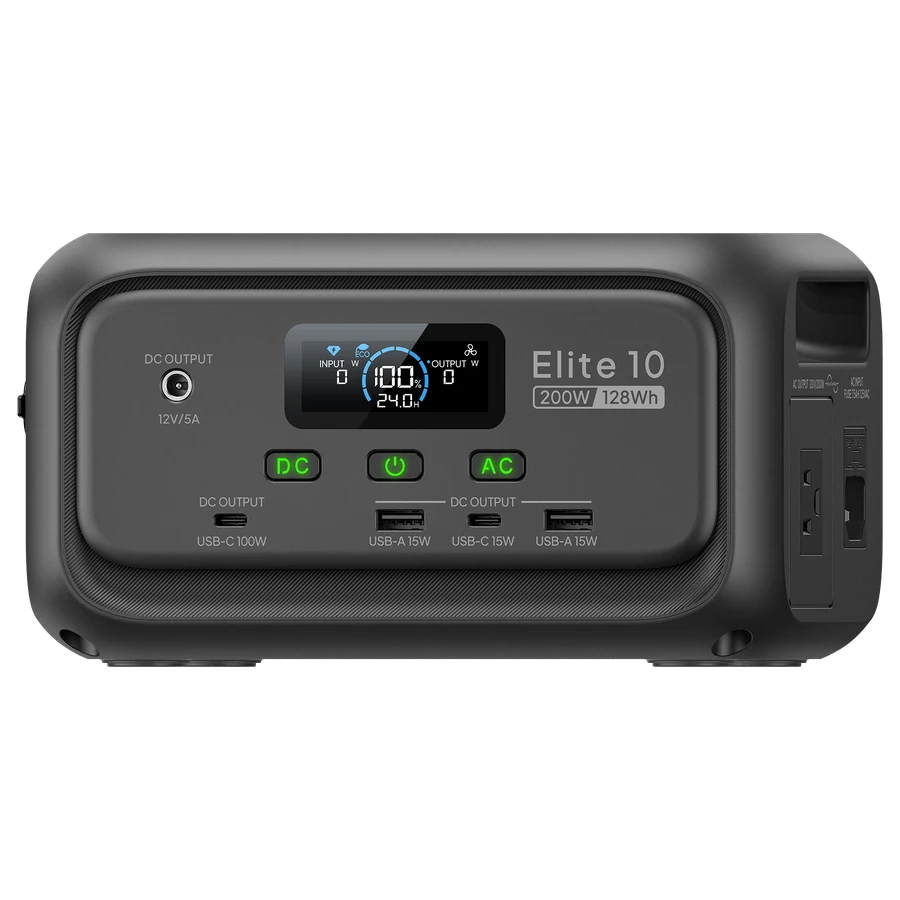
The Elite 30 mini’s panel is the more interesting unknown. It has an AC button and a 300 W rating, so it has an AC outlet; the photographed face shows none, so the outlets sit on a side nobody has shown, and their count and type are unpublished. Its two USB-C ports are marked IN/OUT 140W, so it charges over USB-C as well as through its 100 W DC/PV port; whether it takes AC in at all, and at what rate, BLUETTI has not said. A 288 Wh unit that charges only over USB-C and DC is a different product from one with a wall lead. The other blank that matters across both models is chemistry. BLUETTI named LFP for the Pioneer 5000 and the Balco 500 in the same release and did not for the minis; every other Elite is LFP, so it very likely is, but “very likely” is not a spec, and the 6,000+ cycles on the 200 mini’s placard comes without the retention threshold that would let you compare it to anything.