Head-to-head test
Goal Zero Yeti 300 vs Jackery Explorer 500
The Explorer 500 is the bigger battery and the Yeti 300 is the longer-lived one, and with nine dollars between them the only question that decides this is how many times you plan to refill it.
Full profiles: Goal Zero Yeti 300 → · Jackery Explorer 500 →

Written by Wenny ZhengUpdated
Portable Power Tester, Station Arena Test Desk
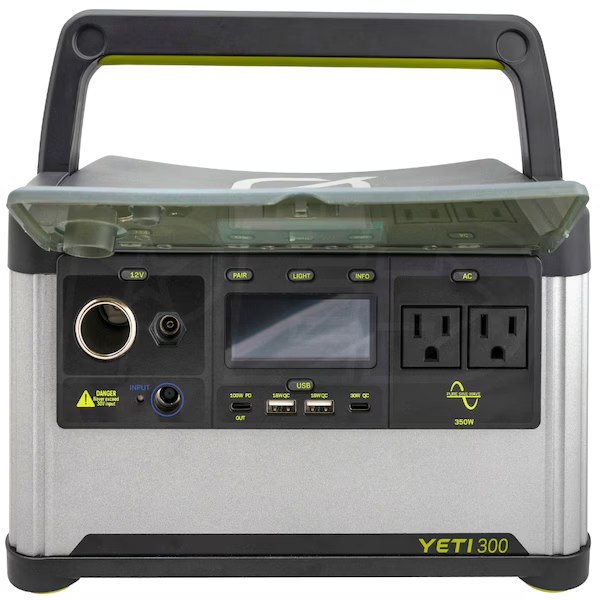
$349.95 · direct from Goal Zero
Last checked 1 day ago. Prices move — check before you buy.

$359.00 · direct from Jackery
Last checked 14 days ago. Prices move — check before you buy.
Spec deltas
Nine dollars separate these two: $350 for the Goal Zero Yeti 300, $359 for the Jackery Explorer 500. For that nine dollars you choose between 518Wh today and 297Wh that keeps coming back. You can't have both.
The Explorer 500 here is the original, not the v2, and it runs traditional lithium-ion cells rated to hold 80% of capacity for 800 cyclesB1B4. The Yeti 300 is a 6th-generation LFP unit rated for 4,000A1. Same shelf, same money, two different products once you stop looking at the nameplate and start counting the recharges.
Five of the seven load profiles on this page go unanswered by both units. One goes to the Explorer 500 alone, and one, an afternoon off-grid on 100Wh, both clear without breathing hard. That's the real shape of this decision: not which unit does more, but which of two small units you'd rather own for the handful of jobs either can do.
What the Numbers Reveal
Each conclusion stated first — the numbers behind it on one line, the full analysis below.
rated cycles
Nothing in that gap is a Goal Zero premium. It's chemistry. The Explorer 500 shipped on traditional lithium-ion, rated to hold 80% of its capacity for 800 cyclesB1, and Jackery's own answer to that was the v2, which put the same 518Wh onto LFPB4. Buying the original today means paying today's price for the generation that has already been replaced.
Yeti 300: $350 for 297Wh, rated 4,000 cyclesExplorer 500: $359 for 518Wh, rated 800 cyclesthe Explorer 500 is the original lithium-ion unit, not the LFP v2B1B4
Why it mattersAnyone who'll cycle this more than about once a week should stop comparing watt-hours and buy the Yeti 300.
That turns the Explorer 500's bigger tank into a narrower funnel. The Yeti 300 hands a laptop 100W directly off a USB-C port with the second one still free and two AC outlets untouched, and its 297Wh covers most of a working day on that laptopA3 without the inverter ever waking up. The Explorer 500 has more energy and fewer ways to spend it.
Explorer 500 ports: 1 AC outlet, 3 USB-A, no USB-C at all (0W maximum USB-C)Yeti 300 ports: 2 AC outlets, 2 USB-C rated 100W, 2 USB-Athe Yeti 300's 297Wh runs a laptop 4-6 hours or charges 20-30 phonesA3
Why it mattersIf your gear charges over USB-C, the Explorer 500 needs an adapter for all of it and the Yeti 300 needs none.
solar input
At this size, refill speed beats capacity. On a multi-day trip the Yeti 300 starts every morning full because it recovers over lunch, while the Explorer 500 spends the daylight catching up from one heavy evening. A unit that refills is effectively bigger than a unit that only drains, and wall power widens it further: the Yeti goes 0 to 100% in 50 minutesA2.
Yeti 300 accepts 200W of solar into a 297Wh packExplorer 500 accepts 100W of solar into a 518Wh pack, about 5.2 hours from empty at its rated ceilingboth clear the Afternoon Off-Grid profile's 100Wh: the Yeti 300 finishes at 40% used, the Explorer 500 at 23%
Why it mattersBuyers charging from a panel rather than an outlet should take the 200W input over the larger battery.
For the person eighteen inches from the unit at 3 a.m., that settles it before noise is even raised, and on noise the Explorer 500 is the only one of the two with a number to be held to. The Yeti's UPS mode doesn't rescue the night either: rated no worse than 20ms, it can carry a router through a flicker, not a machine through eight hours.
CPAP Overnight needs 320Wh; the Yeti 300 has 252Wh usable and finishes 68Wh shortthe Explorer 500's 440Wh usable covers the same night with 120Wh to spareGoal Zero publishes no noise figure for the Yeti 300; Jackery lists 37dB for the Explorer 500
Why it mattersCPAP users should buy the Explorer 500 of these two, or skip both for a unit sized to run the night twice.
The specific dimensions that decide these two units — everything else is a tie.
Lifetime Value
Selected because: Nine dollars apart at checkout, and nearly three times apart on the energy each one delivers before its pack is spent.
cost / lifetime kWh
The Yeti 300 is the expensive battery to buy and the cheap one to own. $1.18 per watt-hour at checkout is the pricier nameplate of the two, and it reads as a clear loss right up until you divide by the cycles each pack is rated for, at which point it inverts to $0.29 per lifetime kilowatt-hour against $0.87. Same money in, three times as much energy out.
That inversion survives every reasonable objection to it: the better-known brand, the extra USB-A port, even the bigger battery. Stack all of them and you have still bought the pack that runs out of cycles first, on the older chemistry, with a two-year warranty against five.
Your Life, Your Pick
Selected because: Five of the seven load profiles here are too big for both units, so the decision lives entirely in the two that aren't.
Both units fail the blackout, the van, the campsite and the workday, and none of them are close: eight hours of blackout essentials alone wants 1,645Wh, more than three times the Explorer 500's 440Wh usable. Reading those rows as a contest is the mistake. They are telling you this is a day-trip and desk class of product, and if your list has a fridge on it you are on the wrong page.
The two rows that do resolve split cleanly. The Explorer 500 takes the CPAP night outright, and both units clear an afternoon off-grid with capacity left over, the Yeti 300 at 40% used and the Explorer 500 at 23%. That second row is where most buyers at this size actually live, and because both pass it, the leftover watt-hours stop deciding anything and everything else on this page starts to.
Runtime: Will It Power Your Gear?
Selected because: 252Wh usable against 440Wh, after the flat 85% derate applied to both, is the Explorer 500's whole case and a genuine one.
continuous output
252Wh usable against 440Wh, after the flat 85% derate applied to both units, is the Explorer 500's one structural advantage and it deserves the credit: 188 more usable watt-hours is a second laptop charge, or the difference between reaching your alarm and not. The Yeti 300's 297Wh is four to six hours of laptop or twenty to thirty phone chargesA3, which is most of what anyone does with a station this size.
Output is where the gap gets physical. The Yeti 300 stops at 350W continuous with 600W of surge; the Explorer 500 holds 500W with 1,000W of surge. Neither is running a kettle, but those extra 150W of continuous headroom are the difference between plugging something in and standing over the unit waiting to see whether it holds.
What the Specs Don't Tell You
Selected because: Six cards fire on this pair and they don't all point the same way: solar input, USB-C and warranty favour the Yeti 300, the noise disclosure does not.
rated cycles
Five of these six cards point at the Yeti 300, and all on things nobody prints on the box: twice the solar input, two 100W USB-C ports against none, a listed UPS mode against none, a longer warranty, and the cycle rating that decides the whole page. Individually small. Together they are the gap between a unit that fits a modern kit bag and one that needs a bag of adapters.
The sixth card is the one to sit with. Goal Zero publishes no decibel figure for the Yeti 300, while Jackery publishes 37dB for the Explorer 500, and that absence is not proof the Yeti is loud. It is proof there is nothing to hold it to, which is a different problem and a slightly worse one if the unit is going in a room where somebody sleeps.
Brand Trust
Selected because: Neither company's support currently earns a premium, which makes where you buy this matter nearly as much as which one you buy.
The premium-brand argument for Goal Zero is thinner than it used to be. It is a Salt Lake City company with the deeper heritage and the tougher housing of the two, but its support has slid off its old standard through 2025-2026: long waits, email that goes unanswered, tickets left for weeks, and the official community forums shut down along the way. Jackery's record is no better, with scripted replies, strict receipt requirements, and refurbished units sent out to replace clearly defective ones.
So neither name buys you a safety net, which lands on a boringly practical conclusion: whichever you pick, buy it somewhere with a real return window. Jackery's distribution is the quiet advantage there, because Costco and Amazon both sit in front of its warranty process, and a return desk resolves faster than any support queue.
Strengths & trade-offs
Goal Zero Yeti 300
Strengths
- +Costs $9.1 less
- +Longer warranty
- +Faster solar charging
- +Rated for 4,000 charge cycles — much longer battery lifespan
Trade-offs
- –No major technical downsides compared to rival.
Jackery Explorer 500
Strengths
- +Lighter by 0.4 lb
- +Larger battery capacity
- +Higher AC output
Trade-offs
- –Lacks smartphone app control for remote monitoring.
- –Shorter-lived battery — rated for 800 charge cycles vs the Yeti 300's 4,000, so it wears out sooner.
Will It Power Your Gear?
Scenario math and per-appliance runtimes, modeled from the spec record.
Scenario verdicts
We ran the math on seven real-world scenarios. Here's which unit survives your actual life.
SCN-01 · 2 nights · needs 2,100Wh
Weekend Camping
Two nights off-grid with essential comfort
Neither unit
Neither unit covers this scenario's 2,100Wh: the Yeti 300 comes up 1,848Wh short (about 12% covered), the Explorer 500 1,660Wh (21%). This is well outside what either unit is for; the right answer here is a larger station, not a choice between these two.
Battery budget usedlower = more headroom
LOAD Phone Charger 15W×6h · LED Lights 40W×8h · Box Fan 75W×14h · CPAP Machine 40W×16h
SCN-02 · 8 hours · needs 1,645Wh
8-Hour Blackout
Keep the essentials running through a night without power
Neither unit
1,645Wh is what eight hours of the essentials costs, and the larger of these two holds 440Wh usable. That is about a quarter of the outage, and the Yeti 300's 252Wh usable is less again. The Yeti's UPS mode is still worth having for a router or a modem, because stopping gear from rebooting through a flicker is a different job from keeping it running all evening. Treat either unit as a bridge, not a backup.
Battery budget usedlower = more headroom
LOAD Fridge 150W×8h · Router + Modem 20W×8h · LED Lights (4 bulbs) 40W×6h · Phone Charger 15W×3h
SCN-03 · 8 hours · needs 320Wh
CPAP Overnight
Sleep therapy without interruption — the #1 medical use case
Explorer 500
320Wh is what this night costs, and the Yeti 300 has 252Wh usable to spend on it. It gets you about 79% of the way to your alarm and then stops, which is the worst possible hour to learn about a 68Wh shortfall. The Explorer 500 finishes with 120Wh still in the tank. At a bedside, that is not a close call.
Battery budget usedlower = more headroom
LOAD CPAP Machine 40W×8h
SCN-04 · 8 hours · needs 910Wh
Remote Workday
Full work day off-grid without power anxiety
Neither unit
Neither unit covers this scenario's 910Wh: the Yeti 300 comes up 658Wh short (about 28% covered), the Explorer 500 470Wh (48%). Treat this as partial cover — enough for the essentials in it, not the whole list.
Battery budget usedlower = more headroom
LOAD Laptop 60W×8h · External Monitor 30W×8h · Router + Modem 20W×8h · Phone Charger 15W×2h
SCN-05 · 4 hours · needs 670Wh
Tailgate Party
Game day power for the crew
Neither unit
The Yeti 300 will start the 400W load and then fail to hold it: 600W of surge gets it moving and the 350W continuous rating takes it away again, so capacity never gets a vote. The Explorer 500 can hold 400W and runs out of energy instead, 440Wh usable against the 670Wh the afternoon wants, 230Wh short. Two different failures, one answer, and it is a bigger unit.
Battery budget usedlower = more headroom
LOAD Blender 400W×0.5h · LED TV (55") 80W×4h · Bluetooth Speaker 15W×4h · Phone Charger (×3) 45W×2h
SCN-06 · 24 hours · needs 4,685Wh
Van Life Daily
A full day of mobile living — the ultimate endurance test
Neither unit
Neither unit covers this scenario's 4,685Wh: the Yeti 300 comes up 4,433Wh short (about 5% covered), the Explorer 500 4,245Wh (9%). This is well outside what either unit is for; the right answer here is a larger station, not a choice between these two.
Battery budget usedlower = more headroom
LOAD Mini-Fridge 150W×24h · Laptop 60W×4h · Phone Charger 15W×3h · LED Lights 40W×5h · Fan 75W×8h
SCN-07 · an afternoon · needs 100Wh
Afternoon Off-Grid
Phones and a speaker at the park, beach, or campsite — the small-unit job description
Either unit
Both finish this one without trying: 100Wh out of a 252Wh usable Yeti 300 or a 440Wh usable Explorer 500, landing at 40% and 23% used. Weight will not break the tie either, since 13.3 lbs against 13.7 is a rounding error you will never feel lifting it out of a trunk. What breaks it is tomorrow: the Yeti 300 takes 200W of solar against the Explorer 500's 100W, so both start the next afternoon full, but only one of them got there over lunch.
Battery budget usedlower = more headroom
LOAD Phone Charger (×2) 30W×2h · Bluetooth Speaker 10W×4h
The Load Test
RUNTIME = (Wh × 0.85) ÷ LOAD
None of the scenarios above exactly yours? Build it. Toggle what you'd plug in; both units are tested against the combined draw.
Essentials
Comfort & Convenience
High-Draw Appliances
Test duration
8h
Continuous draw
205W
Projected runtime
For this load: Explorer 500 runs 2.1h vs 1.2h.
$359 list · direct from Jackery
Modeled from the spec record — same math as the tables below. Methodology
Runtime by appliance
Real-world runtime estimates for common appliances, modeled at 85% inverter efficiency.¹
Essentials
The basics you need runningscale 0–29.4hComfort & Convenience
Makes off-grid life actually enjoyablescale 0–5.9hHigh-Draw Appliances
These reveal the real limits¹ Runtime = (capacity × 0.85) ÷ appliance watts. Within each group, all bars share one time scale (the group's longest runtime), so lengths are comparable across appliances; identical runtimes collapse into a single blue/orange bar. Actual runtime varies with battery age, temperature, and simultaneous loads — see methodology.
Conclusion
September 13, 2026
Verdict: the Goal Zero Yeti 300
Take the Yeti 300. For a nine-dollar difference you get a pack rated for 4,000 cycles instead of 800, on LFP instead of older lithium-ion, and that one swap is worth more than the Explorer 500's extra watt-hours to anyone who uses the unit regularly. The Yeti also refills from a panel in a fraction of the time, carries two 100W USB-C ports the Explorer 500 doesn't have at all, and is covered for five years instead of two. The composite scores them within a hair of each other, which is exactly why the tiebreak has to come from somewhere the score doesn't reach. The one real exception is the CPAP buyer: an overnight run wants 320Wh, more than the Yeti's 252Wh usable can finish, and the Explorer 500 clears it with reserve. If that's the job, buy the Jackery. For everything else a station this size actually does, buy the Goal Zero.
Editor-assigned confidence, based on cited owner research and spec analysis.
List prices as of September 13, 2026. The links below open Goal Zero's and Jackery's current prices.
$349.95 · direct from Goal Zero
Last checked 1 day ago. Prices move — check before you buy.
or check the Explorer 500 price$359.00 list
Written by Wenny Zheng, Portable Power Tester · Station Arena Test Desk · Updated September 13, 2026
Measured Data
Benchmark scores and the full spec record, side by side.
Benchmark scores
Not rated for both units (minimum threshold unmet): UPS, CPAP, Solar Generator, Tailgating.
Full specifications
ᵈ Derived: price ÷ rated capacity. See the data behind our comparisons →
Comparison ToolAdd more power stations, side by sideOpen Tool →How these numbers are produced
Numeric verification
Every figure on this page traces to our spec database or arithmetic on it — no estimated numbers.
Owner claims
Statements about owner experience are cited to published reviews — see Sources & Research Notes below.
Runtime model
Runtime = (rated capacity × 0.85 inverter efficiency) ÷ device wattage. Solar recharge estimates assume panels deliver 70% of rated output. Cold weather, battery age, and stacked loads reduce real-world results.
Power Score
Computed from 14 published spec dimensions, weighted per use-case bench. Higher is better; a unit must meet a bench's minimum threshold to be rated.
See the full weight table and data sourcing on our methodology page →Class ranking (the star rating)
Each unit's star score is a category ranking, not customer reviews — no buyer opinions feed it. We score every station on size-independent quality (value, output, portability, endurance, ports, warranty, and more), then percentile-rank it against the other units in its capacity class, so a class-leading compact unit and a class-leading whole-home unit can both earn 5★. Here, Yeti 300 rates 3.7/5 (24th percentile of 22 Personal-class units), and Explorer 500 rates 3.3/5 (1st percentile of 20 Compact-class units).
How the class ranking is computed →Test Notes & Caveats
Hidden gotchas and advantages we spotted that you won't find on the product page.
Explorer 500: Solar Is a Top-Up, Not a Plan
100W of solar input into 518Wh works out to about 5.2 hours from empty, and that is the optimistic version: the rated figure assumes ideal panel angle and clear sky, and real days deliver less. Plan on a wall outlet as the primary source and treat the panel as a trickle. For contrast, the Yeti 300 takes 200W into a 297Wh pack, roughly an hour and a half of the same sun.
Explorer 500: No App, And How Much That Matters
The Explorer 500 has no app control, so checking the charge level means walking over and looking at it. The Yeti 300 does have one, low-battery alerts included. Be honest about how much that changes your day: this is a 13.7-pound box that lives in whatever room you are in, and you will mostly be within arm's reach of its screen. Call it a real convenience and a thin reason to choose.
Only the Yeti 300 Lists a UPS Mode
The Yeti 300 can sit between the wall and your gear and hand it to battery when the grid drops — rated ≤20ms — fine on paper for routers and most electronics; the fussiest PC power supplies sit right at this line. Worth it for a router or a modem — not a CPAP: at 252Wh usable it can bridge the flicker but cannot run the night. The Explorer 500's spec sheet lists no UPS mode, so anything plugged into it rides an outage only as far as your reaction time.
Five Years Against Two, No Registration Required
The Yeti 300 carries a 5-year warranty, and Goal Zero does not condition it on registering the unit, which is worth saying out loud because plenty of long warranties in this category come with strings. The Explorer 500's term is 2 years. Spread across the covered years that is $70 a year of coverage on the Yeti 300 against $180 on the Explorer 500, and on a unit you plan to keep it is the quiet half of the longevity argument.
Battery Lifespan in Real Years
The Yeti 300 is rated for 4,000 cycles vs 800. In real life: at daily use, that's 11 vs 2.2 years. At weekend use (twice a week), it's 38 vs 8 years. One caution reading years across different sizes: a cycle is 297Wh on the Yeti 300 and 518Wh on the Explorer 500, so count lifetime energy — roughly 1,188 kWh against 414 kWh over the rated life. After hitting the cycle limit, the battery doesn't die — it drops to ~80% of original capacity, which is still very usable.
Yeti 300: No Published Noise Figure
Goal Zero does not publish a decibel rating for the Yeti 300. That is an absence, not an accusation: there is no evidence here that it runs loud, only nothing to hold it to. Jackery lists 37dB for the Explorer 500, and that is worth what spec-sheet noise figures are generally worth, since makers usually quote a best case and often a capped quiet mode, which makes the number a floor rather than a ceiling. Buying for a bedroom or a CPAP, treat the published figure as a starting point and a hands-on listen as the real test.
Full record above — the Test Desk pick is the Yeti 300.
Check Yeti 300 price →or check the Explorer 500 priceOwnership Analysis
What happens after you buy — true cost of ownership, brand trust, and growth potential.
Lifetime value
Service lifeyears at one full cycle per day
Lifetime energy delivered
Cost per delivered kWh
│ warranty ends · Reaching the cycle rating means ~80% capacity remains — degraded, not dead.
Analyst note
The Yeti 300 wins on both sticker price and long-term value. At $0.29/kWh over its lifetime, it's meaningfully cheaper to own. Clear value winner.
Delivers each lifetime kWh for $0.58 less — check the Yeti 300 price →
Brand trust
Goal Zero
Ecosystem
Focused — a compact current line (6th-gen Yeti and Yeti Pro series), the previous-gen X series now out of stock across every model on Goal Zero's own store (checked 2026-09-13: 200X, 500X, 1000X, 1500X, 3000X, 6000X, some listed only as open-box), so buying one new means finding retailer stock, Sherpa power banks for the under-100Wh tier, plus Alta coolers, Nomad/Ranger solar panels, and vehicle integration kits
Support
Goal Zero is a Salt Lake City company owned by NRG Energy, and its support has slipped from the premium standard it built its name on: long waits, email that goes unanswered, tickets left sitting for weeks through 2025-2026. The price no longer buys the queue it used to.
Community
Small and loyal, concentrated in overlanding and preparedness circles. The official forums were shut down recently, which took the best place to search for an answer with them.
App experience
Rated 4.4/5 iOS (~1,200 ratings) but recent reviews skew negative — recurring connectivity issues, crashes, and stability problems.
Unique strength
It invented this category and still builds like it, with ruggedized housings, weather resistance, and a Yeti-Ready ecosystem of coolers, lights and vehicle kits that genuinely plug into each other. IP ratings vary by model, so check the rating on the unit you are actually buying.
Worth knowing
Goal Zero is usually the priciest watt-hour in any given matchup and it is here too at checkout. This happens to be one of the pages where that inverts once you divide by the cycles the pack is rated for, so do not assume the inversion holds elsewhere in the line.
Jackery
Ecosystem
Twelve to fifteen models across the Explorer portables and HomePower backup line, plus the SolarSaga panel range and some genuinely odd experiments like the Solar Gazebo.
Support
US-based and widely criticised: slow or dismissive replies, scripted agents, strict receipt requirements, and refurbished units sent out to replace clearly defective ones. The practical workaround is to buy where returns are easy rather than to rely on the warranty department.
Community
Smallest community of the major brands — Reddit r/Jackery has ~2,000 members. YouTube presence is solid due to brand recognition.
App experience
Rated 2.3-3.3/5 iOS and Android — the weakest app experience of the major brands. Multiple confusing apps (Jackery app vs Jackery Home) and mandatory login even offline.
Unique strength
Jackery is the most recognised name here and the easiest to buy, stocked by Costco, Home Depot, Best Buy and Amazon. That distribution is a real feature, because a retailer's return window resolves faster than any warranty process.
Worth knowing
A couple of older Jackery models still ship NMC cells with a shorter rated lifespan, and the Explorer 500 is one of them, while most of the current line has moved to LFP. Check the cycle rating on the exact unit a listing is selling, not the model family.
Analyst note
Neither brand earns a trust premium on this page. Goal Zero has the heritage and the housing, Jackery has the distribution, and both have support queues people complain about. That points somewhere useful: pick on the hardware, then buy from whoever gives you the easiest return, because that is the warranty you will actually end up using.
Growth path
Yeti 300
FIXED CAPACITYFixed at 297Wh, with no expansion — so size it for your needs up front rather than planning to add capacity later.
Accepts up to 200W of solar. Limited to a single portable panel.
Adequate ports for most setups, but heavy users may want a power strip.
Explorer 500
FIXED CAPACITYFixed at 518Wh, with no expansion — so size it for your needs up front rather than planning to add capacity later.
Accepts up to 100W of solar. Limited to a single portable panel.
Limited ports. You'll likely need a power strip or splitter.
Realistic full solar rechargeat 70% of rated panel output — see methodology
Analyst note
Neither expands, and that's no knock on either — each is a complete unit at a fixed size. Buy the capacity that covers your needs now (the Explorer 500 gives you the larger ceiling); you can't add to either later.
What Owners Report
Patterns from published owner reports and long-term reviews — every claim cited to its source below.
Goal Zero Yeti 300
Field material on the Yeti 300 is reviewer coverage rather than long-term ownership, so read it as first impressionsA1A2A4. What exists is consistent: a 297Wh LiFePO4 pack behind a 350W pure sine inverter with 600W of surge, rated 4,000 cycles, a unit built for service life rather than outputA1. Build quality draws the strongest praise, with rubberized corners, a handle that feels structural, IP54 dust and water resistance, and 0 to 100% in 50 minutesA2.
The complaint is the obvious one and it is honest. 297Wh is light-duty, and it has a hard ceiling: pushed near its continuous limit it shut down two minutes into a coffee makerA3. At $350 the price stings for the watt-hours you get, which is the fairest single sentence written about this unitA4. Our own coverage note adds the distinction that matters when you are reading older reviews: this is the modern 6th-generation LFP Yeti, not the NMC X-series that shares the nameA0.
“A 297Wh LiFePO4 pack behind a 350W pure sine inverter (600W surge), rated 4,000 cycles — Goal Zero backs it with a long service life rather than raw output.”
Sources
goalzero.com · batteryskills.com · campingsolar.us · trailandkale.com · the-gadgeteer.com
Jackery Explorer 500
Coverage of the Explorer 500 keeps circling one fact: it is the pre-LFP unit. 518Wh and 500W of output on traditional lithium-ion cells, with Jackery rating 80% capacity retention after 800 cyclesB1. Reviewers who have looked at both generations are direct about it, since the v2 moved to LiFePO4 and offers significantly better longevityB4, and our coverage note says the sameB0.
The praise is real and it is narrow. This is a compact, genuinely portable 13.3-pound boxB2 and the most affordable way into Jackery's ecosystem, recommended for weekend warriors and occasional usersB3. That last phrase is doing more work than it looks like. Occasional use is precisely the duty cycle where 800 cycles never becomes your problem, and it is the only condition under which this unit's economics hold.
“518Wh capacity with a 500W output, on traditional lithium-ion cells — Jackery rates 80% capacity retention after 800 cycles.”
Sources
backuppowerhub.com · jackery.com · greencitizen.com · poweredportablesolar.com · batteryessence.com
Sources & Research Notes
Every owner claim in this report is traceable to a published source. The bracketed references above resolve here.
Recurring owner themes
- Modern LFP (4,000+ cycles), IP54 ruggedness, and fast charging are the praise; small capacity and high price are the caveats. [Yeti 300 · 3 entries]
- Affordable, portable Jackery entry unit, but on older lithium-ion chemistry with limited cycle life vs newer LFP models. [Explorer 500 · 3 entries]
- A1
“A 297Wh LiFePO4 pack behind a 350W pure sine inverter (600W surge), rated 4,000 cycles — Goal Zero backs it with a long service life rather than raw output.”
goalzero.com / batteryskills.com — Yeti 300 review · 2026 · [positive]
- A2
“At 13.7 lbs, meets IP54 for dust and water resistance, with top-tier build quality — rubberized corners and a sturdy handle; recharges 0-100% in 50 minutes.”
campingsolar.us / trailandkale.com — Yeti 300 review · 2026 · [positive]
- A3
“The 297Wh capacity limits it to lighter-duty use — 4-6 hours on a laptop or 20-30 phone charges — and it struggled near its 300W limit, shutting down after 2 minutes with a coffee maker.”
batteryskills.com — Yeti 300 review · 2026 · [mixed]
- A4
“A modern LFP (not NMC) rugged compact unit, though at $349.95 the price stings for the capacity.”
the-gadgeteer.com — Yeti 300 review · 2026 · [mixed]
- B1
“518Wh capacity with a 500W output, on traditional lithium-ion cells — Jackery rates 80% capacity retention after 800 cycles.”
backuppowerhub.com / jackery.com — Explorer 500 review · 2026 · [mixed]
- B2
“Weighs about 13 lbs — a compact, portable unit.”
greencitizen.com / poweredportablesolar.com — Explorer 500 review · 2026 · [positive]
- B3
“The 518Wh capacity at $449 is the most affordable entry into Jackery's reliable ecosystem — good for weekend warriors and occasional users.”
backuppowerhub.com — Explorer 500 review · 2026 · [positive]
- B4
“An older lithium-ion unit; the newer Explorer 500 v2 uses LiFePO4 rated for far more cycles, offering significantly better longevity.”
batteryessence.com / backuppowerhub.com — Explorer 500 v2 review · 2026 · [mixed]
Research compiled September 13, 2026.
Who Should Buy Which
Buy the Yeti 300 if you…
- →You will use it most weekends rather than twice a summer. Repeat use is the entire argument for this unit, and it is the condition under which the Explorer 500's watt-hour advantage quietly disappears.
- →Your bag is USB-C. A laptop and a phone both charge straight off the 100W ports, no bricks and no inverter involved.
- →You charge from a panel more than from a wall outlet. Twice the solar input into a smaller pack means it is back to full inside an afternoon.
- →You keep a router, a modem or a desk setup from rebooting through flickers. It is the only one of the two with a listed UPS mode, rated no worse than 20ms.
- →You expect to still own it in five years, and you would rather have a five-year warranty that does not ask you to register the unit first.
Buy the Explorer 500 if you…
- →You need one unbroken night for a CPAP. 440Wh usable against the 320Wh that night costs is the only pass on this page the Yeti 300 does not also make.
- →You will use it a handful of times a year. At that duty cycle the cycle rating never bites, and the bigger battery for nine dollars is simply the better buy.
- →You want the most watt-hours you can get at this price and would rather have headroom tonight than longevity in a decade, which is a fair trade as long as you know it is the trade.
- →You would rather lean on a return desk than a warranty department. Costco, Home Depot, Best Buy and Amazon all stock Jackery, and that matters more than it should.
- →Noise matters to you and you want a published figure to point at, understanding that it is a spec-sheet number rather than something anyone measured in your bedroom.
If neither fits
Anyone whose list runs to a fridge, an outage, or a week in a van. Eight hours of blackout essentials wants 1,645Wh and van life daily wants 4,685Wh, while the larger of these two holds 440Wh usable; that is not a gap careful rationing closes. Two other people should also close this tab: anyone who wants the Explorer 500's capacity on modern cells, who should be pricing the LFP v2 rather than this originalB4, and anyone shopping on watt-hours per dollar alone, who should skip this size class entirely and price a kilowatt-hour-class LFP unit instead.
The Bottom Line
Nine dollars, and one of these is still working when the other has been replaced. The Explorer 500 wins the spec sheet you read at checkout, with more watt-hours, more output and a published noise figure, and then loses every year after it, because the older cells run out of cycles first and a bigger tank does not refill itself.
The exception is worth repeating because it is the one that will bite somebody: if this unit's job is a CPAP, the Yeti 300 does not reach morning and the Explorer 500 does. That is a real loss on our pick, and the only row where the bigger battery converts into a win. Everybody else is buying an afternoon of power off a panel, and for that you want the one that refills over lunch and is still doing it in a decade. Take the Yeti 300.
Frequently Asked Questions
Answers drawn from the spec record and cited owner research.
Can the Jackery Explorer 500 run a CPAP all night?
Yes, with reserve. An overnight CPAP run takes 320Wh and the Explorer 500 has 440Wh usable, so it finishes the night with 120Wh left. The Yeti 300 does not: 252Wh usable leaves it 68Wh short, roughly 79% of the way to your alarm. If a CPAP is the reason you are buying, this is the one of the two.
Is the Jackery Explorer 500 LiFePO4?
The original is not. It runs traditional lithium-ion cells, which Jackery rates to hold 80% of capacity for 800 cycles. The Explorer 500 v2 is the LiFePO4 version and is rated for far more cycles, so check which one a listing is actually selling before you buy on the model name alone.
Does the Goal Zero Yeti 300 have USB-C?
Two ports, rated 100W, enough to charge most laptops directly. The Explorer 500 has no USB-C at all, just three USB-A ports and a single AC outlet, so a modern laptop there means running the inverter to feed its wall brick. If your gear is USB-C, that difference shows up every day you use the thing.
How long does each one take to recharge from solar?
The Yeti 300 accepts 200W into a 297Wh pack, so from empty it is about an hour and a half of rated sun. The Explorer 500 accepts 100W into 518Wh, about 5.2 hours, and that figure assumes ideal panel angle and clear sky, so plan on longer. From a wall outlet the Yeti 300 goes 0 to 100% in 50 minutes.
Can either of these power a fridge or run my house during a blackout?
No. Eight hours of blackout essentials needs 1,645Wh and the larger of these two holds 440Wh usable, so you would cover about a quarter of it. The Yeti 300 will bridge a flicker for a router through its UPS mode, rated no worse than 20ms, but neither unit is outage equipment. For that you want a station several times this size.
Where to buy
Goal Zero Yeti 300Pick
$349.95
$349.95 · direct from Goal Zero
Last checked 1 day ago. Prices move — check before you buy.
Jackery Explorer 500
$359.00
$359.00 · direct from Jackery
Last checked 14 days ago. Prices move — check before you buy.
Prices may vary by retailer and are subject to change.