Head-to-head test
EcoFlow DELTA Pro Ultra X vs Goal Zero Yeti 3000X
One of these bolts into your service panel and the other rolls out of the garage on a cart, and no quantity of watt-hours makes that the same purchase.
Full profiles: EcoFlow DELTA Pro Ultra X → · Goal Zero Yeti 3000X →

Written by Gunner GustafsonUpdated
Whole-Home Backup Tester, Station Arena Test Desk

$7,999.00 · direct from EcoFlow
Last checked 1 day ago. Prices move — check before you buy.
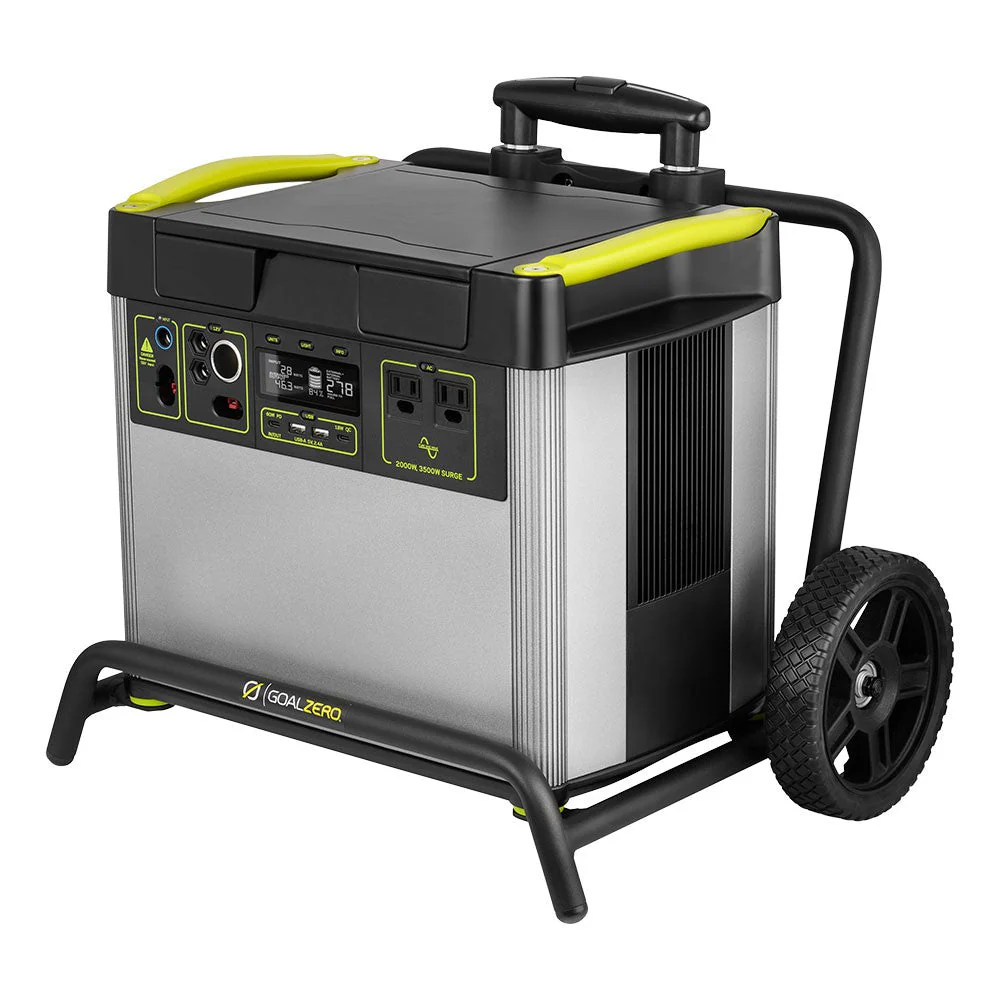
$2,999.95 · direct from Goal Zero
Last checked 1 day ago. Prices move — check before you buy.
Spec deltas
The DELTA Pro Ultra X puts out 12,000W at 120/240V. That is not a number you plug into a wall outlet. It's a number an electrician ties into a panel, and it's why this page isn't really a comparison between two power stations.
The Yeti 3000X is the other kind of object: 69.8 lbs, 2,000W, and a roll cart in the box because you'll need oneB2. If you can get it into a truck bed, it goes where you're going. The Ultra X goes nowhere once it's in.
So the Ultra X takes nearly every line the table draws, except the two a portable buyer came for: what it weighs and what it costs. That matters less than it looks. The interesting question isn't which of these is better. It's whether the Yeti's 500-cycle batteryB1 is a good buy at $3,000, and the answer to that has nothing to do with the $7,999 system it's being measured against.
What the Numbers Reveal
Each conclusion stated first — the numbers behind it on one line, the full analysis below.
weight
The spec table compares these two on watt-hours, watts and dollars, and never touches the only difference that decides the purchase: one of them requires a permit and an electrician, the other requires a free afternoon and a strong back. A buyer who reads the Ultra X as a bigger Yeti is reading a home electrical project as a shopping upgrade.
DELTA Pro Ultra X: 12,000W continuous at 120/240V, 45,000W surgeDELTA Pro Ultra X: 298.7 lbs, a system total covering an inverter plus the battery modules behind its 12,288WhA2The Ultra X ledger's own headline is installation speed and a 7-day turnaround, not a runtimeA4Yeti 3000X: 69.8 lbs, ships with a roll cartB2
Why it mattersIf you don't own the panel you'd be wiring into, the Ultra X isn't expensive, it's unavailable, and the comparison ends there.
rated cycles
Hitting the rating isn't failure. It's roughly 80% of the capacity you paid for, and the unit keeps working. But a chemistry whose rated life expires before its warranty does is telling you plainly what it was designed for, and it wasn't daily cycling. The Ultra X reaching the same milestone at 9.6 years is a different design intent, not just a bigger number.
Yeti 3000X: Li-ion NMC rated 500 cycles to 80% capacity, against LFP units rated past 3,000B1Yeti 3000X warranty: 2 yearsAt a cycle a day, 500 cycles is reached in 1.4 yearsDELTA Pro Ultra X: 3,500 cycles, 9.6 years at the same daily rate
Why it mattersIf this battery is going to work most days, the Yeti's chemistry is the disqualifier, whatever the price.
cost / lifetime kWh
The lifetime-value column describes the battery's potential, not the buyer's electricity bill. For a house drawing on this pack every day it's an accurate forecast and the strongest argument on the page. For anyone cycling it lightly, the Ultra X's $7,999 stays $7,999 and the per-kilowatt-hour advantage is never collected. The same distortion runs the other way on the Yeti: its 4.8-year weekend life assumes you flatten all 3,032Wh every trip.
DELTA Pro Ultra X: $0.19 per lifetime kilowatt-hour, from 43,008 kWh over 3,500 cyclesYeti 3000X: $1.98 per lifetime kilowatt-hour, from 1,516 kWh over 500 cyclesAt two cycles a week, the Ultra X takes 33.7 years to reach 3,500 cyclesThe Ultra X's cheapest scenario load on this page is 670Wh against 12,288Wh of capacity
Why it mattersCheck your own cycle count before you let $0.19 versus $1.98 decide anything. If you won't cycle it near-daily, buy on the sticker instead.
solar input
In a multi-day outage the capacity number stops mattering on the morning of day two, and the input ceiling takes over. Storms are also the weather that flattens solar yield, so a 600W ceiling means your outage plan is to hope for a clear day. The Yeti compounds it by having no UPS at all, so the outage announces itself by rebooting everything you had plugged in.
Yeti 3000X: 600W maximum solar input into 3,032WhDELTA Pro Ultra X: 10,000W solar input into 12,288Wh8-Hour Blackout needs 1,645Wh, leaving the Yeti 932Wh spareYeti 3000X has no UPS switchover
Why it mattersIf storms are why you're shopping, treat solar input as the survival spec and capacity as the comfort spec.
The specific dimensions that decide these two units — everything else is a tie.
Portability & Form Factor
Selected because: 298.7 lbs of wired system against 69.8 lbs and a roll cart is what decides whether this is even a choice.
weight
298.7 lbs isn't a lift, it's a delivery. That figure is the whole system rather than one case: an inverter plus the battery modules that add up to the 12,288Wh headline, 6,144Wh apieceA2. Nobody ever picks up 298.7 lbs, and nobody ever relocates the assembled thing either. It arrives, it gets wired, it stays.
The Yeti's 69.8 lbs is a different category of problem. Heavy enough that Goal Zero puts a cart in the boxB2, light enough that one determined person gets it into a trunk. That's the entire comparison in physical terms. One of these has a location; the other has a route.
Lifetime Value
Selected because: 3,500 cycles against 500 puts these $0.19 and $1.98 apart per lifetime kilowatt-hour, and it's worth knowing who actually collects that.
cost / lifetime kWh
Nineteen cents a kilowatt-hour against a dollar ninety-eight. Read it once, because the rest of this section is about whether that number is yours to collect.
It isn't, for most people. The $0.19 assumes 3,500 full cycles through the Ultra X, and at two cycles a week that's 33.7 years. The figure is honest for a house that draws on the pack every day, which is the job this system was built to do. For anyone lighter, it's describing a battery, not a bill. The Yeti's $1.98 carries the mirror-image flaw in its own favour: a 4.8-year weekend lifespan assumes you drain all 3,032Wh every trip, and a weekend rarely does.
Your Life, Your Pick
Selected because: Five of six scenarios go to the Ultra X, and our scoring model has no class for a system you install rather than carry.
Our scenario set has no installed-system class, and this pair is where the omission shows. Weekend Camping and Tailgate Party score the Ultra X as though it drove itself to the site and set itself up, and their scoring explicitly rewards the lighter unit, so a wired 12,000W fixture sweeps a table it shouldn't have been entered in. Read the sweep as arithmetic about watt-hours, not as advice about your Saturday.
Van Life Daily is where the set earns its keep, because it's the only load big enough to separate the two: 4,685Wh needed against 2,577Wh usable leaves the Yeti 2,108Wh short. Everything else on the list sits far enough under both units that it's measuring headroom nobody will use.
Growth Path
Selected because: Both spec rows say expandable; only one of them expands into something worth having.
solar input
"Expandable: Yes" on both rows is the least informative line in the spec table. The Yeti grows through Goal Zero's Tank, which is lead-acid: coverage of it puts the usable share at roughly half, and connecting one also takes half the onboard lithium out of playB4. You bolt on a battery and the system you already own gets smaller. That's a hole the expansion has to climb out of before it adds anything.
The Ultra X does genuinely scale, by adding battery modules and inverters rather than by being replacedA2, and its 10,000W solar ceiling against the Yeti's 600W means a bigger bank has something to fill it. What we can't tell you is how far it goes. Our sources don't agree on the maximum, so buy the base system on the base system's numbers and treat anything above that as unpriced.
Brand Trust
Selected because: A 500-cycle pack under a 2-year warranty makes after-sale support part of the purchase, not an afterthought.
A 500-cycle pack under a 2-year warranty means who answers the phone matters more here than on most pages. Our brand assessment records Goal Zero's support sliding away from its old premium standard, with long waits, unanswered tickets and community forums shuttered, at the same time as the marketing leans on heritage. That's an awkward combination on a unit whose battery can reach its rated life inside the warranty window.
EcoFlow isn't a clean alternative. Our brand assessment describes polarized outcomes there too, some buyers getting painless prepaid-label replacements and others waiting, and the October 2025 DELTA Max 2000 recall is on the record. What differs is the consequence: a portable that needs service ships back in a box, while a wired 12,000W system needs somebody to come to your house. Ask both companies about out-of-warranty service before you commit. EcoFlow's own profile says it doesn't offer any.
Strengths & trade-offs
EcoFlow DELTA Pro Ultra X
Strengths
- +Larger battery capacity
- +Higher AC output
- +Longer warranty
- +Faster solar charging
- +Rated for 3,500 charge cycles — much longer battery lifespan
Trade-offs
- –Substantially more expensive (+$4,999.1) than the Yeti 3000X.
- –Significantly heavier (+228.9 lbs), making it harder to move.
- –Very heavy unit that may be difficult for one person to lift.
Goal Zero Yeti 3000X
Strengths
- +Costs $4,999.1 less
- +Lighter by 228.9 lb
Trade-offs
- –Weaker inverter (-10,000W) limits appliance compatibility.
- –Shorter-lived battery — rated for 500 charge cycles vs the DELTA Pro Ultra X's 3,500, so it wears out sooner.
Will It Power Your Gear?
Scenario math and per-appliance runtimes, modeled from the spec record.
Scenario verdicts
We ran the math on six real-world scenarios. Here's which unit survives your actual life.
SCN-01 · 2 nights · needs 2,100Wh
Weekend Camping
Two nights off-grid with essential comfort
Yeti 3000X
Both cover a 2,100Wh weekend. The Yeti finishes with 477Wh in reserve, which is a genuine buffer for a phone-and-lanterns morning and not enough for an unplanned third night. The Ultra X finishes with 8,345Wh, which is more than a camping trip will ever ask of it. If your weekends look like this one, capacity stopped being the question a long way back.
Battery budget usedlower = more headroom
LOAD Phone Charger 15W×6h · LED Lights 40W×8h · Box Fan 75W×14h · CPAP Machine 40W×16h
SCN-02 · 8 hours · needs 1,645Wh
8-Hour Blackout
Keep the essentials running through a night without power
DELTA Pro Ultra X
A 1,645Wh night leaves the Yeti 932Wh and the Ultra X 8,800Wh. Night two is where they part, and the spec that settles it isn't capacity, it's refill. The Yeti tops up at 600W of solar; the Ultra X takes 10,000W. Storms are also the weather that kills solar yield, so plan the recharge before you plan the reserve.
Battery budget usedlower = more headroom
LOAD Fridge 150W×8h · Router + Modem 20W×8h · LED Lights (4 bulbs) 40W×6h · Phone Charger 15W×3h
SCN-03 · 8 hours · needs 320Wh
CPAP Overnight
Sleep therapy without interruption — the #1 medical use case
Either unit
A 320Wh night is 3% of the Ultra X and 12% of the Yeti, so capacity settles nothing and it's rightly scored even. Two real specs break the tie in opposite directions: the Ultra X has UPS carry-over and the Yeti has none, while the Yeti is a box you can set beside the bed and the Ultra X is wired into the building. If CPAP backup is the whole reason you're shopping, a smaller unit with a UPS mode does this job better than either.
Battery budget usedlower = more headroom
LOAD CPAP Machine 40W×8h
SCN-04 · 8 hours · needs 910Wh
Remote Workday
Full work day off-grid without power anxiety
DELTA Pro Ultra X
910Wh is 9% of the Ultra X and 35% of the Yeti, and both finish the day without incident. The reserve win goes to the Ultra X on the numbers, and it's also the least useful win on this page. A laptop, a monitor and a video call have no opinion about 9,535Wh sitting unused. If this is your actual load, you're shopping two classes too high.
Battery budget usedlower = more headroom
LOAD Laptop 60W×8h · External Monitor 30W×8h · Router + Modem 20W×8h · Phone Charger 15W×2h
SCN-05 · 4 hours · needs 670Wh
Tailgate Party
Game day power for the crew
Yeti 3000X
670Wh of game day, cleared by both without noticing: 6% used against 26%. The headroom win goes to the Ultra X, and then the parking lot has its own opinion. The Yeti comes with a cart. The Ultra X comes with a wiring diagram. Take the reserve figure as a statement about capacity, not about tailgating.
Battery budget usedlower = more headroom
LOAD Blender 400W×0.5h · LED TV (55") 80W×4h · Bluetooth Speaker 15W×4h · Phone Charger (×3) 45W×2h
SCN-06 · 24 hours · needs 4,685Wh
Van Life Daily
A full day of mobile living — the ultimate endurance test
DELTA Pro Ultra X
This is the load that separates them. A 4,685Wh day needs more than the Yeti's 2,577Wh usable, leaving it 2,108Wh short, so it covers a bit over half the day and then the van goes dark. The Ultra X handles the same day at 45% used with 5,760Wh still in hand. If your daily draw is anywhere near this, the Yeti is the wrong unit rather than a tight fit.
Battery budget usedlower = more headroom
LOAD Mini-Fridge 150W×24h · Laptop 60W×4h · Phone Charger 15W×3h · LED Lights 40W×5h · Fan 75W×8h
The Load Test
RUNTIME = (Wh × 0.85) ÷ LOAD
None of the scenarios above exactly yours? Build it. Toggle what you'd plug in; both units are tested against the combined draw.
Essentials
Comfort & Convenience
High-Draw Appliances
Test duration
8h
Continuous draw
205W
Projected runtime
For this load: DELTA Pro Ultra X runs 51h vs 12.6h.
$7,999 list · direct from EcoFlow
Modeled from the spec record — same math as the tables below. Methodology
Runtime by appliance
Real-world runtime estimates for common appliances, modeled at 85% inverter efficiency.¹
Essentials
The basics you need runningscale 0–696.3hComfort & Convenience
Makes off-grid life actually enjoyablescale 0–139.3hHigh-Draw Appliances
These reveal the real limitsscale 0–10.4h¹ Runtime = (capacity × 0.85) ÷ appliance watts. Within each group, all bars share one time scale (the group's longest runtime), so lengths are comparable across appliances; identical runtimes collapse into a single blue/orange bar. Actual runtime varies with battery age, temperature, and simultaneous loads — see methodology.
Conclusion
August 9, 2026
Verdict: the DELTA Pro Ultra X, on Power Score margin
Take the DELTA Pro Ultra X if you have somewhere to install it: a panel, an electrician, and loads that actually want 12,000W at 120/240V. In that job it isn't close. 3,500 cycles against 500B1 works out to $0.19 per lifetime kilowatt-hour against $1.98, its solar ceiling is 10,000W against 600W, and the Yeti's expansion path runs on lead-acidB4. But if you're shopping for something you can carry, the Ultra X was never a candidate, and the honest advice is that the Yeti 3000X's real competition isn't on this page. It's the modern LFP units at its own size, where a cycle rating past 3,000B1 is ordinary rather than remarkable.
Editor-assigned confidence, based on cited owner research and spec analysis.
List prices as of August 9, 2026. The links below open EcoFlow's and Goal Zero's current prices.
$7,999.00 · direct from EcoFlow
Last checked 1 day ago. Prices move — check before you buy.
or check the Yeti 3000X price$2,999.95 list
Written by Gunner Gustafson, Whole-Home Backup Tester · Station Arena Test Desk · Updated August 9, 2026
Measured Data
Benchmark scores and the full spec record, side by side.
Benchmark scores
Not rated for both units (minimum threshold unmet): RV Living, Solar Generator, Tailgating, Apartment Balcony.
Full specifications
ᵈ Derived: price ÷ rated capacity. See the data behind our comparisons →
Comparison ToolAdd more power stations, side by sideOpen Tool →How these numbers are produced
Numeric verification
Every figure on this page traces to our spec database or arithmetic on it — no estimated numbers.
Owner claims
Statements about owner experience are cited to published reviews — see Sources & Research Notes below.
Runtime model
Runtime = (rated capacity × 0.85 inverter efficiency) ÷ device wattage. Solar recharge estimates assume panels deliver 70% of rated output. Cold weather, battery age, and stacked loads reduce real-world results.
Power Score
Computed from 14 published spec dimensions, weighted per use-case bench. Higher is better; a unit must meet a bench's minimum threshold to be rated.
See the full weight table and data sourcing on our methodology page →Class ranking (the star rating)
Each unit's star score is a category ranking, not customer reviews — no buyer opinions feed it. We score every station on size-independent quality (value, output, portability, endurance, ports, warranty, and more), then percentile-rank it against the other units in its capacity class, so a class-leading compact unit and a class-leading whole-home unit can both earn 5★. Here, DELTA Pro Ultra X rates 4.3/5 (61st percentile of 29 Whole-Home / Off-Grid-class units), and Yeti 3000X rates 3.3/5 (1st percentile of 26 Large-class units).
How the class ranking is computed →Test Notes & Caveats
Hidden gotchas and advantages we spotted that you won't find on the product page.
298.7 lbs Is a Delivery, Not a Lift
The Ultra X's 298.7 lbs is a system total spread across an inverter and separate battery modules, so "two-person lift" doesn't quite describe it. Nobody lifts the assembled system at all. It comes in as pieces, gets wired, and stays where it was put. The Yeti's 69.8 lbs is the number that behaves like a weight: awkward, moveable by one person who has done it before, and the reason a cart is included. The difference between them isn't 229 lbs of carrying, it's the difference between a thing you move and a thing you install.
Surge Power: Inverter Quality Indicator
The DELTA Pro Ultra X has a 3.8× surge-to-continuous ratio vs the Yeti 3000X's 1.8×, and the higher absolute ceiling with it — 45,000W against 3,500W. At 3.8× it clears the 2× rule of thumb for absorbing motor startups — fridges, AC compressors and power tools briefly draw 2-3× their rated wattage. What decides whether a given motor starts is the ceiling, not the ratio: the Yeti 3000X still surges to 3,500W, so check the startup draw of the heaviest thing you plan to run against that figure rather than assuming it trips.
UPS Carry-Over: One Side Only
The Ultra X can sit between the wall and your equipment and take over when the grid drops. EcoFlow rates that handover at 10 milliseconds, which is a published specification and not a stopwatch reading we took. The Yeti 3000X has no UPS function, so anything plugged into it during an outage loses power and reboots. If your reason for buying is a desktop, a router, or medical equipment that can't blink, this is the one line on the page where the Yeti doesn't compete at all.
Warranty: 5 Years vs 2
The DELTA Pro Ultra X is covered for 5 years against the Yeti 3000X's 2 years. An underrated factor if you're keeping this unit for years.
500 Cycles Against a 2-Year Warranty
The years in this row assume a full charge and discharge every single time, which is the least likely way anyone uses these, so read them as a ranking rather than a calendar. What survives the caveat is the shape of it: at a cycle a day the Yeti reaches its 500-cycle rating in 1.4 years, inside its own 2-year warranty, while the Ultra X's 3,500 cycles put the same milestone at 9.6 years. Reaching the rating isn't death, and both packs keep working at reduced capacity. But one of these was designed to be cycled hard and the other visibly wasn't.
One Published Figure, One Blank
EcoFlow publishes 30dB for the Ultra X and Goal Zero publishes nothing for the Yeti 3000X. Neither of those is a measurement we made, and the 30dB arrives with no stated load, so it tells you what the system can be quiet at rather than what it does under serious draw. The blank on the Yeti isn't evidence of anything either way. If noise is your deciding factor, this table can't decide it, and you should find somebody who has heard both.
Full record above — the Test Desk pick is the DELTA Pro Ultra X.
Check DELTA Pro Ultra X price →or check the Yeti 3000X priceOwnership Analysis
What happens after you buy — true cost of ownership, brand trust, and growth potential.
Lifetime value
Service lifeyears at one full cycle per day
Lifetime energy delivered
Cost per delivered kWh
│ warranty ends · Reaching the cycle rating means ~80% capacity remains — degraded, not dead.
Analyst note
The Yeti 3000X is cheaper to buy, but the DELTA Pro Ultra X is cheaper to own. At $0.19/kWh over its lifetime vs $1.98/kWh, the DELTA Pro Ultra X's higher cycle life and capacity make each dollar go further over the years.
Delivers each lifetime kWh for $1.79 less — check the DELTA Pro Ultra X price →
Brand trust
EcoFlow
Ecosystem
Largest in portable power — 12-15 models across DELTA Pro, DELTA 3, and RIVER 3 series, plus solar panels and smart home panels
Support
US-based phone/email/chat support (1-800-368-8604). Experiences are polarized — many report hassle-free prepaid-label replacements, but others report long waits and refurbished units sent for new claims. Pro tip: buying from Costco or Amazon gives you a stronger return safety net.
Community
Largest community in the space — Reddit r/Ecoflow_community (~31K members), multiple Facebook groups, and an official community forum
App experience
Rated 4.6/5 iOS (~8,400 ratings) · 4.2/5 Android (~17,000 ratings)
Unique strength
Fastest-charging technology (X-Stream), deepest product ecosystem, and most active innovation cadence. At the very top of the range, the DELTA Pro Ultra platform stacks batteries and inverters into whole-home backup — a flagship path, not a line-wide feature.
Worth knowing
Tested subscription paywalls for advanced app features in early 2025 before community backlash paused the plan. No parts or service offered out of warranty.
Goal Zero
Ecosystem
Focused — a compact current line (6th-gen Yeti and Yeti Pro series), the previous-gen X series now out of stock across every model on Goal Zero's own store (checked 2026-09-13: 200X, 500X, 1000X, 1500X, 3000X, 6000X, some listed only as open-box), so buying one new means finding retailer stock, Sherpa power banks for the under-100Wh tier, plus Alta coolers, Nomad/Ranger solar panels, and vehicle integration kits
Support
US-based company (Salt Lake City, owned by NRG Energy). Historically considered premium support, but 2025-2026 reports describe long wait times, unresponsive email communication, and tickets going unaddressed for weeks. The "premium support justifies premium pricing" argument is weakening.
Community
Small but loyal — strong following in overlanding and preparedness communities. Official community forums were recently shuttered, frustrating long-time users.
App experience
Rated 4.4/5 iOS (~1,200 ratings) but recent reviews skew negative — recurring connectivity issues, crashes, and stability problems.
Unique strength
Pioneer of the portable power market — strongest brand heritage. US-based company with ruggedized, weather-resistant designs (IP ratings vary by model). Integrated "Yeti-Ready" ecosystem with coolers, lights, and vehicle kits.
Worth knowing
Typically the priciest brand per watt-hour — though individual pairings vary, and on some pages the Yeti is the cheaper energy. Support quality has declined from its "premium" standard. Perceived as competitively stagnant vs. faster-innovating Chinese competitors. Reliability reports on newer models are concerning.
Analyst note
Two support stories heading the same direction. Our brand assessment records service quality declining at Goal Zero, with long waits, unanswered tickets and community forums closed, and polarized outcomes at EcoFlow, where replacements are painless for some buyers and slow for others. Weigh that against what each purchase actually is: a portable that ships back in a box, or a 12,000W system wired into your house that needs somebody to come out. The larger the install, the more the support answer matters, and neither brand's is currently reassuring.
Growth path
DELTA Pro Ultra X
EXPANDABLESupports EcoFlow expansion batteries, so you can add capacity later without replacing the base unit — useful if your needs may climb past 12,288Wh.
Accepts up to 10,000W of solar. Enough for a serious multi-panel array.
Adequate ports for most setups, but heavy users may want a power strip.
Expansion batteries are EcoFlow-specific. You're investing in the EcoFlow ecosystem.
Yeti 3000X
EXPANDABLESupports Goal Zero expansion batteries, so you can add capacity later without replacing the base unit — useful if your needs may climb past 3,032Wh.
Accepts up to 600W of solar. Suitable for a 1-2 panel setup.
Adequate ports for most setups, but heavy users may want a power strip.
Expansion batteries are Goal Zero-specific. You're investing in the Goal Zero ecosystem.
Realistic full solar rechargeat 70% of rated panel output — see methodology
Analyst note
Both expand, but the DELTA Pro Ultra X's higher solar ceiling (10,000W vs 600W) gives it the stronger off-grid growth path — more panels can feed a bigger bank as it grows.
What Owners Report
Patterns from published owner reports and long-term reviews — every claim cited to its source below.
EcoFlow DELTA Pro Ultra X
There is no owner record for the DELTA Pro Ultra X. What exists is four entries that all trace back to EcoFlow or to write-ups of EcoFlow's own material: the 12kW output ratingA1, the LFP cell construction and 10kW solar ceilingA3, the module count behind the 12,288WhA2, and an installation-time claimA4. Every one of them is a specification or a marketing figure.
Treat that as a gap rather than a neutral. On a $7,999 fixture the questions that decide satisfaction are how the inverter behaves on a well pump at 3 a.m., whether the app holds its connection, and what happens when one battery module faults in year three. Those only ever surface in owner reports, and the four entries we haveA1A2A3A4 aren't owner reports.
“Base config delivers 12kW continuous at 120/240V — enough to power every circuit including a 5-ton AC — scaling to 12-36kW with surge handling to 45kW via Adaptive Start.”
Sources
ecoflow.com · outboundpower.com · bobvila.com · thesolarlab.com
Goal Zero Yeti 3000X
The Yeti 3000X's file has the same shape: review and retail coverage, no owners. What it agrees on is a Li-ion NMC pack rated 500 cycles where LFP units are rated past 3,000B1, a roughly 70-pound body that ships with a roll cart because moving it demands oneB2, and the 3,032Wh, 2,000W, 3,500W spec lineB3.
Only one entry is analysis rather than transcription, and it's the important one: the Tank expansion path uses lead-acid, returns about half of what you add, and halves the onboard lithium while it's connectedB4. That comes from a single write-up, not a pattern across independent reports, so weigh it as one careful source rather than as a consensus. It's also the single claim on this page most worth confirming with a dealer before you buy into the expansion story.
“A roughly 70-pound unit that comes with a roll cart, essential to move it around.”
Sources
poweredportablesolar.com · bestgeneratorsolar.com · shopsolarkits.com · rei.com · goalzero.com · protoolreviews.com
Sources & Research Notes
Every owner claim in this report is traceable to a published source. The bracketed references above resolve here.
Recurring owner themes
- Whole-home 12kW output, massive scalability (to 184kWh), EV-grade LFP, 10kW solar, and fast install are the standout features. [DELTA Pro Ultra X · 3 entries]
- Large NMC capacity but a crippling 500-cycle rating, heavy weight (roll cart needed), and a limited lead-acid expansion path are the recurring points. [Yeti 3000X · 3 entries]
- A1
“Base config delivers 12kW continuous at 120/240V — enough to power every circuit including a 5-ton AC — scaling to 12-36kW with surge handling to 45kW via Adaptive Start.”
ecoflow.com / outboundpower.com — DELTA Pro Ultra X review · 2026 · [positive]
- A2
“Base 12.288kWh of LFP storage (6,144Wh x 2), expandable to 61.44kWh with one inverter and up to 184.32kWh with three inverters and thirty batteries.”
ecoflow.com / outboundpower.com — DELTA Pro Ultra X · 2026 · [positive]
- A3
“EV-grade full-tab LFP cells with a multi-layer safety architecture and 24/7 BMS oversight; solar charging up to 10kW.”
ecoflow.com / bobvila.com — DELTA Pro Ultra X review · 2026 · [positive]
- A4
“A quick-connect design cuts installation time and cost by up to 80%, ready in about 7 days; a CES 2026 Innovation Award Honoree at a $7,999 base price.”
ecoflow.com / thesolarlab.com — DELTA Pro Ultra X review · 2026 · [positive]
- B1
“Its biggest drawback is the Li-ion NMC battery rated for only 500 cycles to 80% capacity, where LiFePO4 power stations last 3,000+ cycles.”
poweredportablesolar.com / bestgeneratorsolar.com — Yeti 3000X review · 2026 · [negative]
- B2
“A roughly 70-pound unit that comes with a roll cart, essential to move it around.”
shopsolarkits.com / rei.com — Yeti 3000X review · 2026 · [mixed]
- B3
“3,032Wh capacity with a 2,000W continuous inverter and 3,500W surge.”
goalzero.com / protoolreviews.com — Yeti 3000X specifications · 2026 · [positive]
- B4
“Expandable via the Goal Zero Tank system, but the Tank uses lead-acid batteries that allow only ~50% usable capacity and halve the onboard lithium capacity when connected — a limited expansion path.”
poweredportablesolar.com — Yeti 3000X / Tank review · 2026 · [negative]
Research compiled August 9, 2026.
Who Should Buy Which
Buy the DELTA Pro Ultra X if you…
- →You have a service panel, an electrician's number, and loads that genuinely want 12,000W at 240V: a well pump, a heat pump, central AC. This is a home backup system sold like an appliance.
- →You'll cycle it most days, off-grid or grid-tied. That buyer is the only one who ever actually collects the $0.19 per lifetime kilowatt-hour.
- →You want the array to keep pace with the bank. A 10,000W solar ceiling means panels can grow with the batteries instead of throttling them.
Buy the Yeti 3000X if you…
- →You already live in Goal Zero's world, with the coolers, the Nomad panels and the vehicle kits, and you want the largest Yeti that still moves. Compatibility is a real reason to pay for it.
- →You need a portable 3,032Wh unit and you'll use it a handful of times a year, camping trips and the occasional outage, where 500 cyclesB1 is a limit you'll never approach.
- →You want something rated for weather that lives in a truck bed rather than a utility room, and you'd rather have one box you can lift than a system you have to schedule.
If neither fits
If you're here because you want a big battery for outages and you're weighing a $3,000 portable against a $7,999 installation, you're probably shopping the wrong two products. Look at a modern LFP unit sized near the Yeti's 3,032Wh, where a rating past 3,000 cyclesB1 is ordinary and the price per watt-hour is sane. Same answer if this is for a CPAP: a small unit with a proper UPS mode does that job better than either of these, for a fraction of both prices.
The Bottom Line
The Ultra X wins this, and the win comes with an address. It's a wired 12,000W system with 3,500 cycles behind it and a solar ceiling the Yeti can't approach, and if you have a panel to tie it into, none of the numbers on this page are close. What it is not is a larger portable. Nothing about it goes camping.
And if you can't install one, don't read the Yeti's loss here as a pass. Five hundred cycles at $3,000 is that unit's actual problem, and it has that problem against everything at its own size, not only against a $7,999 fixture. Buy the Ultra X for the house. Buy something modern and LFP for the truck. Buying the Yeti because it's the cheaper box on this page is the one move that doesn't survive contact with the cycle count.
Frequently Asked Questions
Answers drawn from the spec record and cited owner research.
Can I just plug the DELTA Pro Ultra X into a wall outlet?
No. It's rated for 12,000W continuous at 120/240V, which is service-panel territory rather than extension-cord territory. EcoFlow's own material sells the product on how quickly it installs, which tells you what kind of purchase it is. Budget for an electrician on top of the $7,999.
Is the Goal Zero Yeti 3000X still worth buying?
Only in a narrow case. Its pack is Li-ion NMC rated for 500 cycles, against LFP units rated past 3,000, and at a cycle a day it reaches that rating in 1.4 years. If you'll use it a dozen times a year, it will comfortably outlast that math and the 3,032Wh is real capacity. If it's your everyday battery, it's the wrong chemistry at $3,000.
Does the Yeti 3000X work as a UPS for a computer or medical gear?
No. It has no UPS switchover, so it can't sit between the wall and your equipment and take over when the grid drops. Anything connected loses power and restarts. The DELTA Pro Ultra X does have that function, rated by EcoFlow at 10 milliseconds, which is a published specification rather than a timing we measured.
How much bigger is the DELTA Pro Ultra X, really?
Four times the storage and six times the continuous output: 12,288Wh against 3,032Wh, and 12,000W against 2,000W. Solar input is the wider gap at 10,000W against 600W, and that's what decides how fast either one comes back after you've emptied it. It also weighs 298.7 lbs against 69.8, which is the number that decides whether it's a candidate at all.
Which one is cheaper to own over its lifetime?
The Ultra X, by a wide margin on paper: $0.19 per lifetime kilowatt-hour against $1.98, because 3,500 cycles at 12,288Wh is far more total energy than 500 cycles at 3,032Wh. The catch is that you only collect the saving by cycling the pack. At two cycles a week the Ultra X needs 33.7 years to reach its rating, and nobody keeps a battery that long.
Where to buy
EcoFlow DELTA Pro Ultra XPick
$7,999.00
$7,999.00 · direct from EcoFlow
Last checked 1 day ago. Prices move — check before you buy.
Goal Zero Yeti 3000X
$2,999.95
$2,999.95 · direct from Goal Zero
Last checked 1 day ago. Prices move — check before you buy.
Prices may vary by retailer and are subject to change.