Head-to-head test
EcoFlow DELTA Pro Ultra + 1 Battery vs EcoFlow RIVER 2 Max
EcoFlow DELTA Pro Ultra + 1 Battery vs EcoFlow RIVER 2 Max: 12,288Wh that gets installed and never moves against 512Wh you carry in one hand. The Ultra covers every load on this page and the RIVER 2 Max finishes one of six, so buy the Ultra if you're backing up a house, and the RIVER 2 Max only when the box has to travel.
Full profiles: EcoFlow DELTA Pro Ultra + 1 Battery → · EcoFlow RIVER 2 Max →

Written by Gunner GustafsonUpdated
Whole-Home Backup Tester, Station Arena Test Desk

$6,199.00 · direct from EcoFlow
Last checked 1 day ago. Prices move — check before you buy.
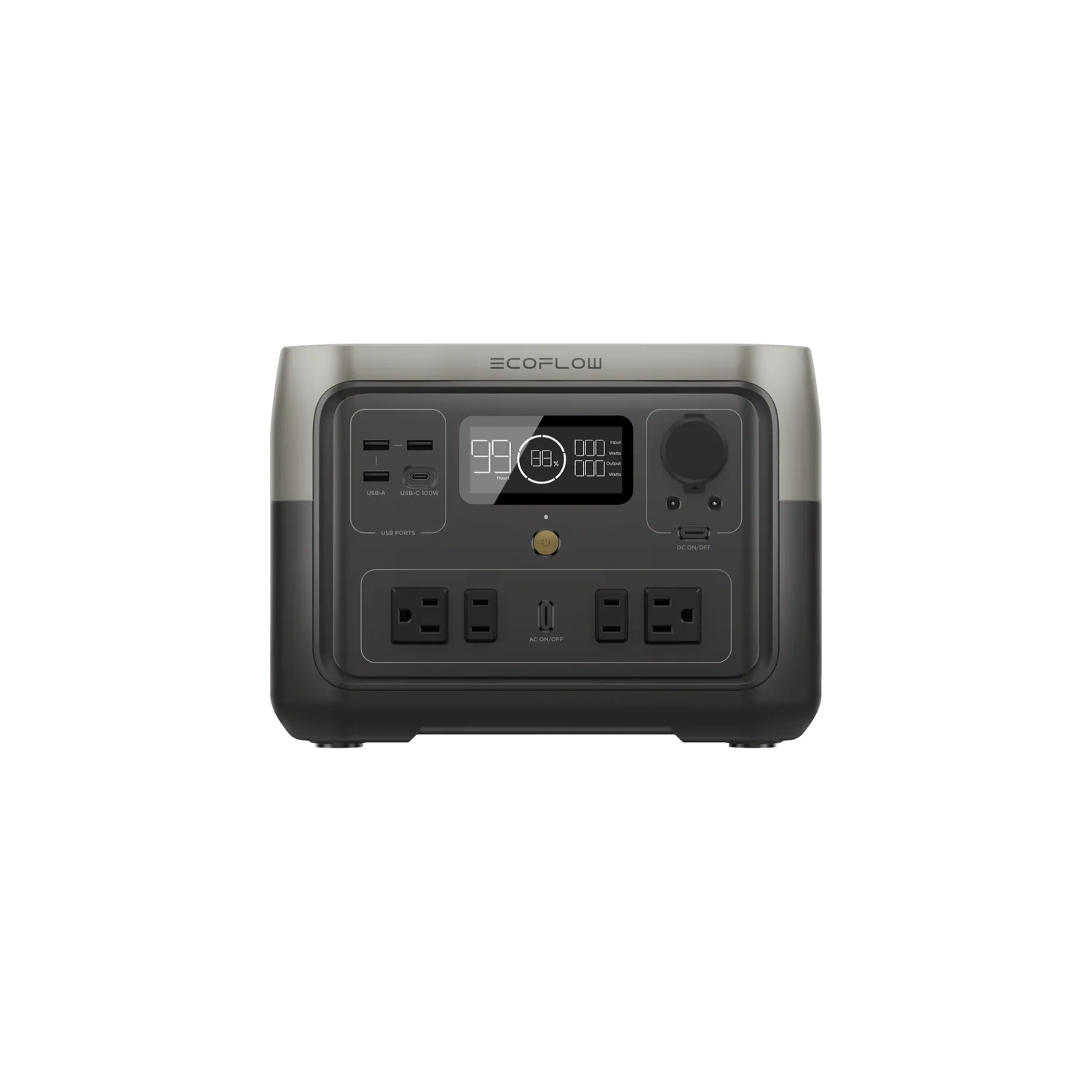
$289.00 · direct from EcoFlow
Last checked 1 day ago. Prices move — check before you buy.
Spec deltas
The spec that settles this page isn't 12,288Wh against 512Wh. It's 293.6 lbs against 13.4. The DELTA Pro Ultra + 1 Battery is an appliance you route through a doorway once, choose a permanent spot for, and never move again, and its own spec sheet marks it stationary. The RIVER 2 Max comes off the back seat in one hand.
So the Ultra takes the verdict, and the verdict is a category rather than a contest. It has the energy for all six loads we model, from a 320Wh CPAP night to a 4,685Wh day of van living. The RIVER 2 Max finishes one of the six. Two of those rows have no winner at all, which is the most informative thing here: at a campsite and at a tailgate, the unit with the energy can't get there and the unit that can get there runs dry.
Which means the decision isn't really between them. If you're backing up a house for days rather than hours, that's what the Ultra does and what the RIVER 2 Max cannot be talked into. If you want a power station you can lift, that's the RIVER 2 Max and the Ultra can't help. If neither description is yours, you're on the wrong page, and the units you actually want live in the gap between $289 and $5,999, about $5,710 of daylight.
What the Numbers Reveal
Each conclusion stated first — the numbers behind it on one line, the full analysis below.
solar input
The RIVER 2 Max's headline recharge figure is a wall-outlet figureB2, and the scenario people buy these units for is defined by the absence of a wall outlet. On sun alone the two are on the same clock, except one of them comes back with 12,288Wh. The Ultra's size costs nothing in recharge time. It costs the weight and the check.
DELTA Pro Ultra + 1 Battery: 12,288Wh pack, 5,600W maximum solar inputRIVER 2 Max: 512Wh pack, 220W maximum solar inputReviews put a full RIVER 2 Max recharge at about 60 minutes on X-Stream wall chargingB2
Why it mattersAnyone who assumed the small unit is the nimble one in a multi-day outage has it backwards: it's the one that needs the grid to be nimble.
Capacity
Cents per watt-hour still can't decide this, because energy isn't sold here in slices you can use. Twenty RIVER 2 Maxes at $289 apiece would run $5,780 and stack up to 10,240Wh, still short of one Ultra, and you'd be managing twenty boxes and twenty charge cycles to get there. The cheap-per-watt-hour option isn't divisible and the small one isn't multipliable, so the price axis collapses into the sizing axis.
$5,999 for 12,288Wh works out to about 49 cents per watt-hour$289 for 512Wh works out to about 56 cents per watt-hourThe RIVER 2 Max is sealed at 512Wh; the Ultra accepts expansion batteries above 12,288Wh
Why it mattersIf you came to find the better deal, there isn't one to find. There's only a size to pick.
The two rows the Ultra doesn't win, it loses to a doorway rather than to a battery: 10,445Wh usable is worth nothing at a campsite it can't reach. And the RIVER 2 Max doesn't win them either, coming up 1,665Wh short of the 2,100Wh weekend. Two of six scenarios end with nobody's hand raised, and no line on either spec sheet fixes that.
RIVER 2 Max: 435Wh usable after the flat 85% derate applied to every unit on the siteThe six modeled loads run from a 320Wh CPAP night to a 4,685Wh van dayThe Ultra is marked stationary and has 10,445Wh usable
Why it mattersThe camper and the tailgater should both leave: the unit that suits them is carryable and sized near that 2,100Wh weekend, and it isn't on this page.
The specific dimensions that decide these two units — everything else is a tie.
Portability & Form Factor
Selected because: At 293.6 lbs the Ultra is marked stationary while the RIVER 2 Max is a 13.4 lb one-hand lift, and that gap settles two of the six scenarios before capacity is considered.
weight
A 13.4 lb unit and a unit that arrives on a pallet aren't competing for shelf space, they're competing for a decision you've mostly already made. If there's a garage wall or a utility room with a permanent home waiting, portability is a column you can ignore for the rest of this page. If the box has to end up in a trunk, the Ultra is out and the only remaining question is whether 512Wh covers the job, because that's the only capacity left on offer.
The stationary marking does more work than the pounds do. Plenty of heavy things get moved twice a year; this one is rated to sit. Route the path before you order, because the difference between a good install and a regretted one gets measured in doorframes, not watt-hours.
Your Life, Your Pick
Selected because: The six modeled loads are the clearest evidence these two aren't substitutes: the Ultra has the energy for all six, the RIVER 2 Max finishes one, and two rows have no winner at all.
Two of the six rows end with nobody winning, and those two say the most. The Ultra sits out the campsite and the tailgate because it doesn't travel, and the RIVER 2 Max loses both on energy. So the table isn't ranking two products, it's sorting you: four rows are decided by how much energy you need, and two by whether the unit can come along.
Where the Ultra does win, it wins by margins that stop being interesting. 9,535Wh still in the pack after the remote workday isn't a better result than the RIVER 2 Max's, it's a different product's result. Read these rows for whether a unit finishes, not for how far ahead it finishes.
Lifetime Value
Selected because: The more expensive unit is also the cheaper one per watt-hour, on the sticker and across its rated life, which takes price off the table as a tiebreak.
cost / lifetime kWh
Twelve cents a lifetime kilowatt-hour against nineteen, and the twelve belongs to the $5,999 unit. That ordering catches people out, and it's the most useful fact in this section, because it kills the one argument that would otherwise carry the RIVER 2 Max: that it's the sensible money.
What it doesn't do is make the Ultra affordable. Cost per kilowatt-hour is a rate; you pay a price. Only one of those two comes out of a checking account, and a better rate on energy you'll never draw is somebody else's bargain, not yours.
What the Specs Don't Tell You
Selected because: The cautions are the real trade here: a two-person install and a 10-year term on one side, a 5-year term and a no-worse-than-30ms UPS transfer on the other.
rated cycles
The card worth arguing with is the warranty one. Per dollar, the cheap unit buys far more coverage, and per dollar is the wrong unit: what you want to know is whether a fault in year six is somebody else's problem. Ten years against five, $600 a covered year against $58. Both figures are true and only one of them pays for a repair.
The surge pair reads backwards too. The RIVER 2 Max keeps the wider headroom above its own rating, 2x against 1.5x, while the Ultra holds the ceiling that matters at 10,800W. A compressor draws watts at switch-on, not a percentage of somebody's inverter rating, so the ratio is a comfort statistic and the ceiling is what starts the pump.
Strengths & trade-offs
EcoFlow DELTA Pro Ultra + 1 Battery
Strengths
- +Larger battery capacity
- +Higher AC output
- +Longer warranty
- +Faster solar charging
- +Rated for 4,000 charge cycles — much longer battery lifespan
Trade-offs
- –Substantially more expensive (+$5,710) than the RIVER 2 Max.
- –Significantly heavier (+280.2 lbs), making it harder to move.
- –Very heavy unit that may be difficult for one person to lift.
EcoFlow RIVER 2 Max
Strengths
- +Costs $5,710 less
- +Lighter by 280.2 lb
Trade-offs
- –Weaker inverter (-6,700W) limits appliance compatibility.
- –Can receive complaints about fan noise under heavy load.
- –Sealed capacity — the DELTA Pro Ultra + 1 Battery can add batteries to grow past 512Wh; this one can't.
- –Shorter-lived battery — rated for 3,000 charge cycles vs the DELTA Pro Ultra + 1 Battery's 4,000, so it wears out sooner.
Will It Power Your Gear?
Scenario math and per-appliance runtimes, modeled from the spec record.
Scenario verdicts
We ran the math on six real-world scenarios. Here's which unit survives your actual life.
SCN-01 · 2 nights · needs 2,100Wh
Weekend Camping
Two nights off-grid with essential comfort
Neither unit
Nobody gets a powered weekend out of this pair. The load is 2,100Wh; the RIVER 2 Max holds 435Wh usable and runs out 1,665Wh short, which is most of a weekend spent in the dark. The Ultra has energy to spare and no way to reach the campsite, since it's marked stationary and built to stay where it's installed. Two failures with nothing in common but the outcome.
Battery budget usedlower = more headroom
LOAD Phone Charger 15W×6h · LED Lights 40W×8h · Box Fan 75W×14h · CPAP Machine 40W×16h
SCN-02 · 8 hours · needs 1,645Wh
8-Hour Blackout
Keep the essentials running through a night without power
DELTA Pro Ultra + 1 Battery
This is the row the Ultra exists for. The load asks 1,645Wh across eight hours, and 10,445Wh usable runs that same draw for about fifty hours before the sun has to contribute anything. The RIVER 2 Max gets roughly a quarter of the way through the first evening, 1,210Wh short, and after that it's a way to charge phones. An outage never tells you how long it plans to last, which is the whole argument for the bigger pack.
Battery budget usedlower = more headroom
LOAD Fridge 150W×8h · Router + Modem 20W×8h · LED Lights (4 bulbs) 40W×6h · Phone Charger 15W×3h
SCN-03 · 8 hours · needs 320Wh
CPAP Overnight
Sleep therapy without interruption — the #1 medical use case
DELTA Pro Ultra + 1 Battery
Both machines reach morning, so read the margins rather than the pass mark. Eight hours of a 40W CPAP is 320Wh: the RIVER 2 Max ends the night on 115Wh of its 435Wh usable, and one night's worth of reserve isn't reserve. The Ultra spends 3% of its pack, and its 10,445Wh usable covers thirty-two of those nights back to back, which is why the row goes to it even though neither unit fails. On night one, nobody knows how many nights there will be.
Battery budget usedlower = more headroom
LOAD CPAP Machine 40W×8h
SCN-04 · 8 hours · needs 910Wh
Remote Workday
Full work day off-grid without power anxiety
DELTA Pro Ultra + 1 Battery
The RIVER 2 Max doesn't finish — 435Wh usable against the 910Wh this needs leaves it 475Wh short, about 48% of the scenario covered. The DELTA Pro Ultra + 1 Battery covers it with 9,535Wh to spare.
Battery budget usedlower = more headroom
LOAD Laptop 60W×8h · External Monitor 30W×8h · Router + Modem 20W×8h · Phone Charger 15W×2h
SCN-05 · 4 hours · needs 670Wh
Tailgate Party
Game day power for the crew
Neither unit
This is the closest the RIVER 2 Max comes to passing anything here, and it still doesn't: 235Wh short of the 670Wh a game day needs, with a 400W peak leaning on a 500W inverter. The Ultra covers the same day with 9,775Wh still in the pack and will be spending the afternoon in the garage regardless, because it doesn't travel. Bring a smaller pack you can carry, or bring two.
Battery budget usedlower = more headroom
LOAD Blender 400W×0.5h · LED TV (55") 80W×4h · Bluetooth Speaker 15W×4h · Phone Charger (×3) 45W×2h
SCN-06 · 24 hours · needs 4,685Wh
Van Life Daily
A full day of mobile living — the ultimate endurance test
DELTA Pro Ultra + 1 Battery
A 4,685Wh day is where the RIVER 2 Max leaves the conversation: about a tenth of it covered, 4,250Wh short. The Ultra handles the day with 5,760Wh in hand, better than two of those days without sun. Read the win for what it is, though. In a van this is a build, with a floor and an axle rating to think about, not a box you set in the back. If that's not the project you're starting, this row isn't a recommendation.
Battery budget usedlower = more headroom
LOAD Mini-Fridge 150W×24h · Laptop 60W×4h · Phone Charger 15W×3h · LED Lights 40W×5h · Fan 75W×8h
The Load Test
RUNTIME = (Wh × 0.85) ÷ LOAD
None of the scenarios above exactly yours? Build it. Toggle what you'd plug in; both units are tested against the combined draw.
Essentials
Comfort & Convenience
High-Draw Appliances
Test duration
8h
Continuous draw
205W
Projected runtime
For this load: DELTA Pro Ultra + 1 Battery runs 51h vs 2.1h.
$5,999 list · direct from EcoFlow
Modeled from the spec record — same math as the tables below. Methodology
Runtime by appliance
Real-world runtime estimates for common appliances, modeled at 85% inverter efficiency.¹
Essentials
The basics you need runningscale 0–696.3hComfort & Convenience
Makes off-grid life actually enjoyablescale 0–139.3hHigh-Draw Appliances
These reveal the real limitsscale 0–10.4h¹ Runtime = (capacity × 0.85) ÷ appliance watts. Within each group, all bars share one time scale (the group's longest runtime), so lengths are comparable across appliances; identical runtimes collapse into a single blue/orange bar. Actual runtime varies with battery age, temperature, and simultaneous loads — see methodology.
Conclusion
September 13, 2026
Verdict: the DELTA Pro Ultra + 1 Battery, on Power Score margin
The Ultra wins every row on this page that can be won, and the win says less than the scoreline suggests. It has the energy for all six modeled loads, holds the only real surge ceiling of the two at 10,800W against 1,000W, carries 10 years of coverage against 5, and comes in cheaper per watt-hour on the sticker and over its rated life. What it cannot do is leave the house: it is marked stationary, which is why the campsite and the tailgate rows end with no winner at all. Buy it if you are backing up a building and you already know which wall it goes against. If the box has to travel, the RIVER 2 Max is not the compromise version of it, it is a 512Wh unit that finishes one of the six jobs here, and most people comparing these two want the middle ground neither one occupies.
Editor-assigned confidence, based on cited owner research and spec analysis.
List prices as of September 13, 2026. The links below open EcoFlow's current price.
$6,199.00 · direct from EcoFlow
Last checked 1 day ago. Prices move — check before you buy.
or check the RIVER 2 Max price$289.00 list
Written by Gunner Gustafson, Whole-Home Backup Tester · Station Arena Test Desk · Updated September 13, 2026
Measured Data
Benchmark scores and the full spec record, side by side.
Benchmark scores
Not rated for both units (minimum threshold unmet): Home Backup, CPAP, Solar Generator, Tailgating, Food Truck, Apartment Balcony, Camping.
Full specifications
ᵈ Derived: price ÷ rated capacity. See the data behind our comparisons →
Comparison ToolAdd more power stations, side by sideOpen Tool →How these numbers are produced
Numeric verification
Every figure on this page traces to our spec database or arithmetic on it — no estimated numbers.
Owner claims
Statements about owner experience are cited to published reviews — see Sources & Research Notes below.
Runtime model
Runtime = (rated capacity × 0.85 inverter efficiency) ÷ device wattage. Solar recharge estimates assume panels deliver 70% of rated output. Cold weather, battery age, and stacked loads reduce real-world results.
Power Score
Computed from 14 published spec dimensions, weighted per use-case bench. Higher is better; a unit must meet a bench's minimum threshold to be rated.
See the full weight table and data sourcing on our methodology page →Class ranking (the star rating)
Each unit's star score is a category ranking, not customer reviews — no buyer opinions feed it. We score every station on size-independent quality (value, output, portability, endurance, ports, warranty, and more), then percentile-rank it against the other units in its capacity class, so a class-leading compact unit and a class-leading whole-home unit can both earn 5★. Here, DELTA Pro Ultra + 1 Battery rates 3.7/5 (25th percentile of 29 Whole-Home / Off-Grid-class units), and RIVER 2 Max rates 3.7/5 (26th percentile of 20 Compact-class units).
How the class ranking is computed →Test Notes & Caveats
Hidden gotchas and advantages we spotted that you won't find on the product page.
Where It Lands Is Where It Lives
This is the real cost of choosing the Ultra and it's paid on delivery day. You don't lift this one, you route it: door widths, a threshold, the stair run, and a final corner you'll still be happy with in a decade. Two people and a dolly, and after that it's furniture. Its own spec sheet marks it stationary, so treat placement as part of the purchase rather than something to work out afterwards.
A Floor and a Ceiling, Side by Side
Both of these figures come from EcoFlow and they don't describe the same moment. The RIVER 2 Max's 62dB is the loud end, a small box with a small fan working at output. The Ultra's 30dB is the quiet end, the as-low-as number makers print. Set a floor beside a ceiling and the gap looks enormous by construction. What neither figure covers is the one that matters for a bedroom: what each unit sounds like at the roughly 40W a CPAP draws overnight. Lean on the direction if you like, but the only real test is standing next to one in a quiet room.
Sealed Isn't the Flaw Here
The RIVER 2 Max is fixed at 512Wh, and that's the shape of the product rather than a defect. Nobody buying a one-hand box is one expansion battery away from a home system. The Ultra's expansion path matters if you already suspect 12,288Wh is a starting point, and it's beside the point for anyone choosing the RIVER 2 Max, whose real question is whether 512Wh covers the job today. If it doesn't, the fix isn't a port, it's a bigger unit.
Surge Power: Ratio and Ceiling Disagree
The RIVER 2 Max holds the higher surge-to-continuous ratio (2× vs 1.5×), but the DELTA Pro Ultra + 1 Battery holds the higher absolute surge ceiling — 10,800W against 1,000W. These measure different things. The ratio says how much headroom an inverter keeps above its own rating; the ceiling says how big a startup spike it can actually swallow. A motor draws a number of watts at switch-on, not a multiple of someone else's rating, so on raw starting ability the DELTA Pro Ultra + 1 Battery is the stronger unit here — while the RIVER 2 Max is the one running further below its own limit at steady state.
UPS Switchover: 0ms-rated vs ≤30ms
Both list a UPS mode, at different rated speeds. The DELTA Pro Ultra + 1 Battery is rated 0ms — a no-break design on paper, which is the maker's classification rather than a stopwatch result. The RIVER 2 Max is rated ≤30ms — a transfer this long is one many desktops will NOT ride through, so plan on reboots for sensitive gear. If a computer with unsaved work is the thing being protected, the stated class is worth the attention; nothing here is a lab result.
Warranty: 10 Years vs 5
The DELTA Pro Ultra + 1 Battery is covered for 10 years against the RIVER 2 Max's 5 years. The cheaper RIVER 2 Max does buy more warranty per dollar (17.3 years per $1,000 against 1.7), but that is a statement about price, not about coverage — if a fault appears in year 6, only one of these is still covered. An underrated factor if you're keeping this unit for years.
Count Kilowatt-Hours, Not Years
A cycle isn't a fixed amount of energy, which is what makes the years above slippery: one cycle is 12,288Wh on the Ultra and 512Wh on the RIVER 2 Max. Count the energy instead. Over their rated lives that's 49,152 kWh against 1,536, thirty-two times as much. Neither pack dies at the end of the count either; both settle to around 80% of original capacity and keep working, which makes a cycle rating a milestone rather than an expiry date.
Full record above — the Test Desk pick is the DELTA Pro Ultra + 1 Battery.
Check DELTA Pro Ultra + 1 Battery price →or check the RIVER 2 Max priceOwnership Analysis
What happens after you buy — true cost of ownership, brand trust, and growth potential.
Lifetime value
Service lifeyears at one full cycle per day
Lifetime energy delivered
Cost per delivered kWh
│ warranty ends · Reaching the cycle rating means ~80% capacity remains — degraded, not dead.
Analyst note
The RIVER 2 Max is cheaper to buy, but the DELTA Pro Ultra + 1 Battery is cheaper to own. At $0.12/kWh over its lifetime vs $0.19/kWh, the DELTA Pro Ultra + 1 Battery's higher cycle life and capacity make each dollar go further over the years.
Growth path
DELTA Pro Ultra + 1 Battery
EXPANDABLESupports EcoFlow expansion batteries, so you can add capacity later without replacing the base unit — useful if your needs may climb past 12,288Wh.
Accepts up to 5,600W of solar. Enough for a serious multi-panel array.
Adequate ports for most setups, but heavy users may want a power strip.
Expansion batteries are EcoFlow-specific. You're investing in the EcoFlow ecosystem.
RIVER 2 Max
FIXED CAPACITYFixed at 512Wh, with no expansion — so size it for your needs up front rather than planning to add capacity later.
Accepts up to 220W of solar. Limited to a single portable panel.
Adequate ports for most setups, but heavy users may want a power strip.
Realistic full solar rechargeat 70% of rated panel output — see methodology
Analyst note
The RIVER 2 Max is sealed at 512Wh, which is fine if that covers you. The DELTA Pro Ultra + 1 Battery starts at 12,288Wh and can grow beyond it with EcoFlow expansion batteries — real headroom the RIVER 2 Max doesn't have if your needs climb toward partial-home backup.
What Owners Report
Patterns from published owner reports and long-term reviews — every claim cited to its source below.
EcoFlow DELTA Pro Ultra + 1 Battery
Field data on this exact configuration is thin, and our own research note says so plainly: the deepest source is a single DIY Solar Forum thread from February 2024, with nothing at all on the +1 Battery setup, cold-weather behavior, or long-term durabilityA0. What is in that thread is specific and worth reading before you commit to a spot on the wall. One owner traced radio-frequency interference on common frequencies that disappeared the moment the unit was switched off, and reported that EcoFlow support's suggestion was a Faraday cageA6A7.
The same thread flags a state-of-charge readout falling from 90% to 8% across a few days of overnight use, an app with no SoC graph at all, and a web user guide standing in for a manualA5A8A9. That owner came away, in his word, meh on the unit and unlikely to expand it into the houseA4. Fan behavior is the recurring question owners ask about this oneA1, but the detailed fan notes in that source may describe a competitor's inverter rather than this unit, so we're citing them for character and not resting anything on themA2A3.
“When the fans are not on, the inverter emits zero noise...even when I put my ear against the case.”
Sources
windinmyface.com · diysolarforum.com
EcoFlow RIVER 2 Max
The RIVER 2 Max reads well, and the praise clusters on three things: about 13 lbs for 512Wh, lighter than same-size Li-Ion rivalsB1; a full recharge in roughly an hour on X-Stream wall chargingB2; and an app that handles remote monitoring and charge-speed control over Wi-Fi and BluetoothB3. One field test ran a telescope, a 65-inch TV, two laptops and phones through a four-hour event with power left overB4, which is exactly the shape of job this unit is good at and nothing like an overnight outage. Coverage skews to reviewers rather than long-term ownersB0.
“512Wh in a light package of about 13 lbs, lighter than some of its closest competitors that use Li-Ion chemistry.”
Sources
storagereview.com · backuppowerhub.com · gagadget.com · ecoflow.com · thecampingnerd.com · thetechnologyman.com · bestbuy.com
Sources & Research Notes
Every owner claim in this report is traceable to a published source. The bracketed references above resolve here.
Recurring owner themes
- SoC/battery metering appears unreliable, with reported percentage dropping much faster than expected after resuming charge cycles [DELTA Pro Ultra + 1 Battery · 2 entries]
- Support interactions were unhelpful or dismissive when owners raised specific technical issues (manual gaps, RFI, missing SoC graph) [DELTA Pro Ultra + 1 Battery · 3 entries]
- Fan behavior/noise is a recurring point of owner scrutiny, though direct DPU-specific noise data is thin and partly inferred from sibling EG4 units [DELTA Pro Ultra + 1 Battery · 3 entries]
- Light weight, fast roughly-one-hour charging, and a simple capable app are the standout praise for this 512Wh unit. [RIVER 2 Max · 3 entries]
- A1
“Yuck—fans always run even on the expensive high end Delta Pro Ultra?”
windinmyface.com blog — 'Fan Noise with Solar Power / Solar Generators (Anker, Ecoflow, EG4)' (comment thread) · 2024-12 · [negative]
- A2
“When the fans are not on, the inverter emits zero noise...even when I put my ear against the case.”
windinmyface.com blog — 'Fan Noise with Solar Power / Solar Generators (Anker, Ecoflow, EG4)' (owner test notes, related EG4 12kPV/18kPV comparison to DPU) · 2024-12 · [positive]
- A3
“At 6.3kW of load, the fan turned on... The fans turned off when I reached about 4.5kW. This is probably the expected hysteresis behavior.”
windinmyface.com blog — 'Fan Noise with Solar Power / Solar Generators (Anker, Ecoflow, EG4)' (thermal/fan behavior test, note: performed on EG4 18kPV, referenced as comparison point to DPU) · 2024-12 · [mixed]
- A4
“Pulled the trigger on an EcoFlow Delta Pro Ultra (DPU) and I'm kind of meh on it and unlikely to expand or integrate it into the house.”
diysolarforum.com — 'EcoFlow Delta Pro Ultra issues' · 2024-02 · [negative]
- A5
“No real manual. All they have is the web user guide which is superficial if I'm being generous.”
diysolarforum.com — 'EcoFlow Delta Pro Ultra issues' · 2024-02 · [negative]
- A6
“Even when the inverter is not running, it interferes with common frequencies like 146.520MHz... Turn off the DPU, emission goes away.”
diysolarforum.com — 'EcoFlow Delta Pro Ultra issues' · 2024-02 · [negative]
- A7
“I contacted EcoFlow support and they told me I could put it in a "faraday cage".”
diysolarforum.com — 'EcoFlow Delta Pro Ultra issues' · 2024-02 · [negative]
- A8
“No State of Charge graph in the app. Figured if they were showing charts of Input and Output over time, they must have a SoC chart. Nope.”
diysolarforum.com — 'EcoFlow Delta Pro Ultra issues' · 2024-02 · [negative]
- A9
“After a few days of using it overnight and letting it charge back up to "90%", it'd go from "90%" down to "8%".”
diysolarforum.com — 'EcoFlow Delta Pro Ultra issues' · 2024-02 · [negative]
- B1
“512Wh in a light package of about 13 lbs, lighter than some of its closest competitors that use Li-Ion chemistry.”
storagereview.com / backuppowerhub.com — RIVER 2 Max review · 2026 · [positive]
- B2
“Fully charges in about 60 minutes via X-Stream charging — far faster than most portable power stations — with multiple charging options.”
gagadget.com / ecoflow.com — RIVER 2 Max review · 2026 · [positive]
- B3
“The EcoFlow app offers simple remote control and monitoring over WiFi and Bluetooth — view charge levels, customize settings, and adjust charging speed from a phone.”
thecampingnerd.com / ecoflow.com — RIVER 2 Max review · 2026 · [positive]
- B4
“Upgraded LFP chemistry rated for about 3,000 cycles, roughly a decade of everyday use; in field testing it powered a telescope, a 65-inch LED TV, two laptops, and phones through a 4-hour event with power to spare.”
thetechnologyman.com / bestbuy.com owner reviews — RIVER 2 Max · 2026 · [positive]
Research compiled September 13, 2026.
Who Should Buy Which
Buy the DELTA Pro Ultra + 1 Battery if you…
- →You're backing up a house, or enough of one to matter, and you already know which wall it's going against.
- →Your loads include a motor. A 10,800W surge ceiling starts things a 1,000W ceiling refuses, and startup spikes are counted in watts, not in percentages of somebody's inverter rating.
- →You suspect 12,288Wh is a starting point. This one takes expansion batteries; the RIVER 2 Max's answer to outgrowing it is a second RIVER 2 Max.
- →A desktop or a NAS is the thing being protected. The Ultra is rated at 0ms transfer, which is the maker's no-break classification rather than a stopwatch result, against the RIVER 2 Max's no-worse-than-30ms, long enough that many desktops reboot.
Buy the RIVER 2 Max if you…
- →One night, one CPAP, and you want the lightest box that reaches morning. It's the single load on this page the RIVER 2 Max finishes, and it finishes with a little in reserve.
- →Power lives in a car and gets carried to things: a job site, a photo shoot, a kid's game. 13.4 lbs is a one-hand lift, and a wall outlet brings it back in about an hourB2.
- →Your ceiling genuinely is 512Wh. The unit is sealed there, so buy it for the job it does today rather than one you hope to grow into.
If neither fits
Close the tab if what you want is a power station for camping, a tailgate, or the back of a van you'd rather not rebuild. The modeled weekend asks 2,100Wh, four times the RIVER 2 Max's entire 512Wh pack, and the Ultra isn't coming along. What suits you is a carryable unit sized around that weekend, from the wide middle of the market these two bracket from either end. Neither of these is a compromise worth making.
The Bottom Line
Take the DELTA Pro Ultra + 1 Battery if you're backing up a building. It has the energy for all six loads on this page, it's the cheaper unit per watt-hour and per lifetime kilowatt-hour, and its solar input is scaled so the whole pack comes back in about the same sun the RIVER 2 Max needs for 512Wh, which is the entire case for it in an outage that doesn't announce how long it will last.
The reason to read this page, though, is the other half. The RIVER 2 Max finishes one of the six jobs modeled here and it's the only one of the two you can pick up, so it isn't a smaller version of the Ultra and no amount of comparing will make it one. If you arrived choosing between a home backup system and a weekend box, you were never choosing between two products. You were deciding which problem you have. Settle that and this page answers itself.
Frequently Asked Questions
Answers drawn from the spec record and cited owner research.
Is the EcoFlow DELTA Pro Ultra + 1 Battery portable?
Not in any useful sense. It's 293.6 lbs and its spec sheet marks it stationary, which means two people and a dolly on delivery day and a permanent spot after that. Measure the doorways and the stair run before you order, because relocating it later is a project rather than an afternoon. If the box needs to move, this is the wrong product no matter how good the capacity looks.
Can an EcoFlow RIVER 2 Max run a CPAP all night?
Yes. A CPAP pulls about 40W, so eight hours is roughly 320Wh, and the RIVER 2 Max has about 435Wh usable once the flat 85% derate we apply to every unit is taken off. It ends the night with around 115Wh left. That's one night rather than two, though, because you've spent most of the pack getting there, so plan on a recharge before the next one.
Will a RIVER 2 Max get me through a power outage?
No, not the outage we model. Eight hours of that household load comes to 1,645Wh and the RIVER 2 Max has about 435Wh usable, so it covers roughly a quarter of the evening and leaves you 1,210Wh short. Treat it as a way to keep phones, a laptop and a light going during an outage, not as a backup system. For the whole eight hours you need something in the Ultra's class.
Which is cheaper to own, the DELTA Pro Ultra or the RIVER 2 Max?
The Ultra, by the rate. It delivers more energy per dollar across its rated life than the RIVER 2 Max does, and it's also the cheaper of the two per watt-hour on the sticker. None of that makes it the cheaper purchase: one is a $5,999 check and the other is $289. A better rate on energy you'll never draw isn't a saving.
Are there any known problems with the EcoFlow DELTA Pro Ultra?
Field reports on this exact configuration are thin, and our research says so: one substantial owner thread from February 2024, and nothing on the +1 Battery setup, cold weather, or long-term durability. In it, one owner documented radio-frequency interference on common frequencies that vanished when the unit was switched off and was told by support to consider a Faraday cage. The same owner reported a state-of-charge readout sliding from 90% to 8% over a few days of overnight use, no SoC graph in the app, and a web guide in place of a manual. None of it is disqualifying for a backup appliance, but it's worth knowing before you pick the spot.
Where to buy
EcoFlow DELTA Pro Ultra + 1 BatteryPick
$6,199.00
$6,199.00 · direct from EcoFlow
Last checked 1 day ago. Prices move — check before you buy.
EcoFlow RIVER 2 Max
$289.00
$289.00 · direct from EcoFlow
Last checked 1 day ago. Prices move — check before you buy.
Prices may vary by retailer and are subject to change.