Head-to-head test
EcoFlow DELTA 3 Ultra vs Anker SOLIX F2600
The Anker sells the cheaper watt-hour and the faster refill from the sun, the EcoFlow sells enough inverter to start a compressor and enough cycles to outlast it, and which of those you'll actually use is the whole decision.
Full profiles: EcoFlow DELTA 3 Ultra → · Anker SOLIX F2600 →

Written by Gunner GustafsonUpdated
Whole-Home Backup Tester, Station Arena Test Desk

$1,399.00 · direct from EcoFlow
Last checked 1 day ago. Prices move — check before you buy.
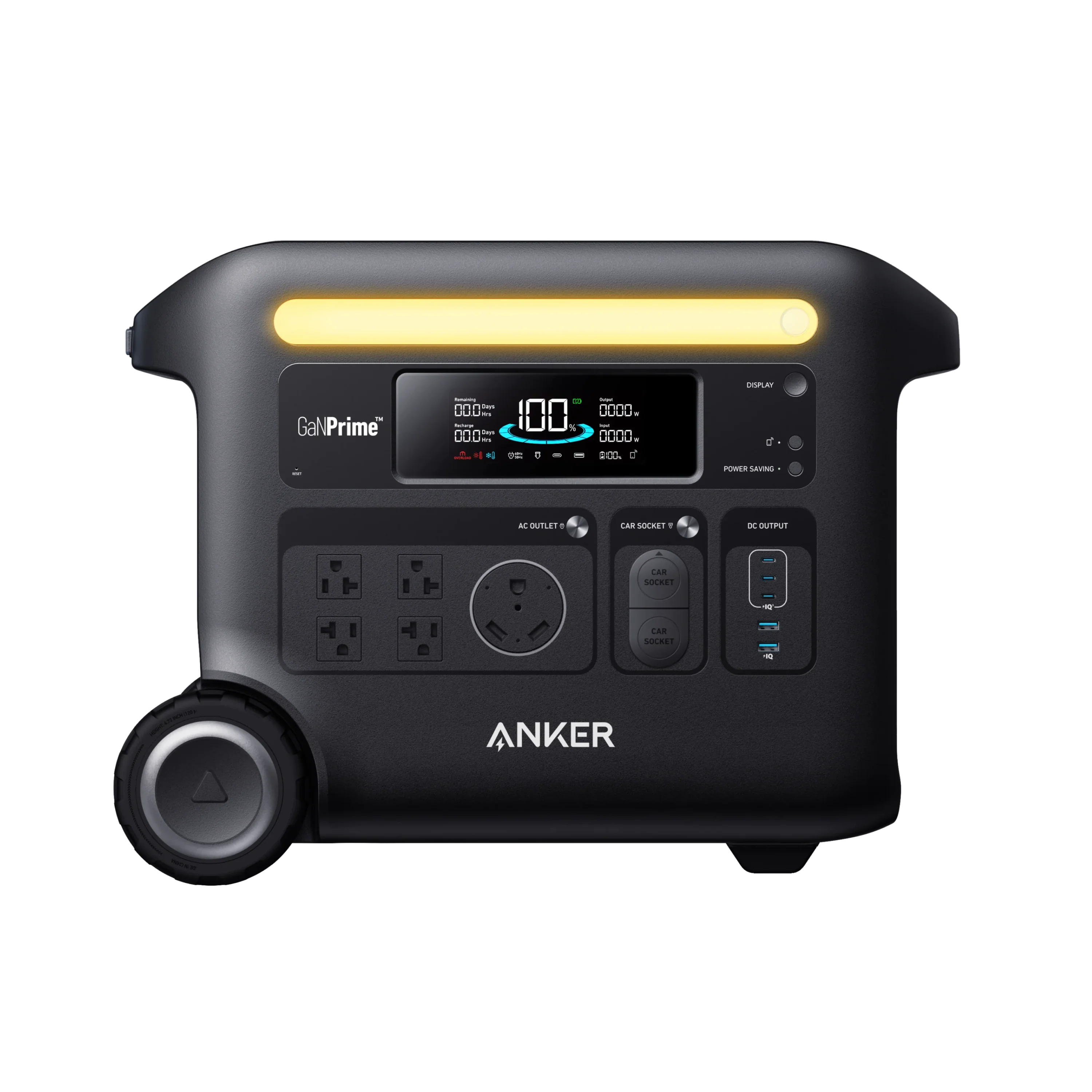
$1,499.99 · direct from Anker
Last checked 1 day ago. Prices move — check before you buy.
Spec deltas
Take the DELTA 3 Ultra. It costs more and it's still the cheaper box to own, because 4,000 cycles on a 3,072Wh pack is 12,288 kWh of energy across its life against the SOLIX F2600's 7,680 kWh. That's eleven cents a kilowatt-hour against thirteen. Read that once and you have the financial argument; the rest of this page is about whether it applies to you, because it only cashes out if you genuinely cycle the thing.
What the extra money buys isn't watt-hours. It's inverter. The Ultra's surge is exactly double its 3,600W continuous rating, while the Anker's sits 400W above its 2,400W and stops there. Capacity decides how long you run something. That number decides whether it starts at all.
The DELTA 3 Ultra doesn't expand. It's a sealed 3,072Wh box and it stays one, which is worth saying flatly rather than leaving in a spec row. The F2600 does grow, to 4,608Wh with a BP2600 moduleB2, but it starts 512Wh below the Ultra, so the first module you buy spends a good part of itself arriving where the EcoFlow already was.
What the Numbers Reveal
Each conclusion stated first — the numbers behind it on one line, the full analysis below.
Capacity
Which leaves a narrow strip of daily draw where expanding is worth the money. Below the Ultra's 3,072Wh you never needed it. Above it, the ceiling works out to 3,917Wh usable once you take the 85% you actually get after inverter losses (4,608 × 0.85), still short of a 4,685Wh van-life day. The expansion covers a band, then quits.
SOLIX F2600 base capacity is 2,560Wh; the DELTA 3 Ultra is fixed at 3,072Wh with no expansion portThe F2600 scales to 4,608Wh with a BP2600 moduleB2The Van Life Daily profile draws 4,685Wh a day
Why it mattersIf the Anker appeals because you might need more later, price the BP2600 in before you compare the two, and check that "more" lands inside that band. Buying a growth path that stops before your load does is a slow way to end up owning two power stations.
solar input
For one bad night that ordering means nothing. It means everything on the morning after night three. A multi-day outage isn't one refill, it's a refill every day before the light goes, and the Anker banks a full charge while you're still making breakfast. The Ultra's larger usable buffer, 2,611Wh against 2,176Wh at the 85% you really get, is a one-time gift of 435Wh. The faster refill shows up every single morning.
DELTA 3 Ultra accepts 800W of solar; SOLIX F2600 accepts 1,000WCapacities are 3,072Wh and 2,560WhThe 8-Hour Blackout load is 1,645Wh, which is 63% of the Ultra's usable energy and 76% of the F2600's
Why it mattersBuy the Ultra if your grid tends to come back by lunch. Buy the F2600 if your realistic worst case runs for days and a panel is the only wall socket you've got.
continuous output
Call the spike a conservative 2× and the Ultra brings up a 3,600W motor (7,200 ÷ 2) while the F2600 tops out near 1,400W (2,800 ÷ 2). That's the gap between a well pump spinning up with the fridge still humming and the whole unit tripping out with everything plugged into it. Stored energy has nothing to do with it. The Anker's 2,560Wh would run that compressor happily all afternoon if it could ever get it turning.
DELTA 3 Ultra: 3,600W continuous, 7,200W surgeSOLIX F2600: 2,400W continuous, 2,800W surgeBoth units clear the peak draw of every scenario modelled on this page
Why it mattersIf a pump, a rooftop air conditioner or a full-size fridge has to start while other things are already drawing, read the Anker's nameplate as a ceiling for steady load, not for starting. The startable number is much lower, and it's the one that bites.
rated cycles
Cycled daily that's 11 years of service against 8.2, and since both warranties stop at five, the extra 2.8 years is durability you buy at the register rather than a claim you could ever file. Here's the honest catch: it only pays if you cycle. Pull the thing out six weekends a year and the two land on exactly the same $0.09 a day, and the premium has bought you headroom you'll almost never touch.
$1,399 for the DELTA 3 Ultra, $1,100 for the SOLIX F26004,000 cycles × 3,072Wh = 12,288 kWh of lifetime energy; 3,000 cycles × 2,560Wh = 7,680 kWhBoth units carry a 5-year warranty
Why it mattersVan dwellers, off-grid cabins, anyone shuffling solar into the house every evening: pay the difference and stop thinking about it. Someone whose power station lives in the garage between camping trips should keep the money and buy a panel with it.
The specific dimensions that decide these two units — everything else is a tie.
Lifetime Value
Selected because: the cheaper box at the register is the dearer one across the life of the pack: $0.11 per lifetime kWh for the DELTA 3 Ultra against $0.13 for the SOLIX F2600.
cost / lifetime kWh
A cycle rating is a promise about year nine, and nobody's warranty reaches that far. Both of these stop at five. The Ultra's covered period costs $260 a year against the Anker's $200, and that's the honest way to price the first half of the decade, because it's the only stretch either company has agreed to stand behind.
Past that line you're betting on cells, and the bet only pays at a certain cadence. Daily cycling is where the EcoFlow's rating pulls away and the throughput gap turns into real years. Weekend cycling is where the whole argument evaporates: at that rate the two are indistinguishable on cost, and you'll replace this thing because something better came out, not because it wore out. Work out which of those two people you are, and the premium either justifies itself or doesn't.
Growth Path
Selected because: expandability is the most misread spec in this matchup, because the F2600 starts 512Wh below the Ultra's fixed 3,072Wh.
solar input
The Ultra has no expansion port. It's 3,072Wh on the day you buy it and 3,072Wh on the day you sell it. The F2600 does have a route out, and on a spec sheet that reads like a clean win for Anker.
It reads differently once you ask what the route costs and where it ends. Expandability is only worth paying for in the stretch above the Ultra's fixed capacity, and the Anker has to buy its way up to that line before it can start climbing past it. So the useful question isn't whether the F2600 can grow. It's whether you'll ever live up there. If you can't name the load that would push you past 3,072Wh, you're paying for a door you'll never open.
Your Life, Your Pick
Selected because: these two only separate at the top of the load range, where a 2,100Wh camping weekend takes 80% of the Ultra's usable capacity and 97% of the Anker's.
Across the light loads these are the same power station, and this page should say so rather than invent a gap. A CPAP night is 320Wh, 12% of the Ultra's usable energy and 15% of the Anker's. A remote workday is 910Wh, a tailgate 670Wh. Both clear all three with most of the tank untouched and both hold the peak. If that's your load list, stop reading the capacity column and decide on price, noise, and where the box is going to live.
The split shows up at the top. A 2,100Wh camping weekend leaves the Ultra at 80% consumed and the F2600 at 97%, which is to say the Anker finishes, and finishes on fumes. That's the state that ages a pack fastest and the state where anything you didn't plan for becomes a problem. The 1,645Wh blackout is the same shape with more slack, 63% against 76%. And the van-life profile beats both so thoroughly that choosing carefully between these two is the wrong activity entirely.
What the Specs Don't Tell You
Selected because: what settles this pair is startup headroom rather than stored energy, and the surge row is where that finally shows up.
rated cycles
Two units with similar watt-hours behave like completely different machines the moment a motor is involved, and nothing in the capacity comparison warns you about it. The Ultra carries double its continuous rating in reserve. The Anker carries 400W. That single row decides more purchases here than every other spec on the page.
Then two smaller flags, one each. Switchover is 10ms against 20ms, a real difference in class and no difference whatsoever to a laptop, a router or a CPAP, so call it a tie unless you're protecting a desktop with a marginal power supply. And the noise column is lopsided: EcoFlow publishes 30 dBA for the Ultra, Anker publishes nothing for the F2600. That isn't an accusation. It's just that one of them handed you a number to hold them to and the other didn't, and if this box is going to sleep in your bedroom, that's worth more than it looks.
Strengths & trade-offs
EcoFlow DELTA 3 Ultra
Strengths
- +Larger battery capacity
- +Higher AC output
- +Rated for 4,000 charge cycles — much longer battery lifespan
Trade-offs
- –No major technical downsides compared to rival.
Anker SOLIX F2600
Strengths
- +Costs $299 less
- +Lighter by 1.6 lb
- +Faster solar charging
Trade-offs
- –Weaker inverter (-1,200W) limits appliance compatibility.
- –Shorter-lived battery — rated for 3,000 charge cycles vs the DELTA 3 Ultra's 4,000, so it wears out sooner.
Will It Power Your Gear?
Scenario math and per-appliance runtimes, modeled from the spec record.
Scenario verdicts
We ran the math on six real-world scenarios. Here's which unit survives your actual life.
SCN-01 · 2 nights · needs 2,100Wh
Weekend Camping
Two nights off-grid with essential comfort
DELTA 3 Ultra
Both make it home. Only one makes it home with anything left. A 2,100Wh weekend takes 80% of the DELTA 3 Ultra's usable capacity and 97% of the SOLIX F2600's, and arriving at 97% is the state that ages a pack fastest while leaving nothing for the thing you didn't plan for. If your camping load has any habit of creeping upward, the Ultra is the one with room to absorb it.
Battery budget usedlower = more headroom
LOAD Phone Charger 15W×6h · LED Lights 40W×8h · Box Fan 75W×14h · CPAP Machine 40W×16h
SCN-02 · 8 hours · needs 1,645Wh
8-Hour Blackout
Keep the essentials running through a night without power
DELTA 3 Ultra
A 1,645Wh night leaves the DELTA 3 Ultra at 63% consumed and the SOLIX F2600 at 76%. Both cover it, both hold the peak, neither comes anywhere near a shutdown. The first night isn't where these two separate. The Ultra's advantage is the second night, when a deeper buffer starts earning its keep and a shallower one starts explaining itself.
Battery budget usedlower = more headroom
LOAD Fridge 150W×8h · Router + Modem 20W×8h · LED Lights (4 bulbs) 40W×6h · Phone Charger 15W×3h
SCN-03 · 8 hours · needs 320Wh
CPAP Overnight
Sleep therapy without interruption — the #1 medical use case
Either unit
Not a capacity question. A 320Wh night is 12% of the DELTA 3 Ultra's usable energy and 15% of the SOLIX F2600's, so either one runs a CPAP for several nights on a single charge and the tank stops mattering. Decide it on noise, and note the asymmetry: EcoFlow rates the Ultra at 30 dBA, Anker publishes no figure for the F2600 at all. For a machine sitting eighteen inches from your head all night, a specified number beats an unspecified one.
Battery budget usedlower = more headroom
LOAD CPAP Machine 40W×8h
SCN-04 · 8 hours · needs 910Wh
Remote Workday
Full work day off-grid without power anxiety
Either unit
Both power your workstation all day without strain. At these utilization levels the real difference is USB-C for direct laptop charging — 140W on the DELTA 3 Ultra against 100W — which beats the inverter for convenience and wastes less energy.
Battery budget usedlower = more headroom
LOAD Laptop 60W×8h · External Monitor 30W×8h · Router + Modem 20W×8h · Phone Charger 15W×2h
SCN-05 · 4 hours · needs 670Wh
Tailgate Party
Game day power for the crew
Either unit
Both handle game day easily. Since capacity isn't the deciding factor, weight is: at 70.5 lbs the SOLIX F2600 is the one you'll be glad you brought. Fan noise under load is worth a listen too — it's audible in the lulls between songs.
Battery budget usedlower = more headroom
LOAD Blender 400W×0.5h · LED TV (55") 80W×4h · Bluetooth Speaker 15W×4h · Phone Charger (×3) 45W×2h
SCN-06 · 24 hours · needs 4,685Wh
Van Life Daily
A full day of mobile living — the ultimate endurance test
Neither unit
Neither unit covers this, and it isn't a near miss. A 4,685Wh day is 179% of the DELTA 3 Ultra's usable capacity and 215% of the SOLIX F2600's, so you'd be recharging by mid-afternoon every day and still falling behind by dark. Even the F2600 taken to its 4,608Wh expanded ceiling lands under 4,685Wh before inverter losses are counted. This load wants a fixed 5kWh-plus system, not something with a handle on it.
Battery budget usedlower = more headroom
LOAD Mini-Fridge 150W×24h · Laptop 60W×4h · Phone Charger 15W×3h · LED Lights 40W×5h · Fan 75W×8h
The Load Test
RUNTIME = (Wh × 0.85) ÷ LOAD
None of the scenarios above exactly yours? Build it. Toggle what you'd plug in; both units are tested against the combined draw.
Essentials
Comfort & Convenience
High-Draw Appliances
Test duration
8h
Continuous draw
205W
Projected runtime
For this load: DELTA 3 Ultra runs 12.7h vs 10.6h.
$1,399 list · direct from EcoFlow
Modeled from the spec record — same math as the tables below. Methodology
Runtime by appliance
Real-world runtime estimates for common appliances, modeled at 85% inverter efficiency.¹
Essentials
The basics you need runningscale 0–174.1hComfort & Convenience
Makes off-grid life actually enjoyablescale 0–34.8hHigh-Draw Appliances
These reveal the real limitsscale 0–2.6h¹ Runtime = (capacity × 0.85) ÷ appliance watts. Within each group, all bars share one time scale (the group's longest runtime), so lengths are comparable across appliances; identical runtimes collapse into a single blue/orange bar. Actual runtime varies with battery age, temperature, and simultaneous loads — see methodology.
Conclusion
August 2, 2026
Verdict: the DELTA 3 Ultra, on Power Score margin
Take the DELTA 3 Ultra unless panels are your only way back to full. It costs $299 more and returns it on two axes the capacity column hides: its surge is exactly double its continuous rating where the Anker's sits 400W above its own, and its cells are rated for 4,000 cycles against 3,000. Those turn into eleven cents a kilowatt-hour across the pack's life against thirteen, which is the unusual case of the pricier box being the cheaper one to own. The F2600's genuine win is solar input, 1,000W against 800W, and it's the one axis where the cheaper unit simply beats the more expensive one. If your realistic emergency runs for days with no grid to fall back on, take the Anker and put the difference into panel. Everyone else should take the Ultra.
Editor-assigned confidence, based on cited owner research and spec analysis.
List prices as of August 2, 2026. The links below open EcoFlow's and Anker's current prices.
$1,399.00 · direct from EcoFlow
Last checked 1 day ago. Prices move — check before you buy.
or check the SOLIX F2600 price$1,499.99 list
Written by Gunner Gustafson, Whole-Home Backup Tester · Station Arena Test Desk · Updated August 2, 2026
Measured Data
Benchmark scores and the full spec record, side by side.
Benchmark scores
Full specifications
ᵈ Derived: price ÷ rated capacity. See the data behind our comparisons →
Comparison ToolAdd more power stations, side by sideOpen Tool →How these numbers are produced
Numeric verification
Every figure on this page traces to our spec database or arithmetic on it — no estimated numbers.
Owner claims
Statements about owner experience are cited to published reviews — see Sources & Research Notes below.
Runtime model
Runtime = (rated capacity × 0.85 inverter efficiency) ÷ device wattage. Solar recharge estimates assume panels deliver 70% of rated output. Cold weather, battery age, and stacked loads reduce real-world results.
Power Score
Computed from 14 published spec dimensions, weighted per use-case bench. Higher is better; a unit must meet a bench's minimum threshold to be rated.
See the full weight table and data sourcing on our methodology page →Class ranking (the star rating)
Each unit's star score is a category ranking, not customer reviews — no buyer opinions feed it. We score every station on size-independent quality (value, output, portability, endurance, ports, warranty, and more), then percentile-rank it against the other units in its capacity class, so a class-leading compact unit and a class-leading whole-home unit can both earn 5★. Here, DELTA 3 Ultra rates 4.7/5 (80th percentile of 26 Large-class units), and SOLIX F2600 rates 4.0/5 (40th percentile of 26 Large-class units).
How the class ranking is computed →Test Notes & Caveats
Hidden gotchas and advantages we spotted that you won't find on the product page.
Two Hands, Bent Knees, Either Way
72.1 lb for the DELTA 3 Ultra and 70.5 lb for the SOLIX F2600. That's 1.6 lb apart, which is to say identical in the hands. Neither one goes over a tailgate or down basement stairs without a plan and preferably a second person. Decide where the box is going to live before you decide which box it is, because you won't be relocating either on a whim.
The First Module Buys Back Ground
The DELTA 3 Ultra has no expansion port and stays at 3,072Wh for good. The SOLIX F2600 starts at 2,560Wh and a BP2600 module carries it to 4,608Wh. The catch is the opening move: because the Anker starts 512Wh lower, a real share of that first module goes to reaching capacity the Ultra already includes. The expansion only earns its price above 3,072Wh, and if you can't name the load that gets you there, it isn't earning anything.
Double the Rating, Against 400W of Room
The DELTA 3 Ultra's 7,200W surge is exactly double its 3,600W continuous rating. The SOLIX F2600's 2,800W sits 400W above its 2,400W, and that's the entire reserve. Motors pull two to three times their running watts for the half-second they wake up, so on a conservative 2× the Ultra starts a 3,600W load and the F2600 about 1,400W. That's what decides fridges, pumps and rooftop air conditioners, and the capacity column never mentions it.
10ms Against 20ms, Which Is To Say Nothing
Both hand over fast enough that a laptop, a router, a modem or a CPAP never notices the grid left; the whole difference is ten milliseconds. It becomes a real distinction only for a desktop with a marginal power supply or gear with a strict hold-up requirement, where the DELTA 3 Ultra's 10ms is the safer number to design around. On a normal load list, call this row even and spend the attention somewhere it pays.
Warranty: No Difference
Both units carry the same 5-year warranty, so coverage isn't a tiebreaker here. Worth saying because the per-dollar framing can suggest otherwise: the SOLIX F2600 works out at 4.5 years of cover per $1,000 spent against the DELTA 3 Ultra's 3.6, but that spread is the price gap, not the terms.
Battery Lifespan in Real Years
The DELTA 3 Ultra is rated for 4,000 cycles vs 3,000. In real life: at daily use, that's 11 vs 8.2 years. At weekend use (twice a week), it's 38 vs 29 years. After hitting the cycle limit, the battery doesn't die — it drops to ~80% of original capacity, which is still very usable.
Only One of Them Gives You a Number
EcoFlow rates the DELTA 3 Ultra at 30 dBA. Anker publishes no noise figure for the SOLIX F2600 at all, so there's nothing on paper to compare and nothing to point at if it turns out louder than you hoped. In a garage that costs you nothing. In a bedroom, a home office, or anywhere you sleep within arm's reach of it, a published figure is worth real money.
Full record above — the Test Desk pick is the DELTA 3 Ultra.
Check DELTA 3 Ultra price →or check the SOLIX F2600 priceOwnership Analysis
What happens after you buy — true cost of ownership, brand trust, and growth potential.
Lifetime value
Service lifeyears at one full cycle per day
Lifetime energy delivered
Cost per delivered kWh
│ warranty ends · Reaching the cycle rating means ~80% capacity remains — degraded, not dead.
Analyst note
The SOLIX F2600 is cheaper to buy, but the DELTA 3 Ultra is cheaper to own. At $0.11/kWh over its lifetime vs $0.14/kWh, the DELTA 3 Ultra's higher cycle life and capacity make each dollar go further over the years.
Brand trust
EcoFlow
Ecosystem
Largest in portable power — 12-15 models across DELTA Pro, DELTA 3, and RIVER 3 series, plus solar panels and smart home panels
Support
US phone, email and chat support, and the experience genuinely varies. Prepaid-label replacements go through painlessly on some claims and drag badly on others, occasionally with a refurbished unit turning up against a new-unit claim. The cheap hedge is to buy through a retailer with its own returns policy layered on top. It costs nothing and gives you a second road out if the first one stalls.
Community
Largest community in the space — Reddit r/Ecoflow_community (~31K members), multiple Facebook groups, and an official community forum
App experience
Rated 4.6/5 iOS (~8,400 ratings) · 4.2/5 Android (~17,000 ratings)
Unique strength
Fastest-charging technology (X-Stream), deepest product ecosystem, and most active innovation cadence. At the very top of the range, the DELTA Pro Ultra platform stacks batteries and inverters into whole-home backup — a flagship path, not a line-wide feature.
Worth knowing
The October 2025 DELTA Max 2000 recall for overheating and fire risk covered six incidents on a different model, but it belongs in how you think about this company handling a problem. EcoFlow also trialled a subscription paywall for advanced app features in early 2025 before backing off under pressure. And it offers no parts or service once the warranty expires, which is a live question rather than an abstract one: a box rated to run 11 years of daily cycling has a service story that stops at year five.
Anker
Ecosystem
7-8 SOLIX portable power stations across C-series (compact) and F-series (flagship), plus the X1 home energy system
Support
US-based support carrying a strong parent-brand reputation, though the SOLIX line specifically is trending the wrong way: automated first-line responses that answer generically, and returns on a 70.5 lb unit that mean hazmat shipping rather than a box and a label. On something this heavy, weight stops being a portability spec and becomes what a warranty claim costs you in patience.
Community
Moderate — active Reddit (r/Anker, r/AnkerSOLIXCommunity) and growing. Benefits from Anker's massive consumer electronics brand awareness.
App experience
Rated 4.5/5 iOS (~1,100 ratings) · 4.3/5 Android
Unique strength
Parent brand trust from Anker's consumer electronics dominance. InfiniPower technology for long cycle life. Strong $/Wh value in the mid-size and larger units — the S2000, F2600 and C1000 are among the better buys per watt-hour in the catalog.
Worth knowing
Firmware updates have removed features without notice, worth weighing if a specific app behaviour is part of why you're buying. The expansion ecosystem is also narrower than EcoFlow's, so the BP2600 path is the path. There isn't much past it.
Analyst note
Neither brand column is a clean win, and they fail in opposite directions. EcoFlow gives you the deepest product line in portable power and the largest community in the space, with support that's a coin flip and a recall on the record. Anker gives you a smaller catalogue and a quieter community but a parent brand with a long history of standing behind hardware, undercut by SOLIX-specific support quality that's sliding and heavy-unit returns that get expensive fast. If brand is the thing you'd break a tie on, buy from a retailer with a generous return window either way and treat the manufacturer as your second line of defence rather than your first.
Growth path
DELTA 3 Ultra
FIXED CAPACITYFixed at 3,072Wh — a sealed, complete system rather than a starting point. There's no expansion port, so that figure is the ceiling: check it against your longest unplugged stretch before you buy.
Accepts up to 800W of solar. Suitable for a 1-2 panel setup.
Generous port selection supports complex multi-device setups.
SOLIX F2600
EXPANDABLESupports Anker expansion batteries, so you can add capacity later without replacing the base unit — useful if your needs may climb past 2,560Wh.
Accepts up to 1,000W of solar. Enough for a serious multi-panel array.
Generous port selection supports complex multi-device setups.
Expansion batteries are Anker-specific. You're investing in the Anker ecosystem.
Realistic full solar rechargeat 70% of rated panel output — see methodology
Analyst note
Don't read the SOLIX F2600's expandability as a straight win here: it starts at 2,560Wh, below the DELTA 3 Ultra's 3,072Wh, so a first expansion battery largely buys back capacity the DELTA 3 Ultra already includes. It only pulls ahead if you'd grow past 3,072Wh — short of that, the DELTA 3 Ultra's larger fixed capacity is the simpler value.
What Owners Report
Patterns from published owner reports and long-term reviews — every claim cited to its source below.
EcoFlow DELTA 3 Ultra
Field evidence on this unit is thin and mostly secondhand. Much of the published testing was done on the Ultra Plus variant sharing the same chassis, so read all of it as directional rather than settledA1A2. Where it's consistent, it's consistent about two things. The fans stay civil: testers describe it running noticeably quieter than older EcoFlow boxes even with the inverter pushed hard, never reaching the point of being distractingA1A2. And the handoff on mains failure behaves like a dedicated UPS, with no dips and no shutdowns when the wall power was pulled mid-testA5A6.
Three details worth having before you own one. It doesn't cap its output to whatever it's drawing on input, which matters if you plan to run a workstation while the box is chargingA4. Build quality draws steady praise, down to the sliding covers on the rear input portsA9A15. And two things you'd rather learn now than at 2 a.m.: the display washes out badly in direct sunA11, and when you overload the unit, the 30A port is the first thing it dropsA3. If that port is feeding something you care about, that's a wiring decision, not trivia.
“Even when you're pushing it hard, the DELTA 3 Ultra Plus runs much quieter than older EcoFlow models, like the DELTA 2 Max.”
Sources
thesolarlab.com · postperspective.com · appleinsider.com · digitaltrends.com · popsci.com
Anker SOLIX F2600
The Anker's coverage is lighter but it lands cleanly. The recurring praise is inverter headroom on household loads, quiet running, and an app that stays out of the way; the recurring gripe is cable routing that eats more space than it shouldB3. HyperFlash is the standout figure, 0 to 80% in about 78 minutesB1. The 3,000-cycle pack and the five-year warranty come up specifically in outage writeups as the reason people trust it for backup dutyB4, and the expansion path is documented hardware rather than a marketing promiseB2.
Note what isn't there. Anker publishes no dBA figure for this unit, so the quiet-operation praiseB3 is an impression rather than something you could ever hold them to. For a garage, fine. For a machine that runs all night in a quiet bedroom, it's a gap.
“Packs 2,560Wh into the same footprint as the F2000, with HyperFlash fast charging reaching 0-80% in about 78 minutes.”
Sources
backuppowerhub.com · ankersolix.com · homedepot.com · outboundpower.com · samsclub.com · batteryskills.com · thesolarlab.com
Sources & Research Notes
Every owner claim in this report is traceable to a published source. The bracketed references above resolve here.
Recurring owner themes
- Reviewers consistently praise the quiet fan operation of the Ultra-tier unit compared to older EcoFlow models, though this is described in professional test conditions rather than long-term ownership. [DELTA 3 Ultra · 2 entries]
- UPS/switchover performance is repeatedly called seamless with no observed dips or shutdowns during power interruption tests. [DELTA 3 Ultra · 3 entries]
- The unit's substantial 74 lb weight is flagged across multiple reviews as a portability drawback, mitigated somewhat by wheels and handle design. [DELTA 3 Ultra · 2 entries]
- Build quality/durability (casing, cable, port covers) is repeatedly highlighted as premium and well-engineered. [DELTA 3 Ultra · 2 entries]
- Fast HyperFlash charging, quiet operation, a good app, expandability, and a 5-year warranty are the standout praise for this 2,560Wh unit. [SOLIX F2600 · 3 entries]
- A1
“Even when you're pushing it hard, the DELTA 3 Ultra Plus runs much quieter than older EcoFlow models, like the DELTA 2 Max.”
thesolarlab.com — EcoFlow DELTA 3 Ultra Plus Review: The Ultimate DELTA? · 2025-09/10 (approx) · [positive]
- A2
“Even when you're pushing the inverter to its maximum output, the fans never become annoying or distracting.”
thesolarlab.com — EcoFlow DELTA 3 Ultra Plus Review: The Ultimate DELTA? · 2025-09/10 (approx) · [positive]
- A3
“One weird thing we noticed was the fact that the unit always seems to shut down the 30A port first when you overload the unit.”
thesolarlab.com — EcoFlow DELTA 3 Ultra Plus Review: The Ultimate DELTA? · 2025-09/10 (approx) · [mixed]
- A4
“Many power stations limit you to the input wattage when outputting power, but this EcoFlow power station does not.”
thesolarlab.com — EcoFlow DELTA 3 Ultra Plus Review: The Ultimate DELTA? · 2025-09/10 (approx) · [positive]
- A5
“Over my career I have become accustomed to APC batteries immediately switching on when there is a power hit or power shut-off, and the EcoFlow Delta 3 Ultra Plus works in the exact same way.”
postperspective.com — Review: EcoFlow Delta 3 Ultra Plus Portable Power Station · 2026-04 · [positive]
- A6
“I didn't experience any shut-offs or dips when I unplugged the EcoFlow from the wall.”
postperspective.com — Review: EcoFlow Delta 3 Ultra Plus Portable Power Station · 2026-04 · [positive]
- A9
“It does not feel cheap or fragile. Everything from the outer shell case to the plastic buttons and the AC cable feels substantial and durable enough to withstand day-to-day wear and tear.”
appleinsider.com — EcoFlow Delta 3 Ultra Plus review: Premium, but solid power · 2025-11-16 · [positive]
- A11
“But, while facing the sun, I had to employ the classic "cup hands cover" maneuver to get a clear look at the screen status.”
appleinsider.com — EcoFlow Delta 3 Ultra Plus review: Premium, but solid power · 2025-11-16 · [negative]
- A15
“I really love how the rear panel doors for the input ports slide into protective slots when in use.”
popsci.com — EcoFlow DELTA 3 portable power station series first impressions · 2025-09-29 · [positive]
- B1
“Packs 2,560Wh into the same footprint as the F2000, with HyperFlash fast charging reaching 0-80% in about 78 minutes.”
backuppowerhub.com / ankersolix.com — SOLIX F2600 review · 2026 · [positive]
- B2
“Expandable via the BP2600 battery module, scaling total capacity to 4,608Wh through Anker's proprietary link cable.”
homedepot.com / outboundpower.com — SOLIX F2600 / BP2600 · 2026 · [positive]
- B3
“Owners praise ample inverter power, quiet operation, and a user-friendly app; some suggest the cable design could be more space-efficient.”
samsclub.com / batteryskills.com — SOLIX F2600 owner reviews · 2026 · [positive]
- B4
“InfiniPower LFP rated for 3,000 cycles with a 5-year warranty; well-received for power-outage performance and ease of use.”
backuppowerhub.com / thesolarlab.com — SOLIX F2600 review · 2026 · [positive]
Research compiled August 2, 2026.
Who Should Buy Which
Buy the DELTA 3 Ultra if you…
- →You start motors. A well pump, an RV rooftop air conditioner, a full-size fridge kicking on while the coffee maker's already running. The Ultra keeps double its continuous rating in surge, the Anker keeps about 1.2×, and that gap decides whether the lights stay on.
- →You cycle it daily: van, off-grid cabin, the evening solar shuffle into the house. This is the only buyer for whom 4,000 cycles against 3,000 turns into money rather than a spec-sheet flourish, and for that buyer it settles the page.
- →You want a box you never have to plan around. It's sealed at 3,072Wh, already more than the Anker ships with, and for most buyers that fixed number is the finished product rather than a ceiling they'll ever meet.
- →It's going to sleep in your bedroom. One of these two tells you how loud it is. The other doesn't.
Buy the SOLIX F2600 if you…
- →You're buying watt-hours, not inverter. The Anker is the cheaper energy at the register and it walks an eight-hour blackout with real reserve still in the pack.
- →Solar is your only way back to full. 1,000W of input against 800W is the single axis where the cheaper unit simply wins, and in an outage measured in days rather than hours it's the axis that decides everything.
- →You genuinely expect to climb past 3,072Wh. The BP2600 gives the Anker a route thereB2. The Ultra has none, at any price.
- →You'd rather spend the difference on panel. Given where the F2600's solar ceiling already sits, that's the better of the two upgrades.
If neither fits
If your day looks like the van-life profile, 4,685Wh and again tomorrow, close this tab. That load is 179% of the Ultra's usable energy and 215% of the Anker's, and even the F2600 taken to its expanded ceiling lands under it before you subtract inverter losses. You're shopping in the 5kWh-and-up class: a rack or cabinet battery with a fixed inverter and a real charge controller, sized once, wired in, and never carried anywhere again. Buying either of these and hoping is the most common way people end up owning two power stations instead of one.
The Bottom Line
Take the DELTA 3 Ultra, at moderate confidence. It costs more and hands the money back on the two axes that survive past the capacity column: enough surge to start a compressor while the rest of the house is still drawing, and enough cycles that the pack is still working years after the Anker's has finished. Its 3,072Wh is fixed with no way out, and that's a genuine limit worth naming out loud. It's also a limit that sits above where the F2600 starts, which is why so few buyers ever reach it.
The case for the Anker is narrower than its price tag suggests, and it isn't really about price. It's the solar ceiling. The F2600 refills from panel faster than the Ultra does, and when the grid stays down for days, the morning refill beats the deeper battery every time. Buy it on that, or buy the Ultra. And if your daily draw is anywhere near the van-life number, stop comparing these two and go look at something that bolts to a wall.
Frequently Asked Questions
Answers drawn from the spec record and cited owner research.
Is the EcoFlow DELTA 3 Ultra worth $299 more than the Anker SOLIX F2600?
If you cycle it regularly or start motor loads, yes. The Ultra's 4,000 cycles on a 3,072Wh pack give it 12,288 kWh of lifetime energy against the F2600's 7,680 kWh, which is why the pricier box is the cheaper one to own at $0.11 per lifetime kilowatt-hour versus $0.13. If it only comes out of the garage a handful of weekends a year, that math never gets to run and you should keep the money.
Can the Anker SOLIX F2600 be expanded to beat the DELTA 3 Ultra's capacity?
Yes. A BP2600 module takes it from 2,560Wh to 4,608Wh, while the DELTA 3 Ultra has no expansion port at all and is permanently fixed at 3,072Wh. The catch is where that first module lands you: the F2600 starts 512Wh below the Ultra, so part of the spend goes to reaching capacity the EcoFlow already includes. It's only a real win if your loads settle above 3,072Wh.
Which one recharges faster from solar panels?
The SOLIX F2600, and it isn't close. It accepts 1,000W of solar against the DELTA 3 Ultra's 800W and it has less to fill, so 2,560Wh ÷ 1,000W is roughly two and a half hours from empty at full rated input, while 3,072Wh ÷ 800W is closer to four. For a single overnight that gap is irrelevant. For an outage where you refill every morning, it's the Anker's strongest card.
Will either one start a fridge, a well pump or an RV air conditioner?
The DELTA 3 Ultra has far more room for it. Its 7,200W surge is exactly double its 3,600W continuous rating, while the F2600's 2,800W sits just 400W above its 2,400W. Motors pull two to three times their running watts at startup, so on a conservative 2× the Ultra brings up a 3,600W motor and the F2600 about 1,400W. How much energy either one has stored never enters into it.
Which battery lasts more years before it wears out?
The DELTA 3 Ultra, on paper. It's rated for 4,000 charge cycles against the SOLIX F2600's 3,000, which at one full cycle a day works out to about 11 years versus 8.2. Both carry the same five-year warranty, so those extra 2.8 years are longevity you pay for at purchase and could never claim on. That's why it only matters to someone who really does cycle daily.
Where to buy
EcoFlow DELTA 3 UltraPick
$1,399.00
$1,399.00 · direct from EcoFlow
Last checked 1 day ago. Prices move — check before you buy.
Anker SOLIX F2600
$1,499.99
$1,499.99 · direct from Anker
Last checked 1 day ago. Prices move — check before you buy.
Prices may vary by retailer and are subject to change.