Head-to-head test
EcoFlow DELTA 3 1000 Air vs EcoFlow RIVER 2 Max
Ten dollars separates these two EcoFlow stations, and that ten dollars buys 448 more watt-hours, a fan that stays at 39dB instead of 62dB, and a UPS switchover three times faster — the RIVER 2 Max only pulls ahead once you need fast USB-C charging or a lighter bag.
Full profiles: EcoFlow RIVER 2 Max →

Written by Ian SchneiderUpdated
Solar & Off-Grid Tester, Station Arena Test Desk

EcoFlow
DELTA 3 1000 Air
2,933Power Score · Appliance Class
No longer sold
EcoFlow has discontinued the DELTA 3 1000 Air — it has left EcoFlow's own store and our price tracking, though remaining retailer stock may linger. Our recommended replacement is the EcoFlow DELTA 3 Classic: the same 1kWh class, with an 1,800W inverter to the Air's 500W.
DELTA 3 Classic · $559.00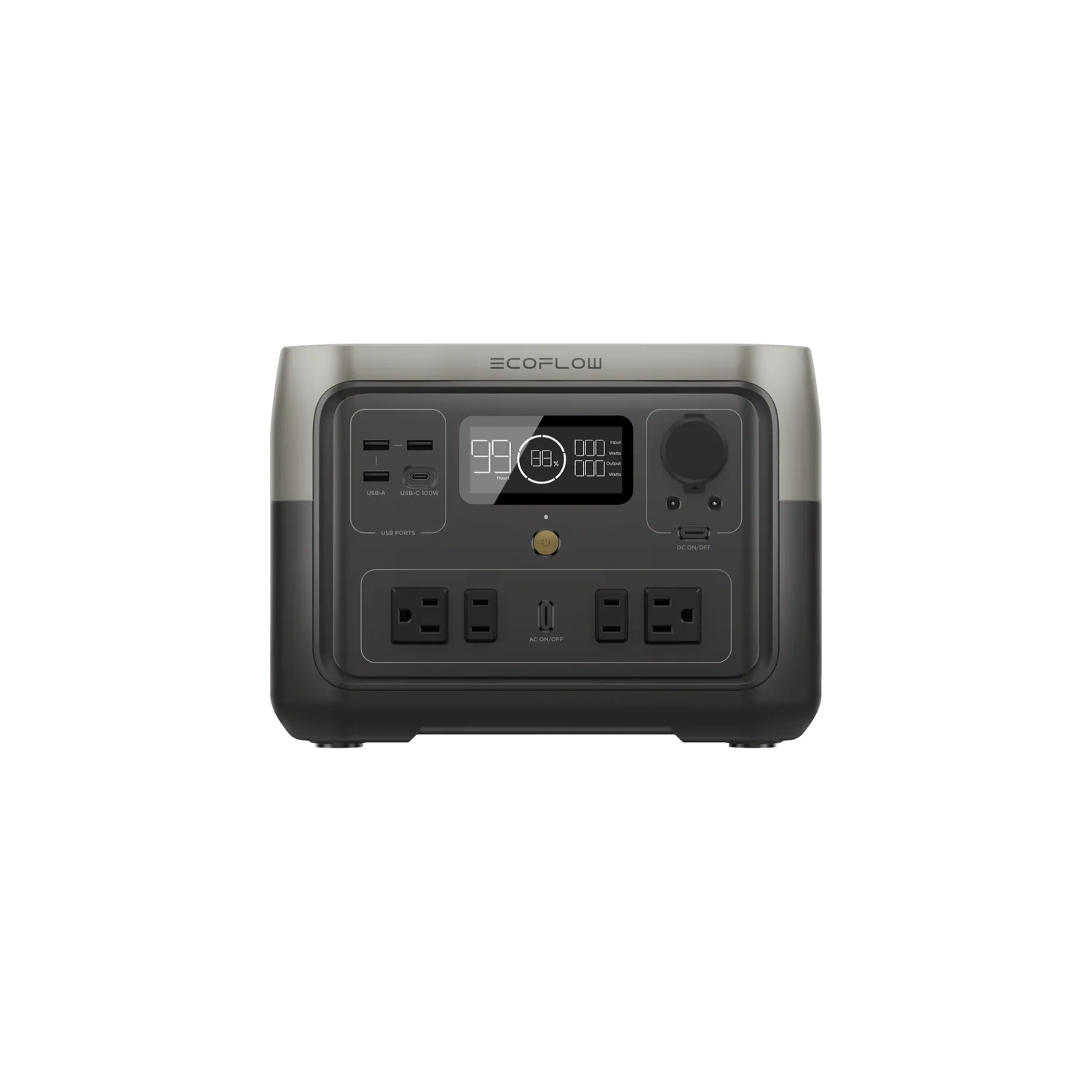
$289.00 · direct from EcoFlow
Last checked 1 day ago. Prices move — check before you buy.
Spec deltas
Ten dollars is what separates a DELTA 3 1000 Air ($309) from a RIVER 2 Max ($289), and that ten dollars buys 448 more watt-hours of capacity — 960Wh against 512Wh, nearly double, for a price gap that rounds to nothing.
The DELTA 3 1000 Air was built as a desk UPS: a 10ms switchover and a 39dB fan mean it can sit under a monitor and keep a router alive through a blip without anyone noticing it fired. The RIVER 2 Max switches over three times slower and runs 23dB louder doing the same job — fine outdoors, more noticeable indoors.
The RIVER 2 Max earns its keep elsewhere: 13.4 lbs against 22 lbs, a 100W USB-C port against 18W, and a five-year warranty against two. Neither station is built for a multi-day outage or a full campsite — both fall well short of those loads — so the real question is whether this box lives at a desk or in a bag.
What the Numbers Reveal
Each conclusion stated first — the numbers behind it on one line, the full analysis below.
Capacity
The RIVER 2 Max's lower sticker price is the only thing about it that looks cheaper — at $.58 per watt-hour against the DELTA 3 1000 Air's $.32, it's actually the more expensive unit to own by capacity.
DELTA 3 1000 Air: 960Wh for $309RIVER 2 Max: 512Wh for $289DELTA 3 1000 Air: $.32 per Wh vs RIVER 2 Max: $.58 per Wh
Why it mattersAnyone comparing these two on price alone should compare them on price-per-watt-hour instead — the DELTA 3 1000 Air wins that math even before the warranty and use-case questions come up.
EcoFlow built the DELTA 3 1000 Air as a power-protection device for a computer, monitor, and routerA2, and the fan behavior backs that up: 62dB is loud enough to interrupt a phone call four feet away, and a desk is exactly where the RIVER 2 Max would be doing that.
DELTA 3 1000 Air: 39dB noise, 10ms UPS switchoverRIVER 2 Max: 62dB noise, 30ms UPS switchover
Why it mattersAnyone protecting a home office through outages should take the DELTA 3 1000 Air; anyone using this outdoors where ambient noise already exists can ignore the gap entirely.
weight
Add the DELTA 3 1000 Air's 500W solar input against the RIVER 2 Max's 220W and a pattern shows up: the RIVER 2 Max is built to be carried and plugged into whatever's nearby, while the DELTA 3 1000 Air is built to be set down once and refilled from a panel without anyone touching it again.
RIVER 2 Max: 100W max USB-C vs DELTA 3 1000 Air: 18W max USB-CDELTA 3 1000 Air: 22 lbs vs RIVER 2 Max: 13.4 lbs
Why it mattersBuy the RIVER 2 Max if you're the one carrying the battery; buy the DELTA 3 1000 Air if the battery is staying put and the sun is doing the carrying.
The specific dimensions that decide these two units — everything else is a tie.
Lifetime Value
Selected because: Near-identical sticker price hides a 2x capacity gap and an inverted cost-per-Wh story.
cost / lifetime kWh
$20 buys 448 more watt-hours here, and the RIVER 2 Max's $.58 per watt-hour against the DELTA 3 1000 Air's $.32 makes the cheaper-looking unit the more expensive one to actually own. The warranty math claws some of that back for the RIVER 2 Max — five years of coverage against two — but on capacity per dollar, the DELTA 3 1000 Air isn't close.
Portability & Form Factor
Selected because: 8.6 lb weight gap and opposite noise profiles decide where each unit actually lives.
weight
22 lbs is a two-hand lift out of a trunk; 13.4 lbs is a one-hand grab off a shelf. That's the RIVER 2 Max's real reason to exist — it's built to live in a backpack, not on a desk. Pair that with 500W of solar input on the DELTA 3 1000 Air against 220W on the RIVER 2 Max, and the DELTA is the one you set up once and let the sun refill while you're not thinking about it.
What the Specs Don't Tell You
Selected because: USB-C ceiling and fan noise are the two specs most likely to surprise a buyer after purchase.
The RIVER 2 Max's fan runs at 62dB under load, loud enough to notice in a quiet room, while the DELTA 3 1000 Air holds at 39dB doing the identical job. Flip the ledger and the DELTA 3 1000 Air's 18W USB-C port is the one that'll annoy you daily if you're charging a phone off it instead of a wall brick — it's built for the AC outlets, not the USB ports.
Your Life, Your Pick
Selected because: Real loads split cleanly — CPAP and tailgate math both favor the DELTA 3 1000 Air outright.
Two of six scenarios produce a clean winner, and both go to the DELTA 3 1000 Air: it clears a Tailgate Party's 670Wh draw at 82% where the RIVER 2 Max needs 154% it doesn't have, and it handles a CPAP overnight using less than half the capacity the RIVER 2 Max burns through for the same job. Neither unit gets near Weekend Camping or an 8-Hour Blackout — both need a bigger class of battery for that.
Strengths & trade-offs
EcoFlow DELTA 3 1000 Air
Strengths
- +Larger battery capacity
- +Faster solar charging
Trade-offs
- –No major technical downsides compared to rival.
EcoFlow RIVER 2 Max
Strengths
- +Costs $20 less
- +Lighter by 8.6 lb
- +Longer warranty
Trade-offs
- –Can receive complaints about fan noise under heavy load.
Will It Power Your Gear?
Scenario math and per-appliance runtimes, modeled from the spec record.
Scenario verdicts
We ran the math on six real-world scenarios. Here's which unit survives your actual life.
SCN-01 · 2 nights · needs 2,100Wh
Weekend Camping
Two nights off-grid with essential comfort
Neither unit
Neither station gets close to a full Weekend Camping load — the DELTA 3 1000 Air would need to be two and a half times bigger, the RIVER 2 Max nearly five times bigger. This pair is a desk-and-day-trip pairing, not a multi-day off-grid one.
Battery budget usedlower = more headroom
LOAD Phone Charger 15W×6h · LED Lights 40W×8h · Box Fan 75W×14h · CPAP Machine 40W×16h
SCN-02 · 8 hours · needs 1,645Wh
8-Hour Blackout
Keep the essentials running through a night without power
Neither unit
Neither unit covers this scenario's 1,645Wh: the DELTA 3 1000 Air comes up 829Wh short (about 50% covered), the RIVER 2 Max 1,210Wh (26%). Treat this as partial cover — enough for the essentials in it, not the whole list.
Battery budget usedlower = more headroom
LOAD Fridge 150W×8h · Router + Modem 20W×8h · LED Lights (4 bulbs) 40W×6h · Phone Charger 15W×3h
SCN-03 · 8 hours · needs 320Wh
CPAP Overnight
Sleep therapy without interruption — the #1 medical use case
DELTA 3 1000 Air
Both handle a CPAP overnight without strain, but not by the same margin — the DELTA 3 1000 Air uses 39% of its capacity, the RIVER 2 Max 74%. Neither runs dry, but the RIVER 2 Max is working twice as hard for the same night's sleep.
Battery budget usedlower = more headroom
LOAD CPAP Machine 40W×8h
SCN-04 · 8 hours · needs 910Wh
Remote Workday
Full work day off-grid without power anxiety
Neither unit
Neither unit covers this scenario's 910Wh: the DELTA 3 1000 Air comes up 94Wh short (about 89% covered) (its nameplate 960Wh actually clears this — the flat 15% conversion allowance is what tips it under), the RIVER 2 Max 475Wh (48%). Treat this as partial cover — enough for the essentials in it, not the whole list.
Battery budget usedlower = more headroom
LOAD Laptop 60W×8h · External Monitor 30W×8h · Router + Modem 20W×8h · Phone Charger 15W×2h
SCN-05 · 4 hours · needs 670Wh
Tailgate Party
Game day power for the crew
DELTA 3 1000 Air
The RIVER 2 Max can't cover a Tailgate Party's 670Wh draw — it would need 154% of what it actually holds. The DELTA 3 1000 Air runs the same load at 82% and still has a slice left over.
Battery budget usedlower = more headroom
LOAD Blender 400W×0.5h · LED TV (55") 80W×4h · Bluetooth Speaker 15W×4h · Phone Charger (×3) 45W×2h
SCN-06 · 24 hours · needs 4,685Wh
Van Life Daily
A full day of mobile living — the ultimate endurance test
Neither unit
Neither unit covers this scenario's 4,685Wh: the DELTA 3 1000 Air comes up 3,869Wh short (about 17% covered), the RIVER 2 Max 4,250Wh (9%). This is well outside what either unit is for; the right answer here is a larger station, not a choice between these two.
Battery budget usedlower = more headroom
LOAD Mini-Fridge 150W×24h · Laptop 60W×4h · Phone Charger 15W×3h · LED Lights 40W×5h · Fan 75W×8h
The Load Test
RUNTIME = (Wh × 0.85) ÷ LOAD
None of the scenarios above exactly yours? Build it. Toggle what you'd plug in; both units are tested against the combined draw.
Essentials
Comfort & Convenience
High-Draw Appliances
Test duration
8h
Continuous draw
205W
Projected runtime
For this load: DELTA 3 1000 Air runs 4h vs 2.1h.
Modeled from the spec record — same math as the tables below. Methodology
Runtime by appliance
Real-world runtime estimates for common appliances, modeled at 85% inverter efficiency.¹
Essentials
The basics you need runningscale 0–54.4hComfort & Convenience
Makes off-grid life actually enjoyablescale 0–10.9hHigh-Draw Appliances
These reveal the real limits¹ Runtime = (capacity × 0.85) ÷ appliance watts. Within each group, all bars share one time scale (the group's longest runtime), so lengths are comparable across appliances; identical runtimes collapse into a single blue/orange bar. Actual runtime varies with battery age, temperature, and simultaneous loads — see methodology.
Conclusion
July 14, 2026
Verdict: the EcoFlow DELTA 3 1000 Air
Buy the DELTA 3 1000 Air if this is living on a desk or a shelf: for $20 more than the RIVER 2 Max you get nearly double the capacity, a quieter fan, and a faster UPS switchover, and it works out cheaper per lifetime kWh despite the shorter warranty. Buy the RIVER 2 Max instead if it's going in a backpack — it's 8.6 lbs lighter, charges a laptop over USB-C five times faster, and EcoFlow backs it for five years instead of two.
Editor-assigned confidence, based on cited owner research and spec analysis.
List prices as of July 14, 2026. The links below open EcoFlow's current price.
$309.00 · direct from EcoFlow
or check the RIVER 2 Max price$289.00 list
Written by Ian Schneider, Solar & Off-Grid Tester · Station Arena Test Desk · Updated July 14, 2026
Measured Data
Benchmark scores and the full spec record, side by side.
Benchmark scores
Not rated for both units (minimum threshold unmet): UPS.
Full specifications
ᵈ Derived: price ÷ rated capacity. See the data behind our comparisons →
Comparison ToolAdd more power stations, side by sideOpen Tool →How these numbers are produced
Numeric verification
Every figure on this page traces to our spec database or arithmetic on it — no estimated numbers.
Owner claims
Statements about owner experience are cited to published reviews — see Sources & Research Notes below.
Runtime model
Runtime = (rated capacity × 0.85 inverter efficiency) ÷ device wattage. Solar recharge estimates assume panels deliver 70% of rated output. Cold weather, battery age, and stacked loads reduce real-world results.
Power Score
Computed from 14 published spec dimensions, weighted per use-case bench. Higher is better; a unit must meet a bench's minimum threshold to be rated.
See the full weight table and data sourcing on our methodology page →Class ranking (the star rating)
Each unit's star score is a category ranking, not customer reviews — no buyer opinions feed it. We score every station on size-independent quality (value, output, portability, endurance, ports, warranty, and more), then percentile-rank it against the other units in its capacity class, so a class-leading compact unit and a class-leading whole-home unit can both earn 5★. Here, DELTA 3 1000 Air rates 5.0/5 (99th percentile of 20 Compact-class units), and RIVER 2 Max rates 3.7/5 (26th percentile of 20 Compact-class units).
How the class ranking is computed →Test Notes & Caveats
Hidden gotchas and advantages we spotted that you won't find on the product page.
The RIVER 2 Max's Fan Has an Opinion
62dB under load is vacuum-cleaner territory — fine at a campsite, less fine four feet from your desk. The DELTA 3 1000 Air stays at 39dB doing the same job, quiet enough to forget it's running.
The DELTA 3 1000 Air's One Real Miss
18W USB-C won't fast-charge a modern phone, let alone a laptop. The RIVER 2 Max's 100W port does both. If your phone lives on this unit's USB-C port, that gap is the whole review.
Ten Milliseconds Against Thirty
Both switch fast enough that a desktop won't reboot, but the DELTA 3 1000 Air's 10ms line-interactive switching carries more margin for sensitive electronics than the RIVER 2 Max's 30ms standby switching.
Five Years Against Two
EcoFlow backs the RIVER 2 Max for five years and the DELTA 3 1000 Air for two. On paper the RIVER 2 Max is the safer long-term bet, even though its lifetime cost per kWh runs higher.
Full record above — the Test Desk pick is the DELTA 3 1000 Air.
Check DELTA 3 1000 Air price →or check the RIVER 2 Max priceOwnership Analysis
What happens after you buy — true cost of ownership, brand trust, and growth potential.
Lifetime value
Service lifeyears at one full cycle per day
Lifetime energy delivered
Cost per delivered kWh
│ warranty ends · Reaching the cycle rating means ~80% capacity remains — degraded, not dead.
Analyst note
The RIVER 2 Max is cheaper to buy, but the DELTA 3 1000 Air is cheaper to own. At $0.11/kWh over its lifetime vs $0.19/kWh, the DELTA 3 1000 Air's higher cycle life and capacity make each dollar go further over the years. One thing to know reading the table: both carry the same 3,000-cycle rating, so the lifetime rows are sticker price and capacity in disguise — the wear horizon is identical and decides nothing here.
Growth path
DELTA 3 1000 Air
FIXED CAPACITYFixed at 960Wh, with no expansion — so size it for your needs up front rather than planning to add capacity later.
Accepts up to 500W of solar. Suitable for a 1-2 panel setup.
Adequate ports for most setups, but heavy users may want a power strip.
RIVER 2 Max
FIXED CAPACITYFixed at 512Wh, with no expansion — so size it for your needs up front rather than planning to add capacity later.
Accepts up to 220W of solar. Limited to a single portable panel.
Adequate ports for most setups, but heavy users may want a power strip.
Realistic full solar rechargeat 70% of rated panel output — see methodology
Analyst note
Neither expands, and that's no knock on either — each is a complete unit at a fixed size. Buy the capacity that covers your needs now (the DELTA 3 1000 Air gives you the larger ceiling); you can't add to either later.
What Owners Report
Patterns from published owner reports and long-term reviews — every claim cited to its source below.
EcoFlow DELTA 3 1000 Air
Reviewers built their read of the DELTA 3 1000 Air around what it's for: a power-protection box that keeps a computer, monitor, and router alive through a blip with a 10ms switchoverA2. It's a 960Wh LiFePO4 unit in a 22 lb, minimalist shell with fewer ports and features than EcoFlow's bigger stationsA1, and its 500W continuous ceiling means it was never meant to run a space heater or hair dryer — just the low-to-moderate desk load it was designed aroundA3. EcoFlow has since discontinued it in favor of the standard DELTA 3, a 1,024Wh, 1,800W unit at roughly $549A4 — worth knowing if you want a currently-sold model with more headroom.
“A 960Wh LiFePO4 unit with a 500W inverter (800W X-Boost) weighing only 22 lbs — a focused, minimalist design with fewer ports and features.”
Sources
thesolarlab.com · batteryskills.com · backuppowerhub.com · matanich.com
EcoFlow RIVER 2 Max
The RIVER 2 Max's field reputation is built on being light and fast: about 13 lbs, lighter than some Li-Ion competitors its sizeB1, and a full charge in roughly 60 minutes via X-Stream chargingB2. Owners lean on the EcoFlow app to check charge level and adjust charging speed over WiFi or BluetoothB3, and one field test ran a telescope, a 65-inch TV, two laptops, and phones through a 4-hour event with power to spare on its 3,000-cycle LFP packB4.
“512Wh in a light package of about 13 lbs, lighter than some of its closest competitors that use Li-Ion chemistry.”
Sources
storagereview.com · backuppowerhub.com · gagadget.com · ecoflow.com · thecampingnerd.com · thetechnologyman.com · bestbuy.com
Sources & Research Notes
Every owner claim in this report is traceable to a published source. The bracketed references above resolve here.
Recurring owner themes
- A focused home-office UPS unit — LFP, 10ms UPS, quiet and light — but low 500W output; now discontinued in favor of the DELTA 3. [DELTA 3 1000 Air · 3 entries]
- Light weight, fast roughly-one-hour charging, and a simple capable app are the standout praise for this 512Wh unit. [RIVER 2 Max · 3 entries]
- A1
“A 960Wh LiFePO4 unit with a 500W inverter (800W X-Boost) weighing only 22 lbs — a focused, minimalist design with fewer ports and features.”
thesolarlab.com / batteryskills.com — DELTA 3 1000 Air review · 2026 · [mixed]
- A2
“Built as a power-protection device with a 10ms UPS switchover to keep a computer, monitor, and router running through outages.”
backuppowerhub.com — DELTA 3 1000 Air review · 2026 · [positive]
- A3
“With only 500W continuous output, it won't run a space heater or hair dryer — it's built for low-to-moderate draw devices.”
backuppowerhub.com / matanich.com — DELTA 3 1000 Air review · 2026 · [mixed]
- A4
“EcoFlow no longer sells the DELTA 3 1000 Air; the closest successor is the standard DELTA 3 (1,024Wh LFP, 1,800W output, ~$549).”
backuppowerhub.com — DELTA 3 line · 2026 · [mixed]
- B1
“512Wh in a light package of about 13 lbs, lighter than some of its closest competitors that use Li-Ion chemistry.”
storagereview.com / backuppowerhub.com — RIVER 2 Max review · 2026 · [positive]
- B2
“Fully charges in about 60 minutes via X-Stream charging — far faster than most portable power stations — with multiple charging options.”
gagadget.com / ecoflow.com — RIVER 2 Max review · 2026 · [positive]
- B3
“The EcoFlow app offers simple remote control and monitoring over WiFi and Bluetooth — view charge levels, customize settings, and adjust charging speed from a phone.”
thecampingnerd.com / ecoflow.com — RIVER 2 Max review · 2026 · [positive]
- B4
“Upgraded LFP chemistry rated for about 3,000 cycles, roughly a decade of everyday use; in field testing it powered a telescope, a 65-inch LED TV, two laptops, and phones through a 4-hour event with power to spare.”
thetechnologyman.com / bestbuy.com owner reviews — RIVER 2 Max · 2026 · [positive]
Research compiled July 14, 2026.
Who Should Buy Which
Buy the DELTA 3 1000 Air if you…
- →Anyone protecting a home office desk through outages — the fast, quiet UPS switchover and near-double capacity mean it can sit under a monitor and disappear.
- →Anyone who wants the most watt-hours per dollar in this pair and doesn't mind the shorter two-year warranty.
This is you — check the DELTA 3 1000 Air price
Buy the RIVER 2 Max if you…
- →Anyone who's the one carrying the battery — 8.6 lbs lighter with a USB-C port that actually fast-charges a laptop.
- →Anyone who values EcoFlow's five-year warranty over raw capacity.
If neither fits
Anyone planning a real multi-day outage, a full campsite, or van-life power needs — both units fall well short of an 8-Hour Blackout's 1,645Wh load, let alone Weekend Camping's 2,100Wh. Look at a 1,500Wh-plus class station instead.
The Bottom Line
This comes down to where the battery lives. Parked at a desk, the DELTA 3 1000 Air's near-double capacity, quieter fan, and faster UPS switchover make it the better $309 than the RIVER 2 Max is a $289 — the ten-dollar gap buys far more than it costs.
Thrown in a bag, the RIVER 2 Max's 8.6 lb weight advantage and fast USB-C charging flip the calculus. Pick the job first; the price difference won't decide it for you.
Frequently Asked Questions
Answers drawn from the spec record and cited owner research.
Is the DELTA 3 1000 Air or RIVER 2 Max quieter?
The DELTA 3 1000 Air, by a wide margin — 39dB against the RIVER 2 Max's 62dB under load. In a quiet room that's the difference between not noticing it's running and having to raise your voice.
Which one is better for a power outage at a desk?
The DELTA 3 1000 Air. Its 10ms UPS switchover is three times faster than the RIVER 2 Max's 30ms, and it was built specifically to keep a computer, monitor, and router running through a blip.
Can either one run a CPAP all night?
Yes, both handle a CPAP overnight comfortably. The DELTA 3 1000 Air uses well under half its capacity doing it, while the RIVER 2 Max uses closer to three-quarters — both finish the night with power left.
Which charges a laptop faster over USB-C?
The RIVER 2 Max, decisively — its 100W USB-C port against the DELTA 3 1000 Air's 18W is more than five times the charging speed. If you're topping off a laptop or phone through that port daily, the RIVER 2 Max is the better fit.
Is the DELTA 3 1000 Air still available new?
EcoFlow has discontinued it; the closest current model is the standard DELTA 3, a 1,024Wh, 1,800W unit around $549. Where it's still in stock, the 1000 Air remains a capable, cheaper pick for the lighter loads covered here.
Check DELTA 3 1000 Air price →
Where to buy
EcoFlow DELTA 3 1000 AirPick
$309.00
$309.00 · direct from EcoFlow
EcoFlow RIVER 2 Max
$289.00
$289.00 · direct from EcoFlow
Last checked 1 day ago. Prices move — check before you buy.
Prices may vary by retailer and are subject to change.