Head-to-head test
BLUETTI Pioneer Na vs Goal Zero Yeti 500X
At daily use the Yeti 500X hits its rated 500 cycles in 1.4 years and the Pioneer Na runs 11, so unless you need the 12.9 lb carry, this is a choice between a unit you replace and a unit you keep.
Full profiles: BLUETTI Pioneer Na → · Goal Zero Yeti 500X →

Written by Wenny ZhengUpdated
Portable Power Tester, Station Arena Test Desk

$899.00 · direct from BLUETTI
Last checked 1 day ago. Prices move — check before you buy.
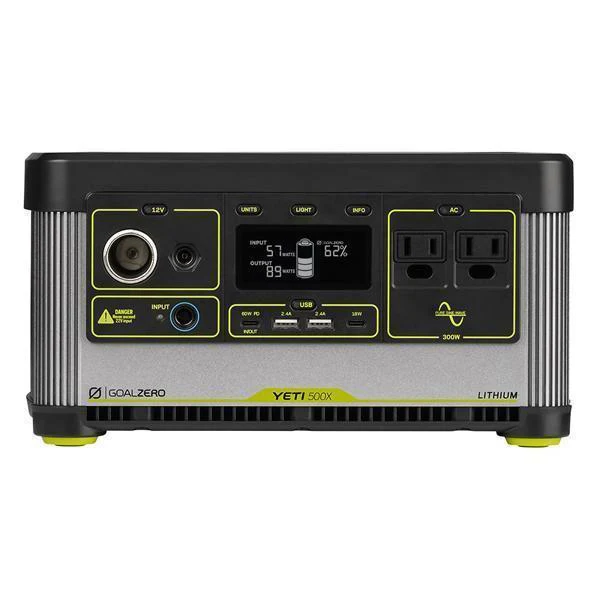
$499.95 · direct from Goal Zero
Last checked 1 day ago. Prices move — check before you buy.
Spec deltas
The Yeti 500X is an older Li-NMC design rated for 500 charge cycles, and Goal Zero has already replaced it in its own lineup with an LFP Yeti 500B4. That decides this page before any other number gets a turn. The Pioneer Na is rated for 4,000 cycles, and it is not a lithium pack at all: it is sodium-ion, the first portable station built on the chemistryA1.
The inverter is the other thing to settle before capacity. The Yeti 500X runs 300W continuous with a 600W surge, which rules out more appliances than its 497Wh ever will. Our Tailgate Party profile asks for a 400W peak, and the Yeti starts it on surge before handing the job back to a 300W rating that cannot hold it. The Pioneer Na runs 1,500W with 2,250W of surge and never notices the question.
The Yeti's case is real and it is narrow. 12.9 lbs against 37 is one hand against two, and it has the field record to match: compact, well-built, and untroublesome with laptops, tablets and phonesB2B3. If that is genuinely the whole list, and a few trips a year is genuinely the whole duty cycle, the cheaper unit is defensible. Buy it knowing what you bought.
What the Numbers Reveal
Each conclusion stated first — the numbers behind it on one line, the full analysis below.
rated cycles
The cycle ratings are where identical pricing comes apart. 900Wh across 4,000 cycles is 3,600 kWh of energy over the rated life of the pack; 497Wh across 500 cycles is 249 kWh. You pay the same rate per watt-hour, and one of these lets you spend each watt-hour eight times as often.
Pioneer Na: $899 for 900Wh, which the catalogue puts at $1.00 per watt-hourYeti 500X: $500 for 497Wh, or $1.01 per watt-hourPioneer Na rated for 4,000 cycles; Yeti 500X rated for 500 cycles
Why it mattersIf the unit will see weekly use for years rather than a handful of trips, the Yeti's lower sticker is a down payment on its own replacement.
continuous output
Push the Yeti to its own ceiling and the arithmetic gets uncomfortable. After the flat 85% usable derate we apply to every unit, it holds 422Wh, and 422Wh at a full 300W draw is about an hour and a half. So it is either doing something small for a long time or something medium for almost no time. The single AC outlet is that same limit in physical form. With four outlets and 1,500W, the Pioneer Na changes the question from which appliance to how many.
Yeti 500X: 300W continuous, 600W surge, 1 AC outletPioneer Na: 1,500W continuous, 2,250W surge, 4 AC outletsTailgate Party needs 670Wh with a 400W peak: the Yeti 500X starts the peak but cannot sustain it and ends 248Wh short, while the Pioneer Na covers it with 95Wh to spare
Why it mattersAnyone whose list contains one motor or one heating element can stop reading about the Yeti right here.
solar input
Stack the solar inputs on top and the cold-weather case stops being close. 900Wh at 500W of input is under two hours of strong sun. 497Wh at 120W is over four hours for barely half the energy, in the season with the least daylight to spend. Testers also clocked the Pioneer Na at 80% in about 35 minutes on AC and solar togetherA3, and put the cold-charging claims in real cold where they held upA2.
The Pioneer Na uses sodium-ion cells, which keep accepting a charge in sub-freezing cold, while the Yeti 500X's Li-NMC pack has to warm up firstPioneer Na accepts 500W of solar input; Yeti 500X accepts 120WPioneer Na holds 900Wh; Yeti 500X holds 497Wh
Why it mattersIf the unit lives in a cabin, a van in February, or an unheated garage, this is the one section where price does not get a vote.
weight
The overnight spec that actually matters is the fan, and neither figure helps as much as it looks. Goal Zero publishes no dB number for this unit, which is missing data rather than proven quiet. The Pioneer Na's 45dB is a spec-sheet figure published as a best case, not a reading we took, and 45dB is roughly a running refrigerator. What does separate them is the wall socket: only the Pioneer Na sits between the grid and the machine and hands over on an outage, rated no worse than 20ms.
CPAP Overnight needs 320Wh and both units pass, the Pioneer Na with 445Wh left and the Yeti 500X with 102WhYeti 500X: 12.9 lbs; Pioneer Na: 37 lbsThe Pioneer Na publishes 45dB and lists a UPS transfer no worse than 20ms; the Yeti 500X publishes no noise figure and lists no UPS mode
Why it mattersTravel CPAP that plugs into nothing: the Yeti is defensible. Bedside CPAP that has to survive a blackout: the Pioneer Na, because the Yeti cannot do that job at all.
The specific dimensions that decide these two units — everything else is a tie.
Lifetime Value
Selected because: These two cost within a cent of each other per watt-hour to buy, and the cycle ratings behind them are 4,000 against 500, so the matchup turns on cost over the life of the pack rather than on the sticker.
cost / lifetime kWh
Two batteries priced the same per watt-hour, and one of them will be on its second owner while the other is at the recycling depot. The cycle count is doing all of that work. At daily use the Yeti 500X reaches its rated 500 cycles in 1.4 years while the Pioneer Na runs 11. Drop to weekends and it is 4.8 years against 38.5, which is really a statement that one of these outlasts your interest in it.
Be precise about what hitting the limit means, because it is not failure. The rating is the point where the pack is down to roughly 80% of the capacity it shipped with, and 80% of 497Wh still runs a CPAP all night. The honest version is not that the Yeti dies after 1.4 years of daily use. It is that after 1.4 years you are living with a smaller unit than the one you paid for, and you arrive there roughly eight times sooner.
What the Specs Don't Tell You
Selected because: The real differences are not on the front of the spec table: sodium-ion charging below freezing, a UPS mode only one unit lists, a 2,250W surge ceiling against 600W, and a noise figure only one maker publishes.
rated cycles
The sodium-ion card is the one that cannot be bought back with money. Lithium cells refuse a charge below freezing, the Yeti's NMC pack included, so a cold-climate buyer is choosing between warming a battery up before it will accept power and a chemistry that never asks. Reviewers put that claim in genuine cold and it heldA2. No price, weight or capacity advantage on the Yeti's side converts a battery you cannot charge in January into one you can.
Then the quiet one: only the Pioneer Na lists a UPS mode. That is the gap between a unit you plug things into and a unit you plug into the wall and forget about, and for a desktop, a router or a bedside CPAP it is the whole reason to own a station. The surge cards need reading in the other direction. The Yeti holds the better surge-to-continuous ratio, 2x against 1.5x, which sounds like a win until you remember that a compressor draws watts at switch-on and not a multiple of somebody else's rating. 2,250W against 600W is the number that decides what starts.
Your Life, Your Pick
Selected because: Four of the six load profiles we run defeat both units, which tells you more about what a 900Wh and a 497Wh station are for than any head-to-head number does.
Four of the six profiles here defeat both units, and that is the most useful thing on the page. Weekend Camping wants 2,100Wh and Van Life Daily wants 4,685Wh. The Pioneer Na covers 36% and 16% of those; the Yeti 20% and 9%. If either is your actual life, this comparison is the wrong page and the right answer is a station in the 2,000Wh class.
Inside the range they were built for, the split is clean. The CPAP night is the one both clear. The Tailgate Party is the one only the Pioneer Na clears, and it fails the Yeti on the inverter rather than the battery. Remote Workday is the interesting near miss: the Pioneer Na ends 145Wh short of 910Wh while the Yeti is 488Wh short, and only one of those gaps is the kind an afternoon of sun can close.
Portability & Form Factor
Selected because: 12.9 lbs against 37 is the Yeti 500X's one clear win, and for a tent or an overhead bin it is not a small one.
weight
37 lbs is a two-hands, bent-knees lift. 12.9 lbs is something you carry in from the car with groceries in the other hand. Nothing else in this comparison changes that, and if the unit's job is to move between a tent, a hotel room and an overhead bin, the Yeti is the one that actually gets taken along instead of being left in the garage because loading it is a project.
The catch is what you are carrying. Our own research notes the Pioneer Na is bulky for its 900WhA0A4, and the arithmetic backs it: 900Wh over 37 lbs is about 24Wh a pound, against 497Wh over 12.9 lbs at about 39. The Yeti carries more energy in every pound you lift. If portability is the reason you are shopping, that is not a tiebreaker, it is the verdict. For anything that gets set down and used where it sits, 37 lbs is a one-time inconvenience you pay once a trip.
Strengths & trade-offs
BLUETTI Pioneer Na
Strengths
- +Larger battery capacity
- +Higher AC output
- +Longer warranty
- +Faster solar charging
- +Rated for 4,000 charge cycles — much longer battery lifespan
Trade-offs
- –Substantially more expensive (+$399.1) than the Yeti 500X.
- –Significantly heavier (+24.1 lbs), making it harder to move.
Goal Zero Yeti 500X
Strengths
- +Costs $399.1 less
- +Lighter by 24.1 lb
Trade-offs
- –Weaker inverter (-1,200W) limits appliance compatibility.
- –Lacks smartphone app control for remote monitoring.
- –Shorter-lived battery — rated for 500 charge cycles vs the Pioneer Na's 4,000, so it wears out sooner.
Will It Power Your Gear?
Scenario math and per-appliance runtimes, modeled from the spec record.
Scenario verdicts
We ran the math on six real-world scenarios. Here's which unit survives your actual life.
SCN-01 · 2 nights · needs 2,100Wh
Weekend Camping
Two nights off-grid with essential comfort
Neither unit
Neither unit covers this scenario's 2,100Wh: the Pioneer Na comes up 1,335Wh short (about 36% covered), the Yeti 500X 1,678Wh (20%). This is well outside what either unit is for; the right answer here is a larger station, not a choice between these two.
Battery budget usedlower = more headroom
LOAD Phone Charger 15W×6h · LED Lights 40W×8h · Box Fan 75W×14h · CPAP Machine 40W×16h
SCN-02 · 8 hours · needs 1,645Wh
8-Hour Blackout
Keep the essentials running through a night without power
Neither unit
Neither unit does the whole 1,645Wh. The Pioneer Na covers 47%, the Yeti 26%, so the realistic plan with either is a triage list rather than a whole-house night. What separates them is what happens next. The Pioneer Na can sit inline and hand over to battery the moment the grid drops, and it takes 500W of solar to refill the following morning against the Yeti's 120W. An outage into its second day is won on recharge, not capacity.
Battery budget usedlower = more headroom
LOAD Fridge 150W×8h · Router + Modem 20W×8h · LED Lights (4 bulbs) 40W×6h · Phone Charger 15W×3h
SCN-03 · 8 hours · needs 320Wh
CPAP Overnight
Sleep therapy without interruption — the #1 medical use case
Either unit
Both of these cover a CPAP night with room left over, so capacity has nothing to say here. Against 765Wh and 422Wh of usable energy, a 320Wh night leaves the Pioneer Na 445Wh spare and the Yeti 102Wh, and neither of those numbers will wake you. The fan might, and that is the one spec you cannot check, because Goal Zero publishes no noise figure at all: its quiet is untested rather than proven. If the machine lives plugged into a bedroom wall, the tiebreak is the UPS mode only the Pioneer Na lists. If you are carrying it to a campsite, take the 12.9 lb unit.
Battery budget usedlower = more headroom
LOAD CPAP Machine 40W×8h
SCN-04 · 8 hours · needs 910Wh
Remote Workday
Full work day off-grid without power anxiety
Neither unit
The Pioneer Na gets 84% of the way through this day and the Yeti 47%, so on battery alone neither one finishes it. The difference is whether the gap is closable. The Pioneer Na is 145Wh short and accepts 500W of solar, which is under twenty minutes of good sun. The Yeti is 488Wh short and accepts 120W, which is over four hours of it. Same verdict, very different afternoon.
Battery budget usedlower = more headroom
LOAD Laptop 60W×8h · External Monitor 30W×8h · Router + Modem 20W×8h · Phone Charger 15W×2h
SCN-05 · 4 hours · needs 670Wh
Tailgate Party
Game day power for the crew
Pioneer Na
This one fails the Yeti 500X on the inverter, not the battery. The 400W peak starts on its 600W surge and then lands on a 300W continuous rating that cannot carry it, and the 670Wh the afternoon needs is 248Wh more than the Yeti has usable anyway. The Pioneer Na finishes with 95Wh to spare without going near its 1,500W ceiling. Four AC outlets against one matters more at a tailgate than anywhere else on this page.
Battery budget usedlower = more headroom
LOAD Blender 400W×0.5h · LED TV (55") 80W×4h · Bluetooth Speaker 15W×4h · Phone Charger (×3) 45W×2h
SCN-06 · 24 hours · needs 4,685Wh
Van Life Daily
A full day of mobile living — the ultimate endurance test
Neither unit
Neither unit covers this scenario's 4,685Wh: the Pioneer Na comes up 3,920Wh short (about 16% covered), the Yeti 500X 4,263Wh (9%). This is well outside what either unit is for; the right answer here is a larger station, not a choice between these two.
Battery budget usedlower = more headroom
LOAD Mini-Fridge 150W×24h · Laptop 60W×4h · Phone Charger 15W×3h · LED Lights 40W×5h · Fan 75W×8h
The Load Test
RUNTIME = (Wh × 0.85) ÷ LOAD
None of the scenarios above exactly yours? Build it. Toggle what you'd plug in; both units are tested against the combined draw.
Essentials
Comfort & Convenience
High-Draw Appliances
Test duration
8h
Continuous draw
205W
Projected runtime
For this load: Pioneer Na runs 3.7h vs 2.1h.
$899 list · direct from BLUETTI
Modeled from the spec record — same math as the tables below. Methodology
Runtime by appliance
Real-world runtime estimates for common appliances, modeled at 85% inverter efficiency.¹
Essentials
The basics you need runningscale 0–51hComfort & Convenience
Makes off-grid life actually enjoyablescale 0–10.2hHigh-Draw Appliances
These reveal the real limitsscale 0–0.8h¹ Runtime = (capacity × 0.85) ÷ appliance watts. Within each group, all bars share one time scale (the group's longest runtime), so lengths are comparable across appliances; identical runtimes collapse into a single blue/orange bar. Actual runtime varies with battery age, temperature, and simultaneous loads — see methodology.
Conclusion
September 13, 2026
Verdict: the Pioneer Na, on Power Score margin
Take the Pioneer Na. It costs $899 against the Yeti 500X's $500 and gives you 900Wh instead of 497, 1,500W of inverter instead of 300, 4,000 rated cycles instead of 500, and sodium-ion cells that keep charging below freezing when the Yeti's NMC pack cannot. On the day you buy, the two are a cent apart per watt-hour: $1.00 against $1.01. Over their rated lives it is 25 cents a kilowatt-hour against $2.01, because 900Wh times 4,000 cycles is 3,600 kWh of energy and 497Wh times 500 cycles is 249. The Yeti earns its place in exactly one hand: 12.9 lbs against 37, which is the difference between carrying it and lifting it. If the list is a phone, a laptop and a CPAP a few weekends a year, that carry is a real argument. Anything heavier, colder, or meant to last, and the Pioneer Na is the unit.
Editor-assigned confidence, based on cited owner research and spec analysis.
List prices as of September 13, 2026. The links below open BLUETTI's and Goal Zero's current prices.
$899.00 · direct from BLUETTI
Last checked 1 day ago. Prices move — check before you buy.
or check the Yeti 500X price$499.95 list
Written by Wenny Zheng, Portable Power Tester · Station Arena Test Desk · Updated September 13, 2026
Measured Data
Benchmark scores and the full spec record, side by side.
Benchmark scores
Not rated for both units (minimum threshold unmet): UPS, CPAP, Solar Generator, Tailgating.
Full specifications
ᵈ Derived: price ÷ rated capacity. See the data behind our comparisons →
Comparison ToolAdd more power stations, side by sideOpen Tool →How these numbers are produced
Numeric verification
Every figure on this page traces to our spec database or arithmetic on it — no estimated numbers.
Owner claims
Statements about owner experience are cited to published reviews — see Sources & Research Notes below.
Runtime model
Runtime = (rated capacity × 0.85 inverter efficiency) ÷ device wattage. Solar recharge estimates assume panels deliver 70% of rated output. Cold weather, battery age, and stacked loads reduce real-world results.
Power Score
Computed from 14 published spec dimensions, weighted per use-case bench. Higher is better; a unit must meet a bench's minimum threshold to be rated.
See the full weight table and data sourcing on our methodology page →Class ranking (the star rating)
Each unit's star score is a category ranking, not customer reviews — no buyer opinions feed it. We score every station on size-independent quality (value, output, portability, endurance, ports, warranty, and more), then percentile-rank it against the other units in its capacity class, so a class-leading compact unit and a class-leading whole-home unit can both earn 5★. Here, Pioneer Na rates 3.9/5 (37th percentile of 20 Compact-class units), and Yeti 500X rates 3.5/5 (14th percentile of 22 Personal-class units).
How the class ranking is computed →Test Notes & Caveats
Hidden gotchas and advantages we spotted that you won't find on the product page.
Pioneer Na: 45dB Published
45dB is about as loud as a running refrigerator. It is BLUETTI's own rating rather than a reading on a shared bench — makers differ on whether they quote a best case or a figure under load, so treat it as a starting point rather than what you would hear at a bedside. For most people, fan noise around 45dB and up is where sleep starts to suffer.
Sodium-Ion: The One Thing Money Cannot Buy Back
The Pioneer Na's cells keep accepting a charge in cold that stops a lithium pack outright. Charging lithium below freezing plates the metal and permanently damages the cells, so the Yeti 500X has to come indoors and warm up before it will take power at all. This is the rare spec with no trade-off attached: there is no amount of price, weight or capacity on the Yeti's side that turns a battery you cannot charge in January into one you can. If the unit lives in a cabin, a van or an unheated garage, stop comparing and buy the sodium-ion one.
Yeti 500X: No App Control
Without app control, you have to physically walk to the Yeti 500X to check battery level, adjust settings, or monitor power draw. The Pioneer Na lets you do all that from your phone, including getting low-battery alerts.
Read the Surge Numbers in the Right Order
The Yeti 500X keeps the better ratio and the worse ceiling, and only one of those starts a motor. Its 600W surge over a 300W rating is 2x of headroom against the Pioneer Na's 2,250W over 1,500W at 1.5x. But a compressor or a power tool pulls a fixed number of watts at switch-on, not a multiple of whatever the inverter is rated for, and 2,250W swallows spikes that 600W cannot. The ratio tells you how relaxed an inverter is at steady state, where the Yeti genuinely does sit further below its own limit. The ceiling tells you what will start. Buy on the ceiling.
Only One of These Sits Between the Wall and Your Gear
The Pioneer Na lists a UPS mode rated no worse than 20ms of transfer, which is a ceiling on a spec sheet rather than a stopwatch reading. That is fine for a router, a desktop or a CPAP, though the fussiest PC power supplies sit right on that line. The Yeti 500X's spec sheet lists no UPS mode at all, so anything plugged into it during an outage rides only as far as your reaction time, and at 3 a.m. your reaction time is not a spec.
Three Years Against Two, and What Each One Covers
The Pioneer Na carries three years and the Yeti 500X two, and Goal Zero's two years are not conditioned on registering the unit. The cheaper Yeti does buy more coverage per dollar, 4 years per $1,000 against 3.3, but that is a fact about its price rather than about its coverage. The question that matters is what happens in year three, and only one of these is still covered then. It is also the one rated for 4,000 cycles instead of 500, which is the more likely reason you are still using it.
What Happens When the Rating Runs Out
Reaching the cycle limit is not failure, and the Yeti 500X gets there first. At daily use the rating is 1.4 years against 11, and at twice a week it is 4.8 against 38.5. What arrives at the end is not a dead battery but a pack down to roughly 80% of the capacity it shipped with, which on 497Wh still covers a CPAP overnight. Count lifetime energy rather than years when the units are different sizes, because a cycle is 900Wh on one of these and 497Wh on the other.
The Noise Figures Do Not Compare, In Either Direction
One of these publishes a number and one does not, and neither fact tells you which is quieter. The Pioneer Na's 45dB is a spec-sheet figure published as a best case, which usually means a quiet mode rather than a fan working hard, so expect more under load. Goal Zero publishes nothing here, and that is missing data rather than a hidden advantage. If this is going in a bedroom or beside a CPAP, treat the Pioneer Na's figure as the only published number on the table and go looking for hands-on accounts of the Yeti before you trust it near your pillow.
Full record above — the Test Desk pick is the Pioneer Na.
Check Pioneer Na price →or check the Yeti 500X priceOwnership Analysis
What happens after you buy — true cost of ownership, brand trust, and growth potential.
Lifetime value
Service lifeyears at one full cycle per day
Lifetime energy delivered
Cost per delivered kWh
│ warranty ends · Reaching the cycle rating means ~80% capacity remains — degraded, not dead.
Analyst note
The Yeti 500X is cheaper to buy, but the Pioneer Na is cheaper to own. At $0.25/kWh over its lifetime vs $2.01/kWh, the Pioneer Na's higher cycle life and capacity make each dollar go further over the years.
Delivers each lifetime kWh for $1.76 less — check the Pioneer Na price →
Brand trust
BLUETTI
Ecosystem
One of the broadest lineups — 15-20+ models from budget (AC2A) to flagship portable (Apex 300, 2764.8Wh). Includes specialized products: vehicle solar hubs, sodium-ion cold-weather units, and balcony storage systems.
Support
BLUETTI's support is the least predictable part of owning one. It runs on email across a China time difference and the quality swings: some cases resolve quickly, others turn into weeks of troubleshooting, and a discount on a replacement sometimes stands in for a repair. Buying direct rather than through a reseller is the one lever you actually hold.
Community
Active and growing — Reddit r/bluetti has a dedicated community. Second-largest after EcoFlow in engagement.
App experience
Rated 4.5/5 iOS and Android — tied for best app experience in the category. V3.0 UI redesign was well-received.
Unique strength
The broadest catalogue in the category, and a willingness to ship things nobody else does. The Pioneer Na exists because BLUETTI built the first sodium-ion station instead of a fifteenth LFP one, and the same instinct produced its solar-plus-alternator vehicle hubs and balcony storage.
Worth knowing
Cycle ratings vary within BLUETTI's own lineup rather than tracking the model tier, so a sibling with a fancier name is not automatically the longer-lived one. Check the specific model. Older discontinued units can also become unrepairable, which is worth weighing more carefully for a first-generation chemistry than for a mainstream LFP box.
Goal Zero
Ecosystem
Focused — a compact current line (6th-gen Yeti and Yeti Pro series), the previous-gen X series now out of stock across every model on Goal Zero's own store (checked 2026-09-13: 200X, 500X, 1000X, 1500X, 3000X, 6000X, some listed only as open-box), so buying one new means finding retailer stock, Sherpa power banks for the under-100Wh tier, plus Alta coolers, Nomad/Ranger solar panels, and vehicle integration kits
Support
Goal Zero is a US company in Salt Lake City, owned by NRG, and for years that was the reason to pay more. The argument has weakened. Wait times have grown, email tickets can sit unanswered for weeks, and the official community forums have been shut down, which removed the place long-time users used to solve problems for each other.
Community
Small but loyal — strong following in overlanding and preparedness communities. Official community forums were recently shuttered, frustrating long-time users.
App experience
Rated 4.4/5 iOS (~1,200 ratings) but recent reviews skew negative — recurring connectivity issues, crashes, and stability problems.
Unique strength
Heritage, and hardware built to be left outside. Goal Zero started this category, and the Yeti line is designed around ruggedness and an ecosystem that expects the unit to live alongside coolers, lights and a vehicle kit rather than on a shelf. IP ratings vary by model, so check the one you are buying rather than trusting the badge.
Worth knowing
The usual Goal Zero premium does not show up in this pairing. Per watt-hour at the till these two are a cent apart, so price reputation is not what should decide it. What should is that the 500X is the previous generation of its own line, already replaced by an LFP Yeti 500.
Analyst note
One of these brands is betting on new chemistry and shipped it first; the other is trading on having started all of this. That maps cleanly onto the two units: a first-generation sodium-ion pack rated for 4,000 cycles with some bulk to show for it, against a well-made NMC box its own maker has already superseded. Support is a gamble on both sides, so buy the hardware rather than the badge. If support quality is what decides it for you, buying BLUETTI direct is the only real lever either brand hands you.
Growth path
Pioneer Na
FIXED CAPACITYFixed at 900Wh, with no expansion — so size it for your needs up front rather than planning to add capacity later.
Accepts up to 500W of solar. Suitable for a 1-2 panel setup.
Adequate ports for most setups, but heavy users may want a power strip.
Yeti 500X
FIXED CAPACITYFixed at 497Wh, with no expansion — so size it for your needs up front rather than planning to add capacity later.
Accepts up to 120W of solar. Limited to a single portable panel.
Limited ports. You'll likely need a power strip or splitter.
Realistic full solar rechargeat 70% of rated panel output — see methodology
Analyst note
Neither expands, and that's no knock on either — each is a complete unit at a fixed size. Buy the capacity that covers your needs now (the Pioneer Na gives you the larger ceiling); you can't add to either later.
What Owners Report
Patterns from published owner reports and long-term reviews — every claim cited to its source below.
BLUETTI Pioneer Na
The field record on the Pioneer Na is reviewer-heavy rather than long-term, which is what you would expect from the first sodium-ion station on the marketA0A1. What exists is consistent on the part that matters. The deep-cold charge and discharge held up in hands-on testing rather than staying a spec-sheet claimA2, and testers put the pack beyond 4,000 cycles with an estimated ten-year life, reaching 80% in about 35 minutes on AC and solar together at 86% efficiencyA3. The recurring complaint is physical rather than electrical: a solid build with glove-friendly buttons and ports, carrying more bulk than 900Wh ought to needA4.
“The world's first sodium-ion portable power station — 900Wh, 1,500W output (2,250W surge) — enough for laptops, fridges, routers, and power tools.”
Sources
techradar.com · backuppowerhub.com · popsci.com · phonearena.com · trustedreviews.com · thesolarlab.com · scotsman.com
Goal Zero Yeti 500X
The Yeti 500X's record is the opposite shape. There is plenty of use behind it and all of it is small. Owners report running two laptops, a Switch, an iPad and a pile of phones off it without troubleB3, and reviewers consistently praise how compact and well-built it isB2. The reservation in every serious writeup is the chemistry: an older Li-NMC pack rated for 500 cycles to 80% capacity, in a line Goal Zero has already moved past with an LFP Yeti 500 carrying a far higher cycle ratingB1B4. Nobody reports it failing. They report that it is the previous generationB0.
“Weighs 12.9 lbs and is one of the most compact 505Wh power stations, with praised portability and build quality.”
Sources
nomadwatts.com · bestbuy.com · yuenx.com · survival-kompass.de · portablepowernerd.com
Sources & Research Notes
Every owner claim in this report is traceable to a published source. The bracketed references above resolve here.
Recurring owner themes
- Sodium-ion delivers standout deep-cold operation and 4,000+ cycle longevity; trade-offs are modest capacity and some bulk. [Pioneer Na · 3 entries]
- Compact, well-built, and reliable for small devices, but held back by 500-cycle NMC chemistry vs newer LFP. [Yeti 500X · 3 entries]
- A1
“The world's first sodium-ion portable power station — 900Wh, 1,500W output (2,250W surge) — enough for laptops, fridges, routers, and power tools.”
techradar.com / backuppowerhub.com — Pioneer Na review · 2026 · [positive]
- A2
“Standout cold-weather performance — its sodium-ion chemistry is designed to charge and discharge in deep sub-freezing cold that lithium can't match, and the claims held up in real-world testing.”
popsci.com / phonearena.com — Pioneer Na review · 2026 · [positive]
- A3
“Over 4,000 charge cycles and an estimated 10-year lifespan; reaches 80% charge in about 35 minutes with AC and solar, with 86% efficiency.”
trustedreviews.com / thesolarlab.com — Pioneer Na review · 2026 · [positive]
- A4
“Solid build with glove-friendly tactile buttons and ports; the trade-offs are a modest 900Wh capacity and some bulk for that capacity.”
techradar.com / scotsman.com — Pioneer Na review · 2026 · [mixed]
- B1
“A 505Wh Li-ion NMC battery rated for 500 charge cycles to 80% capacity, with a 300W continuous inverter (350W surge, 2,000W peak).”
nomadwatts.com / bestbuy.com — Yeti 500X review · 2026 · [negative]
- B2
“Weighs 12.9 lbs and is one of the most compact 505Wh power stations, with praised portability and build quality.”
yuenx.com / survival-kompass.de — Yeti 500X review · 2026 · [positive]
- B3
“Owners report reliably charging multiple devices — two laptops, a Nintendo Switch, an iPad, and multiple phones — without problems.”
bestbuy.com owner reviews — Yeti 500X · 2026 · [positive]
- B4
“An older NMC design; a newer LFP Yeti 500 has since replaced it with a far higher cycle rating.”
portablepowernerd.com — Yeti 500X/500 review · 2026 · [mixed]
Research compiled September 13, 2026.
Who Should Buy Which
Buy the Pioneer Na if you…
- →The cabin, the van in February, the unheated garage. Sodium-ion keeps taking a charge in cold that stops a lithium pack, and nothing on the Yeti's side of the table buys that back.
- →Anyone whose list includes one appliance with a motor or a heating element. 1,500W continuous with 2,250W of surge is the difference between plugging it in and reading the label first.
- →The desktop, the router, or the bedside CPAP that has to ride out an outage. Only the Pioneer Na lists a UPS mode, rated no worse than 20ms.
- →Anyone buying once. At weekend use the rated life is 38.5 years against 4.8, and the Yeti gets replaced while the Pioneer Na is still the unit in the closet.
Buy the Yeti 500X if you…
- →The one-hand carry. 12.9 lbs into a tent, a kayak, a third-floor walk-up or an overhead bin, with about 39Wh in every pound you lift against the Pioneer Na's 24.
- →Phones, tablets, laptops, a CPAP, a fan. The loads it is genuinely good at, on a few trips a year, where the rated 500 cycles is a long time coming.
- →The buyer who wants the cheaper unit and knows exactly why. $500 buys a compact, well-made station from the company that started this category, and if you never ask it for more than 300W you will not find its limits.
If neither fits
If your real list is the Weekend Camping profile at 2,100Wh or the Van Life Daily profile at 4,685Wh, neither of these is the answer and no verdict can make one. The Pioneer Na covers 36% of that camping list and the Yeti 20%, and neither expands, so there is no growing into it later. Shop the 2,000Wh class and up instead, ideally something that takes an expansion battery, and treat either of these as the small second unit you add afterwards.
The Bottom Line
Take the Pioneer Na. You are paying the same rate per watt-hour either way, and the cycle ratings mean one of these hands back 3,600 kWh over its rated life while the other hands back 249. Everything else on the page points the same direction: the bigger inverter, the higher surge ceiling, the UPS mode, more than four times the solar input, and a chemistry that works in cold the Yeti has to be carried indoors to escape.
The Yeti 500X keeps one honest argument and it is a good one. 12.9 lbs is a unit that gets taken places, and it carries about 39Wh in every pound you lift against the Pioneer Na's 24. If the whole job is small devices you carry somewhere a few times a year, buy the light one and enjoy it. If the job is anything that has to start, hold, refill, or still be here in five years, the extra weight is the price of admission. Pay it.
Frequently Asked Questions
Answers drawn from the spec record and cited owner research.
Is the BLUETTI Pioneer Na worth $399 more than the Goal Zero Yeti 500X?
If you use it more than a few times a year, yes. $899 against $500 buys 900Wh instead of 497, 1,500W of inverter instead of 300, and 4,000 rated cycles instead of 500. That last number settles it, because 497Wh times 500 cycles is 249 kWh of energy for the entire rated life of the Yeti's pack. The Yeti is the better buy only when the carry weight is the whole point.
Can the Goal Zero Yeti 500X run a fridge or a coffee maker?
Only if the load draws under 300W, which most coffee makers do not. The inverter is 300W continuous with a 600W surge, so it will start a 400W appliance and then fail to hold it, which is exactly what happens on our Tailgate Party profile. A compressor fridge that runs under 300W is fine on paper, but 422Wh of usable energy at a full 300W draw is about an hour and a half, so plan on topping up.
Does sodium-ion actually matter or is it a marketing story?
It matters in two places and nowhere else. Cold, because sodium-ion keeps accepting a charge below freezing while the Yeti's lithium pack has to warm up first, and longevity, because the Pioneer Na is rated for 4,000 cycles against 500. Hands-on testing found the cold-weather claims held up. In mild weather at light loads, the chemistry buys you nothing you would notice.
Will the Goal Zero Yeti 500X run a CPAP all night?
Yes. A CPAP is about 40W for eight hours, roughly 320Wh, against the 422Wh the Yeti holds after the flat usable derate, so it finishes the night with about 102Wh in hand. Capacity is not the catch. Goal Zero publishes no noise figure for this unit, so the one spec that decides whether you actually sleep is the one you cannot look up, and it lists no UPS mode, so it cannot cover a machine that is plugged into the wall when the grid drops.
Which one is better for a power outage?
The Pioneer Na, though neither covers a full 8-hour blackout as we model it at 1,645Wh: the Pioneer Na gets 47% of the way and the Yeti 26%. Two things separate them for outage duty. Only the Pioneer Na can sit inline and hand over to battery when the grid drops, rated no worse than 20ms, and it accepts 500W of solar against the Yeti's 120W, which is what refills a unit during an outage that lasts longer than one night.
Where to buy
BLUETTI Pioneer NaPick
$899.00
$899.00 · direct from BLUETTI
Last checked 1 day ago. Prices move — check before you buy.
Goal Zero Yeti 500X
$499.95
$499.95 · direct from Goal Zero
Last checked 1 day ago. Prices move — check before you buy.
Prices may vary by retailer and are subject to change.