Head-to-head test
Anker SOLIX F2000 vs DJI Power 1000 V2
The DJI is lighter, quieter, and quicker to switch over, and it still finishes second: the F2000 holds twice the energy for less per watt-hour, and surge headroom doesn't refill a tank half the size.
Full profiles: Anker SOLIX F2000 → · DJI Power 1000 V2 →

Written by Ian SchneiderUpdated
Solar & Off-Grid Tester, Station Arena Test Desk
Spec deltas
Start with the one number that outranks everything else here: the SOLIX F2000 stores 2,048Wh, exactly twice the DJI Power 1000 V2's 1,024Wh. It's also cheaper by the watt-hour, $0.44 against $0.68, which means the DJI's friendlier $699 price buys a smaller tank that costs more per unit of energy than the $900 (last listed price) Anker.
The DJI earns its place on nearly every other line. It's 31.3 lbs to the Anker's 67.2, a real one-trip-to-the-car difference. It surges harder (4,400W vs 2,800W), switches over faster (rated no worse than 10ms vs 20ms), carries a higher cycle rating (4,000 vs 3,000), and independent reviewers keep flagging how quiet it runsB1B2. On paper it wins the skirmishes.
So the whole decision reduces to one question: do you need the energy, or do you need to carry it? For a blackout, an RV, or a work-from-anywhere day, the F2000's second kilowatt-hour is the difference between finishing the job and stopping short. If your loads fit inside 1,024Wh and you move the unit often, the DJI's 36 pounds you don't lift is the better trade. Everyone else should take the Anker.
What the Numbers Reveal
Each conclusion stated first — the numbers behind it on one line, the full analysis below.
Capacity
That gap widens over the unit's life rather than closing. At $0.15 per lifetime kWh against $0.17, the F2000 is the cheaper box to actually own, sticker aside, because you're amortizing a bigger tank over more delivered energy.
SOLIX F2000: 2,048Wh at $900 (last listed price), or $0.44 per watt-hourDJI Power 1000 V2: 1,024Wh at $699, or $0.68 per watt-hourLifetime cost: $0.15/kWh (F2000) vs $0.17/kWh (DJI)
Why it mattersIf you're buying watt-hours, buy the Anker; the DJI's lower price tag is the costlier option per unit of energy.
continuous output
But muscle and endurance are different specs. In an 8-hour blackout the F2000 finishes with 96Wh to spare, while the DJI, with 870 usable watt-hours against 1,645 needed, stops 775Wh short. The DJI starts the fridge more easily; the F2000 is the one that keeps it cold until morning.
DJI: 4,400W surge, 1.7x surge-to-continuous ratio, 2,600W continuousF2000: 2,800W surge, 1.2x ratio, 2,400W continuousUsable energy after the flat 15% derate: 1,741Wh (F2000) vs 870Wh (DJI)8-Hour Blackout needs 1,645Wh
Why it mattersBuy the DJI for brief, surge-heavy work near an outlet; buy the F2000 for anything you need to run for hours off the battery alone.
weight
And on the loads where both have room, that's exactly what happens. A tailgate pulls 670Wh, which both clear easily (the Anker barely notices at 38% used), so capacity stops being the deciding number and the walk from the trunk becomes it.
F2000: 67.2 lbsDJI: 31.3 lbsTailgate Party: both cover the 670Wh load, F2000 at 38% used, DJI at 77%
Why it mattersIf your real-world loads fit inside 1,024Wh, the DJI's lighter body is the whole case for it, and it's a good one.
The specific dimensions that decide these two units — everything else is a tie.
Lifetime Value
Selected because: The headline: the F2000 stores twice the energy (2,048 vs 1,024Wh) at a lower cost per watt-hour ($0.44 vs $0.68) and a lower lifetime cost ($0.15 vs $0.17 per kWh), so the money and the capacity point the same way.
The F2000 is the rare bigger unit that's also the cheaper one to own. Twice the storage, a lower price per watt-hour, and a five-year warranty that works out to about $180 a year of coverage. The DJI's $699 entry is genuine money saved today, but you're spending it on a battery that holds half as much and costs more per watt-hour to fill, which is an odd way to save.
Your Life, Your Pick
Selected because: The runtime scenarios show where the capacity gap decides the day, with the F2000 winning the 8-hour blackout and the remote workday, and where both units are plenty (CPAP, tailgate).
The scenario math sorts cleanly by size. The F2000 covers the 8-hour blackout with 96Wh to spare and the remote workday with 831 in reserve; the DJI comes up 775Wh short on the blackout and, more tantalizingly, just 40Wh short on the workday. That last one stings because the DJI's nameplate 1,024Wh actually clears the 910Wh the day needs. The flat 15% usable allowance every unit here is charged is what tips it under, one small appliance's worth of energy from finishing.
The two big-draw scenarios fall outside both units. Weekend camping at 2,100Wh and van life at 4,685Wh are more than either can cover, though the F2000 covers far more of each. If those are your real loads, the answer isn't on this page; it's a larger station or a stack of expansion batteries from day one.
Portability & Form Factor
Selected because: The DJI's one decisive win: 31.3 lbs against 67.2, a 36-pound difference you feel every time the unit moves.
weight
Thirty-six pounds is the DJI's argument, and it's a strong one. The F2000's 67.2 lbs is a deliberate, bent-knee lift and a two-person job onto a tailgate, and owners consistently say the wheels and retractable EasyTow handle are the main reason they tolerate the weightA1. The DJI needs no such apparatus at 31.3 lbs, though one tester found its side-mounted handles make a one-handed carry feel unbalanced even at that weightB11. Wheels beat no wheels when the ground is flat and the walk is long; a body you can one-hand beats both when it isn't.
What the Specs Don't Tell You
Selected because: Surge headroom, UPS switchover speed, and cycle life all split between these two, and not always toward the bigger battery.
rated cycles
The spec catches don't all favor the Anker, and the honest read says so. The DJI switches over faster (rated no worse than 10ms vs 20ms), surges higher, and carries a 4,000-cycle rating to the F2000's 3,000. But count the cycles as energy rather than tallies: a DJI cycle moves half the watt-hours an Anker cycle does, so the 'shorter-lived' F2000 actually banks more lifetime energy than the higher-cycle DJI, not less. The one catch that lands squarely on the F2000 is its 1.2x surge ratio, only 400W of headroom above its 2,400W continuous rating, so a big compressor's startup spike has less room to breathe than on the DJI's 4,400W ceiling.
Strengths & trade-offs
Anker SOLIX F2000
Strengths
- +Larger battery capacity
Trade-offs
- –Significantly heavier (+35.9 lbs), making it harder to move.
- –Shorter-lived battery — rated for 3,000 charge cycles vs the Power 1000 V2's 4,000, so it wears out sooner.
DJI Power 1000 V2
Strengths
- +Lighter by 35.9 lb
- +Higher AC output
- +Faster solar charging
- +Rated for 4,000 charge cycles — much longer battery lifespan
Trade-offs
- –No major technical downsides compared to rival.
Will It Power Your Gear?
Scenario math and per-appliance runtimes, modeled from the spec record.
Scenario verdicts
We ran the math on six real-world scenarios. Here's which unit survives your actual life.
SCN-01 · 2 nights · needs 2,100Wh
Weekend Camping
Two nights off-grid with essential comfort
Neither unit
Neither unit covers this scenario's 2,100Wh: the SOLIX F2000 comes up 359Wh short (about 83% covered), the Power 1000 V2 1,230Wh (41%). Treat this as partial cover — enough for the essentials in it, not the whole list.
Battery budget usedlower = more headroom
LOAD Phone Charger 15W×6h · LED Lights 40W×8h · Box Fan 75W×14h · CPAP Machine 40W×16h
SCN-02 · 8 hours · needs 1,645Wh
8-Hour Blackout
Keep the essentials running through a night without power
SOLIX F2000
The F2000 is the only one that lasts the night. An 8-hour outage here draws 1,645Wh; the Anker covers it with 96Wh still in the tank, while the DJI's 870 usable watt-hours give out 775Wh early, a little past the halfway mark. Both can start the loads; only one keeps them running until power returns.
Battery budget usedlower = more headroom
LOAD Fridge 150W×8h · Router + Modem 20W×8h · LED Lights (4 bulbs) 40W×6h · Phone Charger 15W×3h
SCN-03 · 8 hours · needs 320Wh
CPAP Overnight
Sleep therapy without interruption — the #1 medical use case
Either unit
A CPAP sips about 320Wh over the night, so both units wake up with most of their charge intact, the F2000 near 18% used and the DJI near 37%. Capacity decides nothing here. Neither publishes a per-unit noise figure you can hold it to, so let price and weight make the call.
Battery budget usedlower = more headroom
LOAD CPAP Machine 40W×8h
SCN-04 · 8 hours · needs 910Wh
Remote Workday
Full work day off-grid without power anxiety
SOLIX F2000
The Power 1000 V2 comes up just short — it needs 910Wh and has 870Wh usable, a 40Wh gap (its nameplate 1,024Wh actually clears this — the flat 15% conversion allowance is what tips it under). Trim that much — one small appliance's worth across the day — and it finishes. The SOLIX F2000 covers it outright with 831Wh to spare.
Battery budget usedlower = more headroom
LOAD Laptop 60W×8h · External Monitor 30W×8h · Router + Modem 20W×8h · Phone Charger 15W×2h
SCN-05 · 4 hours · needs 670Wh
Tailgate Party
Game day power for the crew
SOLIX F2000
Both breeze through game day. A tailgate pulls about 670Wh, and the F2000 barely notices at 38% used against the DJI's 77%, so the Anker keeps more in reserve and takes the win on paper. But a tailgate is a light, short load, so the number you'll actually feel is the walk from the trunk: 31.3 lbs versus 67.2. The Anker wins the scenario; the DJI wins the carry.
Battery budget usedlower = more headroom
LOAD Blender 400W×0.5h · LED TV (55") 80W×4h · Bluetooth Speaker 15W×4h · Phone Charger (×3) 45W×2h
SCN-06 · 24 hours · needs 4,685Wh
Van Life Daily
A full day of mobile living — the ultimate endurance test
Neither unit
Neither unit covers this scenario's 4,685Wh: the SOLIX F2000 comes up 2,944Wh short (about 37% covered), the Power 1000 V2 3,815Wh (19%). This is well outside what either unit is for; the right answer here is a larger station, not a choice between these two.
Battery budget usedlower = more headroom
LOAD Mini-Fridge 150W×24h · Laptop 60W×4h · Phone Charger 15W×3h · LED Lights 40W×5h · Fan 75W×8h
The Load Test
RUNTIME = (Wh × 0.85) ÷ LOAD
None of the scenarios above exactly yours? Build it. Toggle what you'd plug in; both units are tested against the combined draw.
Essentials
Comfort & Convenience
High-Draw Appliances
Test duration
8h
Continuous draw
205W
Projected runtime
For this load: SOLIX F2000 runs 8.5h vs 4.2h.
Planning for more than this? Describe your whole setup and get it sized →
Modeled from the spec record — same math as the tables below. Methodology
Runtime by appliance
Real-world runtime estimates for common appliances, modeled at 85% inverter efficiency.¹
Essentials
The basics you need runningscale 0–116.1hComfort & Convenience
Makes off-grid life actually enjoyablescale 0–23.2hHigh-Draw Appliances
These reveal the real limitsscale 0–1.7h¹ Runtime = (capacity × 0.85) ÷ appliance watts. Within each group, all bars share one time scale (the group's longest runtime), so lengths are comparable across appliances; identical runtimes collapse into a single blue/orange bar. Actual runtime varies with battery age, temperature, and simultaneous loads — see methodology.
Conclusion
August 30, 2026
Verdict withdrawn: the SOLIX F2000 is no longer sold
We picked the SOLIX F2000, but it's been discontinued (Anker now points buyers to the SOLIX C2000 Gen 2). The Power 1000 V2 is still on sale, but that alone doesn't make it our pick. The comparison below is still accurate if you own either one.
Editor-assigned confidence, based on cited owner research and spec analysis.
Written by Ian Schneider, Solar & Off-Grid Tester · Station Arena Test Desk · Updated August 30, 2026
Black Friday · 38 days out
Price to beat:Power 1000 V2 $699
We have never seen it discounted, so any real cut would be a first.
Measured Data
Benchmark scores and the full spec record, side by side.
Benchmark scores
Not rated for both units (minimum threshold unmet): CPAP, Camping.
Full specifications
ᵈ Derived: price ÷ rated capacity. See the data behind our comparisons →
Comparison ToolAdd more power stations, side by sideOpen Tool →How these numbers are produced
Numeric verification
Every figure on this page traces to our spec database or arithmetic on it — no estimated numbers.
Owner claims
Statements about owner experience are cited to published reviews — see Sources & Research Notes below.
Runtime model
Runtime = (rated capacity × 0.85 inverter efficiency) ÷ device wattage. Solar recharge estimates assume panels deliver 70% of rated output. Cold weather, battery age, and stacked loads reduce real-world results.
Power Score
Computed from 14 published spec dimensions, weighted per use-case bench. Higher is better; a unit must meet a bench's minimum threshold to be rated.
See the full weight table and data sourcing on our methodology page →Class ranking (the star rating)
Each unit's star score is a category ranking, not customer reviews — no buyer opinions feed it. We score every station on size-independent quality (value, output, portability, endurance, ports, warranty, and more), then percentile-rank it against the other units in its capacity class, so a class-leading compact unit and a class-leading whole-home unit can both earn 5★. Here, SOLIX F2000 rates 3.7/5 (24th percentile of 26 Large-class units), and Power 1000 V2 rates 4.9/5 (92nd percentile of 27 Everyday-class units).
How the class ranking is computed →Test Notes & Caveats
Hidden gotchas and advantages we spotted that you won't find on the product page.
SOLIX F2000: 67.2 lbs Is a Commitment
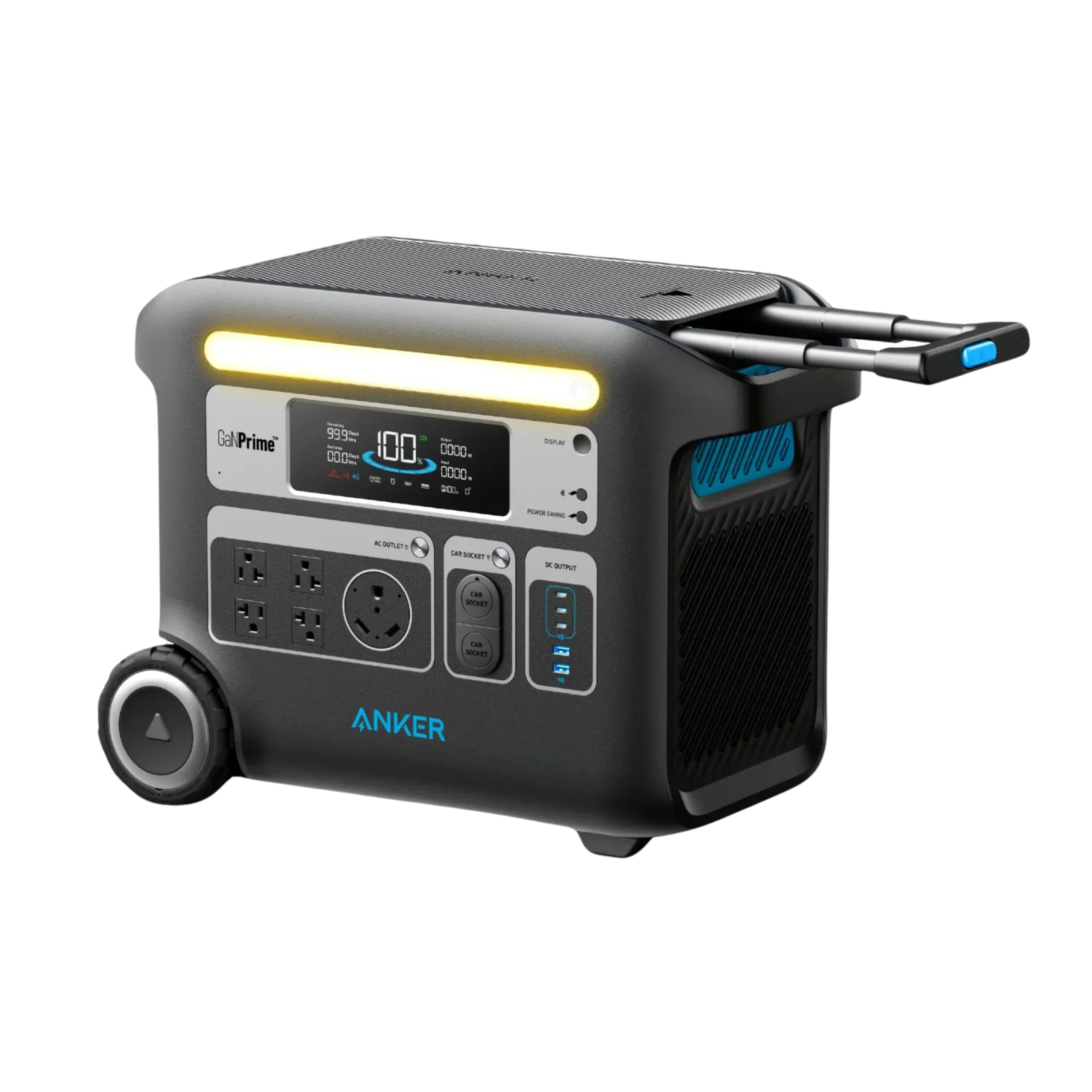
At 67.2 lbs, this is manageable but not fun to move. That's heavier than a large checked suitcase. How much it costs you depends on whether it rolls — wheels and a telescoping handle change the job completely at this weight, and our spec record doesn't track them, so look at the product photos before you plan on carrying it from the car.
The DJI Has the Stronger Inverter
Credit where it's due, this one goes to the DJI. Its 4,400W surge ceiling and 1.7x surge-to-continuous ratio give a motor startup far more room than the F2000's 2,800W and 1.2x, and it runs more continuous power too (2,600W vs 2,400W). Neither hits the 2x mark that swallows any compressor without flinching, but if you're starting a large fridge, an AC unit, or power tools that spike to 2-3x their rating, the DJI is the safer bet not to trip.
UPS Switchover: ≤10ms vs ≤20ms
Both list a UPS mode, at different rated speeds. The Power 1000 V2 is rated ≤10ms — quick enough on paper that desktop PCs and routers should ride through, treating that as the rating it is. The SOLIX F2000 is rated ≤20ms — fine on paper for routers and most electronics; the fussiest PC power supplies sit right at this line. If a computer with unsaved work is the thing being protected, the stated class is worth the attention; nothing here is a lab result.
Warranty: No Difference
Both units carry the same 5-year warranty, so coverage isn't a tiebreaker here. The Power 1000 V2's figure is a maximum rather than a guarantee — it depends on buying from DJI's own store, which is where the full five years is advertised.
More Cycles, Less Lifetime Energy
The DJI's 4,000-cycle rating beats the F2000's 3,000, which sounds like the longer life. Count it as energy instead of tallies. A DJI cycle moves 1,024Wh and an Anker cycle moves 2,048Wh, so across their rated lives the F2000 delivers about 6,144 kWh to the DJI's 4,096. The higher cycle number belongs to the smaller battery, and it still stores less over the years. Either way, reaching the limit means dropping to about 80% of original capacity, not dying.
Ownership Analysis
What happens after you buy — true cost of ownership, brand trust, and growth potential.
Lifetime value
Service lifeyears at one full cycle per day
Lifetime energy delivered
Cost per delivered kWh
│ warranty ends · Reaching the cycle rating means ~80% capacity remains — degraded, not dead.
Analyst note
The SOLIX F2000 is no longer sold, so there is no price to work its cost per kWh from, and this comparison doesn't quote one. On what you can actually buy today, the Power 1000 V2 works out at $0.17/kWh over its rated life. If you already own the SOLIX F2000, the hardware comparison still holds: over its rated life the SOLIX F2000 delivers about 6,144 kWh and the Power 1000 V2 about 4,096 kWh. One caution on the lifespan row: the Power 1000 V2 takes longer to reach its cycle rating, but a cycle moves a different amount of energy on each unit — the SOLIX F2000 still delivers more over its shorter horizon. Years measure wear, not usefulness.
Brand trust
Anker
Ecosystem
Seven or eight SOLIX stations across the compact C-series and flagship F-series, plus the X1 home energy system, so there's a real lineup to grow within.
Support
US-based, and historically Anker's no-hassle replacements were a selling point. Worth knowing that SOLIX-specific support has been slipping lately, with more generic AI-agent replies and painful hazmat return logistics for heavy units.
Community
Moderate — active Reddit (r/Anker, r/AnkerSOLIXCommunity) and growing. Benefits from Anker's massive consumer electronics brand awareness.
App experience
Rated 4.5/5 iOS (~1,100 ratings) · 4.3/5 Android
Unique strength
Parent-brand trust from Anker's consumer-electronics business, InfiniPower long-cycle-life cells, and some of the better dollar-per-watt-hour value in the catalog.
Worth knowing
Firmware updates have quietly removed features before, and the expansion ecosystem is smaller than EcoFlow's.
DJI
Ecosystem
A brand-new lineup. DJI entered power stations in 2024 and already lists five models, and confusingly a 'Power 1000' listing may be the original or this V2, so check the revision before you buy.
Support
Leans on DJI's global repair-center network from the drone business, a real asset, paired with a short power-station-specific track record.
Community
No dedicated power-station community yet. Discussion happens inside r/dji, which is overwhelmingly drone owners.
App experience
Rated 3.5/5 iOS and Android (DJI Home app ratings reflect entire DJI ecosystem including drones/cameras, not power-station-specific). Users report the on-device screen is more reliable than the app.
Unique strength
Quiet operation (23-30dB published across the line), premium industrial design, and the drone-derived SDC fast-charging ports if you're already in the DJI ecosystem.
Worth knowing
No built-in solar charge controller, so solar needs a separate proprietary adapter, and the SDC ports only pay off if you own other DJI gear.
Analyst note
Anker is the known quantity with the deeper station lineup and a softening support reputation; DJI is the polished newcomer with a strong hardware pedigree but a thin power-station history. If long-term parts and community matter to you, Anker has more road behind it. If build quality and quiet out of the box matter more, DJI shows its drone-world engineering.
Growth path
SOLIX F2000
EXPANDABLESupports Anker expansion batteries, so you can add capacity later without replacing the base unit — useful if your needs may climb past 2,048Wh.
Accepts up to 1,000W of solar. Enough for a serious multi-panel array.
Adequate ports for most setups, but heavy users may want a power strip.
Expansion batteries are Anker-specific. You're investing in the Anker ecosystem.
Power 1000 V2
EXPANDABLESupports DJI expansion batteries, so you can add capacity later without replacing the base unit — useful if your needs may climb past 1,024Wh.
Accepts up to 1,200W of solar. Enough for a serious multi-panel array.
Adequate ports for most setups, but heavy users may want a power strip.
Expansion batteries are DJI-specific. You're investing in the DJI ecosystem.
Realistic full solar rechargeat 70% of rated panel output — see methodology
Analyst note
Growth only counts if you can still buy in, and the SOLIX F2000 is no longer sold (Anker points owners to the SOLIX C2000 Gen 2). That leaves the Power 1000 V2: it starts at 1,024Wh and takes DJI expansion batteries, so the ceiling moves if your needs do. The SOLIX F2000's expandability still matters if you already own one, but it isn't a reason to pick it over the Power 1000 V2.
What Owners Report
Patterns from published owner reports and long-term reviews — every claim cited to its source below.
Anker SOLIX F2000
Field coverage of the F2000 leans on review-site testing rather than a big independent owner forum, so weight it accordinglyA0. The through-line is the hardware you touch: owners repeatedly cite the 4.72-inch wheels and retractable EasyTow handle as the reason they picked it over similar-spec rivals, which is telling for a 67-pound unitA1. The app earns steady praise for monitoring and customization, and a meaningful number of owners report Anker stepping in with firmware fixes or replacementsA2. For the loads RVers actually run, fridge, CPAP, lights, fans, and TV, reviewers describe it as quiet, capable, and fast to deployA3, on the same 3,000-plus-cycle LFP chemistry Anker uses across the lineA4.
“It's big and full of heavy batteries, but the durable 4.72-inch wheels and retractable EasyTow handle make it surprisingly easy to lug around — most positive reviews cite the wheels and telescoping handle as a top reason owners chose it over similar-spec competitors.”
Sources
rvoutfitting.com · trustedreviews.com · ankersolix.com · storagereview.com · generatorpeak.com
DJI Power 1000 V2
The DJI V2's field record is younger and comes from expert testers, not an owner crowd: about six months of hands-on reviews with no organic owner-forum threads yetB0. What they agree on is the quiet, near-silent even while charging around 1,400WB1, to the point a couple of testers noticed the fans by a faint warm-plastic smell before any sound, with the app confirming temperatures stayed normalB2. Build quality reads premiumB3, and wall charging is genuinely fast at 56 minutes empty to fullB4. The friction shows up around it: a non-standard C19 charging cable that's easy to loseB5, a solar setup hobbled by a $329 adapter capped near 600W despite '1.8kW' box brandingB6, two shared SDC expansion ports that a battery plus a solar accessory can fully occupyB7, and a measured 18W idle draw that can flatten the pack in about two and a half days on standbyB8.
“The fan barely makes a sound even during full-speed charging around 1,400-1,450W — one of the quietest power stations in its class, nearly silent under normal loads.”
Sources & Research Notes
Every owner claim in this report is traceable to a published source. The bracketed references above resolve here.
Recurring owner themes
- The wheels + retractable handle are the standout, repeatedly-cited reason owners pick the F2000; app monitoring and responsive Anker support are also praised. [SOLIX F2000 · 2 entries]
- Quiet operation is the standout, consistently praised across independent reviewers, though a couple of testers separately noticed a faint smell when the fans do spin up. [Power 1000 V2 · 2 entries]
- Charging is dramatically faster than the original Power 1000, but real-world charging setups bring their own friction: a non-standard AC cable and, for solar, an expensive proprietary adapter with limited throughput. [Power 1000 V2 · 3 entries]
- The two shared SDC expansion ports are a recurring bottleneck — using them for an expansion battery or solar accessory can leave no capacity for other add-ons. [Power 1000 V2 · 2 entries]
- UPS switchover speed and overall build quality are the two things independent reviewers most directly credit as concrete improvements over the original Power 1000. [Power 1000 V2 · 2 entries]
- A1
“It's big and full of heavy batteries, but the durable 4.72-inch wheels and retractable EasyTow handle make it surprisingly easy to lug around — most positive reviews cite the wheels and telescoping handle as a top reason owners chose it over similar-spec competitors.”
rvoutfitting.com / trustedreviews.com — Anker SOLIX F2000 (PowerHouse 767) review · 2025-2026 · [positive]
- A2
“WiFi and Bluetooth app lets you monitor battery, charging, and customize power usage; a meaningful number of owners reported Anker proactively solving issues with firmware updates or replacements.”
ankersolix.com / storagereview.com — F2000 review · 2025-2026 · [positive]
- A3
“For the loads RVers run most — fridge, CPAP, lights, fans, internet, TV, small kitchen appliances — the F2000 is usually quiet, capable, and easy to deploy fast.”
rvoutfitting.com — Anker SOLIX F2000 review · 2026 · [positive]
- A4
“Uses the same long-lasting LFP battery reliability as Anker's other models, rated over 3,000 cycles for years of off-grid or backup use.”
trustedreviews.com / generatorpeak.com — F2000 review · 2025-2026 · [positive]
- B1
“The fan barely makes a sound even during full-speed charging around 1,400-1,450W — one of the quietest power stations in its class, nearly silent under normal loads.”
DroneXL / Haye Kesteloo (Medium mirror) — DJI Power 1000 V2 Review: 2,600W Output In A Package That Won't Wake The Neighbors · 2026-01 · [positive]
- B2
“It's easier to notice when the fans are on by a faint, warm, plasticky smell rather than by sound; a separate reviewer likewise noted an unusual electronics smell on first use but confirmed via the app that internal temperature stayed normal.”
T3 — I tested the DJI Power 1000 v2, and it's the best power station upgrade you shouldn't ignore (month-long test) / corroborated by Android Authority — DJI Power 1000 V2 review · 2026 · [mixed]
- B3
“DJI gear tends to feel really premium — nothing feels cheap or fragile, and it wouldn't look out of place in an office or studio.”
T3 — I tested the DJI Power 1000 v2, and it's the best power station upgrade you shouldn't ignore · 2026 · [positive]
- B4
“Can be recharged from empty to full in 56 minutes — your lunch break, or maybe while cooking dinner.”
GadgetGuy (Australia) — DJI Power 1000 V2 power station review · 2026 · [positive]
- B5
“The non-standard C19 AC charging cable is just asking to get lost, since most people won't have a spare on hand the way they would for a common C13 cable.”
Android Authority — DJI Power 1000 V2 review: Mobile power for drone lovers and more · 2026 · [negative]
- B6
“Solar charging is where things get a little odd: the $329 adapter only allows 600W of solar input despite '1.8kW' branding on the box; pairing solar panels with the adapter runs close to $1,000, which is extremely difficult to justify.”
TheSolarLab — DJI Power 1000 V2 Review: A Quieter, Faster Upgrade? · 2026 · [negative]
- B7
“You only get two SDC expansion ports, and if both are occupied (e.g. an expansion battery plus an MPPT solar accessory) that leaves no spare socket for something like the 12-volt cigarette outlet — described as really odd and potentially annoying in real-world use.”
TheSolarLab — DJI Power 1000 V2 Review: A Quieter, Faster Upgrade? · 2026 · [negative]
- B8
“Idle/standby consumption was measured at roughly 18 watts in testing, enough to drain the battery in about two and a half days if left connected with nothing else drawing power.”
TheSolarLab — DJI Power 1000 V2 Review: A Quieter, Faster Upgrade? · 2026 · [mixed]
- B11
“Side-positioned handles make one-handed carrying feel very unbalanced at just over 31 lbs.”
Android Authority — DJI Power 1000 V2 review: Mobile power for drone lovers and more · 2026 · [negative]
Research compiled August 30, 2026.
Who Should Buy Which
Buy the SOLIX F2000 if you…
- →You're buying for a blackout and want to run a fridge, some lights, the internet, and a CPAP through the night without rationing. The F2000 finishes the 8-hour scenario with room to spare while the DJI stops about halfway.
- →You live out of an RV part-time and run the usual fridge, CPAP, lights, and TV mix, and you'd rather wheel a heavier box than refill a smaller one twice as oftenA3.
- →You want the most watt-hours per dollar in this size class and you don't move the unit every day.
Buy the Power 1000 V2 if you…
- →You carry the thing constantly, tailgate to campsite to car, and 36 fewer pounds changes your day more than a second kilowatt-hour would.
- →Your loads genuinely fit under 1,024Wh (a laptop day, phones, lights, a short outage) and you'd rather have quiet operation and a 56-minute wall recharge than extra reserveB4.
- →You already own DJI drones and would actually use the proprietary SDC ports, accepting that there are only two of them to share between an expansion battery and accessoriesB7.
If neither fits
If your real target is van-life-scale daily use (the 4,685Wh scenario) or whole-home backup, neither of these covers it. The F2000 reaches about 37% of that day and the DJI about 19%. Look at a 3,000Wh-plus station, or commit to stacking expansion batteries from the start.
The Bottom Line
The F2000 wins because it wins the axis that scales. Twice the energy, a lower price per watt-hour, a lower lifetime cost, and it's the only one of the two that finishes a blackout or a full workday without tapping out. Stack the DJI's advantages together, lighter, quieterB1, higher surge, faster switchover, and you've still got half the tank at a higher price per watt-hour, and none of those specs refills it.
The DJI isn't a bad box; it's a smaller, more portable one built to a genuinely nice standardB3. If you carry it constantly and your loads live under 1,024Wh, buy it and enjoy the 36 pounds you're not lifting. Everyone else weighing runtime against a lower sticker should take the F2000. It's more power for less money per watt-hour, and that's the ballgame.
Frequently Asked Questions
Answers drawn from the spec record and cited owner research.
Anker SOLIX F2000 or DJI Power 1000 V2 for a home blackout?
The F2000. It carries 2,048Wh to the DJI's 1,024, and in an 8-hour outage drawing 1,645Wh it finishes with 96Wh to spare while the DJI runs out about 775Wh early. For backup, the bigger tank is the whole point, and it happens to be the cheaper unit per watt-hour too.
Why call the cheaper DJI the more expensive one?
Because price per watt-hour flips the picture. The DJI is $699 for 1,024Wh, which is $0.68 a watt-hour; the F2000 is $900 (last listed price) for 2,048Wh, or $0.44. You pay less at the register for the DJI and more for every unit of energy it stores.
Can the DJI Power 1000 V2 add more battery?
Yes, both units take expansion batteries, so neither locks you out of more capacity. The catch on the DJI is that it has only two SDC expansion ports, and a tester noted that an expansion battery plus a solar accessory can occupy both, leaving nothing for other add-ons. Plan the port budget before you buy.
Which one is easier to carry?
The DJI, clearly, at 31.3 lbs against the F2000's 67.2. One reviewer did find its side-mounted handles make a one-handed lift feel unbalanced, and the heavier Anker offsets its bulk with wheels and a telescoping handle that owners rate highly. If you carry over flat ground the wheels help; if you carry up stairs, 36 fewer pounds wins.
How good is solar charging on the DJI Power 1000 V2?
Underwhelming relative to the branding. The DJI has no built-in solar controller, and a tester found the $329 proprietary adapter caps solar input near 600W despite '1.8kW' labeling, with a full panel-plus-adapter setup approaching $1,000. The F2000 takes up to 1,000W of solar without an add-on, which matters more in the off-grid outages these tend to get bought for.
Brand matchup
Anker SOLIX vs DJI: measured across every matchup →Where to buy
Anker SOLIX F2000
No longer sold

DJI Power 1000 V2
$699.00
$699.00 · direct from DJI
Last checked 16 days ago. Prices move — check before you buy.
Prices may vary by retailer and are subject to change.