Head-to-head test
EcoFlow DELTA 3 Ultra vs EcoFlow DELTA Pro
Pay the DELTA Pro's extra $500 for its 1,600W solar ceiling and its expansion port, or don't pay it at all: on price, weight, noise and cost per kilowatt-hour the DELTA 3 Ultra takes every other column.
Full profiles: EcoFlow DELTA 3 Ultra → · EcoFlow DELTA Pro →

Written by Gunner GustafsonUpdated
Whole-Home Backup Tester, Station Arena Test Desk

$1,399.00 · direct from EcoFlow
Last checked 1 day ago. Prices move — check before you buy.
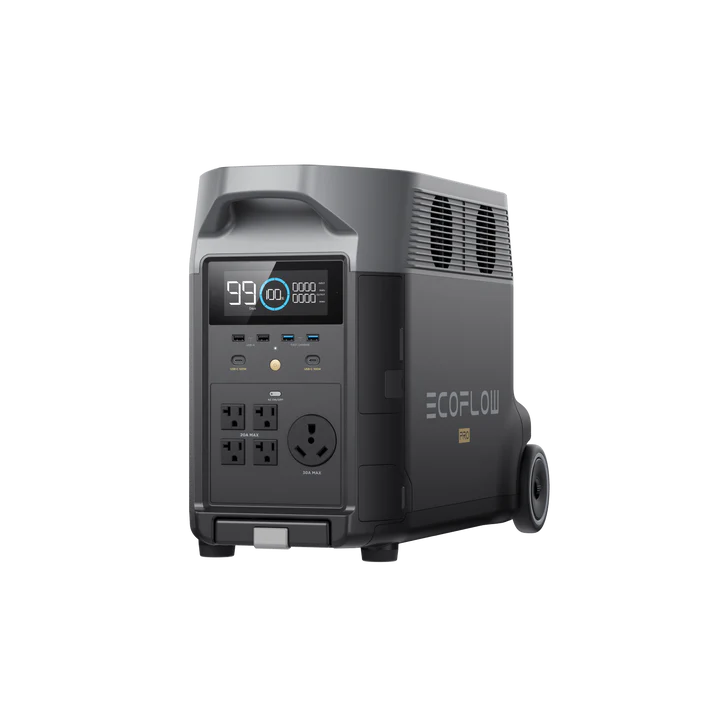
$1,899.00 · direct from EcoFlow
Last checked 1 day ago. Prices move — check before you buy.
Spec deltas
Take the DELTA 3 Ultra and spend the $500 somewhere you'll notice it. Both of these push 3,600W with a 7,200W surge, both are EcoFlow, both carry five years of warranty. What the DELTA Pro's premium actually buys is 528Wh of extra battery and 26.9 lb of extra unit.
That capacity gap sounds decisive and never is. Across the six load profiles here the two units land on the same answer five times: both cover the blackout, both cover the CPAP night, both cover a remote workday, both cover the tailgate, and neither covers a full van-life day. The Pro takes weekend camping, and it takes it on reserve rather than on capability. Nobody comes home from a campsite wishing they'd carried 528Wh they never touched.
Where the Pro separates itself is the top of its input and the back of its case. It accepts 1,600W of solar against the Ultra's 800W, and it takes expansion batteries. The Ultra is sealed at 3,072Wh, and what you buy is the ceiling. If you refill from panels every day, or you can already see your loads climbing past 3,600Wh, that's a real $500. Otherwise it isn't.
What the Numbers Reveal
Each conclusion stated first — the numbers behind it on one line, the full analysis below.
rated cycles
So when the Ultra wins cost of ownership at 11 cents a kilowatt-hour against 13, it isn't winning on chemistry or cycle count. It's winning on the $500. Take the price gap out and the Pro is the unit that delivers more energy over its life, which means the longevity argument people reach for first is the weakest one on the page.
DELTA 3 Ultra: 4,000 cycles on a 3,072Wh pack, $1,399DELTA Pro: 3,500 cycles on a 3,600Wh pack, $1,899Cost of ownership lands at $0.11 per lifetime kWh for the Ultra, $0.13 for the Pro
Why it mattersDon't buy the Ultra because it lasts longer. Buy it because it costs less to reach the same decade of service, and if the Pro's solar or expansion is genuinely worth $500 to you, longevity is not the thing standing in your way.
solar input
That only matters if panels are how you actually refill, and when they are it's the whole argument. A daily off-grid load overruns both packs inside a single day, so the question stops being how much the box holds and becomes how fast the sun puts it back. Four hours is most of a usable solar day. Two and a half is a morning, and it leaves the afternoon free to top up again after you've drawn it down.
DELTA 3 Ultra: 800W maximum solar input into 3,072WhDELTA Pro: 1,600W maximum solar input into 3,600WhThe van-life profile needs 4,685Wh in a day, which is 179% of the Ultra's usable capacity and 153% of the Pro's
Why it mattersIf solar is your primary source rather than your backup plan, the DELTA Pro is the right answer here and the $500 is the cheapest line item in the system.
weight
Add the 30-decibel spread and these stop being competitors and become different appliances. Owners of the Pro line describe a high-pitched whine once draws pass 2,000WB4, which is fine behind a garage door and intolerable in a studio apartment. The Ultra is quiet enough and light enough to live in the room you're already in.
72.1 lb for the DELTA 3 Ultra against 99 lb for the DELTA Pro30 dBA rated for the Ultra against 60 dBA for the ProThe Pro's wheels and telescoping handle work best on flat, smooth ground and want a cart the moment the surface turnsB2
Why it mattersIf the unit gets sited once and rolled out twice a year, the weight and the noise are free and you should shop on capacity. If it moves, or if it shares a wall with a bedroom, the Ultra is the only one of the two that fits the job.
It becomes a lived one in exactly one situation: hardware that can't ride out a 20ms gap. A desktop with no UPS of its own, a rack of network gear, anything that reboots on a flicker. The Ultra's other habit matters there too, because it keeps delivering full output instead of throttling down to whatever the input is doingA4, which is the behavior you want when the grid is sagging rather than failing cleanly.
The Ultra is line-interactive and cuts over in 10ms; the Pro is standby at 20msReviewers pulling the wall feed saw no dip and no shutdownA5A6, and the unit doesn't clamp its output down to match whatever the input is doingA4The 8-hour blackout profile consumes 63% of the Ultra's usable capacity and 54% of the Pro's
Why it mattersProtecting a workstation or a rack? The Ultra's faster cutover is worth having. Protecting a fridge? Call this row a tie and decide on weight, noise or price instead.
The specific dimensions that decide these two units — everything else is a tie.
Lifetime Value
Selected because: The $500 sticker gap is the only thing separating these two on cost of ownership: 11 cents per lifetime kilowatt-hour for the DELTA 3 Ultra against 13 for the DELTA Pro.
cost / lifetime kWh
Both packs retire having moved roughly the same energy, which means this column is decided by the sticker and nothing else. That's why the Ultra wins it, and it's also why the win is narrow rather than structural. Two units from the same brand, on the same chemistry, with the same five-year warranty, land within a couple of cents of each other per kilowatt-hour. There is no twelve-times gap hiding in here.
Spread across the warranty the Ultra runs $260 a year and the Pro $320. Sixty dollars a year is not an argument for or against anything. If the Pro does something you'd use every week, the ownership math won't stop you. If it doesn't, you've paid $500 for reserve.
Your Life, Your Pick
Selected because: Five of the six load profiles end in the same answer for both units, which is the fastest way to see what the DELTA Pro's extra 528Wh actually buys you.
The load profiles keep arriving at the same answer, and that repetition is the finding. Fridge-and-lights blackout: both. Overnight CPAP: both, without either one breaking a sweat. A full remote workday: both, and one reviewer ran a laptop, a desktop workstation and monitors for eight hours and finished with 40% leftA8. Another pulling 300W to 600W off a single AC outlet got a little over four and a half hoursA7. The extra 528Wh never converts a no into a yes.
It converts one maybe into a slightly better maybe. Weekend camping goes to the Pro on margin, and van life goes to neither, because 4,685Wh in a day overruns both packs before the day is out. That's the honest boundary of this comparison. Below it, buy on price and noise. Above it, neither of these is your unit until you add batteries or a serious array.
Growth Path
Selected because: The DELTA 3 Ultra is sealed at 3,072Wh and the DELTA Pro takes expansion batteries. It's the one difference here that money can't undo after you've bought.
solar input
The Ultra is a sealed box, and that's the one thing here you can't fix with money later. 3,072Wh is what it is. Outgrow it and your upgrade path is a second unit standing next to the first. The Pro takes expansion batteries, and its reputation was built on precisely that: it's been the default home-backup platform in this line, sized for high-draw appliances and full-scale expansionB1, and one long-term account has it serving as primary backup across months of overnight outagesB3.
The catch is that expansion is a plan, not a feature. An expansion battery is another purchase at another price, and the port only pays off if you actually make it. If you can name the load that's coming, a well pump, a second fridge, a partial-panel transfer switch, then the port justifies the $500 on its own. If you're guessing, you're paying today for an option you'll reconsider in two years anyway.
Portability & Form Factor
Selected because: 26.9 lb separates them, and 99 lb is where a one-person lift stops being a one-person lift.
weight
26.9 lb is the difference between a unit you carry and a unit you site. At 72.1 lb the Ultra is an awkward, deliberate, one-person lift. At 99 lb the Pro is a second pair of hands or a ramp, and owners are clear that its wheels earn their keep on flat, smooth ground and give up the moment the ground stops cooperatingB2.
So the useful question isn't which is heavier. It's how often the thing moves. A box that lives in a utility closet and gets rolled out twice a year doesn't care about 99 lb. A box that goes into a trunk every other weekend cares about nothing else.
What the Specs Don't Tell You
Selected because: Four cards fire on this pair, and the loudest is literal: the DELTA Pro is rated at 60 dBA against the DELTA 3 Ultra's 30.
rated cycles
The noise card is the one that should change somebody's mind. 30 dBA against 60 dBA is a 30-decibel spread between two units that post identical inverter numbers, and it's the difference between a machine you can sleep beside and one you hear through a wall. Owners of the Pro line describe a high-pitched whine once the draw passes 2,000WB4; reviewers running the Ultra flat out say the fans never become distractingA1A2.
The expansion card cuts the other way and we're not burying it. The Ultra's capacity is fixed, and that's a genuine loss rather than a rounding error. The UPS card splits the difference: 10ms against 20ms is real for a workstation and invisible for a lamp.
Strengths & trade-offs
EcoFlow DELTA 3 Ultra
Strengths
- +Costs $500 less
- +Lighter by 26.9 lb
Trade-offs
- –Sealed capacity — the DELTA Pro can add batteries to grow past 3,072Wh; this one can't.
EcoFlow DELTA Pro
Strengths
- +Larger battery capacity
- +Faster solar charging
Trade-offs
- –Substantially more expensive (+$500) than the DELTA 3 Ultra.
- –Significantly heavier (+26.9 lbs), making it harder to move.
- –Very heavy unit that may be difficult for one person to lift.
- –Can receive complaints about fan noise under heavy load.
Will It Power Your Gear?
Scenario math and per-appliance runtimes, modeled from the spec record.
Scenario verdicts
We ran the math on six real-world scenarios. Here's which unit survives your actual life.
SCN-01 · 2 nights · needs 2,100Wh
Weekend Camping
Two nights off-grid with essential comfort
DELTA Pro
The Pro wins the weekend, and it wins on reserve rather than capability: a 2,100Wh trip takes 69% of its usable stock against 80% of the Ultra's. Both units come home with charge left over. The tiebreak that actually shows up at a campsite is that one of them weighs 72.1 lb and the other weighs 99.
Battery budget usedlower = more headroom
LOAD Phone Charger 15W×6h · LED Lights 40W×8h · Box Fan 75W×14h · CPAP Machine 40W×16h
SCN-02 · 8 hours · needs 1,645Wh
8-Hour Blackout
Keep the essentials running through a night without power
Either unit
Both cover it, and neither comes near the edge on a 1,645Wh essentials load. Break the tie on where the box lives: the Ultra is rated at 30 dBA and cuts over in 10ms, the Pro is rated at 60 dBA and takes 20. If the unit shares a room with the people, that's the whole decision.
Battery budget usedlower = more headroom
LOAD Fridge 150W×8h · Router + Modem 20W×8h · LED Lights (4 bulbs) 40W×6h · Phone Charger 15W×3h
SCN-03 · 8 hours · needs 320Wh
CPAP Overnight
Sleep therapy without interruption — the #1 medical use case
DELTA 3 Ultra
A CPAP is 320Wh, which is a rounding error for either of these. Capacity is not the spec deciding this one. The spec deciding it is that the machine will sit an arm's length from your head all night, and the Ultra is rated at 30 dBA where the Pro is rated at 60. Buy the quiet one and sleep.
Battery budget usedlower = more headroom
LOAD CPAP Machine 40W×8h
SCN-04 · 8 hours · needs 910Wh
Remote Workday
Full work day off-grid without power anxiety
Either unit
Both power your workstation all day without strain. At these utilization levels the real difference is USB-C for direct laptop charging — 140W on the DELTA 3 Ultra against 100W — which beats the inverter for convenience and wastes less energy.
Battery budget usedlower = more headroom
LOAD Laptop 60W×8h · External Monitor 30W×8h · Router + Modem 20W×8h · Phone Charger 15W×2h
SCN-05 · 4 hours · needs 670Wh
Tailgate Party
Game day power for the crew
Either unit
Both handle game day easily. Since capacity isn't the deciding factor, weight is: at 72.1 lbs the DELTA 3 Ultra is the one you'll be glad you brought. Fan noise under load is worth a listen too — it's audible in the lulls between songs.
Battery budget usedlower = more headroom
LOAD Blender 400W×0.5h · LED TV (55") 80W×4h · Bluetooth Speaker 15W×4h · Phone Charger (×3) 45W×2h
SCN-06 · 24 hours · needs 4,685Wh
Van Life Daily
A full day of mobile living — the ultimate endurance test
Neither unit
Neither unit does this, and it isn't close: a 4,685Wh day overruns both packs before the day is out. Don't read that as a knock on either box, read it as the edge of the category. A genuine full-time van load wants expansion batteries or a roof array feeding them, and of these two only the Pro can be grown toward it.
Battery budget usedlower = more headroom
LOAD Mini-Fridge 150W×24h · Laptop 60W×4h · Phone Charger 15W×3h · LED Lights 40W×5h · Fan 75W×8h
The Load Test
RUNTIME = (Wh × 0.85) ÷ LOAD
None of the scenarios above exactly yours? Build it. Toggle what you'd plug in; both units are tested against the combined draw.
Essentials
Comfort & Convenience
High-Draw Appliances
Test duration
8h
Continuous draw
205W
Projected runtime
For this load: DELTA Pro runs 14.9h vs 12.7h.
$1,899 list · direct from EcoFlow
Modeled from the spec record — same math as the tables below. Methodology
Runtime by appliance
Real-world runtime estimates for common appliances, modeled at 85% inverter efficiency.¹
Essentials
The basics you need runningscale 0–204hComfort & Convenience
Makes off-grid life actually enjoyablescale 0–40.8hHigh-Draw Appliances
These reveal the real limitsscale 0–3.1h¹ Runtime = (capacity × 0.85) ÷ appliance watts. Within each group, all bars share one time scale (the group's longest runtime), so lengths are comparable across appliances; identical runtimes collapse into a single blue/orange bar. Actual runtime varies with battery age, temperature, and simultaneous loads — see methodology.
Conclusion
August 2, 2026
Verdict: the DELTA 3 Ultra
The DELTA 3 Ultra costs $500 less, weighs 26.9 lb less, is rated at 30 dBA against the Pro's 60, cuts over in 10ms instead of 20, and works out to 11 cents per lifetime kilowatt-hour against 13. The 528Wh it concedes never changed an answer across the six load profiles on this page. Buy the DELTA Pro only for the two things you cannot add to the Ultra later: a 1,600W solar ceiling that refills a bigger pack faster than the Ultra refills a smaller one, and an expansion port for the day 3,600Wh stops being enough. Both of those are real. Neither applies to someone buying a box that will sit in a closet until the lights go out.
Editor-assigned confidence, based on cited owner research and spec analysis.
List prices as of August 2, 2026. The links below open EcoFlow's current price.
$1,399.00 · direct from EcoFlow
Last checked 1 day ago. Prices move — check before you buy.
or check the DELTA Pro price$1,899.00 list
Written by Gunner Gustafson, Whole-Home Backup Tester · Station Arena Test Desk · Updated August 2, 2026
Measured Data
Benchmark scores and the full spec record, side by side.
Benchmark scores
Not rated for both units (minimum threshold unmet): Tailgating.
Full specifications
ᵈ Derived: price ÷ rated capacity. See the data behind our comparisons →
Comparison ToolAdd more power stations, side by sideOpen Tool →How these numbers are produced
Numeric verification
Every figure on this page traces to our spec database or arithmetic on it — no estimated numbers.
Owner claims
Statements about owner experience are cited to published reviews — see Sources & Research Notes below.
Runtime model
Runtime = (rated capacity × 0.85 inverter efficiency) ÷ device wattage. Solar recharge estimates assume panels deliver 70% of rated output. Cold weather, battery age, and stacked loads reduce real-world results.
Power Score
Computed from 14 published spec dimensions, weighted per use-case bench. Higher is better; a unit must meet a bench's minimum threshold to be rated.
See the full weight table and data sourcing on our methodology page →Class ranking (the star rating)
Each unit's star score is a category ranking, not customer reviews — no buyer opinions feed it. We score every station on size-independent quality (value, output, portability, endurance, ports, warranty, and more), then percentile-rank it against the other units in its capacity class, so a class-leading compact unit and a class-leading whole-home unit can both earn 5★. Here, DELTA 3 Ultra rates 4.7/5 (80th percentile of 26 Large-class units), and DELTA Pro rates 3.9/5 (33rd percentile of 16 Home Backup-class units).
How the class ranking is computed →Test Notes & Caveats
Hidden gotchas and advantages we spotted that you won't find on the product page.
Two Different Kinds of Heavy
72.1 lb and 99 lb are not the same problem. The Ultra is a bent-knees, both-hands lift that one person can make once a weekend. The Pro is a second person, a ramp, or a very flat driveway. Settle how often this thing actually moves before you decide which number you can live with.
DELTA Pro: 60 dBA Under Load
The Pro is rated at 60 dBA where the Ultra is rated at 30, and under a heavy draw the fans make themselves known. Behind a garage door that costs you nothing. In a bedroom, a nursery or a one-room apartment it's the spec you'll notice every night for years. Put a door between you and it, or buy the quiet one.
DELTA 3 Ultra: Fixed Capacity
What you buy is the ceiling. The Ultra is sealed at 3,072Wh with no expansion port, so growing past it means a second unit rather than a second battery. For most buyers that never bites, since 3,072Wh covers an outage, a weekend and a work day with room. But if you can already name the load that's coming, this is the one row on the page that should make you hesitate over the cheaper unit.
UPS Speed: 10ms vs 20ms
The Ultra is line-interactive and cuts over in under 10ms; the Pro is standby and takes up to 20. Both keep a fridge and a router alive without either of them noticing. The gap shows up only on hardware that can't ride out a 20ms gap, like a desktop with no UPS of its own or gear that reboots on a flicker. If that's what you're protecting, take the faster one.
Warranty: No Difference
Both units carry the same 5-year warranty, so coverage isn't a tiebreaker here. Worth saying because the per-dollar framing can suggest otherwise: the DELTA 3 Ultra works out at 3.6 years of cover per $1,000 spent against the DELTA Pro's 2.6, but that spread is the price gap, not the terms.
Full record above — the Test Desk pick is the DELTA 3 Ultra.
Check DELTA 3 Ultra price →or check the DELTA Pro priceOwnership Analysis
What happens after you buy — true cost of ownership, brand trust, and growth potential.
Lifetime value
Service lifeyears at one full cycle per day
Lifetime energy delivered
Cost per delivered kWh
│ warranty ends · Reaching the cycle rating means ~80% capacity remains — degraded, not dead.
Analyst note
The DELTA 3 Ultra wins on both sticker price and long-term value. At $0.11/kWh over its lifetime, it's meaningfully cheaper to own. Clear value winner. One caution on the lifespan row: the DELTA 3 Ultra takes longer to reach its cycle rating, but a cycle moves a different amount of energy on each unit — the DELTA Pro still delivers more over its shorter horizon (12,600 vs 12,288 kWh). Years measure wear, not usefulness.
Growth path
DELTA 3 Ultra
FIXED CAPACITYFixed at 3,072Wh — a sealed, complete system rather than a starting point. There's no expansion port, so that figure is the ceiling: check it against your longest unplugged stretch before you buy.
Accepts up to 800W of solar. Suitable for a 1-2 panel setup.
Generous port selection supports complex multi-device setups.
DELTA Pro
EXPANDABLESupports EcoFlow expansion batteries, so you can add capacity later without replacing the base unit — useful if your needs may climb past 3,600Wh.
Accepts up to 1,600W of solar. Enough for a serious multi-panel array.
Generous port selection supports complex multi-device setups.
Expansion batteries are EcoFlow-specific. You're investing in the EcoFlow ecosystem.
Realistic full solar rechargeat 70% of rated panel output — see methodology
Analyst note
The DELTA 3 Ultra is sealed at 3,072Wh, which is fine if that covers you. The DELTA Pro starts at 3,600Wh and can grow beyond it with EcoFlow expansion batteries — real headroom the DELTA 3 Ultra doesn't have if your needs climb toward partial-home backup.
What Owners Report
Patterns from published owner reports and long-term reviews — every claim cited to its source below.
EcoFlow DELTA 3 Ultra
The field record on the Ultra is thin and mostly secondhand. Nearly all the published testing was done on the Plus variant, which posts an identical chassis, inverter and 3,072Wh pack, so it's fair evidence on fan noise and switchover behavior and thin on everything elseA1A2A5. Read what follows as reviewer testing, not as long-term ownershipA1A5.
What that testing says is consistent. Pushed to full inverter output the fans stay unobtrusive rather than merely tolerableA1A2. Pull the wall feed and there's no dip and no shutdownA5A6, and the unit doesn't clamp its output down to match its inputA4. One reviewer drawing 300W to 600W off a single AC outlet got a little over four and a half hoursA7; another worked a full eight-hour day on a laptop, a desktop workstation and monitors and still had 40% in handA8. Build quality gets praised without hedging, from the shell and cable down to the sliding port coversA9A15.
Two complaints, both small. The display washes out in direct sun badly enough that one reviewer resorted to cupping their hands around it to read the statusA11. And under overload the unit drops its 30A port first, which one tester found strange rather than harmfulA3.
“Even when you're pushing it hard, the DELTA 3 Ultra Plus runs much quieter than older EcoFlow models, like the DELTA 2 Max.”
Sources
thesolarlab.com · postperspective.com · appleinsider.com · digitaltrends.com · popsci.com
EcoFlow DELTA Pro
The DELTA Pro has the thing the Ultra can't buy yet: years of people actually living with it. It's been treated as the gold standard for home backup in this line, built for high-draw appliances and full-scale battery expansion, carrying a fridge, lighting and a space heater through outagesB1. One account has it running as primary backup across months of overnight outages, powering essentials simultaneously without incidentB3.
The consistent knock is noise. Past roughly 2,000W of draw the fans produce a high-pitched whine that's genuinely distracting in a quiet room, though it stays civil at lighter loadsB4. The other recurring note is logistics: the wheels and telescoping handle do real work on flat, smooth ground and want a cart as soon as the surface turnsB2.
One caveat on all of it. Published coverage of this line tends to run the original Pro together with its newer successor, so treat the general behavior as reliable and any specific measured figure as belonging to whichever unit the tester happened to haveB2B4.
“Long regarded as a gold standard for home backup — designed for high-draw appliances and full-scale battery expansion, running home essentials like a fridge, lighting, and a space heater through outages.”
Sources
backuppowerhub.com · us.ecoflow.co · outdoorgearlab.com · bobvila.com · powerstationadvisor.com · robbsutton.com
Sources & Research Notes
Every owner claim in this report is traceable to a published source. The bracketed references above resolve here.
Recurring owner themes
- Reviewers consistently praise the quiet fan operation of the Ultra-tier unit compared to older EcoFlow models, though this is described in professional test conditions rather than long-term ownership. [DELTA 3 Ultra · 2 entries]
- UPS/switchover performance is repeatedly called seamless with no observed dips or shutdowns during power interruption tests. [DELTA 3 Ultra · 3 entries]
- The unit's substantial 74 lb weight is flagged across multiple reviews as a portability drawback, mitigated somewhat by wheels and handle design. [DELTA 3 Ultra · 2 entries]
- Build quality/durability (casing, cable, port covers) is repeatedly highlighted as premium and well-engineered. [DELTA 3 Ultra · 2 entries]
- Established home-backup platform with wheeled portability and massive expandability; the consistent knock is fan noise under heavy load. [DELTA Pro · 3 entries]
- A1
“Even when you're pushing it hard, the DELTA 3 Ultra Plus runs much quieter than older EcoFlow models, like the DELTA 2 Max.”
thesolarlab.com — EcoFlow DELTA 3 Ultra Plus Review: The Ultimate DELTA? · 2025-09/10 (approx) · [positive]
- A2
“Even when you're pushing the inverter to its maximum output, the fans never become annoying or distracting.”
thesolarlab.com — EcoFlow DELTA 3 Ultra Plus Review: The Ultimate DELTA? · 2025-09/10 (approx) · [positive]
- A3
“One weird thing we noticed was the fact that the unit always seems to shut down the 30A port first when you overload the unit.”
thesolarlab.com — EcoFlow DELTA 3 Ultra Plus Review: The Ultimate DELTA? · 2025-09/10 (approx) · [mixed]
- A4
“Many power stations limit you to the input wattage when outputting power, but this EcoFlow power station does not.”
thesolarlab.com — EcoFlow DELTA 3 Ultra Plus Review: The Ultimate DELTA? · 2025-09/10 (approx) · [positive]
- A5
“Over my career I have become accustomed to APC batteries immediately switching on when there is a power hit or power shut-off, and the EcoFlow Delta 3 Ultra Plus works in the exact same way.”
postperspective.com — Review: EcoFlow Delta 3 Ultra Plus Portable Power Station · 2026-04 · [positive]
- A6
“I didn't experience any shut-offs or dips when I unplugged the EcoFlow from the wall.”
postperspective.com — Review: EcoFlow Delta 3 Ultra Plus Portable Power Station · 2026-04 · [positive]
- A7
“Using Maxon's Cinebench 2026 GPU benchmark, I was pulling between 300W and 600W on one of the AC outputs... the EcoFlow Delta 3 Ultra Plus would last a little over 4.5 hours.”
postperspective.com — Review: EcoFlow Delta 3 Ultra Plus Portable Power Station · 2026-04 · [positive]
- A8
“I was able to work remotely for an eight-hour day with 40% power left, which included running my laptop, desktop workstation and monitors.”
postperspective.com — Review: EcoFlow Delta 3 Ultra Plus Portable Power Station · 2026-04 · [positive]
- A9
“It does not feel cheap or fragile. Everything from the outer shell case to the plastic buttons and the AC cable feels substantial and durable enough to withstand day-to-day wear and tear.”
appleinsider.com — EcoFlow Delta 3 Ultra Plus review: Premium, but solid power · 2025-11-16 · [positive]
- A11
“But, while facing the sun, I had to employ the classic "cup hands cover" maneuver to get a clear look at the screen status.”
appleinsider.com — EcoFlow Delta 3 Ultra Plus review: Premium, but solid power · 2025-11-16 · [negative]
- A15
“I really love how the rear panel doors for the input ports slide into protective slots when in use.”
popsci.com — EcoFlow DELTA 3 portable power station series first impressions · 2025-09-29 · [positive]
- B1
“Long regarded as a gold standard for home backup — designed for high-draw appliances and full-scale battery expansion, running home essentials like a fridge, lighting, and a space heater through outages.”
backuppowerhub.com / us.ecoflow.com — EcoFlow DELTA Pro review · 2025-2026 · [positive]
- B2
“Heavy but wheeled — integrated wheels and a telescoping handle help move its considerable weight, though they work best on flat, smooth surfaces; a cart is needed for uneven ground.”
outdoorgearlab.com / bobvila.com — DELTA Pro-line review · 2025-2026 · [mixed]
- B3
“Reliable through extended outage use — served as primary backup across multiple overnight outages over months, powering essentials simultaneously; LFP battery rated for thousands of cycles and 10+ years of daily use.”
powerstationadvisor.com / robbsutton.com — DELTA Pro-line review · 2025-2026 · [positive]
- B4
“Not silent under heavy load — under 2000W-plus draws the fans emit a noticeable high-pitched whine that's distracting in a quiet room, though it runs quietly enough at lighter loads.”
outdoorgearlab.com — DELTA Pro-line noise testing · 2025-2026 · [negative]
Research compiled August 2, 2026.
Who Should Buy Which
Buy the DELTA 3 Ultra if you…
- →You want a backup box for the house and it's going to live where you can hear it. 30 dBA in a hallway closet or a bedroom corner is the reason to pick this one, and $1,399 is the other.
- →It moves. Trunk, truck bed, cabin, back again. 72.1 lb is a lift one determined person can make. 99 lb isn't.
- →You're protecting a desk rather than a fridge: workstation, monitors, network gear. The 10ms cutover, plus the fact that it keeps delivering full output instead of throttling to its inputA4A5, is exactly what keeps a session alive through a flicker.
- →Your ceiling is honestly your ceiling. 3,072Wh covers an outage, a weekend and a work day with room to spare, and you have no plans to grow into partial-home backup.
Buy the DELTA Pro if you…
- →Panels are your primary source, not your backup plan. 1,600W of input refills a bigger battery in less time than the Ultra takes to refill a smaller one, and on a short winter day that's the entire ballgame.
- →You already know the next purchase is an expansion battery. Anything that pushes past 3,600Wh needs the port, and the Ultra doesn't have one at any price.
- →The unit gets installed and left there. Garage, utility room, basement rack. 99 lb stops mattering the day you stop moving it, and 60 dBA stops mattering once there's a door between you and itB4.
If neither fits
If your daily draw looks like the van-life profile, 4,685Wh a day every day, close this tab. Both of these overrun inside a single day, and the fix isn't a bigger portable. It's a rack-mount LFP bank with proper charge controllers and a roof full of panels, or the DELTA Pro plus at least one expansion battery budgeted from the start rather than hoped for later. Buying either of these bare to run a life off-grid means buying a second one within a year.
The Bottom Line
Buy the DELTA 3 Ultra. It's $500 cheaper, 26.9 lb lighter, rated at 30 dBA against the Pro's 60, and cheaper per kilowatt-hour across its life, and the 528Wh it gives up never converted a single load on this page from a no into a yes. The Pro's cycle-life deficit turns out not to matter either, because the bigger pack moves more total energy anyway. What's actually separating these two is the sticker.
The exception is real and it's narrow. If you refill from panels, the Pro's 1,600W ceiling puts a bigger battery back in less time than the Ultra takes to refill a smaller one. If you already know an expansion battery is coming, the Ultra's sealed back panel is a wall you will hit. Those are the two reasons to spend the $500, and if neither is yours, keep it.
Frequently Asked Questions
Answers drawn from the spec record and cited owner research.
Is the EcoFlow DELTA Pro worth $500 more than the DELTA 3 Ultra?
Only for two specific reasons: solar and expansion. The Pro accepts 1,600W of panel input to the Ultra's 800W, and it takes expansion batteries where the Ultra is sealed at 3,072Wh. On everything else the Ultra is ahead, being cheaper, 26.9 lb lighter, rated at 30 dBA instead of 60, and less per kilowatt-hour across its life. If neither fast solar nor future expansion is in your plan, that $500 buys reserve you won't use.
Which is quieter, the DELTA 3 Ultra or the DELTA Pro?
The Ultra, by a wide margin: 30 dBA rated against the Pro's 60. Reviewers pushing the Ultra to full inverter output report that the fans never become distracting, while the Pro line is consistently flagged for a high-pitched whine once draws pass 2,000W. If the unit will share a room with sleeping people, this is the row that decides the whole comparison.
Can either one back up a house during a power outage?
Both can, for essentials. An 8-hour essentials outage modeled at 1,645Wh leaves both units with meaningful reserve, and both deliver 3,600W continuous with 7,200W of surge, so fridge and pump startup spikes aren't the limiting factor. They part company on duration: if your daily draw is closer to 4,685Wh, neither one finishes the day and you're shopping for expansion batteries or a larger fixed system.
Can you add batteries to the DELTA 3 Ultra later?
No. The Ultra is sealed at 3,072Wh with no expansion port, so the only way to add capacity is to buy a second unit and run them separately. The DELTA Pro does take expansion batteries, and that's the strongest argument in its favor. If you can already name the load that will push you past 3,600Wh, buy the Pro now rather than buying the Ultra twice.
How fast does each one recharge from solar?
At full rated input the Ultra needs close to four hours to fill 3,072Wh through an 800W ceiling, and the Pro about two and a half to fill 3,600Wh through 1,600W. Those are ceilings rather than schedules, since a real array rarely hits its rating, so plan on longer for both. The practical difference is that the Pro can finish a full refill in a morning and still have afternoon sun left over.
Where to buy
EcoFlow DELTA 3 UltraPick
$1,399.00
$1,399.00 · direct from EcoFlow
Last checked 1 day ago. Prices move — check before you buy.
EcoFlow DELTA Pro
$1,899.00
$1,899.00 · direct from EcoFlow
Last checked 1 day ago. Prices move — check before you buy.
Prices may vary by retailer and are subject to change.