Head-to-head test
EcoFlow DELTA 3 1500 vs Anker SOLIX S2000
The DELTA 3 1500 is out of production, and the one thing it beat the SOLIX S2000 on, a 20% bigger inverter at both rated and peak, is headroom no load on this page ever asks for.
Full profiles: EcoFlow DELTA 3 1500 → · Anker SOLIX S2000 →

Written by Ian SchneiderUpdated
Solar & Off-Grid Tester, Station Arena Test Desk
Spec deltas
EcoFlow has folded the DELTA 3 1500 out of its range, so this comparison has one buyable side. Its product page forwards to the base DELTA 3, and the one listing left standing is a solar bundle that's sold out. If you came here because you wanted 1.5 kWh from EcoFlow specifically, that's the real news: nothing in EcoFlow's current range sits at that size, and the DELTA 3 Max is the nearest live equivalent.
The 1500 was the bigger inverter of the two, 1,800W rated and 3,600W peak against the SOLIX S2000's 1,500W and 3,000W, and it takes 500W of solar input to the S2000's 400W. What it doesn't have is energy: 1,536Wh against 2,009.6Wh, and 3,000 rated cycles against 10,000.
That second set of numbers is what decides this. Across the six loads on this page the biggest startup peak any of them asks for is 400W, and both units start and sustain every one, so the inverter gap never gets a chance to matter while capacity settles two rows outright. The S2000 is the pick. The rest of this page is for the reader who already owns a 1500, or who is staring at leftover retailer stock and wants to know what's in the case.
What the Numbers Reveal
Each conclusion stated first — the numbers behind it on one line, the full analysis below.
continuous output
A compressor's startup spike is a multiple of its running draw, so what decides whether a fridge catches is that ratio rather than the raw peak, and the ratio here is a dead heat. The 1500's absolute edge only appears above the S2000's 1,500W continuous ceiling, in the hair-dryer-on-high, full-size-microwave band. Nothing on this page goes near it: the worst peak asked for is 400W.
DELTA 3 1500: 1,800W rated output, 3,600W surgeSOLIX S2000: 1,500W rated output, 3,000W surgethe largest startup peak across the six scenarios on this page is 400W, and both units are marked as starting and sustaining every one of them
Why it mattersIf you were choosing the 1500 for inverter headroom, you were paying for a band your loads never enter, and that band is academic now anyway.
Capacity
That makes the blackout row pass or fail rather than better or worse, and it makes the S2000's pass a thin one: 63Wh against a 1,645Wh night is about 4% of headroom, which is one unplanned coffee maker. What the S2000 also does is repeat that night, rated for 10,000 cycles against 3,000, or roughly 20,096 kWh of lifetime energy against 4,608 kWh.
SOLIX S2000: 2,009.6Wh, or 1,708Wh after the flat 85% usable derateDELTA 3 1500: 1,536Wh, or 1,306Wh derated the same waythe 8-hour blackout scenario needs 1,645Wh
Why it mattersAnyone buying for outages should read 2,010Wh as the floor of what works on that night, not as generous, and should plan to shed a load early rather than trust the margin.
So on a unit kept charged in a closet as outage insurance rather than left plugged into the wall, the switch that decides whether it's full when you need it is the AC output, not the capacity. The 1500 has no comparable figure to set against that: its idle draw was debated and never pinned to this SKU, and our own coverage note says field data on it is thin and largely secondhandA4A0.
two independent hands-on tests put the S2000's standby draw in single watts, around 2W with output disabled and around 6W with the AC output on but unused, though the two didn't quite agree on which state gives whichB3B4SOLIX S2000 usable energy is 1,708Wh after the 85% derateposters argued over the Delta 3 line's idle draw and couldn't confirm whether the 1500 had received the firmware fix that cut it, and our researcher flagged that entry as possibly describing a sibling SKUA4
Why it mattersIf your plan is a charged box in a closet, leave the AC output off between uses and check the state of charge monthly. Anyone who wants that number verified before buying has it for one of these two units and not the other.
The specific dimensions that decide these two units — everything else is a tie.
Runtime: Will It Power Your Gear?
Selected because: Energy is the one axis where these two aren't close: 2,009.6Wh against 1,536Wh, or 1,708Wh against 1,306Wh once the flat 85% usable derate is applied.
continuous output
Energy is where these two stop being comparable. 2,009.6Wh against 1,536Wh becomes 1,708Wh against 1,306Wh once the flat 85% usable derate is applied, and 402Wh is a lot to be behind at this size. It's 31% more nameplate capacity in a body 0.3 lb lighter, which is the sort of arithmetic that ends an argument rather than starting one.
Refill speed goes the other way, and it was the 1500's best card after the inverter. At their full rated solar input the 1500 covers its 1,536Wh in about three hours (1,536 divided by 500W) against about five for the S2000 (2,009.6 divided by 400W), so on a campsite with a good roof the smaller pack turns around faster. From a wall socket it's moot: one reviewer took the S2000 from empty to 80% in about 1.2 hours and to full in about 1.7 on a standard 20-amp household circuitB5. If an outage is the use case, the wall is what you'll be using the minute the grid comes back.
Your Life, Your Pick
Selected because: Six loads, and the capacity gap flips one of them from a finish with 63Wh spare to a 339Wh shortfall.
Two of the six rows go to nobody. Weekend camping wants 2,100Wh and neither unit has it, the S2000 covering about 81% and the 1500 about 62%. Van life's daily list wants 4,685Wh, which isn't a near miss so much as a different category of product. On those two the question isn't which unit wins, it's how much of the trip you plan around.
The 8-hour blackout is the row that actually spends the capacity gap. The S2000 finishes it, the 1500 doesn't, and the margin on the pass is 63Wh. The three rows both units clear, the workday, the tailgate and the CPAP night, separate them on reserve only, and reserve is worth something when the call runs long. But nothing in the whole set asks for more than 400W of startup peak, which is why the 1500's stronger inverter never gets a scene to play.
Growth Path
Selected because: The SOLIX S2000 is sealed at 2,010Wh, and the DELTA 3 1500's expansion port sits on a unit you can no longer buy.
solar input
The S2000 is sealed at 2,010Wh, and on most pages this is the paragraph where we hand a point to the expandable unit. Not here. The 1500 starts at 1,536Wh, below the S2000's fixed capacity, so the first expansion battery you bolt on is largely buying back energy the S2000 shipped with. Expansion only pulls ahead past 2,010Wh.
It's also a port on a unit EcoFlow has stopped selling, which settles it. A growth path is a promise about the future of a product line, and this one has no future to promise. The working read for a buyer today: treat 2,010Wh as a hard ceiling, measure your longest unplugged stretch against it, and if that stretch is genuinely growing, this pair is the wrong shelf to be shopping.
Lifetime Value
Selected because: 10,000 rated cycles against 3,000, which works out to roughly 20,096 kWh of lifetime energy against 4,608 kWh.
10,000 rated cycles against 3,000 is the biggest number on this page, and the right way to read it is energy rather than years. A cycle is 2,009.6Wh on the S2000 and 1,536Wh on the 1500, so the rated lifetime works out to roughly 20,096 kWh against 4,608 kWh. The years column, 27.4 against 8.2 at daily use, is the same fact wearing a more flattering suit, and it assumes you cycle a power station every single day, which almost nobody does.
One caveat about the cost-per-kilowatt-hour column, and it's about our numbers rather than the units. The per-kWh figure for the 1500 divides by a price you can't pay any more, so read that side as history. The S2000's side stands on its own: about three cents per lifetime kilowatt-hour at $700, on a pack that settles to roughly 80% of original capacity at the cycle limit instead of failing.
What the Specs Don't Tell You
Selected because: Five cards fire here; the two worth your time are the UPS ratings and the fact that only one of these units publishes a noise figure at all.
rated cycles
Five cards fire, and warranty is a tie: both makers carry five years, so that row is settled before you read it. The UPS ratings aren't a tie, but both are ceilings rather than measurements. The S2000 is rated no worse than 10ms and the 1500 no worse than 15ms, and the gap between those classes only becomes a decision if the thing you're protecting is a desktop with unsaved work on it. On the S2000's side there's corroboration: two independent tests watched connected office equipment ride through a simulated outage without interruptionB9B10.
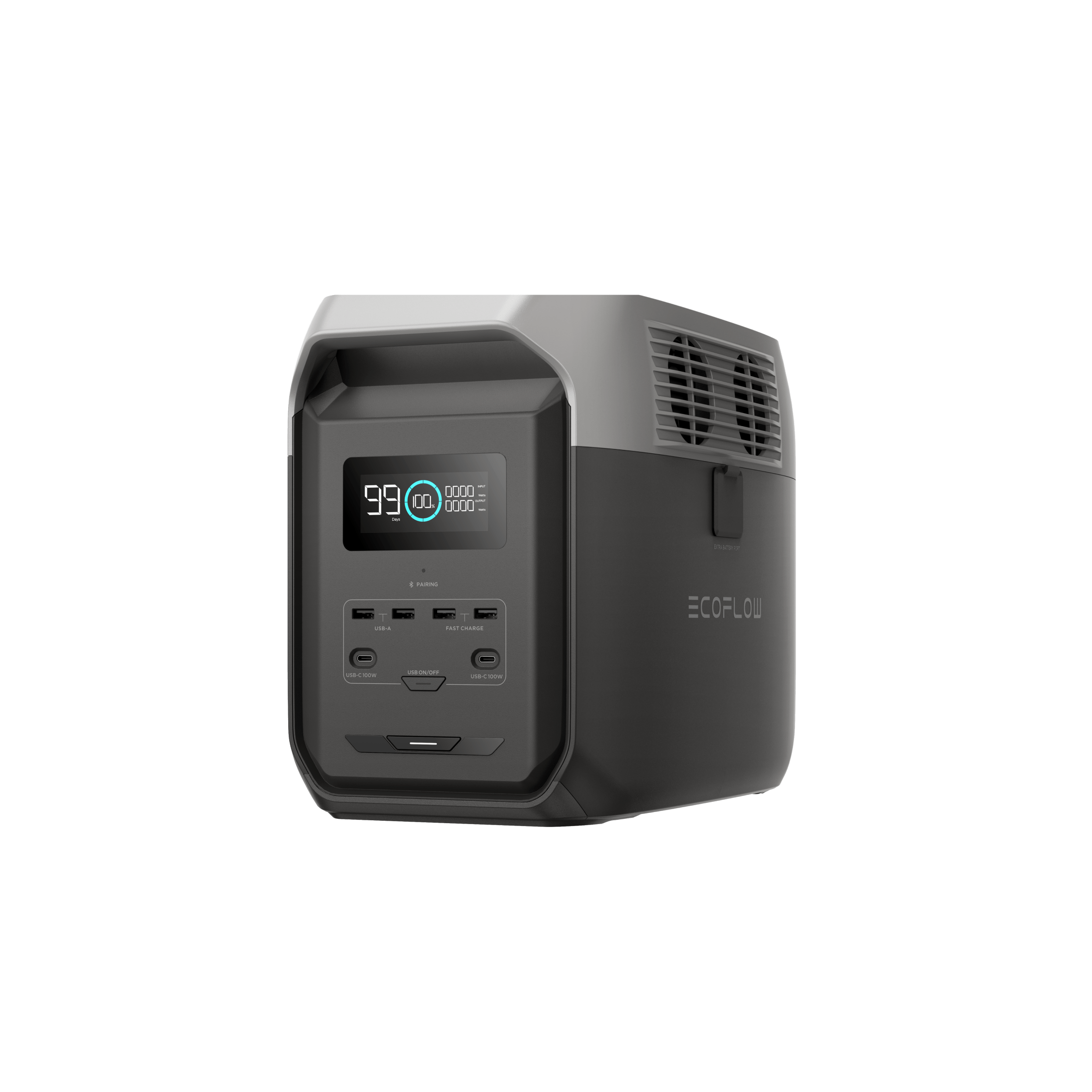
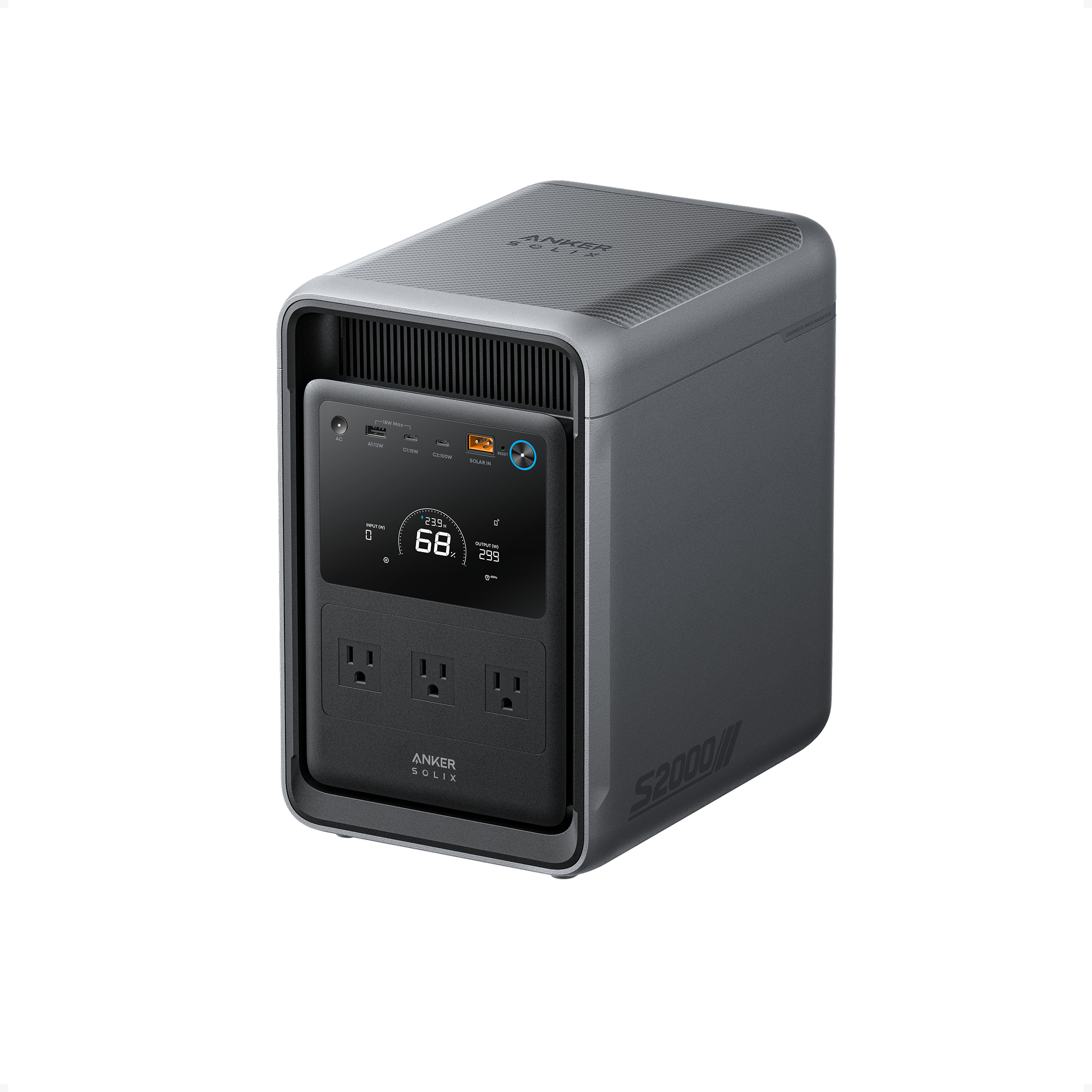
The noise card is the one to read slowly, because it's an absence rather than a measurement. The S2000 publishes 30dB and the 1500 publishes nothing, which is not evidence the 1500 is louder, only that there's no figure to hold it to. Elsewhere the 1500 keeps the small wins: six AC outlets to five, four USB-A ports to one, and 140W of USB-C against 100W, which is a laptop charger you don't have to pack. Real advantages, on a unit that's out of production.
Strengths & trade-offs
EcoFlow DELTA 3 1500
Strengths
- +Higher AC output
- +Faster solar charging
Trade-offs
- –Shorter-lived battery — rated for 3,000 charge cycles vs the SOLIX S2000's 10,000, so it wears out sooner.
Anker SOLIX S2000
Strengths
- +Lighter by 0.3 lb
- +Larger battery capacity
- +Rated for 10,000 charge cycles — much longer battery lifespan
Trade-offs
- –No major technical downsides compared to rival.
Will It Power Your Gear?
Scenario math and per-appliance runtimes, modeled from the spec record.
Scenario verdicts
We ran the math on six real-world scenarios. Here's which unit survives your actual life.
SCN-01 · 2 nights · needs 2,100Wh
Weekend Camping
Two nights off-grid with essential comfort
Neither unit
Nobody wins this one. The weekend's 2,100Wh is more than either unit holds: the S2000 gets you about 81% of the way, the 1500 about 62%. That's a planning problem rather than a dealbreaker, and the fix is the same either way, a panel on the car roof or the cooler off the inverter overnight.
Battery budget usedlower = more headroom
LOAD Phone Charger 15W×6h · LED Lights 40W×8h · Box Fan 75W×14h · CPAP Machine 40W×16h
SCN-02 · 8 hours · needs 1,645Wh
8-Hour Blackout
Keep the essentials running through a night without power
SOLIX S2000
This is the row the capacity gap pays for. The S2000 finishes the eight hours with 63Wh left; the 1500 stops 339Wh short of the 1,645Wh the night needs. Don't read the S2000's pass as comfortable, though. 63Wh is about 4% of headroom, so if the outage runs long, shed something early rather than at the end.
Battery budget usedlower = more headroom
LOAD Fridge 150W×8h · Router + Modem 20W×8h · LED Lights (4 bulbs) 40W×6h · Phone Charger 15W×3h
SCN-03 · 8 hours · needs 320Wh
CPAP Overnight
Sleep therapy without interruption — the #1 medical use case
Either unit
Both cover it and it isn't close: 320Wh against 1,708Wh and 1,306Wh of usable energy, so you finish the night having spent 19% of the S2000 or 25% of the 1500. Which means capacity is not what you're choosing on. You're choosing on whether a fan spins up beside your pillow in the middle of the night, and only one of these two publishes any figure at all for that.
Battery budget usedlower = more headroom
LOAD CPAP Machine 40W×8h
SCN-04 · 8 hours · needs 910Wh
Remote Workday
Full work day off-grid without power anxiety
SOLIX S2000
The SOLIX S2000 clears the workday at 53% used, banking 798Wh — late work, extra calls, or a second laptop charge without arithmetic. The DELTA 3 1500 at 70% also finishes, with 396Wh of slack for the unplanned.
Battery budget usedlower = more headroom
LOAD Laptop 60W×8h · External Monitor 30W×8h · Router + Modem 20W×8h · Phone Charger 15W×2h
SCN-05 · 4 hours · needs 670Wh
Tailgate Party
Game day power for the crew
SOLIX S2000
The S2000 takes it on reserve, 39% used against 51%, with both units coasting. Weight won't break the tie: 35.7 lbs against 36 is a rounding error nobody feels across a parking lot. The 1500's one genuinely useful tailgate spec is a sixth AC outlet, and it's on the unit you can't buy.
Battery budget usedlower = more headroom
LOAD Blender 400W×0.5h · LED TV (55") 80W×4h · Bluetooth Speaker 15W×4h · Phone Charger (×3) 45W×2h
SCN-06 · 24 hours · needs 4,685Wh
Van Life Daily
A full day of mobile living — the ultimate endurance test
Neither unit
Neither unit is really in this conversation. The daily list runs 4,685Wh, and the S2000 covers about 36% of it while the 1500 covers about 28%. That's not a shortfall you close with a panel and discipline, it's a sign you're shopping the wrong shelf. Full-time van power means a wired system with roof solar and a battery bank, not a box you carry inside at night.
Battery budget usedlower = more headroom
LOAD Mini-Fridge 150W×24h · Laptop 60W×4h · Phone Charger 15W×3h · LED Lights 40W×5h · Fan 75W×8h
The Load Test
RUNTIME = (Wh × 0.85) ÷ LOAD
None of the scenarios above exactly yours? Build it. Toggle what you'd plug in; both units are tested against the combined draw.
Essentials
Comfort & Convenience
High-Draw Appliances
Test duration
8h
Continuous draw
205W
Projected runtime
For this load: SOLIX S2000 runs 8.3h vs 6.4h.
Sold on Amazon
Planning for more than this? Describe your whole setup and get it sized →
Modeled from the spec record — same math as the tables below. Methodology
Runtime by appliance
Real-world runtime estimates for common appliances, modeled at 85% inverter efficiency.¹
Essentials
The basics you need runningscale 0–113.9hComfort & Convenience
Makes off-grid life actually enjoyablescale 0–22.8hHigh-Draw Appliances
These reveal the real limitsscale 0–1.7h¹ Runtime = (capacity × 0.85) ÷ appliance watts. Within each group, all bars share one time scale (the group's longest runtime), so lengths are comparable across appliances; identical runtimes collapse into a single blue/orange bar. Actual runtime varies with battery age, temperature, and simultaneous loads — see methodology.
Conclusion
September 19, 2026
Verdict: the Anker SOLIX S2000
Buy the SOLIX S2000. It's the only one of the two EcoFlow hasn't stopped selling, and it would have been the pick anyway. It holds 2,009.6Wh to the 1500's 1,536Wh, which is exactly the margin that decides the modeled 8-hour blackout: the S2000 finishes with 63Wh left and the 1500 comes up 339Wh short. It's rated for 10,000 cycles against 3,000, and its UPS is rated a class quicker, no worse than 10ms against no worse than 15ms. The 1500 was the stronger inverter, 1,800W rated and 3,600W peak against 1,500W and 3,000W, and it refills from the sun faster on 500W of solar input. None of that fires in any of the six scenarios here, every one of which both units start and sustain. Two catches worth knowing before you order: the S2000 is sealed at 2,010Wh, and its field record is six weeks deepB0.
Editor-assigned confidence, based on cited owner research and spec analysis.
List prices as of September 19, 2026. The links below open Anker's current price.
Sold on Amazon · today’s price is on the listing
Written by Ian Schneider, Solar & Off-Grid Tester · Station Arena Test Desk · Updated September 19, 2026
Measured Data
Benchmark scores and the full spec record, side by side.
Benchmark scores
Not rated for both units (minimum threshold unmet): RV Living, Food Truck.
Full specifications
ᵈ Derived: price ÷ rated capacity. See the data behind our comparisons →
Comparison ToolAdd more power stations, side by sideOpen Tool →How these numbers are produced
Numeric verification
Every figure on this page traces to our spec database or arithmetic on it — no estimated numbers.
Owner claims
Statements about owner experience are cited to published reviews — see Sources & Research Notes below.
Runtime model
Runtime = (rated capacity × 0.85 inverter efficiency) ÷ device wattage. Solar recharge estimates assume panels deliver 70% of rated output. Cold weather, battery age, and stacked loads reduce real-world results.
Power Score
Computed from 14 published spec dimensions, weighted per use-case bench. Higher is better; a unit must meet a bench's minimum threshold to be rated.
See the full weight table and data sourcing on our methodology page →Class ranking (the star rating)
Each unit's star score is a category ranking, not customer reviews — no buyer opinions feed it. We score every station on size-independent quality (value, output, portability, endurance, ports, warranty, and more), then percentile-rank it against the other units in its capacity class, so a class-leading compact unit and a class-leading whole-home unit can both earn 5★. Here, DELTA 3 1500 rates 5.0/5 (99th percentile of 27 Everyday-class units), and SOLIX S2000 rates 5.0/5 (99th percentile of 26 Large-class units).
How the class ranking is computed →Test Notes & Caveats
Hidden gotchas and advantages we spotted that you won't find on the product page.
The SOLIX S2000's Ceiling Is 2,010Wh
Sealed, no expansion port, and that number is the whole story, so measure it against your longest unplugged stretch before you order. What it isn't is a loss to the DELTA 3 1500. The 1500 starts at 1,536Wh, so its first expansion battery mostly buys back energy the S2000 already includes, and expansion only pulls ahead past 2,010Wh. It's also a port on a unit that's no longer sold.
UPS Switchover: ≤10ms vs ≤15ms
Both list a UPS mode, at different rated speeds. The SOLIX S2000 is rated ≤10ms — quick enough on paper that desktop PCs and routers should ride through, treating that as the rating it is. The DELTA 3 1500 is rated ≤15ms — fine on paper for routers and most electronics; the fussiest PC power supplies sit right at this line. If a computer with unsaved work is the thing being protected, the stated class is worth the attention; nothing here is a lab result.
Five Years Each, So Look Past the Term
Identical coverage, which settles this row and tells you nothing useful. What differs between these two makers is the claim experience rather than the term, and that belongs in the brand column rather than here. One thing worth remembering on a discontinued unit: the term is the entire runway, since EcoFlow offers no parts or service outside warranty.
Battery Lifespan in Real Years
The SOLIX S2000 is rated for 10,000 cycles vs 3,000. In real life: at daily use, that's 27.4 vs 8.2 years. At weekend use (twice a week), it's 96 vs 29 years. One caution reading years across different sizes: a cycle is 2,010Wh on the SOLIX S2000 and 1,536Wh on the DELTA 3 1500, so count lifetime energy — roughly 20,096 kWh against 4,608 kWh over the rated life. After hitting the cycle limit, the battery doesn't die — it drops to ~80% of original capacity, which is still very usable.
Only One of These Publishes a Noise Figure
The SOLIX S2000 lists 30dB; the DELTA 3 1500 lists nothing. That's an absence of data, not evidence the 1500 is louder. And treat the 30dB as what it is, a spec-sheet claim, and the kind of figure makers usually publish as a best case in a quiet mode, so budget for more under load. If you're buying for a bedroom or a CPAP, the published number is a starting point and a hands-on report is the thing worth hunting down.
Full record above — the Test Desk pick is the SOLIX S2000.
Check SOLIX S2000 price →Ownership Analysis
What happens after you buy — true cost of ownership, brand trust, and growth potential.
Lifetime value
Service lifeyears at one full cycle per day
Lifetime energy delivered
Cost per delivered kWh
│ warranty ends · Reaching the cycle rating means ~80% capacity remains — degraded, not dead.
Analyst note
The DELTA 3 1500 is no longer sold, so there is no price to work its cost per kWh from, and this comparison doesn't quote one. On what you can actually buy today, the SOLIX S2000 works out at $0.03/kWh over its rated life. If you already own the DELTA 3 1500, the hardware comparison still holds: over its rated life the DELTA 3 1500 delivers about 4,608 kWh and the SOLIX S2000 about 20,096 kWh.
Brand trust
EcoFlow
Ecosystem
Largest in portable power — 12-15 models across DELTA Pro, DELTA 3, and RIVER 3 series, plus solar panels and smart home panels
Support
US-based phone/email/chat support (1-800-368-8604). Experiences are polarized — many report hassle-free prepaid-label replacements, but others report long waits and refurbished units sent for new claims. Pro tip: buying from Costco or Amazon gives you a stronger return safety net.
Community
Largest community in the space — Reddit r/Ecoflow_community (~31K members), multiple Facebook groups, and an official community forum
App experience
Rated 4.6/5 iOS (~8,400 ratings) · 4.2/5 Android (~17,000 ratings)
Unique strength
Fastest-charging technology (X-Stream), deepest product ecosystem, and most active innovation cadence. At the top of the range sit two whole-home paths: the TITAN line, one 5 kWh unit that grows to 30 kWh, and the DELTA Pro Ultra platform, which stacks batteries and inverters further — flagship paths, not line-wide features.
Worth knowing
EcoFlow runs the deepest catalogue in portable power, normally its strongest argument and the least useful one here, because the 1500 is no longer part of it. The line that matters instead is that EcoFlow offers no parts or service outside warranty, which on a discontinued unit makes the five-year term the entire support runway.
Anker
Ecosystem
7-8 SOLIX portable power stations across C-series (compact) and F-series (flagship), plus the X1 home energy system
Support
US-based support. Historically known for incredible no-hassle replacements, but recent reports describe AI-driven support agents giving generic responses and complex return logistics for heavy units (hazmat shipping). The Anker brand reputation is still strong, but SOLIX-specific support quality is trending down.
Community
Moderate — active Reddit (r/Anker, r/AnkerSOLIXCommunity) and growing. Benefits from Anker's massive consumer electronics brand awareness.
App experience
Rated 4.5/5 iOS (~1,100 ratings) · 4.3/5 Android
Unique strength
Parent brand trust from Anker's consumer electronics dominance. InfiniPower technology for long cycle life. Strong $/Wh value in the mid-size and larger units — the S2000, F2600 and C1000 are among the better buys per watt-hour in the catalog.
Worth knowing
Anker's reputation was built on no-hassle replacements, and its own record now flags SOLIX support as trending down from that level, with AI-first agents and awkward return logistics on heavy units. The parent brand is still a reason to trust the box; treat the support experience as the part to verify rather than assume.
Analyst note
Brand strength is an argument about the future of a product you can still buy, which leaves one candidate on this page. EcoFlow's larger ecosystem and bigger community don't reach the 1500 any more, and Anker's narrower range is attached to a unit still in production. If the ecosystem question is what brought you here, the place to weigh it is EcoFlow's current range against Anker's, not these two units.
Growth path
DELTA 3 1500
EXPANDABLESupports EcoFlow expansion batteries, so you can add capacity later without replacing the base unit — useful if your needs may climb past 1,536Wh.
Accepts up to 500W of solar. Suitable for a 1-2 panel setup.
Generous port selection supports complex multi-device setups.
Expansion batteries are EcoFlow-specific. You're investing in the EcoFlow ecosystem.
SOLIX S2000
FIXED CAPACITYFixed at 2,010Wh — a sealed, complete system rather than a starting point. There's no expansion port, so that figure is the ceiling: check it against your longest unplugged stretch before you buy.
Accepts up to 400W of solar. Suitable for a 1-2 panel setup.
Adequate ports for most setups, but heavy users may want a power strip.
Realistic full solar rechargeat 70% of rated panel output — see methodology
Analyst note
Growth only counts if you can still buy in, and the DELTA 3 1500 is no longer sold (EcoFlow points owners to the DELTA 3 Max). That leaves the SOLIX S2000: it is sealed at 2,010Wh, so buy the size that covers you now. The DELTA 3 1500's expandability still matters if you already own one, but it isn't a reason to pick it over the SOLIX S2000.
What Owners Report
Patterns from published owner reports and long-term reviews — every claim cited to its source below.
EcoFlow DELTA 3 1500
Field data on the 1500 is thin and largely secondhand. No Reddit, YouTube or Amazon material specific to this SKU turned up, and the forum threads that do discuss it wouldn't load directly, so what we have are close paraphrases of indexed snippets rather than quotesA0. Read the rest of this at that discount.
Posters on the DIY Solar Forum described the 1500 as a Delta 2 and Delta 3 hybrid: UPS-cutover electronics carried over from the Delta 2, in a new case, with what one of them called larger grade B cellsA3. The same threads leaned toward the Delta 3 line drawing more failure reports than the Delta 2, and one poster's neighbour went through three 1500s in about eight monthsA1A2. That's a secondhand account rather than a pattern, but it's the loudest thing in a very quiet file. The forum also pegged the 1500's cutover at 15ms, slower than the figure they discussed for the standard Delta 3 and Delta 3 Plus, which lines up with the no-worse-than-15ms ceiling our own record carriesA5. Idle draw came up in the same threads without resolution, and our researcher flagged that entry as possibly describing a sibling SKUA4.
“Posters described the Delta 3 1500 as essentially a Delta 2/Delta 3 hybrid — UPS-cutover electronics carried over from the Delta 2, housed in a new case with what one called "larger grade B cells."”
Sources
diysolarforum.com
Anker SOLIX S2000
The S2000 has more hands-on material behind it than a unit this new usually does, but all of it is weeks deep rather than months: no longevity reports exist yet, and Reddit couldn't be searched at allB0. Two outlets ran independent tests instead of reprinting the press kit, and they agree on the things you'd actually notice. The fans sit still at idle and spin up only under a heavy load or the fastest charging modeB1B2, standby draw measures in single wattsB3B4, and a simulated outage passed through the switchover without the connected office gear noticingB9B10. One reviewer refilled it from a standard 20-amp household circuit to 80% in about 1.2 hours and to full in about 1.7B5; another ran a fridge plus assorted kitchen gadgets for over 60 hours on one chargeB12. The app drew praise as the more polished one in the categoryB11.
Two complaints, both worth hearing before you order. Reviewers at both outlets independently found the carry awkward for one person: 35.7 lbs is manageable, but they wanted a second handle for stairsB7B8. And one reviewer noticed a warm-electronics smell within a few feet of the unit during the first several hours of sustained AC load in a closed home office. It faded after a day and they raised no safety concernB6.
“Fans only spin up under real load or fast charging, and at idle the unit is silent.”
Sources
ess-news.com · geardiary.com
Sources & Research Notes
Every owner claim in this report is traceable to a published source. The bracketed references above resolve here.
Recurring owner themes
- Forum posters flagged the Delta 3 1500 as less reliable than EcoFlow's earlier Delta 2, both from direct failure reports and from its unusual hybrid Delta 2/Delta 3 hardware platform. [DELTA 3 1500 · 3 entries]
- Idle power draw and UPS cutover time are both discussed as possible regressions or open questions relative to the standard Delta 3 / Delta 3 Plus, without firm confirmation for the 1500 variant specifically. [DELTA 3 1500 · 2 entries]
- Two independent hands-on reviews both found near-silent idle operation, with fans spinning up only under heavy load or the fastest charging mode. [SOLIX S2000 · 2 entries]
- OptiSave's low-idle-draw claim held up under independent testing, with both reviewers separately measuring single-digit-watt standby draw. [SOLIX S2000 · 2 entries]
- Both reviewers praised fast, reliable UPS switchover that connected electronics didn't notice. [SOLIX S2000 · 2 entries]
- Despite otherwise solid build quality, reviewers from two different outlets independently flagged the single/absent carry handle as awkward for one-person transport. [SOLIX S2000 · 2 entries]
- A1
“A poster's neighbor had three separate Delta 3 1500 units fail on him over roughly eight months.”
diysolarforum.com — "Ecoflow Delta 3 1500 (the newer one), refurbed from EF for $360pt, shipped free" · 2026-02 · [negative]
- A2
“Forum consensus leaned toward the Delta 3 line seeing more failure reports than the Delta 2 — one poster said their two Delta 2 units never gave them a single issue by comparison.”
diysolarforum.com — "Ecoflow Delta 3 1500 (the newer one), refurbed from EF for $360pt, shipped free" · 2026-02 · [negative]
- A3
“Posters described the Delta 3 1500 as essentially a Delta 2/Delta 3 hybrid — UPS-cutover electronics carried over from the Delta 2, housed in a new case with what one called "larger grade B cells."”
diysolarforum.com — "Ecoflow Delta 3 1500 (the newer one), refurbed from EF for $360pt, shipped free" · 2026-02 · [mixed]
- A4
“Idle power draw for the Delta 3 line was debated — some cite roughly 25-30W, others said a firmware update cut it from about 40W to 17W — and posters weren't sure whether the 1500 specifically had received that fix.”
diysolarforum.com — "EcoFlow Delta 3 1500? Any user experiences" and "...refurbed from EF for $360pt" threads · 2026-02 to 2026-03 · [mixed]
- A5
“The Delta 3 1500's UPS cutover was pegged at 15ms in forum discussion, versus a sub-10ms cutover reported for the standard Delta 3 and Delta 3 Plus.”
diysolarforum.com — "EcoFlow Delta 3 1500? Any user experiences" · 2026-03 · [mixed]
- B1
“Fans only spin up under real load or fast charging, and at idle the unit is silent.”
ess-news.com — Anker Solix S2000 review: 2 kWh power station built for the long haul · 2026-05 · [positive]
- B2
“The fans only spin up when pulling a heavy load or using the fastest charging mode — otherwise it stays very quiet.”
geardiary.com — Anker SOLIX S2000 Review · 2026-07 · [positive]
- B3
“Charged fully, disconnected from wall power with AC output enabled and no loads attached, then monitored for 10 hours: state of charge dropped only to 99%, implying about 2W average draw — matching Anker's spec.”
ess-news.com — Anker Solix S2000 review: 2 kWh power station built for the long haul · 2026-05 · [positive]
- B4
“With AC ports on but unused, consumption is about 6W; with everything disabled it drops to just 2W.”
geardiary.com — Anker SOLIX S2000 Review · 2026-07 · [positive]
- B5
“Real-world recharge from a standard 20-amp household circuit hit 80% in roughly 1.2 hours and full capacity in about 1.7 hours, matching the manufacturer's claims.”
ess-news.com — Anker Solix S2000 review: 2 kWh power station built for the long haul · 2026-05 · [positive]
- B6
“Under sustained AC load in a small, closed home office there was a slight warm-electronics smell within a few feet of the unit during the first several hours of operation; it faded after one day with no safety concern.”
ess-news.com — Anker Solix S2000 review: 2 kWh power station built for the long haul · 2026-05 · [mixed]
- B7
“At 35.7 lbs the weight is manageable but noticeable — a second handle would be welcome for carrying it up stairs.”
ess-news.com — Anker Solix S2000 review: 2 kWh power station built for the long haul · 2026-05 · [mixed]
- B8
“Lacks a dedicated handle for carrying with one hand, making transport less convenient despite the relatively compact 35.7 lb weight.”
geardiary.com — Anker SOLIX S2000 Review · 2026-07 · [negative]
- B9
“In a simulated outage, connected office equipment rode through the switchover without interruption.”
ess-news.com — Anker Solix S2000 review: 2 kWh power station built for the long haul · 2026-05 · [positive]
- B10
“A 10ms switchover time means a computer or internet router won't even flicker if the grid goes down.”
geardiary.com — Anker SOLIX S2000 Review · 2026-07 · [positive]
- B11
“The Anker app is the more polished entry in this category, with clear navigation and sensible defaults.”
ess-news.com — Anker Solix S2000 review: 2 kWh power station built for the long haul · 2026-05 · [positive]
- B12
“Easily powered a fridge and various kitchen gadgets for over 60 hours without needing a recharge.”
geardiary.com — Anker SOLIX S2000 Review · 2026-07 · [positive]
Research compiled September 19, 2026.
Who Should Buy Which
Buy the DELTA 3 1500 if you…
- →You already own one. Keep it. 1,536Wh, an 1,800W inverter with 3,600W of peak, a 3,000-cycle minimum on the pack and five years of warranty is a working unit, and a catalogue decision at EcoFlow doesn't change what's in the case.
- →You've found leftover retailer stock. We can't recommend a discontinued unit, but if you're weighing one anyway for the 1,800W inverter and 500W solar input in a 36 lb body, go in knowing two things: EcoFlow offers no parts or service outside warranty, so those five years are the whole runway, and independent field data on this exact SKU barely existsA0.
Buy the SOLIX S2000 if you…
- →You're buying for outages. It's the one of the two that finishes the modeled 8-hour blackout, its UPS is rated no worse than 10ms, and two independent tests watched office gear ride the switchover without a flickerB9B10.
- →You want to buy a battery once and stop thinking about it. 10,000 rated cycles is roughly 20,096 kWh of lifetime energy, and at the cycle limit the pack doesn't die, it settles around 80% of its original capacity.
- →You work away from a wall for a day at a time. The workday load leaves 798Wh in reserve, which is the difference between finishing the day and doing arithmetic halfway through it.
- →You want the quieter one, with the honest caveat that quiet is only established for one side here. The S2000 publishes a noise figure, the 1500 publishes none, and reviewers at two outlets found the S2000's fans still at idleB1B2.
If neither fits
Van life on the daily list this page models suits neither: it needs 4,685Wh, and the S2000 covers about 36% of that while the 1500 covers about 28%. That's not a shortfall you manage with a panel and discipline, it's a sign you want a wired system with roof solar and a battery bank rather than a box you carry inside at night. Same answer if you need to run more than 1,500W continuously, which means a bigger inverter class than either of these. And if 1.5 kWh from EcoFlow was the whole reason you're here, close this tab and look at EcoFlow's current range instead, because nothing it sells now sits at that size and the DELTA 3 Max is the nearest live equivalent.
The Bottom Line
Buy the SOLIX S2000, and not by default. The gap between these two is 402Wh of usable energy, and that 402Wh is exactly the width of the blackout result: the S2000 gets through the night with 63Wh left while the 1500 stops short of it. Everything the 1500 won here, the bigger inverter, the faster solar input, the 140W USB-C, the sixth outlet, is headroom the loads on this page never reach for, and it's headroom on a unit EcoFlow no longer makes.
The caveats stand: the S2000's pass on that blackout is thin, it's sealed at 2,010Wh with nowhere to grow, and its field record is six weeks deepB0. None of that changes the recommendation, because the alternative on this page isn't a cheaper unit or a riskier one, it's a unit you can't buy. And if 1.5 kWh from EcoFlow was the whole reason you opened this page, the DELTA 3 Max is where to look next.
Frequently Asked Questions
Answers drawn from the spec record and cited owner research.
Is the EcoFlow DELTA 3 1500 discontinued?
Yes. EcoFlow has folded it out of its range: the product page forwards to the base DELTA 3, and the one listing left is a solar bundle that's sold out. Nothing EcoFlow sells today sits at 1.5 kWh, and the DELTA 3 Max is the nearest live equivalent. This page stays up because the specs still matter to anyone who owns one or turns up leftover retailer stock.
Can the Anker SOLIX S2000 start a fridge?
Its inverter is rated 1,500W continuous with 3,000W of peak, which is exactly twice its rated draw. Compressors pull two to three times their running wattage for the instant they start, so that doubled headroom is the figure that matters, and the DELTA 3 1500's 3,600W peak over 1,800W rated is the identical ratio. Across the six loads on this page the biggest startup peak asked for is 400W, and both units are marked as starting and sustaining all six.
Which lasts longer, the Anker SOLIX S2000 or the EcoFlow DELTA 3 1500?
The S2000, by a wide margin on paper: 10,000 rated cycles against 3,000. A cycle is a different amount of energy on each unit, so the honest comparison is lifetime energy, roughly 20,096 kWh against 4,608 kWh over the rated life. At the cycle limit neither pack dies; it drops to about 80% of original capacity and keeps working.
Can you add batteries to the Anker SOLIX S2000?
No. It's sealed at 2,010Wh and that figure is the ceiling, so check it against your longest unplugged stretch before ordering. The DELTA 3 1500 did take expansion batteries, but it starts at 1,536Wh, below the S2000's fixed capacity, so a first expansion battery largely buys back energy the S2000 already includes. It's also not a card you can play on a unit that's no longer sold.
Will the Anker SOLIX S2000 run a CPAP all night?
Comfortably. A CPAP is about 40W, so eight hours is roughly 320Wh, which is 19% of the S2000's usable energy. Capacity isn't the question at that load; the fan is, since you'll be sleeping next to it. Two independent reviews found the fans silent at idle, spinning up only under a heavy load or the fastest charging mode.
Where to buy
EcoFlow DELTA 3 1500
No longer sold
Anker SOLIX S2000Pick
Sold on Amazon · today’s price is on the listing
Prices may vary by retailer and are subject to change.