Head-to-head test
DJI Power 500 vs Goal Zero Yeti 1000X
Cycled daily, the Yeti 1000X is down to 80% health inside a year and a half while the Power 500 is still working in year eight, and the Power 500 is the one that costs $701 less.
Full profiles: DJI Power 500 → · Goal Zero Yeti 1000X →

Written by Ian SchneiderUpdated
Solar & Off-Grid Tester, Station Arena Test Desk

$299.00 · direct from DJI
Last checked 1 day ago. Prices move — check before you buy.
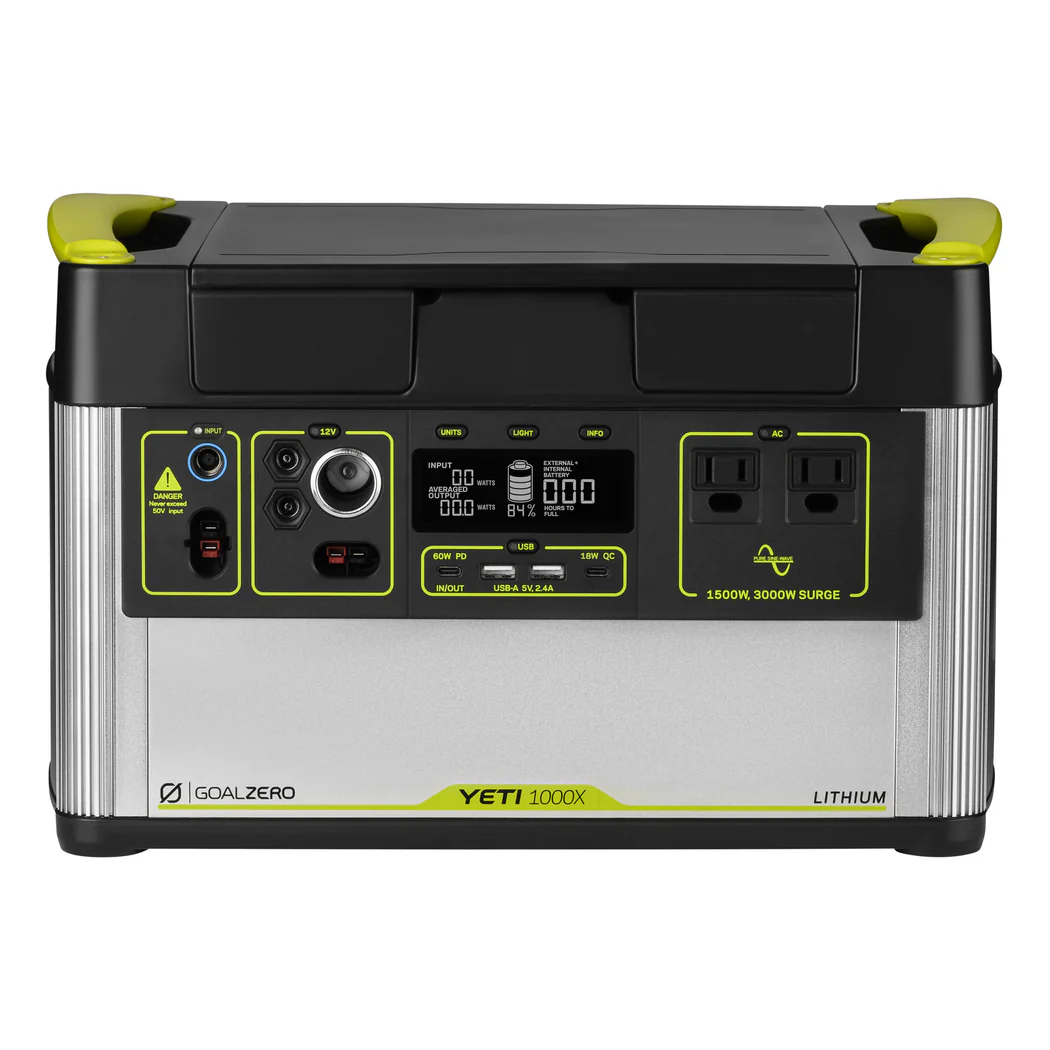
$999.95 · direct from Goal Zero
Last checked 1 day ago. Prices move — check before you buy.
Spec deltas
$299 against $1,000, and the cheaper box is the one that lasts longer. The Yeti 1000X is genuinely the bigger battery, 983Wh to the Power 500's 512Wh, but it holds that energy in lithium NMC cells rated 500 cycles to 80%B1 against LFP cells cited at 3,000 to 4,000 in the DJIA1. Six times the working life at 38% of the price.
The Yeti's whole case rests on that extra battery, so it's worth asking what the extra battery buys. After the 15% inverter derate, you get 836 usable watt-hours against 435. Across the six load profiles we model, that difference changes the answer exactly once: the Yeti covers a 670Wh tailgate and the Power 500 quits 235Wh short. Everywhere else they either both make it, as on a 320Wh CPAP night, or both fail, including the 910Wh remote workday the Yeti misses by 74 watt-hours.
So take the Power 500 unless one of three things is true. Your load list has a compressor, and the Yeti's 3,000W surge against the DJI's 1,000W is the only spec gap here that can strand you. You recharge from panels, and the Yeti takes 600W of solar with nothing extra to buy while the Power 500 has no built-in charge controller and ships with only a wall plugA4. Or you need 670 to 836 watt-hours out of one box in one sitting. Those are real exceptions. None of them is worth $701 to a buyer who doesn't have one.
What the Numbers Reveal
Each conclusion stated first — the numbers behind it on one line, the full analysis below.
rated cycles
The gap survives every conservative assumption you can throw at it. Take the low cycle count, ignore the warranty difference, give the Yeti full credit for its bigger pack, and it still costs roughly eight times as much per unit of energy delivered. That isn't a premium for build quality. It's the arithmetic of 500-cycle NMC in a market that moved to LFPB1B4.
Yeti 1000X: 983Wh at 500 rated cycles = 492 kWh of lifetime throughput, for $1,000Power 500: 512Wh at its rated 4,000 cycles = 2,048 kWh, for $299DJI's cited range is 3,000 to 4,000 cyclesA1, so the floor is 512Wh x 3,000 = 1,536 kWh
Why it mattersAnyone cycling the unit weekly or more should read the Yeti's sticker as buying about five years of weekend use, not a decade of it.
The Yeti is sized into a dead zone. It's twice the money and twice the weight of the small unit, and it's still short of the loads people actually buy a kilowatt-hour box to cover: a workday, an evening blackout. What $701 buys is the range between 435 and 836 watt-hours. That's a real range. It's also a narrow one, and you have to land inside it for the money to mean anything.
Usable capacity after the 15% inverter derate: 435Wh for the Power 500, 836Wh for the Yeti 1000XOf six modeled profiles, both cover the 320Wh CPAP night and only the Yeti covers the 670Wh tailgateThe 910Wh remote workday beats the Yeti by 74Wh; the 1,645Wh blackout and the 4,685Wh van-life day beat it by far more
Why it mattersIf your honest draw in one sitting is above 836Wh, skip both and shop a size up; if it's below 435Wh, the Yeti's capacity is money you will never touch.
continuous output
This is the one place the Yeti's price defends itself. A 400W fridge asking for four figures of watts for half a second is exactly the load that trips a station with no surge margin, and the Power 500's margin is zero by specification. A single reviewer getting 1,500W out of itA3 is an encouraging data point, not a number to plan a freezer around.
Power 500: 1,000W continuous and 1,000W peak, so the peak is the ratingYeti 1000X: 1,500W continuous and 3,000W peak, twice its rating held in reserveFridge, freezer and pump compressors draw two to three times their running wattage at startupOne bench test saw the Power 500 briefly carry 1,500W, above its ratingA3
Why it mattersIf a compressor is on your list, the surge column outranks everything else on this page and the Yeti wins it outright.
solar input
Off-grid, that inverts the comparison for one specific buyer. If your recharge source is the sun rather than a wall outlet, the Power 500's advertised 300W is conditional on hardware that isn't in the box and isn't in its price, while the Yeti's 600W is simply there. Everything else on this page still favours the DJI. This is the line that makes it an argument rather than a formality for van and overland buyers.
Power 500 lists 300W solar input but has no built-in solar charge controller, so panels need a separate proprietary DJI adapterThe Power 500 ships with only a wall plug, no solar or car-charging cablesA4Yeti 1000X accepts 600W of solar inputThe Yeti's 836 usable watt-hours is the bigger tank to refill, against the Power 500's 435
Why it mattersSolar-first buyers should price the DJI adapter before treating $299 as the real number.
The specific dimensions that decide these two units — everything else is a tie.
Lifetime Value
Selected because: Selected because: the same kilowatt-hour costs $0.19 to move through the Power 500 and $2.03 through the Yeti 1000X, and nothing else on this page is close.
cost / lifetime kWh
A thousand dollars buys 492 kilowatt-hours. That's the entire rated life of the Yeti's pack, 983Wh delivered 500 timesB1, and it works out to $2.03 for every kilowatt-hour that will ever pass through it. The Power 500's $299 buys 2,048 kWh at its rated 4,000 cycles, or $0.19. Take the pessimistic end of DJI's cited 3,000 to 4,000 rangeA1 and $299 across 1,536 kWh is $0.25. The conclusion doesn't move.
Warranty tells the same story in dollars per year: the Yeti's two years cost $500 apiece, the DJI's five cost $76. And the calendar bites hardest for the person who uses the thing most. Cycle the Yeti daily and its pack is at 80% health in 1.4 years; run it two days most weekends and you get about 4.8. The Power 500 is somewhere between year eight and year eleven of that same daily habit before it reaches the end of its cited cycle range.
Your Life, Your Pick
Selected because: Selected because: across six load profiles, the Yeti's extra 401 usable watt-hours change the outcome exactly once.
Four of the six profiles end the same way: neither unit gets there. A 2,100Wh camping weekend, a 1,645Wh blackout, a 4,685Wh van-life day are all past what a 512Wh or a 983Wh box can deliver, and choosing well between these two does nothing about it. Read those four as a signal about size class, not about brand.
What's left is one shared win and one genuine difference. Both cover a 320Wh CPAP night with reserve to spare. Only the Yeti covers a 670Wh tailgate. That is what $701 buys, stated without decoration: one more evening out of six. Worth noting that in all six profiles, both units clear the modeled peak draw, so the Yeti's advantage here is depth rather than capability. Its surge headroom matters for startup spikes the scenario model doesn't simulate.
What the Specs Don't Tell You
Selected because: Selected because: surge headroom, UPS and cycle life point in different directions here, and two of them can overturn the verdict.
rated cycles
The six flags don't all point the same way, which is what makes them useful. Two favour the Yeti and could genuinely flip the decision: 3,000W of surge headroom against the DJI's none, and a real expansion path where the Power 500 has none. Four favour the DJI: cycle life, warranty length, the UPS mode, and the plain fact that Goal Zero publishes no noise figure for this unit.
The one to read twice is surge. The Power 500's 1,000W peak is its continuous rating with nothing behind it, and startup spikes are where that shows up. One bench test saw it briefly ride a 1,500W loadA3, which is encouraging and is not a specification. Plan around 1,000W and you'll be right. Plan around 1,500W because one reviewer got away with it onceA3 and you're the one standing in front of a warm fridge.
Growth Path
Selected because: Selected because: expansion is the Yeti's one structural advantage, and the Power 500 has no version of it at any price.
solar input
Expansion is the Yeti's one structural card and it's a legitimate one. Yeti Link chains additional capacity onto the base unit, at the cost of extra cables and adapters bought separatelyB3. The Power 500 has no version of this. 512Wh is the ceiling and it's welded on.
The catch is what you're growing. Every watt-hour you add still runs through a base unit whose own pack is rated 500 cyclesB1, so expansion buys size, not time. And the sealed unit's crude alternative prices out better than it has any right to: two Power 500s cost $758 for 1,024Wh, which is more stored energy than the Yeti holds for $242 less. They're two boxes rather than one, and you can't run a single 1,200W load across them. But if the goal is total energy on hand, the unit with no growth path gets there cheaper.
Portability & Form Factor
Selected because: Selected because: 16.1 lb is a one-handed carry and 31.68 lb is not.
weight
16.1 lb is a one-handed lift out of a trunk. 31.68 lb is both hands and a moment's thought, closer to a full carry-on than a toolbox, and it's the difference between the unit that walks to the campsite and the unit that stays in the truck. Some of those pounds are the ruggedised case doing its job, and reviewers describe the Yeti's build as genuinely premium at that weightB2.
The awkward overlap is that the Yeti's only scenario win is the tailgate, which is precisely the use case where you carry it furthest from the car. Twice the weight to win the party.
Strengths & trade-offs
DJI Power 500
Strengths
- +Costs $701 less
- +Lighter by 15.6 lb
- +Longer warranty
- +Rated for 4,000 charge cycles — much longer battery lifespan
Trade-offs
- –Sealed capacity — the Yeti 1000X can add batteries to grow past 512Wh; this one can't.
Goal Zero Yeti 1000X
Strengths
- +Larger battery capacity
- +Higher AC output
- +Faster solar charging
Trade-offs
- –Substantially more expensive (+$701) than the Power 500.
- –Significantly heavier (+15.6 lbs), making it harder to move.
- –Shorter-lived battery — rated for 500 charge cycles vs the Power 500's 4,000, so it wears out sooner.
Will It Power Your Gear?
Scenario math and per-appliance runtimes, modeled from the spec record.
Scenario verdicts
We ran the math on six real-world scenarios. Here's which unit survives your actual life.
SCN-01 · 2 nights · needs 2,100Wh
Weekend Camping
Two nights off-grid with essential comfort
Neither unit
Neither unit covers this scenario's 2,100Wh: the Power 500 comes up 1,665Wh short (about 21% covered), the Yeti 1000X 1,264Wh (40%). This is well outside what either unit is for; the right answer here is a larger station, not a choice between these two.
Battery budget usedlower = more headroom
LOAD Phone Charger 15W×6h · LED Lights 40W×8h · Box Fan 75W×14h · CPAP Machine 40W×16h
SCN-02 · 8 hours · needs 1,645Wh
8-Hour Blackout
Keep the essentials running through a night without power
Neither unit
1,645Wh over eight hours is roughly double what the Yeti can deliver and nearly four times the Power 500's usable 435Wh, so both fall short and the honest advice is to shop a larger class if whole-evening backup is the job. What these two can do in an outage is keep a router, some phones and a CPAP alive. For that job the Power 500's UPS mode is worth more than the Yeti's extra capacity, because it's the one that works while you're asleep.
Battery budget usedlower = more headroom
LOAD Fridge 150W×8h · Router + Modem 20W×8h · LED Lights (4 bulbs) 40W×6h · Phone Charger 15W×3h
SCN-03 · 8 hours · needs 320Wh
CPAP Overnight
Sleep therapy without interruption — the #1 medical use case
Either unit
A 320Wh night is the one load both of these handle without drama: 74% of the Power 500's usable reserve, 38% of the Yeti's. Which means the tiebreak isn't capacity, it's what happens when the grid drops at 2 a.m. The Power 500 has a UPS mode and takes over in about 20 milliseconds. The Yeti 1000X has no UPS mode at all, so it runs your machine only if you plugged the machine into it before you fell asleep. Want deeper reserve for a heated humidifier, take the Yeti. Want the unit to catch the outage for you, only one of these does.
Battery budget usedlower = more headroom
LOAD CPAP Machine 40W×8h
SCN-04 · 8 hours · needs 910Wh
Remote Workday
Full work day off-grid without power anxiety
Neither unit
Neither one finishes the day. 910Wh of laptop, monitor and coffee is 209% of what the Power 500 can give you and 109% of the Yeti, and that second number is the more annoying one, because it means the bigger, pricier unit misses by 74 watt-hours. Close enough to sting, not close enough to plan around. A full workday off one battery needs more than either of these holds.
Battery budget usedlower = more headroom
LOAD Laptop 60W×8h · External Monitor 30W×8h · Router + Modem 20W×8h · Phone Charger 15W×2h
SCN-05 · 4 hours · needs 670Wh
Tailgate Party
Game day power for the crew
Yeti 1000X
This one goes to the Yeti, cleanly. 670Wh of blender, speakers and lights is 80% of its usable capacity, while the Power 500 runs dry 235 watt-hours short. Price the win, though: you carry 31.68 lb across the lot instead of 16.1, and you paid $701 extra for the privilege of not going quiet at hour six.
Battery budget usedlower = more headroom
LOAD Blender 400W×0.5h · LED TV (55") 80W×4h · Bluetooth Speaker 15W×4h · Phone Charger (×3) 45W×2h
SCN-06 · 24 hours · needs 4,685Wh
Van Life Daily
A full day of mobile living — the ultimate endurance test
Neither unit
Neither unit covers this scenario's 4,685Wh: the Power 500 comes up 4,250Wh short (about 9% covered), the Yeti 1000X 3,849Wh (18%). This is well outside what either unit is for; the right answer here is a larger station, not a choice between these two.
Battery budget usedlower = more headroom
LOAD Mini-Fridge 150W×24h · Laptop 60W×4h · Phone Charger 15W×3h · LED Lights 40W×5h · Fan 75W×8h
The Load Test
RUNTIME = (Wh × 0.85) ÷ LOAD
None of the scenarios above exactly yours? Build it. Toggle what you'd plug in; both units are tested against the combined draw.
Essentials
Comfort & Convenience
High-Draw Appliances
Test duration
8h
Continuous draw
205W
Projected runtime
For this load: Yeti 1000X runs 4.1h vs 2.1h.
$999.95 list · direct from Goal Zero
Modeled from the spec record — same math as the tables below. Methodology
Runtime by appliance
Real-world runtime estimates for common appliances, modeled at 85% inverter efficiency.¹
Essentials
The basics you need runningscale 0–55.7hComfort & Convenience
Makes off-grid life actually enjoyablescale 0–11.1hHigh-Draw Appliances
These reveal the real limitsscale 0–0.8h¹ Runtime = (capacity × 0.85) ÷ appliance watts. Within each group, all bars share one time scale (the group's longest runtime), so lengths are comparable across appliances; identical runtimes collapse into a single blue/orange bar. Actual runtime varies with battery age, temperature, and simultaneous loads — see methodology.
Conclusion
August 9, 2026
Verdict: the Power 500, on Power Score margin
Buy the DJI Power 500. It costs $701 less than the Yeti 1000X ($299 against $1,000), weighs half as much at 16.1 lb versus 31.68, carries five years of warranty against two, and moves a kilowatt-hour through its pack for $0.19 against the Yeti's $2.03 over rated life. The Yeti's real advantages are its 3,000W surge ceiling, 600W of solar input that works without an adapter, and Yeti Link expansionB3, and each of those can decide the purchase on its own if you're starting a fridge, refilling from panels, or planning to grow past 983Wh. If none of them describes you, you're paying $701 for 401 extra usable watt-hours held in NMC cells rated 500 cycles to 80%B1, and that trade doesn't survive contact with a calculator.
Editor-assigned confidence, based on cited owner research and spec analysis.
List prices as of August 9, 2026. The links below open DJI's and Goal Zero's current prices.
$299.00 · direct from DJI
Last checked 1 day ago. Prices move — check before you buy.
or check the Yeti 1000X price$999.95 list
Written by Ian Schneider, Solar & Off-Grid Tester · Station Arena Test Desk · Updated August 9, 2026
Measured Data
Benchmark scores and the full spec record, side by side.
Benchmark scores
Not rated for both units (minimum threshold unmet): UPS, CPAP.
Full specifications
ᵈ Derived: price ÷ rated capacity. See the data behind our comparisons →
Comparison ToolAdd more power stations, side by sideOpen Tool →How these numbers are produced
Numeric verification
Every figure on this page traces to our spec database or arithmetic on it — no estimated numbers.
Owner claims
Statements about owner experience are cited to published reviews — see Sources & Research Notes below.
Runtime model
Runtime = (rated capacity × 0.85 inverter efficiency) ÷ device wattage. Solar recharge estimates assume panels deliver 70% of rated output. Cold weather, battery age, and stacked loads reduce real-world results.
Power Score
Computed from 14 published spec dimensions, weighted per use-case bench. Higher is better; a unit must meet a bench's minimum threshold to be rated.
See the full weight table and data sourcing on our methodology page →Class ranking (the star rating)
Each unit's star score is a category ranking, not customer reviews — no buyer opinions feed it. We score every station on size-independent quality (value, output, portability, endurance, ports, warranty, and more), then percentile-rank it against the other units in its capacity class, so a class-leading compact unit and a class-leading whole-home unit can both earn 5★. Here, Power 500 rates 4.6/5 (74th percentile of 20 Compact-class units), and Yeti 1000X rates 3.5/5 (11th percentile of 20 Compact-class units).
How the class ranking is computed →Test Notes & Caveats
Hidden gotchas and advantages we spotted that you won't find on the product page.
The Power 500 is sealed, and that's the trade
512Wh is the ceiling. No expansion battery, no second pack, no upgrade path except buying another unit, and two Power 500s are two separate 1,000W inverters rather than one bigger one. If you know your needs are climbing toward partial-home backup, this is the honest reason to pause before taking the cheaper box.
Surge headroom is the Yeti's strongest card
The Yeti 1000X runs 1,500W continuous and peaks at 3,000W, twice its rating in reserve. The Power 500 peaks at 1,000W, which is exactly its continuous rating, so nothing is held back. That matters for one specific class of load: compressors. A fridge, freezer or well pump draws two to three times its running wattage for the half second it kicks on, and a 400W fridge can knock harder than a 1,000W door will answer. If there's a motor on your list, this line is worth more than the price difference.
Only one of these catches an outage
The Power 500 has a UPS mode with a rated 20 ms switchover, so gear plugged through it stays up when grid power drops. The Yeti 1000X doesn't have a slow switchover, it has no UPS mode at all. That means it powers your desktop, router or CPAP only if you moved the plug across yourself, before the lights went out. For anything you'd be unhappy to watch reboot, that's a categorical difference rather than a spec-sheet nicety.
Warranty: 5 Years vs 2
The Power 500 is covered for 5 years against the Yeti 1000X's 2 years. The Power 500's figure is a maximum rather than a guarantee — it depends on buying from DJI's own store, which is where the full five years is advertised. An underrated factor if you're keeping this unit for years.
Battery Lifespan in Real Years
The Power 500 is rated for 4,000 cycles vs 500. In real life: at daily use, that's 11 vs 1.4 years. At weekend use (twice a week), it's 38 vs 5 years. One caution reading years across different sizes: a cycle is 512Wh on the Power 500 and 983Wh on the Yeti 1000X, so count lifetime energy — roughly 2,048 kWh against 492 kWh over the rated life. After hitting the cycle limit, the battery doesn't die — it drops to ~80% of original capacity, which is still very usable.
Goal Zero publishes no noise figure for this unit
DJI publishes 23 to 30 dB across its power station line. Goal Zero publishes nothing for the Yeti 1000X. Read that as a disclosure gap rather than proof of a loud fan: we haven't put a meter on either unit, and published figures come from test conditions nobody spells out. It only decides anything if the unit sleeps in the room with you, which for a CPAP buyer it does.
Full record above — the Test Desk pick is the Power 500.
Check Power 500 price →or check the Yeti 1000X priceOwnership Analysis
What happens after you buy — true cost of ownership, brand trust, and growth potential.
Lifetime value
Service lifeyears at one full cycle per day
Lifetime energy delivered
Cost per delivered kWh
│ warranty ends · Reaching the cycle rating means ~80% capacity remains — degraded, not dead.
Analyst note
The Power 500 wins on both sticker price and long-term value. At $0.15/kWh over its lifetime, it's meaningfully cheaper to own. Clear value winner.
Delivers each lifetime kWh for $1.88 less — check the Power 500 price →
Brand trust
DJI
Ecosystem
Four power stations, all since 2024: the Power 500, Power 1000 V2, Power 1000 Mini and Power 2000. A short line with no legacy models to trip over, and SDC ports built for people who already own DJI drones.
Support
Power station buyers inherit DJI's global service and repair network from the drone business, which is a genuine asset most new entrants don't have. The caveat is that there's little power-station-specific track record to judge it by yet.
Community
There's no real power station community. Discussion happens inside r/dji, a roughly 250,000-member room that is overwhelmingly drone pilots, so troubleshooting by forum search is thinner here than with the incumbents.
App experience
Rated 3.5/5 iOS and Android (DJI Home app ratings reflect entire DJI ecosystem including drones/cameras, not power-station-specific). Users report the on-device screen is more reliable than the app.
Unique strength
Quiet by design, with 23 to 30 dB published across the line, fast wall charging, and LFP chemistry throughout, backed by 700-plus battery patents out of DJI's drone R&D. The industrial design is a step above the category norm.
Worth knowing
No built-in solar charge controller, so panels need a separate proprietary adapter and the 300W solar figure is a purchase away. Battery expansion exists on the Power 2000 and Power 1000 V2 but not on this model. And DJI arrived in this category in 2024, so long-term field data is thinner than for EcoFlow, Jackery or BLUETTI, though the drone hardware record is deep.
Goal Zero
Ecosystem
Five or six active models across Yeti and Yeti Pro, plus Alta coolers, Nomad and Ranger panels and vehicle integration kits. If you're already inside it, the accessories are the reason to stay inside it.
Support
US-based in Salt Lake City and owned by NRG Energy, which was historically the premium-support argument for the premium price. That argument has weakened through 2025 and 2026, with long waits and tickets going unanswered for weeks, so don't pay extra expecting white-glove service.
Community
Small and loyal, with real depth in overlanding and preparedness circles. The official forums were recently shut down, which scattered a lot of accumulated knowledge into unofficial groups.
App experience
Rated 4.4/5 iOS (~1,200 ratings) but recent reviews skew negative — recurring connectivity issues, crashes, and stability problems.
Unique strength
The company that created this product category, with ruggedised IPX4 hardware and a Yeti-Ready accessory system for coolers, lights and vehicle kits that nobody else matches.
Worth knowing
Consistently the most expensive brand per watt-hour, and this particular model is an older NMC design in a market that has moved to LFP. Buy it for the ruggedness and the ecosystem, not for the value per watt-hour.
Analyst note
One brand has heritage, weatherproofing and an accessory system; the other has newer cells, a quieter line and a five-year warranty. On this specific pairing, the newer brand's weakness is the smaller risk: thin long-term field data is a question mark, while a 500-cycle pack is a number you can already measure.
Growth path
Power 500
FIXED CAPACITYFixed at 512Wh, with no expansion — so size it for your needs up front rather than planning to add capacity later.
Accepts up to 300W of solar. Limited to a single portable panel.
Adequate ports for most setups, but heavy users may want a power strip.
Yeti 1000X
EXPANDABLESupports Goal Zero expansion batteries, so you can add capacity later without replacing the base unit — useful if your needs may climb past 983Wh.
Accepts up to 600W of solar. Suitable for a 1-2 panel setup.
Adequate ports for most setups, but heavy users may want a power strip.
Expansion batteries are Goal Zero-specific. You're investing in the Goal Zero ecosystem.
Realistic full solar rechargeat 70% of rated panel output — see methodology
Analyst note
The Power 500 is sealed at 512Wh, which is fine if that covers you. The Yeti 1000X starts at 983Wh and can grow beyond it with Goal Zero expansion batteries — though at this size expansion means longer runtimes on the same loads, not a path to home backup. More hours, not more house.
What Owners Report
Patterns from published owner reports and long-term reviews — every claim cited to its source below.
DJI Power 500
Field evidence on the Power 500 is review-bench material rather than long-term ownershipA1A3A4, which is what you'd expect from a company that entered this category in 2024. What exists is consistent. One test ran it at 905W and watched it briefly carry a 1,500W spike above its 1,000W rating, and rated it more efficient than DJI's own larger Power 1000A3. At about 7.3 kg it's a one-hand carryA2, and the LFP pack is cited at 3,000 to 4,000 cycles for roughly a ten-year lifeA1.
The recurring complaint is the box, not the unit. It arrives with a wall plug and nothing else, no solar adapter and no car cableA4. That's a small annoyance for a desk buyer and a real one for anyone whose plan involves panels.
“A 512Wh LFP battery with up to 1,000W output; the automotive-grade LFP cells are rated up to 3,000-4,000 cycles for roughly a 10-year lifespan.”
Sources
dji.com · thesolarlab.com · techradar.com · views-sounds.com · t3.com
Goal Zero Yeti 1000X
The Yeti 1000X's build reputation holds up. Reviewers describe premium construction at 31.68 lb and reliable behaviour in both cold and heat, including a 12-hour run on a mini fridgeB2. Nobody argues with how it's made.
The arguments are about chemistry and price. It uses lithium NMC rated 500 cycles to 80% in a market where LFP rivals run past 3,000B1, and at about $1.02 per watt-hour reviewers repeatedly rate it poor value next to LFP units that hold more, charge faster and last longer, with some also flagging a thin port selectionB4. Expansion is real but not free: the Yeti Link system chains capacity at the cost of extra cables and adaptersB3.
“Excellent premium build at about 31.68 lbs; performs reliably — ran a mini fridge for 12 hours and worked in both cold and hot conditions.”
Sources
thepowerpick.com · batteryskills.com · offgridbenchmark.com · pcworld.com · bestgeneratorsolar.com · appleinsider.com
Sources & Research Notes
Every owner claim in this report is traceable to a published source. The bracketed references above resolve here.
Recurring owner themes
- Light, efficient LFP unit with strong real-world output and drone-pilot appeal; the caveat is minimal included accessories. [Power 500 · 3 entries]
- Premium build and reliable performance, but held back by 500-cycle NMC chemistry, high price per Wh, and expansion needing extra hardware. [Yeti 1000X · 3 entries]
- A1
“A 512Wh LFP battery with up to 1,000W output; the automotive-grade LFP cells are rated up to 3,000-4,000 cycles for roughly a 10-year lifespan.”
dji.com / thesolarlab.com — Power 500 review · 2026 · [positive]
- A2
“Weighs only about 7.3 kg, making it easy to transport.”
dji.com / techradar.com — Power 500 review · 2026 · [positive]
- A3
“In testing it ran a 905W load and briefly handled a 1,500W surge above its 1,000W rating; reviewers found it outperformed the larger DJI Power 1000 in efficiency testing.”
thesolarlab.com / views-sounds.com — Power 500 review · 2026 · [positive]
- A4
“Reviews are positive overall, though one noted it ships with only a wall plug — no solar adapters or car-charging cables included.”
t3.com / techradar.com — Power 500 review · 2026 · [mixed]
- B1
“Uses lithium NMC cells, not LiFePO4, rated for only 500 cycles to 80% — a disadvantage in a LiFePO4 world where rivals last 3,000+ cycles.”
thepowerpick.com / batteryskills.com — Yeti 1000X review · 2026 · [negative]
- B2
“Excellent premium build at about 31.68 lbs; performs reliably — ran a mini fridge for 12 hours and worked in both cold and hot conditions.”
thepowerpick.com / offgridbenchmark.com — Yeti 1000X review · 2026 · [positive]
- B3
“Expandable via the Yeti Link system to chain multiple units for more capacity, though it requires additional cables and adapters.”
pcworld.com / bestgeneratorsolar.com — Yeti 1000X review · 2026 · [mixed]
- B4
“At about $1.02 per Wh it's pricey — reviewers note LFP rivals offer more capacity for less, charge faster, and last far longer; some also flag middling specs and too few ports.”
appleinsider.com / thepowerpick.com — Yeti 1000X review · 2026 · [negative]
Research compiled August 9, 2026.
Who Should Buy Which
Buy the Power 500 if you…
- →You're the drone or camera person topping up batteries at a trailhead with a laptop running alongside. 435 usable watt-hours covers that day, 100W of USB-C charges the laptop without a separate brick, and 16.1 lb walks in from the car.
- →You want the box that lives behind the desk permanently. It's the only one of the two with a UPS mode, so the router, modem and desktop ride out a flicker without you touching anything.
- →You'll cycle it hard. At 3,000 to 4,000 cyclesA1, a cycle a day is somewhere between eight and eleven years of service, and that is the entire case for the cheaper unit.
- →You're buying your first station and you don't yet know how much capacity you need. $299 is a reasonable price for finding out, and you haven't written off $1,000 if the answer turns out to be bigger.
Buy the Yeti 1000X if you…
- →A fridge, freezer or well pump is on the list. 3,000W of surge headroom against 1,000W is the difference between the compressor starting and the station declining.
- →You recharge from panels. 600W of solar input, working straight out of the box, with no adapter to source first.
- →You need 670 to 836 watt-hours out of one box in one sitting, which is the long tailgate or the evening of lights and speakers. The Power 500 quits 235Wh short of that tailgate.
- →You're already in Goal Zero's world with Yeti-Ready accessories, and adding capacity through Yeti Link to hardware you own costs less than starting the collection overB3.
If neither fits
If what you want is a kilowatt-hour that lasts, close this tab and shop a current 1,000Wh-class LiFePO4 unit. Reviewers keep making exactly this point about the Yeti's value, that LFP rivals hold more, charge faster and last far longer for lessB4, and the Power 500 is half the battery you came here for. Same answer if the real job is an eight-hour blackout: covering 1,645Wh after the 15% derate needs roughly 1,935Wh of nameplate capacity, which is a different size class and a different shopping list.
The Bottom Line
Take the Power 500. $701 less, half the weight, five years of warranty against two, and a pack rated at least six times the Yeti's 500 cyclesA1B1. The Yeti's extra 401 usable watt-hours only overturn that if you specifically need them in one box, and across six modeled load profiles they matter exactly once.
The Yeti 1000X is well built and it earns its points on surge and solar honestly. But you're paying premium money for an NMC pack in an LFP marketB4, and the calendar is the one part of the spec sheet that doesn't negotiate. If you need more than 836 watt-hours, don't split the difference between these two. Get the Power 500, or go a size up entirely.
Frequently Asked Questions
Answers drawn from the spec record and cited owner research.
Is the DJI Power 500 big enough to replace a Goal Zero Yeti 1000X?
Not if you're using the whole Yeti. The Power 500 holds 512Wh to the Yeti's 983Wh, which after inverter losses is 435 usable watt-hours against 836. In practice that's the difference between covering a 320Wh CPAP night, which both do comfortably, and covering a 670Wh tailgate, which only the Yeti does. If you routinely draw more than about 435Wh in one sitting, the DJI is the wrong size rather than the better deal.
Can the DJI Power 500 run a refrigerator?
On running watts, yes, since 1,000W of continuous output covers any household fridge. Startup is the real question. Compressors pull two to three times their rated draw for a moment when they kick on, and the Power 500's peak output is 1,000W, identical to its continuous rating, so there is no headroom on the spec sheet. The Yeti 1000X peaks at 3,000W, and that is the single strongest reason to pay $701 more for it.
Does the Goal Zero Yeti 1000X have a UPS or battery backup mode?
No. The Yeti 1000X has no UPS mode, so it can't take over automatically when grid power drops. Anything you want it to protect has to be plugged into the Yeti in advance rather than into the wall. The DJI Power 500 does have a UPS mode, rated to switch over in about 20 milliseconds, which is quick enough that a desktop, router or CPAP shouldn't notice the handover.
Why is the Yeti 1000X so much more expensive?
Brand, build and chemistry, in that order. At $1,000 for 983Wh it works out to about $1.02 per watt-hour against $0.74 for the Power 500 ($299 over 512Wh), and it uses NMC cells rated 500 cycles to 80% where the DJI's LFP cells are cited at 3,000 to 4,000. Reviewers consistently flag value as the Yeti's weak point, with LFP rivals holding more and lasting longer for less. What the money does buy is a rugged, US-designed unit with an accessory ecosystem nobody else matches.
Can you charge the DJI Power 500 with solar panels?
Yes, but not with what's in the box. The Power 500 is listed at 300W of solar input and has no built-in solar charge controller, so panels require a separate proprietary DJI adapter, and the unit ships with only a wall plug. The Yeti 1000X accepts 600W of solar directly. If your recharge plan is the sun rather than an outlet, price the adapter before you compare the two on price.
Brand matchup
DJI vs Goal Zero: measured across every matchup →Where to buy
DJI Power 500Pick
$299.00
$299.00 · direct from DJI
Last checked 1 day ago. Prices move — check before you buy.
Goal Zero Yeti 1000X
$999.95
$999.95 · direct from Goal Zero
Last checked 1 day ago. Prices move — check before you buy.
Prices may vary by retailer and are subject to change.