Head-to-head test
BLUETTI Apex 300 vs DJI Power 2000
The DJI Power 2000 is cheaper on every ownership metric and 35.3 lbs lighter, but it can't actually finish a weekend camping trip on a single charge — the Apex 300's extra 716.8Wh is the difference between completing that scenario and running out mid-trip.
Full profiles: BLUETTI Apex 300 → · DJI Power 2000 →

Written by Gunner GustafsonUpdated
Whole-Home Backup Tester, Station Arena Test Desk
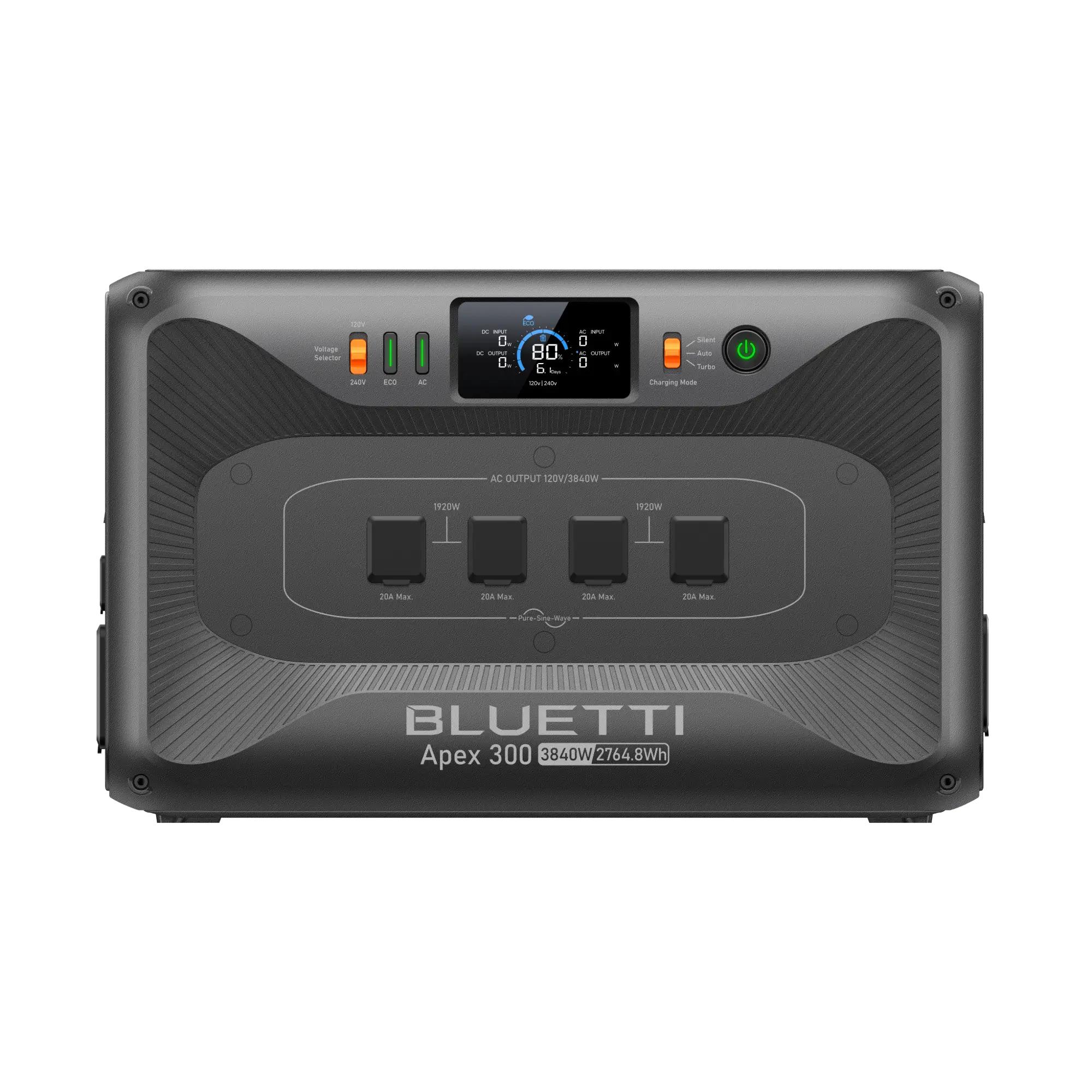
$1,499.00 · direct from BLUETTI
down from $1,699 · 12% below usual
Last checked 1 day ago. Prices move — check before you buy.
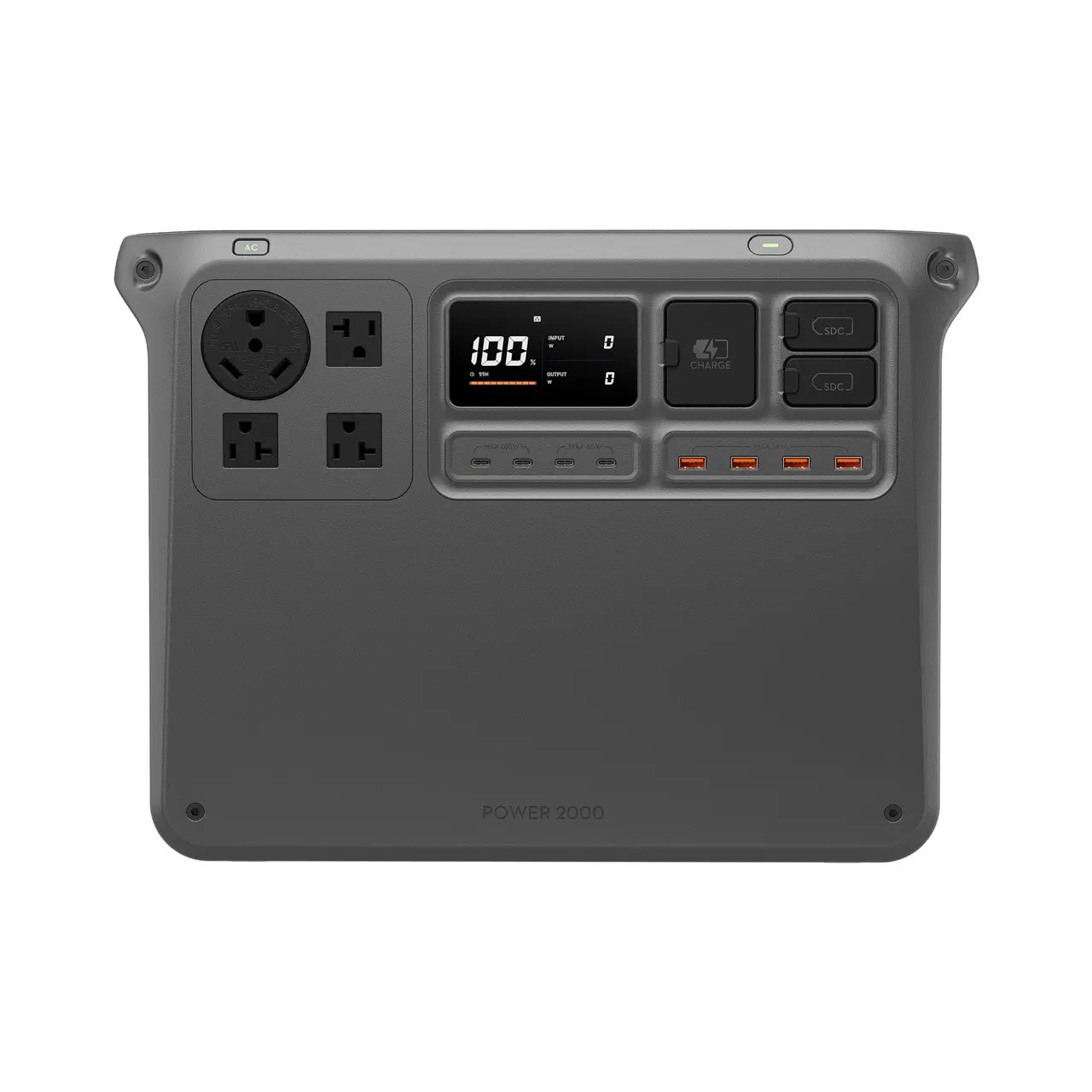
$1,299.00 · direct from DJI
Last checked 1 day ago. Prices move — check before you buy.
Spec deltas
The BLUETTI Apex 300 holds 2,764.8Wh for $1,699; the DJI Power 2000 holds 2,048Wh for $1,299. That's a 716.8Wh gap for $400, and on paper it looks like the DJI is simply the better deal — cheaper per kWh, cheaper per warranty-year, and rated for 500 more charge cycles.
The catch shows up the moment you model an actual weekend camping trip. At 2,100Wh of modeled need, the Power 2000's 2,048Wh capacity can't cover it — it would need more energy than it holds. The Apex 300 finishes the same trip with 11% of its tank still full.
Weight tells the opposite story: the Apex 300 is 83.78 lbs, the Power 2000 just 48.5. If the unit needs to travel light and the trip stays under roughly two days, DJI's the pick. If the trip is the kind that actually needs a full weekend of power, that lighter weight doesn't matter if the battery runs dry.
What the Numbers Reveal
Each conclusion stated first — the numbers behind it on one line, the full analysis below.
Capacity
Per pound, that works out to roughly 33 Wh/lb for the Apex 300 against roughly 42 Wh/lb for the Power 2000 — about a quarter more energy per pound. DJI is doing something with its cell packaging and inverter design that BLUETTI isn't matching here.
Apex 300 weighs 83.78 lbs and holds 2,764.8WhPower 2000 weighs 48.5 lbs and holds 2,048Wh
Why it mattersAnyone carrying this rather than parking it should weight the Power 2000's density advantage heavily, independent of the capacity gap.
The 716.8Wh gap between the two units is exactly the difference between 'made it through the weekend' and 'ran dry partway through day two.'
Weekend Camping needs 2,100Wh: Apex 300 uses 89% of capacity and can complete itPower 2000 needs 121% of its own 2,048Wh capacity for the same trip and cannot complete it
Why it mattersBuyers whose actual use case is overnight-plus camping should not treat the Power 2000's lighter weight as a wash against the Apex 300 — it can't do the job the lighter unit is being bought for.
solar input
Those pull in opposite directions depending on the use case — a CPAP overnight favors the quieter unit, but a multi-day off-grid stretch relying on solar favors the 600W-larger charge ceiling that shortens the wait for a full tank.
Power 2000 runs at 30dB under load against the Apex 300's 45dBApex 300 accepts up to 2,400W of solar against the Power 2000's 1,800W
Why it mattersMatch the pick to what actually happens at 2 a.m. versus what happens at noon on day three of a trip with no wall outlet.
That makes the extra $400 for the Apex 300 a pure capacity purchase, not a value purchase. It's only worth paying if you specifically need the 716.8Wh that closes the Weekend Camping gap.
Power 2000 costs $0.16 per lifetime kWh and $260 per warranty-yearApex 300 costs $0.19 per lifetime kWh and $360 per warranty-year, with 500 fewer rated cycles
Why it mattersBuyers without a real multi-day-trip use case should default to the Power 2000 on price alone; buyers who do have one are paying for headroom, not getting a worse deal.
The specific dimensions that decide these two units — everything else is a tie.
Your Life, Your Pick
Selected because: Power 2000 outright fails Weekend Camping — the sharpest, most concrete decision driver on this page.
The Power 2000 can't complete Weekend Camping on its own — it needs 121% of its 2,048Wh capacity for a trip modeled at 2,100Wh. That's the one scenario on this page with a real, structural winner rather than a matter of degree.
Everywhere else the two are closer: CPAP Overnight and Tailgate Party are ties, and the 8-Hour Blackout and Remote Workday scenarios go to the Apex 300 by a comfortable but not disqualifying margin (70% vs 94%, 39% vs 52%). Van Life Daily beats both units outright — neither is sized for 4,685Wh of daily draw.
Portability & Form Factor
Selected because: 35.3-lb weight gap and 15dB noise gap both favor DJI decisively.
weight
A 35.3-lb weight gap is not a rounding error — the Power 2000 at 48.5 lbs is an easy one-person carry, while the Apex 300 at 83.78 lbs is a braced lift you'd rather do once. If this is traveling with you rather than living in a closet, that alone can decide the purchase.
Noise follows the same direction. The Power 2000 runs at 30dB under load against the Apex 300's 45dB, a 15dB gap that's audible as background hum versus something you notice in a quiet room.
Lifetime Value
Selected because: DJI wins every ownership-cost metric — needs to be stated honestly even though it loses the verdict.
cost / lifetime kWh
The Power 2000 wins here without qualification: $0.16 per lifetime kWh against $0.19, $260 per warranty-year against $360, all while carrying 500 more rated cycles than the Apex 300's 3,500. There's no honest way to call the Apex 300 the better financial buy.
What the Power 2000's cheaper economics don't buy back is the 716.8Wh capacity gap. If Weekend Camping-scale trips are a real part of your use case, you're paying the Apex 300's premium for a job the cheaper unit structurally can't finish.
What the Specs Don't Tell You
Selected because: Weight and noise cards make the portability gap concrete; warranty value clarifies the price story.
rated cycles
Weight and noise both land the same direction here — the Apex 300 is heavier and louder under load, full stop, with no offsetting advantage like a better surge ratio in this particular matchup. Both gotchas exist because BLUETTI is asking for more of the same trade every time: bigger tank, bigger box.
Warranty terms run identical at 5 years on both sides, so the cost-per-warranty-year gap is purely a function of the $400 price difference, not unequal coverage. That's an honest number in the Power 2000's favor, not a hidden catch.
Strengths & trade-offs
BLUETTI Apex 300
Strengths
- +Larger battery capacity
- +Higher AC output
- +Faster solar charging
- +Rated for 6,000 charge cycles — much longer battery lifespan
Trade-offs
- –Substantially more expensive (+$400) than the Power 2000.
- –Significantly heavier (+35.3 lbs), making it harder to move.
- –Very heavy unit that may be difficult for one person to lift.
DJI Power 2000
Strengths
- +Costs $400 less
- +Lighter by 35.3 lb
Trade-offs
- –Weaker inverter (-840W) limits appliance compatibility.
- –Shorter-lived battery — rated for 4,000 charge cycles vs the Apex 300's 6,000, so it wears out sooner.
Will It Power Your Gear?
Scenario math and per-appliance runtimes, modeled from the spec record.
Scenario verdicts
We ran the math on six real-world scenarios. Here's which unit survives your actual life.
SCN-01 · 2 nights · needs 2,100Wh
Weekend Camping
Two nights off-grid with essential comfort
Apex 300
The Power 2000 doesn't finish — 1,741Wh usable against the 2,100Wh this needs leaves it 359Wh short, about 83% of the scenario covered. The Apex 300 covers it with 250Wh to spare.
Battery budget usedlower = more headroom
LOAD Phone Charger 15W×6h · LED Lights 40W×8h · Box Fan 75W×14h · CPAP Machine 40W×16h
SCN-02 · 8 hours · needs 1,645Wh
8-Hour Blackout
Keep the essentials running through a night without power
Apex 300
Both survive the night. The Apex 300 finishes at 70% used with 705Wh left — 43% of a second night. The Power 2000 finishes at 94% with 96Wh, 6% of a second night. If your outages tend to run past one evening, that difference is the whole argument between them.
Battery budget usedlower = more headroom
LOAD Fridge 150W×8h · Router + Modem 20W×8h · LED Lights (4 bulbs) 40W×6h · Phone Charger 15W×3h
SCN-03 · 8 hours · needs 320Wh
CPAP Overnight
Sleep therapy without interruption — the #1 medical use case
Power 2000
A CPAP is about 40W for eight hours, so both of these cover the night several times over — capacity isn't the question here, and the percentages are a formality. What matters is the box next to your pillow, and the only published difference is a rating: the Power 2000 is rated 30dB against the Apex 300's 45dB. Each is the maker's own published rating, and the makers do not measure the same way, some quoting a best case and some a figure under load, so neither number describes a 40W draw and the two are not really comparable. Treat them as a reason to look for hands-on reports before either one goes next to a bed, not as a difference you can count on hearing.
Battery budget usedlower = more headroom
LOAD CPAP Machine 40W×8h
SCN-04 · 8 hours · needs 910Wh
Remote Workday
Full work day off-grid without power anxiety
Apex 300
The Apex 300 clears the workday at 39% used, banking 1,440Wh — late work, extra calls, or a second laptop charge without arithmetic. The Power 2000 at 52% also finishes, with 831Wh of slack for the unplanned.
Battery budget usedlower = more headroom
LOAD Laptop 60W×8h · External Monitor 30W×8h · Router + Modem 20W×8h · Phone Charger 15W×2h
SCN-05 · 4 hours · needs 670Wh
Tailgate Party
Game day power for the crew
Either unit
Both handle game day easily. Since capacity isn't the deciding factor, weight is: at 48.5 lbs the Power 2000 is the one you'll be glad you brought. Fan noise under load is worth a listen too — it's audible in the lulls between songs.
Battery budget usedlower = more headroom
LOAD Blender 400W×0.5h · LED TV (55") 80W×4h · Bluetooth Speaker 15W×4h · Phone Charger (×3) 45W×2h
SCN-06 · 24 hours · needs 4,685Wh
Van Life Daily
A full day of mobile living — the ultimate endurance test
Neither unit
Neither unit covers this scenario's 4,685Wh: the Apex 300 comes up 2,335Wh short (about 50% covered), the Power 2000 2,944Wh (37%). Treat this as partial cover — enough for the essentials in it, not the whole list.
Battery budget usedlower = more headroom
LOAD Mini-Fridge 150W×24h · Laptop 60W×4h · Phone Charger 15W×3h · LED Lights 40W×5h · Fan 75W×8h
The Load Test
RUNTIME = (Wh × 0.85) ÷ LOAD
None of the scenarios above exactly yours? Build it. Toggle what you'd plug in; both units are tested against the combined draw.
Essentials
Comfort & Convenience
High-Draw Appliances
Test duration
8h
Continuous draw
205W
Projected runtime
For this load: Apex 300 runs 11.5h vs 8.5h.
$1,699 list · direct from BLUETTI
Modeled from the spec record — same math as the tables below. Methodology
Runtime by appliance
Real-world runtime estimates for common appliances, modeled at 85% inverter efficiency.¹
Essentials
The basics you need runningscale 0–156.7hComfort & Convenience
Makes off-grid life actually enjoyablescale 0–31.3hHigh-Draw Appliances
These reveal the real limitsscale 0–2.4h¹ Runtime = (capacity × 0.85) ÷ appliance watts. Within each group, all bars share one time scale (the group's longest runtime), so lengths are comparable across appliances; identical runtimes collapse into a single blue/orange bar. Actual runtime varies with battery age, temperature, and simultaneous loads — see methodology.
Conclusion
July 15, 2026
Verdict: the Apex 300, on Power Score margin
Be honest about the numbers first: the DJI Power 2000 is the cheaper unit to own by every computed measure — $0.16 per lifetime kWh against $0.19, $260 a warranty-year against $360, and it does it while weighing 35.3 lbs less. If this were purely an economics-and-portability contest, DJI wins outright. But the Weekend Camping scenario needs 2,100Wh, and the Power 2000's 2,048Wh can't cover it — it would need 121% of its own capacity to make it through. The Apex 300 finishes that same trip using 89% of its tank. A unit that can't complete the job it's being bought for loses to one that can, even at a worse price.
Today the Apex 300 is $1,499, $200 under its typical $1,699. The verdict weighs typical prices, not today's. Prices checked 1 day ago.
Editor-assigned confidence, based on cited owner research and spec analysis.
List prices as of July 15, 2026. The links below open BLUETTI's and DJI's current prices.
$1,499.00 · direct from BLUETTI
down from $1,699 · 12% below usual
Last checked 1 day ago. Prices move — check before you buy.
or check the Power 2000 price$1,299.00 list
Written by Gunner Gustafson, Whole-Home Backup Tester · Station Arena Test Desk · Updated July 15, 2026
Measured Data
Benchmark scores and the full spec record, side by side.
Benchmark scores
Not rated for both units (minimum threshold unmet): CPAP, Tailgating, Apartment Balcony, Camping.
Full specifications
ᵈ Derived: price ÷ rated capacity. See the data behind our comparisons →
Comparison ToolAdd more power stations, side by sideOpen Tool →How these numbers are produced
Numeric verification
Every figure on this page traces to our spec database or arithmetic on it — no estimated numbers.
Owner claims
Statements about owner experience are cited to published reviews — see Sources & Research Notes below.
Runtime model
Runtime = (rated capacity × 0.85 inverter efficiency) ÷ device wattage. Solar recharge estimates assume panels deliver 70% of rated output. Cold weather, battery age, and stacked loads reduce real-world results.
Power Score
Computed from 14 published spec dimensions, weighted per use-case bench. Higher is better; a unit must meet a bench's minimum threshold to be rated.
See the full weight table and data sourcing on our methodology page →Class ranking (the star rating)
Each unit's star score is a category ranking, not customer reviews — no buyer opinions feed it. We score every station on size-independent quality (value, output, portability, endurance, ports, warranty, and more), then percentile-rank it against the other units in its capacity class, so a class-leading compact unit and a class-leading whole-home unit can both earn 5★. Here, Apex 300 rates 5.0/5 (99th percentile of 26 Large-class units), and Power 2000 rates 4.3/5 (56th percentile of 26 Large-class units).
How the class ranking is computed →Test Notes & Caveats
Hidden gotchas and advantages we spotted that you won't find on the product page.
35 Pounds Apart
The Apex 300 weighs 83.78 lbs against the Power 2000's 48.5 lbs. One is an easy one-person carry; the other is a two-hand, watch-your-back lift.
15 Decibels Under Load
The Power 2000 runs at 30dB under load, the Apex 300 at 45dB. Sleeping near either unit, that gap is the difference between background hum and something you notice.
Same Term, Different Yearly Cost
Both carry 5-year warranties, but the price split works out to $360 a year for the Apex 300 against $260 a year for the Power 2000.
Battery Lifespan in Real Years
The Apex 300 is rated for 6,000 cycles vs 4,000. In real life: at daily use, that's 16.4 vs 11 years. At weekend use (twice a week), it's 58 vs 38 years. One caution reading years across different sizes: a cycle is 2,765Wh on the Apex 300 and 2,048Wh on the Power 2000, so count lifetime energy — roughly 16,589 kWh against 8,192 kWh over the rated life. After hitting the cycle limit, the battery doesn't die — it drops to ~80% of original capacity, which is still very usable.
Full record above — the Test Desk pick is the Apex 300.
Check Apex 300 price →or check the Power 2000 priceOwnership Analysis
What happens after you buy — true cost of ownership, brand trust, and growth potential.
Lifetime value
Service lifeyears at one full cycle per day
Lifetime energy delivered
Cost per delivered kWh
│ warranty ends · Reaching the cycle rating means ~80% capacity remains — degraded, not dead.
Analyst note
The Power 2000 is cheaper to buy, but the Apex 300 is cheaper to own. At $0.1/kWh over its lifetime vs $0.16/kWh, the Apex 300's higher cycle life and capacity make each dollar go further over the years.
Brand trust
BLUETTI
Ecosystem
One of the broadest lineups — 15-20+ models from budget (AC2A) to flagship portable (Apex 300, 2764.8Wh). Includes specialized products: vehicle solar hubs, sodium-ion cold-weather units, and balcony storage systems.
Support
The most inconsistent support in the space. Heavily email-based with China timezone delays. Some users get smooth, efficient service; others report weeks of troubleshooting runarounds, being offered discounts on new units instead of repairs, and confusing third-party purchase claim processes. Buying direct from Bluetti's website tends to produce better support outcomes.
Community
Active and growing — Reddit r/bluetti has a dedicated community. Second-largest after EcoFlow in engagement.
App experience
Rated 4.5/5 iOS and Android — tied for best app experience in the category. V3.0 UI redesign was well-received.
Unique strength
Among the best capacity-to-price ratios available — several Elite and Apex units are the lowest $/Wh in the catalog. Widest product diversity including industry-firsts like sodium-ion cold-weather units and dual solar+alternator vehicle hubs. LFP across the rest of the range, though rated cycle life spans 2,500 (EB3A) to 6,000, and it varies WITHIN the Elite range rather than tracking it — the Elite 300 and Elite 200 V2 are rated 6,000 while the Elite 30 V2, Elite 10 Mini, Elite 320 and Elite 400 are rated 3,000+ and the Elite 100 V2 4,000+, so check the specific model. Dual-voltage (120V/240V) in flagships.
Worth knowing
Customer support inconsistency is the #1 risk factor. Older/discontinued units may become unrepairable — no spare parts policy for some models. Some reports of erratic communication from support agents.
DJI
Ecosystem
New entrant (2024) — five power station models to date: Power 500, Power 1000 (since superseded by the V2 but still sold), Power 1000 V2, Power 1000 Mini, Power 2000. Buying a "Power 1000" listing? Check which revision it actually ships.
Support
Leveraging DJI's established global support and repair center network from the drone business. Generally positive reputation inherited from drone operations, but limited power-station-specific track record.
Community
No dedicated power station community yet. Discussions happen within r/dji (~250K members, mostly drone users). Very small power-specific presence on Facebook and forums.
App experience
Rated 3.5/5 iOS and Android (DJI Home app ratings reflect entire DJI ecosystem including drones/cameras, not power-station-specific). Users report the on-device screen is more reliable than the app.
Unique strength
Runs quiet — 23-30dB published on most of the range (manufacturer best-case figures), at the quiet end of the category; our record carries no figure for the Power 1000 V2. Fast wall charging, quickest on the Power 1000 V2 at ~56 min — that figure is the V2's, not the whole line's. 700+ battery patents from drone R&D. SDC ports for ultra-fast DJI drone charging. Premium industrial design and build quality. LFP batteries rated for 4,000+ cycles.
Worth knowing
A recent entrant to power stations, arriving long after the established players, so there is less long-term field data than for EcoFlow, Jackery or BLUETTI — though DJI brings a deep hardware track record from drones. No built-in solar charge controller (requires a separate proprietary adapter). SDC ports are proprietary to the DJI ecosystem, so their fast-charging advantage mostly benefits people who already own DJI gear. Battery expansion is available on the newer Power 2000 and Power 1000 V2, but not on the earlier Power 1000 or Power 500 — check the specific model.
Analyst note
DJI positions itself as a mid-to-premium brand with stronger support infrastructure, while BLUETTI competes on value. The question is whether the DJI ecosystem and support premium is worth it for your use case.
Growth path
Apex 300
EXPANDABLESupports BLUETTI expansion batteries, so you can add capacity later without replacing the base unit — useful if your needs may climb past 2,765Wh.
Accepts up to 2,400W of solar. Enough for a serious multi-panel array.
Generous port selection supports complex multi-device setups.
Expansion batteries are BLUETTI-specific. You're investing in the BLUETTI ecosystem.
Power 2000
EXPANDABLESupports DJI expansion batteries, so you can add capacity later without replacing the base unit — useful if your needs may climb past 2,048Wh.
Accepts up to 1,800W of solar. Enough for a serious multi-panel array.
Generous port selection supports complex multi-device setups.
Expansion batteries are DJI-specific. You're investing in the DJI ecosystem.
Realistic full solar rechargeat 70% of rated panel output — see methodology
Analyst note
Both expand, but the Apex 300's higher solar ceiling (2,400W vs 1,800W) gives it the stronger off-grid growth path — more panels can feed a bigger bank as it grows.
What Owners Report
Patterns from published owner reports and long-term reviews — every claim cited to its source below.
BLUETTI Apex 300
Most of what's known about the Apex 300 comes from press units and BLUETTI's own community forum rather than seasoned owners — this is a recent-2025 launch, so treat the field data as thin. What reviewers do flag consistently is a design tradeoff: no built-in USB or DC ports on the face, requiring a separate $300 Hub D1 accessory to get them backA7A11, and stacking multiple units for parallel output needs a further $699 Hub A1A12.
The app draws a mild but repeated complaint — described as sluggish next to EcoFlow's or Anker's, even though it covers the basics of power-mode toggling and remote monitoringA10. On the hardware side, one reviewer called it heavy enough to be a real handling challenge, unable to lift it onto a table alone despite the built-in handlesA8, while a separate string of community-forum posts describes firmware updates causing mode lockups and error codes shortly after installing themA1A2.
“I was using Bluetti-bt until the latest Bluetti firmware update. I then started having disconnects.”
DJI Power 2000
The Power 2000's review coverage is younger but notably cleaner — no firmware complaints or hardware gripes turned up in the available sources, which is itself worth flagging as much as any praise. Charging speed draws the strongest reaction: reviewers measured a full wall charge in around an hour to 90 minutes, and a full solar charge in about 75 minutes off its 1,800W inputB1.
Noise and build quality are the other two consistent threads. It measured among the quietest units tested at around 29dB even under heavy loadB2, and its eightfold protection system — flame-retardant materials, 26 temperature sensors, 21 fuses, and a chassis rated to a one-ton static load — reads as unusually safety-focused for the categoryB3. DJI's drone-industry pedigree in battery engineering shows up directly here.
“Among the fastest-charging tested — a full wall charge in about 90 minutes (reviewers measured even faster, roughly an hour), and up to 1,800W of solar input for a full solar charge in about 75 minutes.”
Sources
bobvila.com · t3.com · thesolarlab.com · campingsolar.us · protoolreviews.com · greenerideal.com · dronexl.co
Sources & Research Notes
Every owner claim in this report is traceable to a published source. The bracketed references above resolve here.
Recurring owner themes
- Multiple owners report firmware updates causing app glitches, mode-lock issues, error codes, or Bluetooth/Home Assistant disconnects shortly after updating. [Apex 300 · 4 entries]
- Reviewers consistently flag the lack of built-in USB/DC ports as a design tradeoff requiring costly add-on accessories (Hub D1, Hub A1). [Apex 300 · 4 entries]
- The unit's extreme weight (~85 lbs) is repeatedly described as making it barely 'portable' and hard to carry alone. [Apex 300 · 2 entries]
- Standout fast charging (wall and 1800W solar), near-silent operation, and an unusually robust safety-focused build are the consistent praise. [Power 2000 · 3 entries]
- A1
“I updated my Apex 300 to the latest firmware yesterday. Now it's stuck in 'Backup' mode... Now when I go into the app to try to change it back, it flashes to...”
BLUETTI Community forum — 'Apex 300 stuck in Backup mode after last firmware update' · 2025-11 · [negative]
- A2
“When the system reached 97% charge, I decided to install the firmware updates. After the update completed, the charging stopped and I received Error 004.”
BLUETTI Community forum — 'Error E004 Apex 300' · 2025-11 · [negative]
- A7
“Not having DC or USB ports on the face is a tradeoff. The Hub D1 solves the problem—but it's an additional $300 accessory that you then have to bolt on after the fact.”
Techspective — 'Bluetti Apex 300 with B300K Review' · 2025-09 · [negative]
- A8
“In fact, it's so heavy I can hardly carry it more than a few feet at a time and have been unable to lift it onto a table.”
T3 — 'Bluetti Apex 300 review: transform your off-grid life' · 2025-11 · [negative]
- A10
“The Bluetti app is still a little sluggish compared to the EcoFlow or Anker apps, but it lets you toggle power modes, monitor stats, and tweak settings from a distance.”
TheSolarLab — 'Bluetti Apex 300 Review: Cheap, Practical Home Backup?' · unknown · [mixed]
- A11
“That Bluetti D1 Power Hub that gives you your DC and USB ports costs about $300, which is a steep price for what you're getting.”
TheSolarLab — 'Bluetti Apex 300 Review: Cheap, Practical Home Backup?' · unknown · [negative]
- A12
“Say you want to connect multiple Apex 300 power stations together, you'll need to buy the Bluetti Hub A1 Parallel Box, which retails for around $699!”
TheSolarLab — 'Bluetti Apex 300 Review: Cheap, Practical Home Backup?' · unknown · [negative]
- B1
“Among the fastest-charging tested — a full wall charge in about 90 minutes (reviewers measured even faster, roughly an hour), and up to 1,800W of solar input for a full solar charge in about 75 minutes.”
bobvila.com / t3.com — DJI Power 2000 review · 2025-2026 · [positive]
- B2
“One of the quietest power stations tested — only about 29 dB at 5 feet when the fan kicked in, virtually silent, and it stayed among the quietest units even under the heaviest loads.”
bobvila.com / thesolarlab.com — DJI Power 2000 review · 2025-2026 · [positive]
- B3
“Built with an eightfold protection system — flame-retardant materials, a nano-coated BMS, 26 temperature sensors, 21 fuses, and structural reinforcement rated to support a one-ton static load — positioning it as one of the safest, most robust units on the market.”
campingsolar.us / protoolreviews.com — DJI Power 2000 review · 2025-2026 · [positive]
Research compiled July 15, 2026.
What Owners Actually Report
Drawn from 113 comments on independent review channels — not from retailer reviews, which skew to the first week of ownership. Each line is our summary of one commenter's claim, linked to the original. We record what they said, including where it contradicts the spec sheet.
BLUETTI Apex 300
36 claims from 23 comments · 18 from owners · 6 with figures
- Price & value
- 10 · 8% negative
- Solar input
- 6 · 53% negative
- Inverter & surge
- 2 · 0% negative
- Build quality
- 2 · 0% negative
- Runtime
- 2 · 100% negative
What owners complain about
TV, router, Tablo and Firestick drain it from 100% in 7-9 hours; runtime figures are lies.
Runtimemeasuredownersource →
Dropping to a 60V PV max is a deal killer versus the 150V per string they run on the AC300.
Solar inputowner1 agreedsource →
App is portrait-only.
App & firmwareownersource →
What owners praise
Two paralleled units give 7,680W and run dryer, 2-ton AC or oven plus fridges and sump pump.
Inverter & surgemeasuredowner5 agreedsource →
$2,600 for two units plus $659 for the Hub A1 was worth the extra over the Anker.
Price & valuemeasuredowner5 agreedsource →
Three Apex 300s with a Hub A1 give him 18kW solar input and 12kW output.
Solar inputmeasuredownerafter 1 months10 agreedsource →
DJI Power 2000
143 claims from 90 comments · 58 from owners · 5 with figures
- App & firmware
- 24 · 42% negative
- Other
- 21 · 36% negative
- Build quality
- 25 · 72% negative
- Durability
- 11 · 100% negative
- Warranty & support
- 8 · 34% negative
What owners complain about
With the expansion battery he only gets 2800Wh on DC.
Runtimemeasuredownersource →
DJI told him all Power 2000 units have an EMI issue with no fix; his Mac Mini coil-whined.
Build qualityowner5 agreedsource →
3600W surge is not bad but lower than some comparable units.
Inverter & surgemeasuredownersource →
What owners praise
Claims are weighted by how specific they are, whether the commenter owns the unit, and how many readers agreed. Comments that mention a product under a rival's review count for more, because the commenter had no reason to be there. This is what buyers report, not our test results — for measurements we ran ourselves, see the methodology.
Who Should Buy Which
Buy the Apex 300 if you…
- →Your trips actually run to a full weekend or longer away from an outlet — the Apex 300 is the only one of the two that finishes that scenario without running dry.
- →You're relying on solar to refill mid-trip and want the higher 2,400W ceiling to shorten the wait.
Buy the Power 2000 if you…
- →You want the cheapest unit to own by every metric — lower price, lower cost per kWh, lower cost per warranty-year — and your trips stay under roughly two days of draw.
- →Portability and quiet operation matter more than raw capacity; 48.5 lbs and 30dB under load are hard for the Apex 300 to match.
If neither fits
Van Life Daily needs 4,685Wh and both units fall well short — the Apex 300 hits 199% of what's required and the Power 2000 hits 269%. Anyone living off-grid full time should look at larger expandable systems, not choose between these two base units.
The Bottom Line
The DJI Power 2000 is lighter, quieter, and cheaper to own by every metric this page computes — there's no honest way to call the Apex 300 the better financial buy. But the Power 2000's 2,048Wh capacity structurally can't cover a modeled weekend camping trip, while the Apex 300's 2,764.8Wh finishes the same trip with capacity to spare.
If your trips stay short and price is the deciding factor, take the Power 2000 and keep the $400. If a full weekend off-grid is a real, recurring use case, the Apex 300's extra capacity is the difference between finishing the trip and not.
Frequently Asked Questions
Answers drawn from the spec record and cited owner research.
Can the DJI Power 2000 handle a full weekend of camping?
Not from a single charge. The scenario models 2,100Wh of need, and the Power 2000's 2,048Wh capacity falls short — it would need 121% of its own tank. The Apex 300, with 2,764.8Wh, covers the same trip using 89% of its capacity.
Which one is cheaper to own long-term?
The DJI Power 2000, on every computed metric: $0.16 per lifetime kWh against the Apex 300's $0.19, and $260 per warranty-year against $360. It also carries 500 more rated cycles despite the smaller pack, so the cost advantage isn't offset by a shorter lifespan.
How much heavier is the Apex 300?
35.3 lbs heavier — 83.78 lbs against the Power 2000's 48.5 lbs — for 716.8Wh more capacity. Worked per pound, the Power 2000 delivers roughly a quarter more energy density.
Which is quieter, and does it matter for CPAP use?
The Power 2000, at 30dB under load against the Apex 300's 45dB. Both comfortably cover a CPAP Overnight scenario on capacity alone (14-18% of tank used), so the Power 2000's quieter running is the deciding factor for anyone sleeping near the unit.
Is the Apex 300 worth $400 more than the Power 2000?
Only if you need the extra 716.8Wh. Every ownership-cost metric favors the Power 2000, and the Apex 300's one structural win is completing the Weekend Camping scenario the Power 2000 can't. Without that specific use case, the cheaper unit is also the better deal.
Brand matchup
BLUETTI vs DJI: measured across every matchup →Where to buy
BLUETTI Apex 300Pick
$1,499.00
$1,499.00 · direct from BLUETTI
down from $1,699 · 12% below usual
Last checked 1 day ago. Prices move — check before you buy.
DJI Power 2000
$1,299.00
$1,299.00 · direct from DJI
Last checked 1 day ago. Prices move — check before you buy.
Prices may vary by retailer and are subject to change.