Head-to-head test
BLUETTI Apex 300 + B500K vs Goal Zero Yeti 6000X
The Apex 300 + B500K costs $701 less than the 6000X, holds more energy, and is rated for seven times the cycle life — the 6000X answers with 77 fewer pounds and a single-box design.
Full profiles: BLUETTI Apex 300 + B500K → · Goal Zero Yeti 6000X →

Written by Gunner GustafsonUpdated
Whole-Home Backup Tester, Station Arena Test Desk
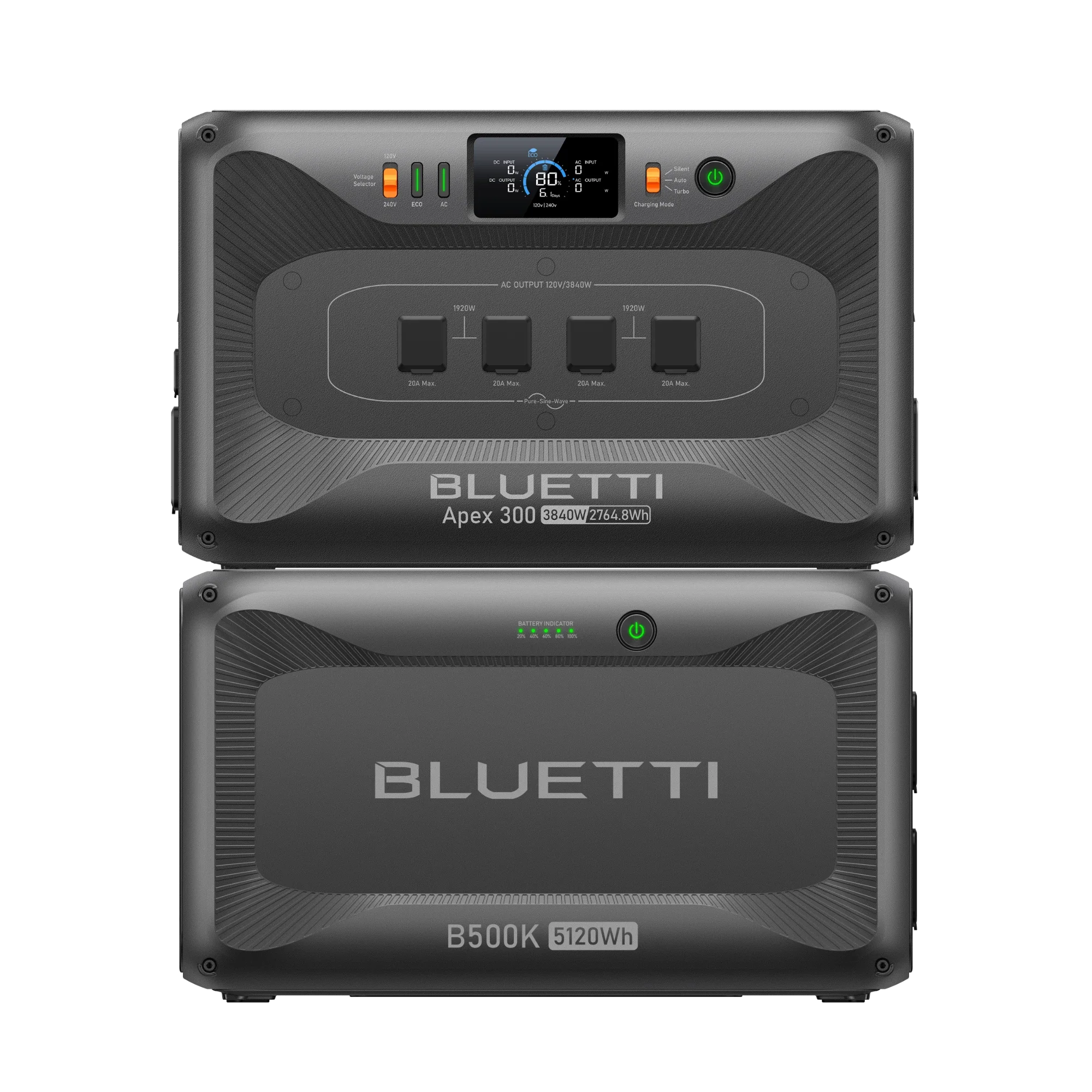
$3,299.00 · direct from BLUETTI
Last checked 1 day ago. Prices move — check before you buy.
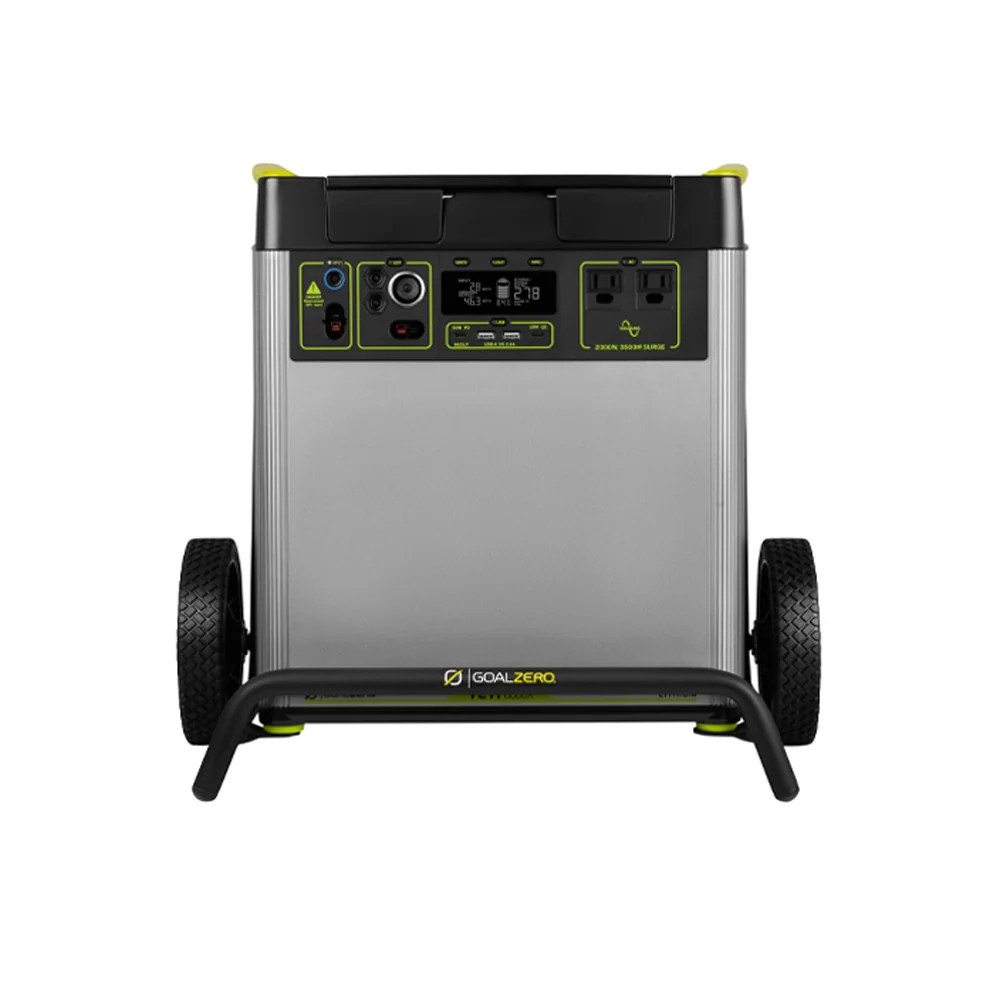
$3,999.95 · direct from Goal Zero
Last checked 1 day ago. Prices move — check before you buy.
Spec deltas
The BLUETTI Apex 300 + B500K costs $3,299, which is $701 less than the Goal Zero Yeti 6000X's $4,000 — and for the lower price you get more, not less: 7,884.8Wh against the 6000X's 6,071, and 3,840W of output against 2,000. That's the whole shape of this comparison before you even get to the battery.
The battery is where it gets lopsided. BLUETTI's B500K expansion runs LiFePO4 cells rated for 3,500 cycles; the 6000X's NMC cells are rated for 500B1. That difference is why the lifetime math comes out to $0.12 per kilowatt-hour for the Apex 300 + B500K against $1.32 for the 6000X — spend $701 less and pay roughly a tenth as much per kilowatt-hour used over the unit's life.
The 6000X's reply is weight and simplicity: 106 lbs in one box, against 183 lbs across the Apex 300 base and its B500K expansion battery. That's real if you want the smallest thing you can lift alone. It doesn't touch the price, capacity, or cycle-life gap.
What the Numbers Reveal
Each conclusion stated first — the numbers behind it on one line, the full analysis below.
rated cycles
Stack all three and the 6000X isn't just the pricier option — it's the pricier option with less capacity and a battery rated to wear out far sooner. There's no axis on this trio where paying $701 more buys anything back.
the Apex 300 + B500K costs $3,299 versus the 6000X's $4,000the Apex 300 + B500K holds 7,884.8Wh versus the 6000X's 6,071Whthe Apex 300 + B500K is rated for 3,500 cycles versus the 6000X's 500
Why it mattersA buyer picking by price alone would already choose correctly here; the harder mistake would be assuming the pricier unit is the safer or longer-lived one.
weight
At 106 lbs the 6000X already isn't something one person carries farB2 — it's a wheeled semi-stationary hub, same as the 183-lb Apex 300 + B500K will be. Weight is the 6000X's one real edge, but it's an edge measured against another unit that also needs help moving, not against something genuinely portable.
the Apex 300 + B500K weighs 183 lbs versus the 6000X's 106 lbsthe 6000X ships with a roll cart because it's built as a semi-stationary hubB2the Apex 300 + B500K publishes a 45dB noise figure while the 6000X publishes none
Why it mattersBuyers picking the 6000X for portability should confirm they actually need a cart-free unit — because the 6000X isn't one either.
BLUETTI's firmware bugs are real but reportedly fixable — one owner's issue resolved after a further updateA8 — while the 6000X's capacity loss is a hardware fact baked into the cell chemistry that no update reversesB4.
field data on this exact Apex 300 + B500K configuration is thin — most published accounts describe the bare Apex 300 or a different expansion pairingsome Apex 300 owners report firmware updates that locked the unit into Backup mode or triggered inverter error codesA7A9the 6000X's NMC cells degrade on a fixed 500-cycle schedule regardless of firmwareB4
Why it mattersA risk-averse buyer should weigh a software problem BLUETTI has a track record of patching against a hardware limit Goal Zero cannot patch away.
The specific dimensions that decide these two units — everything else is a tie.
Lifetime Value
Selected because: An 11x gap in cost per lifetime kWh, on top of an $701 lower price, anchors the verdict.
cost / lifetime kWh
$0.12 per lifetime kWh against $1.32 is an eleven-times gap, and it's layered on top of an $701 lower sticker price. The Apex 300 + B500K also costs $640 per warranty year against the 6000X's $2,000 — nearly a third of the yearly cost, on a warranty that's already two and a half years longer.
There's no scenario in this data where the 6000X is the cheaper unit to actually own. Its higher upfront price and shorter-lived battery both push the same direction, and they push hard.
What the Specs Don't Tell You
Selected because: Weight, noise disclosure, warranty, and cycle life all fire and split unevenly.
rated cycles
The Apex 300 + B500K leads on warranty (5 years to 2), cycle life (3,500 to 500), and noise transparency — it publishes 45dB under load where the 6000X publishes nothing. Its 10ms switchover also beats the 6000X's 25ms, the difference between line-interactive and basic-standby UPS behavior.
The 6000X's one clean win in this section is weight, at 106 lbs to 183. Everywhere else the gotcha list runs one direction, which is unusual for a matchup this close in headline price.
Growth Path
Selected because: Both expand; the Apex 300's solar ceiling gives it the stronger off-grid growth story.
solar input
Both units expand — BLUETTI's B500K is already the expansion battery here, and the platform supports more; the 6000X takes Goal Zero's own expansion line. The difference is solar: 2,400W of input for the Apex 300 against the 6000X's 600W.
A 6000X owner adding capacity is still capped at the same slow 600W refill no matter how many batteries get added. The Apex 300 + B500K's higher ceiling means a bigger future system also charges faster, not just holds more.
Brand Trust
Selected because: BLUETTI's value pitch against Goal Zero's declining premium-support reputation.
BLUETTI's pitch is the best capacity-to-price ratio in the category and a well-rated app, and the numbers on this page back that up. Its real weakness is support — inconsistent, heavily email-based, with reports ranging from smooth to weeks-long runarounds.
Goal Zero's pitch is US-based support and brand heritage, but recent reports describe long wait times and unresponsive tickets — the premium-support argument that used to justify its higher prices is weakening. Between two brands with support question marks, BLUETTI at least pairs its uncertainty with a dramatically lower price and running cost.
Strengths & trade-offs
BLUETTI Apex 300 + B500K
Strengths
- +Costs $700.9 less
- +Larger battery capacity
- +Higher AC output
- +Longer warranty
- +Faster solar charging
- +Rated for 6,000 charge cycles — much longer battery lifespan
Trade-offs
- –Significantly heavier (+77 lbs), making it harder to move.
- –Very heavy unit that may be difficult for one person to lift.
Goal Zero Yeti 6000X
Strengths
- +Lighter by 77 lb
Trade-offs
- –Weaker inverter (-1,840W) limits appliance compatibility.
- –Very heavy unit that may be difficult for one person to lift.
- –Shorter-lived battery — rated for 500 charge cycles vs the Apex 300 + B500K's 6,000, so it wears out sooner.
Will It Power Your Gear?
Scenario math and per-appliance runtimes, modeled from the spec record.
Scenario verdicts
We ran the math on six real-world scenarios. Here's which unit survives your actual life.
SCN-01 · 2 nights · needs 2,100Wh
Weekend Camping
Two nights off-grid with essential comfort
Neither unit
Scoring these two at a campsite is a category error: neither travels — the Apex 300 + B500K is 183 lbs and the Yeti 6000X 106 lbs, and at those weights they roll off a truck bed if they go anywhere at all. The 2,100Wh here is trivial for either — it's the going that doesn't happen. If you need power away from the building, you're shopping the wrong class.
Battery budget usedlower = more headroom
LOAD Phone Charger 15W×6h · LED Lights 40W×8h · Box Fan 75W×14h · CPAP Machine 40W×16h
SCN-02 · 8 hours · needs 1,645Wh
8-Hour Blackout
Keep the essentials running through a night without power
Either unit
Both survive the blackout with similar margin, so the tiebreaker is UPS behaviour — only the Apex 300 + B500K lists a UPS mode, which hands a router or PC to battery the moment the grid drops instead of after your reaction time.
Battery budget usedlower = more headroom
LOAD Fridge 150W×8h · Router + Modem 20W×8h · LED Lights (4 bulbs) 40W×6h · Phone Charger 15W×3h
SCN-03 · 8 hours · needs 320Wh
CPAP Overnight
Sleep therapy without interruption — the #1 medical use case
Either unit
A CPAP is about 40W for eight hours, so both cover the night with room to spare and capacity decides nothing. Fan noise would — but Yeti 6000X doesn't publish a figure, so there's nothing to hold it to. Buy on price, weight, and whether you can live with a fan you haven't heard.
Battery budget usedlower = more headroom
LOAD CPAP Machine 40W×8h
SCN-04 · 8 hours · needs 910Wh
Remote Workday
Full work day off-grid without power anxiety
Either unit
Both power your workstation all day without strain. At these utilization levels the real difference is USB-C for direct laptop charging — 100W on the Apex 300 + B500K against 60W — which beats the inverter for convenience and wastes less energy.
Battery budget usedlower = more headroom
LOAD Laptop 60W×8h · External Monitor 30W×8h · Router + Modem 20W×8h · Phone Charger 15W×2h
SCN-05 · 4 hours · needs 670Wh
Tailgate Party
Game day power for the crew
Neither unit
Scoring these two at a tailgate is a category error: neither travels — the Apex 300 + B500K is 183 lbs and the Yeti 6000X 106 lbs, and at those weights they roll off a truck bed if they go anywhere at all. The 670Wh here is trivial for either — it's the going that doesn't happen. If you need power away from the building, you're shopping the wrong class.
Battery budget usedlower = more headroom
LOAD Blender 400W×0.5h · LED TV (55") 80W×4h · Bluetooth Speaker 15W×4h · Phone Charger (×3) 45W×2h
SCN-06 · 24 hours · needs 4,685Wh
Van Life Daily
A full day of mobile living — the ultimate endurance test
Apex 300 + B500K
The Yeti 6000X uses 91% of its battery on a full day, leaving 475Wh — miss a solar day and that is the entire cushion. The Apex 300 + B500K at 70% keeps 2,017Wh in hand, a far more forgiving rhythm for full-time living.
Battery budget usedlower = more headroom
LOAD Mini-Fridge 150W×24h · Laptop 60W×4h · Phone Charger 15W×3h · LED Lights 40W×5h · Fan 75W×8h
The Load Test
RUNTIME = (Wh × 0.85) ÷ LOAD
None of the scenarios above exactly yours? Build it. Toggle what you'd plug in; both units are tested against the combined draw.
Essentials
Comfort & Convenience
High-Draw Appliances
Test duration
8h
Continuous draw
205W
Projected runtime
For this load: Apex 300 + B500K runs 32.7h vs 25.2h.
$3,299 list · direct from BLUETTI
Modeled from the spec record — same math as the tables below. Methodology
Runtime by appliance
Real-world runtime estimates for common appliances, modeled at 85% inverter efficiency.¹
Essentials
The basics you need runningscale 0–446.8hComfort & Convenience
Makes off-grid life actually enjoyablescale 0–89.4hHigh-Draw Appliances
These reveal the real limitsscale 0–6.7h¹ Runtime = (capacity × 0.85) ÷ appliance watts. Within each group, all bars share one time scale (the group's longest runtime), so lengths are comparable across appliances; identical runtimes collapse into a single blue/orange bar. Actual runtime varies with battery age, temperature, and simultaneous loads — see methodology.
Conclusion
July 14, 2026
Verdict: the Apex 300 + B500K
The BLUETTI Apex 300 + B500K is the stronger buy. At $3,299 it's $701 cheaper than the Yeti 6000X's $4,000, while holding 1,814Wh more capacity, outputting 1,840W more, and running LiFePO4 cells rated for 3,500 cycles against the 6000X's 500 — a gap that turns a $0.66-per-Wh sticker price into an $0.12-per-lifetime-kWh running cost versus the 6000X's $1.32. It also publishes a 45dB noise figure the Yeti doesn't disclose at all. The honest catch: this exact B500K pairing is new enough that field data is thin and mostly unverified for this configuration, and at 183 lbs it's 77 pounds heavier than the 6000X's 106. If a lighter single box matters more to you than price, capacity, and running cost combined, the 6000X has an argument. For most buyers, the Apex 300 + B500K wins clearly.
Editor-assigned confidence, based on cited owner research and spec analysis.
List prices as of July 14, 2026. The links below open BLUETTI's and Goal Zero's current prices.
$3,299.00 · direct from BLUETTI
Last checked 1 day ago. Prices move — check before you buy.
or check the Yeti 6000X price$3,999.95 list
Written by Gunner Gustafson, Whole-Home Backup Tester · Station Arena Test Desk · Updated July 14, 2026
Measured Data
Benchmark scores and the full spec record, side by side.
Benchmark scores
Not rated for both units (minimum threshold unmet): Solar Generator.
Full specifications
ᵈ Derived: price ÷ rated capacity. See the data behind our comparisons →
Comparison ToolAdd more power stations, side by sideOpen Tool →How these numbers are produced
Numeric verification
Every figure on this page traces to our spec database or arithmetic on it — no estimated numbers.
Owner claims
Statements about owner experience are cited to published reviews — see Sources & Research Notes below.
Runtime model
Runtime = (rated capacity × 0.85 inverter efficiency) ÷ device wattage. Solar recharge estimates assume panels deliver 70% of rated output. Cold weather, battery age, and stacked loads reduce real-world results.
Power Score
Computed from 14 published spec dimensions, weighted per use-case bench. Higher is better; a unit must meet a bench's minimum threshold to be rated.
See the full weight table and data sourcing on our methodology page →Class ranking (the star rating)
Each unit's star score is a category ranking, not customer reviews — no buyer opinions feed it. We score every station on size-independent quality (value, output, portability, endurance, ports, warranty, and more), then percentile-rank it against the other units in its capacity class, so a class-leading compact unit and a class-leading whole-home unit can both earn 5★. Here, Apex 300 + B500K rates 3.5/5 (11th percentile of 29 Whole-Home / Off-Grid-class units), and Yeti 6000X rates 3.3/5 (1st percentile of 16 Home Backup-class units).
How the class ranking is computed →Test Notes & Caveats
Hidden gotchas and advantages we spotted that you won't find on the product page.
183 lbs versus 106 — both need help moving
The Apex 300 + B500K is 77 lbs heavier than the 6000X, but the 6000X is already heavy enough to ship with its own roll cart. Neither is a solo carry; the real question is which weight you'd rather load into a vehicle.
45dB under load, published
BLUETTI lists 45dB for the Apex 300 + B500K under load. The Yeti 6000X publishes no noise figure at all, which matters if either unit will run near a bedroom, office, or CPAP overnight.
Only the Apex 300 + B500K Lists a UPS Mode
The Apex 300 + B500K can sit between the wall and your gear and hand it to battery when the grid drops — rated ≤10ms — quick enough on paper that desktop PCs and routers should ride through, treating that as the rating it is. Worth it for a router, a desktop PC, or a CPAP. The Yeti 6000X's spec sheet lists no UPS mode, so anything plugged into it rides an outage only as far as your reaction time.
5 years versus 2
The Apex 300 + B500K's warranty runs two and a half times longer than the 6000X's, and at a lower price it also costs $640 per warranty year against $2,000 for the 6000X. That's a wide gap on a purchase this size.
3,500 cycles versus 500
BLUETTI's LiFePO4 pairing is rated for seven times the charge cycles of the 6000X's NMC battery. That single spec is most of the reason the lifetime cost-per-kWh math favors the Apex 300 + B500K so heavily.
Goal Zero doesn't publish a noise number
The 6000X's spec sheet has no decibel rating anywhere, while BLUETTI lists 45dB for the Apex 300 + B500K. On a $4,000 purchase that might sit next to a bed or desk, buying with the number in writing is worth something on its own.
Full record above — the Test Desk pick is the Apex 300 + B500K.
Check Apex 300 + B500K price →or check the Yeti 6000X priceOwnership Analysis
What happens after you buy — true cost of ownership, brand trust, and growth potential.
Lifetime value
Service lifeyears at one full cycle per day
Lifetime energy delivered
Cost per delivered kWh
│ warranty ends · Reaching the cycle rating means ~80% capacity remains — degraded, not dead.
Analyst note
The Apex 300 + B500K wins on both sticker price and long-term value. At $0.07/kWh over its lifetime, it's meaningfully cheaper to own. Clear value winner.
Delivers each lifetime kWh for $1.25 less — check the Apex 300 + B500K price →
Brand trust
BLUETTI
Ecosystem
One of the broadest lineups — 15-20+ models from budget (AC2A) to flagship portable (Apex 300, 2764.8Wh). Includes specialized products: vehicle solar hubs, sodium-ion cold-weather units, and balcony storage systems.
Support
The most inconsistent support in the space. Heavily email-based with China timezone delays. Some users get smooth, efficient service; others report weeks of troubleshooting runarounds, being offered discounts on new units instead of repairs, and confusing third-party purchase claim processes. Buying direct from Bluetti's website tends to produce better support outcomes.
Community
Active and growing — Reddit r/bluetti has a dedicated community. Second-largest after EcoFlow in engagement.
App experience
Rated 4.5/5 iOS and Android — tied for best app experience in the category. V3.0 UI redesign was well-received.
Unique strength
Among the best capacity-to-price ratios available — several Elite and Apex units are the lowest $/Wh in the catalog. Widest product diversity including industry-firsts like sodium-ion cold-weather units and dual solar+alternator vehicle hubs. LFP across the rest of the range, though rated cycle life spans 2,500 (EB3A) to 6,000, and it varies WITHIN the Elite range rather than tracking it — the Elite 300 and Elite 200 V2 are rated 6,000 while the Elite 30 V2, Elite 10 Mini, Elite 320 and Elite 400 are rated 3,000+ and the Elite 100 V2 4,000+, so check the specific model. Dual-voltage (120V/240V) in flagships.
Worth knowing
Customer support inconsistency is the #1 risk factor. Older/discontinued units may become unrepairable — no spare parts policy for some models. Some reports of erratic communication from support agents.
Goal Zero
Ecosystem
Focused — a compact current line (6th-gen Yeti and Yeti Pro series), the previous-gen X series now out of stock across every model on Goal Zero's own store (checked 2026-09-13: 200X, 500X, 1000X, 1500X, 3000X, 6000X, some listed only as open-box), so buying one new means finding retailer stock, Sherpa power banks for the under-100Wh tier, plus Alta coolers, Nomad/Ranger solar panels, and vehicle integration kits
Support
US-based company (Salt Lake City, owned by NRG Energy). Historically considered premium support, but 2025-2026 reports describe long wait times, unresponsive email communication, and tickets going unaddressed for weeks. The "premium support justifies premium pricing" argument is weakening.
Community
Small but loyal — strong following in overlanding and preparedness communities. Official community forums were recently shuttered, frustrating long-time users.
App experience
Rated 4.4/5 iOS (~1,200 ratings) but recent reviews skew negative — recurring connectivity issues, crashes, and stability problems.
Unique strength
Pioneer of the portable power market — strongest brand heritage. US-based company with ruggedized, weather-resistant designs (IP ratings vary by model). Integrated "Yeti-Ready" ecosystem with coolers, lights, and vehicle kits.
Worth knowing
Typically the priciest brand per watt-hour — though individual pairings vary, and on some pages the Yeti is the cheaper energy. Support quality has declined from its "premium" standard. Perceived as competitively stagnant vs. faster-innovating Chinese competitors. Reliability reports on newer models are concerning.
Analyst note
BLUETTI's case is the best capacity-to-price ratio in the category, a well-rated app, and full LFP standardization across its lineup — the tradeoff is inconsistent, heavily email-based support with delays some owners describe as weeks long. Goal Zero's case is US-based support and brand heritage, but recent reports describe long wait times and unresponsive tickets, and it's widely acknowledged as the most expensive brand per watt-hour in the category. Neither brand's support is bulletproof right now, but BLUETTI pairs its uncertainty with a dramatically better price and running cost, which is the more defensible tradeoff on a purchase this size.
Growth path
Apex 300 + B500K
EXPANDABLESupports BLUETTI expansion batteries, so you can add capacity later without replacing the base unit — useful if your needs may climb past 7,885Wh.
Accepts up to 2,400W of solar. Enough for a serious multi-panel array.
Generous port selection supports complex multi-device setups.
Expansion batteries are BLUETTI-specific. You're investing in the BLUETTI ecosystem.
Yeti 6000X
EXPANDABLESupports Goal Zero expansion batteries, so you can add capacity later without replacing the base unit — useful if your needs may climb past 6,071Wh.
Accepts up to 600W of solar. Suitable for a 1-2 panel setup.
Adequate ports for most setups, but heavy users may want a power strip.
Expansion batteries are Goal Zero-specific. You're investing in the Goal Zero ecosystem.
Realistic full solar rechargeat 70% of rated panel output — see methodology
Analyst note
Both expand, but the Apex 300 + B500K's higher solar ceiling (2,400W vs 600W) gives it the stronger off-grid growth path — more panels can feed a bigger bank as it grows.
What Owners Report
Patterns from published owner reports and long-term reviews — every claim cited to its source below.
BLUETTI Apex 300 + B500K
Field data for this exact Apex 300 + B500K pairing is thin — most of what's out there describes the bare Apex 300 or a B300K combo, so treat the specifics loosely. What does carry over: reviewers consistently describe the fan noise as tame for the output class, even under loadA1A2A13.
The rougher edges are firmware-related. Owners report updates that locked units into Backup mode or triggered inverter error codes, though threads show these getting resolved after further updates or support contactA7A8A9. Multiple sources also flag the weight as a two-person job and note the lack of built-in USB/DC ports without the separate hub accessoryA11A12.
“Turns out the Apex 300's noise control is on par with the quietest power stations on the market, like those on offer from EcoFlow and DJI.”
Goal Zero Yeti 6000X
The 6000X's defining trait is its battery: lithium NMC cells rated for only 500 cycles, low next to competing LFP designsB1. At 106 lbs it's a semi-stationary hub that ships with a roll cart rather than something you carryB2.
Its 2,000W inverter peaks to 3,500W and takes about 12 hours for a full recharge on the included 600W chargerB3. By the time it's used up its rated cycles, reviewers note the battery is giving back meaningfully less than its rated 6,071WhB4 — a structural cost of the older cell chemistry, not a defect.
“Weighs about 106 lbs — not portable for most people; designed as a semi-stationary power hub, and comes with a roll cart.”
Sources
poweredportablesolar.com · bestgeneratorsolar.com · shopsolarkits.com · bhphotovideo.com · poweraic.com
Sources & Research Notes
Every owner claim in this report is traceable to a published source. The bracketed references above resolve here.
Recurring owner themes
- Multiple independent reviewers describe the dual-fan cooling as noticeably quiet/even for a unit of this output class, even under load. [Apex 300 + B500K · 3 entries]
- Firmware and app updates have repeatedly caused mode-lock, download failures, or inverter error codes; several threads show the issue eventually resolved after further updates or support contact. [Apex 300 + B500K · 4 entries]
- When running multiple Apex 300 units or expansion batteries in parallel, owners report uneven charge rates between units, with community-devised (unofficial) workarounds needed to keep them in sync. [Apex 300 + B500K · 2 entries]
- The stripped-down, modular design draws criticism for real-world handling: extreme weight makes it hard to move, and lack of native USB/DC ports forces reliance on a separate paid hub accessory. [Apex 300 + B500K · 2 entries]
- Large NMC capacity but a crippling 500-cycle rating, very heavy (~106 lbs), and slow charging are the recurring points. [Yeti 6000X · 3 entries]
- A1
“Turns out the Apex 300's noise control is on par with the quietest power stations on the market, like those on offer from EcoFlow and DJI.”
The Solar Lab — "Bluetti Apex 300 Review: Cheap, Practical Home Backup?" · unknown · [positive]
- A2
“Some units sound like small jet engines under load, but the Apex 300's fans are relatively tame.”
Techspective — "Bluetti Apex 300 with B300K Review" · 2025-09 · [positive]
- A7
“I updated my Apex 300 to the latest firmware yesterday. Now it's stuck in 'Backup' mode... when I go into the app to try to change it back, it flashes to...”
BLUETTI Community — "Apex 300 stuck in Backup mode after last firmware update" · 2025-11 · [negative]
- A8
“There was an update on my Apex 300 a few days ago IOT v8026.12... Problem is every time I connect to the power st[ation]... Edit - This seems fixed now hooray!”
BLUETTI Community — "Check For Update App issue" · 2025-09 · [mixed]
- A9
“After the update completed, the charging stopped and I received Error 004... I have error E004 Inverter Output Failure.”
BLUETTI Community — "Error E004 Apex 300" · 2025-11 · [negative]
- A11
“it's so heavy I can hardly carry it more than a few feet at a time and have been unable to lift it onto a table.”
T3 — "Bluetti Apex 300 review: transform your off-grid life" · 2025-11 · [negative]
- A12
“The Apex 300 doesn't have USB ports, DC ports, or much of anything beyond its six AC plugs and high-voltage connectors.”
The Solar Lab — "Bluetti Apex 300 Review: Cheap, Practical Home Backup?" · unknown · [negative]
- A13
“Fan noise remains even, with no distracting pitch or rattle. This makes the Apex 300 usable near sleeping areas or indoor workspaces without disturbance.”
Yanko Design — "BLUETTI Apex 300 Review" · 2025-05 · [positive]
- B1
“Uses lithium NMC cells with a 6,071Wh capacity but a cycle life of only 500 cycles to 80% — not high compared to competing LFP models.”
poweredportablesolar.com / bestgeneratorsolar.com — Yeti 6000X review · 2026 · [negative]
- B2
“Weighs about 106 lbs — not portable for most people; designed as a semi-stationary power hub, and comes with a roll cart.”
shopsolarkits.com / bhphotovideo.com — Yeti 6000X review · 2026 · [mixed]
- B3
“A 2,000W pure sine inverter peaking to 3,500W, fully rechargeable in 12 hours with the included 600W AC charger.”
bestgeneratorsolar.com / poweraic.com — Yeti 6000X review · 2026 · [mixed]
- B4
“After 500 cycles capacity drops to ~80%, so the 6,071Wh battery effectively becomes ~4,857Wh — a structural NMC disadvantage vs LFP.”
poweredportablesolar.com — Yeti 6000X review · 2026 · [negative]
Research compiled July 14, 2026.
Who Should Buy Which
Buy the Apex 300 + B500K if you…
- →You want the lower price, more capacity, and a battery rated for seven times the cycle life.
- →You need the transparent 45dB noise figure for a garage, utility room, or shared living space.
- →You're comfortable with a newer product whose exact expansion pairing has limited long-term field reports.
Buy the Yeti 6000X if you…
- →You want the single lightest box at this rough capacity tier, even though it still needs a cart.
- →You're already invested in Goal Zero's ecosystem and value that continuity over price.
- →You don't plan to cycle the unit often, so the 500-cycle rating matters less to you.
If neither fits
Buyers who need true one-person portability should look outside both of these — a 106-to-183-lb unit, cart or no cart, is a garage or vehicle fixture, not something carried to a site solo.
The Bottom Line
The Apex 300 + B500K is the clear buy: $701 cheaper, more capacity, more output, a published noise figure, and a battery rated for seven times the cycle life of the 6000X's, which is most of why it costs roughly a tenth as much per lifetime kilowatt-hour.
The 6000X's case is narrow — 77 fewer pounds in a single box, for a buyer already committed to Goal Zero and unlikely to cycle the unit hard. Everyone else should take the savings and the longer-lived battery.
Frequently Asked Questions
Answers drawn from the spec record and cited owner research.
BLUETTI Apex 300 + B500K vs Goal Zero Yeti 6000X — which should I buy?
The Apex 300 + B500K for most buyers: it's $701 cheaper, holds 1,814Wh more, and is rated for 3,500 cycles against the 6000X's 500, which is most of why its lifetime cost per kWh comes out to $0.12 against $1.32. Choose the 6000X only if being 77 lbs lighter, at 106 lbs versus 183, outweighs the price and longevity gap for you.
Why is the Apex 300 + B500K so much cheaper to own long-term?
Cell chemistry. It runs LiFePO4 rated for 3,500 cycles, while the 6000X runs NMC rated for 500. That sevenfold cycle-life gap, combined with an $701 lower sticker price, is why the lifetime cost per kWh works out to roughly a tenth of the 6000X's.
Is the 6000X's lighter weight worth the higher price?
Only for a narrow buyer. The 6000X is 77 lbs lighter at 106 lbs versus 183, but it still ships with a roll cart because it's not truly portable either. For most people, that weight difference doesn't offset $701, nearly two more kWh, and a battery rated for a fraction of the cycle life.
Does the BLUETTI Apex 300 + B500K have reliability issues?
Some — owners report firmware updates that briefly locked units into Backup mode or triggered inverter error codes, though several threads describe the issue resolving after a further update. Field data on this exact B500K pairing is also still thin since it's a newer configuration. Weigh that against the 6000X's own fixed 500-cycle capacity limit, which no update can fix.
Where to buy
BLUETTI Apex 300 + B500KPick
$3,299.00
$3,299.00 · direct from BLUETTI
Last checked 1 day ago. Prices move — check before you buy.
Goal Zero Yeti 6000X
$3,999.95
$3,999.95 · direct from Goal Zero
Last checked 1 day ago. Prices move — check before you buy.
Prices may vary by retailer and are subject to change.