Head-to-head test
BLUETTI EB3A vs BLUETTI Pioneer 50 BLUETTI AC60
BLUETTI EB3A vs BLUETTI Pioneer 50 BLUETTI AC60: Take the Pioneer 50 AC60 if this unit will ever run something unattended overnight or if there's a real chance your capacity needs grow.
Full profiles: BLUETTI EB3A → · BLUETTI Pioneer 50 BLUETTI AC60 →

Written by Wenny ZhengUpdated
Portable Power Tester, Station Arena Test Desk

$219.00 · direct from BLUETTI
Last checked 1 day ago. Prices move — check before you buy.
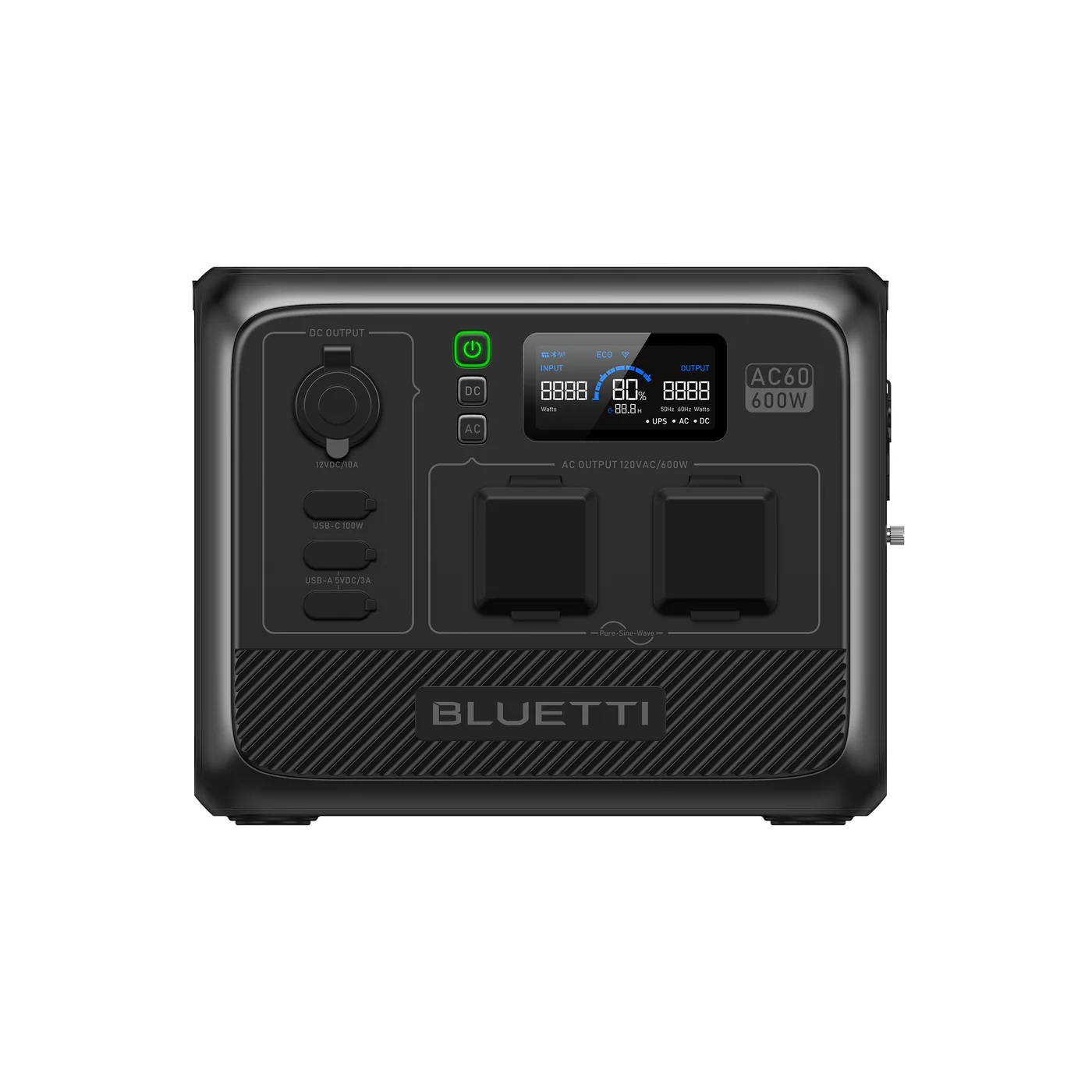
$599.00 · direct from BLUETTI
Last checked 1 day ago. Prices move — check before you buy.
Spec deltas
The EB3A costs $219 and the Pioneer 50 AC60 costs $599, three times as much for 403Wh against 268Wh. Run the ownership math instead of the sticker and the gap closes almost entirely: both units price out to exactly $100 per warranty-year, because the AC60's 6-year term is also three times longer than the EB3A's 2 years.
Where they don't tie is the one scenario built around running unattended: CPAP Overnight. The AC60 finishes that modeled night at 93% of its usable capacity; the EB3A needs 140% of what it holds, the same capacity shortfall that shows up whenever the EB3A is asked to do a full night's job. It's also the same unit with a documented pattern of false 'overload' shutdowns under light UPS loads, reported by owners from 2022 through 2024A5A7A9.
The AC60 isn't just bigger. It's quieter, switches to battery faster, and genuinely accepts add-on batteries the EB3A can never take. None of that is free: it weighs nearly twice as much and costs three times the cash today. Buy it anyway if the job includes an unattended night or a real chance of growing.
What the Numbers Reveal
Each conclusion stated first — the numbers behind it on one line, the full analysis below.
That capacity shortfall isn't a one-off against a single sibling either. It's the same unit with the same well-documented weakness: EB3A owners running CPAPs or routers on UPS power report false 'overload' shutdowns under 40-60W loads, a problem that firmware updates have failed to resolve across reports from 2022 to 2024A5A7A9.
The CPAP Overnight scenario needs 320Wh; the AC60 covers it at 93% of its usable capacityThe EB3A needs 140% of its own usable capacity for the same job, past what it holds
Why it mattersAnyone buying either of these specifically for overnight medical-device backup should treat the EB3A as the wrong choice twice over, once on the capacity model and once on its own field record.
Typical price
The AC60's warranty runs 6 years against the EB3A's 2, three times longer, and covers 3,000 cycles against 2,500. The extra $380 buys matching extra coverage plus real capacity, quiet, and expandability, not a markup on the same battery in a bigger box.
The AC60 costs three times as much upfront, $599 against $219Both units price out to an identical $100 per warranty-year despite that gap
Why it mattersBuyers dismissing the AC60 as needlessly expensive should run the per-year math before deciding that. By that measure it isn't more expensive to own.
Choosing the AC60 means committing to a bigger, heavier base unit today in exchange for a slot to attach more capacity tomorrow, not a lighter box that just happens to cost more for no reason.
The AC60 weighs 20.06 lbs against the EB3A's 10.1 lbs, nearly doubleThe AC60 genuinely accepts add-on batteries to grow past its 403Wh base; the EB3A is a closed system
Why it mattersBuyers who prize portability above everything and have no plans to ever expand should weigh that near-doubling of carry weight seriously. It's the AC60's one real physical cost, and it isn't small.
Capacity
The $380 buys capacity, quiet, warranty length, faster UPS switchover, and a real expansion port, not raw output. Anyone whose whole use case is charging a laptop and a phone at up to 100W already has that in the cheaper unit.
The EB3A and AC60 share identical 600W continuous output, a 1,200W surge rating, and 100W max USB-CWhat differs is capacity (403Wh against 268Wh), noise (45dB against 50dB), UPS switchover (20ms against 30ms), warranty (6 years against 2), and expandability
Why it mattersBuyers deciding purely on charging speed or peak output gain nothing from the AC60's inverter that the EB3A doesn't already provide. The premium is entirely about capacity, longevity, and reliability.
The specific dimensions that decide these two units — everything else is a tie.
Your Life, Your Pick
Selected because: CPAP Overnight is the one scenario where these two actually diverge, and the AC60 wins it.
Five of six modeled scenarios put both units well past their limits: Weekend Camping, the 8-Hour Blackout, Remote Workday, Tailgate Party, and Van Life Daily all need more capacity than either box holds, so the gap between them barely changes which one loses. You need a bigger class of station for any of those jobs regardless of which of these two you buy.
CPAP Overnight is the exception, and it flips from the AC50B comparison in this same lineup: here the AC60 is the unit that finishes the night, using 93% of its usable capacity against the EB3A's 140%. The same EB3A capacity shortfall shows up again. It doesn't have enough tank for a full night's medical-device load.
Lifetime Value
Selected because: Equal cost-per-warranty-year despite a 3x sticker gap is the counterintuitive number worth surfacing.
cost / lifetime kWh
The AC60 costs three times as much upfront, $599 against $219, and the ownership math doesn't punish it for that. Both units land at exactly $100 per warranty-year. The AC60's price scales with a warranty term that's also three times longer, 6 years against 2, so the extra money buys matching extra coverage rather than a markup.
Where they do diverge is lifetime energy delivered: 1,209kWh over the AC60's service life against 670kWh for the EB3A, and $0.50 per lifetime kWh against $0.30. The EB3A remains the cheaper unit to own by that specific measure. It's just no longer the free lunch it can look like against a smaller unit, because here the pricier unit isn't wasting the premium.
What the Specs Don't Tell You
Selected because: Noise, expansion, and UPS speed all fire and all point the same direction, toward the AC60.
rated cycles
The AC60 is the quieter unit under load, 45dB against the EB3A's 50dB, and its 20ms UPS switchover beats the EB3A's 30ms basic standby. Both point the same direction as the CPAP scenario above.
The bigger gotcha is structural: the EB3A is a closed system with no expansion path, while the AC60 genuinely accepts add-on batteries to grow past its 403Wh base. That's a real, spec-confirmed capability gap, not a marketing distinction, and it's the one advantage on this page that compounds the longer you own the unit.
Growth Path
Selected because: The AC60's expansion path is a real, spec-confirmed advantage the EB3A structurally can't match.
The EB3A's ceiling is 268Wh for the life of the unit, no exceptions. The AC60 ships at a higher 403Wh and, per its own field reports, genuinely grows from there with BLUETTI's add-on batteries, a real, confirmed capability rather than a spec-sheet claim that doesn't hold up.
If there's any real chance your power needs grow over the next few years, more gear, longer trips, a step toward partial home backup, that expansion port is worth paying for today rather than buying the EB3A now and a second unit later.
Strengths & trade-offs
BLUETTI EB3A
Strengths
- +Costs $380 less
- +Lighter by 10 lb
Trade-offs
- –Sealed capacity — the Pioneer 50 BLUETTI AC60 can add batteries to grow past 268Wh; this one can't.
BLUETTI Pioneer 50 BLUETTI AC60
Strengths
- +Larger battery capacity
- +Longer warranty
Trade-offs
- –Substantially more expensive (+$380) than the EB3A.
Will It Power Your Gear?
Scenario math and per-appliance runtimes, modeled from the spec record.
Scenario verdicts
We ran the math on seven real-world scenarios. Here's which unit survives your actual life.
SCN-01 · 2 nights · needs 2,100Wh
Weekend Camping
Two nights off-grid with essential comfort
Neither unit
Neither unit covers this scenario's 2,100Wh: the EB3A comes up 1,872Wh short (about 11% covered), the Pioneer 50 BLUETTI AC60 1,757Wh (16%). This is well outside what either unit is for; the right answer here is a larger station, not a choice between these two.
Battery budget usedlower = more headroom
LOAD Phone Charger 15W×6h · LED Lights 40W×8h · Box Fan 75W×14h · CPAP Machine 40W×16h
SCN-02 · 8 hours · needs 1,645Wh
8-Hour Blackout
Keep the essentials running through a night without power
Neither unit
Neither unit covers this scenario's 1,645Wh: the EB3A comes up 1,417Wh short (about 14% covered), the Pioneer 50 BLUETTI AC60 1,302Wh (21%). This is well outside what either unit is for; the right answer here is a larger station, not a choice between these two.
Battery budget usedlower = more headroom
LOAD Fridge 150W×8h · Router + Modem 20W×8h · LED Lights (4 bulbs) 40W×6h · Phone Charger 15W×3h
SCN-03 · 8 hours · needs 320Wh
CPAP Overnight
Sleep therapy without interruption — the #1 medical use case
Pioneer 50 BLUETTI AC60
The AC60 finishes a modeled overnight CPAP load at 93% of its usable capacity. The EB3A needs 140% of what it holds, the same shortfall that shows up against its smaller sibling, the AC50B.
Battery budget usedlower = more headroom
LOAD CPAP Machine 40W×8h
SCN-04 · 8 hours · needs 910Wh
Remote Workday
Full work day off-grid without power anxiety
Neither unit
Neither unit covers this scenario's 910Wh: the EB3A comes up 682Wh short (about 25% covered), the Pioneer 50 BLUETTI AC60 567Wh (38%). Treat this as partial cover — enough for the essentials in it, not the whole list.
Battery budget usedlower = more headroom
LOAD Laptop 60W×8h · External Monitor 30W×8h · Router + Modem 20W×8h · Phone Charger 15W×2h
SCN-05 · 4 hours · needs 670Wh
Tailgate Party
Game day power for the crew
Neither unit
Neither unit covers this scenario's 670Wh: the EB3A comes up 442Wh short (about 34% covered), the Pioneer 50 BLUETTI AC60 327Wh (51%). Treat this as partial cover — enough for the essentials in it, not the whole list.
Battery budget usedlower = more headroom
LOAD Blender 400W×0.5h · LED TV (55") 80W×4h · Bluetooth Speaker 15W×4h · Phone Charger (×3) 45W×2h
SCN-06 · 24 hours · needs 4,685Wh
Van Life Daily
A full day of mobile living — the ultimate endurance test
Neither unit
Neither unit covers this scenario's 4,685Wh: the EB3A comes up 4,457Wh short (about 5% covered), the Pioneer 50 BLUETTI AC60 4,342Wh (7%). This is well outside what either unit is for; the right answer here is a larger station, not a choice between these two.
Battery budget usedlower = more headroom
LOAD Mini-Fridge 150W×24h · Laptop 60W×4h · Phone Charger 15W×3h · LED Lights 40W×5h · Fan 75W×8h
SCN-07 · an afternoon · needs 100Wh
Afternoon Off-Grid
Phones and a speaker at the park, beach, or campsite — the small-unit job description
Either unit
This is the job small stations are actually for, and both do it: the EB3A finishes at 44% used, the Pioneer 50 BLUETTI AC60 at 29%. At this size the decider is what rides in the bag — 10.1 lbs for the EB3A against 20.1 for the Pioneer 50 BLUETTI AC60 — and price, not the leftover watt-hours.
Battery budget usedlower = more headroom
LOAD Phone Charger (×2) 30W×2h · Bluetooth Speaker 10W×4h
The Load Test
RUNTIME = (Wh × 0.85) ÷ LOAD
None of the scenarios above exactly yours? Build it. Toggle what you'd plug in; both units are tested against the combined draw.
Essentials
Comfort & Convenience
High-Draw Appliances
Test duration
8h
Continuous draw
205W
Projected runtime
For this load: Pioneer 50 BLUETTI AC60 runs 1.7h vs 1.1h.
$599 list · direct from BLUETTI
Modeled from the spec record — same math as the tables below. Methodology
Runtime by appliance
Real-world runtime estimates for common appliances, modeled at 85% inverter efficiency.¹
Essentials
The basics you need runningscale 0–22.8hComfort & Convenience
Makes off-grid life actually enjoyablescale 0–4.6hHigh-Draw Appliances
These reveal the real limits¹ Runtime = (capacity × 0.85) ÷ appliance watts. Within each group, all bars share one time scale (the group's longest runtime), so lengths are comparable across appliances; identical runtimes collapse into a single blue/orange bar. Actual runtime varies with battery age, temperature, and simultaneous loads — see methodology.
Conclusion
July 15, 2026
Verdict: the BLUETTI Pioneer 50 BLUETTI AC60
Take the Pioneer 50 AC60 if this unit will ever run something unattended overnight or if there's a real chance your capacity needs grow. It passes the modeled CPAP-overnight load at 93% of its usable capacity where the EB3A needs 140%, and despite a $599 sticker against $219, both units land at an identical $100 per warranty-year because the AC60's coverage runs three times longer. It also genuinely accepts add-on batteries, a real spec-confirmed capability, not a marketing line. The honest catch is weight: the AC60 is nearly double the EB3A's 10.1 lbs, and $599 is a real jump for anyone who just wants a light, cheap, occasional-use box. If that's you and nothing ever runs unattended overnight, the EB3A remains a legitimate, lighter pick.
Editor-assigned confidence, based on cited owner research and spec analysis.
List prices as of July 15, 2026. The links below open BLUETTI's current price.
$599.00 · direct from BLUETTI
Last checked 1 day ago. Prices move — check before you buy.
or check the EB3A price$219.00 list
Written by Wenny Zheng, Portable Power Tester · Station Arena Test Desk · Updated July 15, 2026
Measured Data
Benchmark scores and the full spec record, side by side.
Benchmark scores
Not rated for both units (minimum threshold unmet): UPS.
Full specifications
ᵈ Derived: price ÷ rated capacity. See the data behind our comparisons →
Comparison ToolAdd more power stations, side by sideOpen Tool →How these numbers are produced
Numeric verification
Every figure on this page traces to our spec database or arithmetic on it — no estimated numbers.
Owner claims
Statements about owner experience are cited to published reviews — see Sources & Research Notes below.
Runtime model
Runtime = (rated capacity × 0.85 inverter efficiency) ÷ device wattage. Solar recharge estimates assume panels deliver 70% of rated output. Cold weather, battery age, and stacked loads reduce real-world results.
Power Score
Computed from 14 published spec dimensions, weighted per use-case bench. Higher is better; a unit must meet a bench's minimum threshold to be rated.
See the full weight table and data sourcing on our methodology page →Class ranking (the star rating)
Each unit's star score is a category ranking, not customer reviews — no buyer opinions feed it. We score every station on size-independent quality (value, output, portability, endurance, ports, warranty, and more), then percentile-rank it against the other units in its capacity class, so a class-leading compact unit and a class-leading whole-home unit can both earn 5★. Here, EB3A rates 3.8/5 (29th percentile of 22 Personal-class units), and Pioneer 50 BLUETTI AC60 rates 3.9/5 (38th percentile of 22 Personal-class units).
How the class ranking is computed →Test Notes & Caveats
Hidden gotchas and advantages we spotted that you won't find on the product page.
5 Decibels, the Same Gap as Its Smaller Sibling
The AC60 holds at 45dB under load; the EB3A climbs to 50dB. It's worth factoring in for anything running near where you sleep.
One Closed System, One Real Expansion Port
The EB3A ships as a closed system, 268Wh is the ceiling for the life of the unit. The AC60 genuinely accepts add-on batteries to grow past its 403Wh base, a confirmed capability rather than an assumption.
20ms vs 30ms Switchover
The AC60 switches to battery power in 20ms; the EB3A rates a basic 30ms standby. Ten milliseconds won't register with most connected devices on its own, so treat it as a minor tiebreaker alongside the AC60's win in the CPAP-overnight scenario, not a decision by itself.
Warranty: 6 Years vs 2
The Pioneer 50 BLUETTI AC60 is covered for 6 years against the EB3A's 2 years. An underrated factor if you're keeping this unit for years.
Full record above — the Test Desk pick is the Pioneer 50 BLUETTI AC60.
Check Pioneer 50 BLUETTI AC60 price →or check the EB3A priceOwnership Analysis
What happens after you buy — true cost of ownership, brand trust, and growth potential.
Lifetime value
Service lifeyears at one full cycle per day
Lifetime energy delivered
Cost per delivered kWh
│ warranty ends · Reaching the cycle rating means ~80% capacity remains — degraded, not dead.
Analyst note
The EB3A wins on both sticker price and long-term value. At $0.33/kWh over its lifetime, it's meaningfully cheaper to own. Clear value winner.
Growth path
EB3A
FIXED CAPACITYFixed at 268Wh, with no expansion — so size it for your needs up front rather than planning to add capacity later.
Accepts up to 200W of solar. Limited to a single portable panel.
Limited ports. You'll likely need a power strip or splitter.
Pioneer 50 BLUETTI AC60
EXPANDABLESupports BLUETTI expansion batteries, so you can add capacity later without replacing the base unit — useful if your needs may climb past 403Wh.
Accepts up to 200W of solar. Limited to a single portable panel.
Limited ports. You'll likely need a power strip or splitter.
Expansion batteries are BLUETTI-specific. You're investing in the BLUETTI ecosystem.
Realistic full solar rechargeat 70% of rated panel output — see methodology
Analyst note
The EB3A is sealed at 268Wh, which is fine if that covers you. The Pioneer 50 BLUETTI AC60 starts at 403Wh and can grow beyond it with BLUETTI expansion batteries — though at this size expansion means longer runtimes on the same loads, not a path to home backup. More hours, not more house.
What Owners Report
Patterns from published owner reports and long-term reviews — every claim cited to its source below.
BLUETTI EB3A
At 10.1 lbs the EB3A is the pick-it-up-with-one-hand option in this pairing, about half the AC60's weight, and reviewers who put it through extended testing call it 'tiny but mighty,' praising how much port and feature density BLUETTI crammed into that sizeA13. A 60-day test covering two camping trips, an 18-hour outage, and five days of van life ended with the reviewer saying they'd buy it again without hesitationA16.
The catch carries over from its cheaper stablemate: put the EB3A to work as a UPS or an overnight CPAP supply and it has a habit of crying 'overload' on loads as light as 40 watts, a complaint owners have logged from 2022 well into 2024A5A7A8. A firmware update was supposed to fix it; instead one owner watched the false alarms get more frequentA9. Fan noise is a separate, recurring gripe on top of thatA1A3.
“Bluetti advertises the EB3A as "tiny but mighty," and I have to agree. They crammed a lot of ports and functionality into a very portable package... it seems to be a very well-polished product.”
Sources
toolguyd.com · diysolarforum.com · backuppowerhub.com · wanderwoman.ca
BLUETTI Pioneer 50 BLUETTI AC60
The Pioneer 50 AC60 shares its IP65 dust- and water-resistant rating and LiFePO4 chemistry with BLUETTI's higher-capacity AC60P, differing mainly in base capacity and priceB1. Reviewers note it Turbocharges to full in about an hourB2 and call it durable enough to earn a 'Goldilocks' nickname among BLUETTI's smaller stationsB4.
Its standout field-confirmed feature is genuine expansion: reviewers confirm it accepts add-on batteries to grow past its 403Wh base into a multi-kWh bank, a real capability rather than a marketed oneB3. Coverage here is thinner than the EB3A's, this is a newer, less-reviewed unit, but nothing in it contradicts the spec sheet.
“Same IP65 water- and dust-resistant rating (protected from dust and low-pressure water jets, but not fully waterproof) and LiFePO4 chemistry as the AC60P.”
Sources
bluettipower.com · thriftyclik.com · joshwp.com · trustedreviews.com · gearjunkie.com
Sources & Research Notes
Every owner claim in this report is traceable to a published source. The bracketed references above resolve here.
Recurring owner themes
- Multiple owners across forums (2022-2024) report the EB3A randomly shutting off or throwing false 'overload' errors under light loads (40-60W) when used in UPS mode for CPAPs, computers, or routers — a persistent, unresolved issue even after firmware updates. [EB3A · 6 entries]
- Recurring complaints about fan noise and odd fan behavior (ramping, buzzing, wobble) span from 2022 through 2024, spanning silent mode, idle, and charging states, suggesting an ongoing hardware/firmware characteristic rather than a one-time defect. [EB3A · 5 entries]
- Owners report poor or unresponsive Bluetti customer support when troubleshooting UPS failures, including unhelpful firmware fixes and unanswered app support tickets. [EB3A · 2 entries]
- Despite reliability complaints in UPS use, several long-term/extended testers (60+ days, CPAP overnight use) report satisfaction with portability, build quality, and real-world runtime for camping/outage scenarios. [EB3A · 3 entries]
- Same IP65 ruggedness, Turbo charging, and expandability as the AC60P at a lower price and smaller base capacity. [Pioneer 50 BLUETTI AC60 · 3 entries]
- A1
“I got tired of hearing the fan on the EB3a coming and going off and on, even in the silent mode. The wobbly noise is because of being unbalanced.”
BLUETTI Community forum — 'EB3A fans noise - how is fix it!' · 2022-08 · [negative]
- A3
“Even in slow charging mode and even when fully charged already, the eb3a fan noise is too high to be in a bedroom (if AC input plugged in) The fan runs every 20 min or so”
BLUETTI Community forum — 'EB3A idle noise suggestion' · 2023-09 · [negative]
- A5
“There is a known issue when running it in UPS mode with a light load (40~60 watts). The unit does not keep itself cool and overheats. (The display shows overload.)”
toolguyd.com — 'Bluetti EB3A Portable Power Station Review' comments · 2023-04 (purchased Aug 2023) · [negative]
- A7
“About 2-3 hours into my night's sleep it shut down, showing an "overload" indication despite the fact that my CPAP only draws at most 40 watts.”
diysolarforum.com — 'EB3A "Overload" When Used as Uninterruptible Power Supply' · 2022-09 · [negative]
- A8
“He said that both had failed recently in exactly the same way under light loads... Of the units I personally know of that're being used in this way that's a 100% failure rate”
diysolarforum.com — 'EB3A "Overload" When Used as Uninterruptible Power Supply' · 2022-09 · [negative]
- A9
“I contacted bluetti support and they told me to upgrade the firmware. I did so, and that actually increased the frequency of the "blinks". Support eventually just shrugged and had no further help”
diysolarforum.com — 'Is Bluetti EB3A any good as a UPS?' · 2022-12 · [negative]
- A13
“Bluetti advertises the EB3A as "tiny but mighty," and I have to agree. They crammed a lot of ports and functionality into a very portable package... it seems to be a very well-polished product.”
toolguyd.com — 'Bluetti EB3A Portable Power Station Review' · 2023-04 · [positive]
- A16
“After 60 days of testing—two camping trips, an 18-hour power outage, and five days of van life—would I buy the Bluetti EB3A again? Yes, without hesitation.”
backuppowerhub.com — 'Bluetti EB3A Review: Ultra-Compact Emergency Power Station' · 2026-05 · [positive]
- B1
“Same IP65 water- and dust-resistant rating (protected from dust and low-pressure water jets, but not fully waterproof) and LiFePO4 chemistry as the AC60P.”
bluettipower.com / thriftyclik.com — AC60 review · 2026 · [mixed]
- B2
“Turbocharging to a full charge in about one hour.”
bluettipower.com / joshwp.com — AC60 review · 2026 · [positive]
- B3
“Expandable from its 403Wh base to a multi-kWh bank with add-on batteries.”
bluettipower.com / trustedreviews.com — AC60 review · 2026 · [positive]
- B4
“The standard 403Wh AC60 at a lower price; owners praise its IP65 durability and compact design, calling it the 'Goldilocks' of portable charging.”
gearjunkie.com / bluettipower.com — Pioneer 50 (AC60) review · 2026 · [positive]
Research compiled July 15, 2026.
Who Should Buy Which
Buy the EB3A if you…
- →You're weight-conscious and budget-constrained above all else: $219, 10.1 lbs, and a $0.02-per-day weekend running cost that's a third of the AC60's.
- →You've read the reliability concerns and your use case genuinely never touches UPS or unattended overnight mode, camping and short trips, not medical-device backup.
Buy the Pioneer 50 BLUETTI AC60 if you…
- →You need this to survive a CPAP or UPS overnight without a false shutdown. The AC60 passes the modeled night at 93% of capacity where the EB3A needs 140%.
- →You want a real path to more capacity later. The AC60's expansion port is spec-confirmed, not a claim that evaporates on inspection.
If neither fits
If your real need is a two-night camping trip (about 2,100Wh) or an 8-hour multi-appliance blackout (about 1,645Wh), both of these fail the job. The AC60 needs 613% and 480% of its capacity for those two jobs respectively, and the EB3A needs even more. Look at BLUETTI's larger AC-series units instead of choosing between these two.
The Bottom Line
Same story as the AC50B comparison in this lineup, different opponent: the EB3A's 268Wh and its documented overload pattern in UPS and CPAP mode disqualify it from anything that needs to run unattended overnight, and the AC60 passes that exact test at 93% of its usable capacity against the EB3A's 140%.
The AC60 costs three times as much, but it doesn't cost three times as much to own, both land at $100 per warranty-year, and it adds a genuine expansion port the EB3A will never have. Buy the EB3A for light, weight-conscious trips where nothing runs unattended. Buy the AC60 for anything that needs to still be running when you wake up, or any real chance you'll want more capacity later.
Frequently Asked Questions
Answers drawn from the spec record and cited owner research.
Is the EB3A's overload shutdown issue relevant when comparing it to the AC60?
Yes, directly. Multiple EB3A owners report false 'overload' shutdowns under light 40-60W loads during UPS or CPAP use, a pattern spanning 2022 through 2024 that firmware updates haven't reliably fixed. The AC60 has no comparable pattern in its thinner field record, and it passes the modeled CPAP-overnight scenario where the EB3A doesn't.
Is the BLUETTI Pioneer 50 AC60 worth three times the EB3A's price?
By the ownership math, yes. Both units land at the same $100 per warranty-year despite the AC60 costing $599 against $219, because the AC60's warranty term is also three times longer at 6 years against 2. The extra money buys matching extra coverage, plus a real expansion port and quieter operation, not a markup on the same box.
Does the AC60 actually support battery expansion, or is that just marketing?
It's genuine. Reviewers confirm the AC60 accepts add-on batteries to grow past its 403Wh base into a multi-kWh bank. The EB3A, by contrast, is a fully closed system with no expansion path at any price.
What's the weight difference between the EB3A and the AC60?
Nearly double. The EB3A is 10.1 lbs; the AC60 is 20.06 lbs. If portability is the priority and you don't need the extra capacity or the expansion port, that's a real point in the EB3A's favor.
Which is quieter and faster to switch over during an outage?
The AC60, on both counts, 45dB against the EB3A's 50dB under load, and a 20ms UPS switchover against the EB3A's 30ms basic standby. Neither gap is dramatic on its own, but they both point the same direction as the AC60's win in the CPAP-overnight scenario.
Where to buy
BLUETTI EB3A
$219.00
$219.00 · direct from BLUETTI
Last checked 1 day ago. Prices move — check before you buy.
BLUETTI Pioneer 50 BLUETTI AC60Pick
$599.00
$599.00 · direct from BLUETTI
Last checked 1 day ago. Prices move — check before you buy.
Prices may vary by retailer and are subject to change.