Head-to-head test
BLUETTI AC200P L vs Jackery Explorer 2000 Plus
The Jackery now costs less AND is the stronger, quieter machine — 6,000W surge, 3,000W output, a 30 dBA noise floor, and a 4,000-cycle battery — while the BLUETTI's one remaining edge is about 260Wh more capacity for the long-blackout buyer.
Full profiles: BLUETTI AC200P L → · Jackery Explorer 2000 Plus →

Written by Gunner GustafsonUpdated
Whole-Home Backup Tester, Station Arena Test Desk

$1,199.00 · direct from BLUETTI
Last checked 1 day ago. Prices move — check before you buy.
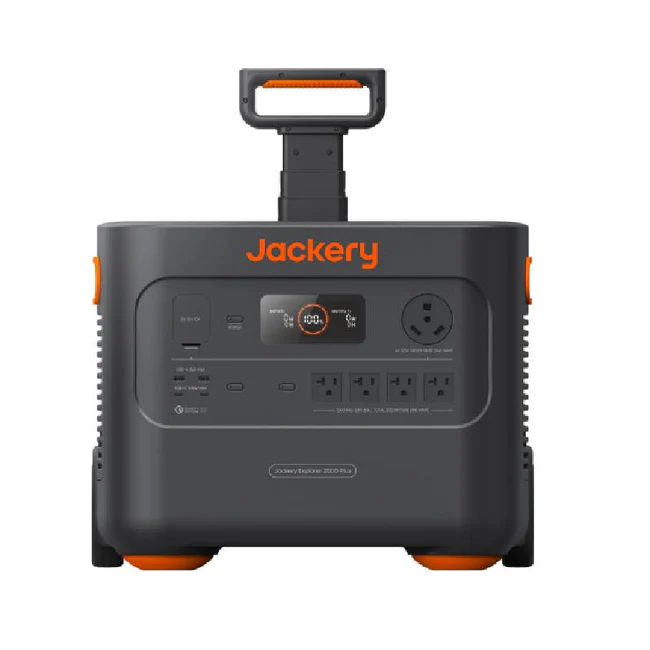
No longer sold
Jackery no longer sells the Explorer 2000 Plus as a standalone unit — the listing now carries only kits, the add-on battery and a refurbished unit. Its successor in the line is the HomePower 2000 Plus v2: the same 2 kWh class with a 2,400W inverter in the newer design.
HomePower 2000 Plus v2 · $1,199.00Spec deltas
The BLUETTI AC200P L used to be the cheaper power station here and the bigger one, a combination that usually ends the argument before it starts. But the Jackery Explorer 2000 Plus has dropped to $899 against the BLUETTI's $1,099 — so the BLUETTI is now the pricier unit, and all it keeps is the capacity line: 2,304Wh to the Jackery's 2,042.8, about 260Wh more battery, now for $200 more money.
The Jackery already won the parts of a power station you don't find on the capacity line, and now it wins them for less. Its inverter surges to 6,000W where the BLUETTI stops at 3,600, it pushes 3,000W continuous to the BLUETTI's 2,400, and its noise floor is 30 dBA against 50 under load. Reviewers back the quiet up, calling it calm even at a full 3,000W drawB1. It's also rated for 4,000 charge cycles to 3,000, which now makes the cheaper unit the cheaper one to own over its life as well.
The verdict up front: for most buyers, take the Jackery. It's cheaper today and stronger nearly everywhere, and the BLUETTI's extra capacity shows up in just one scenario, the long overnight blackout. If that reserve is exactly what you're buying for, we'll show you where the BLUETTI still wins.
What the Numbers Reveal
Each conclusion stated first — the numbers behind it on one line, the full analysis below.
rated cycles
Spread each price across that lifetime energy and the Jackery's edge is no longer a rounding error: $0.11 a kilowatt-hour against $0.16, a five-cent gap that used to be one. The price cut collapsed the old trade entirely — the Jackery no longer needs a decade of daily cycling to justify itself, because it's cheaper the day the box arrives and cheaper across every kilowatt-hour after.
AC200P L: $1,099, 2,304Wh, rated 3,000 cyclesExplorer 2000 Plus: now $899, 2,042.8Wh, rated 4,000 cyclescomputed lifetime energy: 6,912 kWh (BLUETTI) vs 8,171 kWh (Jackery)
Why it mattersThe lifetime-cost math that once waited a decade to favor the Jackery now lands immediately; only a buyer who specifically needs the BLUETTI's extra reserve pays more for less.
continuous output
A well pump or rooftop air conditioner that spikes past 3,600W for a heartbeat at startup lands inside the Jackery's ceiling and over the BLUETTI's. Both units will run a fridge, a CPAP, and a laptop all night without complaint. Only the Jackery is sure to start the heavier motor that briefly demands triple its running watts, which is why the surge column is the one spec here that can hard-stop a purchase.
BLUETTI inverter: 2,400W continuous, 3,600W surgeJackery inverter: 3,000W continuous, 6,000W surgecompressor motors briefly pull 2-3x their rated draw at startup
Why it mattersA load list with a well pump, a rooftop AC, or big shop tools picks the Jackery on the surge ceiling alone — and now that ceiling comes on the cheaper unit, not the pricier one.
Capacity
Run the small loads, a CPAP or a work-from-home day, and both finish with most of the tank left, so the extra capacity is invisible. Aim at a two-night camp or a full van-life day and both overshoot, so the extra capacity is useless. The 260Wh earns its keep in exactly one place: the long outage where the Jackery would be scraping bottom and the BLUETTI still has a cushion.
BLUETTI holds 2,304Wh; Jackery holds 2,042.8Wh8-Hour Blackout needs 1,645Wh: BLUETTI uses 84%, Jackery 95%Weekend Camping needs 2,100Wh and Van Life needs 4,685Wh: both units fail both
Why it mattersIf a multi-appliance overnight blackout is your core use, the BLUETTI's reserve is the reason to buy it; live at the small or the huge end of the range and capacity isn't your tiebreaker.
The specific dimensions that decide these two units — everything else is a tie.
Lifetime Value
Selected because: The whole tension lives here: the Jackery is now cheaper up front and cheaper per lifetime kWh, while the BLUETTI answers only with more raw capacity — its price cut and the 4,000-vs-3,000 cycle rating stack the cost columns on the Jackery.
cost / lifetime kWh
The pricier station is now also the more expensive one to run. The Jackery wins the sticker by $200 and, on its 4,000-cycle battery rated to deliver 1,259 more kilowatt-hours before it dies, drops its lifetime cost to $0.11 a kilowatt-hour against BLUETTI's $0.16. It's the same fact from two directions: the Jackery now costs less to buy and less to keep.
The price cut also erased the old caveat. That lifetime edge used to require a decade of daily cycling to matter; now it doesn't, because the Jackery is cheaper the day it arrives regardless of how you use it. Even the warranty column has flipped: at $899 the Jackery runs about $180 per covered year against the BLUETTI's $220. The BLUETTI no longer wins any cost column — its one remaining card is the raw 260Wh of extra capacity, and that only pays off in the long overnight blackout.
What the Specs Don't Tell You
Selected because: Four cards fire; surgeRatio (Jackery advantage) and noise (BLUETTI penalty) are the honest catches against our own pick, plus cycleLife and a near-tie weight.
rated cycles
Four flags fire, and the sharpest ones point at the BLUETTI. The surge-ratio card is Jackery's to claim: its inverter doubles to 6,000W where the BLUETTI's stretches to 3,600, and a high surge-to-continuous ratio is the cleanest spec-sheet tell of a stout inverter. If you own anything with a compressor or a big motor, that card is decisive — and it no longer costs extra, since the Jackery is now the cheaper unit.
The noise card lands on the BLUETTI too: 50 dBA under load against the Jackery's 30, a gap you'd hear across a quiet campsite or a bedroom. Read it with a grain of salt, though, because 50 dBA is a heavy-load figure and a CPAP or a router won't drive the fan there. The cycle-life card just restates the lifetime story, 4,000 against 3,000, and the weight card is a near-tie the engine flags out of reflex: 63.5 pounds to 61.5, two pounds no back will notice. Both are get-a-second-person-for-the-stairs boxes.
Your Life, Your Pick
Selected because: The 8-hour blackout is the one contested standalone win (BLUETTI, on capacity); every other scenario ties or fails for both.
Line the six scenarios up and five of them refuse to pick a side. The CPAP night, the work-from-home day, and the tailgate all finish with both units well over half full, and the two big ones, a two-night camp and a full van-life day, overshoot both batteries by the same wide margin. Capacity decides nothing across those five.
The exception is the one people actually buy these for. The 8-hour blackout draws 1,645Wh from the fridge, router, and lights, which the BLUETTI absorbs at 84% of usable capacity and the Jackery at 95%. Both keep the lights on. Only the BLUETTI keeps a cushion, the difference between a unit that shrugs off the outage and one that limps across the line at dawn. If the grid going dark for a night is your reason for buying, that extra 260Wh is the whole argument, and it belongs to BLUETTI.
Brand Trust
Selected because: Cross-brand pair where ecosystem and app favor BLUETTI (4.5 vs 2.3-3.3), while support is a wash with different buy-direct advice on each side.
This is where the BLUETTI answers back. Its app rates 4.5 out of 5, among the best in the category, against a Jackery app that scores 2.3 to 3.3 and splits itself across two login-required apps. BLUETTI also fields one of the widest lineups in the business and the second-largest owner community after EcoFlow, so accessories, expansion batteries, and troubleshooting neighbors are all easier to come by.
Support is the wash that keeps this from being a rout. BLUETTI's is the most inconsistent in the space and runs on China-timezone email, though buying direct from BLUETTI tends to smooth the outcome. Jackery's is US-based but widely panned for scripted replies and strict receipt rules, which is why the standing advice is to buy it from Costco or Amazon for the return protection. Neither record should flip your verdict; both argue for registering the warranty and keeping the receipt.
Strengths & trade-offs
BLUETTI AC200P L
Strengths
- +Larger battery capacity
Trade-offs
- –Weaker inverter (-600W) limits appliance compatibility.
- –Shorter-lived battery — rated for 3,000 charge cycles vs the Explorer 2000 Plus's 4,000, so it wears out sooner.
Jackery Explorer 2000 Plus
Strengths
- +Costs $200 less
- +Lighter by 2 lb
- +Higher AC output
- +Rated for 4,000 charge cycles — much longer battery lifespan
Trade-offs
- –No major technical downsides compared to rival.
Will It Power Your Gear?
Scenario math and per-appliance runtimes, modeled from the spec record.
Scenario verdicts
We ran the math on six real-world scenarios. Here's which unit survives your actual life.
SCN-01 · 2 nights · needs 2,100Wh
Weekend Camping
Two nights off-grid with essential comfort
Neither unit
A two-night camp asks for 2,100Wh, and both batteries come up short, the BLUETTI at 107% of usable capacity and the Jackery at 121%. The BLUETTI gets closer, but close doesn't keep the lights on. The fix is the same for either: a sunny afternoon on solar, both take 1,200W, or a shorter appliance list.
Battery budget usedlower = more headroom
LOAD Phone Charger 15W×6h · LED Lights 40W×8h · Box Fan 75W×14h · CPAP Machine 40W×16h
SCN-02 · 8 hours · needs 1,645Wh
8-Hour Blackout
Keep the essentials running through a night without power
AC200P L
The night's 1,645Wh load is the one place capacity changes the answer. The BLUETTI absorbs it at 84% of usable capacity and keeps a real cushion; the Jackery clears it too, at 95%, but with almost nothing left in the tank. Both hand off in 20ms, so the fridge never blinks. If a long outage is the plan, the roomier BLUETTI is the one that isn't sweating at dawn.
Battery budget usedlower = more headroom
LOAD Fridge 150W×8h · Router + Modem 20W×8h · LED Lights (4 bulbs) 40W×6h · Phone Charger 15W×3h
SCN-03 · 8 hours · needs 320Wh
CPAP Overnight
Sleep therapy without interruption — the #1 medical use case
Explorer 2000 Plus
A CPAP sips: 16% of the BLUETTI, 18% of the Jackery, so capacity is beside the point. Two feet from your pillow, noise is the spec that matters, and the Jackery's 30 dBA floor beats the BLUETTI's 50. The nuance: 50 dBA is a heavy-load figure and a CPAP won't push the fan there, so both are likely quiet, with the Jackery the safer bet if silence is non-negotiable.
Battery budget usedlower = more headroom
LOAD CPAP Machine 40W×8h
SCN-04 · 8 hours · needs 910Wh
Remote Workday
Full work day off-grid without power anxiety
Either unit
A laptop-and-monitor day runs both units to about half, 46% on the BLUETTI and 52% on the Jackery, through identical 100W USB-C. There's no daylight here. Pick on price and capacity, not this scenario.
Battery budget usedlower = more headroom
LOAD Laptop 60W×8h · External Monitor 30W×8h · Router + Modem 20W×8h · Phone Charger 15W×2h
SCN-05 · 4 hours · needs 670Wh
Tailgate Party
Game day power for the crew
Either unit
An afternoon of food and speakers uses barely over a third of either battery, 34% and 39%. Both cruise. If the cook gear escalates, the Jackery's 3,000W inverter carries 600W more headroom than the BLUETTI's 2,400; short of that, it's a tie.
Battery budget usedlower = more headroom
LOAD Blender 400W×0.5h · LED TV (55") 80W×4h · Bluetooth Speaker 15W×4h · Phone Charger (×3) 45W×2h
SCN-06 · 24 hours · needs 4,685Wh
Van Life Daily
A full day of mobile living — the ultimate endurance test
Neither unit
A full van day draws 4,685Wh, more than double what either box usably holds, 239% of the BLUETTI's capacity and 270% of the Jackery's. This is expansion-plus-solar territory, not a job for a single 2kWh unit. Both expand toward it; if this is your daily reality, budget the second battery on day one or shop a class up.
Battery budget usedlower = more headroom
LOAD Mini-Fridge 150W×24h · Laptop 60W×4h · Phone Charger 15W×3h · LED Lights 40W×5h · Fan 75W×8h
The Load Test
RUNTIME = (Wh × 0.85) ÷ LOAD
None of the scenarios above exactly yours? Build it. Toggle what you'd plug in; both units are tested against the combined draw.
Essentials
Comfort & Convenience
High-Draw Appliances
Test duration
8h
Continuous draw
205W
Projected runtime
For this load: AC200P L runs 9.6h vs 8.5h.
$1,099 list · direct from BLUETTI
Modeled from the spec record — same math as the tables below. Methodology
Runtime by appliance
Real-world runtime estimates for common appliances, modeled at 85% inverter efficiency.¹
Essentials
The basics you need runningscale 0–130.6hComfort & Convenience
Makes off-grid life actually enjoyablescale 0–26.1hHigh-Draw Appliances
These reveal the real limitsscale 0–2h¹ Runtime = (capacity × 0.85) ÷ appliance watts. Within each group, all bars share one time scale (the group's longest runtime), so lengths are comparable across appliances; identical runtimes collapse into a single blue/orange bar. Actual runtime varies with battery age, temperature, and simultaneous loads — see methodology.
Conclusion
July 13, 2026
Verdict: the Explorer 2000 Plus
Buy the Jackery Explorer 2000 Plus. It used to cost $100 more than the AC200P L, and the old verdict leaned entirely on the BLUETTI being cheaper and bigger — but at $899 the Jackery is now $200 cheaper, so that whole case has collapsed to one line: the BLUETTI still holds about 260Wh more (2,304Wh vs 2,042.8), enough to carry the modeled 8-hour blackout with a real reserve where the Jackery arrives at 95%. Everywhere else the Jackery already led and now does it for less: a 6,000W surge ceiling against 3,600, 600W more continuous output, a 30 dBA noise floor against 50, and a 4,000-cycle battery that makes it cheaper per lifetime kWh too ($0.11 against $0.16). Being $200 cheaper and stronger on nearly every axis outweighs a 12.8% capacity edge for most buyers. The one place to still choose the BLUETTI is a multi-appliance overnight blackout where you specifically want the biggest reserve; for everyone else, the Jackery is now the better box.
Editor-assigned confidence, based on cited owner research and spec analysis.
List prices as of July 13, 2026. The links below open BLUETTI's and Jackery's current prices.
$899.00 · direct from Jackery
Last checked 21 days ago. Prices move — check before you buy.
or check the AC200P L price$1,199.00 list
Written by Gunner Gustafson, Whole-Home Backup Tester · Station Arena Test Desk · Updated July 13, 2026
Measured Data
Benchmark scores and the full spec record, side by side.
Benchmark scores
Full specifications
ᵈ Derived: price ÷ rated capacity. See the data behind our comparisons →
Comparison ToolAdd more power stations, side by sideOpen Tool →How these numbers are produced
Numeric verification
Every figure on this page traces to our spec database or arithmetic on it — no estimated numbers.
Owner claims
Statements about owner experience are cited to published reviews — see Sources & Research Notes below.
Runtime model
Runtime = (rated capacity × 0.85 inverter efficiency) ÷ device wattage. Solar recharge estimates assume panels deliver 70% of rated output. Cold weather, battery age, and stacked loads reduce real-world results.
Power Score
Computed from 14 published spec dimensions, weighted per use-case bench. Higher is better; a unit must meet a bench's minimum threshold to be rated.
See the full weight table and data sourcing on our methodology page →Class ranking (the star rating)
Each unit's star score is a category ranking, not customer reviews — no buyer opinions feed it. We score every station on size-independent quality (value, output, portability, endurance, ports, warranty, and more), then percentile-rank it against the other units in its capacity class, so a class-leading compact unit and a class-leading whole-home unit can both earn 5★. Here, AC200P L rates 3.6/5 (20th percentile of 26 Large-class units), and Explorer 2000 Plus rates 4.5/5 (68th percentile of 26 Large-class units).
How the class ranking is computed →Test Notes & Caveats
Hidden gotchas and advantages we spotted that you won't find on the product page.
Two Pounds Apart
Weight gets flagged here, but it's a near-tie: 63.5 pounds for the BLUETTI, 61.5 for the Jackery. No back will feel two pounds. Both are genuinely heavy, get-a-second-person-for-stairs boxes, and the Jackery's built-in wheels are the real portability difference, not the scale.
50 dB Under Load, With an Asterisk
The BLUETTI is rated at 50 dBA under load against the Jackery's 30, a gap you'd notice in a quiet room. The asterisk: 50 dBA is a heavy-draw figure, so a fridge or CPAP that barely taxes the unit won't drive the fan there. Under a real workout, though, the Jackery is the quieter machine by a wide margin.
Surge Headroom Favors the Jackery
The Jackery's inverter doubles its 3,000W rating to a 6,000W surge; the BLUETTI stretches its 2,400W to 3,600. That ratio, how far an inverter can spike above its steady rating, is the cleanest spec-sheet read on whether a unit can start a motor. Anything with a compressor, a pump, or a big electric motor wants the Jackery's ceiling — and it no longer costs extra to get it, now that the Jackery is the cheaper of the two.
Warranty: No Difference
Both units carry the same 5-year warranty, so coverage isn't a tiebreaker here. Both figures are maximums rather than guarantees: BLUETTI's depends on buying direct from BLUETTI or registering the unit, since reseller purchases carry a shorter term; Jackery's on registering the unit with Jackery, which is what extends the base term to the full period.
4,000 Cycles vs 3,000, In Real Years
The Jackery's battery is rated for 4,000 charge cycles to the BLUETTI's 3,000, which at a full cycle a day is roughly eleven years against eight. Cycle either one a couple dozen times a year as backup and both sail past the decade with life to spare, and the difference turns into trivia. This number only pays the people who actually use it.
Full record above — the Test Desk pick is the Explorer 2000 Plus.
Check Explorer 2000 Plus price →or check the AC200P L priceOwnership Analysis
What happens after you buy — true cost of ownership, brand trust, and growth potential.
Lifetime value
Service lifeyears at one full cycle per day
Lifetime energy delivered
Cost per delivered kWh
│ warranty ends · Reaching the cycle rating means ~80% capacity remains — degraded, not dead.
Analyst note
The Explorer 2000 Plus wins on both sticker price and long-term value. At $0.11/kWh over its lifetime, it's meaningfully cheaper to own. Clear value winner.
Brand trust
BLUETTI
Ecosystem
One of the broadest lineups — 15-20+ models from budget (AC2A) to flagship portable (Apex 300, 2764.8Wh). Includes specialized products: vehicle solar hubs, sodium-ion cold-weather units, and balcony storage systems.
Support
The most inconsistent support in the space. Heavily email-based with China timezone delays. Some users get smooth, efficient service; others report weeks of troubleshooting runarounds, being offered discounts on new units instead of repairs, and confusing third-party purchase claim processes. Buying direct from Bluetti's website tends to produce better support outcomes.
Community
Active and growing — Reddit r/bluetti has a dedicated community. Second-largest after EcoFlow in engagement.
App experience
Rated 4.5/5 iOS and Android — tied for best app experience in the category. V3.0 UI redesign was well-received.
Unique strength
Best-in-class value and one of the widest lineups in the category, from budget units to flagships, backed by the top-rated app in the space at 4.5 out of 5.
Worth knowing
Support is the most inconsistent in the category and leans on email across a China timezone. Buying direct from BLUETTI tends to produce the smoother outcome.
Jackery
Ecosystem
12-15+ models across Explorer (portable) and HomePower (home backup) series, plus SolarSaga panel ecosystem and innovative form factors
Support
US-based support but widely criticized. Reddit reports describe slow/dismissive responses, scripted AI agents, strict receipt requirements for warranty claims, and refurbished replacements for clearly defective units. Strongly recommended: buy from Costco or Amazon for return protection.
Community
Smallest community of the major brands — Reddit r/Jackery has ~2,000 members. YouTube presence is solid due to brand recognition.
App experience
Rated 2.3-3.3/5 iOS and Android — the weakest app experience of the major brands. Multiple confusing apps (Jackery app vs Jackery Home) and mandatory login even offline.
Unique strength
The highest brand recognition and widest retail reach in power stations, sold everywhere from Costco to Home Depot, wrapped in a rugged, wheeled, IP65 build.
Worth knowing
The app is the weakest of the major brands at 2.3 to 3.3 out of 5, split across two login-required apps, and US-based support draws steady complaints. Buying from Costco or Amazon adds return protection.
Analyst note
Different bets on what a brand is for. BLUETTI sells value, breadth, and the better software, with support that's a coin flip you improve by buying direct. Jackery sells ubiquity and a tank-like build you can grab off a warehouse shelf, paired with a weak app and support you hedge by buying from a generous returner. Neither should decide your purchase; both argue for keeping the receipt and registering the warranty the day it lands.
Growth path
AC200P L
EXPANDABLESupports BLUETTI expansion batteries, so you can add capacity later without replacing the base unit — useful if your needs may climb past 2,304Wh.
Accepts up to 1,200W of solar. Enough for a serious multi-panel array.
Adequate ports for most setups, but heavy users may want a power strip.
Expansion batteries are BLUETTI-specific. You're investing in the BLUETTI ecosystem.
Explorer 2000 Plus
EXPANDABLESupports Jackery expansion batteries, so you can add capacity later without replacing the base unit — useful if your needs may climb past 2,043Wh.
Accepts up to 1,200W of solar. Enough for a serious multi-panel array.
Adequate ports for most setups, but heavy users may want a power strip.
Expansion batteries are Jackery-specific. You're investing in the Jackery ecosystem.
Realistic full solar rechargeat 70% of rated panel output — see methodology
Analyst note
Both expand, so neither locks you out of growth — decide on capacity, price, and the rest, not the expansion checkbox.
What Owners Report
Patterns from published owner reports and long-term reviews — every claim cited to its source below.
BLUETTI AC200P L
One caveat this page owes you up front: the owner record for this line was written about the earlier AC200P, a lower-capacity, slower-charging version than the AC200P L listed here, which carries a bigger battery, more solar input, and a 20ms UPS. So what follows is the line's general reputation, not spec-by-spec reports on this exact variant. That reputation is warm: the AC200P line sits around 4.5 stars on Amazon, praised for its capacity, its feature count, and how simply the solar panels hook upA1.
Reviewers file it under value rather than flash, more usable energy per dollar than most of its rivals, if not the lightest or the fastest to chargeA3. Support reads mixed but net-positive: a share of buyers got defective units, and most still came away satisfied with how quickly BLUETTI made it rightA4. Read all of it as line-level sentiment with the variant caveat firmly attached.
“Owners largely love it — around 4.5 stars across 890+ Amazon reviews for the AC200P line, praised for high capacity, feature count, and easy solar-panel connection.”
Sources
survivalcreation.com · thepowerpick.com · thetechnologyman.com · reviewed.com · techradar.com
Jackery Explorer 2000 Plus
Jackery's record on the Explorer 2000 Plus is deeper and lands on this exact unit. Reviewers call it dependable and genuinely easy to live with, quiet even under a full 3,000W load, and happy to run anything from a CPAP to an electric grillB1. The headline is expansion: each unit stretches to 12kWh, and a pair reaches 6,000W and 24kWh, real off-grid and whole-home territoryB2.
The honest knocks are two. It's a heavy unit at around 61 pounds, and while the built-in wheels and handle help on smooth ground, stairs still make it a two-person liftB3. And the app, while it nails the essentials down to cycle counts and efficiency graphs, still feels a step behind rivals and in need of polishB4. The build answers back with IP65 dust and water resistance on the key ports and dual MPPT solar inputsB5.
“Reviewers describe it as dependable, easy to use, and relatively quiet even under a 3000W load, with universal compatibility for powering everything from CPAP machines to electric grills.”
Sources
outdoorgearlab.com · thesolarpit.com · jackery.com · voltagebasics.com · storagereview.com · thesolarlab.com · tipselite3s.com
Sources & Research Notes
Every owner claim in this report is traceable to a published source. The bracketed references above resolve here.
Recurring owner themes
- Strong owner satisfaction and value reputation for the AC200P line, tempered by slow charging and occasional defective-unit reports. [AC200P L · 3 entries]
- Standout expandability (up to 24kWh dual), a rugged IP65 build with wheels, and dependable quiet operation are the praise; the heavy weight and an app that needs polish are the caveats. [Explorer 2000 Plus · 3 entries]
- A1
“Owners largely love it — around 4.5 stars across 890+ Amazon reviews for the AC200P line, praised for high capacity, feature count, and easy solar-panel connection.”
survivalcreation.com / thepowerpick.com — BLUETTI AC200P review · 2025-2026 · [positive]
- A3
“Framed as the best value in high-capacity power — not the lightest or fastest-charging, but delivering more usable power per dollar than most rivals.”
reviewed.com / techradar.com — BLUETTI AC200P review · 2025-2026 · [mixed]
- A4
“Some owners reported defective units, but most were satisfied with the responsiveness of BLUETTI's customer service in resolving issues.”
survivalcreation.com — AC200P owner-satisfaction summary · 2025-2026 · [mixed]
- B1
“Reviewers describe it as dependable, easy to use, and relatively quiet even under a 3000W load, with universal compatibility for powering everything from CPAP machines to electric grills.”
outdoorgearlab.com / thesolarpit.com — Jackery Explorer 2000 Plus review · 2026 · [positive]
- B2
“Massive expandability — each unit's battery expands up to 12kWh, and pairing two units gives 6000W output and up to 24kWh total, ideal for RVs, home backup, or serious off-grid setups.”
jackery.com / thesolarpit.com — Explorer 2000 Plus review · 2026 · [positive]
- B3
“Not light at around 61-62 lbs — included wheels and a handle help on smooth surfaces, but it still demands a two-person lift for stairs.”
outdoorgearlab.com / voltagebasics.com — Explorer 2000 Plus review · 2026 · [mixed]
- B4
“The app nails the essentials with pro-level insights like cycle counts and efficiency graphs, but it lacks some of the bells and whistles of rivals and still needs polishing.”
storagereview.com / thesolarlab.com — Explorer 2000 Plus review · 2026 · [mixed]
- B5
“Strong solar with two MPPT inputs (up to ~1,200-1,400W), plus a tank-like build with IP65 dust and water resistance on key ports.”
storagereview.com / tipselite3s.com — Explorer 2000 Plus review · 2026 · [positive]
Research compiled July 13, 2026.
Who Should Buy Which
Buy the AC200P L if you…
- →Your reason for buying is a long overnight blackout and you want the biggest reserve. In the modeled 8-hour blackout the BLUETTI runs the fridge, router, and lights to 84% of capacity and still holds a cushion where the Jackery arrives at 95% — its extra 260Wh is the one thing the Jackery can't match.
- →You'll live in the app and the ecosystem. BLUETTI's app rates 4.5 out of 5 and the lineup and owner community are among the deepest around, so expansion batteries and answers are easy to find.
Buy the Explorer 2000 Plus if you…
- →You want the better value — at $899 the Jackery is now $200 cheaper than the BLUETTI, and cheaper per lifetime kWh too ($0.11 against $0.16). For most buyers that alone settles it.
- →You start big motors. A well pump, a rooftop RV air conditioner, or serious shop tools can spike past the BLUETTI's 3,600W surge ceiling, and only the Jackery's 6,000W inverter is sure to catch them.
- →The unit sleeps where you do, or you want it built like a truck. At 30 dBA against 50 under load it's the quieter machineB1, and its 4,000-cycle, IP65-sealed, wheeled body shrugs off the daily abuse the BLUETTI's shorter cycle life and louder fan don't answerB5.
This is you — check the Explorer 2000 Plus price
If neither fits
If your target is a two-night camp (about 2,100Wh) or a full van-life day (4,685Wh), both of these come up short, and you should shop a 3kWh-class base or plan an expansion battery from day one. And if the real load is a phone, a laptop, and a lamp, a 1kWh station does that job for hundreds less than either of these.
The Bottom Line
Cheaper and stronger is a hard combination to beat, and the Jackery Explorer 2000 Plus is now both: at $899 it's $200 under the BLUETTI and the better machine on nearly every spec — a 6,000W surge ceiling, 600W more continuous output, a 30 dBA noise floor against 50, and a 4,000-cycle battery. The BLUETTI's one honest advantage is capacity: 260Wh more, which carries the long overnight blackout with more reserve.
So the split is clean. If you start heavy motors, need a quiet unit in a lived-in room, want the longest-lived battery, or just want the lowest price, buy the Jackery — it now wins on cost and on nearly every spec at once. Buy the BLUETTI only if your worst night is a multi-appliance blackout and you want the biggest reserve to ride it out, the one job its extra 260Wh does that the Jackery's can't. Match the box to your worst night, not to the spec you'll never use.
Frequently Asked Questions
Answers drawn from the spec record and cited owner research.
Is the Jackery Explorer 2000 Plus or the BLUETTI AC200P L the better buy?
For most buyers, the Jackery. At $899 it's now $200 cheaper than the BLUETTI, and it already led on the specs that matter under load: a 6,000W surge ceiling for big motors, a 30 dBA noise floor for quiet rooms, and a 4,000-cycle battery that makes it cheaper per lifetime kWh too ($0.11 against $0.16). The BLUETTI holds about 260Wh more capacity, which only matters if your priority is the biggest reserve for a long overnight blackout.
Which one lasts longer, the AC200P L or the Explorer 2000 Plus?
The Jackery, on paper. Its battery is rated for 4,000 charge cycles to the BLUETTI's 3,000, which pencils out to roughly eleven years of daily cycling against eight, and 1,259 more kilowatt-hours of lifetime energy. At light backup duty, both outlast the decade and the gap stops mattering.
Can either one run a refrigerator through an overnight blackout?
Yes, both. The modeled 8-hour outage of fridge, router, and lights comes to 1,645Wh, which takes 84% of the BLUETTI's capacity and 95% of the Jackery's, and both switch over in 20ms, fast enough that the fridge never notices. The BLUETTI simply finishes the night with more in reserve.
Which is quieter for a bedroom or CPAP?
The Jackery, by its spec: 30 dBA against the BLUETTI's 50 under load, and reviewers describe it as quiet even at a full 3,000W draw. One nuance: the BLUETTI's 50 dBA is a heavy-load number, and a CPAP pulls so little, about 16% of the battery overnight, that its fan may barely stir. For a silent bedroom, the Jackery is still the safer pick.
Do both support expansion batteries?
Yes. Both take add-on batteries from their own brands, so neither strands you at 2kWh; Jackery's documented ceiling is a hefty 12kWh per unit and 24kWh for a pair. Since both expand, growth isn't the tiebreaker here. Decide on price, capacity, surge, and noise instead.
Check Explorer 2000 Plus price →
Brand matchup
BLUETTI vs Jackery: measured across every matchup →Where to buy
BLUETTI AC200P L
$1,199.00
$1,199.00 · direct from BLUETTI
Last checked 1 day ago. Prices move — check before you buy.
Jackery Explorer 2000 PlusPick
$899.00
$899.00 · direct from Jackery
Last checked 21 days ago. Prices move — check before you buy.
Prices may vary by retailer and are subject to change.