Head-to-head test
BLUETTI Elite 400 vs Goal Zero Yeti PRO 4000
The Yeti PRO 4000 asks $2,601 more than the Elite 400 for 154Wh more battery, about four percent, and everything else in that premium is headroom most buyers will never load.
Full profiles: BLUETTI Elite 400 → · Goal Zero Yeti PRO 4000 →

Written by Gunner GustafsonUpdated
Whole-Home Backup Tester, Station Arena Test Desk

$1,299.00 · direct from BLUETTI
down from $1,399 · 7% below usual
Last checked 1 day ago. Prices move — check before you buy.
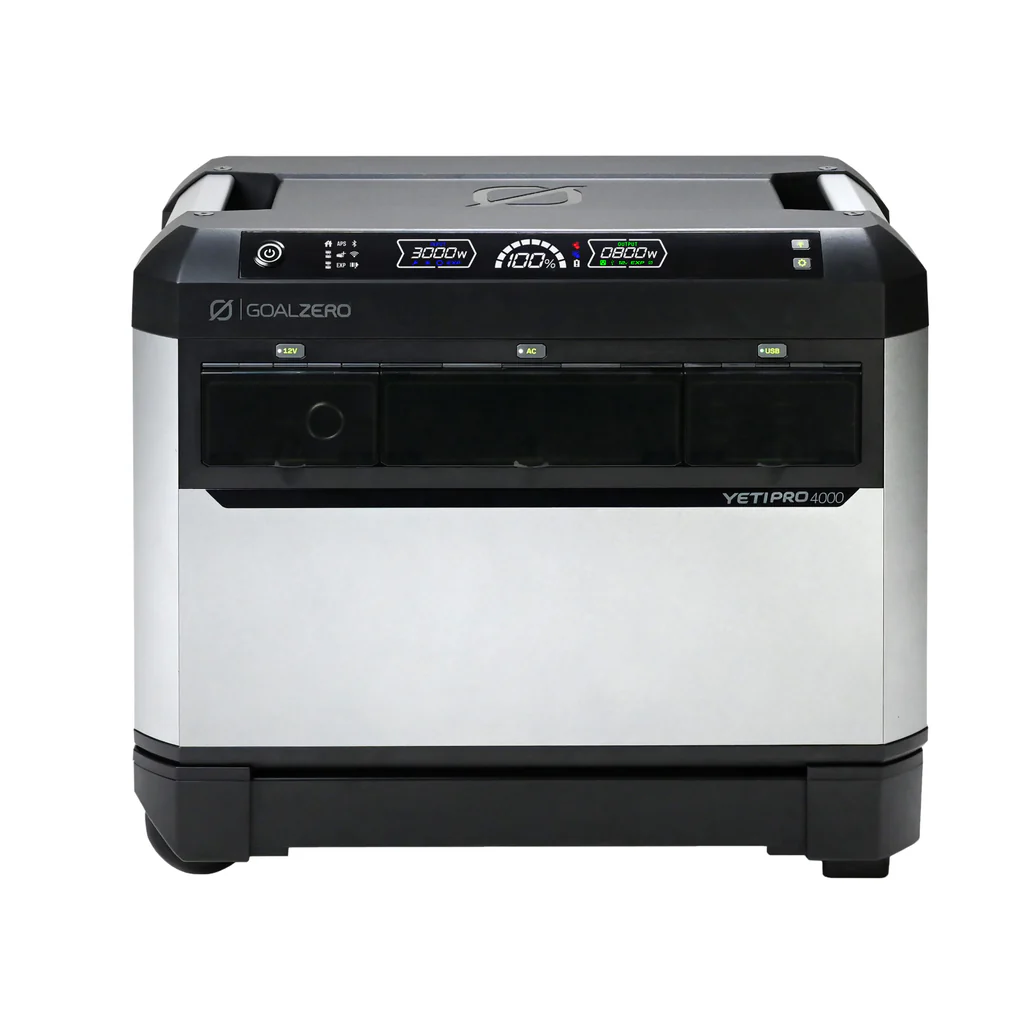
$3,999.95 · direct from Goal Zero
Last checked 1 day ago. Prices move — check before you buy.
Spec deltas
Buy the Elite 400. It's $1,399 against $4,000 for the Yeti PRO 4000, and the extra $2,601 does not buy capacity: 3,840Wh versus 3,994Wh is a difference of 154Wh. On the eight-hour blackout load this site models, that's the gap between using half the Elite and 48 percent of the Yeti. Nobody has ever felt two percentage points.
The premium doesn't buy faster backup either. Both units transfer to battery in 15ms, so a desktop, a modem or a sump controller sees the same brief dip whichever box is under the bench. Neither one is a zero-transfer online UPS, and neither pretends to be.
What the premium actually buys is three things you can name: 1,000W more continuous inverter, roughly double the surge ceiling, and three times the solar input, plus a port for expansion batteries. Those are real, and a narrow slice of buyers genuinely needs them. Everyone else is looking at a box that clears every load this page tests, for a third of the money.
What the Numbers Reveal
Each conclusion stated first — the numbers behind it on one line, the full analysis below.
Capacity
Thirty-six cents a watt-hour against a dollar even. That spread isn't paying for stored energy and it isn't paying for backup response, because both are effectively matched. It's paying for inverter headroom, solar input, and an expansion port. Three things you either specifically need or specifically don't, with no middle ground where you get a little of each.
Elite 400: $1,399 for 3,840Wh, or 36 cents a watt-hourYeti PRO 4000: $4,000 for 3,994Wh, or a dollar a watt-hourBoth units transfer from grid to battery in 15ms
Why it mattersIf you can't name the appliance, the panel array, or the expansion you're going to buy, you're paying the premium for four percent.
rated cycles
This is the one spec on the page that genuinely earns part of the Yeti's premium, and it arrives with a condition attached. A 3,000W input only helps if you own 3,000W of panels, bought separately, hauled and deployed separately. Buy the Yeti for its solar port and you haven't bought a battery, you've committed to an array.
Yeti PRO 4000 accepts 3,000W of solar input, clocked at 0-100 percent in under two hours off-gridB2Elite 400 accepts 1,000W of solar; 3,840Wh divided by 1,000W is just under four hours at full inputElite 400 refills from AC in about 70 minutesA2
Why it mattersSolar-only for days at a stretch, with the panels to match: take the Yeti. Everyone else pays for an input they'll feed at a fraction of its rating.
continuous output
Both units start the peak of all six scenarios here, including the one neither can finish. So the Yeti's extra surge isn't protecting the fridge or the coffee maker in the situations most people land on this page for. It's protecting the well pump, the shop compressor, the tool with a hard start. A specific machine you either own or you don't.
Yeti PRO 4000: 3,600W continuous, 7,200W surgeElite 400: 2,600W continuous, 3,900W surgeEvery one of the six scenarios shows both units able to start its peak load
Why it mattersOwn that machine and the Yeti's inverter justifies itself on its own. Don't own it, and you've insured a load that isn't on your list.
Typical price
A cycle rating is a promise about cells, not about the box around them. On weekend duty the Elite's 3,000 cycles already run 28.8 years and the Yeti's run 38.5. Both are promises you will never collect, because you'll replace either unit for a reason that has nothing to do with its battery. Paying twice per stored kilowatt-hour for a decade past your own replacement horizon, on the unit with the open reliability threadB3, is the wrong direction to spend.
Elite 400: 3,000 cycles on a 3,840Wh pack is 11,520 kWh of lifetime energy, 12 cents per lifetime kWh at $1,399Yeti PRO 4000: 4,000 cycles on a 3,994Wh pack is 15,976 kWh, 25 cents per lifetime kWhOne thread of owner reports describes 12V errors on the Yeti PRO 4000, including a first unit returned or replaced and a second that threw a 12V error and would not charge from solarB3
Why it mattersAnyone shopping this pair on which one lasts longer should stop: both outlive realistic use by decades. Shop on which one you're still happy to own in year eight.
The specific dimensions that decide these two units — everything else is a tie.
Lifetime Value
Selected because: Both are five-year-warranty LFP boxes within 154Wh of each other, so what actually separates them is what a stored kilowatt-hour ends up costing over the life of the cells.
cost / lifetime kWh
Twelve cents a lifetime kilowatt-hour against twenty-five. The Yeti gets there honestly: 4,000 cycles on a 3,994Wh pack works out to 15,976 kWh of stored energy across its life, against 11,520 kWh for the Elite, and that extra 39 percent is the strongest defense the price has. It just never closes the gap, only narrows it to about two to one.
Per warranty year it's $280 against $800, for five years of coverage each. Same length of promise, nearly triple the annual cost, and the coverage runs out long before either battery does. If you're going to pay a premium on a power station, pay it for something that shows up in the first five years, because that's the only window anyone is guaranteeing.
Your Life, Your Pick
Selected because: Five of the six modeled loads end in a tie and the sixth defeats both units, which is the clearest evidence that capacity is not what you're choosing between.
Five loads, five ties, and one that beats both boxes. Camping, blackout, CPAP, remote work, tailgate: the Elite and the Yeti clear every one of them with charge to spare, separated by a percentage point or two, which is a rounding error you will never notice on an actual Saturday.
The sixth is the one worth staring at. A full van-life day wants 4,685Wh, which is 144 percent of what the Elite can deliver and 138 percent of what the Yeti can. Both run out before morning. The Yeti runs out slightly later, and that changes nothing about the fact that you wake up to a dead box. If that's your daily draw, neither of these is the answer and the premium buys you a marginally later failure.
What the Specs Don't Tell You
Selected because: The Yeti's surge ceiling and its missing noise figure are the two spec facts most likely to move a buyer, and they move in opposite directions.
rated cycles
A 2x surge-to-continuous ratio against 1.5x is the Yeti's best card here, and it deserves to be played straight: 7,200W of surge on a 3,600W inverter, against 3,900W on a 2,600W inverter. That ratio is a decent tell for how much an inverter has been over-built. The Elite starts every peak load modeled on this page. The Yeti starts them with 3,300W of room left over.
Against that, Goal Zero publishes no noise figure for the Yeti PRO 4000 at all, while BLUETTI rates the Elite 400 at 30 dBA. A missing number isn't proof of a loud fan. It does mean that on the one spec deciding whether this thing can live in a bedroom during an outage, you're buying blind, and you only find out after the freight arrives.
Growth Path
Selected because: The Elite 400 is sealed at 3,840Wh while the Yeti PRO 4000 takes expansion batteries, the one structural advantage the price gap can honestly be argued from.
solar input
Here's the Elite's real weakness, before anyone else raises it: 3,840Wh is the ceiling. No expansion port, no second pack, no upgrade path that isn't buying a whole second unit. The Yeti PRO 4000 takes Goal Zero expansion batteries, so its 3,994Wh is a floor instead of a wall, and that is a structural difference no amount of price advantage erases.
It matters if you're heading toward partial-home backup and you already know it. It matters much less for outages and weekends, because the honest way to read an expansion port is as a coupon for a future purchase you haven't priced yet. A sealed box you never outgrow beats an expandable one you never expand. Check 3,840Wh against your longest unplugged stretch, and if it clears, the ceiling is not your problem.
Portability & Form Factor
Selected because: 115.7 lbs against 85 lbs decides whether you can move the thing alone, and both are heavy enough that it matters.
weight
115.7 lbs is where portable stops describing the object. That's a two-person liftB1, or one person and a plan they'll regret on the second step. The Elite's 85 lbs isn't light either, but it comes with wheels and a built-in trolleyA2A3, and 30.7 lbs is roughly the margin between wrestling it into a trunk yourself and going to find a neighbor. If the unit lives on a garage shelf and never moves, skip this section entirely. If it goes camping, this is the section that decides.
Strengths & trade-offs
BLUETTI Elite 400
Strengths
- +Costs $2,601 less
- +Lighter by 30.7 lb
Trade-offs
- –Weaker inverter (-1,000W) limits appliance compatibility.
- –Very heavy unit that may be difficult for one person to lift.
- –Sealed capacity — the Yeti PRO 4000 can add batteries to grow past 3,840Wh; this one can't.
- –Shorter-lived battery — rated for 3,000 charge cycles vs the Yeti PRO 4000's 4,000, so it wears out sooner.
Goal Zero Yeti PRO 4000
Strengths
- +Larger battery capacity
- +Higher AC output
- +Faster solar charging
- +Rated for 4,000 charge cycles — much longer battery lifespan
Trade-offs
- –Substantially more expensive (+$2,601) than the Elite 400.
- –Significantly heavier (+30.7 lbs), making it harder to move.
- –Very heavy unit that may be difficult for one person to lift.
Will It Power Your Gear?
Scenario math and per-appliance runtimes, modeled from the spec record.
Scenario verdicts
We ran the math on six real-world scenarios. Here's which unit survives your actual life.
SCN-01 · 2 nights · needs 2,100Wh
Weekend Camping
Two nights off-grid with essential comfort
Elite 400
A weekend takes 64 percent of the Elite and 62 percent of the Yeti, so both come home with charge left and this is a coin flip. Settle it on weight instead: 85 lbs against 115.7 lbs matters far more at a campsite than two percentage points of headroom you never reach.
Battery budget usedlower = more headroom
LOAD Phone Charger 15W×6h · LED Lights 40W×8h · Box Fan 75W×14h · CPAP Machine 40W×16h
SCN-02 · 8 hours · needs 1,645Wh
8-Hour Blackout
Keep the essentials running through a night without power
Either unit
Both boxes walk this one. The load takes half the Elite and 48 percent of the Yeti, which is a dead heat in every sense that matters when the lights are out. Backup switching is 15ms on both, so there's nothing left to break the tie except price.
Battery budget usedlower = more headroom
LOAD Fridge 150W×8h · Router + Modem 20W×8h · LED Lights (4 bulbs) 40W×6h · Phone Charger 15W×3h
SCN-03 · 8 hours · needs 320Wh
CPAP Overnight
Sleep therapy without interruption — the #1 medical use case
Either unit
A CPAP night draws about a tenth of either box, so capacity is irrelevant here and the fan is the whole question. BLUETTI publishes 30 dBA for the Elite 400. Goal Zero publishes nothing for the Yeti PRO 4000. When the unit is sitting a couple of feet from your head all night, a number you can check beats a number you can't.
Battery budget usedlower = more headroom
LOAD CPAP Machine 40W×8h
SCN-04 · 8 hours · needs 910Wh
Remote Workday
Full work day off-grid without power anxiety
Either unit
Both power your workstation all day without strain, and their USB-C output is a wash — pick on weight, ports, or price.
Battery budget usedlower = more headroom
LOAD Laptop 60W×8h · External Monitor 30W×8h · Router + Modem 20W×8h · Phone Charger 15W×2h
SCN-05 · 4 hours · needs 670Wh
Tailgate Party
Game day power for the crew
Elite 400
The Yeti PRO 4000 at 115.7 lbs is not a take-along — it rolls off a truck bed if it travels at all, so this scenario belongs to the Elite 400 by default — and it earns it, covering the 670Wh with 2,594Wh to spare. Capacity was never the Yeti PRO 4000's problem here; getting to a tailgate was.
Battery budget usedlower = more headroom
LOAD Blender 400W×0.5h · LED TV (55") 80W×4h · Bluetooth Speaker 15W×4h · Phone Charger (×3) 45W×2h
SCN-06 · 24 hours · needs 4,685Wh
Van Life Daily
A full day of mobile living — the ultimate endurance test
Neither unit
Neither one gets you through this. A full van day wants 4,685Wh, which is 144 percent of what the Elite can deliver and 138 percent of what the Yeti can, and losing by six points is still losing. A draw this size wants an expandable stack or a fixed install rather than a portable box, and the real fix is more panel and a smaller daily load.
Battery budget usedlower = more headroom
LOAD Mini-Fridge 150W×24h · Laptop 60W×4h · Phone Charger 15W×3h · LED Lights 40W×5h · Fan 75W×8h
The Load Test
RUNTIME = (Wh × 0.85) ÷ LOAD
None of the scenarios above exactly yours? Build it. Toggle what you'd plug in; both units are tested against the combined draw.
Essentials
Comfort & Convenience
High-Draw Appliances
Test duration
8h
Continuous draw
205W
Projected runtime
Dead heat — both run this 205W load for roughly 15.9h. Pick on price, weight, or ports.
Modeled from the spec record — same math as the tables below. Methodology
Runtime by appliance
Real-world runtime estimates for common appliances, modeled at 85% inverter efficiency.¹
Essentials
The basics you need runningscale 0–226.3hComfort & Convenience
Makes off-grid life actually enjoyablescale 0–45.3hHigh-Draw Appliances
These reveal the real limitsscale 0–3.4h¹ Runtime = (capacity × 0.85) ÷ appliance watts. Within each group, all bars share one time scale (the group's longest runtime), so lengths are comparable across appliances; identical runtimes collapse into a single blue/orange bar. Actual runtime varies with battery age, temperature, and simultaneous loads — see methodology.
Conclusion
August 2, 2026
Verdict: the BLUETTI Elite 400
Buy the BLUETTI Elite 400 unless you can name the specific load, panel array, or future expansion that needs the Goal Zero. These two cover every scenario on this page identically, hand off to battery at the same speed, and land 5,086 against 5,373 on our PowerScore, 287 points apart. The Yeti's genuine advantages are 1,000W more continuous inverter, roughly double the surge ceiling, three times the solar input, and a port for expansion batteries. Each of those costs more money to actually use: panels you don't own yet, appliances you may not have, extra battery sold separately. The Elite gives you 3,840Wh, the same 15ms handoff, a published 30 dBA and a built-in trolleyA2A3 for $1,399. Start there and spend what's left on panels.
Today the Elite 400 is $1,299, $100 under its typical $1,399. The verdict weighs typical prices, not today's. Prices checked 1 day ago.
Editor-assigned confidence, based on cited owner research and spec analysis.
List prices as of August 2, 2026. The links below open BLUETTI's and Goal Zero's current prices.
$1,299.00 · direct from BLUETTI
down from $1,399 · 7% below usual
Last checked 1 day ago. Prices move — check before you buy.
or check the Yeti PRO 4000 price$3,999.95 list
Written by Gunner Gustafson, Whole-Home Backup Tester · Station Arena Test Desk · Updated August 2, 2026
Measured Data
Benchmark scores and the full spec record, side by side.
Benchmark scores
Not rated for both units (minimum threshold unmet): UPS.
Full specifications
ᵈ Derived: price ÷ rated capacity. See the data behind our comparisons →
Comparison ToolAdd more power stations, side by sideOpen Tool →How these numbers are produced
Numeric verification
Every figure on this page traces to our spec database or arithmetic on it — no estimated numbers.
Owner claims
Statements about owner experience are cited to published reviews — see Sources & Research Notes below.
Runtime model
Runtime = (rated capacity × 0.85 inverter efficiency) ÷ device wattage. Solar recharge estimates assume panels deliver 70% of rated output. Cold weather, battery age, and stacked loads reduce real-world results.
Power Score
Computed from 14 published spec dimensions, weighted per use-case bench. Higher is better; a unit must meet a bench's minimum threshold to be rated.
See the full weight table and data sourcing on our methodology page →Class ranking (the star rating)
Each unit's star score is a category ranking, not customer reviews — no buyer opinions feed it. We score every station on size-independent quality (value, output, portability, endurance, ports, warranty, and more), then percentile-rank it against the other units in its capacity class, so a class-leading compact unit and a class-leading whole-home unit can both earn 5★. Here, Elite 400 rates 3.8/5 (27th percentile of 16 Home Backup-class units), and Yeti PRO 4000 rates 3.6/5 (20th percentile of 16 Home Backup-class units).
How the class ranking is computed →Test Notes & Caveats
Hidden gotchas and advantages we spotted that you won't find on the product page.
Neither of these travels light
115.7 lbs on the Yeti PRO 4000 is a two-person lift, or a very deliberate one-person one. The Elite 400's 85 lbs is 30.7 lbs better and still a bent-knees job. Both are manageable on flat ground and neither is manageable on basement stairs, so decide now where the thing is going to live.
Elite 400: what you buy is the ceiling
The Elite 400 is sealed at 3,840Wh. No expansion port, no second pack, no upgrade path that isn't a whole second unit, and this is the one place the Yeti PRO 4000 has a genuine structural answer. It only bites if your needs actually grow. Check 3,840Wh against your longest unplugged stretch before you commit, because nothing gets added later.
The Yeti has the better inverter
A 2x surge-to-continuous ratio against the Elite's 1.5x is a decent tell for how much margin an inverter carries. Motors pull a multiple of their running wattage in the instant they start, and that margin is what absorbs it. Both units start every peak load modeled on this page. The Yeti does it with considerably more room left.
Warranty: No Difference
Both units carry the same 5-year warranty, so coverage isn't a tiebreaker here. The Elite 400's figure is a maximum rather than a guarantee — it depends on buying direct from BLUETTI or registering the unit, since reseller purchases carry a shorter term. Worth saying because the per-dollar framing can suggest otherwise: the Elite 400 works out at 3.6 years of cover per $1,000 spent against the Yeti PRO 4000's 1.3, but that spread is the price gap, not the terms.
Battery Lifespan in Real Years
The Yeti PRO 4000 is rated for 4,000 cycles vs 3,000. In real life: at daily use, that's 11 vs 8.2 years. At weekend use (twice a week), it's 38 vs 29 years. After hitting the cycle limit, the battery doesn't die — it drops to ~80% of original capacity, which is still very usable.
Goal Zero doesn't publish a noise figure
BLUETTI rates the Elite 400 at 30 dBA. There's no published number for the Yeti PRO 4000, which isn't evidence of a loud fan but does mean you can't compare the one spec that decides whether this unit can share a bedroom. Undisclosed is not the same thing as quiet.
Full record above — the Test Desk pick is the Elite 400.
Check Elite 400 price →or check the Yeti PRO 4000 priceOwnership Analysis
What happens after you buy — true cost of ownership, brand trust, and growth potential.
Lifetime value
Service lifeyears at one full cycle per day
Lifetime energy delivered
Cost per delivered kWh
│ warranty ends · Reaching the cycle rating means ~80% capacity remains — degraded, not dead.
Analyst note
The Elite 400 wins on both sticker price and long-term value. At $0.12/kWh over its lifetime, it's meaningfully cheaper to own. Clear value winner.
Delivers each lifetime kWh for $0.13 less — check the Elite 400 price →
Brand trust
BLUETTI
Ecosystem
One of the broadest lineups — 15-20+ models from budget (AC2A) to flagship portable (Apex 300, 2764.8Wh). Includes specialized products: vehicle solar hubs, sodium-ion cold-weather units, and balcony storage systems.
Support
BLUETTI's support is the most inconsistent in the category, and it's the honest cost of the price. It's email-first with China-timezone delays, and outcomes swing from smooth and efficient to weeks of runaround. Buying direct from BLUETTI rather than through a third party improves the odds noticeably. Treat this as a real risk on a $1,399 purchase, not a footnote.
Community
Active and growing — Reddit r/bluetti has a dedicated community. Second-largest after EcoFlow in engagement.
App experience
Rated 4.5/5 iOS and Android — tied for best app experience in the category. V3.0 UI redesign was well-received.
Unique strength
Among the best capacity-to-price ratios available — several Elite and Apex units are the lowest $/Wh in the catalog. Widest product diversity including industry-firsts like sodium-ion cold-weather units and dual solar+alternator vehicle hubs. LFP across the rest of the range, though rated cycle life spans 2,500 (EB3A) to 6,000, and it varies WITHIN the Elite range rather than tracking it — the Elite 300 and Elite 200 V2 are rated 6,000 while the Elite 30 V2, Elite 10 Mini, Elite 320 and Elite 400 are rated 3,000+ and the Elite 100 V2 4,000+, so check the specific model. Dual-voltage (120V/240V) in flagships.
Worth knowing
BLUETTI's entire position is capacity per dollar, and the Elite line is where that shows up hardest, with full LFP standardization across the lineup. The tradeoff is a support organization that hasn't scaled with the product range, plus older discontinued units that can become unrepairable for want of spare parts.
Goal Zero
Ecosystem
Focused — a compact current line (6th-gen Yeti and Yeti Pro series), the previous-gen X series now out of stock across every model on Goal Zero's own store (checked 2026-09-13: 200X, 500X, 1000X, 1500X, 3000X, 6000X, some listed only as open-box), so buying one new means finding retailer stock, Sherpa power banks for the under-100Wh tier, plus Alta coolers, Nomad/Ranger solar panels, and vehicle integration kits
Support
Goal Zero is a US company in Salt Lake City, and for years that was the answer to why it costs more. The answer is thinner now. Through 2025-2026 the wait times have run long, tickets have gone unaddressed, and the official community forums were shut down. The premium is still charged. The premium service is less reliably delivered.
Community
Small but loyal — strong following in overlanding and preparedness communities. Official community forums were recently shuttered, frustrating long-time users.
App experience
Rated 4.4/5 iOS (~1,200 ratings) but recent reviews skew negative — recurring connectivity issues, crashes, and stability problems.
Unique strength
Goal Zero effectively started this category and still builds like it: IPX4-rated, weather-resistant hardware inside a tight Yeti-Ready ecosystem of coolers, lights and vehicle kits. If you want one US company's system rather than a battery plus accessories, nothing else on this page offers it.
Worth knowing
Typically the priciest brand per watt-hour — though individual pairings vary, and on some pages the Yeti is the cheaper energy. Support quality has declined from its "premium" standard. Perceived as competitively stagnant vs. faster-innovating Chinese competitors. Reliability reports on newer models are concerning.
Analyst note
This is the value brand against the heritage brand, and both trades are real. BLUETTI gives you the best capacity-per-dollar in the category alongside support that may test your patience. Goal Zero gives you US-based, ruggedized hardware and a service reputation it is currently living off rather than earning. Neither app decides it: BLUETTI's rates 4.5 out of 5 after a well-received redesign, Goal Zero's rates 4.4 and has been trending the wrong way on connectivity and stability.
Growth path
Elite 400
FIXED CAPACITYFixed at 3,840Wh — a sealed, complete system rather than a starting point. There's no expansion port, so that figure is the ceiling: check it against your longest unplugged stretch before you buy.
Accepts up to 1,000W of solar. Enough for a serious multi-panel array.
Adequate ports for most setups, but heavy users may want a power strip.
Yeti PRO 4000
EXPANDABLESupports Goal Zero expansion batteries, so you can add capacity later without replacing the base unit — useful if your needs may climb past 3,994Wh.
Accepts up to 3,000W of solar. Enough for a serious multi-panel array.
Generous port selection supports complex multi-device setups.
Expansion batteries are Goal Zero-specific. You're investing in the Goal Zero ecosystem.
Realistic full solar rechargeat 70% of rated panel output — see methodology
Analyst note
The Elite 400 is sealed at 3,840Wh, which is fine if that covers you. The Yeti PRO 4000 starts at 3,994Wh and can grow beyond it with Goal Zero expansion batteries — real headroom the Elite 400 doesn't have if your needs climb toward partial-home backup.
What Owners Report
Patterns from published owner reports and long-term reviews — every claim cited to its source below.
BLUETTI Elite 400
Field coverage on the Elite 400 comes from reviewers rather than long-term ownersA1A2A3A4, so read it as a strong first impression rather than a durability record. Reviewers call it one of the most complete units at the 3,000Wh-plus tier, pointing at the 3,840Wh LFP pack, 3,900W of power lifting, roughly 70-minute fast charging and 15ms UPSA2. Weight measures around 86 lbs in reviewer hands, a shade above our listed 85, and they're consistent that the wheels and trolley take most of the sting out of itA3.
The complaints are specific and worth respecting: only two AC sockets, and no battery expansion, both flagged as compromises on an otherwise strong unitA1A4. Two AC outlets on a 2,600W inverter is the one that would irritate me in an outage, when the fridge, a lamp and the modem all want a plug at the same time. A power strip solves it for small loads and doesn't solve it for anything with a motor.
“BLUETTI's largest Elite-range unit — a 3,840Wh LiFePO4 battery with 2,600W continuous output (3,900W Power Lifting), fixed at native capacity with no expansion.”
Sources
techradar.com · amazon.com · backuppowerhub.com · cleantechnica.com · notebookcheck.net · thesolarlab.com · edinburghnews.scotsman.co
Goal Zero Yeti PRO 4000
The Yeti PRO 4000 draws the strongest build praise on this page. Reviewers rate it among the most durable units they've handled, backed by American-based support and a good appB1, and the 3,000W solar input is the spec they keep returning to, with 0-100 percent in under two hours off-gridB2. At roughly 3,994Wh it gets specific praise for RV and camping backupB4.
The reliability thread is the counterweight and it isn't nothing: one set of owner reports describes 12V errors, including a first unit returned or replaced and a second that threw a 12V error and wouldn't charge from solarB3. That's a single thread rather than a pattern across many independent sources, so don't read it as a verdict on the model. Read it as the reason a premium price ought to come with something more than a premium price.
“Weighs about 115.7 lbs — a two-person unit to move — with one of the most durable builds reviewers have seen, backed by American-based support and a great app.”
Sources
bestgeneratorsolar.com · thesolarlab.com · goalzero.com · business.walmart.co · techradar.com · cleantechnica.com
Sources & Research Notes
Every owner claim in this report is traceable to a published source. The bracketed references above resolve here.
Recurring owner themes
- Large 3,840Wh LFP capacity, fast charging, 15ms UPS, and a trolley are the praise; only two AC sockets, no expansion, and heavy weight are the caveats. [Elite 400 · 2 entries]
- Strong solar input, a great app, American-based support, and a durable build are the praise; heavy weight and some owner reliability reports (12V errors) are the caveats. [Yeti PRO 4000 · 3 entries]
- A1
“BLUETTI's largest Elite-range unit — a 3,840Wh LiFePO4 battery with 2,600W continuous output (3,900W Power Lifting), fixed at native capacity with no expansion.”
techradar.com / amazon.com — Elite 400 review · 2026 · [mixed]
- A2
“Combines 3,840Wh LFP capacity, 3,900W surge, 70-minute fast charging, 15ms UPS protection, and a built-in trolley system — one of the most complete units at the 3,000Wh+ tier in 2026.”
backuppowerhub.com / cleantechnica.com — Elite 400 review · 2026 · [positive]
- A3
“A hefty ~86 lbs (39 kg), though reviewers note it's lighter than some competitors, with wheels and a trolley for mobility.”
notebookcheck.net / thesolarlab.com — Elite 400 review · 2026 · [mixed]
- A4
“Powerful, but reviewers flag only two AC sockets and no battery expansion as compromises — good but not quite as good as it could have been.”
techradar.com / edinburghnews.scotsman.com — Elite 400 review · 2026 · [mixed]
- B1
“Weighs about 115.7 lbs — a two-person unit to move — with one of the most durable builds reviewers have seen, backed by American-based support and a great app.”
bestgeneratorsolar.com / thesolarlab.com — Yeti PRO 4000 review · 2026 · [mixed]
- B2
“3,000W solar input recharges 0-100% in under 2 hours off-grid, with impressive surge and idle efficiency; fully expandable.”
goalzero.com / thesolarlab.com — Yeti PRO 4000 review · 2026 · [positive]
- B3
“Owner reliability is mixed — some report 12V errors, including a first unit returned or replaced and a second that had a 12V error and would not charge from solar.”
business.walmart.com reviews / oliver owner forums — Yeti PRO 4000 · 2026 · [negative]
- B4
“Roughly 3,994Wh capacity; praised for RV and camping backup.”
techradar.com / cleantechnica.com — Yeti PRO 4000 review · 2026 · [positive]
Research compiled August 2, 2026.
Who Should Buy Which
Buy the Elite 400 if you…
- →The blackout buyer whose list is a fridge, a modem, a couple of lamps and everyone's phones. That load uses half the Elite over eight hours and leaves the other half for the next morning.
- →Anyone putting a desktop, a NAS or a home lab behind it. The 15ms transfer is identical on both units, so the cheaper one delivers exactly the same ride-through.
- →The camper or RV owner who wants one big battery and not a project: 3,840Wh, 30 dBA on the spec sheet, and a trolley to move itA2A3, for $1,399.
- →The buyer who'd rather keep the difference. What separates these two prices is enough to buy a second Elite 400 outright, which is a better redundancy story than any expansion port.
Buy the Yeti PRO 4000 if you…
- →You own the motor. A well pump, a shop compressor, a tool with a hard start: the surge ceiling is the entire reason to be on this side of the page.
- →You're solar-only for days at a time and you already have the panels, or you're buying them. Three times the input turns a full charging day into a long lunchB2.
- →You're building toward partial-home backup and expect to pass 3,994Wh. The Elite has no answer to that, and expansion batteries are a real structural advantage rather than a marketing one.
- →You want hardware from a US-based company with a durable, weather-resistant build and an ecosystem behind it, and you've decided that's worth paying forB1.
If neither fits
If your real daily draw is a full van-life load at 4,685Wh, both of these fail on the same night: that's 144 percent of what the Elite can deliver and 138 percent of what the Yeti can, and losing by less is still losing. Go look at an expandable stack or a fixed installation, not a box you carry. At the other end, if what you actually run overnight is a 320Wh CPAP, you're shopping for twelve times the battery you need against a 3,840Wh unit. Buy something a fraction of this size, cheerfully, and put the rest toward panels.
The Bottom Line
Take the Elite 400. It lands within four percent of the Yeti's capacity, clears every load this page models, hands off to battery at the same speed, and asks $1,399 to do it. The Yeti's longer cycle life claws back part of that gap over the full life of the cells and never closes it, which leaves the premium resting on inverter headroom and a solar port.
The exception is honest and it's narrow. If you own the motor that needs the Yeti's surge to start it, or you're feeding a 3,000W array, or you know you'll outgrow 3,994Wh, Goal Zero is selling something BLUETTI isn't. Everyone else is being asked to pay for headroom they will never touch. Buy the Elite, put the difference into panels, and you'll still be ahead of where the Yeti would have left you.
Frequently Asked Questions
Answers drawn from the spec record and cited owner research.
Is the Goal Zero Yeti PRO 4000 worth $2,601 more than the BLUETTI Elite 400?
Only if you can name what you'd do with the surge, the solar input, or the expansion port. At $4,000 against $1,399 you're paying nearly three times as much for four percent more capacity, 3,994Wh versus 3,840Wh, with identical 15ms backup switching. For a fridge-and-router blackout kit that's a bad trade. For a well pump and a rooftop array it isn't.
Can I use either one as a UPS for a computer?
Both hand off from grid to battery in 15ms, and it's the same figure on either unit, so backup speed is not a reason to choose between them. Neither is a zero-transfer online UPS, though. Both take a brief break before the battery picks up, so if you're protecting hardware that genuinely cannot see any interruption, you want a double-conversion UPS rather than a power station.
Which one is better for home backup?
The Elite 400 for outage-scale backup, the Yeti PRO 4000 if you're building toward running part of the house. An eight-hour blackout load uses half the Elite, and it costs $1,399. The Yeti's case is a 3,600W continuous inverter, 7,200W of surge, and Goal Zero expansion batteries that let it grow past 3,994Wh. Sealed at 3,840Wh, the Elite can't follow it there.
How much faster does the Yeti PRO 4000 recharge from solar?
Three times the input: 3,000W against the Elite's 1,000W, which reviewers translate to 0-100 percent in under two hours off-grid. The Elite needs just under four hours at its full rating, which is 3,840Wh divided by 1,000W, and that's before real-world panel losses. The catch is that a 3,000W input only helps if you own 3,000W of panels, and those are a separate purchase.
How heavy are these really, and can one person move them?
The Elite 400 is 85 lbs and the Yeti PRO 4000 is 115.7 lbs, so the Elite is 30.7 lbs lighter. The Yeti is a two-person lift. The Elite has wheels and a built-in trolley, which makes flat ground easy and leaves stairs unpleasant. Neither of these is a grab-and-go unit, so plan where it lives before it arrives.
Where to buy
BLUETTI Elite 400Pick
$1,299.00
$1,299.00 · direct from BLUETTI
down from $1,399 · 7% below usual
Last checked 1 day ago. Prices move — check before you buy.
Goal Zero Yeti PRO 4000
$3,999.95
$3,999.95 · direct from Goal Zero
Last checked 1 day ago. Prices move — check before you buy.
Prices may vary by retailer and are subject to change.