Head-to-head test
Anker SOLIX S2000 vs Jackery Explorer 1500 Ultra
The cheaper unit here is also the bigger, lighter, longer-lived one, so the only live question is whether you're buying a battery or buying a sealed box that refills from panels twice as fast.
Full profiles: Anker SOLIX S2000 → · Jackery Explorer 1500 Ultra →

Written by Ian SchneiderUpdated
Solar & Off-Grid Tester, Station Arena Test Desk
Spec deltas
The cheaper unit here is also the bigger one: 2,009.6Wh in the Anker SOLIX S2000 against 1,536Wh in the Jackery Explorer 1500 Ultra, for $499 less. It's rated for 10,000 cycles to the Explorer's 4,000, and it weighs 35.7 lbs against 38.6. Premiums usually buy something.
What the $499 does buy is narrower than the spec table suggests, and it's worth naming up front, because for two kinds of buyer it's the entire argument. The Explorer takes 800W of solar input against the S2000's 400W, and it's built to an IP65 seal that reviewers called unique at its price bracketB1. If your power station lives outdoors, or refills from panels in a short window of sun, those are two things money genuinely cannot buy on the Anker side of this page.
Everything else that looks like a Jackery advantage shrinks on inspection. Both makers publish peak output at exactly twice their rated figure, 1,500W and 3,000W on the S2000 against 1,800W and 3,600W on the Explorer, so the 600W surge gap is the 300W output gap wearing a disguise. It only touches you if you own one appliance that draws between those two numbers. Take the S2000 unless the box is going to get rained on.
What the Numbers Reveal
Each conclusion stated first — the numbers behind it on one line, the full analysis below.
solar input
That advantage is real, and it is also narrow, because the day it would matter most is the one neither unit finishes. Van Life Daily needs 4,685Wh and the Explorer covers 28% of it. Panels refill a battery during daylight; van-life draw happens after dark, through a 1,536Wh tank that is the bottleneck no input rate can widen. The 800W figure pays off on short trips with real panels and a bad sky, not on the deficit days.
Explorer 1500 Ultra accepts 800W of solar input; SOLIX S2000 accepts 400WExplorer 1500 Ultra holds 1,536Wh; SOLIX S2000 holds 2,009.6WhVan Life Daily asks 4,685Wh a day and neither unit covers it: the S2000 is 2,977Wh short, the Explorer 3,379Wh
Why it mattersIf you carry panels and camp under trees or in late-season sun, price that input seriously. If your unit mostly refills from a wall socket, it never touches you.
continuous output
The surge column never gets tested here anyway, because nothing modelled asks for more than 400W at startup and both units start all of it. What the Explorer's 1,800W rating actually buys is headroom for a single sustained load sitting between 1,500W and 1,800W: a space heater run at full, a large microwave. That's a genuine appliance-shaped reason to pay more, and it's the only one hiding in these two rows.
SOLIX S2000: 1,500W rated output, 3,000W surgeExplorer 1500 Ultra: 1,800W rated output, 3,600W surgeThe heaviest startup draw in any modelled scenario is 400W, at the Tailgate Party, and both units start every one of the six
Why it mattersGo read the nameplate on the one appliance you're worried about. Under 1,500W and this whole comparison collapses back to capacity and price.
rated cycles
Now the honest part: nobody collects on it. Eleven years of daily cycling already outruns the 5-year warranty on both units by six, and the S2000's 27.4-year figure is a spreadsheet artifact rather than a purchase reason. What the cycle rating actually tells you is what sort of cells sit behind the lower price, and the answer is not cheap ones. The reason to buy the S2000 is the 473.6Wh you get today for less money. The cycle gap is just the receipt proving the discount didn't come out of the battery.
SOLIX S2000: 2,009.6Wh rated for at least 10,000 cycles, 20,096 kWh over the rated lifeExplorer 1500 Ultra: 1,536Wh rated for 4,000 cycles, 6,144 kWhBoth carry a 5-year warranty, and 4,000 cycles at daily use is 11 years
Why it mattersIgnore the year counts on both units. Do notice that the cheaper box is the one with the better-rated cells in it.
The difference you'll actually swear about at 9pm isn't the 63Wh, it's the sockets. Five AC outlets against two. A blackout is a fridge, a router, a lamp and two phone bricks running at once, and with two outlets that's a hunt for a power strip by flashlight. Capacity decides whether the night ends early. Outlet count decides whether the night is irritating.
8-Hour Blackout asks 1,645Wh; the S2000 finishes with 63Wh of usable energy left, the Explorer stops 339Wh short at about 79% coveredThe S2000 has five AC outlets; the Explorer has twoUsable energy is figured with a flat 85% derate applied to every unit: 1,708Wh for the S2000, 1,306Wh for the Explorer
Why it mattersBuying for grid failure? Count the sockets, take the larger tank, and still plan to switch something off.
The specific dimensions that decide these two units — everything else is a tie.
Lifetime Value
Selected because: One unit here costs less and holds 473.6Wh more (2,009.6Wh against 1,536Wh) while carrying two and a half times the cycle rating. This is where that stops being a spec list and turns into money.
cost / lifetime kWh
Two batteries, and one of them will still be doing this job long after the other has been recycled, except that neither you nor I will be around to check. That's the useful thing this section shows. The figures above run to 27.4 years and 11 years of daily cycling, and both outlast any realistic ownership, so read the column as a statement about cell quality and pricing rather than a forecast.
Where it bites is now. Strip the cycle projections out entirely and just divide today's price by the energy in the box: $0.35 per watt-hour on the S2000 against $0.78 on the Explorer. That figure asks you to believe nothing about a decade from now. It's a price tag and a battery. The Explorer's premium has to come back to you somewhere else on this page, and it isn't here.
Your Life, Your Pick
Selected because: Across six modelled nights the capacity gap flips exactly one outcome, and it flips it by 63Wh. Worth seeing before you decide what the extra capacity is for.
Six modelled nights and the capacity gap flips exactly one of them. Three rows both units finish, two rows neither unit finishes, and the blackout is the single pass-fail flip, decided by 63Wh. That's a coin landing on its edge, and it's worth knowing that the S2000's win here is arithmetic rather than comfort.
The two rows nobody wins are the informative ones. Weekend Camping asks 2,100Wh and the S2000 covers 81% of it; Van Life Daily asks 4,685Wh and the S2000 covers 36%. If your actual week looks like either of those, the takeaway from this page is that you're shopping one size too small, and which of these two you pick is a detail.
What the Specs Don't Tell You
Selected because: Three cards fire here: transfer speed, warranty terms and cycle life. Two of the three are smaller differences than the spec table makes them look.
rated cycles
Three cards fire and two of them are smaller than they look. The warranty card resolves to no difference at all, the same 5-year term on each, with Jackery's reaching the full period through registration. The cycle-life card compares two numbers that both outlive your interest in the product.
The transfer-speed card is the one worth reading. The S2000 is rated no worse than 10ms and the Explorer no worse than 20ms, and both figures are ratings rather than measurements, so what you're comparing is two claims about a class of behavior. Two independent hands-on tests of the S2000 did watch a simulated outage pass without the connected office gear noticingA9A10, which is about as close to confirmation as a spec like this gets. If a desktop with unsaved work is the thing you're protecting, weigh that column. A router and a TV won't notice either figure.
Brand Trust
Selected because: Anker rates 4.5/5 on iOS against Jackery's 2.3-3.3/5, but Jackery sits on the shelf at Costco, Home Depot, Best Buy and Amazon. Software against a return counter.
The apps are where these two brands genuinely diverge. Anker's rates 4.5/5 on iOS across roughly 1,100 ratings and 4.3/5 on Android, and a hands-on reviewer called it the more polished entry in the categoryA11. Jackery ships two confusing apps that demand a login even when you're standing next to the unit, and they sit at 2.3-3.3/5 on both stores. If you plan to check the state of charge from another room during an outage, that gap isn't cosmetic.
Neither support operation is a selling point, and our brand profile is unkind to both: Anker's desk has been sliding from a genuinely excellent baseline toward scripted first responses and hazmat logistics on heavy returns, and Jackery's draws sharper criticism still. The practical hedge is Jackery's one structural advantage, which is shelf space at Costco, Home Depot, Best Buy and Amazon, putting a retailer's return policy between you and the manufacturer. Buy either one somewhere with a return counter.
Strengths & trade-offs
Anker SOLIX S2000
Strengths
- +Costs $499 less
- +Lighter by 2.9 lb
- +Larger battery capacity
- +Rated for 10,000 charge cycles — much longer battery lifespan
Trade-offs
- –No major technical downsides compared to rival.
Jackery Explorer 1500 Ultra
Strengths
- +Higher AC output
- +Faster solar charging
Trade-offs
- –Substantially more expensive (+$499) than the SOLIX S2000.
- –Shorter-lived battery — rated for 4,000 charge cycles vs the SOLIX S2000's 10,000, so it wears out sooner.
Will It Power Your Gear?
Scenario math and per-appliance runtimes, modeled from the spec record.
Scenario verdicts
We ran the math on six real-world scenarios. Here's which unit survives your actual life.
SCN-01 · 2 nights · needs 2,100Wh
Weekend Camping
Two nights off-grid with essential comfort
Neither unit
Neither tank covers the 2,100Wh a full weekend asks for. The S2000 gets you 81% of the way and the Explorer 62%, which is the whole trip minus the last evening. It's also the one row where the Explorer's 800W solar input earns its keep, filling its smaller battery in a fraction of the time the S2000's 400W ceiling needs for its larger one. Carry panels and camp somewhere sunny, and the Explorer is back to full while the Anker is still working on it. Without panels, the bigger tank simply lasts longer and that's the end of the argument.
Battery budget usedlower = more headroom
LOAD Phone Charger 15W×6h · LED Lights 40W×8h · Box Fan 75W×14h · CPAP Machine 40W×16h
SCN-02 · 8 hours · needs 1,645Wh
8-Hour Blackout
Keep the essentials running through a night without power
SOLIX S2000
The S2000 is the only one of these that finishes the 1,645Wh the outage asks for, and it finishes with 63Wh left out of 1,708 usable. Call that what it is: a pass, not a margin. The Explorer stops 339Wh short, about 79% of the way through. The difference you'll feel first, though, is the socket count, five AC outlets against two, which is the gap between plugging in the fridge, the router and a lamp, and going to look for a power strip in the dark.
Battery budget usedlower = more headroom
LOAD Fridge 150W×8h · Router + Modem 20W×8h · LED Lights (4 bulbs) 40W×6h · Phone Charger 15W×3h
SCN-03 · 8 hours · needs 320Wh
CPAP Overnight
Sleep therapy without interruption — the #1 medical use case
Either unit
A CPAP is about 40W for eight hours, so both of these cover the night several times over — capacity isn't the question here. Both happen to list 30dB — two makers' own figures landing on the same number rather than a measured tie — so there is nothing in the noise column to separate them either. Buy whichever is cheaper or easier to carry.
Battery budget usedlower = more headroom
LOAD CPAP Machine 40W×8h
SCN-04 · 8 hours · needs 910Wh
Remote Workday
Full work day off-grid without power anxiety
SOLIX S2000
The SOLIX S2000 clears the workday at 53% used, banking 798Wh — late work, extra calls, or a second laptop charge without arithmetic. The Explorer 1500 Ultra at 70% also finishes, with 396Wh of slack for the unplanned.
Battery budget usedlower = more headroom
LOAD Laptop 60W×8h · External Monitor 30W×8h · Router + Modem 20W×8h · Phone Charger 15W×2h
SCN-05 · 4 hours · needs 670Wh
Tailgate Party
Game day power for the crew
SOLIX S2000
Both handle game day; the SOLIX S2000 keeps more in reserve (39% used vs 51%). Tailgating is a light load, though, so the number you'll feel is weight: 35.7 lbs for the SOLIX S2000 against 38.6 lbs for the Explorer 1500 Ultra, from the trunk to the setup spot.
Battery budget usedlower = more headroom
LOAD Blender 400W×0.5h · LED TV (55") 80W×4h · Bluetooth Speaker 15W×4h · Phone Charger (×3) 45W×2h
SCN-06 · 24 hours · needs 4,685Wh
Van Life Daily
A full day of mobile living — the ultimate endurance test
Neither unit
Neither of these is a van-life battery. The day asks 4,685Wh; the S2000 covers 36% and the Explorer 28%. The Explorer's faster input doesn't close it either, because van-life draw happens after dark and what you can bank overnight is capped by the size of the tank, not the rate of the pipe. What either one gives you is a partial day, with the deficit arriving well before the next sunrise.
Battery budget usedlower = more headroom
LOAD Mini-Fridge 150W×24h · Laptop 60W×4h · Phone Charger 15W×3h · LED Lights 40W×5h · Fan 75W×8h
The Load Test
RUNTIME = (Wh × 0.85) ÷ LOAD
None of the scenarios above exactly yours? Build it. Toggle what you'd plug in; both units are tested against the combined draw.
Essentials
Comfort & Convenience
High-Draw Appliances
Test duration
8h
Continuous draw
205W
Projected runtime
For this load: SOLIX S2000 runs 8.3h vs 6.4h.
Sold on Amazon
Planning for more than this? Describe your whole setup and get it sized →
Modeled from the spec record — same math as the tables below. Methodology
Runtime by appliance
Real-world runtime estimates for common appliances, modeled at 85% inverter efficiency.¹
Essentials
The basics you need runningscale 0–113.9hComfort & Convenience
Makes off-grid life actually enjoyablescale 0–22.8hHigh-Draw Appliances
These reveal the real limitsscale 0–1.7h¹ Runtime = (capacity × 0.85) ÷ appliance watts. Within each group, all bars share one time scale (the group's longest runtime), so lengths are comparable across appliances; identical runtimes collapse into a single blue/orange bar. Actual runtime varies with battery age, temperature, and simultaneous loads — see methodology.
Conclusion
September 19, 2026
Verdict: the SOLIX S2000
Take the SOLIX S2000. It costs $499 less than the Explorer 1500 Ultra and gives you 473.6Wh more to spend (2,009.6Wh against 1,536Wh), five AC sockets instead of two, and a pack rated for 10,000 cycles against 4,000, which works out to 20,096 kWh of lifetime energy against 6,144. Two independent hands-on tests found it refills from a wall outlet in about 1.7 hours and idles at single-digit wattsA3A4A5, so the 400W solar ceiling only bites if panels are your main source rather than your backup. The Explorer earns its premium in exactly two situations: an IP65 seal for a unit that lives outdoorsB1, and 800W of solar input when your sun window is short. Neither describes most buyers, and neither is worth $499 to someone who charges from a wall.
Today the Explorer 1500 Ultra is $1,079, $120 under its typical $1,199. The verdict weighs typical prices, not today's. Prices checked 16 days ago.
Editor-assigned confidence, based on cited owner research and spec analysis.
List prices as of September 19, 2026. The links below open Anker's and Jackery's current prices.
Sold on Amazon · today’s price is on the listing
or check the Explorer 1500 Ultra price$1,079.00 list
Written by Ian Schneider, Solar & Off-Grid Tester · Station Arena Test Desk · Updated September 19, 2026
Black Friday · 38 days out
Price to beat:Explorer 1500 Ultra $999
The lowest we have recorded. A Black Friday price above it is a sale this unit has already had.
Measured Data
Benchmark scores and the full spec record, side by side.
Benchmark scores
Not rated for both units (minimum threshold unmet): RV Living, Food Truck.
Full specifications
ᵈ Derived: price ÷ rated capacity. See the data behind our comparisons →
Comparison ToolAdd more power stations, side by sideOpen Tool →How these numbers are produced
Numeric verification
Every figure on this page traces to our spec database or arithmetic on it — no estimated numbers.
Owner claims
Statements about owner experience are cited to published reviews — see Sources & Research Notes below.
Runtime model
Runtime = (rated capacity × 0.85 inverter efficiency) ÷ device wattage. Solar recharge estimates assume panels deliver 70% of rated output. Cold weather, battery age, and stacked loads reduce real-world results.
Power Score
Computed from 14 published spec dimensions, weighted per use-case bench. Higher is better; a unit must meet a bench's minimum threshold to be rated.
See the full weight table and data sourcing on our methodology page →Class ranking (the star rating)
Each unit's star score is a category ranking, not customer reviews — no buyer opinions feed it. We score every station on size-independent quality (value, output, portability, endurance, ports, warranty, and more), then percentile-rank it against the other units in its capacity class, so a class-leading compact unit and a class-leading whole-home unit can both earn 5★. Here, SOLIX S2000 rates 5.0/5 (99th percentile of 26 Large-class units), and Explorer 1500 Ultra rates 3.5/5 (12th percentile of 27 Everyday-class units).
How the class ranking is computed →Test Notes & Caveats
Hidden gotchas and advantages we spotted that you won't find on the product page.
UPS Switchover: ≤10ms vs ≤20ms
Both list a UPS mode, at different rated speeds. The SOLIX S2000 is rated ≤10ms — quick enough on paper that desktop PCs and routers should ride through, treating that as the rating it is. The Explorer 1500 Ultra is rated ≤20ms — fine on paper for routers and most electronics; the fussiest PC power supplies sit right at this line. If a computer with unsaved work is the thing being protected, the stated class is worth the attention; nothing here is a lab result.
Warranty: No Difference
Both units carry the same 5-year warranty, so coverage isn't a tiebreaker here. The Explorer 1500 Ultra's figure is a maximum rather than a guarantee — it depends on registering the unit with Jackery, which is what extends the base term to the full period. Worth saying because the per-dollar framing can suggest otherwise: the SOLIX S2000 works out at 7.1 years of cover per $1,000 spent against the Explorer 1500 Ultra's 4.2, but that spread is the price gap, not the terms.
Two batteries that outlive the argument
The S2000's 10,000-cycle rating against the Explorer's 4,000 is real, and it's also a number nobody gets to collect. Four thousand cycles at daily use is 11 years, which already outruns the 5-year warranty on both units by six. Read this column as a statement about what's inside the cheaper box rather than a promise about 2050: the S2000 is the unit with the better-rated cells and the lower price at the same time, which is not how this usually goes.
Full record above — the Test Desk pick is the SOLIX S2000.
Check SOLIX S2000 price →or check the Explorer 1500 Ultra priceOwnership Analysis
What happens after you buy — true cost of ownership, brand trust, and growth potential.
Lifetime value
Service lifeyears at one full cycle per day
Lifetime energy delivered
Cost per delivered kWh
│ warranty ends · Reaching the cycle rating means ~80% capacity remains — degraded, not dead.
Analyst note
The SOLIX S2000 wins on both sticker price and long-term value. At $0.03/kWh over its lifetime, it's meaningfully cheaper to own. Clear value winner.
Delivers each lifetime kWh for $0.17 less — check the SOLIX S2000 price →
Brand trust
Anker
Ecosystem
7-8 SOLIX portable power stations across C-series (compact) and F-series (flagship), plus the X1 home energy system
Support
Historically the best no-hassle replacement desk in the category, and currently sliding: scripted AI first responses, and hazmat logistics that turn returning a heavy unit into its own project.
Community
Moderate — active Reddit (r/Anker, r/AnkerSOLIXCommunity) and growing. Benefits from Anker's massive consumer electronics brand awareness.
App experience
Rated 4.5/5 iOS (~1,100 ratings) · 4.3/5 Android
Unique strength
Anker's consumer-electronics reputation, plus genuinely strong dollars-per-watt-hour in the mid and large sizes. The S2000 is one of the better buys per watt-hour in the catalog.
Worth knowing
Firmware updates have removed features without notice, and the SOLIX expansion ecosystem is thinner than EcoFlow's. Neither point touches this particular unit, which doesn't expand anyway.
Jackery
Ecosystem
12-15+ models across Explorer (portable) and HomePower (home backup) series, plus SolarSaga panel ecosystem and innovative form factors
Support
The weakest reputation among the major brands: scripted responses, strict receipt requirements for warranty claims, and refurbished replacements for units that failed new.
Community
Smallest community of the major brands — Reddit r/Jackery has ~2,000 members. YouTube presence is solid due to brand recognition.
App experience
Rated 2.3-3.3/5 iOS and Android — the weakest app experience of the major brands. Multiple confusing apps (Jackery app vs Jackery Home) and mandatory login even offline.
Unique strength
The widest retail distribution in the category, from Costco to Home Depot to Best Buy to Amazon, which is the real answer to a support desk you'd rather not have to call.
Worth knowing
The app is the weakest of the major brands at 2.3-3.3/5, split across two confusing apps with a mandatory login even when you're offline and standing next to the unit.
Analyst note
Anker is the better software and the thinner shelf presence; Jackery is the better return counter and the worse app. Whichever you pick, buy it from a retailer with a generous return window, because neither manufacturer's support desk is one you want to be depending on.
Growth path
SOLIX S2000
FIXED CAPACITYFixed at 2,010Wh — a sealed, complete system rather than a starting point. There's no expansion port, so that figure is the ceiling: check it against your longest unplugged stretch before you buy.
Accepts up to 400W of solar. Suitable for a 1-2 panel setup.
Adequate ports for most setups, but heavy users may want a power strip.
Explorer 1500 Ultra
FIXED CAPACITYFixed at 1,536Wh, with no expansion — so size it for your needs up front rather than planning to add capacity later.
Accepts up to 800W of solar. Suitable for a 1-2 panel setup.
Adequate ports for most setups, but heavy users may want a power strip.
Realistic full solar rechargeat 70% of rated panel output — see methodology
Analyst note
Neither expands, and that's no knock on either — each is a complete unit at a fixed size. Buy the capacity that covers your needs now (the SOLIX S2000 gives you the larger ceiling); you can't add to either later.
What Owners Report
Patterns from published owner reports and long-term reviews — every claim cited to its source below.
Anker SOLIX S2000
There are no long-term owners yet. The S2000 launched on 2 June 2026, so what exists is two independent hands-on tests rather than years of field reports, and every durability read here should be treated as weeks-oldA0. Within that limit the testing was unusually concrete. Both outlets found the fans sit silent at idle and only spin up under heavy load or the fastest charging modeA1A2, and both separately measured standby draw in single digits: about 2W with everything disabled, about 6W with the AC ports on but unusedA3A4.
The charging and outage results held up too. A wall recharge measured roughly 1.2 hours to 80% and 1.7 hours to full, matching Anker's own claimA5, and a simulated outage passed without connected office equipment noticingA9A10. One reviewer ran a fridge and assorted kitchen gadgets for more than 60 hours on a single chargeA12. The honest catch is the one both outlets independently raised: the carry handle. At 35.7 lbs the weight is manageable but awkward to move one-handed, and both reviewers wanted a second handle for stairsA7A8. One also noticed a warm-electronics smell within a few feet of the unit during its first hours under sustained load, which faded after a day with no safety concernA6.
“Fans only spin up under real load or fast charging, and at idle the unit is silent.”
Sources
ess-news.com · geardiary.com
Jackery Explorer 1500 Ultra
The Explorer 1500 Ultra's evidence is thinner and newer still: a CES 2026 launch with review-based, directional sentiment rather than owner dataB0. What's there is consistent. Reviewers score it 9.1/10 and keep landing on the same three strengths, an IP65 seal, a 1.5-hour AC recharge, and the 4,000-cycle LFP pack under a 5-year warrantyB3B4. The seal is the part worth paying attention to, described as dust-tight and resistant to heavy rain and low-pressure jets, and unique in its price bracketB1.
One claim doesn't survive this particular matchup. The lightness pitch relayed in reviews is Jackery's own, that the Explorer is up to 53% lighter than comparable-capacity rivalsB2. Against the unit on the other side of this page it runs the wrong way: 38.6 lbs with 1,536Wh in it, against 35.7 lbs with 2,009.6Wh.
“Built around a 1,536Wh LFP battery with a true IP65 dustproof and water-resistant rating — unique in its price bracket — and a fully sealed titanium-alloy multi-layer cooling structure; totally protected against dust, and resistant to low-pressure water jets, heavy rain, and splashes.”
Sources
backuppowerhub.com · gearbrain.com · protoolreviews.com · jackery.com · thesolarlab.com
Sources & Research Notes
Every owner claim in this report is traceable to a published source. The bracketed references above resolve here.
Recurring owner themes
- Two independent hands-on reviews both found near-silent idle operation, with fans spinning up only under heavy load or the fastest charging mode. [SOLIX S2000 · 2 entries]
- OptiSave's low-idle-draw claim held up under independent testing, with both reviewers separately measuring single-digit-watt standby draw. [SOLIX S2000 · 2 entries]
- Both reviewers praised fast, reliable UPS switchover that connected electronics didn't notice. [SOLIX S2000 · 2 entries]
- Despite otherwise solid build quality, reviewers from two different outlets independently flagged the single/absent carry handle as awkward for one-person transport. [SOLIX S2000 · 2 entries]
- IP65 ruggedness (unique at its price), fast recharge, and the 4,000-cycle LFP battery are the standout praise; it is a newer CES-2026 launch so long-term owner data is thin. [Explorer 1500 Ultra · 3 entries]
- A1
“Fans only spin up under real load or fast charging, and at idle the unit is silent.”
ess-news.com — Anker Solix S2000 review: 2 kWh power station built for the long haul · 2026-05 · [positive]
- A2
“The fans only spin up when pulling a heavy load or using the fastest charging mode — otherwise it stays very quiet.”
geardiary.com — Anker SOLIX S2000 Review · 2026-07 · [positive]
- A3
“Charged fully, disconnected from wall power with AC output enabled and no loads attached, then monitored for 10 hours: state of charge dropped only to 99%, implying about 2W average draw — matching Anker's spec.”
ess-news.com — Anker Solix S2000 review: 2 kWh power station built for the long haul · 2026-05 · [positive]
- A4
“With AC ports on but unused, consumption is about 6W; with everything disabled it drops to just 2W.”
geardiary.com — Anker SOLIX S2000 Review · 2026-07 · [positive]
- A5
“Real-world recharge from a standard 20-amp household circuit hit 80% in roughly 1.2 hours and full capacity in about 1.7 hours, matching the manufacturer's claims.”
ess-news.com — Anker Solix S2000 review: 2 kWh power station built for the long haul · 2026-05 · [positive]
- A6
“Under sustained AC load in a small, closed home office there was a slight warm-electronics smell within a few feet of the unit during the first several hours of operation; it faded after one day with no safety concern.”
ess-news.com — Anker Solix S2000 review: 2 kWh power station built for the long haul · 2026-05 · [mixed]
- A7
“At 35.7 lbs the weight is manageable but noticeable — a second handle would be welcome for carrying it up stairs.”
ess-news.com — Anker Solix S2000 review: 2 kWh power station built for the long haul · 2026-05 · [mixed]
- A8
“Lacks a dedicated handle for carrying with one hand, making transport less convenient despite the relatively compact 35.7 lb weight.”
geardiary.com — Anker SOLIX S2000 Review · 2026-07 · [negative]
- A9
“In a simulated outage, connected office equipment rode through the switchover without interruption.”
ess-news.com — Anker Solix S2000 review: 2 kWh power station built for the long haul · 2026-05 · [positive]
- A10
“A 10ms switchover time means a computer or internet router won't even flicker if the grid goes down.”
geardiary.com — Anker SOLIX S2000 Review · 2026-07 · [positive]
- A11
“The Anker app is the more polished entry in this category, with clear navigation and sensible defaults.”
ess-news.com — Anker Solix S2000 review: 2 kWh power station built for the long haul · 2026-05 · [positive]
- A12
“Easily powered a fridge and various kitchen gadgets for over 60 hours without needing a recharge.”
geardiary.com — Anker SOLIX S2000 Review · 2026-07 · [positive]
- B1
“Built around a 1,536Wh LFP battery with a true IP65 dustproof and water-resistant rating — unique in its price bracket — and a fully sealed titanium-alloy multi-layer cooling structure; totally protected against dust, and resistant to low-pressure water jets, heavy rain, and splashes.”
backuppowerhub.com / gearbrain.com — Explorer 1500 Ultra review · 2026 · [positive]
- B2
“Weighs about 38 lbs, which Jackery claims is up to 53% lighter than comparable competitor units of similar capacity.”
protoolreviews.com / jackery.com — Explorer 1500 Ultra · 2026 · [positive]
- B3
“1.5-hour AC recharge via ChargeShield 2.0, with a 4,000-cycle LFP battery and a 5-year warranty.”
backuppowerhub.com / thesolarlab.com — Explorer 1500 Ultra review · 2026 · [positive]
- B4
“Reviewers score it 9.1/10; its three defining strengths are the IP65 certification, a 1.5-hour AC recharge, and the 4,000-cycle LFP battery with a 5-year warranty.”
thesolarlab.com / backuppowerhub.com — Explorer 1500 Ultra review · 2026 · [positive]
Research compiled September 19, 2026.
Who Should Buy Which
Buy the SOLIX S2000 if you…
- →The person buying for the next ice storm, who'll have the fridge, the router, a lamp and two phone bricks going at once. Five AC outlets and 2,009.6Wh, and a hands-on test that kept a fridge and kitchen gadgets running past 60 hoursA12.
- →Anyone whose power station lives in a garage or a closet and comes out for outages and campsites. It refills from a wall outlet in about 1.7 hoursA5, so the 400W solar ceiling is a spec you'll never meet.
- →The buyer who wants the most watt-hours per dollar on this page and has no interest in paying for ruggedness they will never use. 2,009.6Wh for less money than 1,536Wh costs, and that is the whole pitch.
Buy the Explorer 1500 Ultra if you…
- →The unit that lives outside. A jobsite, an open truck bed, a boat deck, a campsite in real rain. The IP65 sealB1 is the one thing on this page that money cannot buy on the Anker side.
- →The person with one appliance between 1,500W and 1,800W. A full-power space heater, a big microwave. The Explorer's 1,800W rating runs it; the S2000's 1,500W rating sits exactly on the line.
- →The panel-first buyer working a short window of sun. 800W of input against 400W, filling 1,536Wh, means back to full while a bigger battery is still halfway there.
If neither fits
Anyone whose real day looks like the Van Life Daily row, at 4,685Wh. The S2000 covers 36% of it and the Explorer 28%, and since neither unit expands, there's no version of this purchase that grows into the job. That buyer wants a 3,000Wh-plus station with a genuine expansion path, or a wired 12V house system, and should close both of these tabs.
The Bottom Line
Take the SOLIX S2000. It's the cheaper unit, the bigger unit, the lighter unit, and the one whose cells are rated to keep going long after both of you have lost interest, and the striking thing is that none of those four facts required trading against the others. The Explorer 1500 Ultra isn't a bad power station. It's a good one priced $499 above a better-matched rival.
Buy the Explorer anyway if the box is going to live outdoors, where its IP65 seal is genuinely the one thing here the Anker can't answerB1, or if panels are your power plant and 800W of input is what beats your sun window. Those are real buyers and they should stop reading and go get it. Everyone else takes the S2000 and spends the difference on panels.
Frequently Asked Questions
Answers drawn from the spec record and cited owner research.
Is the Jackery Explorer 1500 Ultra worth the extra money over the Anker SOLIX S2000?
For most buyers, no. The S2000 costs $499 less and gives you 473.6Wh more capacity (2,009.6Wh against 1,536Wh), five AC outlets against two, and a 10,000-cycle rating against 4,000. The Explorer earns its premium in two specific cases: a unit that lives outdoors and needs its IP65 seal, or a panel-first setup that needs 800W of solar input rather than 400W.
Will the Anker SOLIX S2000 run a refrigerator through a power outage?
Yes, and for a long time. A hands-on test ran a fridge plus assorted kitchen gadgets for more than 60 hours on one charge. The modelled eight-hour blackout here asks 1,645Wh and leaves the S2000 with 63Wh of usable energy at the end, so a fridge alone is comfortable while a fridge plus everything else is where you start switching things off.
Can either of these run a 1,500W space heater?
The Explorer 1500 Ultra can, with room above it; the S2000 sits exactly on the line. The S2000's inverter is rated 1,500W, which is the heater's full draw with nothing spare, while the Explorer is rated 1,800W. If a full-power heater or a large microwave is the reason you're shopping, that 300W is the one place the Explorer's premium buys something the Anker can't match.
How long does each one take to recharge?
From a wall outlet they're close. An independent test measured the S2000 at about 1.2 hours to 80% and 1.7 hours to full, and the Explorer is credited with a 1.5-hour AC recharge. From solar they're not close at all: the S2000 takes 400W in, so 2,009.6Wh needs about five hours of strong sun, while the Explorer takes 800W and fills its 1,536Wh in about two.
Can I add more batteries to either of these later?
No. Both are sealed at their rated capacity with no expansion port, so what you buy is the ceiling. That isn't a knock on either one, since each is a complete unit rather than a starter kit, but it does mean you should size for your longest unplugged stretch now. If 2,009.6Wh isn't enough, neither of these is your power station.
Where to buy
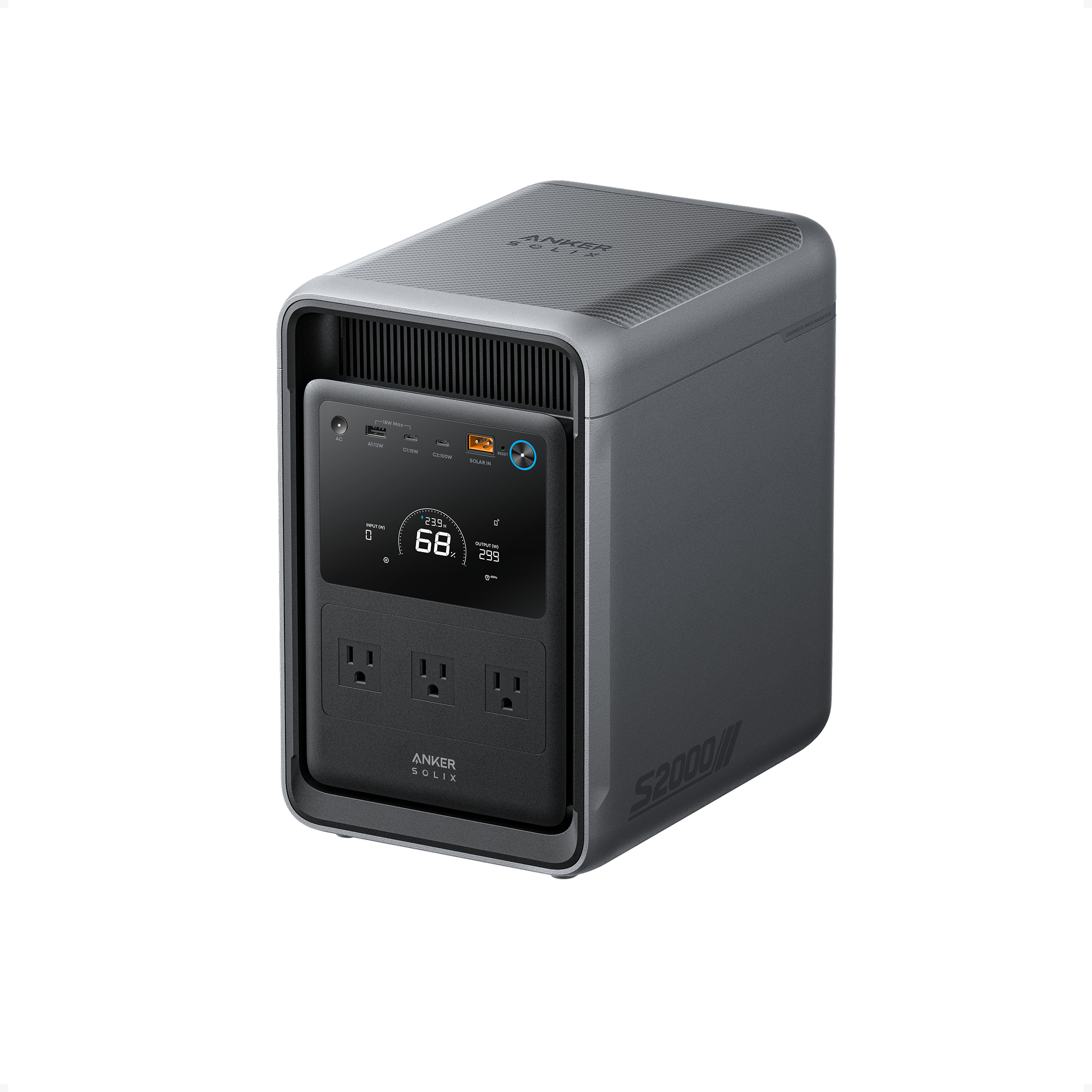
Anker SOLIX S2000Pick
Sold on Amazon · today’s price is on the listing

Jackery Explorer 1500 Ultra
$1,079.00
$1,079.00 · direct from Jackery
down from $1,199 · 10% below usual
Last checked 16 days ago. Prices move — check before you buy.
Prices may vary by retailer and are subject to change.