Head-to-head test
Anker SOLIX F3800 PLUS vs BLUETTI Apex 300 + B500K
Both inverters clear every load on this page, so what you're actually buying is storage, and the Apex 300 + B500K sells you 4,045Wh more of it for $699.
Full profiles: Anker SOLIX F3800 PLUS → · BLUETTI Apex 300 + B500K →

Written by Gunner GustafsonUpdated
Whole-Home Backup Tester, Station Arena Test Desk
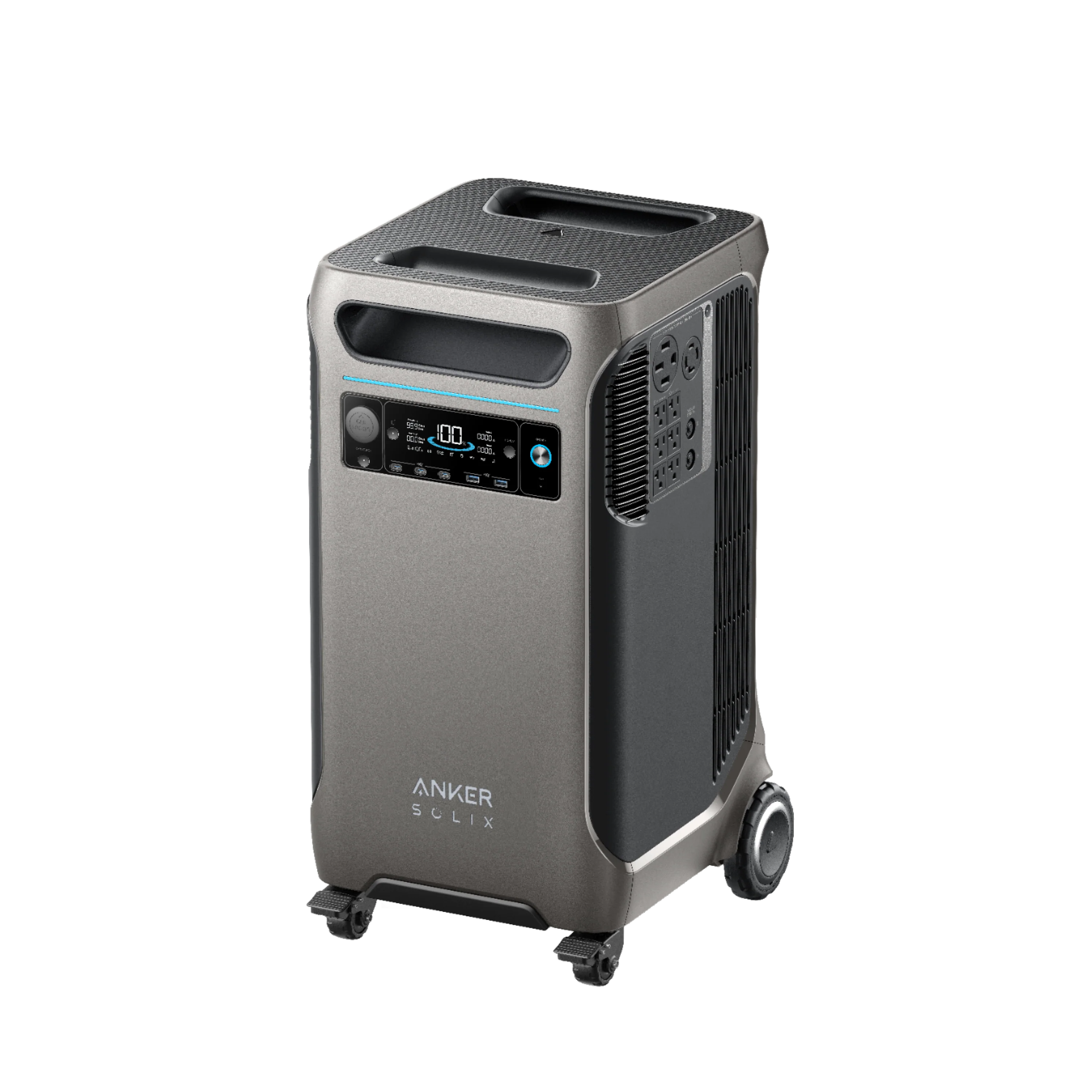
$2,599.99 · direct from Anker
Last checked 1 day ago. Prices move — check before you buy.
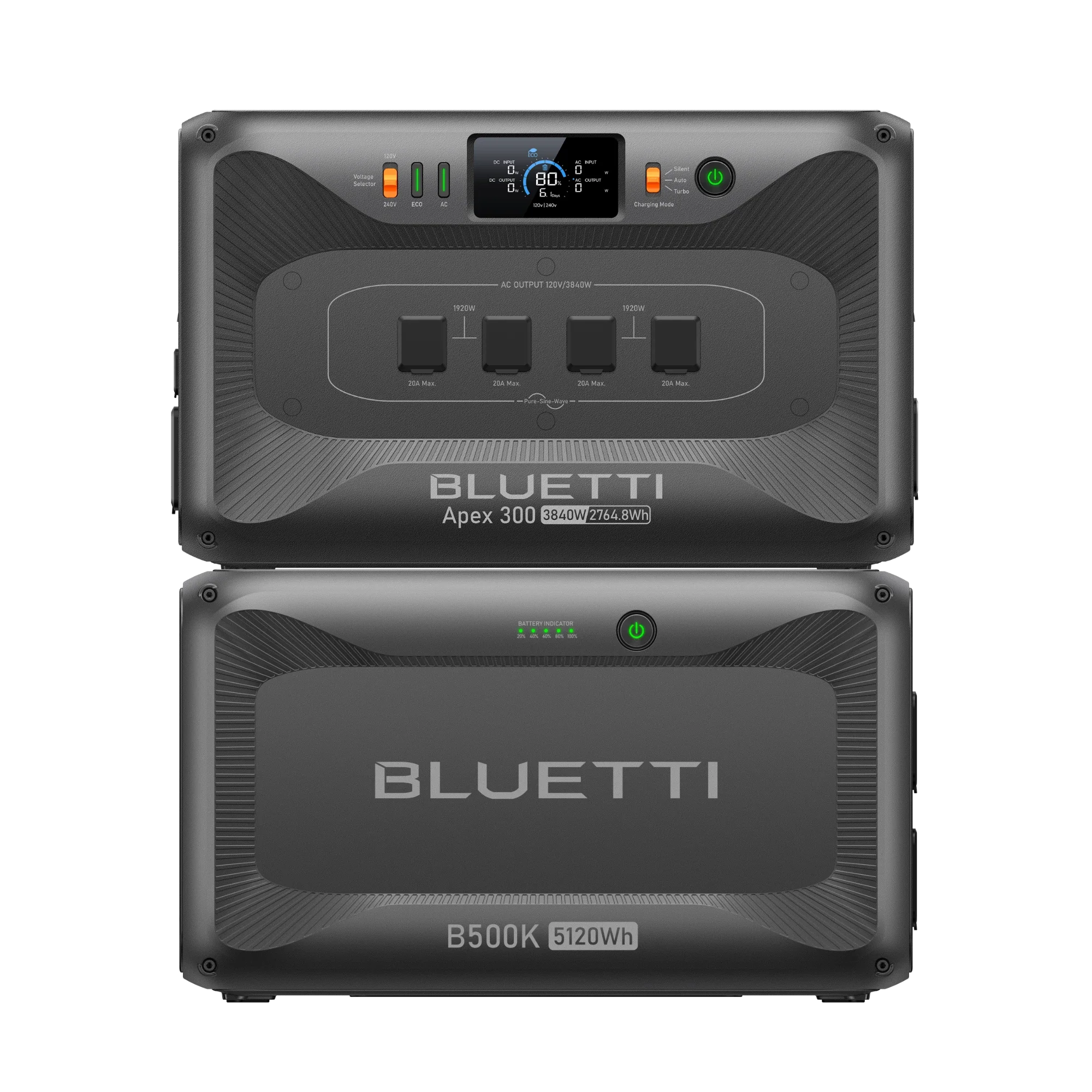
$3,299.00 · direct from BLUETTI
Last checked 1 day ago. Prices move — check before you buy.
Spec deltas
The Anker SOLIX F3800 PLUS has the bigger inverter, and in this matchup that turns out not to matter. Its 6,000W continuous rating beats the Apex pairing's 3,840W by 2,160W, but all six load profiles we model here (camping, blackout, CPAP, workday, tailgate, van life) sit inside both units' peak capability. Nothing on this page asks the Anker to do the one thing it does better.
What the loads do ask for is energy, and that's where these two split. The Apex 300 + B500K stores 7,885Wh; the F3800 PLUS stores 3,840Wh. After the usual inverter derate that's 6,702Wh usable against 3,264Wh, and a full van-life day of 4,685Wh lands comfortably inside one of those numbers and 44% past the other.
So the BLUETTI takes it, at $3,299 against $2,600. That gap is real money, and the Apex pairing is 51 lbs heavier and accepts 800W less solar. But $699 for 4,045Wh is the cheapest energy on this page by a wide margin, and it's the difference between a unit that covers your worst day and one that needs the weather to cooperate.
What the Numbers Reveal
Each conclusion stated first — the numbers behind it on one line, the full analysis below.
continuous output
The only scenario either unit fails is Van Life Daily, and it fails on storage: 4,685Wh needed against 3,264Wh usable, or 144% of the tank. A bigger inverter cannot hold more energy. Choosing the F3800 PLUS because it pushes 6,000W spends the decision on an axis that never comes up.
F3800 PLUS: 6,000W continuous, 9,000W surgeApex 300 + B500K: 3,840W continuous, 7,680W surgeAll six modeled scenarios show both units clearing the scenario's peak draw
Why it mattersUnless you can name a load that pulls more than 3,840W at once, a well pump starting while the AC is already running, the output column shouldn't move you.
Capacity
Cycle life widens it again. 3,000 cycles across 3.84kWh is 11,520kWh over the pack's life, or $0.22 per lifetime kilowatt-hour. 3,500 cycles across 7.88kWh is 27,597kWh, or $0.12. The BLUETTI is cheaper per watt-hour bought and cheaper again per watt-hour delivered, and it holds that lead for 500 more cycles.
F3800 PLUS: $2,600 for 3,840WhApex 300 + B500K: $3,299 for 7,884.8WhCycle ratings: 3,000 for the Anker, 3,500 for the BLUETTI
Why it mattersIf the $699 is your reason to take the Anker, you're paying $0.65 a watt-hour to avoid paying twenty cents.
solar input
That rescues the Anker for exactly one buyer: the one parked in open sun who doesn't move. Replacing a 4,685Wh day takes the Anker about 1.5 hours of rated input and the BLUETTI about 2 hours, so on a bright stationary day the smaller pack works as a buffer rather than a tank and its shortfall never surfaces. Shade the panels, drive the van, or lose two days to overcast, and the buffer strategy collapses, because the only spec that survives bad weather is how much you banked before it arrived.
Anker solar input ceiling: 3,200WBLUETTI solar input ceiling: 2,400WVan Life Daily draws 4,685Wh a day
Why it mattersBoondockers with a big fixed array and dependable sun have a genuine case for the Anker. Anyone whose panels move, tilt wrong, or sit under trees should take the storage.
45 dBA is an under-load rating from the manufacturer, not a figure measured beside the Anker, and there's no shared test condition behind the two entries. In the one scenario where noise actually decides a purchase, a CPAP at 320Wh, neither pack is working hard enough to spin fans up, and the field reports on both agree about thatA10B13.
BLUETTI publishes 45 dBA under load; there is no published noise figure for the F3800 PLUSCPAP Overnight draws 320Wh, 10% of the Anker's usable capacity and 5% of the BLUETTI'sReviewers put the Anker's fans at barely audible below 4,000WA10A12 and call the Apex's dual fans even and tameB2B13
Why it mattersDon't let a published decibel figure push you toward the unit that didn't publish one. If bedroom noise is your deciding factor, neither number answers it and both idle quietly.
The specific dimensions that decide these two units — everything else is a tie.
Your Life, Your Pick
Selected because: Both units clear every peak draw, so only one load separates them: a 4,685Wh van-life day, which is 144% of the Anker's usable capacity and 70% of the BLUETTI's.
Only one of these six loads produces a failure, and it's the van. 4,685Wh a day against 3,264Wh usable means the F3800 PLUS doesn't run low, it runs out, and no amount of sequencing your loads fixes a tank that's too small. The Apex pairing ends that same day 70% used, with the last 30% as margin you never had to think about.
Everywhere else the difference isn't pass or fail, it's depth of discharge, which is worth more than it sounds. A 2,100Wh camping weekend leaves the Anker 64% drained and the BLUETTI 31%. Same trip, same outcome, except one pack spent Sunday near the bottom of its range and the other barely noticed. Those percentages are against usable energy after the inverter derate, not the number printed on the box.
Lifetime Value
Selected because: $0.12 per lifetime kilowatt-hour against $0.22 is the widest gap on this page, and it's the one that survives the $699 difference in sticker price.
cost / lifetime kWh
Twenty cents a watt-hour is what the upgrade costs, and that's roughly a third of what the Anker charges for its own energy. It's an unusual thing for the more expensive unit to be able to say. The premium isn't really a premium; it's a discount you have to spend more to collect.
The catch is coverage. Both carry five years, so the BLUETTI spreads $660 of purchase price across each warranty year and the Anker $500. You're paying about a third more per covered year, on the unit whose support you'd least want to lean on. If you cycle daily, the cells outlast the paperwork either way: 9.6 years for the BLUETTI, 8.2 for the Anker.
What the Specs Don't Tell You
Selected because: Five cards fire on this pair. Four of them are artifacts of how the numbers get published; the weight card is the one that will actually change your day.
rated cycles
Four of the five cards below come from how these numbers get published rather than from anything you'd feel in a room. A 10ms-against-20ms line and a 45-dBA-against-blank line both read like verdicts and neither was measured with the two units side by side. Read them as things to check, not as points scored.
The weight card is the real one. 132 lbs and 183 lbs are both well past the point where portable means anything, so what separates them is shape rather than mass. The Anker is one object on wheels. The BLUETTI's total splits across a 2,764.8Wh Apex 300 and the 5,120Wh B500K that supplies the rest of the 7,885Wh, which means two trips up the driveway and a reconnection at the other end. If it lives in one corner of the garage forever, neither of those facts costs you anything.
Growth Path
Selected because: Both expand, but the Anker's 3,200W solar ceiling against the BLUETTI's 2,400W is the strongest argument on this page for taking the smaller pack.
solar input
The Anker's best card doesn't make headlines: 3,200W of solar input against the BLUETTI's 2,400W, on standard MC4 panelsA11. If your plan involves a ground array or a roof that grows over the next few years, the input ceiling is the wall you eventually hit, and the Anker's sits 800W higher.
But "both expand" hides an asymmetry. The Apex pairing already sits at 7,885Wh, so growing the Anker means buying batteries to reach a place the BLUETTI ships from. BLUETTI's own scaling story has a wrinkle worth knowing first: owners running multiple Apex units in parallel report them charging at uneven rates, with unofficial community workarounds needed to keep them in stepB3B4. That's a caution about how you scale it, not a reason to skip it, but it's better read now than discovered in a field.
Brand Trust
Selected because: You're choosing between Anker's slipping SOLIX support and BLUETTI's inconsistent support, and on a $3,299 purchase that isn't a footnote.
Neither brand hands you a clean answer. Anker's SOLIX support splits hard: one F3800 PLUS owner describes emailing five times about a noise fault and getting nothing backA1, while another owner in the same thread reports responsive tickets and an advance replacementA2. BLUETTI's support is email-based with timezone delays and is the more inconsistent of the two by some distance, though buying direct from BLUETTI's own site rather than a marketplace tends to produce the better version of it.
The apps are close, at 4.5 out of 5 on iOS for both, with BLUETTI holding 4.5 on Android where Anker sits at 4.3. The firmware is not close. Apex 300 owners have hit a unit stuck in Backup mode after an update, an app that wouldn't complete a download, and an E004 inverter output failure right after a firmware installB7B8B9, with the same threads later showing those resolvedB8B10. Treat month one as a settling-in period and don't wire it into anything you can't afford to lose until you've watched it run.
Strengths & trade-offs
Anker SOLIX F3800 PLUS
Strengths
- +Costs $699 less
- +Lighter by 50.7 lb
- +Higher AC output
- +Faster solar charging
Trade-offs
- –Very heavy unit that may be difficult for one person to lift.
- –Shorter-lived battery — rated for 3,000 charge cycles vs the Apex 300 + B500K's 6,000, so it wears out sooner.
BLUETTI Apex 300 + B500K
Strengths
- +Larger battery capacity
- +Rated for 6,000 charge cycles — much longer battery lifespan
Trade-offs
- –Significantly heavier (+50.7 lbs), making it harder to move.
- –Weaker inverter (-2,160W) limits appliance compatibility.
- –Very heavy unit that may be difficult for one person to lift.
Will It Power Your Gear?
Scenario math and per-appliance runtimes, modeled from the spec record.
Scenario verdicts
We ran the math on six real-world scenarios. Here's which unit survives your actual life.
SCN-01 · 2 nights · needs 2,100Wh
Weekend Camping
Two nights off-grid with essential comfort
Neither unit
2,100Wh over a weekend runs fine on either, so the question is where you'd rather finish: 64% drained on the Anker or 31% on the Apex pairing. If your weekend is predictable, that reserve is capacity you paid for and didn't use. If someone shows up Saturday with a second cooler, it's the reason you don't drive home early.
Battery budget usedlower = more headroom
LOAD Phone Charger 15W×6h · LED Lights 40W×8h · Box Fan 75W×14h · CPAP Machine 40W×16h
SCN-02 · 8 hours · needs 1,645Wh
8-Hour Blackout
Keep the essentials running through a night without power
Apex 300 + B500K
1,645Wh through an outage is comfortable on both, at half the Anker's usable energy and a quarter of the BLUETTI's. The Apex pairing takes this one on what's left in the tank afterward rather than on anything it does better during the eight hours, plus a 10ms handoff against 20ms if you've got a desktop that hates a blink.
Battery budget usedlower = more headroom
LOAD Fridge 150W×8h · Router + Modem 20W×8h · LED Lights (4 bulbs) 40W×6h · Phone Charger 15W×3h
SCN-03 · 8 hours · needs 320Wh
CPAP Overnight
Sleep therapy without interruption — the #1 medical use case
Either unit
A dead heat, and a boring one. 320Wh is 10% of the Anker's usable energy and 5% of the BLUETTI's, so both wake up with the tank essentially full and capacity has nothing to say here. Break the tie somewhere else: the BLUETTI publishes a 45 dBA under-load figure and the Anker publishes nothing, but at a load this small neither unit is working hard enough for fans to decide anything.
Battery budget usedlower = more headroom
LOAD CPAP Machine 40W×8h
SCN-04 · 8 hours · needs 910Wh
Remote Workday
Full work day off-grid without power anxiety
Apex 300 + B500K
The Apex 300 + B500K clears the workday at 14% used, banking 5,792Wh — late work, extra calls, or a second laptop charge without arithmetic. The SOLIX F3800 PLUS at 28% also finishes, with 2,354Wh of slack for the unplanned.
Battery budget usedlower = more headroom
LOAD Laptop 60W×8h · External Monitor 30W×8h · Router + Modem 20W×8h · Phone Charger 15W×2h
SCN-05 · 4 hours · needs 670Wh
Tailgate Party
Game day power for the crew
Neither unit
Scoring these two at a tailgate is a category error: neither travels — the SOLIX F3800 PLUS is 132.3 lbs and the Apex 300 + B500K 183 lbs, and at those weights they roll off a truck bed if they go anywhere at all. The 670Wh here is trivial for either — it's the going that doesn't happen. If you need power away from the building, you're shopping the wrong class.
Battery budget usedlower = more headroom
LOAD Blender 400W×0.5h · LED TV (55") 80W×4h · Bluetooth Speaker 15W×4h · Phone Charger (×3) 45W×2h
SCN-06 · 24 hours · needs 4,685Wh
Van Life Daily
A full day of mobile living — the ultimate endurance test
Apex 300 + B500K
4,685Wh a day is where the F3800 PLUS stops being an option. That's 144% of its 3,264Wh of usable energy, so the day ends short no matter how cleverly you sequence the loads. The Apex pairing finishes at 70% used and starts tomorrow with a reserve.
Battery budget usedlower = more headroom
LOAD Mini-Fridge 150W×24h · Laptop 60W×4h · Phone Charger 15W×3h · LED Lights 40W×5h · Fan 75W×8h
The Load Test
RUNTIME = (Wh × 0.85) ÷ LOAD
None of the scenarios above exactly yours? Build it. Toggle what you'd plug in; both units are tested against the combined draw.
Essentials
Comfort & Convenience
High-Draw Appliances
Test duration
8h
Continuous draw
205W
Projected runtime
For this load: Apex 300 + B500K runs 32.7h vs 15.9h.
$3,299 list · direct from BLUETTI
Modeled from the spec record — same math as the tables below. Methodology
Runtime by appliance
Real-world runtime estimates for common appliances, modeled at 85% inverter efficiency.¹
Essentials
The basics you need runningscale 0–446.8hComfort & Convenience
Makes off-grid life actually enjoyablescale 0–89.4hHigh-Draw Appliances
These reveal the real limitsscale 0–6.7h¹ Runtime = (capacity × 0.85) ÷ appliance watts. Within each group, all bars share one time scale (the group's longest runtime), so lengths are comparable across appliances; identical runtimes collapse into a single blue/orange bar. Actual runtime varies with battery age, temperature, and simultaneous loads — see methodology.
Conclusion
August 9, 2026
Verdict: the BLUETTI Apex 300 + B500K
Take the Apex 300 + B500K. It holds 7,885Wh against the F3800 PLUS's 3,840Wh, and the $699 between them works out to roughly twenty cents for each extra watt-hour, against the $0.65 a watt-hour the Anker charges for its own tank ($2,600 divided by 3,840Wh). Across all six scenarios both units clear the peak draw, so the Anker's 6,000W inverter never gets to be the deciding factor, while the single heavy day (4,685Wh of van life) blows straight past the Anker's 3,264Wh of usable capacity. Two things should give you pause: 183 lbs against 132, and a firmware track record on this BLUETTI platform that has locked units into the wrong mode and thrown an inverter error after an updateB7B9. Buy direct, update it before you rely on it, and the capacity is worth the money.
Editor-assigned confidence, based on cited owner research and spec analysis.
List prices as of August 9, 2026. The links below open Anker's and BLUETTI's current prices.
$3,299.00 · direct from BLUETTI
Last checked 1 day ago. Prices move — check before you buy.
or check the SOLIX F3800 PLUS price$2,599.99 list
Written by Gunner Gustafson, Whole-Home Backup Tester · Station Arena Test Desk · Updated August 9, 2026
Measured Data
Benchmark scores and the full spec record, side by side.
Benchmark scores
Not rated for both units (minimum threshold unmet): RV Living, Solar Generator.
Full specifications
ᵈ Derived: price ÷ rated capacity. See the data behind our comparisons →
Comparison ToolAdd more power stations, side by sideOpen Tool →How these numbers are produced
Numeric verification
Every figure on this page traces to our spec database or arithmetic on it — no estimated numbers.
Owner claims
Statements about owner experience are cited to published reviews — see Sources & Research Notes below.
Runtime model
Runtime = (rated capacity × 0.85 inverter efficiency) ÷ device wattage. Solar recharge estimates assume panels deliver 70% of rated output. Cold weather, battery age, and stacked loads reduce real-world results.
Power Score
Computed from 14 published spec dimensions, weighted per use-case bench. Higher is better; a unit must meet a bench's minimum threshold to be rated.
See the full weight table and data sourcing on our methodology page →Class ranking (the star rating)
Each unit's star score is a category ranking, not customer reviews — no buyer opinions feed it. We score every station on size-independent quality (value, output, portability, endurance, ports, warranty, and more), then percentile-rank it against the other units in its capacity class, so a class-leading compact unit and a class-leading whole-home unit can both earn 5★. Here, SOLIX F3800 PLUS rates 4.5/5 (73rd percentile of 16 Home Backup-class units), and Apex 300 + B500K rates 3.5/5 (11th percentile of 29 Whole-Home / Off-Grid-class units).
How the class ranking is computed →Test Notes & Caveats
Hidden gotchas and advantages we spotted that you won't find on the product page.
132 lbs and 183 lbs: Both Are Furniture
Neither of these is portable in any sense you'd use about a cooler. The difference is shape rather than mass: the F3800 PLUS is one 132-lb object on wheels, while the Apex pairing splits its 183 lbs across a 2,764.8Wh base unit and the 5,120Wh B500K that makes up the rest of the 7,885Wh, so it moves in two trips and reconnects at the far end. Favor the Anker if it has to relocate. Either is fine if it's going to live in one corner of the garage forever.
45 dBA Is a Published Figure, Not a Verdict
BLUETTI's 45 dBA is an under-load rating from the manufacturer, and it's the only noise number anywhere on this page, which makes the Apex pairing look like the loud one by default. It wasn't measured against the Anker under matched conditions, and nothing here was. Use it to set expectations for the Apex working hard, not to rank two units against each other.
The Ratio Favors One, the Ceiling Favors the Other
The Apex pairing surges to 2.0 times its 3,840W continuous rating while the F3800 PLUS manages only 1.5 times over its 6,000W, which is a real compliment to BLUETTI's design headroom. It's also the wrong number to shop on. What starts a compressor is the absolute ceiling, and there the Anker's 9,000W beats the BLUETTI's 7,680W. Shop the ratio if you're curious about the engineering, the ceiling if you're starting a well pump.
10ms vs 20ms: Real, and Smaller Than It Looks
The Apex pairing hands over in 10ms against the F3800 PLUS's 20ms, a genuine advantage for a desktop or a NAS with no battery of its own. For a fridge, a router or lights, 20ms is invisible. Treat this as insurance on specific gear rather than a general reliability gap between the two units.
Warranty: No Difference
Both units carry the same 5-year warranty, so coverage isn't a tiebreaker here. The Apex 300 + B500K's figure is a maximum rather than a guarantee — it depends on buying direct from BLUETTI or registering the unit, since reseller purchases carry a shorter term. Worth saying because the per-dollar framing can suggest otherwise: the SOLIX F3800 PLUS works out at 1.9 years of cover per $1,000 spent against the Apex 300 + B500K's 1.5, but that spread is the price gap, not the terms.
Battery Lifespan in Real Years
The Apex 300 + B500K is rated for 6,000 cycles vs 3,000. In real life: at daily use, that's 16.4 vs 8.2 years. At weekend use (twice a week), it's 58 vs 29 years. One caution reading years across different sizes: a cycle is 7,885Wh on the Apex 300 + B500K and 3,840Wh on the SOLIX F3800 PLUS, so count lifetime energy — roughly 47,309 kWh against 11,520 kWh over the rated life. After hitting the cycle limit, the battery doesn't die — it drops to ~80% of original capacity, which is still very usable.
Anker Doesn't Publish One, Which Isn't the Same as Quiet
There's no noise rating for the F3800 PLUS in our data, so the spec table has nothing to show. Read the blank as missing information rather than a good result. A 6,000W inverter with fans is not silent under load, and the absence of a figure only means nobody had to stand behind one.
Full record above — the Test Desk pick is the Apex 300 + B500K.
Check Apex 300 + B500K price →or check the SOLIX F3800 PLUS priceOwnership Analysis
What happens after you buy — true cost of ownership, brand trust, and growth potential.
Lifetime value
Service lifeyears at one full cycle per day
Lifetime energy delivered
Cost per delivered kWh
│ warranty ends · Reaching the cycle rating means ~80% capacity remains — degraded, not dead.
Analyst note
The SOLIX F3800 PLUS is cheaper to buy, but the Apex 300 + B500K is cheaper to own. At $0.07/kWh over its lifetime vs $0.23/kWh, the Apex 300 + B500K's higher cycle life and capacity make each dollar go further over the years.
Delivers each lifetime kWh for $0.16 less — check the Apex 300 + B500K price →
Brand trust
Anker
Ecosystem
7-8 SOLIX portable power stations across C-series (compact) and F-series (flagship), plus the X1 home energy system
Support
US-based, and historically the whole reason people bought Anker. The current SOLIX picture is less certain: first-line responses skew automated and generic, and return logistics on a 132-lb hazmat-shipped unit are a project in themselves. Still one of the better brands to need help from in this category. Just no longer the standout it used to be.
Community
Moderate — active Reddit (r/Anker, r/AnkerSOLIXCommunity) and growing. Benefits from Anker's massive consumer electronics brand awareness.
App experience
Rated 4.5/5 iOS (~1,100 ratings) · 4.3/5 Android
Unique strength
Parent brand trust from Anker's consumer electronics dominance. InfiniPower technology for long cycle life. Strong $/Wh value in the mid-size and larger units — the S2000, F2600 and C1000 are among the better buys per watt-hour in the catalog.
Worth knowing
Anker firmware updates have removed features without warning before, and the SOLIX expansion ecosystem is narrower than EcoFlow's. Neither is a reason to walk away. Both are reasons to read the release notes before you tap update.
BLUETTI
Ecosystem
One of the broadest lineups — 15-20+ models from budget (AC2A) to flagship portable (Apex 300, 2764.8Wh). Includes specialized products: vehicle solar hubs, sodium-ion cold-weather units, and balcony storage systems.
Support
The weakest link in an otherwise strong product. Email-based, with China timezone delays, and outcomes range from efficient to weeks of runaround. Buying direct from BLUETTI's own site rather than through a marketplace tends to produce the better version of that experience, which on a $3,299 purchase is worth the extra click.
Community
Active and growing — Reddit r/bluetti has a dedicated community. Second-largest after EcoFlow in engagement.
App experience
Rated 4.5/5 iOS and Android — tied for best app experience in the category. V3.0 UI redesign was well-received.
Unique strength
Capacity per dollar is the entire pitch, and this pairing delivers it: among the lowest cost per watt-hour in the catalog. The lineup is also the widest in the space, running from budget units through sodium-ion cold-weather models to balcony storage.
Worth knowing
The 3,500-cycle rating on this pairing sits at the floor of the range BLUETTI claims across its LFP lineup, and older or discontinued BLUETTI models have run into spare-parts problems. Buy the current flagship rather than last year's.
Analyst note
Anker is the brand you'd rather call; BLUETTI is the brand you'd rather buy from. Both apps rate 4.5 on iOS, with BLUETTI holding 4.5 on Android where Anker sits at 4.3. If support access is the thing that keeps you up at night, that's the single strongest argument for the Anker on this page, and it deserves to be weighed honestly against everything the capacity gap buys.
Growth path
SOLIX F3800 PLUS
EXPANDABLESupports Anker expansion batteries, so you can add capacity later without replacing the base unit — useful if your needs may climb past 3,840Wh.
Accepts up to 3,200W of solar. Enough for a serious multi-panel array.
Generous port selection supports complex multi-device setups.
Expansion batteries are Anker-specific. You're investing in the Anker ecosystem.
Apex 300 + B500K
EXPANDABLESupports BLUETTI expansion batteries, so you can add capacity later without replacing the base unit — useful if your needs may climb past 7,885Wh.
Accepts up to 2,400W of solar. Enough for a serious multi-panel array.
Generous port selection supports complex multi-device setups.
Expansion batteries are BLUETTI-specific. You're investing in the BLUETTI ecosystem.
Realistic full solar rechargeat 70% of rated panel output — see methodology
Analyst note
Both expand, but the SOLIX F3800 PLUS's higher solar ceiling (3,200W vs 2,400W) gives it the stronger off-grid growth path — more panels can feed a bigger bank as it grows.
What Owners Report
Patterns from published owner reports and long-term reviews — every claim cited to its source below.
Anker SOLIX F3800 PLUS
Field data on the F3800 PLUS specifically is thinner than the unit's profile suggests. Most of what exists comes from review-site writers who lived with one for weeks rather than from long-term ownersA4A7A12, and no clearly dated six-month report on the Plus turned up at all. Within that, the runtime picture is consistent and genuinely useful: light household duty (a fridge or freezer, a couple of laptops, an e-bike charge) ran about 17 hours on the base unitA4, and putting a fridge and a freezer on it together cut that to roughly seven and a half hoursA5.
Three things to file away. Support experiences diverge sharplyA1A2. Fan noise is reported as background-level under normal household loads and only obvious above 4,000W or at maximum charge speedA10, with one reviewer rating it behind only the quietest units in the categoryA12. And one review notes a firmware update that Anker said cuts idle drain by about halfA9, though that's a single source we couldn't corroborate. On mobility, the wheels handle grass and small bumps and stop thereA8.
“I've called them and submitted tickets via their portal, always very responsive. They've even done advanced replacement for me.”
Sources
campingsolar.us · cleanenergybusinesscouncil.com
BLUETTI Apex 300 + B500K
Almost none of the field data is about this exact pairing. The owners posting about the Apex 300 are running the bare unit or the B300K combo rather than the B500KB3B5B7, and no six-month ownership report for this configuration exists, so read everything here as evidence about the Apex 300 platform rather than about your specific 7,885Wh build.
On that platform, the recurring complaint is firmware and the recurring compliment is noise. Three separate reviewers describe the dual-fan cooling as even and quiet for the output class, with no distracting pitch or rattleB1B2B13. One owner reports it running cleanly with external batteries and singles out the 240V output as the best part of the packageB5. A reviewer who tried to move it says they could barely carry it a few feet and couldn't lift it onto a tableB11, which is the most honest sentence written about either unit's portability.
“Turns out the Apex 300's noise control is on par with the quietest power stations on the market, like those on offer from EcoFlow and DJI.”
Sources & Research Notes
Every owner claim in this report is traceable to a published source. The bracketed references above resolve here.
Recurring owner themes
- Owner support experiences with Anker/Solix diverge sharply — some report being ghosted after repeated contact attempts over a hardware fault, while others describe fast, responsive advanced-replacement service. [SOLIX F3800 PLUS · 2 entries]
- Real-world runtime drops off steeply with load: light loads (lights, router, occasional laptop/e-bike charging) stretch toward the ~17-hour mark, but running a fridge and freezer together drains the base unit in around 7 hours. [SOLIX F3800 PLUS · 2 entries]
- Fan noise is reported as low/background during normal household loads and only becomes noticeably audible under heavy loads (4,000W+) or max-speed charging. [SOLIX F3800 PLUS · 2 entries]
- The unit's near-137 lb weight is a recurring friction point: reviewers note the wheels/handles work for moderate use but struggle over rough terrain, and aggregated user feedback flags portability and packaging as concerns despite praise for raw performance. [SOLIX F3800 PLUS · 2 entries]
- Multiple independent reviewers describe the dual-fan cooling as noticeably quiet/even for a unit of this output class, even under load. [Apex 300 + B500K · 3 entries]
- Firmware and app updates have repeatedly caused mode-lock, download failures, or inverter error codes; several threads show the issue eventually resolved after further updates or support contact. [Apex 300 + B500K · 4 entries]
- When running multiple Apex 300 units or expansion batteries in parallel, owners report uneven charge rates between units, with community-devised (unofficial) workarounds needed to keep them in sync. [Apex 300 + B500K · 2 entries]
- The stripped-down, modular design draws criticism for real-world handling: extreme weight makes it hard to move, and lack of native USB/DC ports forces reliance on a separate paid hub accessory. [Apex 300 + B500K · 2 entries]
- A1
“I think it may be a fire hazard with this crazy noise it's making. I have emailed Anker support over 5 times... Anker support is ghosting me after I spent over 20k on their solix line and solar panels within a month.”
DIY Solar Forum — "Big issue with Anker Solix F3800 plus battery pack (Large Anker Solix setup)" · 2025-08 · [negative]
- A2
“I've called them and submitted tickets via their portal, always very responsive. They've even done advanced replacement for me.”
DIY Solar Forum — "Big issue with Anker Solix F3800 plus battery pack (Large Anker Solix setup)" (reply from another Solix owner) · 2025-08 · [positive]
- A3
“In UPS mode, the F3800 Plus can switch in about 20ms. There's more cabling and components when connected to the whole home setup, but the lights still barely flicker.”
Android Authority — "Anker SOLIX F3800 Plus with Home Power Panel review: Total power backup" · 2025-05 · [positive]
- A4
“You would be able to keep a fridge or freezer running, charge a few laptops or phones, maybe charge up an e-Bike and the F3800 Plus base unit would last about 17 hours before needing a recharge.”
Digital Trends — "Anker Solix F3800 Plus review: this power station wins for versatility and value" · 2025-05 · [positive]
- A5
“With both the freezer and my fridge plugged in at the same time, I was about to get 7.34 hours before the unit was completely drained.”
Digital Trends — "Anker Solix F3800 Plus review: this power station wins for versatility and value" · 2025-05 · [mixed]
- A7
“After a few months with its successor, I can easily say it is a repeat success.”
AppleInsider — "Anker Solix F3800 Plus portable power station review: investment in reliable home power" · 2025-08 · [positive]
- A8
“The big wheels in the back are enough to go over grassy terrain, but avoid anything too challenging. Small bumps can be enough to slam everything to a halt.”
AppleInsider — "Anker Solix F3800 Plus portable power station review: investment in reliable home power" · 2025-08 · [mixed]
- A9
“Early reviews focused heavily on the standby drain of the Anker SOLIX F3800 Plus. Anker later released a firmware update that said it can cut idle use by about 50%.”
VoltNest — "Anker SOLIX F3800 Plus Review: My Honest Test Results" · 2026-04 · [mixed]
- A10
“Under normal loads (lights, fridge, TV), the fans are barely audible. It only gets loud when you're pulling over 4,000W or charging at max speed.”
CampingSolar.us — "Anker SOLIX F3800 Plus Review: The Ultimate 240V Home & RV Power" · 2026-02 · [positive]
- A11
“Anker really addressed this issue with the F3800 Plus. You now get a true 3,200W solar input, which is compatible with normal MC4 solar panels.”
TheSolarLab — "Anker SOLIX F3800 Plus Review: Big Power, Big Price?" · unknown · [positive]
- A12
“It doesn't match the whisper-quiet performance of the EcoFlow Delta Pro Ultra, which remains one of the quietest power stations we've ever tested, but the F3800 Plus is still surprisingly quiet, even when you're really pushing it.”
TheSolarLab — "Anker SOLIX F3800 Plus Review: Big Power, Big Price?" · unknown · [positive]
- B1
“Turns out the Apex 300's noise control is on par with the quietest power stations on the market, like those on offer from EcoFlow and DJI.”
The Solar Lab — "Bluetti Apex 300 Review: Cheap, Practical Home Backup?" · unknown · [positive]
- B2
“Some units sound like small jet engines under load, but the Apex 300's fans are relatively tame.”
Techspective — "Bluetti Apex 300 with B300K Review" · 2025-09 · [positive]
- B3
“The Apex 300 have some major charging problems... When the units are charging from the grid they charge at different rates and not together.”
DIY Solar Power Forum — "Bluetti Apex 300 problems" · 2025-09 · [negative]
- B4
“I have found a simple way to get around some of the solar charging limitations with multiple APEX 300s hooked up in parallel... So far, I have not had any problems with my setup.”
DIY Solar Power Forum — "Bluetti Apex 300 problems" · 2025-09 · [mixed]
- B5
“So far so good. Works with external batteries. For small applications the solar available works OK. For me the 240V output is great.”
DIY Solar Power Forum — "Bluetti Apex 300 launched today… anyone have thoughts?" (page 2) · 2025-05 · [positive]
- B7
“I updated my Apex 300 to the latest firmware yesterday. Now it's stuck in 'Backup' mode... when I go into the app to try to change it back, it flashes to...”
BLUETTI Community — "Apex 300 stuck in Backup mode after last firmware update" · 2025-11 · [negative]
- B8
“There was an update on my Apex 300 a few days ago IOT v8026.12... Problem is every time I connect to the power st[ation]... Edit - This seems fixed now hooray!”
BLUETTI Community — "Check For Update App issue" · 2025-09 · [mixed]
- B9
“After the update completed, the charging stopped and I received Error 004... I have error E004 Inverter Output Failure.”
BLUETTI Community — "Error E004 Apex 300" · 2025-11 · [negative]
- B10
“I had a power outage in the middle of the night, so I hooked everything (Hub A1 and all 300's) back up and now HA is populating. YEA!!!”
GitHub bluetti-official/bluetti-home-assistant — "APEX 300 and Hub A1 now working" (Issue #95) · 2026-05 · [mixed]
- B11
“it's so heavy I can hardly carry it more than a few feet at a time and have been unable to lift it onto a table.”
T3 — "Bluetti Apex 300 review: transform your off-grid life" · 2025-11 · [negative]
- B13
“Fan noise remains even, with no distracting pitch or rattle. This makes the Apex 300 usable near sleeping areas or indoor workspaces without disturbance.”
Yanko Design — "BLUETTI Apex 300 Review" · 2025-05 · [positive]
Research compiled August 9, 2026.
Who Should Buy Which
Buy the SOLIX F3800 PLUS if you…
- →You have a load that genuinely pulls past 3,840W at once: a well pump kicking in while the AC is already running, a compressor and a saw sharing a circuit. That's what the 6,000W continuous rating and 9,000W surge ceiling exist for, and the Apex pairing matches neither number.
- →Your panels are fixed, plentiful, and in real sun. 3,200W of MC4-compatible inputA11 refills the pack faster than most people can drain it, which turns a smaller battery into a buffer instead of a tank.
- →It has to relocate more than once, and you want one object rather than two. 132 lbs on the Anker's own wheels beats hauling a base unit plus an expansion battery and reconnecting them at the other end.
- →You want to spend $699 less and you're honest that your worst night is an outage, not a van-life day. The Anker covers that with capacity to spare, and $699 is a lot of money to spend on headroom you'd never reach.
Buy the Apex 300 + B500K if you…
- →Your daily draw runs above 3,264Wh and there are days the sun doesn't show. Van life, an off-grid shop, a well and a chest freezer through a rural outage: this is the only one of the two that covers a full heavy day without negotiating.
- →You plan to cycle it hard for a decade. Daily use puts the pack at 9.6 years before it reaches its cycle rating, and the energy it delivers across that life is the cheapest on this page.
- →You want the tighter UPS handoff for a desktop or a NAS with no battery of its own: 10ms against 20ms. Both are fast enough for a fridge or a router; the 10ms is insurance on the small set of gear that isn't forgiving.
- →You're buying direct from BLUETTI and you're willing to update the firmware and watch it run for a month before you depend on it.
If neither fits
If your worst case is a fridge, a router and some phones through an eight-hour outage, you're shopping two classes above your problem. That's 1,645Wh, which uses half the Anker's usable capacity and a quarter of the BLUETTI's, and a 2kWh-class unit handles the same night at a fraction of the weight and price, with the bonus that you can actually carry it to a neighbor's house. And if what you want is backup that simply happens when the grid drops, with no app and no decision, price out a permanently installed home battery on a transfer switch instead. Both of these are appliances you have to manage.
The Bottom Line
Take the Apex 300 + B500K. Both inverters clear every load on this page, which means the output rating, the surge ceiling and the millisecond difference in UPS handoff are all arguing about a contest that never takes place. What does take place is a day that needs more energy than the smaller pack holds, and the BLUETTI holds more than twice as much for the cheapest watt-hours either brand is selling here.
Two caveats to carry into the purchase rather than discover after it. It's 183 lbs across two boxes and it is not going anywhere once you set it down. And the firmware on this platform has genuinely misbehavedB7B9, so buy direct, update it, and run it for a month on something you don't need before you run it on something you do. Do that and you own the unit that covers your worst night, instead of the one that covers most of it.
Frequently Asked Questions
Answers drawn from the spec record and cited owner research.
Is the BLUETTI Apex 300 + B500K worth $699 more than the Anker SOLIX F3800 PLUS?
Yes, if you'll ever use the capacity. The $699 buys 4,045Wh, about twenty cents per watt-hour, against the $0.65 a watt-hour the Anker charges for its own 3,840Wh ($2,600 divided by 3,840Wh). The math only turns bad if your real ceiling sits well under 3,264Wh of usable energy, in which case you're paying for a second tank you never fill.
Do I actually need 6,000W of output?
Almost certainly not. Across the six load profiles here, both units clear the peak draw in every one, so the Anker's extra 2,160W of continuous capability never becomes the deciding factor. It matters when something with a motor starts while several other things are already running. If you can't name that load, the output column shouldn't be steering your decision.
Which one is quieter?
Nobody can tell you honestly. BLUETTI publishes 45 dBA under load and there's no published figure for the F3800 PLUS, and the two were never measured against each other. Reviewers on each side describe them similarly: the Anker's fans barely audible until you pass 4,000W or charge at full speed, the Apex's dual fans even and unobtrusive. At a 320Wh CPAP load, neither is working hard enough for it to matter.
How long before the battery wears out?
On daily cycling, about 9.6 years for the Apex pairing and 8.2 for the F3800 PLUS, from cycle ratings of 3,500 and 3,000. Cycle only on weekends and both run past any warranty you'd ever claim, at 33.7 and 28.8 years. Both carry five years of coverage, so the cells outlive the paperwork on either unit and the real question is which company you'd rather deal with in year six.
Can either of these back up a whole house?
Both can carry heavy circuits, but neither is a whole-house answer on its own. The Anker's UPS handoff is about 20ms, which one reviewer running it with a home power panel described as barely flickering the lights; the BLUETTI's is 10ms. The harder limit is energy rather than switching speed: 3,264Wh and 6,702Wh of usable capacity are a long evening and a long night, not a week, and a real whole-home setup means panels, a transfer switch, and enough solar input to keep up with what you're drawing.
Where to buy
Anker SOLIX F3800 PLUS
$2,599.99
$2,599.99 · direct from Anker
Last checked 1 day ago. Prices move — check before you buy.
BLUETTI Apex 300 + B500KPick
$3,299.00
$3,299.00 · direct from BLUETTI
Last checked 1 day ago. Prices move — check before you buy.
Prices may vary by retailer and are subject to change.