Head-to-head test
Anker SOLIX C2000 Gen 2 vs Jackery HomePower 2000 Plus v2
Cycle these on weekends and Jackery's extra 2,000 cycles do not start paying until year 38; cycle them daily and they pay from year 11, and that single fork is the whole decision, because everything else about these two boxes matches.
Full profiles: Anker SOLIX C2000 Gen 2 → · Jackery HomePower 2000 Plus v2 →

Written by Gunner GustafsonUpdated
Whole-Home Backup Tester, Station Arena Test Desk
Spec deltas
Same 2,048Wh pack. Same 2,400W inverter, same 800W solar ceiling, same 140W USB-C, same 5-year term, same no-worse-than-10ms UPS class, and a quarter of a pound between them at 41.7 lb and 41.45. The spec sheet runs out of ways to tell these two apart before it reaches anything you would notice with the unit in the room.
Three differences survive. The HomePower is rated for 6,000 charge cycles against the SOLIX's 4,000. It publishes a 4,800W peak against 4,000W. And it costs $1,069 against $1,000, so $69 more. Every one of those is a point for Jackery except the last.
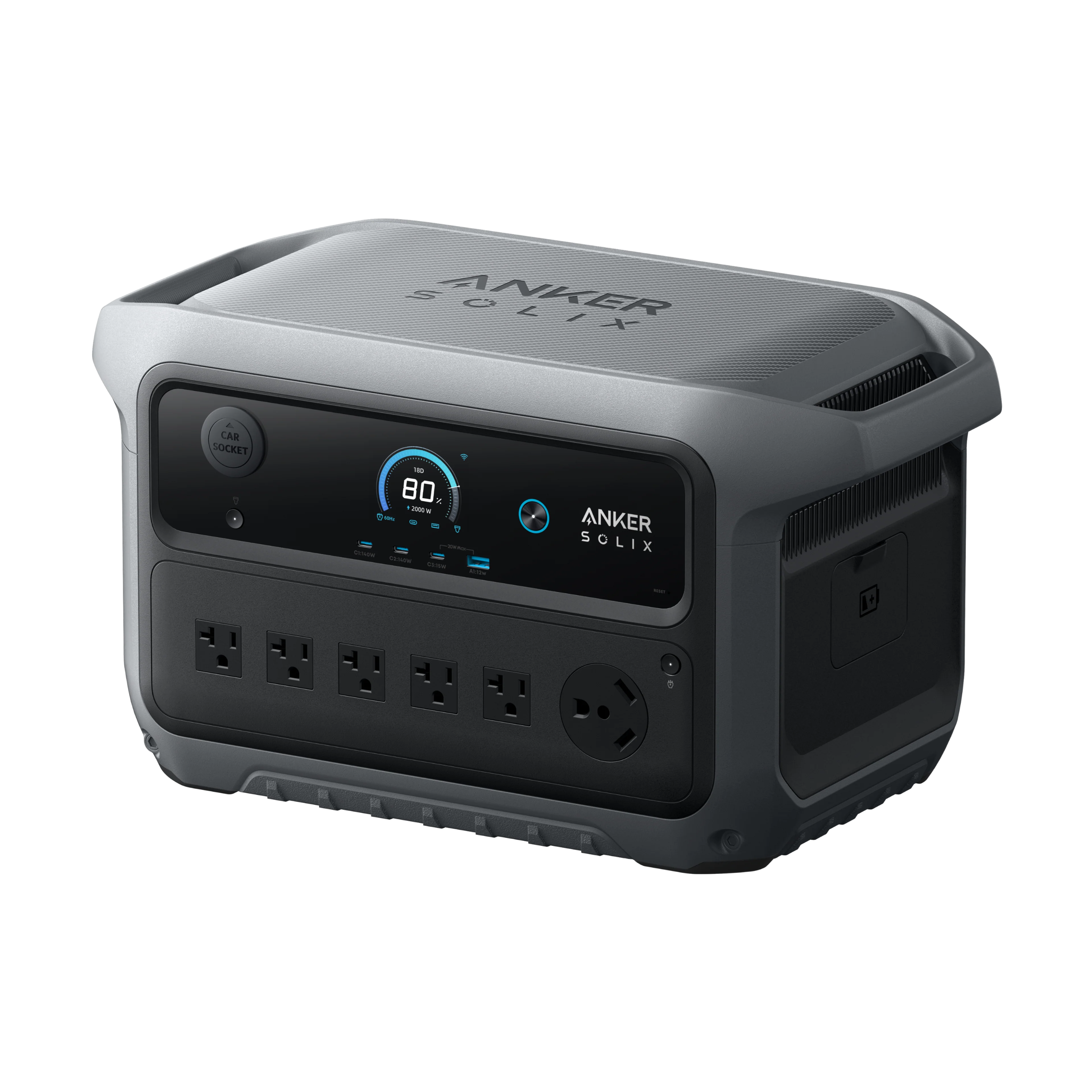
Take the SOLIX and keep the $69, unless you plan to cycle this pack nearly every day. Both of Jackery's edges are drawn on an account you probably will not visit: the cycle advantage only begins once you have worn the Anker out, and the extra peak headroom is untouched by every load in our six scenarios, the heaviest of which asks for 400W. What you actually meet in the first week is the app, the support queue, and the question of whether anybody has put the thing you bought on a benchA0B0. On that last one they are not close. The C2000 Gen 2 has a consistent body of hands-on coverageA0A1A2A4 and this exact HomePower SKU has noneB0.
What the Numbers Reveal
Each conclusion stated first — the numbers behind it on one line, the full analysis below.
rated cycles
The gap converts into money only on a daily cycle, where the same two ratings read 11 years and 16.4. That is the fork. A van roof or a solar array that fills and empties the pack every day turns 2,000 extra cycles into about five more years of service (16.4 minus 11), while a backup box that runs during outages and camps twice a month never reaches the question.
Both packs are 2,048Wh; the HomePower is rated for 6,000 cycles and the SOLIX for 4,000, both as minimums.At twice-a-week use those ratings work out to 57.7 years for the HomePower and 38.5 for the SOLIX.Both units carry the same 5-year warranty, and past its cycle rating a pack settles to about 80% of original capacity rather than dying.
Why it mattersDaily cyclers should pay the $69 without thinking about it. Everyone buying backup or weekend power is paying a premium for years the box will spend in somebody else's garage.
Nothing here is a pass-or-fail case. Both units start every peak in the set, and one appliance drawing two to three times its rating at startup is nowhere near either ceiling. The HomePower's extra 800W is concurrency insurance: it shows up the moment a pump or a saw kicks in while the panel is already pulling near 2,400W, and it does nothing at all on a list of fridge, router, laptop and lamps.
Both inverters are rated 2,400W continuous; the SOLIX peaks at 4,000W and the HomePower at 4,800W.The heaviest peak across our six scenarios is the tailgate's 400W, and both units start and sustain every one of them.Compressor loads briefly pull two to three times their rated wattage at startup.
Why it mattersIf your worst case is a motor starting behind an already-loaded house, the 800W is worth buying. If your worst case is a long outage with ordinary household loads, it is a ceiling you will never touch and it should not be what makes you pay more.
The unknowns on the HomePower are exactly the ones a backup purchase turns on: fan noise under real load, idle drain, whether the app cooperates when the router is dark, whether the UPS handoff holds. None of them has been checked on this SKUB0, and the app that would report them rates 2.3 to 3.3 across the two stores and wants a login even offline. Paying $69 extra to be the person who finds out inverts the reason people buy backup power in the first place.
Independent hands-on coverage of the SOLIX C2000 Gen 2 is consistent and uniformly positive: fans that stay a subdued whirr and only reach about 35 dB at a meter under high load, no firmware ritual, premium build, and app monitoring that works over Bluetooth as well as Wi-FiA1A2A3A4.No hands-on or tested review of the HomePower 2000 Plus v2 exists; the only substantive source is a launch-announcement article that states it did not test the hardwareB0.Both units publish the same 30 dBA best-case floor, a manufacturer quiet-mode figure rather than a measurement, along with the same UPS class and the same 5-year term.
Why it mattersAnyone who needs the box working the week it arrives should take the SOLIX. A buyer who still wants the Jackery should get it from a retailer with a return counter and treat month one as the test nobody else has run.
The specific dimensions that decide these two units — everything else is a tie.
Lifetime Value
Selected because: Everything else ties, so the decision lives here: 6,000 rated cycles against 4,000, and what that does to the cost of every kilowatt-hour these two packs will ever deliver.
cost / lifetime kWh
Nine cents a lifetime kilowatt-hour against twelve. That is Jackery's whole case and it is a real one: 6,000 cycles across a 2,048Wh pack is 12,288 kWh of lifetime energy for $1,069, where 4,000 cycles is 8,192 kWh for $1,000. Fifty percent more energy for $69, about 7% more money, is good arithmetic by any measure you like.
It is also arithmetic that pays out on a schedule most buyers never reach. Cycle a pack twice a week and the SOLIX's rating comes due at 38.5 years, more than three decades after the 5-year warranty covering it has lapsed, and the HomePower's at 57.7. Cycle it daily and the same ratings read 11 years and 16.4, which is a difference someone living off a van roof can feel. Work out which of those two people you are and the price question answers itself, rather than the other way round.
Brand Trust
Selected because: With the spec sheets this close, what is left to choose between is the app you will open during a blackout and the desk you will take a warranty claim to.
With the boxes this close you are not picking a battery, you are picking whose software you will stare at by flashlight and whose queue you will sit in when something fails. Anker's app rates 4.5 on iOS and 4.3 on Android. Jackery's runs 2.3 to 3.3 across both stores, splits itself across two separate apps, and expects a login even when you are offline, which is an odd dependency to build into a box whose whole job is the hour the internet is down.
Neither support story is good, and the brand column grades both of them down, Jackery further. There is one genuine mitigation on Jackery's side and it is worth real money: the brand sits on shelves at Costco, Home Depot, Best Buy and Amazon, so a failed unit can go back through a retailer's return desk instead of a manufacturer's ticket queue. Anker's ecosystem is smaller and points you at Anker. If you would rather buy your insurance at a counter than open a case, that is the strongest argument on this page for spending the extra $69.
What the Specs Don't Tell You
Selected because: Only one card here has a direction, and it reads better as absolute room above the 2,400W continuous rating (1,600W against 2,400W) than as a ratio.
rated cycles
Three cards fire and two of them say no difference, which is the useful news. The warranty is five years on both sides. The cycle card is the lifetime-value argument again, restated in years. Only the surge card points somewhere, and it needs restating: what separates these inverters is not a surge-to-continuous ratio but the absolute room above the continuous rating, 1,600W on the SOLIX from its 4,000W peak and 2,400W on the HomePower from 4,800W.
That room gets spent on concurrency rather than on single appliances. Both units start every peak in our scenario set, the largest of which is 400W, and the ceiling only comes into play when a compressor pulling two to three times its rated draw starts while you are already near 2,400W. If your backup plan is a fridge, a router, a laptop and a few lamps, you will never find either ceiling. If it is a well pump starting behind a running house, buy the 800W and stop reading.
Your Life, Your Pick
Selected because: An identical 2,048Wh pack means identical results: the same four passes, and the same two misses by 359Wh and 2,944Wh.
The two scenarios neither unit covers are the ones worth planning around, and they fail identically: the 2,100Wh camping weekend leaves both 359Wh short, and the 4,685Wh van-life day leaves both 2,944Wh short. Same pack, same flat 85% usable factor, same gap. There is no version of this comparison where one of them rescues a load the other drops.
Everything else lands with room, and the pattern is worth naming. Where these two fail, they fail on capacity, never on power: both start and sustain every peak in the set, from a 40W CPAP to a 400W tailgate. So the honest question the scenario grid asks is not which box to buy, it is whether 2,048Wh is the right size at all.
Strengths & trade-offs
Anker SOLIX C2000 Gen 2
Strengths
- +Costs $69 less
Trade-offs
- –Shorter-lived battery — rated for 4,000 charge cycles vs the HomePower 2000 Plus v2's 6,000, so it wears out sooner.
Jackery HomePower 2000 Plus v2
Strengths
- +Lighter by 0.3 lb
- +Rated for 6,000 charge cycles — much longer battery lifespan
Trade-offs
- –No major technical downsides compared to rival.
Will It Power Your Gear?
Scenario math and per-appliance runtimes, modeled from the spec record.
Scenario verdicts
We ran the math on six real-world scenarios. Here's which unit survives your actual life.
SCN-01 · 2 nights · needs 2,100Wh
Weekend Camping
Two nights off-grid with essential comfort
Neither unit
2,100Wh is the first load on this page that beats both boxes, and it beats them by the same amount: each covers about 83% of the weekend and stops. That is not a reason to rule them out, it is a reason to decide now which item comes off the list. Drop the electric kettle or bring a panel and the weekend works on either unit. Whatever you choose between them, choose on something other than this, because on this they are the same.
Battery budget usedlower = more headroom
LOAD Phone Charger 15W×6h · LED Lights 40W×8h · Box Fan 75W×14h · CPAP Machine 40W×16h
SCN-02 · 8 hours · needs 1,645Wh
8-Hour Blackout
Keep the essentials running through a night without power
Either unit
Both clear the 1,645Wh blackout, and both clear it with 96Wh left out of 1,741Wh usable. That is the thinnest margin either unit posts here, so treat eight hours as the design limit rather than the comfortable case. Both also list a UPS mode in the same class, no worse than 10ms, and since that figure is a published ceiling rather than a measured handoff on both sides it settles nothing. What would actually help is the 800W of solar input they both accept. Plan on daylight.
Battery budget usedlower = more headroom
LOAD Fridge 150W×8h · Router + Modem 20W×8h · LED Lights (4 bulbs) 40W×6h · Phone Charger 15W×3h
SCN-03 · 8 hours · needs 320Wh
CPAP Overnight
Sleep therapy without interruption — the #1 medical use case
Either unit
A CPAP pulls about 40W, so a full night is roughly 320Wh, or 18% of what either unit will hand over. Capacity is a formality on both. The specs also refuse to break the tie you would expect them to: both publish the same 30 dBA best-case floor, which is the same number twice and a quiet-mode figure rather than a measurement, so it cannot separate them. Decide it on price, and on which one you would rather have sitting on the nightstand.
Battery budget usedlower = more headroom
LOAD CPAP Machine 40W×8h
SCN-04 · 8 hours · needs 910Wh
Remote Workday
Full work day off-grid without power anxiety
Either unit
Both power your workstation all day without strain, and their USB-C output is a wash — pick on weight, ports, or price.
Battery budget usedlower = more headroom
LOAD Laptop 60W×8h · External Monitor 30W×8h · Router + Modem 20W×8h · Phone Charger 15W×2h
SCN-05 · 4 hours · needs 670Wh
Tailgate Party
Game day power for the crew
Either unit
670Wh of game day against 1,741Wh usable, with a 400W peak against 2,400W of continuous output on both. Neither unit is going to notice. The weight difference people reach for here is a quarter of a pound, 41.7 lb against 41.45, which is not a reason to choose anything, so carry whichever you end up owning. Buy on price and put the difference into ice.
Battery budget usedlower = more headroom
LOAD Blender 400W×0.5h · LED TV (55") 80W×4h · Bluetooth Speaker 15W×4h · Phone Charger (×3) 45W×2h
SCN-06 · 24 hours · needs 4,685Wh
Van Life Daily
A full day of mobile living — the ultimate endurance test
Neither unit
Neither unit covers this scenario's 4,685Wh: the SOLIX C2000 Gen 2 comes up 2,944Wh short (about 37% covered), the HomePower 2000 Plus v2 2,944Wh (37%). Treat this as partial cover — enough for the essentials in it, not the whole list.
Battery budget usedlower = more headroom
LOAD Mini-Fridge 150W×24h · Laptop 60W×4h · Phone Charger 15W×3h · LED Lights 40W×5h · Fan 75W×8h
The Load Test
RUNTIME = (Wh × 0.85) ÷ LOAD
None of the scenarios above exactly yours? Build it. Toggle what you'd plug in; both units are tested against the combined draw.
Essentials
Comfort & Convenience
High-Draw Appliances
Test duration
8h
Continuous draw
205W
Projected runtime
Dead heat — both run this 205W load for roughly 8.5h. Pick on price, weight, or ports.
Planning for more than this? Describe your whole setup and get it sized →
Modeled from the spec record — same math as the tables below. Methodology
Runtime by appliance
Real-world runtime estimates for common appliances, modeled at 85% inverter efficiency.¹
Essentials
The basics you need runningscale 0–116.1hComfort & Convenience
Makes off-grid life actually enjoyablescale 0–23.2hHigh-Draw Appliances
These reveal the real limitsscale 0–1.7h¹ Runtime = (capacity × 0.85) ÷ appliance watts. Within each group, all bars share one time scale (the group's longest runtime), so lengths are comparable across appliances; identical runtimes collapse into a single blue/orange bar. Actual runtime varies with battery age, temperature, and simultaneous loads — see methodology.
Conclusion
September 13, 2026
Verdict: the SOLIX C2000 Gen 2
Buy the Anker SOLIX C2000 Gen 2 at $1,000. It matches the HomePower on every spec you will actually use and asks $69 less than its $1,069, and the two places it loses are both deferred: 4,000 rated cycles against 6,000 only starts to bite after roughly 11 years of daily cycling, and the 800W of peak ceiling it gives up goes unused by every load in our scenario set. Against that sits a first week where the Anker is documented and the Jackery is not. Independent hands-on coverage of the C2000 Gen 2 is consistent and uniformly positiveA0A1A2A4; four weeks after launch, no hands-on or tested review of this HomePower SKU exists anywhereB0, and Jackery's app is the weakest of the major brands at 2.3 to 3.3 across the two stores. One buyer should still pay the extra: if you cycle the pack every day, 12,288 lifetime kWh against 8,192 makes the Jackery genuinely the cheaper box to own, and nine cents a lifetime kilowatt-hour against twelve is not a rounding error.
Editor-assigned confidence, based on cited owner research and spec analysis.
List prices as of September 13, 2026. The links below open Anker's and Jackery's current prices.
Sold on Amazon · today’s price is on the listing
or check the HomePower 2000 Plus v2 price$1,069.00 list
Written by Gunner Gustafson, Whole-Home Backup Tester · Station Arena Test Desk · Updated September 13, 2026
Black Friday · 38 days out
Price to beat:HomePower 2000 Plus v2 $1,049
The lowest we have recorded. A Black Friday price above it is a sale this unit has already had.
Measured Data
Benchmark scores and the full spec record, side by side.
Benchmark scores
Full specifications
ᵈ Derived: price ÷ rated capacity. See the data behind our comparisons →
Comparison ToolAdd more power stations, side by sideOpen Tool →How these numbers are produced
Numeric verification
Every figure on this page traces to our spec database or arithmetic on it — no estimated numbers.
Owner claims
Statements about owner experience are cited to published reviews — see Sources & Research Notes below.
Runtime model
Runtime = (rated capacity × 0.85 inverter efficiency) ÷ device wattage. Solar recharge estimates assume panels deliver 70% of rated output. Cold weather, battery age, and stacked loads reduce real-world results.
Power Score
Computed from 14 published spec dimensions, weighted per use-case bench. Higher is better; a unit must meet a bench's minimum threshold to be rated.
See the full weight table and data sourcing on our methodology page →Class ranking (the star rating)
Each unit's star score is a category ranking, not customer reviews — no buyer opinions feed it. We score every station on size-independent quality (value, output, portability, endurance, ports, warranty, and more), then percentile-rank it against the other units in its capacity class, so a class-leading compact unit and a class-leading whole-home unit can both earn 5★. Here, SOLIX C2000 Gen 2 rates 4.1/5 (48th percentile of 26 Large-class units), and HomePower 2000 Plus v2 rates 4.4/5 (64th percentile of 26 Large-class units).
How the class ranking is computed →Test Notes & Caveats
Hidden gotchas and advantages we spotted that you won't find on the product page.
Surge: read the room above continuous, not the ratio
Both inverters run 2,400W continuous. What differs is the room above that: 1,600W on the SOLIX, from a 4,000W peak, and 2,400W on the HomePower, from 4,800W. Absolute headroom is the useful way to read it, because headroom is what a startup spike actually eats, and it only gets eaten when the spike lands on top of a load that is already running. Both units start every peak load in our scenario set, so this is not a pass-or-fail line between them. The HomePower's extra 800W is margin for concurrency, and it is real margin if your list includes a pump or a shop tool that kicks in while the house is already drawing hard.
Warranty: five years each, one asterisk
Five years on both, so coverage is not a tiebreaker, with one condition worth knowing: Jackery's five is a three-year term plus two more only if you register the unit. Register it the week it arrives, or the coverage you compared is not the coverage you own.
Cycle life: a difference with a date on it
6,000 rated cycles against 4,000 is a real advantage with a schedule attached. Cycle daily and it reads 16.4 years against 11, which is worth paying for. Cycle twice a week and both ratings land decades past the warranty and past most owners' interest in the box. Either way the rating is not an expiry date: past it a pack settles to about 80% of its original capacity and keeps working, so the shorter-lived unit here is not a unit that dies, it is one that fades later than you will care.
Full record above — the Test Desk pick is the SOLIX C2000 Gen 2.
Check SOLIX C2000 Gen 2 price →or check the HomePower 2000 Plus v2 priceOwnership Analysis
What happens after you buy — true cost of ownership, brand trust, and growth potential.
Lifetime value
Service lifeyears at one full cycle per day
Lifetime energy delivered
Cost per delivered kWh
│ warranty ends · Reaching the cycle rating means ~80% capacity remains — degraded, not dead.
Analyst note
The SOLIX C2000 Gen 2 is cheaper to buy, but the HomePower 2000 Plus v2 is cheaper to own. At $0.09/kWh over its lifetime vs $0.12/kWh, the HomePower 2000 Plus v2's higher cycle life and capacity make each dollar go further over the years.
Brand trust
Anker
Ecosystem
7-8 SOLIX portable power stations across C-series (compact) and F-series (flagship), plus the X1 home energy system
Support
Anker's support used to be the reason people bought Anker: replacements with no argument. SOLIX service is trending the other way, with scripted first responses and hazmat logistics to arrange if something this heavy has to travel. Still US-based, still the better of the two here, but not the guarantee it was.
Community
Moderate — active Reddit (r/Anker, r/AnkerSOLIXCommunity) and growing. Benefits from Anker's massive consumer electronics brand awareness.
App experience
Rated 4.5/5 iOS (~1,100 ratings) · 4.3/5 Android
Unique strength
Strong dollars-per-watt-hour across the mid and large sizes, InfiniPower cells behind the long cycle ratings, and the parent brand's consumer-electronics track record. The app is rated well on both stores, which is rarer in this category than it should be.
Worth knowing
Firmware updates have removed features without warning, and the expansion lineup is smaller than EcoFlow's. If expansion batteries are your plan rather than a maybe, check the current add-on list before you commit.
Jackery
Ecosystem
12-15+ models across Explorer (portable) and HomePower (home backup) series, plus SolarSaga panel ecosystem and innovative form factors
Support
Jackery's warranty path is the stricter of the two: receipts expected, replacements that can arrive refurbished, slow and scripted first contact. The workaround is structural rather than fixable. Buy it from Costco or Amazon and let the retailer's return policy be your real warranty.
Community
Smallest community of the major brands — Reddit r/Jackery has ~2,000 members. YouTube presence is solid due to brand recognition.
App experience
Rated 2.3-3.3/5 iOS and Android — the weakest app experience of the major brands. Multiple confusing apps (Jackery app vs Jackery Home) and mandatory login even offline.
Unique strength
The widest retail footprint in the category, Costco through Home Depot, Best Buy and Amazon, which is worth more than it sounds when support is the weak link. The Toyota of power stations: proven, everywhere, rarely the cheapest per spec.
Worth knowing
The app is the weakest of the major brands at 2.3 to 3.3 across the two stores, split across two separate apps, and it expects a login even offline. For a home-backup unit that is the wrong dependency in the wrong hour. A couple of older Jackery models also still ship NMC cells with shorter rated lives, so check the cycle rating on whichever SKU you are actually buying.
Analyst note
Both brands are betting you will not need support, and both are worse at it than they used to be. The difference is where you go when you do need it: Anker points you at Anker, and Jackery points you back at the store you bought it from. If you would rather have a return desk than a ticket queue, that is a genuine reason to pay Jackery's premium. It is just not a reason about the battery.
Growth path
SOLIX C2000 Gen 2
EXPANDABLESupports Anker expansion batteries, so you can add capacity later without replacing the base unit — useful if your needs may climb past 2,048Wh.
Accepts up to 800W of solar. Suitable for a 1-2 panel setup.
Adequate ports for most setups, but heavy users may want a power strip.
Expansion batteries are Anker-specific. You're investing in the Anker ecosystem.
HomePower 2000 Plus v2
EXPANDABLESupports Jackery expansion batteries, so you can add capacity later without replacing the base unit — useful if your needs may climb past 2,048Wh.
Accepts up to 800W of solar. Suitable for a 1-2 panel setup.
Adequate ports for most setups, but heavy users may want a power strip.
Expansion batteries are Jackery-specific. You're investing in the Jackery ecosystem.
Realistic full solar rechargeat 70% of rated panel output — see methodology
Analyst note
Both expand, so neither locks you out of growth — decide on capacity, price, and the rest, not the expansion checkbox.
What Owners Report
Patterns from published owner reports and long-term reviews — every claim cited to its source below.
Anker SOLIX C2000 Gen 2
The C2000 Gen 2 reads as a quiet machine, which for a 2 kWh box is what you notice first: fans that stay a subdued, easily-backgrounded whirr and only reach about 35 dB at a meter under high loadA1. The rest of the coverage is unglamorous in the best wayA0. No firmware ritual, no voltage weirdness, plug it in and go, on a build reviewers called premium with rapid charging to matchA2, and an app that earns its keep monitoring over Bluetooth or Wi-FiA3. The verdicts land in the same place: few points of criticism, one of the more attractive 2 kWh stations on the marketA4.
One honest limit on all of that. It comes from hands-on review sites rather than owner forums, and nobody has published a six-month report yetA0, so the questions that only time answers, idle drain over a season and how the pack behaves in year three, are still open.
“Even at full power it's far quieter than any other powerful Anker station tested — the fans never rise above a subdued, easily-backgrounded whirr, working largely silently and only occasionally reaching a pleasantly quiet ~35 dB at 1 m under high load.”
Sources
notebookcheck.net · thesolarlab.com · trustedreviews.com · androidguys.com
Jackery HomePower 2000 Plus v2
There is no field experience to report for this unit, and that is the finding rather than a gap in our researchB0. Four weeks after launch, no hands-on or tested review of the HomePower 2000 Plus v2 could be found anywhere; the only substantive source is a launch-announcement article that says outright it did not test the hardwareB0. Searching turned up sibling units under confusingly similar names and zero accessible owner text for this SKUB0.
What that source does offer is framing rather than experience. At 41.5 lb it weighs less than a five-gallon water cooler bottle and less than the 47.4 lb dry weight of the Honda EU2000i generator it is pitched againstB1, and it is about 21 lb, or 34%, lighter than the model it replacesB2. Also true and also unsurprising: no fuel to carry, no exhaust, so it can run indoors where a gas generator cannotB3. All of it is about lifting the box. None of it is about living with it, and the things that decide a backup purchase, fan noise under load, idle drain, whether the app works offline, whether the UPS handoff holds, are precisely what nobody has checkedB0.
“At 41.5 lb., the new model weighs less than a 5-gallon water cooler bottle — a Honda EU2000i portable generator (1800W rated/2200W peak, versus 2400W rated/3800W peak here) still weighs more at 47.4 lb. dry.”
Sources & Research Notes
Every owner claim in this report is traceable to a published source. The bracketed references above resolve here.
Recurring owner themes
- Reviewers consistently praise quiet operation, fast charging, premium build, and no-fuss plug-and-play simplicity. [SOLIX C2000 Gen 2 · 3 entries]
- The only public commentary found frames the unit's value primarily around weight/portability relative to its predecessor and to gas generators, rather than any lived-in usage detail. [HomePower 2000 Plus v2 · 2 entries]
- A1
“Even at full power it's far quieter than any other powerful Anker station tested — the fans never rise above a subdued, easily-backgrounded whirr, working largely silently and only occasionally reaching a pleasantly quiet ~35 dB at 1 m under high load.”
notebookcheck.net / thesolarlab.com — Anker SOLIX C2000 Gen 2 review · 2026 · [positive]
- A2
“Really simple to use — no need to download firmware or deal with weird voltage drops; you just turn it on, plug in, and go. Rapid charging and premium build.”
trustedreviews.com / thesolarlab.com — Anker SOLIX C2000 Gen 2 review · 2026 · [positive]
- A3
“The Anker Solix app is a good way to monitor the station during charging and use over Bluetooth or Wi-Fi; reviewers appreciated the monitoring functionality.”
androidguys.com — Anker SOLIX C2000 Gen 2 review · 2026 · [positive]
- A4
“Delivers a convincing performance with few points of criticism — undoubtedly one of the most attractive 2 kWh power stations on the market.”
notebookcheck.net — Anker SOLIX C2000 Gen 2 review · 2026 · [positive]
- B1
“At 41.5 lb., the new model weighs less than a 5-gallon water cooler bottle — a Honda EU2000i portable generator (1800W rated/2200W peak, versus 2400W rated/3800W peak here) still weighs more at 47.4 lb. dry.”
CleanTechnica — Jackery Launches Latest, Versatile HomePower Batteries (launch coverage, not a hands-on test) · 2026-06 · [positive]
- B2
“A ~21 lb., or 34%, weight reduction in the HomePower 2000 Plus v2 over its predecessor — that weight might still be a challenge for some people, but it is much easier to lift and move than many competing portable power sources.”
CleanTechnica — Jackery Launches Latest, Versatile HomePower Batteries (launch coverage, not a hands-on test) · 2026-06 · [positive]
- B3
“Unlike a gas generator, there's no need to carry combustible liquid fuel, no noise, and no exhaust — the kind of thing that makes a Honda-style generator unsuitable for indoor use in the first place.”
CleanTechnica — Jackery Launches Latest, Versatile HomePower Batteries (launch coverage, not a hands-on test) · 2026-06 · [positive]
Research compiled September 13, 2026.
Who Should Buy Which
Buy the SOLIX C2000 Gen 2 if you…
- →You want a 2 kWh backup box working the week it arrives and you would rather not be the first person to discover how this one behaves. The C2000 Gen 2 has the tested coverageA0A1A2A4 and it is the cheaper of the two by $69.
- →You will be within earshot of it. Bedroom, nursery, or a CPAP on the nightstand: the quiet-fan behavior on this one is documented rather than promisedA1.
- →You expect to actually use the app. It rates well on both stores and talks over Bluetooth as well as Wi-FiA3, which is the connection still standing when the router is dark.
Buy the HomePower 2000 Plus v2 if you…
- →You cycle the pack close to every day: a van roof, an off-grid cabin, a solar array that fills and empties it. Those 2,000 extra cycles are the one advantage on this page that turns into money, and 12,288 lifetime kWh against 8,192 is why.
- →Your loads start motors while the house is already drawing hard. 2,400W of room above continuous against 1,600W, from peaks of 4,800W and 4,000W, is insurance you can genuinely spend.
- →You want a return desk more than a track record. Jackery is stocked at Costco, Home Depot, Best Buy and Amazon, which is a real answer to a warranty problem on a box that weighs 41.45 lb.
If neither fits
If your list is the van-life day, 4,685Wh of fridge, laptops, pump and lights, both of these cover 37% of it and no amount of choosing between them fixes the other 63%. Covering that load needs about 5,500Wh of nameplate capacity (4,685 divided by the 0.85 usable factor), which means a larger single unit or one of these plus its brand's expansion battery, and both brands sell them, so neither locks you out. The 2,100Wh camping weekend is the same story in miniature: 359Wh short on both. Buying the better 2 kWh box is the wrong move when the honest answer is more kilowatt-hours.
The Bottom Line
Two spec twins $69 apart, and the cheaper one is the one with a track record. The HomePower's 6,000-cycle rating is the better number on this page, and the trouble with it is when it arrives: at twice-a-week use the Anker's own rating outlives its 5-year warranty by more than three decades, so Jackery's advantage starts somewhere past year 38. Its other edge, the extra peak ceiling, sits behind every load in our scenario set without ever being touched. One of these boxes has been carried, plugged in and written upA0A1A2A4. The other has a launch article that says it was not testedB0.
Take the SOLIX C2000 Gen 2 and put the $69 into solar, because the blackout case is the tight one on both sides and daylight moves that needle further than a badge does. If you cycle a pack every single day, buy the Jackery and enjoy the cycles. You are the one reader here who will ever see them.
Frequently Asked Questions
Answers drawn from the spec record and cited owner research.
Is the Jackery HomePower 2000 Plus v2 worth $69 more than the Anker SOLIX C2000 Gen 2?
Only if you cycle the pack close to every day. The two match on capacity, continuous output, solar input, USB-C and warranty term, so the premium buys 2,000 more rated cycles and 800W more peak. On a daily cycle it is the cheaper box to own, at nine cents a lifetime kilowatt-hour against twelve. On weekend or backup duty the $69 goes further toward a solar panel than toward cycles you will not reach.
Which one starts a refrigerator or a well pump more reliably?
Both start everything in our scenario set, where the largest peak is 400W, so this is not a pass-or-fail difference between them. The comparison that matters is room above the 2,400W continuous rating: 1,600W on the SOLIX, from its 4,000W peak, and 2,400W on the HomePower, from 4,800W. That margin earns its keep when a motor starts while other loads are already running, not when a single appliance kicks on by itself.
Are the Anker C2000 Gen 2 and the Jackery HomePower 2000 Plus v2 the same size battery?
Yes, both are 2,048Wh, and against the flat 85% usable factor we apply to every unit both hand over about 1,741Wh. That is why their scenario results are identical down to the watt-hour, including the two loads they both miss. Capacity is not a reason to pick between them.
Will either one carry my house through an 8-hour outage?
Both do. The 1,645Wh load uses 94% of what either unit will actually give you, which is the thinnest pass on this page, so treat eight hours as the design limit rather than the comfortable case. Both list a UPS mode no worse than 10ms, and because that is a manufacturer ceiling rather than a measured handoff on both sides, it breaks no ties. If your outages run longer than eight hours, spend on solar input before you spend on a different badge.
Should I wait for reviews of the Jackery HomePower 2000 Plus v2?
If you want measured behavior rather than a spec sheet, yes. Four weeks after launch no hands-on or tested review of this exact SKU could be found, and the only substantive source is launch coverage that says it did not test the unit. Nothing about the specification looks wrong; it just means the fan noise, idle drain and UPS handoff are unverified, where the SOLIX's are on the record.
Where to buy
Anker SOLIX C2000 Gen 2Pick
Sold on Amazon · today’s price is on the listing

Jackery HomePower 2000 Plus v2
$1,069.00
$1,069.00 · direct from Jackery
Last checked 16 days ago. Prices move — check before you buy.
Prices may vary by retailer and are subject to change.