Head-to-head test
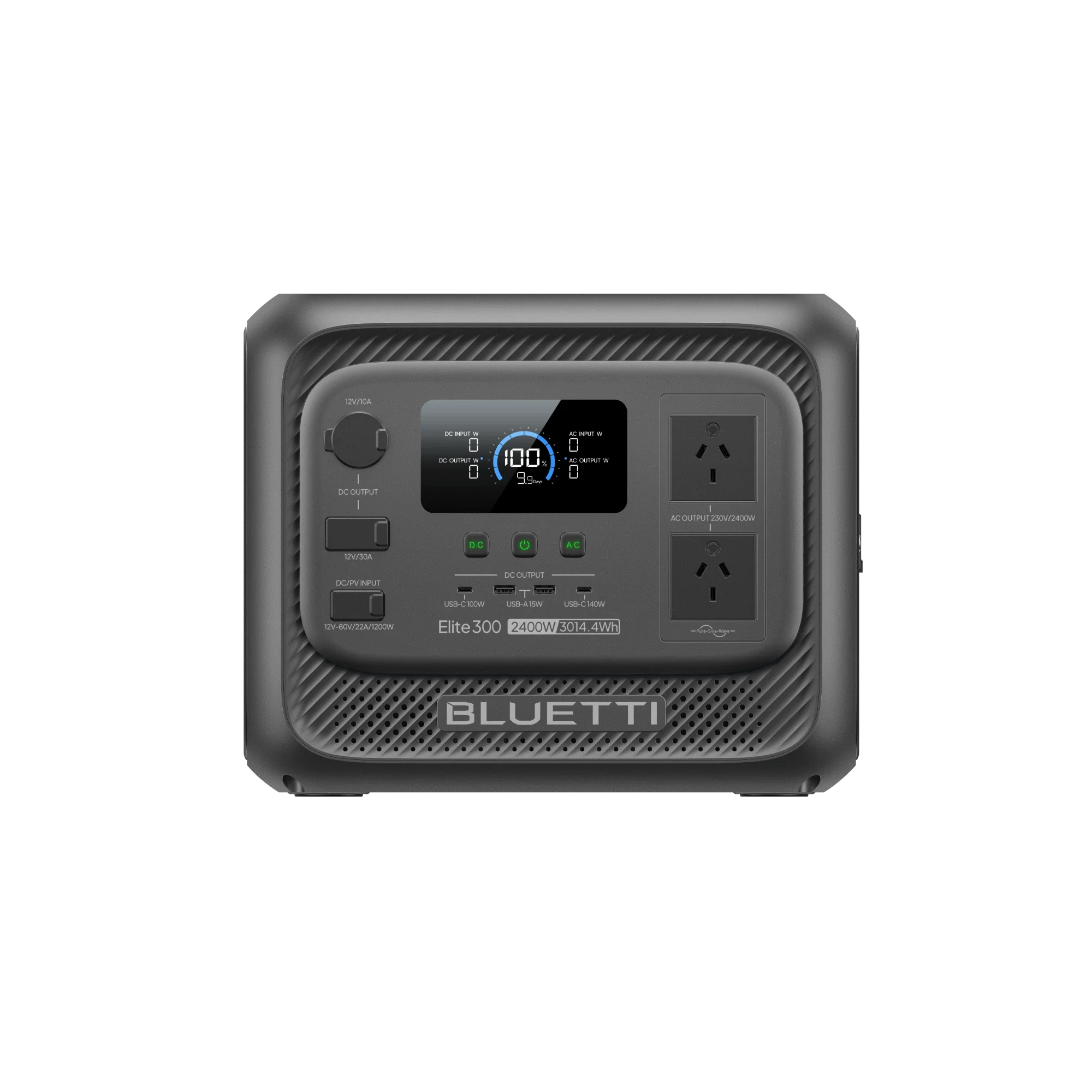
BLUETTI Elite 300 vs BLUETTI Pioneer MD AC180T
Both are a 58 lb lift, but only one of them holds enough to finish a weekend, and it's the one that costs $400 more.
Full profiles: BLUETTI Elite 300 → · BLUETTI Pioneer MD AC180T →

Written by Gunner GustafsonUpdated
Whole-Home Backup Tester, Station Arena Test Desk
$1,099.00 · direct from BLUETTI
down from $1,199 · 8% below usual
Last checked 1 day ago. Prices move — check before you buy.

$799.00 · direct from BLUETTI
Last checked 1 day ago. Prices move — check before you buy.
Spec deltas
Four hundred dollars separates these two, and it buys 1,581Wh more battery (3,014Wh against 1,433Wh) in a box that weighs a hair less. The Elite 300 is 58 lbs. The Pioneer MD AC180T is 58.4. Whatever else is true here, this is not a capacity-versus-portability trade.
The Pioneer's real card is that it comes apart. Two B70 packs slide out of the chassis and can be swapped while the unit is running, so the devices plugged into it never see the gapB1, and the 58.4 lbs can travel up the stairs in piecesB4. That is a genuinely useful design, and it's the one thing on this page the Elite has no answer to.
It still doesn't hold enough. A weekend of camping asks 2,100Wh and a full day without grid power asks 1,645Wh, and both of those land above 1,433Wh and below 3,014Wh, which is to say precisely in the gap between these two units. Buy the Elite 300 unless $799 is a ceiling rather than a preference.
What the Numbers Reveal
Each conclusion stated first — the numbers behind it on one line, the full analysis below.
rated cycles
Put that on a calendar and it stops being an abstraction. Cycled once a day, the Pioneer's cells reach end of rating in 8.2 years while the Elite is only at the halfway point of 16.4. The $400 you keep at checkout is a down payment on replacing the cheaper unit while the expensive one is still mid-life.
Elite 300: $1,199 for 3,014Wh rated at 6,000 cyclesPioneer MD AC180T: $799 for 1,433Wh rated at 3,000 cyclesRated lifetime energy: 18,086kWh for the Elite, 4,299kWh for the Pioneer
Why it mattersAnyone who plans to genuinely cycle this thing, weekly camping or seasonal outages or off-grid weekends, should stop reading the sticker price and buy the Elite.
weight
So the portability question isn't which is lighter, because neither is. It's which one comes apart. The Pioneer's packs slide out, so its 58.4 lbs can go down the basement stairs in stagesB1B4, while the Elite is one committed two-hands lift. That's the entire physical difference between them.
Elite 300: 58 lbs holding 3,014WhPioneer MD AC180T: 58.4 lbs holding 1,433WhThe Pioneer's two B70 packs pull out of the chassisB1B4
Why it mattersIf a single 58 lb lift is genuinely out of reach, bad back, narrow stairs, loading solo, the Pioneer's modularity is the one honest reason to pay more per watt-hour.
solar input
Recharge doesn't rescue the smaller unit either. At 1,200W, a full 3,014Wh goes back into the Elite in about 2.5 hours of strong sun; the Pioneer's 500W ceiling needs about 3 hours to replace 1,433Wh. The bigger battery is also the faster one to refill in clock time, so on day two of an outage the gap opens further instead of closing.
Weekend Camping draws 2,100Wh: 82% of the Elite's usable capacity, 172% of the Pioneer's8-Hour Blackout draws 1,645Wh: 64% of the Elite, 135% of the PioneerSolar input ceilings: 1,200W for the Elite, 500W for the Pioneer
Why it mattersIf the word 'outage' or 'weekend' is anywhere in your reason for shopping, the Pioneer is the wrong size and sunshine won't fix it.
Bring in the $400 gap and the case inverts for this one buyer. They'd be paying it for headroom they'll use 12% of, and giving up the only documented noise figure in the matchup to do it. The Pioneer's 45dB is a known quantity. The Elite's silence on the subject is not the same thing as silence.
CPAP Overnight draws 320Wh: 12% of the Elite, 26% of the PioneerPioneer MD AC180T: 45dB under loadElite 300: no published noise figure in our data
Why it mattersIf the unit's main job is running a CPAP 18 inches from your head, buy the Pioneer and keep the $400.
The specific dimensions that decide these two units — everything else is a tie.
Runtime: Will It Power Your Gear?
Selected because: The two loads people buy these for, a 2,100Wh camping weekend and a 1,645Wh blackout, both land above the Pioneer's 1,433Wh and below the Elite's 3,014Wh.
continuous output
A camping weekend asks 2,100Wh, and that single figure sorts these two. The Elite finishes it having spent 82% of usable capacity, with something left for Sunday morning. The Pioneer would need 172% of everything it holds, which is a technical way of saying you'd be driving somewhere to find an outlet on Saturday night.
Below about 900Wh the two are interchangeable and the Elite's capacity is just insurance. A remote workday's 910Wh costs the Pioneer 75% of its usable capacity and the Elite 36%; a tailgate's 670Wh costs 55% and 26%. The Pioneer clears both. It clears them with nothing in reserve for a second day, which is the difference between a unit that fits your load and a unit that fits your load once.
Lifetime Value
Selected because: Half the capacity on half the cycle rating compounds into 18,086kWh of rated lifetime energy for the Elite against 4,299kWh for the Pioneer.
cost / lifetime kWh
Seven cents a kilowatt-hour against nineteen. Spread the purchase price across every kilowatt-hour each unit is rated to deliver and the Elite lands at $0.07 while the Pioneer lands at $0.19, and once you've read that you don't need it again: the box with the bigger sticker is the cheap one. The counterweight is real but narrow. Across the five-year warranty both units carry, the Elite costs $240 a year and the Pioneer $160, and that is the only frame in which the Pioneer is the cheaper machine. It's also the frame that stops counting at year five.
The cycle ratings are what decide it. 6,000 against 3,000 means a daily-cycled Pioneer reaches the end of its rating at 8.2 years while the Elite still has eight years of the same duty left in it. Batteries don't fail on the day the warranty ends, they fail on the cycle count, and one of these two was specified to be replaced sooner.
Portability & Form Factor
Selected because: At 58 lbs and 58.4 lbs these are the same lift, so the real question is which one you can carry in pieces.
weight
Fifty-eight pounds is a bent-knees, two-hands, get-it-in-one-go lift, and both of these are that. Where the Elite wins is volume rather than mass: it's certified the smallest 3kWh portable by volume as of January 2026, in a chassis closer to a standard 2kWh unitA2, and reviewers put it only about 2kg above the Elite 200 V2A3. Nobody calls it light. They call it smaller than a 3kWh box has any right to be.
The Pioneer answers with divisibility instead. Pull the B70 packs and the load distributes, which is the difference between one impossible trip and two manageable onesB4. The honest catch reviewers raise in the same breath is that the individual packs are heavy in the hand and the modular design is part of why the unit costs what it costsB4. If nobody in your household is doing stairs with this thing, you're paying for a solution to a problem you don't have.
Growth Path
Selected because: Neither unit's capacity can grow, which makes the Pioneer's hot-swap packs a runtime feature rather than an expansion path.
solar input
Buy a second Pioneer outright and you'd have 2,866Wh for $1,598 (1,433Wh and $799, twice over). That's still less energy than one Elite holds, for $400 more than one Elite costs. Neither of these units can grow its own capacity, so the ceiling you buy is the ceiling you keep, and the Elite's ceiling is more than double.
What the hot-swap actually buys is continuity, not capacity. Run a pack flat, drop in a charged one, and the load never noticesB1, with the sensible caveat that you don't perform the swap under heavy drawB1. That's worth real money to someone days from a wall socket with spare packs in the truck. It's worth nothing to someone who recharges every night, and it never raises the 1,433Wh the unit itself holds.
Strengths & trade-offs
BLUETTI Elite 300
Strengths
- +Lighter by 0.4 lb
- +Larger battery capacity
- +Higher AC output
- +Faster solar charging
- +Rated for 6,000 charge cycles — much longer battery lifespan
Trade-offs
- –Substantially more expensive (+$400) than the Pioneer MD AC180T.
BLUETTI Pioneer MD AC180T
Strengths
- +Costs $400 less
Trade-offs
- –Weaker inverter (-600W) limits appliance compatibility.
- –Shorter-lived battery — rated for 3,000 charge cycles vs the Elite 300's 6,000, so it wears out sooner.
Will It Power Your Gear?
Scenario math and per-appliance runtimes, modeled from the spec record.
Scenario verdicts
We ran the math on six real-world scenarios. Here's which unit survives your actual life.
SCN-01 · 2 nights · needs 2,100Wh
Weekend Camping
Two nights off-grid with essential comfort
Elite 300
A weekend asks 2,100Wh of whichever unit you brought. The Elite gets there on 82% of usable capacity with a margin for Sunday morning. The Pioneer would need 172% of everything it holds, so it doesn't get there at all, and the nearest outlet becomes part of your itinerary.
Battery budget usedlower = more headroom
LOAD Phone Charger 15W×6h · LED Lights 40W×8h · Box Fan 75W×14h · CPAP Machine 40W×16h
SCN-02 · 8 hours · needs 1,645Wh
8-Hour Blackout
Keep the essentials running through a night without power
Elite 300
Eight hours without grid power needs 1,645Wh. The Elite covers it on 64% of usable capacity, which leaves room for the outage that runs long, and they usually do. The Pioneer needs 135% of what it holds and goes dark before the lights come back.
Battery budget usedlower = more headroom
LOAD Fridge 150W×8h · Router + Modem 20W×8h · LED Lights (4 bulbs) 40W×6h · Phone Charger 15W×3h
SCN-03 · 8 hours · needs 320Wh
CPAP Overnight
Sleep therapy without interruption — the #1 medical use case
Either unit
Both units coast through this one. A CPAP asks 320Wh a night, 12% of the Elite and 26% of the Pioneer, so capacity isn't the spec that decides it. The fan 18 inches from your head is, and there the Pioneer is the known quantity at 45dB while the Elite has no published figure at all.
Battery budget usedlower = more headroom
LOAD CPAP Machine 40W×8h
SCN-04 · 8 hours · needs 910Wh
Remote Workday
Full work day off-grid without power anxiety
Elite 300
A workday's 910Wh fits in either one, but not equally. The Elite spends 36% of usable capacity; the Pioneer spends 75% and ends the day near the bottom with nothing banked for tomorrow. Margin is the entire win here, and margin is what you're buying.
Battery budget usedlower = more headroom
LOAD Laptop 60W×8h · External Monitor 30W×8h · Router + Modem 20W×8h · Phone Charger 15W×2h
SCN-05 · 4 hours · needs 670Wh
Tailgate Party
Game day power for the crew
Elite 300
Both handle game day; the Elite 300 keeps more in reserve (26% used vs 55%). Tailgating is a light load, though, so the number you'll feel is weight: 58 lbs for the Elite 300 against 58.4 lbs for the Pioneer MD AC180T, from the trunk to the setup spot.
Battery budget usedlower = more headroom
LOAD Blender 400W×0.5h · LED TV (55") 80W×4h · Bluetooth Speaker 15W×4h · Phone Charger (×3) 45W×2h
SCN-06 · 24 hours · needs 4,685Wh
Van Life Daily
A full day of mobile living — the ultimate endurance test
Neither unit
Neither unit does this. Full-time van living draws 4,685Wh a day, which is 183% of the Elite and 385% of the Pioneer, and no amount of disciplined use closes a gap of that size. This buyer needs a wired 12V house bank charged off the alternator and roof panels, not a portable with a handle.
Battery budget usedlower = more headroom
LOAD Mini-Fridge 150W×24h · Laptop 60W×4h · Phone Charger 15W×3h · LED Lights 40W×5h · Fan 75W×8h
The Load Test
RUNTIME = (Wh × 0.85) ÷ LOAD
None of the scenarios above exactly yours? Build it. Toggle what you'd plug in; both units are tested against the combined draw.
Essentials
Comfort & Convenience
High-Draw Appliances
Test duration
8h
Continuous draw
205W
Projected runtime
For this load: Elite 300 runs 12.5h vs 5.9h.
$1,199 list · direct from BLUETTI
Modeled from the spec record — same math as the tables below. Methodology
Runtime by appliance
Real-world runtime estimates for common appliances, modeled at 85% inverter efficiency.¹
Essentials
The basics you need runningscale 0–170.8hComfort & Convenience
Makes off-grid life actually enjoyablescale 0–34.2hHigh-Draw Appliances
These reveal the real limitsscale 0–2.6h¹ Runtime = (capacity × 0.85) ÷ appliance watts. Within each group, all bars share one time scale (the group's longest runtime), so lengths are comparable across appliances; identical runtimes collapse into a single blue/orange bar. Actual runtime varies with battery age, temperature, and simultaneous loads — see methodology.
Conclusion
August 9, 2026
Verdict: the Elite 300
The Elite 300 at $1,199 does the two jobs people actually buy these boxes for and the Pioneer MD AC180T at $799 doesn't: a 2,100Wh camping weekend and a 1,645Wh blackout both exceed the Pioneer's 1,433Wh, and both fit inside the Elite's 3,014Wh. The extra $400 also buys double the cycle rating (6,000 against 3,000) and 1,200W of solar input against 500W, for the same 58 lb lift. The Pioneer earns its place in two specific cases: a hard $799 budget attached to small loads, and a buyer who physically needs the weight to come apart. Outside those two, the cheaper unit is the one that costs more.
Today the Elite 300 is $1,099, $100 under its typical $1,199. The verdict weighs typical prices, not today's. Prices checked 1 day ago.
Editor-assigned confidence, based on cited owner research and spec analysis.
List prices as of August 9, 2026. The links below open BLUETTI's current price.
$1,099.00 · direct from BLUETTI
down from $1,199 · 8% below usual
Last checked 1 day ago. Prices move — check before you buy.
or check the Pioneer MD AC180T price$799.00 list
Written by Gunner Gustafson, Whole-Home Backup Tester · Station Arena Test Desk · Updated August 9, 2026
Measured Data
Benchmark scores and the full spec record, side by side.
Benchmark scores
Not rated for both units (minimum threshold unmet): CPAP.
Full specifications
ᵈ Derived: price ÷ rated capacity. See the data behind our comparisons →
Comparison ToolAdd more power stations, side by sideOpen Tool →How these numbers are produced
Numeric verification
Every figure on this page traces to our spec database or arithmetic on it — no estimated numbers.
Owner claims
Statements about owner experience are cited to published reviews — see Sources & Research Notes below.
Runtime model
Runtime = (rated capacity × 0.85 inverter efficiency) ÷ device wattage. Solar recharge estimates assume panels deliver 70% of rated output. Cold weather, battery age, and stacked loads reduce real-world results.
Power Score
Computed from 14 published spec dimensions, weighted per use-case bench. Higher is better; a unit must meet a bench's minimum threshold to be rated.
See the full weight table and data sourcing on our methodology page →Class ranking (the star rating)
Each unit's star score is a category ranking, not customer reviews — no buyer opinions feed it. We score every station on size-independent quality (value, output, portability, endurance, ports, warranty, and more), then percentile-rank it against the other units in its capacity class, so a class-leading compact unit and a class-leading whole-home unit can both earn 5★. Here, Elite 300 rates 4.6/5 (76th percentile of 26 Large-class units), and Pioneer MD AC180T rates 3.6/5 (19th percentile of 27 Everyday-class units).
How the class ranking is computed →Test Notes & Caveats
Hidden gotchas and advantages we spotted that you won't find on the product page.
Pioneer MD AC180T: 45dB Published
45dB is about as loud as a running refrigerator. It is BLUETTI's own rating rather than a reading on a shared bench — makers differ on whether they quote a best case or a figure under load, so treat it as a starting point rather than what you would hear at a bedside. For most people, fan noise around 45dB and up is where sleep starts to suffer.
The ceiling is what you're buying
The Elite 300 is sealed at 3,014Wh with no port to add to, and it's worth saying plainly since it's the one place our pick has no answer. The honest check is your longest stretch away from a wall socket. Note that the Pioneer's packs come out but don't raise its 1,433Wh either, so neither unit grows. One of them just starts higher.
Exactly double, and one and a half times
The Elite peaks at 4,800W over a 2,400W continuous rating. The Pioneer manages 2,700W over 1,800W. Compressors in fridges and air conditioners pull a multiple of their running draw for the half second it takes to spin up, and that half second is where headroom either exists or the inverter trips out and your fridge stays warm.
10ms or 20ms, and why it probably doesn't decide anything
The Elite transfers in about 10ms, the Pioneer in about 20ms. A desktop, a router, and a CPAP all ride through either without noticing. Save this spec for gear with a documented transfer-time requirement in its manual. For everything else in a normal house, treat it as a tie and spend your attention on capacity.
Warranty: No Difference
Both units carry the same 5-year warranty, so coverage isn't a tiebreaker here. Both figures are maximums rather than guarantees — they depend on buying direct from BLUETTI or registering the unit, since reseller purchases carry a shorter term. Worth saying because the per-dollar framing can suggest otherwise: the Pioneer MD AC180T works out at 6.3 years of cover per $1,000 spent against the Elite 300's 4.2, but that spread is the price gap, not the terms.
Eight years, or sixteen
6,000 cycles against 3,000, under identical five-year warranties. Cycled daily that's 16.4 years for the Elite and 8.2 for the Pioneer, so the warranty runs out long before either battery does and tells you nothing useful. The cycle rating is the spec that's actually describing the lifespan.
No dB figure for the Elite 300
The Pioneer publishes 45dB under load. For the Elite 300 there's no noise spec in our data, and we won't guess at one. If this unit is going to live in a bedroom or beside a desk, that absence is a genuine hole in the case for the more expensive box, and it's the strongest card the Pioneer holds at low loads.
Full record above — the Test Desk pick is the Elite 300.
Check Elite 300 price →or check the Pioneer MD AC180T priceOwnership Analysis
What happens after you buy — true cost of ownership, brand trust, and growth potential.
Lifetime value
Service lifeyears at one full cycle per day
Lifetime energy delivered
Cost per delivered kWh
│ warranty ends · Reaching the cycle rating means ~80% capacity remains — degraded, not dead.
Analyst note
The Pioneer MD AC180T is cheaper to buy, but the Elite 300 is cheaper to own. At $0.07/kWh over its lifetime vs $0.19/kWh, the Elite 300's higher cycle life and capacity make each dollar go further over the years.
Delivers each lifetime kWh for $0.12 less — check the Elite 300 price →
Growth path
Elite 300
FIXED CAPACITYFixed at 3,014Wh — a sealed, complete system rather than a starting point. There's no expansion port, so that figure is the ceiling: check it against your longest unplugged stretch before you buy.
Accepts up to 1,200W of solar. Enough for a serious multi-panel array.
Adequate ports for most setups, but heavy users may want a power strip.
Pioneer MD AC180T
SWAPPABLEThe battery packs slide out and swap like power-tool batteries: run one flat, drop in a charged one, keep going with no wait to recharge. That makes runtime a question of how many packs you own and are willing to carry, not how big the unit is. What it does not do is raise the 1,433Wh the unit itself holds.
Accepts up to 500W of solar. Suitable for a 1-2 panel setup.
Adequate ports for most setups, but heavy users may want a power strip.
Not applicable (no expansion available).
Realistic full solar rechargeat 70% of rated panel output — see methodology
Analyst note
Neither unit's own capacity can grow. The Elite 300 is sealed at 3,014Wh. The Pioneer MD AC180T holds 1,433Wh too, but its packs slide out, so you can carry a charged spare and swap it in rather than waiting on a recharge — useful if you're away from power for long stretches, and irrelevant if you aren't.
What Owners Report
Patterns from published owner reports and long-term reviews — every claim cited to its source below.
BLUETTI Elite 300
Field evidence on the Elite 300 is 2026 review coverage rather than years of ownership, so read it as first impressions rather than a service recordA1A4. What's there is consistent: multiple 2026 reviews report strong real-world performance across home backup, RV, and off-grid useA4, and the cells are the same LiFePO4 tier BLUETTI ships in the Elite 100 V2, Elite 200 V2, and Apex 300, rated 6,000+ cycles to 80%A1.
The claim reviewers keep circling back to is the packaging. Certified the world's smallest 3kWh portable power station by volume as of January 2026, in a footprint closer to a standard 2kWh unit and at just under 58 lbsA2, and only around 2kg heavier than the Elite 200 V2 while not being dramatically biggerA3. That's a compliment about density, not about being easy to carry.
“3,014Wh of premium LiFePO4 rated for 6,000+ cycles to 80% — over 16 years of daily use — the same cell tier used in the Elite 100 V2, Elite 200 V2, and Apex 300.”
Sources
backuppowerhub.com · trustedreviews.com · rv.com · thetechnologyman.com · exspenditure.com · reviewed.com · camerajabber.com
BLUETTI Pioneer MD AC180T
The hot-swap system is what reviewers single out, and they're specific about how it behaves: the two B70 packs can be changed during operation without interrupting power to connected devices, provided you're not swapping above a moderate loadB1. Refills are quick, roughly 45 minutes to 80% and about 1.1 hours to fullB3, and the 1,800W inverter is reported to cover the usual suspects including coffee makers, microwaves, and induction cooktopsB2.
The criticism is aimed at what the modularity costs. Solar Reviews graded it a B, flagging that the swappable design pushes the price up and that the individual batteries are heavy even though removing them lightens the 58.4 lb wholeB4. That's the trade in one sentence: a premium for a feature that only pays you back if you're actually carrying spares.
“Owner-swappable batteries that can be hot-swapped during operation without interrupting power to devices (avoid swapping above a moderate load); two slots for hot-swappable B70 packs.”
Sources
bluettipower.com · dustinabbott.net · bestgeneratorsolar.com · rv.com · amazon.com · techradar.com · solarreviews.com
Sources & Research Notes
Every owner claim in this report is traceable to a published source. The bracketed references above resolve here.
Recurring owner themes
- 6,000-cycle LFP longevity, a class-leading compact size for 3kWh, and strong real-world performance are the standout praise. [Elite 300 · 3 entries]
- The hot-swappable modular B70 battery system is the standout — enabling continuous power and distributable weight; the trade-offs are a price premium and heavy individual batteries. [Pioneer MD AC180T · 2 entries]
- A1
“3,014Wh of premium LiFePO4 rated for 6,000+ cycles to 80% — over 16 years of daily use — the same cell tier used in the Elite 100 V2, Elite 200 V2, and Apex 300.”
backuppowerhub.com / trustedreviews.com — Elite 300 review · 2026 · [positive]
- A2
“Certified as the world's smallest 3kWh portable power station by volume (as of January 2026), fitting a chassis closer to a standard 2kWh unit, at just under 58 lbs.”
backuppowerhub.com / rv.com — Elite 300 review · 2026 · [positive]
- A3
“Only about 2 kg heavier than the Elite 200 V2 and not dramatically larger, so it's still manageable to move around for a 3kWh unit.”
thetechnologyman.com / exspenditure.com — Elite 300 review · 2026 · [positive]
- A4
“Multiple 2026 owner reviews report strong real-world performance across home backup, RV, and off-grid use.”
reviewed.com / camerajabber.com — Elite 300 owner reviews · 2026 · [positive]
- B1
“Owner-swappable batteries that can be hot-swapped during operation without interrupting power to devices (avoid swapping above a moderate load); two slots for hot-swappable B70 packs.”
bluettipower.com / dustinabbott.net — AC180T review · 2026 · [positive]
- B2
“The 1,800W output covers nearly all common appliances — coffee makers, laptops, TVs, microwaves, and induction cooktops.”
bestgeneratorsolar.com / rv.com — AC180T review · 2026 · [positive]
- B3
“Reaches 80% charge in about 45 minutes and fully charges in roughly 1.1 hours.”
amazon.com / techradar.com — AC180T review · 2026 · [positive]
- B4
“58.4 lbs fully loaded, but the removable B70 batteries let you lighten or distribute the load; reviewers grade it a B, noting the swappable-battery design drives the price up and the individual batteries are heavy.”
solarreviews.com / rv.com — AC180T review · 2026 · [mixed]
Research compiled August 9, 2026.
Who Should Buy Which
Buy the Elite 300 if you…
- →You're buying for outages. Eight hours off-grid comes to 1,645Wh, which is 64% of the Elite, so the outage can run long and you're still not rationing.
- →You camp with a cooler that never gets switched off. A 2,100Wh weekend fits inside 3,014Wh with margin, and it doesn't fit inside 1,433Wh at all.
- →You'll be charging from panels. 1,200W of input replaces the full 3,014Wh in roughly 2.5 hours of strong sun, so one good solar day resets the entire bank.
- →You start motors. 4,800W of surge over a 2,400W continuous rating is exactly double, and compressors want that headroom for the half second they spin up.
Buy the Pioneer MD AC180T if you…
- →$799 is a hard ceiling and your loads are small. At 320Wh a night for a CPAP or 910Wh for a workday, the Pioneer clears them and you keep the $400.
- →A single 58 lb lift isn't happening. The B70 packs come out so the unit travels in piecesB1B4, and nothing else in this matchup does that.
- →You need it back to full fast from a wall outlet. Reviewers clock roughly 45 minutes to 80% and about 1.1 hours to fullB3.
- →Quiet is a requirement rather than a preference. 45dB under load is a published number you can plan around; the Elite 300 has no noise figure at all.
If neither fits
You're powering a van you actually live in. That's 4,685Wh a day, which is 183% of the Elite and 385% of the Pioneer, and careful rationing doesn't close a gap that size. What you want is a wired 12V house bank sized in kilowatt-hours, charged off the alternator and roof panels, installed once. Close this tab and go price a system, not a box with a handle.
The Bottom Line
Take the Elite 300. Same lift, more than double the battery, 4.2 times the energy across its rated life, and the two scenarios most people buy these boxes for both sit in the gap where the Pioneer runs out and the Elite doesn't. The $400 is not a premium for a nicer version of the same thing. It's the price of the size that matches the job.
The Pioneer isn't a bad box, it's a $799 box with one clever trick. If that number is a ceiling rather than a preference, or if you need the weight to come apart to get it where it's going, buy it and don't apologize. Everyone else is looking at the cheapest 1,581Wh they will ever be offered.
Frequently Asked Questions
Answers drawn from the spec record and cited owner research.
Is the Elite 300 worth $400 more than the Pioneer MD AC180T?
Yes, if you'll ever draw more than 1,433Wh in a single stretch. The $400 buys 1,581Wh of additional capacity, double the cycle rating, and more than twice the solar input, all at the same 58 lb lift. If your loads are CPAP-and-laptop sized, it's $400 for headroom you'll never touch, and the Pioneer is the right call.
Will either one get me through an 8-hour blackout?
The Elite will, spending 64% of its usable capacity on the 1,645Wh that eight hours requires. The Pioneer won't: the same 1,645Wh works out to 135% of what it holds, so it's empty before the eighth hour. If blackout coverage is why you're shopping, that single comparison settles the matchup.
Do the Pioneer's swappable batteries make it expandable?
No. The two B70 packs slide out and can be swapped while the unit is running, but a swap replaces energy rather than adding it. With both packs in, the unit holds 1,433Wh, and that stays the ceiling no matter how many spares you own. What swapping buys you is continuous operation without waiting on a recharge.
Which one is quieter?
The Pioneer is the only one with a number: 45dB under load. There's no published noise figure for the Elite 300, and we won't invent one. If the unit is going to live in a bedroom or beside a desk, the documented unit is the safer buy on that specific point.
How long will each battery actually last?
The Elite is rated for 6,000 cycles and the Pioneer for 3,000, which comes to 16.4 years and 8.2 years at one full cycle every day. Cycle either one weekly instead and the ratings run out to 115.4 years and 57.7 years, which is a polite way of saying cycle count stops mattering at that duty. Both carry the same five-year warranty, so the cycle rating is the part that tells you something.
Where to buy
BLUETTI Elite 300Pick
$1,099.00
$1,099.00 · direct from BLUETTI
down from $1,199 · 8% below usual
Last checked 1 day ago. Prices move — check before you buy.
BLUETTI Pioneer MD AC180T
$799.00
$799.00 · direct from BLUETTI
Last checked 1 day ago. Prices move — check before you buy.
Prices may vary by retailer and are subject to change.