Head-to-head test
Anker SOLIX S2000 vs Jackery Explorer 1000 Plus
Same money, and the Explorer spends it on an inverter it can only hold wide open for about half an hour while the S2000 spends it on 746Wh more battery and two and a half times the rated cycles.
Full profiles: Anker SOLIX S2000 → · Jackery Explorer 1000 Plus →

Written by Ian SchneiderUpdated
Solar & Off-Grid Tester, Station Arena Test Desk
Spec deltas
These two cost the same money, $700 for the SOLIX S2000 and $699 for the Explorer 1000 Plus, and they spend it in opposite directions. Anker puts it in the battery: 2,010Wh against 1,264Wh, rated for 10,000 cycles against 4,000. Jackery puts it in the inverter: 2,000W against 1,500W.
The output gap comes with a peak-power gap, and the second one is the first one doubled. Anker publishes 1,500W rated and 3,000W peak. Jackery publishes 2,000W and 4,000W. Exactly two times, both times, which is the convention across this class, so the Explorer doesn't have a separate surge talent. It has one 500W advantage counted twice. The heaviest startup draw in any scenario on this page is 400W, and both units take it.
So the Explorer's headroom is real and almost nobody reaches it. What people do reach is the bottom of the battery, and that's where this settles: the Explorer stops 571Wh short of the 8-hour blackout the S2000 finishes, and it gets three CPAP nights to the S2000's five. Take the S2000 unless you own a specific appliance over 1,500W, own panels that push past 400W, or already know you'll grow past 2,010Wh. The Explorer is the only one of the two that can.
What the Numbers Reveal
Each conclusion stated first — the numbers behind it on one line, the full analysis below.
continuous output
Run the Explorer at the output it advertises and the battery decides how long that lasts: 1,074Wh usable against 2,000W is about half an hour. The S2000 flat out at 1,500W runs about an hour on 1,708Wh. The bigger inverter is fed by the smaller tank, so the unit with more power has less time to use it.
SOLIX S2000: 1,500W rated output, 3,000W published peakExplorer 1000 Plus: 2,000W rated output, 4,000W published peakThe heaviest startup draw across the six modeled scenarios is 400W, and both units start and sustain every oneUsable energy after the flat 85% derate: 1,708Wh on the S2000, 1,074Wh on the Explorer 1000 Plus
Why it mattersThe Explorer's output earns its keep only if you own one specific appliance above 1,500W and run it in bursts. For anything you'd keep on through an evening, the tank matters more than the tap.
rated cycles
The refill clock is the same on both, near enough, at about 1.7 hours from the wallA5B1. So every one of those plugged-in-overnight cycles moves 746Wh more with the S2000 (2,010Wh against 1,264Wh), and there are two and a half times as many of them before either pack settles to 80% of what it started with.
Both carry a 5-year warranty and both cost the same moneyS2000: 2,010Wh per cycle x 10,000 rated cycles = 20,096 kWh over the rated lifeExplorer 1000 Plus: 1,264Wh x 4,000 cycles = 5,056 kWhWall recharge measured at roughly 1.7 hours to full on both unitsA5B1
Why it mattersAnyone who cycles the unit regularly rather than storing it for emergencies is buying the S2000's pack several times over at the same price.
solar input
That reverses the argument the moment the outage outlives the battery. For one night, capacity decides it and the Explorer doesn't finish. For a grid-down week on panels, the Explorer is full before mid-morning and can do it again after lunch while the S2000 spends the entire good-sun window on a single fill. The catch is that 800W of input needs 800W of panels, which is a separate purchase most buyers never make.
Solar input: 400W maximum on the S2000, 800W on the Explorer 1000 PlusCapacity: 2,010Wh against 1,264Wh8-Hour Blackout needs 1,645Wh: the S2000 finishes with 63Wh spare, the Explorer is 571Wh short
Why it mattersBuy the Explorer on power grounds if you already own panels past 400W and expect multi-day outages. If your kit is one or two folding panels, the input ceiling is decoration and the bigger battery wins.
And it stops paying sooner than you'd hope. Take the full bank at roughly 5,000WhB2 and apply the same 85% derate every scenario here uses: about 4,250Wh usable, still around 435Wh short of the 4,685Wh van-life day it would be bought for. The expansion path covers the middle ground between 2,010Wh and roughly 4,250Wh usable, and nothing past it.
The S2000 is sealed at 2,010Wh with no expansion portThe Explorer 1000 Plus takes up to three additional batteries, about 5,000Wh in totalB2Van Life Daily needs 4,685Wh and neither unit covers it as soldEvery scenario here derates capacity by a flat 85% to get usable energy
Why it mattersIf your target sits in that band, the Explorer is the only unit here that reaches it. If it's a van's daily load, both of these are the wrong purchase and a larger station is the right one.
The specific dimensions that decide these two units — everything else is a tie.
Lifetime Value
Selected because: Same price, same 5-year warranty, and four times the lifetime energy on one side: 20,096 kWh against 5,056 kWh.
cost / lifetime kWh
Three cents a kilowatt-hour against fourteen. Read that once and the ownership question is settled, and it comes from two places at the same time: the S2000's pack is rated for 10,000 cycles against 4,000, and each of those cycles is 2,010Wh instead of 1,264Wh. Warranty doesn't break the tie either, since both records read five years.
The honest caveat is that almost nobody spends 10,000 cycles. At twice a week the S2000's rated life runs 96 years against the Explorer's 38, which is where a number stops meaning anything. The version that matters is daily use: 27.4 years against 11. One of these is a unit you hand down, the other is a unit you replace once. Neither dies at the limit; both settle to about 80% of original capacity and carry on.
Runtime: Will It Power Your Gear?
Selected because: Every scenario here is decided by usable energy, 1,708Wh against 1,074Wh, rather than by the 500W output gap.
continuous output
The Explorer wins the specification and loses the arithmetic. Its 2,000W is real, and a six-month test ran every appliance inside that rating, including a fridge, lights, a laptop and a router together during an outageB3. But it draws on 1,074Wh of usable energy, and the 85% derate behind that figure is applied identically to both units, so it isn't a thumb on the scale. The S2000 has 1,708Wh to spend.
What the extra 634Wh buys is unglamorous and constant: another evening of the same load, not a different class of capability. The S2000's own limits show up elsewhere, in 400W of solar input and a carry that two separate hands-on tests called awkward on stairsA7A8. They don't show up in how long it runs.
Your Life, Your Pick
Selected because: The 8-hour blackout splits them: the S2000 finishes with 63Wh to spare, the Explorer stops 571Wh short.
The 8-hour blackout is the row that decides this page. The Explorer 1000 Plus stops 571Wh short of the 1,645Wh the night asks for, roughly two-thirds of the way through, which means the tail of the night runs on nothing. The S2000 finishes. It finishes narrowly rather than comfortably, but one unit finishing where the other doesn't is the only step change anywhere in these six scenarios.
Above and below that row the page is quieter. The CPAP night is 320Wh, a formality for both, and the only thing separating them there is how many nights you get before you need sun or a socket. At the other end, the camping and van-life loads beat both boxes, and the van-life day by a margin no expansion battery closes. In between, the S2000 wins on margin rather than capability: the workday at 53% used against 85%, game day at 39% against 62%.
Growth Path
Selected because: The Explorer is the expandable one, but it starts 746Wh behind, so the first battery buys back ground rather than gaining it.
solar input
Expandability reads like the Explorer's trump card until you notice where it starts. It ships 746Wh behind the S2000, so the first battery you buy, at a price that isn't on this page, mostly closes a gap the S2000 never had. Growth only becomes growth past 2,010Wh.
Past that point it's a genuine advantage and the S2000 has no answer, because sealed is sealed and the way you get more Anker is a second Anker. Three added batteries take the Explorer to roughly 5,000WhB2, covering ground the S2000 can't reach at any budget. Just check your target against the path before you buy it: derated the way every scenario here is derated, that maxed bank lands near 4,250Wh usable, still short of the 4,685Wh a van-life day asks for.
Brand Trust
Selected because: Matching warranty terms, a wide gap in app quality, and two support desks that both need watching.
Warranty is a wash on paper and nearly one in practice. Both records read five years, but the Explorer's is the conditional maximum you reach by registering the unit with Jackery. Register it the week it arrives and forget about it.
The apps aren't close. Anker's sits around 4.5 out of 5 on iOS across roughly 1,100 ratings; Jackery's runs 2.3 to 3.3 across both stores, split between two confusing apps and demanding a login even offline. Support runs the other way only in the sense that neither desk is a selling point: Jackery's is the weaker record, with strict receipt requirements on warranty claims and refurbished replacements for units that were clearly defective, while Anker's SOLIX service has drifted from the no-hassle reputation the parent brand earned and firmware updates have removed features without warning. Jackery's answer to its own support is distribution, and it's a decent one.
Strengths & trade-offs
Anker SOLIX S2000
Strengths
- +Larger battery capacity
- +Rated for 10,000 charge cycles — much longer battery lifespan
Trade-offs
- –No major technical downsides compared to rival.
Jackery Explorer 1000 Plus
Strengths
- +Costs $1 less
- +Lighter by 3.7 lb
- +Higher AC output
- +Faster solar charging
Trade-offs
- –Shorter-lived battery — rated for 4,000 charge cycles vs the SOLIX S2000's 10,000, so it wears out sooner.
Will It Power Your Gear?
Scenario math and per-appliance runtimes, modeled from the spec record.
Scenario verdicts
We ran the math on six real-world scenarios. Here's which unit survives your actual life.
SCN-01 · 2 nights · needs 2,100Wh
Weekend Camping
Two nights off-grid with essential comfort
Neither unit
The camping load here is 2,100Wh and neither box holds it. The S2000 lands 392Wh short, covering about 81% of the weekend; the Explorer 1000 Plus is 1,026Wh short at 51%. That's the difference between rationing on the last evening and rationing from Saturday afternoon. Bring panels and the Explorer's 800W input closes its bigger gap faster than the S2000's 400W closes its smaller one.
Battery budget usedlower = more headroom
LOAD Phone Charger 15W×6h · LED Lights 40W×8h · Box Fan 75W×14h · CPAP Machine 40W×16h
SCN-02 · 8 hours · needs 1,645Wh
8-Hour Blackout
Keep the essentials running through a night without power
SOLIX S2000
The S2000 finishes this one and the Explorer 1000 Plus doesn't, which is the cleanest result on the page and also the narrowest. 1,645Wh needed against 1,708Wh usable leaves 63Wh in hand, under 4% of the load. Treat it as a pass, not a cushion, and don't plan on adding anything to the night. The Explorer stops 571Wh short, roughly two-thirds of the way through.
Battery budget usedlower = more headroom
LOAD Fridge 150W×8h · Router + Modem 20W×8h · LED Lights (4 bulbs) 40W×6h · Phone Charger 15W×3h
SCN-03 · 8 hours · needs 320Wh
CPAP Overnight
Sleep therapy without interruption — the #1 medical use case
Either unit
A CPAP night is 320Wh, which is 19% of the S2000 and 30% of the Explorer 1000 Plus, so both cover it and the margin is a formality. The number worth knowing is nights per charge: five on the S2000's 1,708Wh usable, three on the Explorer's 1,074Wh. If the power is back by morning that's irrelevant. If you're the person who needs the machine running through a multi-day outage without a generator in the yard, it's the whole question.
Battery budget usedlower = more headroom
LOAD CPAP Machine 40W×8h
SCN-04 · 8 hours · needs 910Wh
Remote Workday
Full work day off-grid without power anxiety
SOLIX S2000
The SOLIX S2000 clears the workday at 53% used, banking 798Wh — late work, extra calls, or a second laptop charge without arithmetic. The Explorer 1000 Plus at 85% also finishes, with 164Wh of slack for the unplanned.
Battery budget usedlower = more headroom
LOAD Laptop 60W×8h · External Monitor 30W×8h · Router + Modem 20W×8h · Phone Charger 15W×2h
SCN-05 · 4 hours · needs 670Wh
Tailgate Party
Game day power for the crew
SOLIX S2000
Game day asks 400W at startup, the heaviest peak anywhere on this page, and both units take it without noticing: 3,000W of published peak on the S2000, 4,000W on the Explorer 1000 Plus. So peak power decides nothing here, and energy barely does either at 39% used against 62%. What you'll feel is the walk from the trunk: 32 lbs for the Explorer against 35.7 for the S2000, and neither one needs a second person.
Battery budget usedlower = more headroom
LOAD Blender 400W×0.5h · LED TV (55") 80W×4h · Bluetooth Speaker 15W×4h · Phone Charger (×3) 45W×2h
SCN-06 · 24 hours · needs 4,685Wh
Van Life Daily
A full day of mobile living — the ultimate endurance test
Neither unit
Neither unit covers this scenario's 4,685Wh: the SOLIX S2000 comes up 2,977Wh short (about 36% covered), the Explorer 1000 Plus 3,611Wh (23%). This is well outside what either unit is for; the right answer here is a larger station, not a choice between these two.
Battery budget usedlower = more headroom
LOAD Mini-Fridge 150W×24h · Laptop 60W×4h · Phone Charger 15W×3h · LED Lights 40W×5h · Fan 75W×8h
The Load Test
RUNTIME = (Wh × 0.85) ÷ LOAD
None of the scenarios above exactly yours? Build it. Toggle what you'd plug in; both units are tested against the combined draw.
Essentials
Comfort & Convenience
High-Draw Appliances
Test duration
8h
Continuous draw
205W
Projected runtime
For this load: SOLIX S2000 runs 8.3h vs 5.2h.
Sold on Amazon
Planning for more than this? Describe your whole setup and get it sized →
Modeled from the spec record — same math as the tables below. Methodology
Runtime by appliance
Real-world runtime estimates for common appliances, modeled at 85% inverter efficiency.¹
Essentials
The basics you need runningscale 0–113.9hComfort & Convenience
Makes off-grid life actually enjoyablescale 0–22.8hHigh-Draw Appliances
These reveal the real limitsscale 0–1.7h¹ Runtime = (capacity × 0.85) ÷ appliance watts. Within each group, all bars share one time scale (the group's longest runtime), so lengths are comparable across appliances; identical runtimes collapse into a single blue/orange bar. Actual runtime varies with battery age, temperature, and simultaneous loads — see methodology.
Conclusion
September 19, 2026
Verdict: the Anker SOLIX S2000
Take the S2000. At $700 against $699 you get 2,010Wh instead of 1,264Wh and 10,000 rated cycles instead of 4,000, which is why it covers the 8-hour blackout at all while the Explorer misses it by 571Wh. The Explorer's advantages are genuine and specific: 2,000W of rated output against 1,500W, 800W of solar input against 400W, and a path to expansion batteriesB2. Every one of them is a good reason to buy it, and none of them applies to a buyer who can't yet name which one they need. The one thing that would raise the confidence here is time: the S2000 launched in June 2026, so what we have on it is short-term hands-on testing rather than anyone's second winter with itA0.
Today the Explorer 1000 Plus is $619, $80 under its typical $699. The verdict weighs typical prices, not today's. Prices checked 16 days ago.
Editor-assigned confidence, based on cited owner research and spec analysis.
List prices as of September 19, 2026. The links below open Anker's and Jackery's current prices.
Sold on Amazon · today’s price is on the listing
or check the Explorer 1000 Plus price$619.00 list
Written by Ian Schneider, Solar & Off-Grid Tester · Station Arena Test Desk · Updated September 19, 2026
Black Friday · 38 days out
Price to beat:Explorer 1000 Plus $619
The lowest we have recorded. A Black Friday price above it is a sale this unit has already had.
Measured Data
Benchmark scores and the full spec record, side by side.
Benchmark scores
Not rated for both units (minimum threshold unmet): RV Living, Food Truck.
Full specifications
ᵈ Derived: price ÷ rated capacity. See the data behind our comparisons →
Comparison ToolAdd more power stations, side by sideOpen Tool →How these numbers are produced
Numeric verification
Every figure on this page traces to our spec database or arithmetic on it — no estimated numbers.
Owner claims
Statements about owner experience are cited to published reviews — see Sources & Research Notes below.
Runtime model
Runtime = (rated capacity × 0.85 inverter efficiency) ÷ device wattage. Solar recharge estimates assume panels deliver 70% of rated output. Cold weather, battery age, and stacked loads reduce real-world results.
Power Score
Computed from 14 published spec dimensions, weighted per use-case bench. Higher is better; a unit must meet a bench's minimum threshold to be rated.
See the full weight table and data sourcing on our methodology page →Class ranking (the star rating)
Each unit's star score is a category ranking, not customer reviews — no buyer opinions feed it. We score every station on size-independent quality (value, output, portability, endurance, ports, warranty, and more), then percentile-rank it against the other units in its capacity class, so a class-leading compact unit and a class-leading whole-home unit can both earn 5★. Here, SOLIX S2000 rates 5.0/5 (99th percentile of 26 Large-class units), and Explorer 1000 Plus rates 4.6/5 (77th percentile of 27 Everyday-class units).
How the class ranking is computed →Test Notes & Caveats
Hidden gotchas and advantages we spotted that you won't find on the product page.
The S2000's ceiling is the box it came in
This is the S2000's one structural loss, so take it seriously: 2,010Wh isn't a starting point, it's the end of the road, and outgrowing it means buying a second unit. The Explorer 1000 Plus can add batteries. The catch is that it starts 746Wh behind, so the first one you buy mostly gets you where the S2000 already was. Expansion counts here only if you'd pass 2,010Wh.
UPS Switchover: ≤10ms vs ≤20ms
Both list a UPS mode, at different rated speeds. The SOLIX S2000 is rated ≤10ms — quick enough on paper that desktop PCs and routers should ride through, treating that as the rating it is. The Explorer 1000 Plus is rated ≤20ms — fine on paper for routers and most electronics; the fussiest PC power supplies sit right at this line. If a computer with unsaved work is the thing being protected, the stated class is worth the attention; nothing here is a lab result.
Warranty: No Difference
Both units carry the same 5-year warranty, so coverage isn't a tiebreaker here. The Explorer 1000 Plus's figure is a maximum rather than a guarantee — it depends on registering the unit with Jackery, which is what extends the base term to the full period.
10,000 cycles against 4,000, and what that's actually worth
Cycled daily, the S2000's rating works out to 27.4 years against the Explorer 1000 Plus's 11. At twice a week it's 96 years against 38, at which point the years have stopped being a real number and you should count energy instead: about four times as much over the rated life, since the S2000's cycles are both more numerous and 746Wh bigger. Neither pack dies at the limit. Both settle to roughly 80% of original capacity and keep working.
Full record above — the Test Desk pick is the SOLIX S2000.
Check SOLIX S2000 price →or check the Explorer 1000 Plus priceOwnership Analysis
What happens after you buy — true cost of ownership, brand trust, and growth potential.
Lifetime value
Service lifeyears at one full cycle per day
Lifetime energy delivered
Cost per delivered kWh
│ warranty ends · Reaching the cycle rating means ~80% capacity remains — degraded, not dead.
Analyst note
The Explorer 1000 Plus is cheaper to buy, but the SOLIX S2000 is cheaper to own. At $0.03/kWh over its lifetime vs $0.14/kWh, the SOLIX S2000's higher cycle life and capacity make each dollar go further over the years.
Delivers each lifetime kWh for $0.11 less — check the SOLIX S2000 price →
Brand trust
Anker
Ecosystem
Seven or eight SOLIX stations across the compact C-series and the flagship F-series, plus the X1 home energy system. Smaller than EcoFlow's, which matters less on a sealed unit than it would on an expandable one.
Support
US-based, and drifting. Anker built its name on no-hassle replacements, and SOLIX service has moved away from that: scripted agents on first contact, and return logistics for a heavy unit that run through hazmat shipping.
Community
Moderate — active Reddit (r/Anker, r/AnkerSOLIXCommunity) and growing. Benefits from Anker's massive consumer electronics brand awareness.
App experience
Rated 4.5/5 iOS (~1,100 ratings) · 4.3/5 Android
Unique strength
Value per watt-hour in the mid-size class is where Anker is strongest in this catalogue, and the S2000 is one of the clearest examples of it.
Worth knowing
Firmware updates have removed features without warning. That's the one Anker caveat that still reaches you on a unit with nothing to expand.
Jackery
Ecosystem
Twelve to fifteen models across the Explorer and HomePower lines plus the SolarSaga panels, and some genuinely odd form factors like the Solar Gazebo. Breadth is not the problem here.
Support
US-based and the weaker record of the two: strict receipt requirements on warranty claims, and refurbished replacements sent out for units that were clearly defective.
Community
The smallest community of the major brands, somewhere around 2,000 members on Reddit, offset by heavy YouTube coverage that comes with the name recognition.
App experience
Rated 2.3-3.3/5 iOS and Android — the weakest app experience of the major brands. Multiple confusing apps (Jackery app vs Jackery Home) and mandatory login even offline.
Unique strength
Distribution. Costco, Home Depot, Best Buy and Amazon all stock Jackery, so you can buy it somewhere that has its own return counter and its own receipt.
Worth knowing
The app is the weakest of the major brands at 2.3 to 3.3 out of 5, split across two separate apps and demanding a login even when you're offline and standing next to the unit.
Analyst note
Neither support desk is a reason to buy, which makes the workarounds the story. Anker's is that a sealed unit with a 10,000-cycle pack gives you less to call about; Jackery's is that you can hand the box back to Costco. If you're the sort of buyer who wants a human on the phone, buy wherever the returns are easy and treat both warranties as paperwork you file the week it arrives.
Growth path
SOLIX S2000
FIXED CAPACITYFixed at 2,010Wh — a sealed, complete system rather than a starting point. There's no expansion port, so that figure is the ceiling: check it against your longest unplugged stretch before you buy.
Accepts up to 400W of solar. Suitable for a 1-2 panel setup.
Adequate ports for most setups, but heavy users may want a power strip.
Explorer 1000 Plus
EXPANDABLESupports Jackery expansion batteries, so you can add capacity later without replacing the base unit — useful if your needs may climb past 1,264Wh.
Accepts up to 800W of solar. Suitable for a 1-2 panel setup.
Adequate ports for most setups, but heavy users may want a power strip.
Expansion batteries are Jackery-specific. You're investing in the Jackery ecosystem.
Realistic full solar rechargeat 70% of rated panel output — see methodology
Analyst note
Don't read the Explorer 1000 Plus's expandability as a straight win here: it starts at 1,264Wh, below the SOLIX S2000's 2,010Wh, so a first expansion battery largely buys back capacity the SOLIX S2000 already includes. It only pulls ahead if you'd grow past 2,010Wh — short of that, the SOLIX S2000's larger fixed capacity is the simpler value.
What Owners Report
Patterns from published owner reports and long-term reviews — every claim cited to its source below.
Anker SOLIX S2000
Field data on the S2000 is early by definition. It launched in June 2026, and what exists is short-term hands-on testing rather than anyone's second winter with itA0. Within that limit it's consistent. Two independent tests found it silent at idle with fans spinning up only under heavy load or the fastest charging modeA1A2, and both separately measured standby draw in single-digit watts, about 6W with the AC ports on and unused and about 2W with everything off, with a 10-hour sit dropping the pack only to 99%A3A4. Wall charging hit 80% in roughly 1.2 hours and full in about 1.7, matching Anker's own claimA5. One test ran a fridge and kitchen gadgets for over 60 hours on a chargeA12, and connected office equipment rode through a simulated grid cut without interruptionA9A10.
Two complaints, both worth knowing. Reviewers at two different outlets independently flagged the carryA7A8. At 35.7 lbs it's manageable, but there's no dedicated one-hand handle, and a second grip would help on stairs. And one tester noticed a faint warm-electronics smell within a few feet of the unit during its first hours under sustained load in a closed room, which faded after a day with nothing else to itA6.
“Fans only spin up under real load or fast charging, and at idle the unit is silent.”
Sources
ess-news.com · geardiary.com
Jackery Explorer 1000 Plus
The Explorer 1000 Plus has the thing the S2000 hasn't got yet: a six-month record. One owner ran it across dozens of camping trips, two extended outages and daily home-office use, and it handled every appliance inside its 2,000W rating, including a fridge, lights, a laptop and a router at once during a simulated outageB3. The 4,000-cycle LFP rating and the roughly 1.7-hour wall charge both held up under testingB1, and the consensus across reviews is that it's one of the best-rounded units in its size class this year, with expansion to about 5,000Wh across three added batteries as the standoutB2B4.
Our research turned up one limit the spec sheet doesn't advertiseB0. The Explorer carries no dust or water ingress rating, so the unsealed design wants a tailgate or a tarp rather than a rainstorm.
“The LiFePO4 battery genuinely hits 4,000 cycles, AC recharge consistently shows ~1.7-hour full charges, and the 2,000W pure sine wave inverter handles surge loads.”
Sources
backuppowerhub.com · thesolarlab.com · vettedhomegear.com · walkingsolar.com · mtnweekly.com · sparklingpicks.com · trustedreviews.com
Sources & Research Notes
Every owner claim in this report is traceable to a published source. The bracketed references above resolve here.
Recurring owner themes
- Two independent hands-on reviews both found near-silent idle operation, with fans spinning up only under heavy load or the fastest charging mode. [SOLIX S2000 · 2 entries]
- OptiSave's low-idle-draw claim held up under independent testing, with both reviewers separately measuring single-digit-watt standby draw. [SOLIX S2000 · 2 entries]
- Both reviewers praised fast, reliable UPS switchover that connected electronics didn't notice. [SOLIX S2000 · 2 entries]
- Despite otherwise solid build quality, reviewers from two different outlets independently flagged the single/absent carry handle as awkward for one-person transport. [SOLIX S2000 · 2 entries]
- Expandability to a multi-kWh bank, dependable 2,000W output, fast charging, and best-rounded-of-2026 status are the consistent praise. [Explorer 1000 Plus · 3 entries]
- A1
“Fans only spin up under real load or fast charging, and at idle the unit is silent.”
ess-news.com — Anker Solix S2000 review: 2 kWh power station built for the long haul · 2026-05 · [positive]
- A2
“The fans only spin up when pulling a heavy load or using the fastest charging mode — otherwise it stays very quiet.”
geardiary.com — Anker SOLIX S2000 Review · 2026-07 · [positive]
- A3
“Charged fully, disconnected from wall power with AC output enabled and no loads attached, then monitored for 10 hours: state of charge dropped only to 99%, implying about 2W average draw — matching Anker's spec.”
ess-news.com — Anker Solix S2000 review: 2 kWh power station built for the long haul · 2026-05 · [positive]
- A4
“With AC ports on but unused, consumption is about 6W; with everything disabled it drops to just 2W.”
geardiary.com — Anker SOLIX S2000 Review · 2026-07 · [positive]
- A5
“Real-world recharge from a standard 20-amp household circuit hit 80% in roughly 1.2 hours and full capacity in about 1.7 hours, matching the manufacturer's claims.”
ess-news.com — Anker Solix S2000 review: 2 kWh power station built for the long haul · 2026-05 · [positive]
- A6
“Under sustained AC load in a small, closed home office there was a slight warm-electronics smell within a few feet of the unit during the first several hours of operation; it faded after one day with no safety concern.”
ess-news.com — Anker Solix S2000 review: 2 kWh power station built for the long haul · 2026-05 · [mixed]
- A7
“At 35.7 lbs the weight is manageable but noticeable — a second handle would be welcome for carrying it up stairs.”
ess-news.com — Anker Solix S2000 review: 2 kWh power station built for the long haul · 2026-05 · [mixed]
- A8
“Lacks a dedicated handle for carrying with one hand, making transport less convenient despite the relatively compact 35.7 lb weight.”
geardiary.com — Anker SOLIX S2000 Review · 2026-07 · [negative]
- A9
“In a simulated outage, connected office equipment rode through the switchover without interruption.”
ess-news.com — Anker Solix S2000 review: 2 kWh power station built for the long haul · 2026-05 · [positive]
- A10
“A 10ms switchover time means a computer or internet router won't even flicker if the grid goes down.”
geardiary.com — Anker SOLIX S2000 Review · 2026-07 · [positive]
- A12
“Easily powered a fridge and various kitchen gadgets for over 60 hours without needing a recharge.”
geardiary.com — Anker SOLIX S2000 Review · 2026-07 · [positive]
- B1
“The LiFePO4 battery genuinely hits 4,000 cycles, AC recharge consistently shows ~1.7-hour full charges, and the 2,000W pure sine wave inverter handles surge loads.”
backuppowerhub.com / thesolarlab.com — Explorer 1000 Plus review · 2026 · [positive]
- B2
“Expandable — you can add up to three additional batteries, bringing total capacity to about 5,000Wh; at maximum you could run a refrigerator for 3+ days or power a home office through multi-day outages.”
backuppowerhub.com / vettedhomegear.com — Explorer 1000 Plus review · 2026 · [positive]
- B3
“After six months across dozens of camping trips, two extended outages, and daily home-office use, it ran every appliance within its 2,000W rating; in a simulated outage it powered a refrigerator, lights, a laptop, and a Wi-Fi router simultaneously.”
walkingsolar.com / mtnweekly.com — Explorer 1000 Plus 6-month review · 2026 · [positive]
- B4
“Widely called one of the most well-rounded portable power stations of 2026 — 4,000-cycle LFP battery, 2,000W output, fast wall charging, and expandable design check every important box.”
sparklingpicks.com / trustedreviews.com — Explorer 1000 Plus review · 2026 · [positive]
Research compiled September 19, 2026.
Who Should Buy Which
Buy the SOLIX S2000 if you…
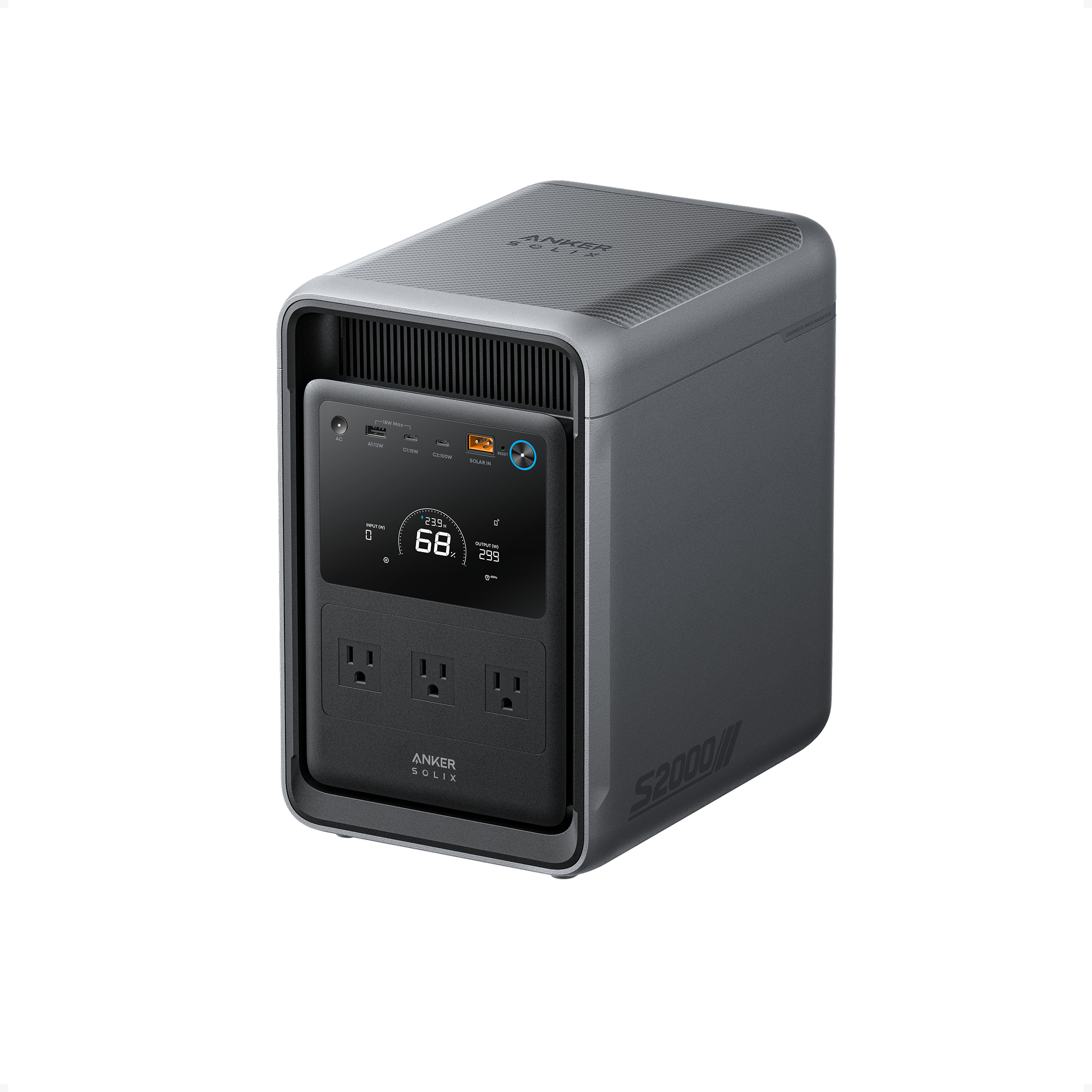
- →You want one box to cover an evening without doing arithmetic: an 8-hour outage, a full remote workday with calls, the fridge overnight. The S2000 is the only one of the two that finishes the blackout, and it has five AC sockets against three for when the fridge, a lamp and a laptop brick all want it at once.
- →You'll actually cycle it, on weekend trips, summer power cuts or a mobile office, and want the pack still healthy in a decade. Daily, that's 27.4 years of rated life against 11.
- →You're protecting a desktop with unsaved work. The S2000's UPS is rated at the tighter class, no worse than 10ms against no worse than 20ms, and a simulated grid cut didn't interrupt connected office gearA9A10.
- →You carry it yourself and don't mind a two-hand lift. 35.7 lbs is one person's load; just expect to want a second handle on the stairsA7A8.
Buy the Explorer 1000 Plus if you…
- →You own a specific appliance rated above 1,500W. That's the one thing on this page the S2000 simply cannot do, and the Explorer does it with 2,000W rated and 4,000W peak.
- →Your solar kit already pushes past 400W. 800W of input is the difference between a whole sunny day spent refilling and a refill before lunch.
- →You know your capacity need is heading past 2,010Wh and stopping under roughly 4,250Wh usable. Expansion is the only route there and the S2000 hasn't got one.
- →You want the purchase sitting behind a retail return counter. Costco, Home Depot, Best Buy and Amazon all carry Jackery, which is worth something when a warranty claim wants a receipt.
If neither fits
Anyone sizing for a van's daily load should close this page cheerfully. That day is 4,685Wh and these two cover 36% and 23% of it; even the Explorer with three expansion batteries lands short of it once you derate the bank. That's a job for a larger station or a hardwired system. The same applies if you're planning a full weekend off-grid with no sun in between, since the 2,100Wh camping load beats both of them too.
The Bottom Line
Same money, and one of them is carrying 746Wh more battery and two and a half times the cycles. The Explorer's 2,000W inverter is the better spec and the weaker buy here, because the pack it's bolted to runs about half an hour flat out and stops 571Wh short of the night the S2000 finishes.
Buy the Explorer if you've already identified the appliance over 1,500W, the panel array past 400W, or the capacity target past 2,010Wh. Those are three real reasons and any one of them settles it on its own. If you can't name which one is yours, you're paying for output you'll never reach instead of energy you will. Take the S2000.
Frequently Asked Questions
Answers drawn from the spec record and cited owner research.
Does the Jackery Explorer 1000 Plus really start bigger appliances than the Anker SOLIX S2000?
Yes, but it's one advantage rather than two. Jackery publishes 2,000W rated with a 4,000W peak; Anker publishes 1,500W with a 3,000W peak. Both peaks are exactly double the rated figure, which is the convention across this class, so the peak column is the output column restated rather than a separate capability. Nothing in the six scenarios on this page asks for more than 400W at startup, and both units start and sustain every one of them.
Which one gets a fridge through an overnight outage?
The S2000. The 8-hour blackout load here is 1,645Wh, and it covers that with 63Wh to spare while the Explorer runs out 571Wh short, about two-thirds of the way through. One test ran a fridge plus kitchen gadgets on the S2000 for over 60 hours on a single charge, and the Explorer handled a fridge, lights, a laptop and a router together during a simulated outage. It just can't hold that up for a full night.
Is the expandable Jackery the better long-term buy if they cost the same?
Only if you'll pass 2,010Wh. The Explorer starts at 1,264Wh, which is 746Wh behind the sealed S2000, so the first expansion battery you buy mostly recovers capacity the Anker already ships with. Three batteries take it to roughly 5,000Wh, which is genuinely beyond anything the S2000 reaches at any budget. That's the real case for it, if your needs are growing in that direction.
Which charges faster?
From the wall it's a tie: both measure about 1.7 hours to full, with the S2000 reaching 80% in roughly 1.2. From the sun the Explorer is much quicker, since 800W of input fills 1,264Wh in about an hour and a half while 400W takes about five hours to fill 2,010Wh. That advantage only exists if you own panels that can actually deliver 800W.
How long will each battery last before it wears out?
The S2000 is rated for at least 10,000 cycles and the Explorer for 4,000. Cycled daily that's 27.4 years against 11; at twice a week it's 96 against 38, which is where the years stop being useful and you should count energy instead. Neither one stops working at the limit: both drop to roughly 80% of original capacity and keep going.
Where to buy
Anker SOLIX S2000Pick
Sold on Amazon · today’s price is on the listing

Jackery Explorer 1000 Plus
$619.00
$619.00 · direct from Jackery
down from $699 · 11% below usual
Last checked 16 days ago. Prices move — check before you buy.
Prices may vary by retailer and are subject to change.