Head-to-head test
Anker SOLIX F2000 vs BLUETTI Pioneer 150 AC240
At the same $999, the F2000 hands you 512 more watt-hours for 4.8 fewer pounds; the Pioneer 150 hands back an IP65-sealed shell and a surge rating built for a compressor. Buy the number or buy the environment.
Full profiles: Anker SOLIX F2000 → · BLUETTI Pioneer 150 AC240 →

Written by Ian SchneiderUpdated
Solar & Off-Grid Tester, Station Arena Test Desk
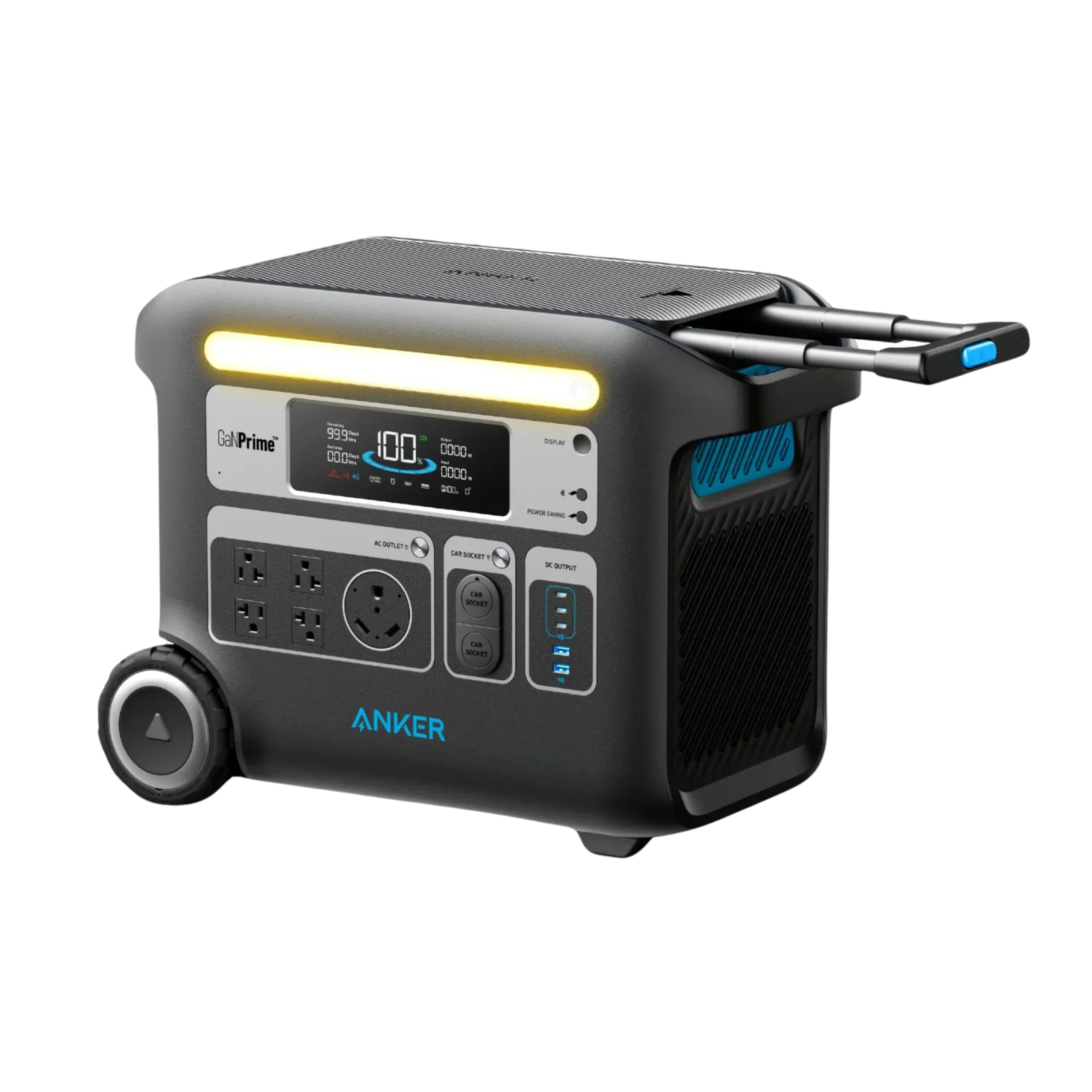
No longer sold
Anker no longer sells the SOLIX F2000 (PowerHouse 767). Its natural replacement is the SOLIX C2000 Gen 2 — the same 2,048Wh capacity and 2,400W output in a newer design.
SOLIX C2000 Gen 2 · $999.99
$999.00 · direct from BLUETTI
Last checked 1 day ago. Prices move — check before you buy.
Spec deltas
At $999, the Anker SOLIX F2000 and BLUETTI Pioneer 150 (AC240) cost exactly the same, and that's where the agreement ends. The F2000 packs 2,048Wh to the Pioneer's 1,536Wh, a 512Wh gap for identical money, while somehow weighing 4.8 lbs less (67.2 vs 72 lbs).
Run the ownership math and the F2000 pulls further ahead. It lands at $0.16 per lifetime kWh against the Pioneer's $0.19, because 2,048Wh moved over 3,000 rated cycles works out to 6,144 lifetime kWh, more than the Pioneer's 5,376 even though the Pioneer is rated for 500 more cycles.
The Pioneer 150 doesn't fold, though. It surges to 3,600W, a 1.5x ratio over its rated output, against the F2000's thin 2,800W, only 1.17x, and it carries an IP65 rating tested through rain and constant saltwater spray with no water intrusionB2, a claim the F2000's spec sheet makes no equivalent of. If a fridge compressor or a wet campsite is in the picture, that pair of specs matters more than the watt-hour math.
What the Numbers Reveal
Each conclusion stated first — the numbers behind it on one line, the full analysis below.
rated cycles
Multiply cycles by capacity and the story flips: the F2000's 3,000 cycles at 2,048Wh work out to 6,144 lifetime kWh, while the Pioneer's higher 3,500-cycle rating at 1,536Wh only delivers 5,376, 768 fewer lifetime kWh for the same $999. That's why the Pioneer's cost per lifetime kWh lands higher ($0.19) than the F2000's ($0.16) despite winning the spec sheet's cycle count.
the Pioneer 150 is rated for 3,500 cycles versus the F2000's 3,000the Pioneer 150 holds 1,536Wh versus the F2000's 2,048Whboth cost $999
Why it mattersDon't shop cycle count in isolation. A smaller battery with more cycles can still deliver less total energy than a bigger one with fewer, and here it does.
weight
Work out the density and it's stark: the F2000 packs roughly 30.5 Wh per pound, the Pioneer roughly 21.3. Whatever the Pioneer's extra 4.8 lbs is buying, a thicker IP65-sealed shell, a beefier inverter behind that 3,600W surge, it isn't battery.
the F2000 weighs 67.2 lbs and holds 2,048Whthe Pioneer 150 weighs 72 lbs and holds 1,536Whthat's 4.8 lbs more for 512Wh less
Why it mattersIf you're judging portability by weight alone, know that the lighter unit here (67.2 lbs) also carries the bigger battery, an unusual pairing worth checking before you assume heavier means more capacity.
A compressor's startup spike eats straight into whatever headroom sits above the continuous rating, and the Pioneer simply has more of it: 1.5x versus the F2000's 1.17x. That's the difference between an inverter that shrugs off a fridge kicking on and one that's already close to its ceiling.
the F2000 surges to 2,800W, a 1.17x ratio over its 2,400W continuous ratingthe Pioneer 150 surges to 3,600W, a 1.5x ratio over the same 2,400Wcompressors in fridges and ACs routinely spike 2-3x their running draw at startup
Why it mattersRunning a compressor-driven appliance, especially alongside other loads, is the clearest reason to pick the Pioneer over the cheaper-to-own F2000.
The F2000's capacity and ownership-cost edge don't touch this. An unrated case is an unrated case, and nothing in its spec sheet suggests it handles rain or salt air the way testers have already put the Pioneer throughB2.
the Pioneer 150 carries an IP65 rating, valid with port covers closedB1independent testing found it survived a rainstorm bone-dry inside and constant saltwater spray on a sailboat with no moisture intrusionB2the F2000's spec sheet lists no ingress rating at all
Why it mattersIf the unit will ever sit outside uncovered, a boat, a truck bed, an exposed camp table, buy the Pioneer 150 regardless of which one wins the value math.
The specific dimensions that decide these two units — everything else is a tie.
Lifetime Value
Selected because: Identical $999 price makes cost-per-kWh the cleanest lens on the real gap.
cost / lifetime kWh
Same price, so cost-per-kWh is the cleanest lens here, and the F2000 wins it. Its 2,048Wh at 3,000 cycles works out to 6,144 lifetime kWh against the Pioneer's 5,376 (1,536Wh at 3,500 cycles), which puts the F2000 at $0.16 per lifetime kWh to the Pioneer's $0.19.
Slice it differently and the gap narrows, or flips. Per warranty year, the Pioneer's six years actually costs less ($167 a year against the F2000's $200), and on a strict weekend-camping cadence the Pioneer edges ahead too, at $0.08 a day to the F2000's $0.09. The lifetime-kWh number is the one that holds up regardless of how often you use the unit, which is why it's the number to trust, but if you're buying purely for warranty coverage or occasional weekend use, the race is closer than the headline suggests.
Your Life, Your Pick
Selected because: The F2000 wins every scenario with a real winner; worth showing why.
Line up the six standard scenarios and the F2000 doesn't lose a single one outright. It wins the 8-Hour Blackout (94% of usable capacity against the Pioneer's 126%, which comes up short) and the Remote Workday (52% used versus 70%), and the two tie on CPAP Overnight, where both are barely touched (18% and 25%).
The scenarios where neither wins are the honest limits of a $999 single unit. Weekend Camping needs 2,100Wh, more than either usable capacity covers (121% and 161%), and Van Life Daily needs 4,685Wh, which blows past both by a wide margin (269% and 359%). For those two, the fix is the same for either brand: add an expansion battery, not a bigger single box.
What the Specs Don't Tell You
Selected because: Surge ratio and undisclosed noise are the two specs that can flip the pick.
rated cycles
The two specs that can flip this pick both favor the Pioneer. Its 3,600W surge is a real 1.5x ratio over its 2,400W continuous rating; the F2000's 2,800W surge is only 1.17x over the same baseline, thin headroom for anything with a compressor. The Pioneer also discloses a 50dB noise figure under load; the F2000 lists no noise rating at all, an honest gap in the spec sheet rather than proof it's quiet.
Warranty runs the same direction: six years on the Pioneer against five on the F2000, plus 500 more rated cycles (3,500 vs 3,000). None of that overturns the ownership-cost math, the F2000 still lands at a lower cost per lifetime kWh, but if the deciding factor is surge headroom, warranty length, or knowing the exact noise number before you buy, the Pioneer wins that argument.
Portability & Form Factor
Selected because: Same-price pair where the heavier unit holds less capacity, worth explaining.
weight
The number that looks backwards here is weight. The Pioneer 150 is 72 lbs and holds 1,536Wh; the F2000 is 67.2 lbs, 4.8 lbs lighter, and holds 2,048Wh, 512Wh more. Work out the density and the F2000 carries roughly 30.5 Wh per pound to the Pioneer's 21.3.
That extra Pioneer weight isn't wasted, it's the IP65-sealed shell and the beefier inverter behind that 3,600W surge, but it means the usual heavier-unit-bigger-battery assumption doesn't hold for this pair. Whichever one you're hauling, expect two hands and bent knees either way: both are well past the one-person-comfortable range.
Brand Trust
Selected because: Cross-brand pair; Anker and BLUETTI support and ecosystem differ meaningfully.
Anker brings its consumer-electronics scale and a well-reviewed SOLIX app; BLUETTI brings the broader lineup and the strongest capacity-per-dollar reputation in the category, of which this exact matchup (same price, more Wh from Anker here) is something of an exception. Support is where they diverge hardest: Anker's is historically strong with recent reports of more AI-driven agents handling cases, while BLUETTI's is the most inconsistent in the space, heavily email-based with China-timezone delays.
Both apps score similarly well (4.5/5 iOS for Anker, 4.5/5 iOS and Android for BLUETTI), so app quality doesn't break the tie. Over the five-to-six-year warranty window these units are built for, the honest read is that neither support organization is bulletproof, so pick based on what you can already see in the specs above.
Strengths & trade-offs
Anker SOLIX F2000
Strengths
- +Costs $99 less
- +Lighter by 4.8 lb
- +Larger battery capacity
Trade-offs
- –No major technical downsides compared to rival.
BLUETTI Pioneer 150 AC240
Strengths
- +Longer warranty
- +Faster solar charging
Trade-offs
- –No major technical downsides compared to rival.
Will It Power Your Gear?
Scenario math and per-appliance runtimes, modeled from the spec record.
Scenario verdicts
We ran the math on six real-world scenarios. Here's which unit survives your actual life.
SCN-01 · 2 nights · needs 2,100Wh
Weekend Camping
Two nights off-grid with essential comfort
Neither unit
Neither box covers a full weekend alone. The 2,100Wh ask is 121% of the F2000's usable capacity and 161% of the Pioneer's, so both come up short. Since price is identical, break the tie on the bigger buffer: the F2000 is closer to covering the weekend and needs less top-up from solar or an expansion pack.
Battery budget usedlower = more headroom
LOAD Phone Charger 15W×6h · LED Lights 40W×8h · Box Fan 75W×14h · CPAP Machine 40W×16h
SCN-02 · 8 hours · needs 1,645Wh
8-Hour Blackout
Keep the essentials running through a night without power
SOLIX F2000
The F2000 clears this one at 94% of usable capacity. The Pioneer doesn't, landing at 126%, over budget. For an overnight outage, that's the difference between making it to morning and not.
Battery budget usedlower = more headroom
LOAD Fridge 150W×8h · Router + Modem 20W×8h · LED Lights (4 bulbs) 40W×6h · Phone Charger 15W×3h
SCN-03 · 8 hours · needs 320Wh
CPAP Overnight
Sleep therapy without interruption — the #1 medical use case
Either unit
Both handle this easily, 18% of usable capacity for the F2000, 25% for the Pioneer, so capacity isn't the deciding factor here. At that light a load, whichever one is quieter next to the bed matters more than the watt-hour math.
Battery budget usedlower = more headroom
LOAD CPAP Machine 40W×8h
SCN-04 · 8 hours · needs 910Wh
Remote Workday
Full work day off-grid without power anxiety
SOLIX F2000
Both get through the day, but the F2000 does it with more room to spare: 52% of usable capacity against the Pioneer's 70%. That headroom matters if the workday runs long or a device gets added that wasn't planned for.
Battery budget usedlower = more headroom
LOAD Laptop 60W×8h · External Monitor 30W×8h · Router + Modem 20W×8h · Phone Charger 15W×2h
SCN-05 · 4 hours · needs 670Wh
Tailgate Party
Game day power for the crew
SOLIX F2000
Another win by margin rather than a hard limit, 38% used on the F2000 versus 51% on the Pioneer. Either handles the load; the F2000 just has more left over if the party runs late.
Battery budget usedlower = more headroom
LOAD Blender 400W×0.5h · LED TV (55") 80W×4h · Bluetooth Speaker 15W×4h · Phone Charger (×3) 45W×2h
SCN-06 · 24 hours · needs 4,685Wh
Van Life Daily
A full day of mobile living — the ultimate endurance test
Neither unit
Neither is close here, 269% of usable capacity needed from the F2000, 359% from the Pioneer. A single $999 unit was never going to run a full van-life day; this is squarely an expansion-battery or solar-array problem, not a pick-the-right-box problem.
Battery budget usedlower = more headroom
LOAD Mini-Fridge 150W×24h · Laptop 60W×4h · Phone Charger 15W×3h · LED Lights 40W×5h · Fan 75W×8h
The Load Test
RUNTIME = (Wh × 0.85) ÷ LOAD
None of the scenarios above exactly yours? Build it. Toggle what you'd plug in; both units are tested against the combined draw.
Essentials
Comfort & Convenience
High-Draw Appliances
Test duration
8h
Continuous draw
205W
Projected runtime
For this load: SOLIX F2000 runs 8.5h vs 6.4h.
Modeled from the spec record — same math as the tables below. Methodology
Runtime by appliance
Real-world runtime estimates for common appliances, modeled at 85% inverter efficiency.¹
Essentials
The basics you need runningscale 0–116.1hComfort & Convenience
Makes off-grid life actually enjoyablescale 0–23.2hHigh-Draw Appliances
These reveal the real limitsscale 0–1.7h¹ Runtime = (capacity × 0.85) ÷ appliance watts. Within each group, all bars share one time scale (the group's longest runtime), so lengths are comparable across appliances; identical runtimes collapse into a single blue/orange bar. Actual runtime varies with battery age, temperature, and simultaneous loads — see methodology.
Conclusion
July 13, 2026
Verdict: the SOLIX F2000
Take the SOLIX F2000 unless your load list includes a compressor or the unit lives somewhere wet. At an identical $999, the F2000 packs 512Wh more capacity (2,048 vs 1,536Wh) while weighing 4.8 lbs less, and it's the cheaper unit to own over its life: $0.16 per lifetime kWh against the Pioneer 150's $0.19, because its 6,144 lifetime kWh beats the Pioneer's 5,376 despite the Pioneer's higher 3,500-cycle rating. It also wins the scenarios that have a real winner on that same capacity edge. But the Pioneer 150 has two genuine, spec-true advantages the F2000 doesn't touch: a 3,600W surge (1.5x its 2,400W rating) against the F2000's thin 2,800W (1.17x), and an IP65-sealed case already tested through rain and saltwater sprayB2, where the F2000 discloses no ingress rating at all. If you're running a fridge or AC compressor, or the unit sits outside uncovered, buy the Pioneer 150 instead.
Editor-assigned confidence, based on cited owner research and spec analysis.
List prices as of July 13, 2026. The links below open Anker's and BLUETTI's current prices.
$899.99 · direct from Anker
Last checked 50 days ago. Prices move — check before you buy.
or check the Pioneer 150 AC240 price$999.00 list
Written by Ian Schneider, Solar & Off-Grid Tester · Station Arena Test Desk · Updated July 13, 2026
Measured Data
Benchmark scores and the full spec record, side by side.
Benchmark scores
Not rated for both units (minimum threshold unmet): Apartment Balcony.
Full specifications
ᵈ Derived: price ÷ rated capacity. See the data behind our comparisons →
Comparison ToolAdd more power stations, side by sideOpen Tool →How these numbers are produced
Numeric verification
Every figure on this page traces to our spec database or arithmetic on it — no estimated numbers.
Owner claims
Statements about owner experience are cited to published reviews — see Sources & Research Notes below.
Runtime model
Runtime = (rated capacity × 0.85 inverter efficiency) ÷ device wattage. Solar recharge estimates assume panels deliver 70% of rated output. Cold weather, battery age, and stacked loads reduce real-world results.
Power Score
Computed from 14 published spec dimensions, weighted per use-case bench. Higher is better; a unit must meet a bench's minimum threshold to be rated.
See the full weight table and data sourcing on our methodology page →Class ranking (the star rating)
Each unit's star score is a category ranking, not customer reviews — no buyer opinions feed it. We score every station on size-independent quality (value, output, portability, endurance, ports, warranty, and more), then percentile-rank it against the other units in its capacity class, so a class-leading compact unit and a class-leading whole-home unit can both earn 5★. Here, SOLIX F2000 rates 3.7/5 (24th percentile of 26 Large-class units), and Pioneer 150 AC240 rates 4.5/5 (69th percentile of 27 Everyday-class units).
How the class ranking is computed →Test Notes & Caveats
Hidden gotchas and advantages we spotted that you won't find on the product page.
Weight Reality Check
The heavier unit here is also the smaller battery. The Pioneer 150 is 72 lbs and holds 1,536Wh; the F2000 is 67.2 lbs, 4.8 lbs lighter, and holds 512Wh more. If portability is being judged by the number on the box, check which number is being read.
Pioneer 150 AC240: 50dB Published
50dB is about as loud as moderate rainfall. It is BLUETTI's own rating rather than a reading on a shared bench — makers differ on whether they quote a best case or a figure under load, so treat it as a starting point rather than what you would hear at a bedside. For most people, fan noise around 45dB and up is where sleep starts to suffer.
Surge Power: Inverter Quality Indicator
The Pioneer 150's 3,600W surge is a genuine 1.5x ratio over its 2,400W continuous rating. The F2000's 2,800W surge is only 1.17x over the same baseline, thin headroom for a compressor's startup spike. Both run 2,400W continuous, so this only shows up the moment a fridge or AC kicks on.
UPS Switchover: ≤15ms vs ≤20ms
Both list a UPS mode, at different rated speeds. The Pioneer 150 AC240 is rated ≤15ms — fine on paper for routers and most electronics; the fussiest PC power supplies sit right at this line. The SOLIX F2000 is rated ≤20ms — fine on paper for routers and most electronics; the fussiest PC power supplies sit right at this line. If a computer with unsaved work is the thing being protected, the stated class is worth the attention; nothing here is a lab result.
Warranty: 6 Years vs 5
The Pioneer 150 AC240 is covered for 6 years against the SOLIX F2000's 5 years. An underrated factor if you're keeping this unit for years.
SOLIX F2000: Noise Level Not Disclosed
The Pioneer 150 publishes a 50dB rating under load. The F2000's spec sheet has no noise figure at all, not necessarily louder, just unverified. If quiet operation next to a tent or a bed is a requirement, the Pioneer at least gives a number to hold it to.
Full record above — the Test Desk pick is the SOLIX F2000.
Check SOLIX F2000 price →or check the Pioneer 150 AC240 priceOwnership Analysis
What happens after you buy — true cost of ownership, brand trust, and growth potential.
Lifetime value
Service lifeyears at one full cycle per day
Lifetime energy delivered
Cost per delivered kWh
│ warranty ends · Reaching the cycle rating means ~80% capacity remains — degraded, not dead.
Analyst note
The SOLIX F2000 wins on both sticker price and long-term value. At $0.15/kWh over its lifetime, it's meaningfully cheaper to own. Clear value winner. One caution on the lifespan row: the Pioneer 150 AC240 takes longer to reach its cycle rating, but a cycle moves a different amount of energy on each unit — the SOLIX F2000 still delivers more over its shorter horizon (6,144 vs 5,376 kWh). Years measure wear, not usefulness.
Brand trust
Anker
Ecosystem
Anker runs 7-8 SOLIX portable stations across the compact C-series and flagship F-series, plus the X1 home energy system.
Support
US-based and historically excellent with no-hassle replacements. Recent reports describe more AI-driven agents handling cases and heavier return logistics, though the core brand reputation still holds.
Community
Moderate — active Reddit (r/Anker, r/AnkerSOLIXCommunity) and growing. Benefits from Anker's massive consumer electronics brand awareness.
App experience
Rated 4.5/5 iOS (~1,100 ratings) · 4.3/5 Android
Unique strength
Anker's core edge shows up directly in this matchup: same price as the Pioneer, a third more capacity.
Worth knowing
Firmware updates have reportedly removed features without warning on some SOLIX units, and Anker's expansion ecosystem is smaller than some rivals'.
BLUETTI
Ecosystem
The broadest lineup in the category, from budget units to flagships, plus specialty gear like sodium-ion cold-weather packs and dual solar-plus-alternator vehicle hubs.
Support
The most inconsistent in the space, heavily email-based with China-timezone delays. Buying direct from BLUETTI's own site tends to produce smoother outcomes than third-party purchases.
Community
Active and growing — Reddit r/bluetti has a dedicated community. Second-largest after EcoFlow in engagement.
App experience
Rated 4.5/5 iOS and Android — tied for best app experience in the category. V3.0 UI redesign was well-received.
Unique strength
Best capacity-to-price ratio in the category overall, and here that shows up as the IP65 seal and surge headroom rather than the cheapest sticker price.
Worth knowing
Support inconsistency is the real risk with this brand, not hardware quality. The Pioneer's own numbers, surge, cycle life, warranty, are all genuinely strong.
Analyst note
Same price, different brand bets. Anker is the safer support call with the better value math; BLUETTI is the ruggedness and surge specialist with the messier support record. Neither brand risk is small enough to ignore, so weigh it against how much the warranty is actually relied on.
Growth path
SOLIX F2000
EXPANDABLESupports Anker expansion batteries, so you can add capacity later without replacing the base unit — useful if your needs may climb past 2,048Wh.
Accepts up to 1,000W of solar. Enough for a serious multi-panel array.
Generous port selection supports complex multi-device setups.
Expansion batteries are Anker-specific. You're investing in the Anker ecosystem.
Pioneer 150 AC240
EXPANDABLESupports BLUETTI expansion batteries, so you can add capacity later without replacing the base unit — useful if your needs may climb past 1,536Wh.
Accepts up to 1,200W of solar. Enough for a serious multi-panel array.
Adequate ports for most setups, but heavy users may want a power strip.
Expansion batteries are BLUETTI-specific. You're investing in the BLUETTI ecosystem.
Realistic full solar rechargeat 70% of rated panel output — see methodology
Analyst note
Both expand, so neither locks you out of growth — decide on capacity, price, and the rest, not the expansion checkbox.
What Owners Report
Patterns from published owner reports and long-term reviews — every claim cited to its source below.
Anker SOLIX F2000
The F2000's owner reviews cluster around one thing: it's easy to live with despite the size. Its 4.72-inch wheels and retractable EasyTow handle are the most-cited reason owners picked it over similar-spec rivalsA1, and its WiFi and Bluetooth app draws praise for monitoring and customization, with a number of owners reporting Anker proactively fixing issues through firmware updates or replacementsA2.
For the loads RVers actually run, fridge, CPAP, lights, internet, small kitchen gear, reviewers call it quiet, capable, and quick to deployA3, built on the same 3,000-cycle LFP chemistry Anker uses across the SOLIX lineA4. The recurring theme is a well-rounded unit rather than a spec leader, which tracks with how it wins this matchup: not on any single dramatic number, but on being cheaper to own and easy to move.
“It's big and full of heavy batteries, but the durable 4.72-inch wheels and retractable EasyTow handle make it surprisingly easy to lug around — most positive reviews cite the wheels and telescoping handle as a top reason owners chose it over similar-spec competitors.”
Sources
rvoutfitting.com · trustedreviews.com · ankersolix.com · storagereview.com · generatorpeak.com
BLUETTI Pioneer 150 AC240
Owner and reviewer coverage on the Pioneer 150 centers on ruggedness. It's IP65 water- and dust-resistant, though that protection only holds with the port covers closed, and it shouldn't be run in the rain with cables plugged inB1. Real-world testing backs the rating up: one review found water beaded off the case in a rainstorm with a bone-dry interior afterward, and the unit survived constant saltwater spray on a sailboat with no moisture intrusion after wiping downB2.
On the rest, coverage mostly confirms what the spec sheet already says: it's the standard-capacity AC240 at a lower price than the higher-capacity AC240P, on the same 2,400W IP65 platformB3, with a fast-charging LFP battery, expandability into a large bank, and frequent discounting off its premium-end list priceB4.
“IP65 water- and dust-resistant, not truly waterproof — protection applies with the port covers closed, and it should not be used in the rain with cables plugged in, as water ingress to the output ports risks damage or short circuits.”
Sources
backuppowerhub.com · bluettipower.com · makeuseof.com · storagereview.com · amazon.com · batteryessence.com
Sources & Research Notes
Every owner claim in this report is traceable to a published source. The bracketed references above resolve here.
Recurring owner themes
- The wheels + retractable handle are the standout, repeatedly-cited reason owners pick the F2000; app monitoring and responsive Anker support are also praised. [SOLIX F2000 · 2 entries]
- Same IP65 ruggedness and expandability as the AC240P at a lower price and capacity; water-resistant not waterproof is the key caveat. [Pioneer 150 AC240 · 3 entries]
- A1
“It's big and full of heavy batteries, but the durable 4.72-inch wheels and retractable EasyTow handle make it surprisingly easy to lug around — most positive reviews cite the wheels and telescoping handle as a top reason owners chose it over similar-spec competitors.”
rvoutfitting.com / trustedreviews.com — Anker SOLIX F2000 (PowerHouse 767) review · 2025-2026 · [positive]
- A2
“WiFi and Bluetooth app lets you monitor battery, charging, and customize power usage; a meaningful number of owners reported Anker proactively solving issues with firmware updates or replacements.”
ankersolix.com / storagereview.com — F2000 review · 2025-2026 · [positive]
- A3
“For the loads RVers run most — fridge, CPAP, lights, fans, internet, TV, small kitchen appliances — the F2000 is usually quiet, capable, and easy to deploy fast.”
rvoutfitting.com — Anker SOLIX F2000 review · 2026 · [positive]
- A4
“Uses the same long-lasting LFP battery reliability as Anker's other models, rated over 3,000 cycles for years of off-grid or backup use.”
trustedreviews.com / generatorpeak.com — F2000 review · 2025-2026 · [positive]
- B1
“IP65 water- and dust-resistant, not truly waterproof — protection applies with the port covers closed, and it should not be used in the rain with cables plugged in, as water ingress to the output ports risks damage or short circuits.”
backuppowerhub.com / bluettipower.com — AC240 review · 2026 · [mixed]
- B2
“Real-world testing was positive — water beaded off the case in a rainstorm and the interior was bone dry afterward; the unit survived constant saltwater spray on a sailboat with no moisture intrusion after wiping down.”
makeuseof.com / storagereview.com — AC240 review · 2026 · [positive]
- B3
“The standard AC240 (Pioneer 150) holds 1,536Wh at a lower price than the AC240P, with the same 2,400W output and IP65 rugged build.”
bluettipower.com / amazon.com — Pioneer 150 (AC240) listing · 2026 · [positive]
- B4
“LFP battery with a fast charge reaching most of full quickly, and expandable to a very large multi-kWh bank; sits at the premium end of the lineup but is frequently discounted.”
amazon.com / batteryessence.com — Pioneer 150 (AC240) review · 2026 · [positive]
Research compiled July 13, 2026.
Who Should Buy Which
Buy the SOLIX F2000 if you…
- →You want the most watt-hours per dollar: 2,048Wh for the same $999 the Pioneer charges for 1,536Wh.
- →You're running steady RV loads, fridge, CPAP, lights, internet, rather than a compressor-heavy setupA3.
- →You'll actually move the unit and want the wheels and retractable handle owners cite as their reason for buying itA1.
This is you — check the SOLIX F2000 price
Buy the Pioneer 150 AC240 if you…
- →You're running a fridge, AC, or pump: its 3,600W surge (1.5x rated output) has real headroom the F2000's 2,800W (1.17x) doesn't.
- →The unit lives outdoors or near water: its IP65 seal has been tested through rain and saltwater spray with no intrusionB2.
- →You value the longer warranty and higher cycle count: six years and 3,500 cycles against the F2000's five years and 3,000.
If neither fits
Anyone planning to run a full weekend off one box, or cover a van-life day, should skip both. Weekend Camping needs 2,100Wh (121%-161% of what's usable here) and Van Life Daily needs 4,685Wh (269%-359%), so look at a larger single unit or budget for an expansion battery from day one.
The Bottom Line
At an identical $999, this comes down to what you're optimizing for. The F2000 wins the math: 512Wh more capacity, 4.8 lbs less weight, and a lower cost per lifetime kWh ($0.16 vs $0.19), which is why it also wins every scenario that has a real winner in this comparison.
The Pioneer 150 wins the environment: a 3,600W surge with real headroom for a compressor, and an IP65 seal already tested through rain and saltwater sprayB2 that the F2000 simply doesn't claim. If the unit runs a fridge or lives somewhere wet, pay for the Pioneer's ruggedness. Otherwise, take the F2000 and bank the extra watt-hours.
Frequently Asked Questions
Answers drawn from the spec record and cited owner research.
Anker SOLIX F2000 or BLUETTI Pioneer 150 (AC240), which should I buy?
Buy the F2000 unless your load list includes a compressor or the unit sits outside uncovered. At the same $999, the F2000 gives you 512Wh more capacity (2,048 vs 1,536Wh), weighs 4.8 lbs less, and costs less to own over its life ($0.16 per lifetime kWh vs $0.19). The Pioneer 150 answers back with a stronger 3,600W surge and an IP65-sealed case tested through rain and saltwater, real advantages if you're running a fridge or the unit lives outdoors.
Are the Anker SOLIX F2000 and BLUETTI Pioneer 150 really the same price?
Yes, both list at $999. That makes this one of the rare matchups where price isn't a variable. The F2000 simply gives you more capacity, 2,048Wh versus 1,536Wh, for the identical dollar.
Which is cheaper to own over time?
The F2000, on the number that matters most. Its 2,048Wh at 3,000 rated cycles works out to 6,144 lifetime kWh, versus 5,376 for the Pioneer's 1,536Wh at 3,500 cycles, so the F2000 lands at $0.16 per lifetime kWh against the Pioneer's $0.19 despite the Pioneer's higher cycle count. On a pure per-warranty-year basis the Pioneer is actually a bit cheaper ($167 a year vs $200), so the answer shifts slightly depending on which number you're optimizing for.
Which handles rain, humidity, or a boat better?
The Pioneer 150, clearly. It carries an IP65 water- and dust-resistance rating, valid with port covers closed, and independent testing found it survived a rainstorm bone-dry inside and constant saltwater spray on a sailboat with no moisture intrusion. The F2000's spec sheet lists no equivalent ingress rating.
Which has the stronger surge for a fridge or air conditioner?
The Pioneer 150. It surges to 3,600W, a 1.5x ratio over its 2,400W continuous rating, against the F2000's 2,800W, only a 1.17x ratio over the same baseline. Both run 2,400W continuous, so the gap only shows up the moment a compressor kicks on.
Check SOLIX F2000 price →
Where to buy
Anker SOLIX F2000Pick
$899.99
$899.99 · direct from Anker
Last checked 50 days ago. Prices move — check before you buy.
BLUETTI Pioneer 150 AC240
$999.00
$999.00 · direct from BLUETTI
Last checked 1 day ago. Prices move — check before you buy.
Prices may vary by retailer and are subject to change.