Head-to-head test
Anker SOLIX F2000 vs Anker SOLIX F3800 PLUS
Whether you ever have to lift it settles this: the 67-pound F2000 is the portable you can actually move and the cheaper unit to own, while the 132-pound F3800 Plus only earns its premium bolted into one fixed spot, doing whole-home work the smaller unit can't touch.
Full profiles: Anker SOLIX F2000 → · Anker SOLIX F3800 PLUS →

Written by Gunner GustafsonUpdated
Whole-Home Backup Tester, Station Arena Test Desk
No longer sold
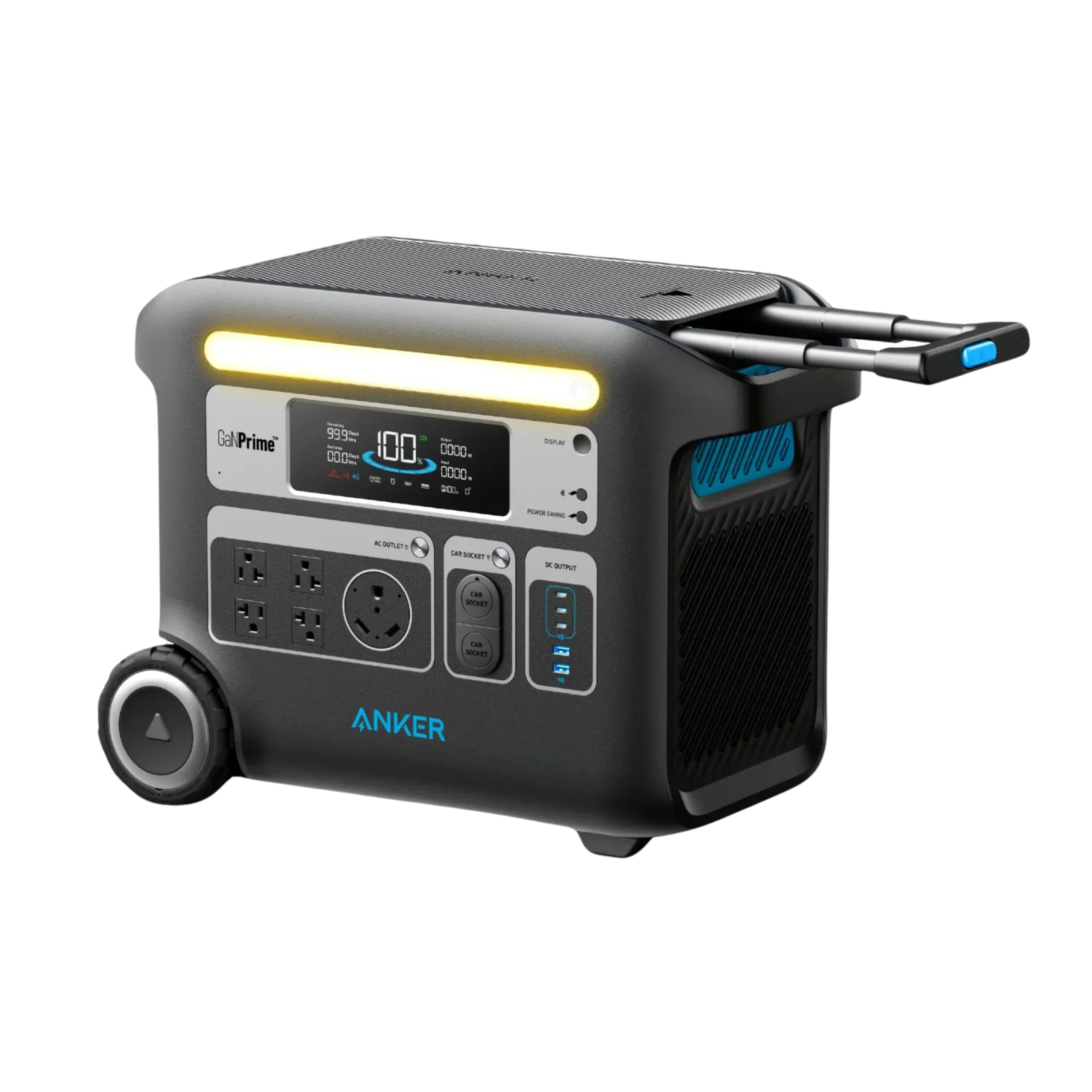
Anker no longer sells the SOLIX F2000 (PowerHouse 767). Its natural replacement is the SOLIX C2000 Gen 2 — the same 2,048Wh capacity and 2,400W output in a newer design.
SOLIX C2000 Gen 2 · $999.99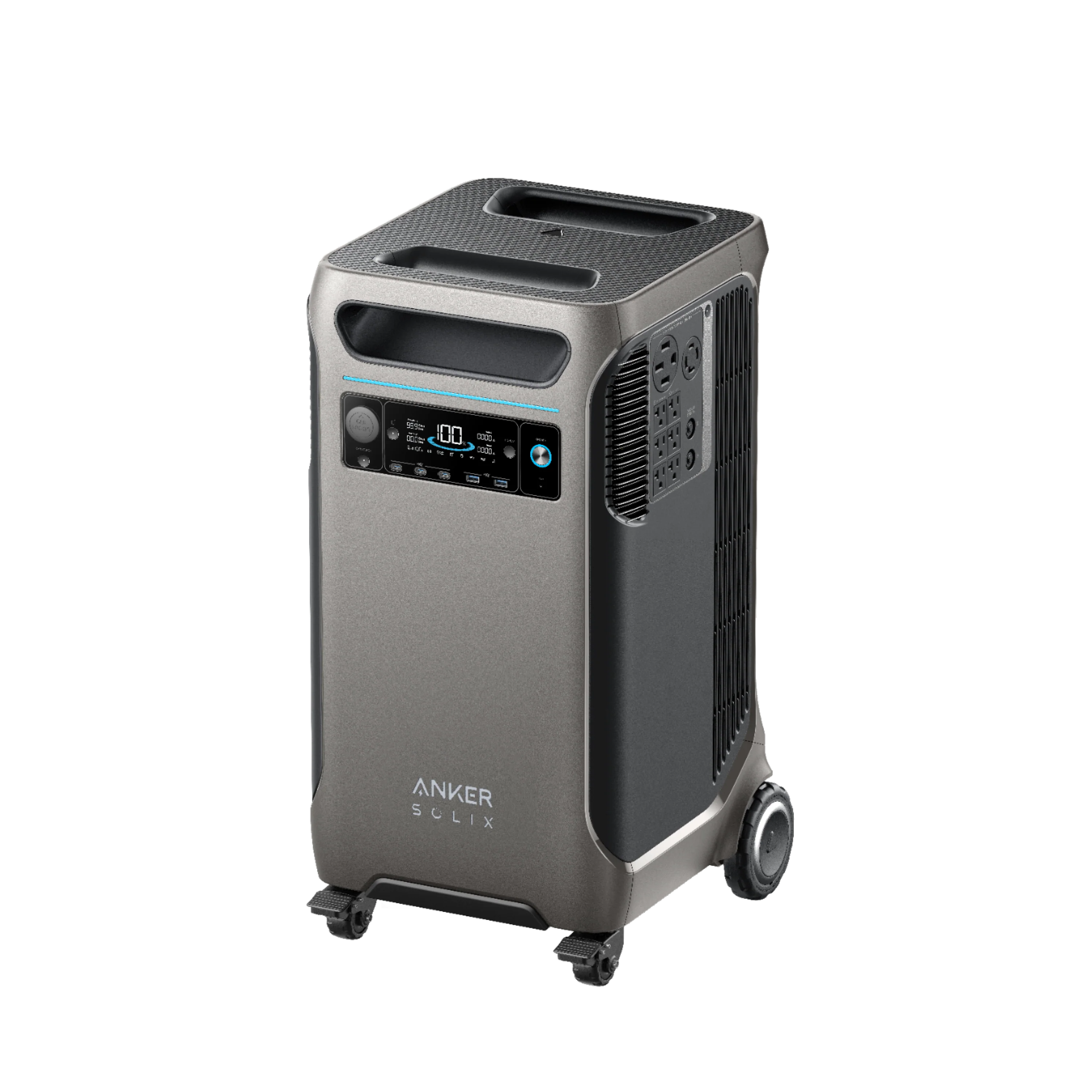
$2,599.99 · direct from Anker
Last checked 1 day ago. Prices move — check before you buy.
Spec deltas
One of these you roll to a campsite on its own wheels; the other is a 132-pound machine that goes exactly where two people set it down and then doesn't move again. That's the real story of the F2000 against the F3800 Plus. They aren't two sizes of the same product. They're a portable power station and a home-backup appliance that happen to share a badge.
At $900 the F2000 is about a third the price of the $2,600 F3800 Plus, and it's the cheaper unit to own on top of that. It also covers the scenarios most people buy a power station for in the first place: a blackout, a workday, a campsite, a night on CPAP. For a lot of buyers, the comparison ends right there.
The F3800 Plus earns its extra $1,700 in one specific place, bolted into a fixed spot where the F2000 runs out of either capacity or output. Whole-home backup, days-long outages, heavy simultaneous loads, a big solar array. If that's your list, the bigger machine isn't a splurge. If it isn't, you're buying weight and headroom you'll never reach.
What the Numbers Reveal
Each conclusion stated first — the numbers behind it on one line, the full analysis below.
weight
The tailgate makes it plain: the F3800 Plus has more than enough energy for the day, yet it loses because at 132.3 lbs it can't get to the parking lot. Weight, not capacity, disqualifies it from every use that involves leaving the house.
F2000 weighs 67.2 lbs with wheels and a retractable handleF3800 Plus weighs 132.3 lbs and is stationaryTailgate Party: F3800 Plus covers 670Wh with 1,071Wh to spare but still loses to the F2000
Why it mattersIf your use ever involves carrying the unit, stop comparing specs. The F2000 is the only one of the two that travels.
Capacity
So the F3800 Plus's higher cost per kilowatt-hour doesn't make it a worse battery. It makes it a bigger one, delivering 5,376 kWh more over its life. The money isn't asking which is cheaper per kWh; it's asking whether you'll ever pull that much extra energy through it.
F2000: $900 for 2,048Wh, rated 3,000 cyclesF3800 Plus: $2,600 for 3,840Wh, rated 3,000 cyclesTotal lifetime energy: 6,144 kWh vs 11,520 kWh
Why it mattersBuyers whose real draw fits the F2000 pay less up front and get cheaper energy. Only the buyer who will genuinely cycle the larger bank should pay for it.
solar input
In a multi-day outage you refill from the sun each morning, and here the F3800 Plus wins twice: it holds more to begin with and takes 3,200W of solar against the F2000's 1,000W, over three times the array, so it rebuilds far faster between nights. A single-evening outage never exposes that gap. A three-day one is defined by it.
8-Hour Blackout needs 1,645WhF2000 finishes at 94% used, 96Wh leftF3800 Plus finishes at 50% used, 1,619Wh leftSolar input 1,000W vs 3,200W
Why it mattersFor outages that end by morning, the F2000 is plenty. For the ones that don't, the F3800 Plus is the unit that keeps up.
The specific dimensions that decide these two units — everything else is a tie.
Portability & Form Factor
Selected because: At 67.2 lbs the F2000 rolls to a site on its own wheels; at 132.3 lbs the F3800 Plus is a two-person lift that stays put, and for most buyers that one line settles it.
weight
The F2000 you pick up; the F3800 Plus you commit to a location. One person can wheel the 67.2 lb F2000 on its 4.72-inch wheels and retractable EasyTow handle, which reviewers name as the top reason they chose it over similar-spec rivalsA1. The F3800 Plus has wheels too, but at 132.3 lbs they're really for nudging it across a flat garage. Owners report they cope with grass but stall on small bumpsB8, and getting it into a truck bed is a two-person job.
That single difference reorganizes the whole comparison. If the unit ever leaves the house, the F3800 Plus is out before capacity or price even enters the conversation. It doesn't travel so much as relocate. The F2000 is the only one of the two built to come with you.
Lifetime Value
Selected because: The F2000 costs $900 to the F3800 Plus's $2,600 and turns each dollar into cheaper energy, $0.15 versus $0.23 per lifetime kWh.
cost / lifetime kWh
The F2000 is the cheaper unit to own, not just the cheaper one to buy. Both packs use the same LFP chemistry rated for at least 3,000 cycles, so the unit with the cheaper capacity wins the per-kilowatt-hour math outright: $0.15 against $0.23 over the full life of the battery. Spend a dollar on the F2000 and more of it comes back as energy.
Read that the right way, though. The F3800 Plus isn't overpriced for what it is; it simply holds far more, so its higher per-kWh figure is buying a much bigger tank. The real question the money asks isn't which is cheaper per kilowatt-hour. It's whether your loads will ever reach the bottom of the larger one, or whether you're paying for capacity that mostly reassures you on a spec sheet.
Your Life, Your Pick
Selected because: Run both through six real days and the split is clean: the F2000 owns the ones you travel to, the F3800 Plus owns the long, fixed, high-draw ones.
Sort the six sample days by whether you're carrying the unit and the verdict falls out on its own. The F2000 takes the tailgate outright, and not on power. It covers the party's 670Wh with 1,071Wh to spare. It wins because the F3800 Plus, at its weight, was never getting to the parking lot in the first place.
The F3800 Plus takes the days that stay put and run long. It clears the 8-hour blackout and the remote workday with far more in reserve than the F2000, which finishes both, just closer to empty. Two days go to neither unit: a full camping weekend wants 2,100Wh the F2000 can't quite reach and the F3800 Plus can't travel to, and van life's 4,685Wh is past both of them. Pick the unit that wins the day you have most often.
What the Specs Don't Tell You
Selected because: Two identical 5-year warranties and one real capability gap: the F3800 Plus's 9,000W surge starts motors the F2000's 2,800W can stall on.
Set price and weight aside and one hardware difference is left that changes what you can actually plug in: surge. The F2000's inverter tops out at 2,800W over a 2,400W continuous rating, leaving 400W of startup headroom. The F3800 Plus runs 6,000W continuous with a 9,000W surge, a 3,000W cushion. Fridge and AC compressors pull two to three times their running watts for the instant they spin up, and that spike is exactly what an inverter with thin headroom refuses. The bigger unit shrugs it off; the smaller one can stall.
The warranty column looks like a tiebreaker and isn't. Both units carry the same five years and the same 3,000-cycle rating, so any per-dollar warranty spread you see is the price gap wearing a warranty costume, not a difference in what's covered.
Strengths & trade-offs
Anker SOLIX F2000
Strengths
- +Costs $1,700 less
- +Lighter by 65.1 lb
Trade-offs
- –Weaker inverter (-3,600W) limits appliance compatibility.
Anker SOLIX F3800 PLUS
Strengths
- +Larger battery capacity
- +Higher AC output
- +Faster solar charging
Trade-offs
- –Substantially more expensive (+$1,700) than the SOLIX F2000.
- –Significantly heavier (+65.1 lbs), making it harder to move.
- –Very heavy unit that may be difficult for one person to lift.
Will It Power Your Gear?
Scenario math and per-appliance runtimes, modeled from the spec record.
Scenario verdicts
We ran the math on six real-world scenarios. Here's which unit survives your actual life.
SCN-01 · 2 nights · needs 2,100Wh
Weekend Camping
Two nights off-grid with essential comfort
Neither unit
Nobody wins the weekend, for opposite reasons. The F2000 has the wheels for it but comes up about 359Wh short of the 2,100Wh a full weekend asks, close but not enough. The F3800 Plus has energy to burn and no way to get there; at 132 pounds it doesn't come camping. One can't finish, the other can't go.
Battery budget usedlower = more headroom
LOAD Phone Charger 15W×6h · LED Lights 40W×8h · Box Fan 75W×14h · CPAP Machine 40W×16h
SCN-02 · 8 hours · needs 1,645Wh
8-Hour Blackout
Keep the essentials running through a night without power
SOLIX F3800 PLUS
Both survive the night. The SOLIX F3800 PLUS finishes at 50% used with 1,619Wh left — 98% of a second night. The SOLIX F2000 finishes at 94% with 96Wh, 6% of a second night. If your outages tend to run past one evening, that difference is the whole argument between them.
Battery budget usedlower = more headroom
LOAD Fridge 150W×8h · Router + Modem 20W×8h · LED Lights (4 bulbs) 40W×6h · Phone Charger 15W×3h
SCN-03 · 8 hours · needs 320Wh
CPAP Overnight
Sleep therapy without interruption — the #1 medical use case
Either unit
A CPAP sips about 40W, so a full night is roughly 320Wh, 18% of the F2000 and 10% of the F3800 Plus. Both coast through it and capacity decides nothing. What would decide it is fan noise at 3 a.m. eighteen inches from your head, and neither Anker publishes a noise rating, so that's the one thing you can't check on a spec sheet. Buy on price and weight, and hear one first if you can.
Battery budget usedlower = more headroom
LOAD CPAP Machine 40W×8h
SCN-04 · 8 hours · needs 910Wh
Remote Workday
Full work day off-grid without power anxiety
SOLIX F3800 PLUS
The SOLIX F3800 PLUS clears the workday at 28% used, banking 2,354Wh — late work, extra calls, or a second laptop charge without arithmetic. The SOLIX F2000 at 52% also finishes, with 831Wh of slack for the unplanned.
Battery budget usedlower = more headroom
LOAD Laptop 60W×8h · External Monitor 30W×8h · Router + Modem 20W×8h · Phone Charger 15W×2h
SCN-05 · 4 hours · needs 670Wh
Tailgate Party
Game day power for the crew
SOLIX F2000
The SOLIX F3800 PLUS at 132.3 lbs is not a take-along — it rolls off a truck bed if it travels at all, so this scenario belongs to the SOLIX F2000 by default — and it earns it, covering the 670Wh with 1,071Wh to spare. Capacity was never the SOLIX F3800 PLUS's problem here; getting to a tailgate was.
Battery budget usedlower = more headroom
LOAD Blender 400W×0.5h · LED TV (55") 80W×4h · Bluetooth Speaker 15W×4h · Phone Charger (×3) 45W×2h
SCN-06 · 24 hours · needs 4,685Wh
Van Life Daily
A full day of mobile living — the ultimate endurance test
Neither unit
Neither unit covers this scenario's 4,685Wh: the SOLIX F2000 comes up 2,944Wh short (about 37% covered), the SOLIX F3800 PLUS 1,421Wh (69%). Treat this as partial cover — enough for the essentials in it, not the whole list.
Battery budget usedlower = more headroom
LOAD Mini-Fridge 150W×24h · Laptop 60W×4h · Phone Charger 15W×3h · LED Lights 40W×5h · Fan 75W×8h
The Load Test
RUNTIME = (Wh × 0.85) ÷ LOAD
None of the scenarios above exactly yours? Build it. Toggle what you'd plug in; both units are tested against the combined draw.
Essentials
Comfort & Convenience
High-Draw Appliances
Test duration
8h
Continuous draw
205W
Projected runtime
For this load: SOLIX F3800 PLUS runs 15.9h vs 8.5h.
$2,599.99 list · direct from Anker
Modeled from the spec record — same math as the tables below. Methodology
Runtime by appliance
Real-world runtime estimates for common appliances, modeled at 85% inverter efficiency.¹
Essentials
The basics you need runningscale 0–217.6hComfort & Convenience
Makes off-grid life actually enjoyablescale 0–43.5hHigh-Draw Appliances
These reveal the real limitsscale 0–3.3h¹ Runtime = (capacity × 0.85) ÷ appliance watts. Within each group, all bars share one time scale (the group's longest runtime), so lengths are comparable across appliances; identical runtimes collapse into a single blue/orange bar. Actual runtime varies with battery age, temperature, and simultaneous loads — see methodology.
Conclusion
August 30, 2026
Verdict: the Anker SOLIX F2000
Buy the F2000 unless you can name the reason you need the bigger box. It's the cheaper unit to buy and to own, it's the only one of the two a single person can move, and it clears every portable scenario people actually shop for: a blackout, a workday, a tailgate, a night on CPAP. The F3800 Plus is the right call for one specific buyer, the person backing up a house or running heavy, fixed, days-long loads who needs its 240V output, larger bank, and triple-size solar and will use them. For everyone else, that capability sits idle while they haul around double the weight.
Editor-assigned confidence, based on cited owner research and spec analysis.
List prices as of August 30, 2026. The links below open Anker's current price.
$899.99 · direct from Anker
Last checked 50 days ago. Prices move — check before you buy.
or check the SOLIX F3800 PLUS price$2,599.99 list
Written by Gunner Gustafson, Whole-Home Backup Tester · Station Arena Test Desk · Updated August 30, 2026
Measured Data
Benchmark scores and the full spec record, side by side.
Benchmark scores
Not rated for both units (minimum threshold unmet): UPS, Tailgating, Apartment Balcony.
Full specifications
ᵈ Derived: price ÷ rated capacity. See the data behind our comparisons →
Comparison ToolAdd more power stations, side by sideOpen Tool →How these numbers are produced
Numeric verification
Every figure on this page traces to our spec database or arithmetic on it — no estimated numbers.
Owner claims
Statements about owner experience are cited to published reviews — see Sources & Research Notes below.
Runtime model
Runtime = (rated capacity × 0.85 inverter efficiency) ÷ device wattage. Solar recharge estimates assume panels deliver 70% of rated output. Cold weather, battery age, and stacked loads reduce real-world results.
Power Score
Computed from 14 published spec dimensions, weighted per use-case bench. Higher is better; a unit must meet a bench's minimum threshold to be rated.
See the full weight table and data sourcing on our methodology page →Class ranking (the star rating)
Each unit's star score is a category ranking, not customer reviews — no buyer opinions feed it. We score every station on size-independent quality (value, output, portability, endurance, ports, warranty, and more), then percentile-rank it against the other units in its capacity class, so a class-leading compact unit and a class-leading whole-home unit can both earn 5★. Here, SOLIX F2000 rates 3.7/5 (24th percentile of 26 Large-class units), and SOLIX F3800 PLUS rates 4.5/5 (73rd percentile of 16 Home Backup-class units).
How the class ranking is computed →Test Notes & Caveats
Hidden gotchas and advantages we spotted that you won't find on the product page.
Weight Reality Check
Neither unit is grab-and-go. The SOLIX F2000 (67.2 lbs) is manageable solo but heavier than a large checked suitcase. The SOLIX F3800 PLUS (132.3 lbs) is firmly a two-person lift. It goes where you put it and stays there. That's a 65 lb difference, and it is paid once — getting the heavier one into position, not every time you move it.
Surge headroom is the real capability gap
This is the one spec where the F3800 Plus does something the F2000 simply can't. Its surge ceiling starts heavy motors, a well pump, a large AC, a table saw, that the F2000's inverter can stall trying to spin up. If nothing you run spikes at startup, ignore it. If you start compressors or power tools regularly, it's reason enough on its own.
The warranty 'gap' is just the price gap
Both units carry the same 5-year warranty, so read the per-dollar version carefully: 5.6 years of cover per $1,000 on the F2000 against 1.9 on the F3800 Plus describes what you paid, not what you're covered for. Same terms, same 3,000-cycle rating. Warranty is not a tiebreaker between these two.
Full record above — the Test Desk pick is the SOLIX F2000.
Check SOLIX F2000 price →or check the SOLIX F3800 PLUS priceOwnership Analysis
What happens after you buy — true cost of ownership, brand trust, and growth potential.
Lifetime value
Service lifeyears at one full cycle per day
Lifetime energy delivered
Cost per delivered kWh
│ warranty ends · Reaching the cycle rating means ~80% capacity remains — degraded, not dead.
Analyst note
The SOLIX F2000 wins on both sticker price and long-term value. At $0.15/kWh over its lifetime, it's meaningfully cheaper to own. Clear value winner. One thing to know reading the table: both carry the same 3,000-cycle rating, so the lifetime rows are sticker price and capacity in disguise — the wear horizon is identical and decides nothing here.
Growth path
SOLIX F2000
EXPANDABLESupports Anker expansion batteries, so you can add capacity later without replacing the base unit — useful if your needs may climb past 2,048Wh.
Accepts up to 1,000W of solar. Enough for a serious multi-panel array.
Generous port selection supports complex multi-device setups.
Expansion batteries are Anker-specific. You're investing in the Anker ecosystem.
SOLIX F3800 PLUS
EXPANDABLESupports Anker expansion batteries, so you can add capacity later without replacing the base unit — useful if your needs may climb past 3,840Wh.
Accepts up to 3,200W of solar. Enough for a serious multi-panel array.
Generous port selection supports complex multi-device setups.
Expansion batteries are Anker-specific. You're investing in the Anker ecosystem.
Realistic full solar rechargeat 70% of rated panel output — see methodology
Analyst note
Both expand, but the SOLIX F3800 PLUS's higher solar ceiling (3,200W vs 1,000W) gives it the stronger off-grid growth path — more panels can feed a bigger bank as it grows.
What Owners Report
Patterns from published owner reports and long-term reviews — every claim cited to its source below.
Anker SOLIX F2000
Field sentiment on the F2000 is consistent, and it's mostly about the wheels: reviewers repeatedly name the 4.72-inch wheels and retractable EasyTow handle as the main reason they picked it over similar-spec rivalsA1. The app draws praise for letting owners watch charge and consumption, and several report Anker fixing issues with firmware or replacements rather than stonewallingA2. For the everyday RV mix of fridge, CPAP, lights, fans, and a TV, reviewers call it quiet and quick to deployA3, and it uses the same LFP chemistry rated past 3,000 cycles as the rest of Anker's lineA4.
One honest caveat on all of this: the coverage leans on review sites and Anker's own materials more than on large independent owner forums, so weight the wheels-and-handle praise, which is consistent across independent reviews, more heavily than any single marketing-adjacent lineA0.
“It's big and full of heavy batteries, but the durable 4.72-inch wheels and retractable EasyTow handle make it surprisingly easy to lug around — most positive reviews cite the wheels and telescoping handle as a top reason owners chose it over similar-spec competitors.”
Sources
rvoutfitting.com · trustedreviews.com · ankersolix.com · storagereview.com · generatorpeak.com
Anker SOLIX F3800 PLUS
Genuine long-term owner data on the F3800 Plus specifically is thin. A search for Reddit and dedicated owner threads turned up almost nothing, so most of what exists comes from review-site writers who ran the unit for weeks to months rather than from six-month ownersB0. What they report is encouraging on the basics: fans stay in the background under normal household loads and only get loud past roughly 4,000W or at max-speed chargingB10B12, and the headline upgrade is real, a true 3,200W solar input that accepts ordinary MC4 panelsB11.
The cautions are worth hearing. Real runtime tracks load hard: a fridge and freezer together drained the base unit in about seven hours, while lighter mixes stretched toward seventeenB4B5. Support stories split sharply, one owner on a solar forum described an alarming battery-pack noise and being ghosted after repeated support attempts on a large Solix purchaseB1, while another owner in that same thread reported fast, advanced-replacement service, though it isn't certain that second account is even the same modelB2. And early units drew complaints about idle drain that Anker says a firmware update roughly halved, a claim from a single source we couldn't cross-verifyB9.
“I've called them and submitted tickets via their portal, always very responsive. They've even done advanced replacement for me.”
Sources
campingsolar.us · cleanenergybusinesscouncil.com
Sources & Research Notes
Every owner claim in this report is traceable to a published source. The bracketed references above resolve here.
Recurring owner themes
- The wheels + retractable handle are the standout, repeatedly-cited reason owners pick the F2000; app monitoring and responsive Anker support are also praised. [SOLIX F2000 · 2 entries]
- Owner support experiences with Anker/Solix diverge sharply — some report being ghosted after repeated contact attempts over a hardware fault, while others describe fast, responsive advanced-replacement service. [SOLIX F3800 PLUS · 2 entries]
- Real-world runtime drops off steeply with load: light loads (lights, router, occasional laptop/e-bike charging) stretch toward the ~17-hour mark, but running a fridge and freezer together drains the base unit in around 7 hours. [SOLIX F3800 PLUS · 2 entries]
- Fan noise is reported as low/background during normal household loads and only becomes noticeably audible under heavy loads (4,000W+) or max-speed charging. [SOLIX F3800 PLUS · 2 entries]
- The unit's near-137 lb weight is a recurring friction point: reviewers note the wheels/handles work for moderate use but struggle over rough terrain, and aggregated user feedback flags portability and packaging as concerns despite praise for raw performance. [SOLIX F3800 PLUS · 2 entries]
- A1
“It's big and full of heavy batteries, but the durable 4.72-inch wheels and retractable EasyTow handle make it surprisingly easy to lug around — most positive reviews cite the wheels and telescoping handle as a top reason owners chose it over similar-spec competitors.”
rvoutfitting.com / trustedreviews.com — Anker SOLIX F2000 (PowerHouse 767) review · 2025-2026 · [positive]
- A2
“WiFi and Bluetooth app lets you monitor battery, charging, and customize power usage; a meaningful number of owners reported Anker proactively solving issues with firmware updates or replacements.”
ankersolix.com / storagereview.com — F2000 review · 2025-2026 · [positive]
- A3
“For the loads RVers run most — fridge, CPAP, lights, fans, internet, TV, small kitchen appliances — the F2000 is usually quiet, capable, and easy to deploy fast.”
rvoutfitting.com — Anker SOLIX F2000 review · 2026 · [positive]
- A4
“Uses the same long-lasting LFP battery reliability as Anker's other models, rated over 3,000 cycles for years of off-grid or backup use.”
trustedreviews.com / generatorpeak.com — F2000 review · 2025-2026 · [positive]
- B1
“I think it may be a fire hazard with this crazy noise it's making. I have emailed Anker support over 5 times... Anker support is ghosting me after I spent over 20k on their solix line and solar panels within a month.”
DIY Solar Forum — "Big issue with Anker Solix F3800 plus battery pack (Large Anker Solix setup)" · 2025-08 · [negative]
- B2
“I've called them and submitted tickets via their portal, always very responsive. They've even done advanced replacement for me.”
DIY Solar Forum — "Big issue with Anker Solix F3800 plus battery pack (Large Anker Solix setup)" (reply from another Solix owner) · 2025-08 · [positive]
- B3
“In UPS mode, the F3800 Plus can switch in about 20ms. There's more cabling and components when connected to the whole home setup, but the lights still barely flicker.”
Android Authority — "Anker SOLIX F3800 Plus with Home Power Panel review: Total power backup" · 2025-05 · [positive]
- B4
“You would be able to keep a fridge or freezer running, charge a few laptops or phones, maybe charge up an e-Bike and the F3800 Plus base unit would last about 17 hours before needing a recharge.”
Digital Trends — "Anker Solix F3800 Plus review: this power station wins for versatility and value" · 2025-05 · [positive]
- B5
“With both the freezer and my fridge plugged in at the same time, I was about to get 7.34 hours before the unit was completely drained.”
Digital Trends — "Anker Solix F3800 Plus review: this power station wins for versatility and value" · 2025-05 · [mixed]
- B8
“The big wheels in the back are enough to go over grassy terrain, but avoid anything too challenging. Small bumps can be enough to slam everything to a halt.”
AppleInsider — "Anker Solix F3800 Plus portable power station review: investment in reliable home power" · 2025-08 · [mixed]
- B9
“Early reviews focused heavily on the standby drain of the Anker SOLIX F3800 Plus. Anker later released a firmware update that said it can cut idle use by about 50%.”
VoltNest — "Anker SOLIX F3800 Plus Review: My Honest Test Results" · 2026-04 · [mixed]
- B10
“Under normal loads (lights, fridge, TV), the fans are barely audible. It only gets loud when you're pulling over 4,000W or charging at max speed.”
CampingSolar.us — "Anker SOLIX F3800 Plus Review: The Ultimate 240V Home & RV Power" · 2026-02 · [positive]
- B11
“Anker really addressed this issue with the F3800 Plus. You now get a true 3,200W solar input, which is compatible with normal MC4 solar panels.”
TheSolarLab — "Anker SOLIX F3800 Plus Review: Big Power, Big Price?" · unknown · [positive]
- B12
“It doesn't match the whisper-quiet performance of the EcoFlow Delta Pro Ultra, which remains one of the quietest power stations we've ever tested, but the F3800 Plus is still surprisingly quiet, even when you're really pushing it.”
TheSolarLab — "Anker SOLIX F3800 Plus Review: Big Power, Big Price?" · unknown · [positive]
Research compiled August 30, 2026.
What Owners Actually Report
Drawn from 32 comments on independent review channels — not from retailer reviews, which skew to the first week of ownership. Each line is our summary of one commenter's claim, linked to the original. We record what they said, including where it contradicts the spec sheet.
Anker SOLIX F2000
21 claims from 12 comments · 13 from owners · 3 with figures
- Price & value
- 6 · 10% negative
- Runtime
- 1 · 0% negative
- Solar input
- 3 · 100% negative
- Noise
- 2 · 0% negative
- Inverter & surge
- 1 · 0% negative
What owners complain about
The 60V solar charging limit is the main bummer holding it back.
Solar inputowner3 agreedsource →
Reconnecting grid power briefly shut down all AC outputs, so he returned it.
UPS switchoverowner1 agreedsource →
His two-year-old SOLIX F2000 died last week and cannot be owner-diagnosed or repaired.
Durabilityownerafter 24 months1 agreedsource →
What owners praise
Ordered the F2000 with three 400W panels, each piece over 30% off on Black Friday.
Price & valuemeasuredowner5 agreedsource →
With the expansion battery it ran a small fan for two days and powers a gaming setup 8-10 hours.
Runtimemeasuredowner3 agreedsource →
Runs anything in the 1-2400W range with roughly 3000W surge.
Inverter & surgeowner3 agreedsource →
Anker SOLIX F3800 PLUS
32 claims from 20 comments · 18 from owners · 4 with figures
- Solar input
- 4 · 0% negative
- Price & value
- 3 · 44% negative
- Expandability
- 5 · 77% negative
- Charging
- 4 · 15% negative
- Inverter & surge
- 3 · 88% negative
What owners complain about
F3800 Plus shuts down above 20A charging from the battery expansion port; 16A is stable.
Expandabilitymeasuredowner1 agreedsource →
Could not start two 240V hoist pumps or a well pump; motors shudder and the unit shuts off.
Inverter & surgeowner4 agreedsource →
Returned within 48 hours; would only have kept it at half the price.
Price & valueowner4 agreedsource →
What owners praise
Anker tech support was friendly, a native English speaker, and taught him things he didn't know.
Warranty & supportowner13 agreedsource →
Generator recharged it from 15% to full in under an hour while powering the house.
Chargingmeasuredowner4 agreedsource →
Got an F3800 Plus with an expansion battery and home backup kit for $4,200.
Price & valuemeasuredowner3 agreedsource →
Claims are weighted by how specific they are, whether the commenter owns the unit, and how many readers agreed. Comments that mention a product under a rival's review count for more, because the commenter had no reason to be there. This is what buyers report, not our test results — for measurements we ran ourselves, see the methodology.
Who Should Buy Which
Buy the SOLIX F2000 if you…
- →You carry it. Campsites, tailgates, job sites, a friend's driveway mid-outage, anything that means lifting the unit into a vehicle, the F2000 is the only one of these two that comes along.
- →Your backup horizon is a single evening, not a siege. It clears an 8-hour blackout and a full remote workday with power to spare, at the lower price and the lower cost per lifetime kWh.
- →You want into Anker's ecosystem without paying the home-backup entry fee: the app owners praise for live monitoringA2, LFP longevity rated past 3,000 cycles, and a unit one person can move on their own.
This is you — check the SOLIX F2000 price
Buy the SOLIX F3800 PLUS if you…
- →You're backing up a house, not a campsite. The 240V output and Home Power Panel support make it a fixed whole-home unit, and reviewers watching a full home-wiring setup saw the lights barely flicker on switchoverB3. The F2000 cannot do that job.
- →Your outages run into day two, or your loads are heavy and simultaneous. Its bigger bank, motor-ready surge, and triple the solar input to rebuild each day are precisely what the extra money buys.
- →You're building a real off-grid solar array. The 3,200W solar input dwarfs the F2000's 1,000W, and the higher expansion ceiling gives it a growth path the smaller unit can't follow.
If neither fits
If your daily draw looks like full-time van life, roughly 4,685Wh a day with heat and cooking in it, neither base unit finishes alone. The F2000 covers about a third, the F3800 Plus about two-thirds. That's a cue to size up to a larger fixed system or add a second battery, not to pick between these two.
The Bottom Line
Buy the F2000 unless you can name the reason you need the bigger box. It's the cheaper unit to buy and to own, it's the only one of the two a single person can move, and it clears the blackout, the workday, the tailgate, and the CPAP night that most people are actually shopping for. The one hardware gap that isn't about size, surge headroom for starting motors, only bites if you run compressors or power tools.
The F3800 Plus is not the loser here; it's the answer to a different question. Bolt it into a fixed spot with heavy loads, days-long outages, or a whole house to back up, and its capacity, 240V output, and triple-size solar input are exactly what you paid for. The trap is buying that machine for a job the F2000 does for $1,700 less and half the weight to haul. Match the unit to whether you carry it, and neither choice is wrong.
Frequently Asked Questions
Answers drawn from the spec record and cited owner research.
Is the Anker SOLIX F3800 Plus worth the extra money over the F2000?
Only if you'll use what the extra money buys. The F3800 Plus holds 3,840Wh to the F2000's 2,048Wh, more than doubles the continuous output, and adds 240V whole-home capability the smaller unit doesn't have. If your loads fit inside the F2000, it's the better deal twice over, lower price and lower cost per lifetime kWh, so step up only for a concrete reason rather than the bigger number.
Can you take the F3800 Plus camping or tailgating?
In practice, no. It has wheels, but at 132 pounds it's a two-person lift into any vehicle and the wheels stall on rough ground. For anything you carry to a site, the lighter F2000 is the one that goes. The F3800 Plus is built to sit in one place and stay there.
Which one lasts longer, and does either have a better warranty?
They're matched. Both are rated for at least 3,000 charge cycles of LFP and both carry a 5-year warranty. If you see a per-dollar warranty comparison that favors the F2000, that's only the price difference restated. The coverage terms are identical.
How long will the F3800 Plus run a refrigerator?
Owners report a fridge and freezer running together drained the base unit in about seven hours, while lighter mixes of fridge, lights, and occasional charging stretched toward seventeen. Runtime tracks the load you put on it, not the number on the box. Plan around your real appliances, not the nameplate hours.
Can the F2000 back up my house the way the F3800 Plus can?
Not in the same way. The F2000 powers whatever you plug into it, but the F3800 Plus adds 240V output and Home Power Panel support for circuit-level, whole-home backup, plus far more solar to rebuild during a multi-day outage. If you want the power station wired into your house, that's the F3800 Plus's job, not the F2000's.
Check SOLIX F2000 price →
Where to buy
Anker SOLIX F2000Pick
$899.99
$899.99 · direct from Anker
Last checked 50 days ago. Prices move — check before you buy.
Anker SOLIX F3800 PLUS
$2,599.99
$2,599.99 · direct from Anker
Last checked 1 day ago. Prices move — check before you buy.
Prices may vary by retailer and are subject to change.