Head-to-head test
Anker SOLIX C2000 Gen 2 vs Jackery Explorer 300D
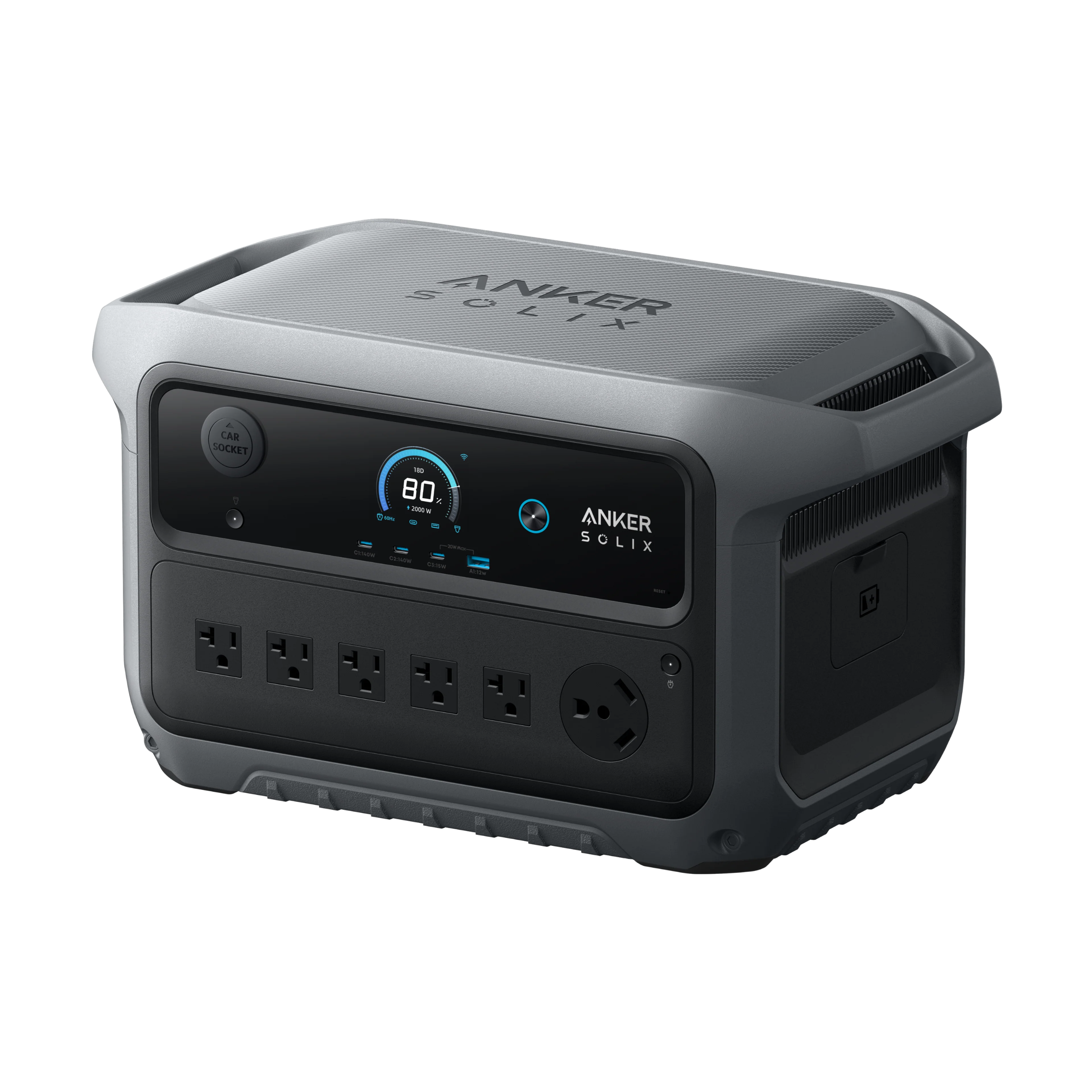
The Jackery Explorer 300D has no AC outlet at all — nothing to plug a lamp, a fridge, or a blender into, at any wattage — so this isn't two power stations competing for the same job. It's a 2,048Wh backup box against a 5.5-lb USB-C charger that happens to share a comparison page.
Full profiles: Anker SOLIX C2000 Gen 2 → · Jackery Explorer 300D →

Written by Ian SchneiderUpdated
Solar & Off-Grid Tester, Station Arena Test Desk
$999.99 · direct from Anker
Last checked 1 day ago. Prices move — check before you buy.

$209.00 · direct from Jackery
Last checked 1 day ago. Prices move — check before you buy.
Spec deltas
The Jackery Explorer 300D has no AC outletB1 — no inverter, nothing to plug a lamp or a fridge into. The Anker SOLIX C2000 Gen 2 has one, plus 2,048Wh of capacity to run it from, for $1,000 against the Explorer 300D's $179. Nearly six times the price buys 1,760Wh more capacity, plus the inverter that makes any of it usable for something other than a phone or a laptop.
Run both through six real-world scenarios and the pattern holds for a reason. The C2000 Gen 2 covers an 8-hour blackout, a CPAP overnight, a full remote workday, and a tailgate party on its own. The Explorer 300D can't finish any of the six. On most of them it simply runs out of stored energy first. On the tailgate party, the reason is different and more basic: whatever needs powering there needs a wall-style AC plug, and this unit was never built with oneB1.
None of that makes the Explorer 300D a bad product. It's a 5.5-lb batteryB2 with a genuine 4,000-cycle lifespanB1 and fast USB-C charging that reviewers like for exactly what it's for, keeping phones, laptops, and small gear charged on the moveB3B4. It just isn't competing for the same shelf as a power station. What follows treats them as what they are: a home-backup box, and the thing you'd throw in a backpack alongside it.
What the Numbers Reveal
Each conclusion stated first — the numbers behind it on one line, the full analysis below.
Capacity
Both units are now rated for the same 4,000 cycles, so that per-Wh gap carries straight through to lifetime cost with no cycle-life discount needed on either side: $0.12 per lifetime kWh for the C2000 Gen 2 against $0.16 for the Explorer 300D.
C2000 Gen 2: 2,048Wh capacity at $1,000, $0.49 per WhExplorer 300D: 288Wh capacity at $179, $0.62 per Wh
Why it mattersIf the Explorer 300D's appeal is 'it's the cheap one,' that's only true of the sticker. Per watt-hour, on day one and every year after, it's the more expensive battery to own.
solar input
Anker scaled solar input right along with the battery, so the bigger unit doesn't punish you with a longer wait for sun. These two units differ enormously in what they hold and barely at all in how long they take to refill.
C2000 Gen 2: 800W solar input, 2,048Wh capacityExplorer 300D: 100W solar input, 288Wh capacity
Why it mattersIf solar is the recharge plan, check input watts, not capacity, to guess refill time in camp.
weight
Losing the inverter is what makes it 5.5 lb instead of a scaled-down 10-plus-lb power station, but the same missing part is why it can't power anything that needs a wall plug, at any wattageB1. The light weight and the AC ceiling aren't two separate facts. They're the same tradeoff.
Explorer 300D: 300W max output, 0W surge rating, no AC switchover specB1Explorer 300D: 5.5 lb against the C2000 Gen 2's 41.7 lbB2
Why it mattersDon't shop the Explorer 300D expecting a smaller power station. It's a different category of device, a USB-C charger, and that's exactly why it's light enough to live in a backpack pocket.
The specific dimensions that decide these two units — everything else is a tie.
Lifetime Value
Selected because: Sticker price favors the Explorer 300D; cost per Wh and per lifetime kWh flip it, and cycle life is now tied, worth explaining.
cost / lifetime kWh
The sticker makes the Explorer 300D look like the frugal pick: $179 against $1,000, nearly six times less. Divide by capacity and it flips: $0.62 per Wh on the Explorer 300D against $0.49 on the C2000 Gen 2, so you're paying more per watt-hour on the 'budget' unit before ownership even starts.
Both units are now rated for the same 4,000 cycles, so the lifetime math doesn't need a longevity discount on either side: at twice-weekly use, both are rated for about 38.5 years. What's left is the same per-Wh gap stretched across that equal lifespan, $0.12 per lifetime kWh for the C2000 Gen 2 against $0.16 for the Explorer 300D. The Anker isn't the cheaper battery to own because it lasts longer. It's cheaper because it holds more capacity for a smaller premium than the price tag suggests.
Your Life, Your Pick
Selected because: The Explorer 300D can't fully clear any of the six modeled scenarios; the mechanism differs by scenario and is worth showing.
The C2000 Gen 2 clears four of the six scenarios modeled here outright: an 8-hour blackout, a CPAP overnight, a full remote workday, and a tailgate party. It only comes up short on the two biggest asks, weekend camping and van-life daily, which need 2,100Wh and 4,685Wh, more than its own 2,048Wh holds. The Explorer 300D doesn't fully clear any of the six.
Most of those misses are simple arithmetic: 320Wh to 1,645Wh of need against a 288Wh battery, so it runs out before the scenario ends. Tailgate Party is the exception worth noticing. The shortfall there isn't really about energy: it's that the gear being run needs a wall-style AC outlet, and the Explorer 300D was built without one, so no watt-hour total would have changed the result.
What the Specs Don't Tell You
Selected because: Four spec-sheet quirks fire, three favor the C2000 Gen 2 and one, warranty economics, genuinely favors the Explorer 300D.
Three of the four spec-sheet quirks that fire for this pair favor the C2000 Gen 2. It's quieter under load, it can add capacity later where the Explorer 300D can't, and it has real UPS protection, about a 10-millisecond switch to battery, where the Explorer 300D has no AC path to switch to in the first place.
One flips the other way: warranty economics. At roughly $60 of coverage per year against $200 a year for the C2000 Gen 2, the Explorer 300D is the arithmetically cheaper insurance, even though its 3-year term is shorter in absolute length than the Anker's 5. It's a real point in the Jackery's column, just not one that outweighs the rest of this page.
Portability & Form Factor
Selected because: The one spec where the Explorer 300D dominates outright, and it's causally linked to the DC-only story, so it earns its own look.
weight
Here's the honest trade the C2000 Gen 2 asks you to make everywhere else on this page: it weighs 41.7 lb. That's not a two-person lift, but you feel it every time you carry it from the garage to the porch. The Explorer 300D weighs 5.5 lbB2, less than a seventh as much, in a vertical, speaker-like shapeB2 that fits a backpack side pocket without a second thought.
That difference isn't a coincidence next to the AC-outlet story above. It's the same design decision: drop the inverter and you drop most of the weight along with it, but you also drop the ability to run anything that needs a wall plug. The Explorer 300D isn't a lighter power station. It's a lighter category of device, and 5.5 lb is what that trade buys.
Strengths & trade-offs
Anker SOLIX C2000 Gen 2
Strengths
- +Larger battery capacity
- +Higher AC output
- +Longer warranty
- +Faster solar charging
Trade-offs
- –Substantially more expensive (+$821) than the Explorer 300D.
- –Significantly heavier (+36.2 lbs), making it harder to move.
Jackery Explorer 300D
Strengths
- +Costs $821 less
- +Lighter by 36.2 lb
Trade-offs
- –Weaker inverter (-2,100W) limits appliance compatibility.
- –Sealed capacity — the SOLIX C2000 Gen 2 can add batteries to grow past 288Wh; this one can't.
Will It Power Your Gear?
Scenario math and per-appliance runtimes, modeled from the spec record.
Scenario verdicts
We ran the math on seven real-world scenarios. Here's which unit survives your actual life.
SCN-01 · 2 nights · needs 2,100Wh
Weekend Camping
Two nights off-grid with essential comfort
Neither unit
A two-night camping trip's fan, lights, and phone charging adds up to about 2,100Wh. That's more than the C2000 Gen 2's usable capacity too, about 121 percent of it, and more than eight and a half times what the Explorer 300D can usably hold. This is a job for a bigger station or a solar top-up, not a reason to choose between these two.
Battery budget usedlower = more headroom
LOAD Phone Charger 15W×6h · LED Lights 40W×8h · Box Fan 75W×14h · CPAP Machine 40W×16h
SCN-02 · 8 hours · needs 1,645Wh
8-Hour Blackout
Keep the essentials running through a night without power
SOLIX C2000 Gen 2
Eight hours of blackout essentials needs about 1,645Wh. The C2000 Gen 2 covers it using 94 percent of what it holds, tight, but it finishes the night. The Explorer 300D would need more than six and a half times its own usable capacity to do the same.
Battery budget usedlower = more headroom
LOAD Fridge 150W×8h · Router + Modem 20W×8h · LED Lights (4 bulbs) 40W×6h · Phone Charger 15W×3h
SCN-03 · 8 hours · needs 320Wh
CPAP Overnight
Sleep therapy without interruption — the #1 medical use case
SOLIX C2000 Gen 2
An overnight CPAP draws about 320Wh. The C2000 Gen 2 barely notices, using just 18 percent of what it holds. The Explorer 300D comes closer here than anywhere else on this page, but it would still need about 31 percent more energy than its 288Wh usably holds.
Battery budget usedlower = more headroom
LOAD CPAP Machine 40W×8h
SCN-04 · 8 hours · needs 910Wh
Remote Workday
Full work day off-grid without power anxiety
SOLIX C2000 Gen 2
A full remote workday, laptop, monitor, phone, router, needs about 910Wh. The C2000 Gen 2 uses about half of what it holds, 52 percent. The Explorer 300D would need more than three and a half times its own usable capacity to make it through the day.
Battery budget usedlower = more headroom
LOAD Laptop 60W×8h · External Monitor 30W×8h · Router + Modem 20W×8h · Phone Charger 15W×2h
SCN-05 · 4 hours · needs 670Wh
Tailgate Party
Game day power for the crew
SOLIX C2000 Gen 2
This is the clearest case of the two units playing different sports. The C2000 Gen 2 covers the whole spread using just 38 percent of what it holds. The Explorer 300D doesn't fail this one on energy math the way it fails the others. It fails because there's no AC outlet to plug the gear into in the first place, no matter what the watt-hour count says.
Battery budget usedlower = more headroom
LOAD Blender 400W×0.5h · LED TV (55") 80W×4h · Bluetooth Speaker 15W×4h · Phone Charger (×3) 45W×2h
SCN-06 · 24 hours · needs 4,685Wh
Van Life Daily
A full day of mobile living — the ultimate endurance test
Neither unit
A full day of van-life draw, fridge, laptop, lights, fan, needs about 4,685Wh, the heaviest ask on this page. Neither unit gets through it alone: the C2000 Gen 2 would need 269 percent of its own usable capacity, and the Explorer 300D would need more than nineteen times its. If this is your actual daily pattern, the answer is a bigger battery with solar sized for daily recovery, not a choice between these two.
Battery budget usedlower = more headroom
LOAD Mini-Fridge 150W×24h · Laptop 60W×4h · Phone Charger 15W×3h · LED Lights 40W×5h · Fan 75W×8h
SCN-07 · an afternoon · needs 100Wh
Afternoon Off-Grid
Phones and a speaker at the park, beach, or campsite — the small-unit job description
Either unit
This row is here for the Explorer 300D's class of job: phones and a speaker, 100Wh across an afternoon. Both cover it — the Explorer 300D finishes at 41% used, and the SOLIX C2000 Gen 2 barely notices it. For this job the SOLIX C2000 Gen 2's extra capacity is dead weight, not headroom; take the Explorer 300D at 5.5 lbs and leave the rest at home.
Battery budget usedlower = more headroom
LOAD Phone Charger (×2) 30W×2h · Bluetooth Speaker 10W×4h
The Load Test
RUNTIME = (Wh × 0.85) ÷ LOAD
None of the scenarios above exactly yours? Build it. Toggle what you'd plug in; both units are tested against the combined draw.
Essentials
Comfort & Convenience
High-Draw Appliances
Test duration
8h
Continuous draw
205W
Projected runtime
Only the SOLIX C2000 Gen 2 can run this load — the Explorer 300D has no AC outlets for the wall-plug gear in it.
$999.99 list · direct from Anker
Modeled from the spec record — same math as the tables below. Methodology
Runtime by appliance
Real-world runtime estimates for common appliances, modeled at 85% inverter efficiency.¹
Essentials
The basics you need runningscale 0–116.1hComfort & Convenience
Makes off-grid life actually enjoyablescale 0–23.2hHigh-Draw Appliances
These reveal the real limitsscale 0–1.7h¹ Runtime = (capacity × 0.85) ÷ appliance watts. Within each group, all bars share one time scale (the group's longest runtime), so lengths are comparable across appliances; identical runtimes collapse into a single blue/orange bar. Actual runtime varies with battery age, temperature, and simultaneous loads — see methodology.
Conclusion
July 29, 2026
Verdict: the SOLIX C2000 Gen 2, on Power Score margin
The SOLIX C2000 Gen 2 wins because it's the only one of these two built to do what a power station is for: it clears four of the six real-world scenarios tested here outright, the Explorer 300D clears zero, at a lower $0.12 per lifetime kWh against $0.16. But the honest framing matters as much as the score. The Explorer 300D has no AC outlet at allB1, so no amount of stored energy was ever going to run a blackout or a CPAP night — it's a genuinely good 5.5-lb USB-C device charger, not a smaller, cheaper version of the C2000 Gen 2. Buy the Anker for anything that needs to plug into a wall. Buy the Jackery only if everything you own already charges over USB-C or a car socket.
Editor-assigned confidence, based on cited owner research and spec analysis.
List prices as of July 29, 2026. The links below open Anker's and Jackery's current prices.
$999.99 · direct from Anker
Last checked 1 day ago. Prices move — check before you buy.
or check the Explorer 300D price$209.00 list
Written by Ian Schneider, Solar & Off-Grid Tester · Station Arena Test Desk · Updated July 29, 2026
Measured Data
Benchmark scores and the full spec record, side by side.
Benchmark scores
Not rated for both units (minimum threshold unmet): UPS, RV Living, Home Backup, CPAP, Solar Generator, Tailgating, Food Truck.
Full specifications
ᵈ Derived: price ÷ rated capacity. See the data behind our comparisons →
Comparison ToolAdd more power stations, side by sideOpen Tool →How these numbers are produced
Numeric verification
Every figure on this page traces to our spec database or arithmetic on it — no estimated numbers.
Owner claims
Statements about owner experience are cited to published reviews — see Sources & Research Notes below.
Runtime model
Runtime = (rated capacity × 0.85 inverter efficiency) ÷ device wattage. Solar recharge estimates assume panels deliver 70% of rated output. Cold weather, battery age, and stacked loads reduce real-world results.
Power Score
Computed from 14 published spec dimensions, weighted per use-case bench. Higher is better; a unit must meet a bench's minimum threshold to be rated.
See the full weight table and data sourcing on our methodology page →Class ranking (the star rating)
Each unit's star score is a category ranking, not customer reviews — no buyer opinions feed it. We score every station on size-independent quality (value, output, portability, endurance, ports, warranty, and more), then percentile-rank it against the other units in its capacity class, so a class-leading compact unit and a class-leading whole-home unit can both earn 5★. Here, SOLIX C2000 Gen 2 rates 4.1/5 (48th percentile of 26 Large-class units), and Explorer 300D rates 4.8/5 (90th percentile of 22 Personal-class units).
How the class ranking is computed →Test Notes & Caveats
Hidden gotchas and advantages we spotted that you won't find on the product page.
The Fan You'll Actually Hear
30dB on the C2000 Gen 2 sits close to a quiet room. 45dB on the Explorer 300D is closer to a running refrigerator, noticeable if it's pitched near your head overnight or next to a tent. Neither is loud in an absolute sense, but the 15dB gap between them is real.
Explorer 300D: No AC Outlets At All
The Explorer 300D's 300W is a DC port total — USB and 12V — not an inverter rating. Anything with a wall plug (a fridge, a TV, a coffee maker, most fans and lamps) never plugs in, at any wattage. That's the design, not a defect: it buys weight, silence, and efficiency for phone, laptop, camera, and 12V-CPAP loads. The SOLIX C2000 Gen 2 carries a real inverter behind 6 AC outlets, so it plays in both worlds. Decide which side of that line your gear lives on before weighing anything else on this page.
Sealed vs. Built to Grow
288Wh is the whole story for the Explorer 300D, permanently. The C2000 Gen 2 starts at 2,048Wh and can add Anker's expansion batteries later. That only matters if you'd ever need more than 2,048Wh to begin with. Plenty of buyers of a 5.5-lb device charger never will.
Only the SOLIX C2000 Gen 2 Has UPS Protection
The C2000 Gen 2 switches to battery in about 10 milliseconds if wall power drops, fast enough that a connected computer typically never notices. The Explorer 300D has no equivalent at all. With no AC inverter or outlet to switch to, there's no UPS function to speak of, not a slow one, just none.
Two Ways to Read the Warranty
5 years against 3 in absolute terms, the C2000 Gen 2's favor. Per dollar spent, the Explorer 300D is the cheaper insurance: about $60 a year of coverage against $200 a year for the C2000 Gen 2, mostly because $179 is a much smaller number to divide by. Both facts are true at once.
Full record above — the Test Desk pick is the SOLIX C2000 Gen 2.
Check SOLIX C2000 Gen 2 price →or check the Explorer 300D priceOwnership Analysis
What happens after you buy — true cost of ownership, brand trust, and growth potential.
Lifetime value
Service lifeyears at one full cycle per day
Lifetime energy delivered
Cost per delivered kWh
│ warranty ends · Reaching the cycle rating means ~80% capacity remains — degraded, not dead.
Analyst note
The Explorer 300D is cheaper to buy, but the SOLIX C2000 Gen 2 is cheaper to own. At $0.12/kWh over its lifetime vs $0.16/kWh, the SOLIX C2000 Gen 2's higher cycle life and capacity make each dollar go further over the years. One thing to know reading the table: both carry the same 4,000-cycle rating, so the lifetime rows are sticker price and capacity in disguise — the wear horizon is identical and decides nothing here.
Brand trust
Anker
Ecosystem
7-8 SOLIX portable power stations across C-series (compact) and F-series (flagship), plus the X1 home energy system
Support
US-based support. Historically known for incredible no-hassle replacements, but recent reports describe AI-driven support agents giving generic responses and complex return logistics for heavy units (hazmat shipping). The Anker brand reputation is still strong, but SOLIX-specific support quality is trending down.
Community
Moderate — active Reddit (r/Anker, r/AnkerSOLIXCommunity) and growing. Benefits from Anker's massive consumer electronics brand awareness.
App experience
Rated 4.5/5 iOS (~1,100 ratings) · 4.3/5 Android
Unique strength
Parent brand trust from Anker's consumer electronics dominance. InfiniPower technology for long cycle life. Strong $/Wh value in the mid-size and larger units — the S2000, F2600 and C1000 are among the better buys per watt-hour in the catalog.
Worth knowing
Support quality appears to be declining from its historically excellent level. Firmware updates have removed features without warning. Expansion ecosystem is smaller than EcoFlow's.
Jackery
Ecosystem
12-15+ models across Explorer (portable) and HomePower (home backup) series, plus SolarSaga panel ecosystem and innovative form factors
Support
US-based support but widely criticized. Reddit reports describe slow/dismissive responses, scripted AI agents, strict receipt requirements for warranty claims, and refurbished replacements for clearly defective units. Strongly recommended: buy from Costco or Amazon for return protection.
Community
Smallest community of the major brands — Reddit r/Jackery has ~2,000 members. YouTube presence is solid due to brand recognition.
App experience
Rated 2.3-3.3/5 iOS and Android — the weakest app experience of the major brands. Multiple confusing apps (Jackery app vs Jackery Home) and mandatory login even offline.
Unique strength
Highest brand recognition and widest retail distribution (Costco, Home Depot, Best Buy, Amazon). The "Toyota" of power stations — dependable, proven, wide availability. Innovative form factors like the Solar Gazebo and Solar Mars Bot.
Worth knowing
A couple of older models still ship NMC chemistry with a shorter rated lifespan, so check the cycle rating on the specific unit — though most of the current line has moved to LFP. Generally perceived as overpriced for the specs offered compared to newer competitors. App experience is significantly behind rivals.
Analyst note
Anker and Jackery are close competitors. Both have established support channels and growing ecosystems. Compare their specific warranty terms and community size for your peace of mind.
Growth path
SOLIX C2000 Gen 2
EXPANDABLESupports Anker expansion batteries, so you can add capacity later without replacing the base unit — useful if your needs may climb past 2,048Wh.
Accepts up to 800W of solar. Suitable for a 1-2 panel setup.
Generous port selection supports complex multi-device setups.
Expansion batteries are Anker-specific. You're investing in the Anker ecosystem.
Explorer 300D
FIXED CAPACITYFixed at 288Wh, with no expansion — so size it for your needs up front rather than planning to add capacity later.
Accepts up to 100W of solar. Limited to a single portable panel.
Limited ports. You'll likely need a power strip or splitter.
Realistic full solar rechargeat 70% of rated panel output — see methodology
Analyst note
The Explorer 300D is sealed at 288Wh, which is fine if that covers you. The SOLIX C2000 Gen 2 starts at 2,048Wh and can grow beyond it with Anker expansion batteries — real headroom the Explorer 300D doesn't have if your needs climb toward partial-home backup.
What Owners Report
Patterns from published owner reports and long-term reviews — every claim cited to its source below.
Anker SOLIX C2000 Gen 2
Independent reviewers are close to unanimous here. Even at full power, testers found the C2000 Gen 2 quieter than other high-output Anker stations, with the fan staying easily backgrounded rather than climbing to something you'd noticeA1. The recurring theme is fuss-free operation, no firmware wrangling, no weird voltage drops, just plug in and goA2A4, and the companion app gets specific praise for monitoring charge and usage over Bluetooth or Wi-FiA3.
The Gen 2 revision also shed real weight versus its predecessor, which reviewers called out directly as a meaningful improvement for anyone who has to carry itA5. Coverage so far comes from hands-on review sites rather than long-term owner forums, so there's no field data yet past the first few months on this specific revision, but every source retrieved points the same direction: quiet, fast-charging, and fuss-freeA4.
“Even at full power it's far quieter than any other powerful Anker station tested — the fans never rise above a subdued, easily-backgrounded whirr, working largely silently and only occasionally reaching a pleasantly quiet ~35 dB at 1 m under high load.”
Sources
notebookcheck.net · thesolarlab.com · trustedreviews.com · androidguys.com
Jackery Explorer 300D
Owner and reviewer coverage here is thinner and more product-specific: the Explorer 300D is a DC-only design with no AC inverter or outlet, built around USB-C, USB-A, and a car socket rather than a wall plugB1. Reviewers who cover it like exactly what it's for, fast USB-C charging for laptops, drones, and other gear on the go, in a distinctive vertical, speaker-like shape that's easier to grab than a traditional boxB2B3.
One outlet rated it around 4.3 out of 5, calling it a good fit for digital nomads and outdoor enthusiasts who prioritize portability and modern device charging over raw capacityB4. That's a fair description of what it is, just worth being clear that none of this coverage tests it as a power station for a blackout or a campsite. It's being reviewed as a charger, because that's what it is.
“288Wh of LiFePO4 capacity rated for over 4,000 cycles — around a decade of regular use — built entirely around DC output with no inverter or AC outlet.”
Sources
jackery.com · solarwaypoint.com · eu.jackery.co · toolhuntr.com
Sources & Research Notes
Every owner claim in this report is traceable to a published source. The bracketed references above resolve here.
Recurring owner themes
- Reviewers consistently praise quiet operation, fast charging, premium build, and no-fuss plug-and-play simplicity. [SOLIX C2000 Gen 2 · 3 entries]
- Light DC-only design (no AC), LFP 4,000-cycle longevity, and modern USB-C fast charging for device users are the highlights. [Explorer 300D · 3 entries]
- A1
“Even at full power it's far quieter than any other powerful Anker station tested — the fans never rise above a subdued, easily-backgrounded whirr, working largely silently and only occasionally reaching a pleasantly quiet ~35 dB at 1 m under high load.”
notebookcheck.net / thesolarlab.com — Anker SOLIX C2000 Gen 2 review · 2026 · [positive]
- A2
“Really simple to use — no need to download firmware or deal with weird voltage drops; you just turn it on, plug in, and go. Rapid charging and premium build.”
trustedreviews.com / thesolarlab.com — Anker SOLIX C2000 Gen 2 review · 2026 · [positive]
- A3
“The Anker Solix app is a good way to monitor the station during charging and use over Bluetooth or Wi-Fi; reviewers appreciated the monitoring functionality.”
androidguys.com — Anker SOLIX C2000 Gen 2 review · 2026 · [positive]
- A4
“Delivers a convincing performance with few points of criticism — undoubtedly one of the most attractive 2 kWh power stations on the market.”
notebookcheck.net — Anker SOLIX C2000 Gen 2 review · 2026 · [positive]
- A5
“Substantially lighter than its predecessor — the Gen 2 shed a large amount of weight versus the original C2000, making it notably easier to carry for its capacity.”
notebookcheck.net — '11.6 kg lighter than its predecessor' review · 2026 · [positive]
- B1
“288Wh of LiFePO4 capacity rated for over 4,000 cycles — around a decade of regular use — built entirely around DC output with no inverter or AC outlet.”
jackery.com / solarwaypoint.com — Explorer 300D review · 2026 · [positive]
- B2
“A unique vertical, speaker-like form factor at about 5.5 lbs, significantly smaller and lighter than traditional models.”
jackery.com (EU) — Explorer 300D · 2026 · [positive]
- B3
“Up to 300W total DC output via 3x USB-C, 1x USB-A, and a car socket, with 140W PD fast charging for laptops, drones, and gear.”
eu.jackery.com — Explorer 300D · 2026 · [positive]
- B4
“Rated about 4.3/5 — ideal for digital nomads and outdoor enthusiasts who prioritize portability and modern device charging.”
toolhuntr.com — Explorer 300D review · 2026 · [positive]
Research compiled July 29, 2026.
Who Should Buy Which
Buy the SOLIX C2000 Gen 2 if you…
- →Buy the SOLIX C2000 Gen 2 if you need a power station that actually behaves like one: it clears the 8-hour blackout, CPAP-overnight, remote-workday, and tailgate scenarios tested here on its own, and it can grow past 2,048Wh later with Anker's expansion batteries.
- →Buy it if you're comparing real cost of ownership rather than the sticker: $0.12 per lifetime kWh against the Explorer 300D's $0.16, a longer 5-year warranty, and a 30dB noise floor quiet enough to sit next to overnight.
Buy the Explorer 300D if you…
- →Buy the Explorer 300D if what you actually need is a light charger for phones, laptops, and small gear on the move. At 5.5 lb it's genuinely good everyday-carry gearB2, and $179 is a fair price for that job.
- →Buy it if everything you own already charges over USB-C, USB-A, or a car socketB1, because that's the entirety of what it can power. It has no AC outletB1, so a lamp, a fridge, or a blender has nowhere to plug in, no matter what else is true about the rest of the spec sheet.
If neither fits
Skip both if you need to run real loads for more than a few hours off-grid without also owning a bigger battery. Weekend camping here needs 2,100Wh and van-life daily needs 4,685Wh, and neither of these units clears either scenario on its own. Look at a 3,000Wh-plus station instead, ideally paired with solar.
The Bottom Line
The SOLIX C2000 Gen 2 wins this comparison because it's the only one of these two units built to do what a power station is for: four of six real-world scenarios covered outright against zero for the Explorer 300D, and a lower $0.12 per lifetime kWh against $0.16. The honest framing matters too. The Explorer 300D has no AC outlet at allB1, so no amount of capacity was ever going to change the outcome for a blackout or a CPAP night.
What it is instead is a genuinely good 5.5-lb USB-C charger with a 4,000-cycle batteryB1 for $179. Buy it for a backpack, not a blackout. If anything on your list needs to plug into a wall, buy the C2000 Gen 2. If everything you own already charges over USB-C, buy the Jackery and keep the difference.
Frequently Asked Questions
Answers drawn from the spec record and cited owner research.
Is the Jackery Explorer 300D actually cheaper than the Anker SOLIX C2000 Gen 2?
Only on the sticker: $179 against $1,000. Per watt-hour of capacity it's actually the more expensive of the two, $0.62 versus $0.49, and per lifetime kWh the gap holds at $0.16 versus $0.12. Both units are now rated for the same 4,000 cycles, so the Anker's edge is about how much battery your dollar buys, not about which one lasts longer.
Can the Jackery Explorer 300D run a mini-fridge, a lamp, or power tools?
No. It has no AC outlet at all — every watt it delivers goes out through USB-C, USB-A, or a 12V car socket, up to 300W total. Anything that needs a standard wall plug has nowhere to connect, regardless of how much charge is left in the battery.
Is the Anker SOLIX C2000 Gen 2 worth almost six times the price of the Explorer 300D?
If you need what a power station does, yes. It covers an 8-hour blackout, a full remote workday, and a CPAP overnight on its own, and the Explorer 300D can't do any of those jobs at any price, because it has no AC output to do them with. If all you need is to keep phones and laptops charged on the move, the Explorer 300D does that for a fraction of the cost and a fraction of the weight.
Which one has the better warranty?
In absolute terms, the C2000 Gen 2: 5 years against 3. The Explorer 300D flips it on a per-dollar basis, about $60 of coverage per year against roughly $200 a year for the C2000 Gen 2, simply because it costs so much less to insure in the first place. Both things are true at once: the Anker's coverage lasts longer, the Jackery's costs less per year of it.
Where to buy
Anker SOLIX C2000 Gen 2Pick
$999.99
$999.99 · direct from Anker
Last checked 1 day ago. Prices move — check before you buy.
Jackery Explorer 300D
$209.00
$209.00 · direct from Jackery
Last checked 1 day ago. Prices move — check before you buy.
Prices may vary by retailer and are subject to change.