Head-to-head test
Anker SOLIX C2000 Gen 2 vs BLUETTI Premium 200 V2
Both units land at $0.12 per lifetime kilowatt-hour, so the $549 gap between them isn't extra margin — it's a warranty you can read weighed against a cycle count and a noise rating you can hear.
Full profiles: Anker SOLIX C2000 Gen 2 → · BLUETTI Premium 200 V2 →
Looking for a different matchup? Anker SOLIX C2000 Gen 2 vs BLUETTI Elite 200 V2

Written by Gunner GustafsonUpdated
Whole-Home Backup Tester, Station Arena Test Desk
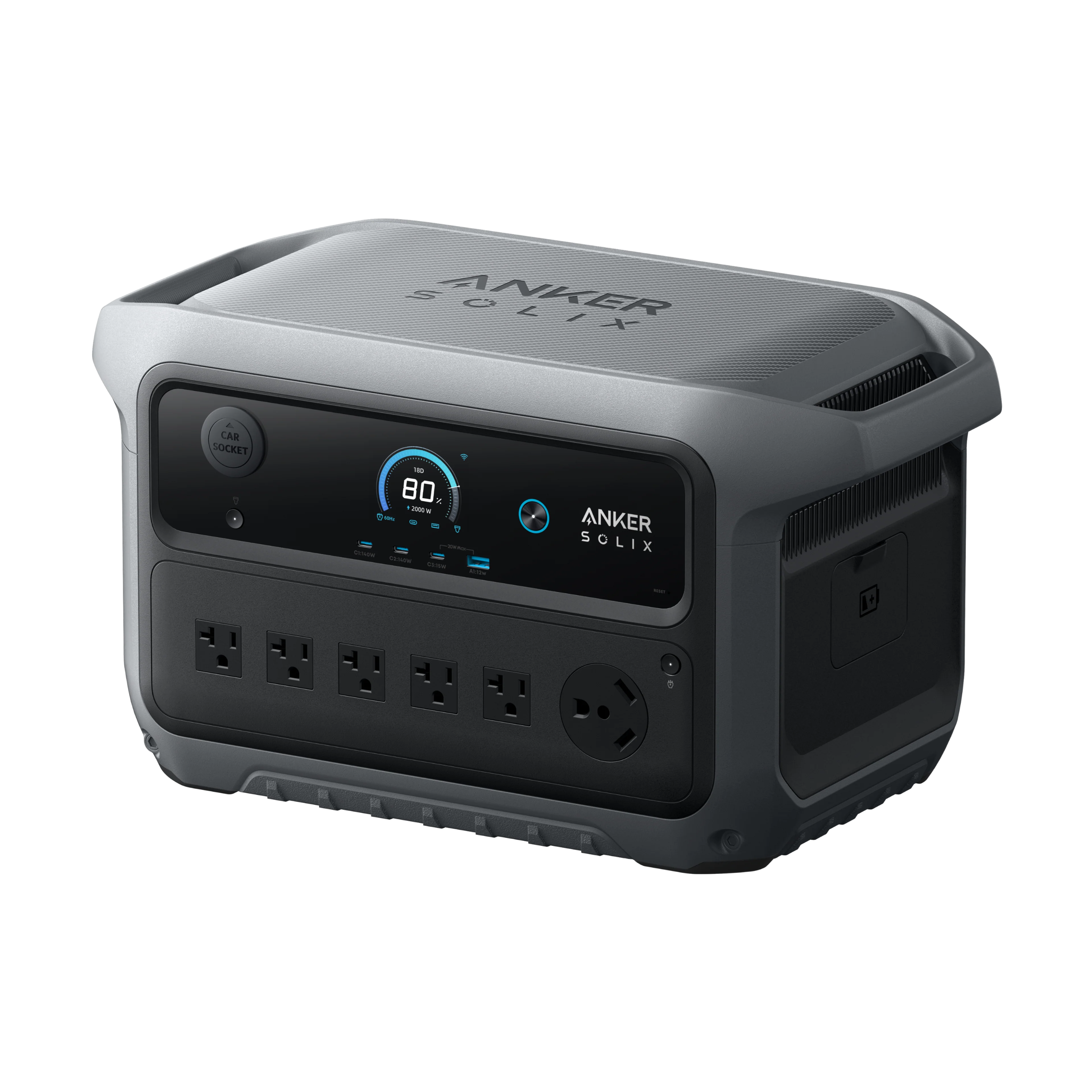
$999.99 · direct from Anker
Last checked 1 day ago. Prices move — check before you buy.

$1,549.00 · direct from BLUETTI
Last checked 1 day ago. Prices move — check before you buy.
Spec deltas
The Anker SOLIX C2000 Gen 2 costs $1,000. The BLUETTI Premium 200 V2 costs $1,549 and holds 2,074Wh to the Anker's 2,048Wh — about 1% more — while running the same evenings, the same blackouts, the same weekends. That's a $549 gap on a battery that's barely different in size.
Credit BLUETTI's full 6,000-cycle rating and it delivers 12,442 lifetime kilowatt-hours against the Anker's 8,192 — about half again the energy, for 55% more money. Divide it out and both land at $0.12 per lifetime kilowatt-hour. That's the whole thesis of this page: the extra cycles are priced almost exactly at what they're worth, dollar for dollar.
So the decision doesn't live in the runtime tables — every scenario here ties or fails both units by nearly the same margin — and it doesn't live in a lifetime-cost gap either, because there isn't one. It lives in four gotchas: warranty, cycle life, UPS speed, and expansion. Weigh those against how you'll actually use the thing, and the $549 either earns its keep or it doesn't.
What the Numbers Reveal
Each conclusion stated first — the numbers behind it on one line, the full analysis below.
rated cycles
Divide it out and both land at $0.12 per lifetime kilowatt-hour — the same number, to the cent. BLUETTI's extra cycles cost almost exactly what they deliver: a straightforward trade of $549 for a longer-rated battery, not a markup on capacity you'd never use.
Anker SOLIX C2000 Gen 2: $1,000 for 2,048Wh, rated 4,000 cyclesBLUETTI Premium 200 V2: $1,549 for 2,073.6Wh, rated 6,000 cyclescomputed lifetime cost: $0.12 per kWh for both units
Why it mattersIf you were counting on a hidden lifetime discount to decide this for you, there isn't one — decide on the $549 sticker price or the four gotchas below, on their own terms.
A cycle rating is a projection about the cells; a warranty is what the company signs today. BLUETTI projects a battery that outlives its own warranty roughly three-to-one at daily use (16.4 projected years against 4 signed for); Anker's warranty covers nearly half of its own projected daily-use life (5 of 11 years). Anker is putting more of its projection in writing.
warranty: 5 years (Anker) at $200 per covered year vs 4 years (BLUETTI) at $387 per covered yearcycle ratings: 4,000 (Anker) vs 6,000 (BLUETTI)yearsDaily: 11 (Anker) vs 16.4 (BLUETTI) at one full cycle a day
Why it mattersIf BLUETTI's longer projected life is the pull, notice which company actually backs more of that life on paper.
The gap that matters lives entirely in the daily-use column. Weekend cadence pushes both units past the point where the battery outlasts the owner's interest in camping — the extra cycles are real, they're just parked past the horizon for anyone who isn't cycling this every day.
cycles: 4,000 (Anker) vs 6,000 (BLUETTI)yearsDaily: 11 (Anker) vs 16.4 (BLUETTI) at one full cycle a dayyearsWeekend: 38.5 (Anker) vs 57.7 (BLUETTI) at weekend cadence
Why it mattersCycle it daily — a van, a cabin, a desk rig — and BLUETTI's extra years are ones you'll actually spend. Cycle it on weekends and you're both parked past the point where it counts.
solar input
Those two specs describe one specific life: the unit that works every day and sleeps where you sleep. Low fan noise is felt nightly; a bigger solar ceiling is felt every recharge. Neither shows up in a cost-per-kilowatt-hour spreadsheet, and neither is a line the Anker answers.
rated noise: 30 dBA (Anker) vs 16 dBA (BLUETTI)solar input ceiling: 800W (Anker) vs 1,000W (BLUETTI)independent charge testing measured 80% state-of-charge in about an hour on wall turboB6
Why it mattersIf the unit sleeps within earshot of a bed, or refills off panels daily, this is where the $549 buys something the lifetime-cost math can't show.
The specific dimensions that decide these two units — everything else is a tie.
What the Specs Don't Tell You
Selected because: Lifetime cost is now a wash, so the four info-severity gotchas (warranty, cycleLife, ups, expansion) carry the actual decision.
rated cycles
Nothing red fires here — four cards, all informational, which on a $549 gap is itself a data point: neither unit is hiding a landmine. The two that matter argue with each other. Anker wins the warranty card outright — more years, signed, at a lower cost per year. BLUETTI wins the cycle-rating card outright — a genuinely higher-rated battery, if you'll actually use the extra cycles. The tiebreak is exposure: the Anker owner's downside is wanting more than 2,048Wh someday, solvable with an add-on battery since the C2000 Gen 2 has an expansion port. The BLUETTI has no such port, but at 2,074Wh it already ships larger than Anker's base unit, so 'not expandable' here just means 'already complete.' The real BLUETTI-owner exposure is needing service in year five of a four-year warranty, with $549 more already spent.
Lifetime Value
Selected because: Needs its own section to show why the price gap no longer signals a value gap — both compute to the same cost per kWh.
The tie holds up even under BLUETTI's best-case assumptions: full credit for all 6,000 rated cycles, no early failure, no lost charger across the unit's entire rated life. Under those terms it still lands at the same cost per kilowatt-hour as the Anker — not a bad deal, just an even one. The engine still tags the Anker as marginally cheaper to own, but the margin is thin enough to round away to the same number for both units.
Weekend use makes it human: cycle either one twice a week and the daily cost works out to seven cents for both — a gap too small to feel at the outlet. What buyers actually feel is the $549 difference on the price tag today, which the lifetime math neither justifies nor erases.
Portability & Form Factor
Selected because: 11.7 lb gap at near-equal capacity is the daily felt difference the gotchas don't cover.
weight
41.7 lb against 53.4 lb — an 11.7-lb gap that's the difference between a one-handed lift off a tailgate and a lift you set your feet for. Both hold roughly the same 2,050Wh, so the Anker just costs less effort every time you move it — and reviewers specifically praised how much lighter the Gen 2 got against the original C2000A5.
Your Life, Your Pick
Selected because: All six scenarios compute to ties or shared misses, confirming runtime can't break this pair and reinforcing why the gotchas decide it.
Six scenarios, and the engine ties four of them and fails both units on the other two. Both clear an eight-hour blackout with single digits of margin left, both coast through a CPAP night on well under a quarter tank, and both come up short on a no-recharge weekend and a full van-life day by nearly the same percentage. Runtime can't separate these units on a single use case here — which is exactly why the decision sits in the four gotchas above and the $549 on the price tag, not in how either battery performs.
Brand Trust
Selected because: Cross-brand pair; the support-quality gap still matters, especially set against the pricier unit's shorter warranty.
Anker carries the larger consumer-electronics halo and a support record that's historically been the category's benchmark, though its first line increasingly leans on AI-scripted responses, and returning a unit this heavy means hazmat shipping logistics nobody enjoys. BLUETTI's support is the most inconsistent in the space — email-first, timezone-lagged, sometimes smooth, sometimes weeks of runaround — with meaningfully better odds if you buy direct from BLUETTI. Their apps tie at 4.5 stars on iOS, for what it's worth.
Neither record disqualifies its unit, but service risk scales with the size of the check, and only one of these companies asks for the bigger check while offering the shorter warranty behind it.
Strengths & trade-offs
Anker SOLIX C2000 Gen 2
Strengths
- +Costs $549 less
- +Lighter by 11.7 lb
- +Longer warranty
Trade-offs
- –Shorter-lived battery — rated for 4,000 charge cycles vs the Premium 200 V2's 6,000, so it wears out sooner.
BLUETTI Premium 200 V2
Strengths
- +Larger battery capacity
- +Higher AC output
- +Faster solar charging
- +Rated for 6,000 charge cycles — much longer battery lifespan
Trade-offs
- –Substantially more expensive (+$549) than the SOLIX C2000 Gen 2.
- –Significantly heavier (+11.7 lbs), making it harder to move.
Will It Power Your Gear?
Scenario math and per-appliance runtimes, modeled from the spec record.
Scenario verdicts
We ran the math on six real-world scenarios. Here's which unit survives your actual life.
SCN-01 · 2 nights · needs 2,100Wh
Weekend Camping
Two nights off-grid with essential comfort
Neither unit
The weekend camping budget calls for 2,100Wh; Anker comes up needing 121% of its capacity, BLUETTI 119% — both short, by nearly the same amount. Bring a panel or an expansion battery and either handles the weekend easily; on battery alone, plan for Saturday night, not Sunday.
Battery budget usedlower = more headroom
LOAD Phone Charger 15W×6h · LED Lights 40W×8h · Box Fan 75W×14h · CPAP Machine 40W×16h
SCN-02 · 8 hours · needs 1,645Wh
8-Hour Blackout
Keep the essentials running through a night without power
Either unit
Both units clear the full eight hours with single digits of margin left — 94% and 93% of capacity spent. That's a pass, not a comfort margin. If outages run longer than an evening, recharge speed becomes the real question, and BLUETTI's bigger solar ceiling has the edge there.
Battery budget usedlower = more headroom
LOAD Fridge 150W×8h · Router + Modem 20W×8h · LED Lights (4 bulbs) 40W×6h · Phone Charger 15W×3h
SCN-03 · 8 hours · needs 320Wh
CPAP Overnight
Sleep therapy without interruption — the #1 medical use case
Premium 200 V2
Neither breaks a sweat — a CPAP night uses under a fifth of either battery. The spec that actually decides this one is the one you'll hear at 2 a.m.: BLUETTI's noise rating is roughly half the Anker's, and two feet from a pillow, that's the whole ballgame.
Battery budget usedlower = more headroom
LOAD CPAP Machine 40W×8h
SCN-04 · 8 hours · needs 910Wh
Remote Workday
Full work day off-grid without power anxiety
Either unit
An even split on capacity — about half a tank for a full desk day, for both units. The tiebreak is the USB-C port: Anker pushes 140W to BLUETTI's 100W, which is most of the difference between replacing a big laptop's charger outright and almost replacing it.
Battery budget usedlower = more headroom
LOAD Laptop 60W×8h · External Monitor 30W×8h · Router + Modem 20W×8h · Phone Charger 15W×2h
SCN-05 · 4 hours · needs 670Wh
Tailgate Party
Game day power for the crew
Either unit
Both do this on a little over a third of a charge, so the choice comes down to which one you'd rather carry across a parking lot. That's the Anker, 11.7 lb lighter, and your shoulder will vote before the spec sheet does.
Battery budget usedlower = more headroom
LOAD Blender 400W×0.5h · LED TV (55") 80W×4h · Bluetooth Speaker 15W×4h · Phone Charger (×3) 45W×2h
SCN-06 · 24 hours · needs 4,685Wh
Van Life Daily
A full day of mobile living — the ultimate endurance test
Neither unit
A full van-life day asks for nearly 2.7 times what either unit holds, so the base-unit question is moot here. Both scale with expansion batteries, which turns this into a budget-and-ecosystem question rather than one about these two boxes — and the cheaper starting unit begins that race a step ahead.
Battery budget usedlower = more headroom
LOAD Mini-Fridge 150W×24h · Laptop 60W×4h · Phone Charger 15W×3h · LED Lights 40W×5h · Fan 75W×8h
The Load Test
RUNTIME = (Wh × 0.85) ÷ LOAD
None of the scenarios above exactly yours? Build it. Toggle what you'd plug in; both units are tested against the combined draw.
Essentials
Comfort & Convenience
High-Draw Appliances
Test duration
8h
Continuous draw
205W
Projected runtime
Dead heat — both run this 205W load for roughly 8.5h. Pick on price, weight, or ports.
Modeled from the spec record — same math as the tables below. Methodology
Runtime by appliance
Real-world runtime estimates for common appliances, modeled at 85% inverter efficiency.¹
Essentials
The basics you need runningscale 0–117.5hComfort & Convenience
Makes off-grid life actually enjoyablescale 0–23.5hHigh-Draw Appliances
These reveal the real limitsscale 0–1.8h¹ Runtime = (capacity × 0.85) ÷ appliance watts. Within each group, all bars share one time scale (the group's longest runtime), so lengths are comparable across appliances; identical runtimes collapse into a single blue/orange bar. Actual runtime varies with battery age, temperature, and simultaneous loads — see methodology.
Conclusion
July 26, 2026
Verdict: the SOLIX C2000 Gen 2, on Power Score margin
Both units cost the same per lifetime kilowatt-hour, so this isn't fundamentally a value gap — it's a $549 upfront gap and four smaller trade-offs. Anker backs its unit for five years at a lower cost per covered year; BLUETTI backs its for four years at a much higher cost per covered year — a real, computed edge for Anker. BLUETTI answers with a genuine 6,000-cycle rating (worth 5.4 more years of service at daily use), a rated noise floor at roughly half the Anker's, and a bigger solar ceiling — none of which the Anker counters. For anyone who isn't cycling this daily or sleeping next to it, the $549 and the warranty math point at the C2000 Gen 2. For the daily user or the light sleeper, BLUETTI's premium is fairly priced, not a markup, and it's the better buy.
Editor-assigned confidence, based on cited owner research and spec analysis.
List prices as of July 26, 2026. The links below open Anker's and BLUETTI's current prices.
$999.99 · direct from Anker
Last checked 1 day ago. Prices move — check before you buy.
or check the Premium 200 V2 price$1,549.00 list
Written by Gunner Gustafson, Whole-Home Backup Tester · Station Arena Test Desk · Updated July 26, 2026
Measured Data
Benchmark scores and the full spec record, side by side.
Benchmark scores
Not rated for both units (minimum threshold unmet): Camping.
Full specifications
ᵈ Derived: price ÷ rated capacity. See the data behind our comparisons →
Comparison ToolAdd more power stations, side by sideOpen Tool →How these numbers are produced
Numeric verification
Every figure on this page traces to our spec database or arithmetic on it — no estimated numbers.
Owner claims
Statements about owner experience are cited to published reviews — see Sources & Research Notes below.
Runtime model
Runtime = (rated capacity × 0.85 inverter efficiency) ÷ device wattage. Solar recharge estimates assume panels deliver 70% of rated output. Cold weather, battery age, and stacked loads reduce real-world results.
Power Score
Computed from 14 published spec dimensions, weighted per use-case bench. Higher is better; a unit must meet a bench's minimum threshold to be rated.
See the full weight table and data sourcing on our methodology page →Class ranking (the star rating)
Each unit's star score is a category ranking, not customer reviews — no buyer opinions feed it. We score every station on size-independent quality (value, output, portability, endurance, ports, warranty, and more), then percentile-rank it against the other units in its capacity class, so a class-leading compact unit and a class-leading whole-home unit can both earn 5★. Here, SOLIX C2000 Gen 2 rates 4.1/5 (48th percentile of 26 Large-class units), and Premium 200 V2 rates 3.4/5 (8th percentile of 26 Large-class units).
How the class ranking is computed →Test Notes & Caveats
Hidden gotchas and advantages we spotted that you won't find on the product page.
Fixed capacity isn't a con here
BLUETTI's fixed 2,074Wh already starts above Anker's base 2,048Wh, so Anker's expansion port doesn't create an advantage until you'd grow past that number — the first expansion battery mostly buys back capacity BLUETTI already ships with. It only pulls ahead once your needs are provably headed past roughly 2,074Wh.
Ten milliseconds vs fifteen
Both handoffs beat what most gear can even notice, and neither is a true online UPS. Anker's line-interactive-class switch is the marginally quicker one — a real tiebreak if a desktop or NAS rides on this outlet, trivia for a fridge or router.
Who signs their name, and for how much
Anker backs its unit for five years; BLUETTI backs its for four, on the pricier unit. Per covered year, that gap is wider than the sticker gap suggests — the two aren't dividing the same math into the same number of slices. If BLUETTI's larger projected cycle life is the draw, note that most of that projected life sits past anyone's signature.
The one card BLUETTI wins outright
6,000 rated cycles against 4,000 is a genuine engineering edge — worth 5.4 more years of service at daily use. At weekend cadence, though, both ratings stretch past three decades: this card only pays out if the battery works full time.
Full record above — the Test Desk pick is the SOLIX C2000 Gen 2.
Check SOLIX C2000 Gen 2 price →or check the Premium 200 V2 priceOwnership Analysis
What happens after you buy — true cost of ownership, brand trust, and growth potential.
Lifetime value
Service lifeyears at one full cycle per day
Lifetime energy delivered
Cost per delivered kWh
│ warranty ends · Reaching the cycle rating means ~80% capacity remains — degraded, not dead.
Analyst note
Both units cost the same to own over their rated lives — $0.12/kWh each. Lifetime cost can't separate them, so decide on the sticker price and everything else.
Brand trust
Anker
Ecosystem
7-8 SOLIX portable power stations across C-series (compact) and F-series (flagship), plus the X1 home energy system
Support
Anker's support was long the category's gold standard for no-hassle replacements. Lately the first line leans more AI-scripted, and returning a unit this heavy means hazmat shipping logistics. The brand halo holds; SOLIX-specific service is trending the wrong way.
Community
Moderate — active Reddit (r/Anker, r/AnkerSOLIXCommunity) and growing. Benefits from Anker's massive consumer electronics brand awareness.
App experience
Rated 4.5/5 iOS (~1,100 ratings) · 4.3/5 Android
Unique strength
Parent brand trust from Anker's consumer electronics dominance. InfiniPower technology for long cycle life. Strong $/Wh value in the mid-size and larger units — the S2000, F2600 and C1000 are among the better buys per watt-hour in the catalog.
Worth knowing
Firmware updates have removed features without warning — buy for what the unit does today, not what the app promises tomorrow.
BLUETTI
Ecosystem
One of the broadest lineups — 15-20+ models from budget (AC2A) to flagship portable (Apex 300, 2764.8Wh). Includes specialized products: vehicle solar hubs, sodium-ion cold-weather units, and balcony storage systems.
Support
The widest variance in the category: some tickets resolve smoothly, others turn into weeks of cross-timezone email, and repair requests sometimes come back as discounts on a new unit instead of a fix. Buying direct from BLUETTI improves the odds.
Community
Active and growing — Reddit r/bluetti has a dedicated community. Second-largest after EcoFlow in engagement.
App experience
Rated 4.5/5 iOS and Android — tied for best app experience in the category. V3.0 UI redesign was well-received.
Unique strength
Among the best capacity-to-price ratios available — several Elite and Apex units are the lowest $/Wh in the catalog. Widest product diversity including industry-firsts like sodium-ion cold-weather units and dual solar+alternator vehicle hubs. LFP across the rest of the range, though rated cycle life spans 2,500 (EB3A) to 6,000, and it varies WITHIN the Elite range rather than tracking it — the Elite 300 and Elite 200 V2 are rated 6,000 while the Elite 30 V2, Elite 10 Mini, Elite 320 and Elite 400 are rated 3,000+ and the Elite 100 V2 4,000+, so check the specific model. Dual-voltage (120V/240V) in flagships.
Worth knowing
Some older BLUETTI models have no spare-parts path once discontinued — out-of-warranty can mean unrepairable, not just expensive.
Analyst note
Two capable ecosystems with the same weak spot in different sizes. Anker's service is a strong reputation eroding at the edges; BLUETTI's is a coin flip that improves if you buy direct. At $549 apart, the coin flip is the one that costs more to lose.
Growth path
SOLIX C2000 Gen 2
EXPANDABLESupports Anker expansion batteries, so you can add capacity later without replacing the base unit — useful if your needs may climb past 2,048Wh.
Accepts up to 800W of solar. Suitable for a 1-2 panel setup.
Generous port selection supports complex multi-device setups.
Expansion batteries are Anker-specific. You're investing in the Anker ecosystem.
Premium 200 V2
FIXED CAPACITYFixed at 2,074Wh — a sealed, complete system rather than a starting point. There's no expansion port, so that figure is the ceiling: check it against your longest unplugged stretch before you buy.
Accepts up to 1,000W of solar. Enough for a serious multi-panel array.
Adequate ports for most setups, but heavy users may want a power strip.
Realistic full solar rechargeat 70% of rated panel output — see methodology
Analyst note
Don't read the SOLIX C2000 Gen 2's expandability as a straight win here: it starts at 2,048Wh, below the Premium 200 V2's 2,074Wh, so a first expansion battery largely buys back capacity the Premium 200 V2 already includes. It only pulls ahead if you'd grow past 2,074Wh — short of that, the Premium 200 V2's larger fixed capacity is the simpler value.
What Owners Report
Patterns from published owner reports and long-term reviews — every claim cited to its source below.
Anker SOLIX C2000 Gen 2
Independent review coverage of the C2000 Gen 2 is broad and remarkably consistent. Reviewers describe fans that stay a quiet, easily-backgrounded whirr even at full charging loadA1, no-fuss plug-and-play behavior with none of the firmware or voltage quirks common in the categoryA2, and an app reviewers found genuinely useful for monitoring rather than a checkbox featureA3. One outlet called it one of the more attractive 2kWh stations on the marketA4, and the weight cut from the original C2000 draws its own specific praiseA5.
What's missing is longevity: this is reviewer testing, not months of ownership. No six-month-plus owner accounts turned up in this research pass, so treat durability claims as spec-backed rather than field-proven.
“Even at full power it's far quieter than any other powerful Anker station tested — the fans never rise above a subdued, easily-backgrounded whirr, working largely silently and only occasionally reaching a pleasantly quiet ~35 dB at 1 m under high load.”
Sources
notebookcheck.net · thesolarlab.com · trustedreviews.com · androidguys.com
BLUETTI Premium 200 V2
Field data naming the Premium 200 V2 specifically is thin — it's a newer SKU sold through fewer channels, and most long-term write-ups attach to its Elite 200 V2 sibling, deliberately excluded here to avoid mixing models. What exists is modest: one buyer describes it as the higher-specced Elite variant, probably differing mostly in softwareB1; early owners report smooth ordering and well-packed arrivalsB2B3; and independent charge testing clocked the wall-turbo recharge at 80% state-of-charge in about an hour, with real-world solar harvest landing near 70% of a panel's rated outputB5B6.
That's a starting ledger, not a verdict on ownership — treat it as limited field data on a unit that's still new.
“This is the slightly higher specced version of the Elite 200 v2. The only difference is probably in the software limitations.”
Sources
backuppowerhub.com
Sources & Research Notes
Every owner claim in this report is traceable to a published source. The bracketed references above resolve here.
Recurring owner themes
- Reviewers consistently praise quiet operation, fast charging, premium build, and no-fuss plug-and-play simplicity. [SOLIX C2000 Gen 2 · 3 entries]
- Buyers who purchased the Premium 200 V2 through the retailer's storefront consistently describe the ordering, packaging, and delivery experience as smooth and well-communicated. [Premium 200 V2 · 3 entries]
- Independent charging-performance write-ups report the Premium 200 V2's turbo AC recharge and solar input behaving close to BLUETTI's stated figures, with solar harvest efficiency landing a bit below the panel's rated wattage in real conditions. [Premium 200 V2 · 2 entries]
- A1
“Even at full power it's far quieter than any other powerful Anker station tested — the fans never rise above a subdued, easily-backgrounded whirr, working largely silently and only occasionally reaching a pleasantly quiet ~35 dB at 1 m under high load.”
notebookcheck.net / thesolarlab.com — Anker SOLIX C2000 Gen 2 review · 2026 · [positive]
- A2
“Really simple to use — no need to download firmware or deal with weird voltage drops; you just turn it on, plug in, and go. Rapid charging and premium build.”
trustedreviews.com / thesolarlab.com — Anker SOLIX C2000 Gen 2 review · 2026 · [positive]
- A3
“The Anker Solix app is a good way to monitor the station during charging and use over Bluetooth or Wi-Fi; reviewers appreciated the monitoring functionality.”
androidguys.com — Anker SOLIX C2000 Gen 2 review · 2026 · [positive]
- A4
“Delivers a convincing performance with few points of criticism — undoubtedly one of the most attractive 2 kWh power stations on the market.”
notebookcheck.net — Anker SOLIX C2000 Gen 2 review · 2026 · [positive]
- A5
“Substantially lighter than its predecessor — the Gen 2 shed a large amount of weight versus the original C2000, making it notably easier to carry for its capacity.”
notebookcheck.net — '11.6 kg lighter than its predecessor' review · 2026 · [positive]
- B1
“This is the slightly higher specced version of the Elite 200 v2. The only difference is probably in the software limitations.”
Outbound Power — customer review on BLUETTI Premium 200 V2 product page · unknown · [mixed]
- B2
“I'm glad to hear your BLUETTI Premium 200 V2 arrived safely, packaged well, and already powering up nicely... once you have it fully set up in your van with the charger.”
Outbound Power — retailer reply paraphrasing a customer review (product page) · unknown · [positive]
- B3
“Excellent service with excellent pricing. By far the best price I could find on the battery. Delivery arrived in perfect condition.”
Outbound Power — customer review on BLUETTI Premium 200 V2 product page · unknown · [positive]
- B5
“Efficiency data suggests real-world solar harvest lands around 70% of rated panel capacity in average conditions.”
backuppowerhub.com — "BLUETTI Premium 200 V2 Review: Is the $750 Premium Upgrade Worth It?" · 2026-04 (page_age) · [mixed]
- B6
“Charge time data confirms the unit reaches 80% state-of-charge in roughly an hour at full turbo, with a full cycle completing in under two hours from the wall.”
backuppowerhub.com — "BLUETTI Premium 200 V2 Review: Is the $750 Premium Upgrade Worth It?" · 2026-04 (page_age) · [positive]
Research compiled July 26, 2026.
Who Should Buy Which
Buy the SOLIX C2000 Gen 2 if you…
- →The occasional user: a handful of nights a year, weekend trips, no daily grind. With lifetime cost a wash between the two, there's no reason to pay $549 more for cycles you won't use.
- →The warranty-first buyer: five years signed against four, at a lower cost per covered year. If a paper guarantee matters more than a projected one, this is the cheaper promise.
- →The trunk-and-tailgate camper: 41.7 lb against 53.4 lb, plus a 140W USB-C port against 100W, make this the easier one to live with on the move.
Buy the Premium 200 V2 if you…
- →The daily cycler: a van, a cabin, a desk that runs off this every day. 6,000 rated cycles is 5.4 more years of service at that cadence, and at $549 more, that's a fair trade, not a markup.
- →The light sleeper: a rated noise floor at roughly half the Anker's is the one spec on this page felt every single night the unit shares a room.
- →The solar-dependent buyer: a 1,000W input ceiling against 800W, backed by independent charge testingB6, refills faster off panels when the grid is the thing that's down.
If neither fits
The CPAP-and-phone sleeper — an overnight draw uses under a fifth of either battery, so a smaller, cheaper station does the same job for less money. And the full-time van dweller planning around a near-4,700Wh day: neither base unit holds even half that, so start with expansion batteries or a bigger flagship class instead of either box alone.
The Bottom Line
Both units cost the same per lifetime kilowatt-hour, so BLUETTI's extra cycles, quieter cells, and bigger solar ceiling are earning their keep rather than padding a bill. What's left is a $549 gap and four gotchas: Anker wins the warranty math outright, BLUETTI wins cycle count and noise outright, and neither runtime table nor a single scenario picks a side.
So the call is genuinely conditional, and that's the honest answer: take the C2000 Gen 2 if this battery works occasional duty and you'd rather have the cheaper receipt and the longer warranty. Take the Premium 200 V2 if it's cycling daily or sleeping near you — at $549 more, that premium buys real, specific things: more cycles, less noise, more solar.
Frequently Asked Questions
Answers drawn from the spec record and cited owner research.
Is the BLUETTI Premium 200 V2 worth $549 more than the Anker SOLIX C2000 Gen 2?
For daily use or noise-sensitive placement, yes — the lifetime cost lands at $0.12 per kilowatt-hour for both units, so BLUETTI's extra cycles, quieter fans, and bigger solar ceiling are fairly priced rather than a markup. For occasional or weekend use, the Anker does the same job for $549 less and backs it with a longer, cheaper-per-year warranty.
What's the difference between the BLUETTI Premium 200 V2 and the Elite 200 V2?
Same 2,073.6Wh battery, different sales channel, with the Premium carrying a slightly higher continuous-output claim. One owner describes it as the higher-specced Elite variant, probably differing mostly in software. Long-term Elite reviews likely translate, but they're kept out of this comparison to avoid conflating models.
Can either one run a full weekend of camping without recharging?
Not on battery alone. The weekend budget here is 2,100Wh, and after inverter losses both units come up short by nearly the same margin — Anker needs 121% of its capacity, BLUETTI 119%. A panel or an expansion battery closes the gap for either, and both accept solar input.
Which is quieter, the C2000 Gen 2 or the Premium 200 V2?
The BLUETTI, by a wide rated margin — 16 dBA against 30 dBA. That matters most at arm's reach overnight; reviewers describe the Anker's fans as an easily-backgrounded whirr even under load, but rated-quieter still wins next to a pillow.
Can these work as a UPS for a desktop computer?
Both switch fast enough for routers, consoles, and most desktops. Anker's 10ms handoff is line-interactive class and the marginally safer choice under a PC; BLUETTI's 15ms standby-class switch is fine for most gear but a touch slower. Neither replaces a true online UPS for genuinely critical equipment.
Where to buy
Anker SOLIX C2000 Gen 2Pick
$999.99
$999.99 · direct from Anker
Last checked 1 day ago. Prices move — check before you buy.
BLUETTI Premium 200 V2
$1,549.00
$1,549.00 · direct from BLUETTI
Last checked 1 day ago. Prices move — check before you buy.
Prices may vary by retailer and are subject to change.