Head-to-head test
BLUETTI AC500 + 2×B300K vs BLUETTI Elite 300
Real-world runtimes, scenario verdicts, and ownership costs compared — which wins for your use case.
Full profiles: BLUETTI AC500 + 2×B300K → · BLUETTI Elite 300 →

Written by Gunner GustafsonUpdated
Whole-Home Backup Tester, Station Arena Test Desk

$3,299.00 · direct from BLUETTI
down from $3,948 · 16% below usual
Last checked 1 day ago. Prices move — check before you buy.
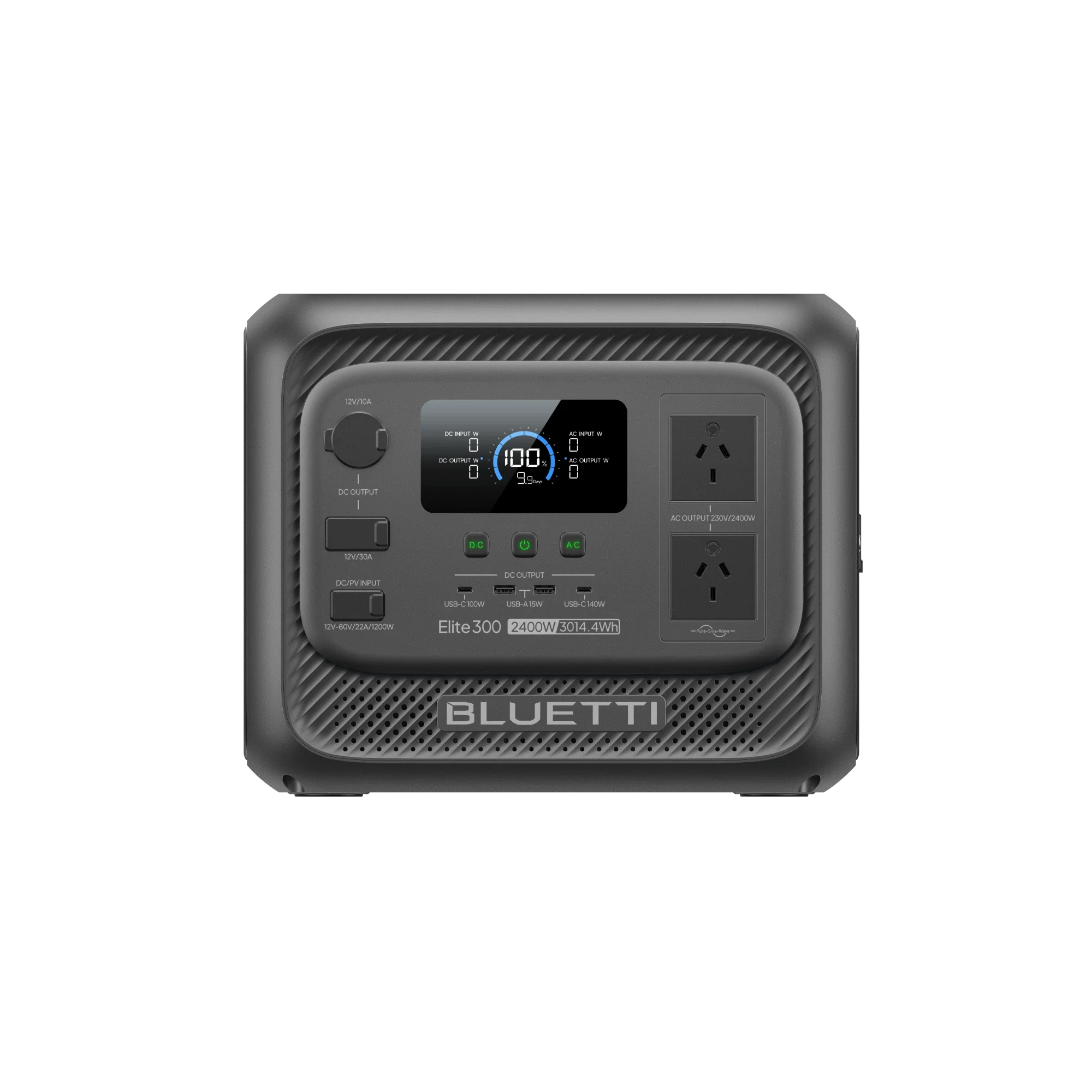
$1,099.00 · direct from BLUETTI
down from $1,199 · 8% below usual
Last checked 1 day ago. Prices move — check before you buy.
Spec deltas
Both carry the BLUETTI name, but they're built for different buyers. The AC500 + 2×B300K (5,530Wh, 5,000W) and the Elite 300 (3,014Wh, 2,400W) come from different product lines with different engineering priorities and a $2,749 price gap. The AC500 + 2×B300K has a slight edge, but the margin is close enough that your use case should break the tie.
What the spec gap means in practice: the AC500 + 2×B300K's 5,000W inverter has the headroom for a window AC, a full-size fridge, and power tools. The Elite 300's 2,400W inverter still runs most single appliances; the AC500 + 2×B300K's real edge is surge headroom for the biggest motor starts and stacking several heavy loads at once. On stamina, the AC500 + 2×B300K keeps a fridge alive for roughly 31 hours vs the Elite 300's 17 hours. The cost? Portability. At 196.1 lbs, the AC500 + 2×B300K is spread across boxes you site once and leave. The Elite 300 at 58 lbs is more manageable, though still not light.
Pick the AC500 + 2×B300K if your primary use is 8-hour blackout or remote workday. Go with the Elite 300 if you primarily need it for weekend camping or tailgate party. Most buyers stop at the sticker price and miss this: over a full lifespan the Elite 300 works out to about $0.07/kWh against the AC500 + 2×B300K's $0.2, a gap that compounds in the Elite 300's favor the more you cycle it. Keep scrolling for the full breakdown. The scenario verdicts below hold a few surprises.
Bench Notes
What each unit does well, where it falls short, and the trade-offs that matter.
BLUETTI AC500 + 2×B300K
With a massive 5,000W output (and 10,000W surge), the AC500 + 2×B300K can run high-wattage appliances like space heaters, hair dryers, and electric grills without tripping. Weighing in at 196.1 lbs, this is not a unit you want to carry far. It's best suited as a stationary backup or RV companion.
Strengths
- +Larger battery capacity
- +Higher AC output
- +Faster solar charging
Trade-offs
- –Substantially more expensive (+$2,749) than the Elite 300.
- –Significantly heavier (+138.1 lbs), making it harder to move.
- –Very heavy unit that may be difficult for one person to lift.
- –Shorter-lived battery — rated for 3,500 charge cycles vs the Elite 300's 6,000, so it wears out sooner.
BLUETTI Elite 300
With a massive 2,400W output (and 4,800W surge), the Elite 300 can run high-wattage appliances like space heaters, hair dryers, and electric grills without tripping. Weighing in at 58 lbs, this is not a unit you want to carry far. It's best suited as a stationary backup or RV companion. A standout feature is the value proposition: at roughly $0.40 per watt-hour, it's one of the most cost-effective options on the market.
Strengths
- +Costs $2,749 less
- +Lighter by 138.1 lb
- +Longer warranty
- +Rated for 6,000 charge cycles — much longer battery lifespan
Trade-offs
- –Weaker inverter (-2,600W) limits appliance compatibility.
- –Sealed capacity — the AC500 + 2×B300K can add batteries to grow past 3,014.4Wh; this one can't.
Will It Power Your Gear?
Scenario math and per-appliance runtimes, modeled from the spec record.
Scenario verdicts
We ran the math on six real-world scenarios. Here's which unit survives your actual life.
SCN-01 · 2 nights · needs 2,100Wh
Weekend Camping
Two nights off-grid with essential comfort
Elite 300
The AC500 + 2×B300K at 196.1 lbs is not a take-along — it rolls off a truck bed if it travels at all, so this scenario belongs to the Elite 300 by default — and it earns it, covering the 2,100Wh with 462Wh to spare. Capacity was never the AC500 + 2×B300K's problem here; getting to a campsite was.
Battery budget usedlower = more headroom
LOAD Phone Charger 15W×6h · LED Lights 40W×8h · Box Fan 75W×14h · CPAP Machine 40W×16h
SCN-02 · 8 hours · needs 1,645Wh
8-Hour Blackout
Keep the essentials running through a night without power
AC500 + 2×B300K
Both survive the night. The AC500 + 2×B300K finishes at 35% used with 3,056Wh left — 1.9 more nights like it. The Elite 300 finishes at 64% with 917Wh, 56% of a second night. If your outages tend to run past one evening, that difference is the whole argument between them.
Battery budget usedlower = more headroom
LOAD Fridge 150W×8h · Router + Modem 20W×8h · LED Lights (4 bulbs) 40W×6h · Phone Charger 15W×3h
SCN-03 · 8 hours · needs 320Wh
CPAP Overnight
Sleep therapy without interruption — the #1 medical use case
Either unit
A CPAP is about 40W for eight hours, so both cover the night with room to spare and capacity decides nothing. Fan noise would — but neither maker publishes a fan-noise figure, so there's nothing to hold either of them to. Buy on price, weight, and whether you can live with a fan you haven't heard.
Battery budget usedlower = more headroom
LOAD CPAP Machine 40W×8h
SCN-04 · 8 hours · needs 910Wh
Remote Workday
Full work day off-grid without power anxiety
AC500 + 2×B300K
The AC500 + 2×B300K clears the workday at 19% used, banking 3,791Wh — late work, extra calls, or a second laptop charge without arithmetic. The Elite 300 at 36% also finishes, with 1,652Wh of slack for the unplanned.
Battery budget usedlower = more headroom
LOAD Laptop 60W×8h · External Monitor 30W×8h · Router + Modem 20W×8h · Phone Charger 15W×2h
SCN-05 · 4 hours · needs 670Wh
Tailgate Party
Game day power for the crew
Elite 300
The AC500 + 2×B300K at 196.1 lbs is not a take-along — it rolls off a truck bed if it travels at all, so this scenario belongs to the Elite 300 by default — and it earns it, covering the 670Wh with 1,892Wh to spare. Capacity was never the AC500 + 2×B300K's problem here; getting to a tailgate was.
Battery budget usedlower = more headroom
LOAD Blender 400W×0.5h · LED TV (55") 80W×4h · Bluetooth Speaker 15W×4h · Phone Charger (×3) 45W×2h
SCN-06 · 24 hours · needs 4,685Wh
Van Life Daily
A full day of mobile living — the ultimate endurance test
AC500 + 2×B300K
The Elite 300 doesn't finish — 2,562Wh usable against the 4,685Wh this needs leaves it 2,123Wh short, about 55% of the scenario covered. The AC500 + 2×B300K covers it with only 16Wh left — well under half a percent of what the day asks, so it finishes with nothing behind it.
Battery budget usedlower = more headroom
LOAD Mini-Fridge 150W×24h · Laptop 60W×4h · Phone Charger 15W×3h · LED Lights 40W×5h · Fan 75W×8h
The Load Test
RUNTIME = (Wh × 0.85) ÷ LOAD
None of the scenarios above exactly yours? Build it. Toggle what you'd plug in; both units are tested against the combined draw.
Essentials
Comfort & Convenience
High-Draw Appliances
Test duration
8h
Continuous draw
205W
Projected runtime
For this load: AC500 + 2×B300K runs 22.9h vs 12.5h.
$3,948 list · direct from BLUETTI
Modeled from the spec record — same math as the tables below. Methodology
Runtime by appliance
Real-world runtime estimates for common appliances, modeled at 85% inverter efficiency.¹
Essentials
The basics you need runningscale 0–313.4hComfort & Convenience
Makes off-grid life actually enjoyablescale 0–62.7hHigh-Draw Appliances
These reveal the real limitsscale 0–4.7h¹ Runtime = (capacity × 0.85) ÷ appliance watts. Within each group, all bars share one time scale (the group's longest runtime), so lengths are comparable across appliances; identical runtimes collapse into a single blue/orange bar. Actual runtime varies with battery age, temperature, and simultaneous loads — see methodology.
Conclusion
July 10, 2026
Verdict: the AC500 + 2×B300K, on Power Score margin
These two units are closely matched on individual specs, but our Power Score analysis gives the AC500 + 2×B300K the edge with a composite score of 5,982 vs 4,644.
Today the AC500 + 2×B300K is $3,299, $649 under its typical $3,948 and the Elite 300 is $1,099, $100 under its typical $1,199. The verdict weighs typical prices, not today's. Prices checked 1 day ago.
Overall score margin: 5,982 vs 4,644 (+28.8%)
List prices as of July 10, 2026. The links below open BLUETTI's current price.
$3,299.00 · direct from BLUETTI
down from $3,948 · 16% below usual
Last checked 1 day ago. Prices move — check before you buy.
or check the Elite 300 price$1,099.00 list
Written by Gunner Gustafson, Whole-Home Backup Tester · Station Arena Test Desk · Updated July 10, 2026
Measured Data
Benchmark scores and the full spec record, side by side.
Benchmark scores
Not rated for both units (minimum threshold unmet): UPS, RV Living, Solar Generator, Tailgating, Apartment Balcony.
Full specifications
ᵈ Derived: price ÷ rated capacity. See the data behind our comparisons →
Comparison ToolAdd more power stations, side by sideOpen Tool →How these numbers are produced
Numeric verification
Every figure on this page traces to our spec database or arithmetic on it — no estimated numbers.
Owner claims
Statements about owner experience are cited to published reviews.
Runtime model
Runtime = (rated capacity × 0.85 inverter efficiency) ÷ device wattage. Solar recharge estimates assume panels deliver 70% of rated output. Cold weather, battery age, and stacked loads reduce real-world results.
Power Score
Computed from 14 published spec dimensions, weighted per use-case bench. Higher is better; a unit must meet a bench's minimum threshold to be rated.
See the full weight table and data sourcing on our methodology page →Class ranking (the star rating)
Each unit's star score is a category ranking, not customer reviews — no buyer opinions feed it. We score every station on size-independent quality (value, output, portability, endurance, ports, warranty, and more), then percentile-rank it against the other units in its capacity class, so a class-leading compact unit and a class-leading whole-home unit can both earn 5★. Here, AC500 + 2×B300K rates 4.2/5 (53rd percentile of 16 Home Backup-class units), and Elite 300 rates 4.6/5 (76th percentile of 26 Large-class units).
How the class ranking is computed →Test Notes & Caveats
Hidden gotchas and advantages we spotted that you won't find on the product page.
AC500 + 2×B300K: 196.1 lbs Is a Commitment
At 196.1 lbs across its boxes, no one piece is the whole problem — but this is hardware you site, not hardware you carry. Once it's set up, you won't want to move it. It's a semi-permanent appliance. Pick your spot.
Elite 300: Fixed Capacity
The Elite 300 is sealed at 3,014Wh — fine if that covers you, but it's the ceiling. By contrast the AC500 + 2×B300K can add expansion batteries, though the first thing it has over the Elite 300 is its own 5,530Wh base — expansion is the step after that, for the buyer who would outgrow 5,530Wh as well.
UPS Switchover: ≤10ms vs ≤20ms
Both list a UPS mode, at different rated speeds. The Elite 300 is rated ≤10ms — quick enough on paper that desktop PCs and routers should ride through, treating that as the rating it is. The AC500 + 2×B300K is rated ≤20ms — fine on paper for routers and most electronics; the fussiest PC power supplies sit right at this line. If a computer with unsaved work is the thing being protected, the stated class is worth the attention; nothing here is a lab result.
Warranty: 5 Years vs 4
The Elite 300 is covered for 5 years against the AC500 + 2×B300K's 4 years. The Elite 300's figure is a maximum rather than a guarantee — it depends on buying direct from BLUETTI or registering the unit, since reseller purchases carry a shorter term. An underrated factor if you're keeping this unit for years.
Battery Lifespan in Real Years
The Elite 300 is rated for 6,000 cycles vs 3,500. In real life: at daily use, that's 16.4 vs 9.6 years. At weekend use (twice a week), it's 58 vs 34 years. One caution reading years across different sizes: a cycle is 3,014Wh on the Elite 300 and 5,530Wh on the AC500 + 2×B300K, so count lifetime energy — roughly 18,086 kWh against 19,355 kWh over the rated life. After hitting the cycle limit, the battery doesn't die — it drops to ~80% of original capacity, which is still very usable.
Full record above — the Test Desk pick is the AC500 + 2×B300K.
Check AC500 + 2×B300K price →or check the Elite 300 priceOwnership Analysis
What happens after you buy — true cost of ownership, brand trust, and growth potential.
Lifetime value
Service lifeyears at one full cycle per day
Lifetime energy delivered
Cost per delivered kWh
│ warranty ends · Reaching the cycle rating means ~80% capacity remains — degraded, not dead.
Analyst note
The Elite 300 wins on both sticker price and long-term value. At $0.07/kWh over its lifetime, it's meaningfully cheaper to own. Clear value winner. One caution on the lifespan row: the Elite 300 takes longer to reach its cycle rating, but a cycle moves a different amount of energy on each unit — the AC500 + 2×B300K still delivers more over its shorter horizon (19,355 vs 18,086 kWh). Years measure wear, not usefulness.
Growth path
AC500 + 2×B300K
EXPANDABLESupports BLUETTI expansion batteries, so you can add capacity later without replacing the base unit — useful if your needs may climb past 5,530Wh.
Accepts up to 3,000W of solar. Enough for a serious multi-panel array.
Limited ports. You'll likely need a power strip or splitter.
Expansion batteries are BLUETTI-specific. You're investing in the BLUETTI ecosystem.
Elite 300
FIXED CAPACITYFixed at 3,014Wh — a sealed, complete system rather than a starting point. There's no expansion port, so that figure is the ceiling: check it against your longest unplugged stretch before you buy.
Accepts up to 1,200W of solar. Enough for a serious multi-panel array.
Adequate ports for most setups, but heavy users may want a power strip.
Realistic full solar rechargeat 70% of rated panel output — see methodology
Analyst note
The Elite 300 is sealed at 3,014Wh, which is fine if that covers you. The AC500 + 2×B300K starts at 5,530Wh and can grow beyond it with BLUETTI expansion batteries — real headroom the Elite 300 doesn't have if your needs climb toward partial-home backup.
The Bottom Line
The full picture comes down to this. The AC500 + 2×B300K edges ahead on our overall analysis, but the margin is narrow enough that your specific use case should drive the decision. Review the scenario verdicts above — if the Elite 300 wins in the scenarios that match your life, it's the right choice regardless of aggregate scores.
If neither the AC500 + 2×B300K nor the Elite 300 feels like the right fit, your power needs probably sit outside what these two target. For lighter use — weekend camping or phone/laptop charging — you'd be overpaying for capacity you'll rarely tap. Consider a unit in the 500–1,500Wh range instead. Prices on portable power stations fluctuate frequently. Both BLUETTI discount regularly, so check the current price before committing. Prime Day and Black Friday pricing typically drops 20-30%.
Frequently Asked Questions
Answers drawn from the spec record and cited owner research.
Is the AC500 + 2×B300K worth $2,749 more than the Elite 300?
The short answer: yes, if you'll actually use the extra capability. The AC500 + 2×B300K costs $2,749 more, but that premium buys you 2,515.6Wh more battery capacity (that's 14 extra hours of running a mini-fridge); 2,600W higher AC output (opening the door to more demanding appliances); 1,800W faster solar charging for quicker off-grid recovery. On a cost-per-watt-hour basis, you're paying $0.71/Wh vs $0.40/Wh. For regular use, we'd pay the premium.
How does the 2,515.6Wh capacity difference actually affect daily use?
The AC500 + 2×B300K's 5,530Wh battery keeps a mini-fridge running for roughly 31 hours vs the Elite 300's 17 hours. Both can handle a full 8-hour blackout setup (fridge + router + lights + phone charging ≈ 1,645Wh), but the AC500 + 2×B300K finishes with significantly more margin. That matters if conditions aren't ideal or the outage runs long. What specs don't mention: runtime drops 20-30% in cold weather (below 32°F/0°C) as battery chemistry slows down. The AC500 + 2×B300K's extra capacity provides a critical cold-weather buffer. For occasional phone and laptop charging, both are overkill. This gap only matters for sustained, multi-appliance use.
Can I actually carry the AC500 + 2×B300K, or is the Elite 300 the only portable option?
Neither is "portable" in any hiking sense. The Elite 300 (58 lbs) and the AC500 + 2×B300K (196.1 lbs) are both appliances you place and leave. The 138.1-lb difference matters when loading into a vehicle or moving between rooms, but that's about it. If true portability is your priority, look at units under 20 lbs in a different class entirely.
How fast can each unit recharge from solar panels in real conditions?
On paper, the AC500 + 2×B300K accepts 3,000W vs the Elite 300's 1,200W of solar input. What the spec sheet won't tell you: solar panels typically deliver only 60-80% of their rated output due to panel angle, cloud cover, and temperature. In realistic conditions, expect full recharge in about 2.6 hours for the AC500 + 2×B300K and 3.6 hours for the Elite 300. That gap widens on cloudy days, when the AC500 + 2×B300K's higher input ceiling captures more of whatever sunlight is available. One more thing: summer gives you ~7 productive solar hours per day. Winter drops to ~4. If solar is your primary recharge method, the AC500 + 2×B300K's advantage is substantial.
"6,000 vs 3,500 cycles" — what does that actually mean for me?
In real years: the Elite 300 (6,000 cycles) lasts 16.4 years at daily use, 58 years at weekend use (twice a week), or 250 years at twice-monthly camping trips. The AC500 + 2×B300K (3,500 cycles): 9.6 years daily, 34 years weekends, or 146 years twice-monthly. What most people miss: hitting the cycle limit doesn't kill your battery. Capacity drops to about 80%. Your 3,014.4Wh unit becomes a ~2,412Wh unit. Still very usable. For weekend users, both batteries will outlast the warranty by years.
What if I need more capacity than the Elite 300's 3,014.4Wh later?
The Elite 300 is sealed at 3,014.4Wh, so if you expect your needs to climb, the AC500 + 2×B300K is the more future-proof pick: it starts at 5,530Wh and adds BLUETTI-compatible batteries without replacing the base unit. That said, "not expandable" isn't a flaw on its own — if 3,014.4Wh comfortably covers your loads, the Elite 300 is a complete unit, not a downgrade.
Bottom line: should I buy the AC500 + 2×B300K or the Elite 300?
We'd pay the premium for the AC500 + 2×B300K. Yes, it costs more. The capability jump is real: you're stepping into a tier that handles appliances the base model can't start. The Elite 300 is still solid if budget is the priority, but the AC500 + 2×B300K will leave you less likely to wish you'd "gone bigger" six months from now. That regret costs more than the price difference.
Where to buy
BLUETTI AC500 + 2×B300KPick
$3,299.00
$3,299.00 · direct from BLUETTI
down from $3,948 · 16% below usual
Last checked 1 day ago. Prices move — check before you buy.
BLUETTI Elite 300
$1,099.00
$1,099.00 · direct from BLUETTI
down from $1,199 · 8% below usual
Last checked 1 day ago. Prices move — check before you buy.
Prices may vary by retailer and are subject to change.