Head-to-head test
Anker SOLIX F3800 vs BLUETTI Pioneer 150 AC240
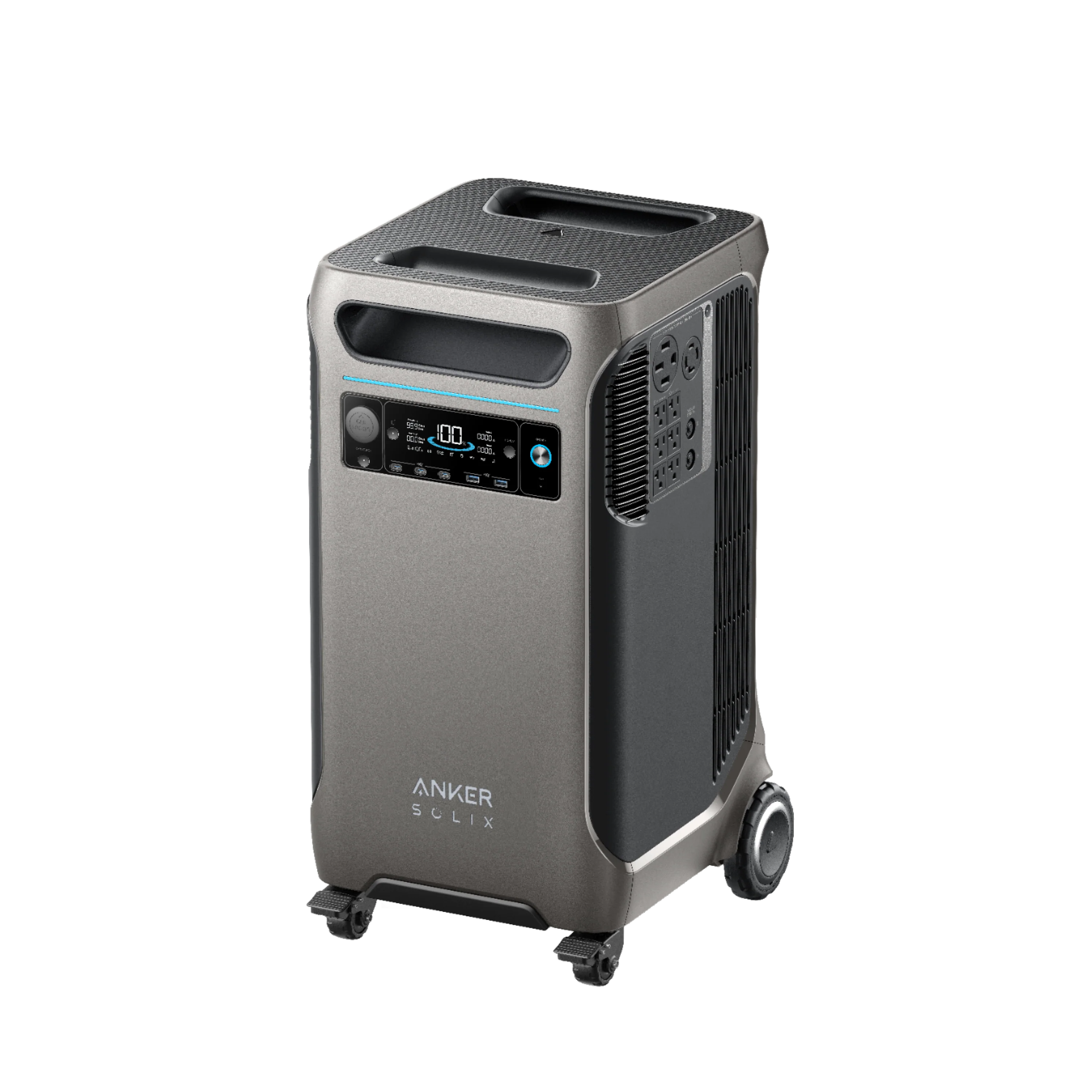
You're not choosing between 3,840Wh and 1,536Wh here, you're choosing whether the box ever moves again, because at 132.3 lbs the Anker goes where you put it and stays.
Full profiles: Anker SOLIX F3800 → · BLUETTI Pioneer 150 AC240 →

Written by Gunner GustafsonUpdated
Whole-Home Backup Tester, Station Arena Test Desk
$1,999.99 · direct from Anker
Last checked 7 hours ago. Prices move — check before you buy.

$999.00 · direct from BLUETTI
Last checked 7 hours ago. Prices move — check before you buy.
Spec deltas
The F3800 carries 6,000W of inverter and a 9,000W surge ceiling, and the heaviest startup draw anywhere on this page's scenario list is 400W. That gap tells you what the unit is. Those are breaker-panel numbers, not campsite numbers, and at 132.3 lbs the case agrees with them: it goes where you put it and stays there.
The Pioneer 150 AC240 takes the other side of that bet. It's 1,536Wh and 2,400W in a 72 lb IP65 box, $999 against the Anker's $2,000, and it will actually come with you. Twice the money buys two and a half times the battery (3,840Wh against 1,536Wh) and two and a half times the output (6,000W against 2,400W), so the Anker is the better buy per watt-hour. It's not the better buy per trip, because it doesn't take any.
And the figure that usually settles these pages abstains: $0.17 per lifetime kWh for the Anker against $0.19 for the BLUETTI. Two cents apart is a wash, so cost of ownership has no opinion and the decision falls entirely to what each box can do. For the eight-hour outage most people are cross-shopping this pair over, the Pioneer doesn't finish.
What the Numbers Reveal
Each conclusion stated first — the numbers behind it on one line, the full analysis below.
continuous output
Six thousand watts isn't a portable-power spec at all. It exists to pick up house circuits through a transfer switch, and that's the same reason nobody designed the case to be lifted. The Anker's headline numbers and its immobility are one design decision, not a trade you can negotiate down.
SOLIX F3800: 6,000W continuous output, 9,000W surge ceilingPioneer 150 AC240: 2,400W continuous output, 3,600W surge ceilingthe largest startup draw in the six scenarios on this page is the Tailgate Party's 400W, and both units start every one of themSOLIX F3800 weighs 132.3 lbs; Pioneer 150 AC240 weighs 72 lbs
Why it mattersIf you're not wiring it into a panel, you're paying for output you'll never call on and weight you can't put down.
cost / lifetime kWh
Cost of ownership recuses itself. Energy comes out of either box at the same price to within rounding, so every dollar of the gap between them is buying capability, not efficiency, and any argument that starts with long-run savings is an argument about nothing.
SOLIX F3800: $2,000, 3,840Wh, rated for a minimum 3,000 cyclesPioneer 150 AC240: $999, 1,536Wh, rated for a minimum 3,500 cycleslifetime energy works out to 11,520kWh for the Anker against 5,376kWh for the BLUETTI$0.17 per lifetime kWh against $0.19
Why it mattersDon't buy the Anker to save money later; buy it because you need 3,264Wh usable standing in one spot. And don't buy the Pioneer because it's the cheap energy, because it isn't.
A two-day outage is a different product test than an eight-hour one. The F3800 has the tank for the first night, but with no passthroughA4 recharging is something you do instead of running the house rather than alongside it, which turns day two into a scheduling problem.
the 8-Hour Blackout scenario needs 1,645Wh; the Anker covers it with 1,619Wh spare while the Pioneer finishes 339Wh shortowners report there's no passthrough, so the F3800 can't charge from the 120V input while it's dischargingA4one owner found the line cord got very hot charging at the full 1,800W wall rate and throttled it down to 600-800WA3owners consistently report the solar input's limitations make non-Anker arrays difficult, pushing you toward Anker's pricier panelsA1A2A13A14
Why it mattersIf your outages run long, price the Anker panels into the purchase now, because the 2,400W solar ceiling is the best reason to own this unit and the reason it costs more than the sticker.
Buying the F3800 for a bedside is buying a fan you can't look up. The Pioneer's 50dB isn't a measurement either, and like most published noise figures it reads as a best case rather than the sound of the unit working, but it's a number BLUETTI has to stand behind and it's the only one on the table.
a CPAP is about 40W for eight hours, or 320Wh, which is a tenth of the Anker's usable energy and a quarter of the BLUETTI'sBLUETTI publishes 50dB for the Pioneer 150; Anker publishes no noise figure for the F3800the noise figures circulating for the F3800 come from review pages our own research flags as marketing-style content rather than owner testimonyA0A11owners describe the F3800's fans cycling in and out rather than running steadily, and about a second of buzzing as the inverter ramps up under a heavy loadA6A12
Why it mattersIf the unit sleeps in your bedroom, take the Pioneer, or hear an F3800 running before you commit to one.
The specific dimensions that decide these two units — everything else is a tie.
Portability & Form Factor
Selected because: The Anker is 132.3 lbs and stays where you set it; the Pioneer is 72 lbs and can be somewhere else next weekend. That one difference decides more of this matchup than capacity does.
weight
Seventy-two pounds is not light. It's a bent-knees, both-hands lift, heavier than any suitcase an airline will take, but one adult can get it into a truck bed, and that is the entire difference between these two products. The Anker is a two-person carry, done once, to the spot where it will live for years.
So portability isn't a score on this page, it's a gate. If the answer to where this lives is one place, the Anker's weight costs you nothing after the day it arrives. If the answer is wherever you happen to be, the Anker isn't a candidate and its 3,840Wh never gets a vote.
Your Life, Your Pick
Selected because: Six loads, and the only one the Pioneer loses outright is the eight-hour blackout, where it finishes 339Wh short of the 1,645Wh needed.
The blackout row is the one that matters, because it's why most people land on a pair like this. The Pioneer gets about 79% of the way through and quits: 1,306Wh usable against the 1,645Wh the night takes. A backup unit that stops at 3 a.m. hasn't done the job. The Anker finishes with 1,619Wh still in the pack, which is the next morning instead of a scramble.
Everything else is a tie or a forfeit. Both run a CPAP or a workday without strain. The tailgate goes to the Pioneer by walkover, since the Anker can't attend. And the van-life row goes to nobody: 4,685Wh a day is past the Anker's 3,264Wh usable, never mind the Pioneer's 1,306Wh.
Lifetime Value
Selected because: $0.17 per lifetime kWh against $0.19, close enough that cost of ownership can't break the tie, which is worth knowing before you read any further.
cost / lifetime kWh
The BLUETTI's pack is rated for more cycles than the Anker's, 3,500 against 3,000, both stated as minimums, and that's the quiet reason the cost-per-kWh columns come out nearly level. Two and a half times the battery spread over fewer rated cycles works out to a bit more than twice the lifetime energy for twice the price.
Treat the money as settled and stop looking at it. The Anker is not the thrifty long-term play and the Pioneer is not the cheap-energy play. They sell the same energy at different scales, and scale is the thing you're actually buying.
Growth Path
Selected because: Both take expansion batteries, and the Anker's 2,400W solar ceiling doubles the Pioneer's 1,200W, though which panels can actually feed it is the catch.
solar input
Both units accept expansion batteries, so neither one walls you in, and the Anker's 2,400W solar ceiling against the Pioneer's 1,200W is the real growth story: more panels feeding a bigger bank as the bank grows. On paper it's the better off-grid path by a wide margin.
The catch is which panels can actually feed it. Owners consistently describe the F3800's solar input as restrictive enough that generic arrays are hard to use, which pushes you toward Anker's own pricier panelsA1A2A13A14, and one owner said flatly he'd only charge by solar if there were no other wayA1. The 2,400W ceiling is real. Reaching it is a line item, not a default.
Brand Trust
Selected because: Two support organizations with real complaint patterns, and one of these units is a freight problem if it ever has to go back.
Neither brand's service record is a reason to buy. Anker built its name on no-hassle replacements and SOLIX service has drifted from that standard, with AI-driven agents returning generic answers and hazmat shipping in the way of returning a heavy unit. BLUETTI runs the most inconsistent support in the category, largely email on China time, with noticeably better outcomes for people who ordered direct.
The asymmetry worth pricing in is physical. The Pioneer goes back in a carton. The Anker goes back as freight, and that's the part of a warranty claim nobody reads about until they're living it. Buy either one direct and register it. The paperwork is cheaper than the shipping.
Strengths & trade-offs
Anker SOLIX F3800
Strengths
- +Larger battery capacity
- +Higher AC output
- +Faster solar charging
Trade-offs
- –Substantially more expensive (+$1,001) than the Pioneer 150 AC240.
- –Significantly heavier (+60.3 lbs), making it harder to move.
- –Very heavy unit that may be difficult for one person to lift.
BLUETTI Pioneer 150 AC240
Strengths
- +Costs $1,001 less
- +Lighter by 60.3 lb
- +Longer warranty
Trade-offs
- –Weaker inverter (-3,600W) limits appliance compatibility.
Will It Power Your Gear?
Scenario math and per-appliance runtimes, modeled from the spec record.
Scenario verdicts
We ran the math on six real-world scenarios. Here's which unit survives your actual life.
SCN-01 · 2 nights · needs 2,100Wh
Weekend Camping
Two nights off-grid with essential comfort
Neither unit
Nobody wins a weekend here. The Pioneer is 794Wh short of the 2,100Wh a full one takes, and the F3800 has the energy but no way to arrive, since 132.3 lbs doesn't go camping. One can't finish; the other can't come.
Battery budget usedlower = more headroom
LOAD Phone Charger 15W×6h · LED Lights 40W×8h · Box Fan 75W×14h · CPAP Machine 40W×16h
SCN-02 · 8 hours · needs 1,645Wh
8-Hour Blackout
Keep the essentials running through a night without power
SOLIX F3800
The Pioneer gets about 79% of the way through and stops: 1,306Wh usable against the 1,645Wh this night takes, 339Wh short. A backup unit that quits at 3 a.m. doesn't get credit for the first seven hours. The F3800 covers it and still holds 1,619Wh, which is tomorrow morning rather than a scramble.
Battery budget usedlower = more headroom
LOAD Fridge 150W×8h · Router + Modem 20W×8h · LED Lights (4 bulbs) 40W×6h · Phone Charger 15W×3h
SCN-03 · 8 hours · needs 320Wh
CPAP Overnight
Sleep therapy without interruption — the #1 medical use case
Either unit
Both units cover a 320Wh night without noticing, so ignore the capacity columns here entirely. The fan decides this scenario, and only the Pioneer publishes a number anyone can be held to, a spec-sheet figure and almost certainly a best case rather than the sound of the unit working. Buying the F3800 for a bedside means buying a fan you haven't heard.
Battery budget usedlower = more headroom
LOAD CPAP Machine 40W×8h
SCN-04 · 8 hours · needs 910Wh
Remote Workday
Full work day off-grid without power anxiety
SOLIX F3800
The SOLIX F3800 clears the workday at 28% used, banking 2,354Wh — late work, extra calls, or a second laptop charge without arithmetic. The Pioneer 150 AC240 at 70% also finishes, with 396Wh of slack for the unplanned.
Battery budget usedlower = more headroom
LOAD Laptop 60W×8h · External Monitor 30W×8h · Router + Modem 20W×8h · Phone Charger 15W×2h
SCN-05 · 4 hours · needs 670Wh
Tailgate Party
Game day power for the crew
Pioneer 150 AC240
The Pioneer takes this one partly on merit and partly by being the only unit that can attend, covering the 670Wh with 636Wh to spare in a case one adult can move. Capacity was never the F3800's problem in a parking lot. Getting to the parking lot was.
Battery budget usedlower = more headroom
LOAD Blender 400W×0.5h · LED TV (55") 80W×4h · Bluetooth Speaker 15W×4h · Phone Charger (×3) 45W×2h
SCN-06 · 24 hours · needs 4,685Wh
Van Life Daily
A full day of mobile living — the ultimate endurance test
Neither unit
Neither unit covers this scenario's 4,685Wh: the SOLIX F3800 comes up 1,421Wh short (about 69% covered), the Pioneer 150 AC240 3,379Wh (28%). Treat this as partial cover — enough for the essentials in it, not the whole list.
Battery budget usedlower = more headroom
LOAD Mini-Fridge 150W×24h · Laptop 60W×4h · Phone Charger 15W×3h · LED Lights 40W×5h · Fan 75W×8h
The Load Test
RUNTIME = (Wh × 0.85) ÷ LOAD
None of the scenarios above exactly yours? Build it. Toggle what you'd plug in; both units are tested against the combined draw.
Essentials
Comfort & Convenience
High-Draw Appliances
Test duration
8h
Continuous draw
205W
Projected runtime
For this load: SOLIX F3800 runs 15.9h vs 6.4h.
$1,999.99 list · direct from Anker
Modeled from the spec record — same math as the tables below. Methodology
Runtime by appliance
Real-world runtime estimates for common appliances, modeled at 85% inverter efficiency.¹
Essentials
The basics you need runningscale 0–217.6hComfort & Convenience
Makes off-grid life actually enjoyablescale 0–43.5hHigh-Draw Appliances
These reveal the real limitsscale 0–3.3h¹ Runtime = (capacity × 0.85) ÷ appliance watts. Within each group, all bars share one time scale (the group's longest runtime), so lengths are comparable across appliances; identical runtimes collapse into a single blue/orange bar. Actual runtime varies with battery age, temperature, and simultaneous loads — see methodology.
Conclusion
September 13, 2026
Verdict: the SOLIX F3800, on Power Score margin
Take the F3800 if this is home backup, which is the only job its specs were drawn for: 3,264Wh usable covers the 8-hour blackout with 1,619Wh still in hand, while the Pioneer stops 339Wh short of finishing the same night. The extra thousand dollars buys two and a half times the battery and two and a half times the inverter, plus a 9,000W surge ceiling that only pays off wired to a panel. It does not buy cheaper energy: over their rated lives the two land within two cents of each other per lifetime kWh, so nothing about the money settles this. The honest catch is refilling. There's no charging from the 120V input while it's dischargingA4, and owners consistently report the solar input limits you in practice to Anker's own pricier panelsA1A2A13A14. If the unit has to travel, stop here and take the Pioneer, because it's the only one of the two that can.
Editor-assigned confidence, based on cited owner research and spec analysis.
List prices as of September 13, 2026. The links below open Anker's and BLUETTI's current prices.
$1,999.99 · direct from Anker
Last checked 7 hours ago. Prices move — check before you buy.
or check the Pioneer 150 AC240 price$999.00 list
Written by Gunner Gustafson, Whole-Home Backup Tester · Station Arena Test Desk · Updated September 13, 2026
Measured Data
Benchmark scores and the full spec record, side by side.
Benchmark scores
Not rated for both units (minimum threshold unmet): UPS, Tailgating.
Full specifications
ᵈ Derived: price ÷ rated capacity. See the data behind our comparisons →
Comparison ToolAdd more power stations, side by sideOpen Tool →How these numbers are produced
Numeric verification
Every figure on this page traces to our spec database or arithmetic on it — no estimated numbers.
Owner claims
Statements about owner experience are cited to published reviews — see Sources & Research Notes below.
Runtime model
Runtime = (rated capacity × 0.85 inverter efficiency) ÷ device wattage. Solar recharge estimates assume panels deliver 70% of rated output. Cold weather, battery age, and stacked loads reduce real-world results.
Power Score
Computed from 14 published spec dimensions, weighted per use-case bench. Higher is better; a unit must meet a bench's minimum threshold to be rated.
See the full weight table and data sourcing on our methodology page →Class ranking (the star rating)
Each unit's star score is a category ranking, not customer reviews — no buyer opinions feed it. We score every station on size-independent quality (value, output, portability, endurance, ports, warranty, and more), then percentile-rank it against the other units in its capacity class, so a class-leading compact unit and a class-leading whole-home unit can both earn 5★. Here, SOLIX F3800 rates 4.7/5 (80th percentile of 16 Home Backup-class units), and Pioneer 150 AC240 rates 4.5/5 (69th percentile of 27 Everyday-class units).
How the class ranking is computed →Test Notes & Caveats
Hidden gotchas and advantages we spotted that you won't find on the product page.
Weight: One Lift, Then Never Again
72 lbs is a real lift, but it's a solo one, and it's the weight that decides whether a unit ever sees a second location. 132.3 lbs is a two-person job you do once, on the day it arrives, to the spot it will occupy for years. Price the heavier figure as an installation cost rather than a daily one, and price the lighter one as the difference between a unit that goes to the tailgate and a unit that doesn't.
Pioneer 150 AC240: 50dB Published
50dB is about as loud as moderate rainfall. It is BLUETTI's own rating rather than a reading on a shared bench — makers differ on whether they quote a best case or a figure under load, so treat it as a starting point rather than what you would hear at a bedside. For most people, fan noise around 45dB and up is where sleep starts to suffer.
UPS: Two Ratings, Neither of Them Measured
Both units list a UPS mode, and both numbers are published ceilings rather than stopwatch results: no worse than 15ms for the Pioneer, 20ms or better for the F3800. A five-millisecond spread between two manufacturers' worst-case claims is not a difference you can feel or verify from a spec sheet. If a desktop with unsaved work is the thing being protected, treat either figure as a rating to confirm on your own hardware, not a guarantee.
Warranty: Read the Condition, Not Just the Number
The listed terms put the Pioneer a year ahead, 6 against 5. Both are maximum standard terms rather than what every buyer automatically gets, and BLUETTI's top tier in particular tends to depend on buying direct and registering the unit, with shorter cover behind a reseller purchase. One year of paper isn't the reason to pick between these two. On a purchase this size, the service organization standing behind the warranty matters more than its length.
Noise: One Number and One Blank
BLUETTI publishes 50dB for the Pioneer and Anker publishes nothing for the F3800, and a blank is not evidence of anything except a blank. What it does mean is that there's no way to compare these two on noise without hearing them, and that the single number on the table is a spec-sheet figure, most likely a best case rather than the unit under load. If this is going in a bedroom, an apartment, or next to a CPAP, that's a reason to go find hands-on reports of the F3800 before committing, not a reason to assume the worst.
Full record above — the Test Desk pick is the SOLIX F3800.
Check SOLIX F3800 price →or check the Pioneer 150 AC240 priceOwnership Analysis
What happens after you buy — true cost of ownership, brand trust, and growth potential.
Lifetime value
Service lifeyears at one full cycle per day
Lifetime energy delivered
Cost per delivered kWh
│ warranty ends · Reaching the cycle rating means ~80% capacity remains — degraded, not dead.
Analyst note
The Pioneer 150 AC240 is cheaper to buy, but the SOLIX F3800 is cheaper to own. At $0.17/kWh over its lifetime vs $0.19/kWh, the SOLIX F3800's higher cycle life and capacity make each dollar go further over the years. One caution on the lifespan row: the Pioneer 150 AC240 takes longer to reach its cycle rating, but a cycle moves a different amount of energy on each unit — the SOLIX F3800 still delivers more over its shorter horizon (11,520 vs 5,376 kWh). Years measure wear, not usefulness.
Brand trust
Anker
Ecosystem
7-8 SOLIX portable power stations across C-series (compact) and F-series (flagship), plus the X1 home energy system
Support
Anker built its name on no-hassle replacements, and SOLIX service has drifted from that standard: AI-driven agents returning generic answers, and hazmat shipping standing between you and a return on the heavy units. The parent brand still counts for something. The service trend behind it points down.
Community
Moderate — active Reddit (r/Anker, r/AnkerSOLIXCommunity) and growing. Benefits from Anker's massive consumer electronics brand awareness.
App experience
Rated 4.5/5 iOS (~1,100 ratings) · 4.3/5 Android
Unique strength
A consumer-electronics track record most of this category can't match, a pack built for long cycle life, and genuinely strong dollars per watt-hour through the mid-size and larger models. The F3800 sits at the top of that portable line, just below the X1 home energy system.
Worth knowing
Firmware updates have removed features without warning, and the expansion ecosystem is smaller than EcoFlow's. Buy direct and register it.
BLUETTI
Ecosystem
One of the broadest lineups — 15-20+ models from budget (AC2A) to flagship portable (Apex 300, 2764.8Wh). Includes specialized products: vehicle solar hubs, sodium-ion cold-weather units, and balcony storage systems.
Support
The most inconsistent support in the space, mostly email with China-timezone delays. Outcomes swing from smooth and quick to weeks of runaround, or an offer of a discount on a new unit in place of a repair. Ordering direct from BLUETTI tends to produce the better result.
Community
Active and growing — Reddit r/bluetti has a dedicated community. Second-largest after EcoFlow in engagement.
App experience
Rated 4.5/5 iOS and Android — tied for best app experience in the category. V3.0 UI redesign was well-received.
Unique strength
Among the best capacity per dollar available, across an unusually wide lineup that runs from budget units to sodium-ion cold-weather models and vehicle solar hubs, with an app rated at the top of the category.
Worth knowing
Rated cycle life varies widely by model across this lineup, so check the specific unit rather than trusting the badge, and older discontinued models can become unrepairable for want of spare parts.
Analyst note
Neither support organization is a reason to pick a side. Both have documented complaint patterns and both reward buying direct rather than through a reseller. The difference is what a failure costs to resolve: the unit one person can lift goes back in a carton, and the other goes back as freight, which is the kind of detail that only becomes interesting once something has broken.
Growth path
SOLIX F3800
EXPANDABLESupports Anker expansion batteries, so you can add capacity later without replacing the base unit — useful if your needs may climb past 3,840Wh.
Accepts up to 2,400W of solar. Enough for a serious multi-panel array.
Generous port selection supports complex multi-device setups.
Expansion batteries are Anker-specific. You're investing in the Anker ecosystem.
Pioneer 150 AC240
EXPANDABLESupports BLUETTI expansion batteries, so you can add capacity later without replacing the base unit — useful if your needs may climb past 1,536Wh.
Accepts up to 1,200W of solar. Enough for a serious multi-panel array.
Adequate ports for most setups, but heavy users may want a power strip.
Expansion batteries are BLUETTI-specific. You're investing in the BLUETTI ecosystem.
Realistic full solar rechargeat 70% of rated panel output — see methodology
Analyst note
Both expand, but the SOLIX F3800's higher solar ceiling (2,400W vs 1,200W) gives it the stronger off-grid growth path — more panels can feed a bigger bank as it grows.
What Owners Report
Patterns from published owner reports and long-term reviews — every claim cited to its source below.
Anker SOLIX F3800
The F3800's field record is thinner than its price suggests, and most of it traces to one DIY Solar Forum thread from mid-2024 plus a support thread in mid-2025; several of the review pages carrying F3800 impressions read as marketing content rather than owner testimony, and there's no CPAP report and nothing past six months of ownership in what we could findA0. What exists agrees on one thing: the solar input is the sore spot. Owners describe input limitations that make anything but Anker's own panels difficult, and those panels are pricey for a maxed-out configA2A13A14. One owner put it as plainly as it can be put, saying he uses solar only when there's no other way to charge itA1.
The rest is mixed but useful. One owner ran everything he threw at it, water pump included, through a Reliance transfer switch fed by a single 120V outletA5. Another found the line cord very hot at the full 1,800W wall-charge rate and backed off to 600-800WA3, and there's no charging from the AC input while the unit is dischargingA4. A couple of owners report about a second of buzzing or rattling as the inverter ramps up under a heavy load, which Anker attributed to a vibrating ferrite bead and which went away for one owner after he moved the batteries aroundA6A7, plus fans that cycle in and out rather than holding steadyA12. Support reads polarized: fast, responsive, advance replacements for one ownerA9; silence after a very large order for another, on a thread we can't confirm is even about this modelA8.
“I have been using the F3800 for a couple weeks now, using only a single 120V outlet into a reliance transfer switch and it runs everything I throw at it including a water pump.”
Sources
diysolarforum.com · thesolarlab.com
BLUETTI Pioneer 150 AC240
Field material on the Pioneer 150 is thin and almost all about the case. It's the standard 1,536Wh AC240 on the same IP65 platform as the higher-capacity AC240P, and the weatherproofing reviews wellB0B3. Water beaded off the case in a rainstorm with a bone-dry interior afterward, and one unit took constant saltwater spray on a sailboat with no moisture intrusion after a wipe-downB2. The caveat is the one people skip: IP65 holds with the port covers closed, so running it in the rain with cables plugged in is how water finds the output portsB1.
Past the case, there's little long-term owner testimony to lean on yetB0. What's there points to fast charging and a large expansion ceiling, at the premium end of BLUETTI's range but frequently discountedB4. Read that as a reviewer's picture rather than an owner'sB0B4.
“IP65 water- and dust-resistant, not truly waterproof — protection applies with the port covers closed, and it should not be used in the rain with cables plugged in, as water ingress to the output ports risks damage or short circuits.”
Sources
backuppowerhub.com · bluettipower.com · makeuseof.com · storagereview.com · amazon.com · batteryessence.com
Sources & Research Notes
Every owner claim in this report is traceable to a published source. The bracketed references above resolve here.
Recurring owner themes
- Owners consistently complain that the solar/DC input is restrictive, effectively locking users into pricier Anker-branded panels rather than generic arrays. [SOLIX F3800 · 4 entries]
- Fan/inverter noise is generally reported as quiet at idle but with occasional intermittent buzzing/rattling under load or fault conditions. [SOLIX F3800 · 3 entries]
- Anker support experiences are polarized — some owners report fast, responsive replacements while at least one reports being ignored after a major purchase. [SOLIX F3800 · 3 entries]
- Same IP65 ruggedness and expandability as the AC240P at a lower price and capacity; water-resistant not waterproof is the key caveat. [Pioneer 150 AC240 · 3 entries]
- A1
“The solar input for charging is a pain, so much so that I'm only using it if there is no other way to charge the F3800.”
diysolarforum.com — 'Anker F3800 user reviews and opinions welcome' · 2024-07 · [negative]
- A2
“The limitations of the inputs make it very difficult to use solar panels other than Anker's panels, which are pricey for a "full up" config.”
diysolarforum.com — 'Anker F3800 user reviews and opinions welcome' · 2024-07 · [negative]
- A3
“if you charge the F3800 from a 120VAC wall outlet at full rate (1800 watts), the line cord gets very hot. I've backed off the charge rate to 600-800 watts.”
diysolarforum.com — 'Anker F3800 user reviews and opinions welcome' · 2024-07 · [negative]
- A4
“the lack of passthru mode, you cannot charge via the 120VAC input while discharging.”
diysolarforum.com — 'Anker F3800 user reviews and opinions welcome' · 2024-07 · [negative]
- A5
“I have been using the F3800 for a couple weeks now, using only a single 120V outlet into a reliance transfer switch and it runs everything I throw at it including a water pump.”
diysolarforum.com — 'Anker F3800 user reviews and opinions welcome' · 2024-07 · [positive]
- A6
“I have 4 BP3800s and one of them made similar buzzing/rattling noise when a heavy AC load was starting up... only for around a second while inverter was ramping up.”
diysolarforum.com — 'Big issue with Anker Solix F3800 plus battery pack' · 2025-08 · [mixed]
- A7
“Anker support told me it was a ferrite bead vibrating inside the unit... This reduced the noise, initially. At some point, I moved the batteries around and now the noise is gone.”
diysolarforum.com — 'Big issue with Anker Solix F3800 plus battery pack' · 2025-08 · [mixed]
- A8
“Anker support is ghosting me after I spent over 20k on their solix line and solar panels within a month... they are not answering/returning my calls or emails.”
diysolarforum.com — 'Big issue with Anker Solix F3800 plus battery pack' · 2025-08 · [negative]
- A9
“I've called them and submitted tickets via their portal, always very responsive. They've even done advanced replacement for me.”
diysolarforum.com — 'Big issue with Anker Solix F3800 plus battery pack' · 2025-08 · [positive]
- A11
“producing between 50 and 60 decibels when engaged, making it almost inaudible during regular use... until you try to lift it, that is.”
thesolarlab.com — 'Anker SOLIX F3800 Review: Did It Kill the Competition?' · unknown · [positive]
- A12
“Sometimes the fans are completely silent, then they kick in and out intermittently.”
thesolarlab.com — 'Anker SOLIX F3800 Review: Did It Kill the Competition?' · unknown · [mixed]
- A13
“no one on Youtube is addressing the solar input problem directly. But People smarter than myself with secondary charge controllers... are able to navigate around the problem.”
diysolarforum.com — 'Anker F3800 user reviews and opinions welcome' · 2024-07 · [negative]
- A14
“other than the solar input problem having limited panel array choices to max out it's input capability it's a great unit so far.”
diysolarforum.com — 'Anker F3800 user reviews and opinions welcome' · 2024-07 · [mixed]
- B1
“IP65 water- and dust-resistant, not truly waterproof — protection applies with the port covers closed, and it should not be used in the rain with cables plugged in, as water ingress to the output ports risks damage or short circuits.”
backuppowerhub.com / bluettipower.com — AC240 review · 2026 · [mixed]
- B2
“Real-world testing was positive — water beaded off the case in a rainstorm and the interior was bone dry afterward; the unit survived constant saltwater spray on a sailboat with no moisture intrusion after wiping down.”
makeuseof.com / storagereview.com — AC240 review · 2026 · [positive]
- B3
“The standard AC240 (Pioneer 150) holds 1,536Wh at a lower price than the AC240P, with the same 2,400W output and IP65 rugged build.”
bluettipower.com / amazon.com — Pioneer 150 (AC240) listing · 2026 · [positive]
- B4
“LFP battery with a fast charge reaching most of full quickly, and expandable to a very large multi-kWh bank; sits at the premium end of the lineup but is frequently discounted.”
amazon.com / batteryessence.com — Pioneer 150 (AC240) review · 2026 · [positive]
Research compiled September 13, 2026.
Who Should Buy Which
Buy the SOLIX F3800 if you…
- →You're setting it beside the panel and wiring it to a transfer switch. That's the product, and an owner has already run a house off exactly that arrangement, water pump and all, from a single 120V outletA5.
- →You want one box that covers an eight-hour outage and still has 1,619Wh left for the morning, without doing arithmetic at 11 p.m.
- →Your outages run past one night and you're willing to buy Anker's panels to refill it. The 2,400W solar ceiling is the reason to own this unit, and owners say a generic array is the hard roadA1A2.
Buy the Pioneer 150 AC240 if you…
- →The unit has to be in more than one place: a tailgate, a job site, the boat. It covers the 670Wh tailgate with 636Wh to spare and it's the only one of the two that can get there.
- →It's going to see weather. IP65 with the covers closed is real protection, and reviewers have had rain bead off it and saltwater spray blow over it without harmB1B2.
- →It sleeps next to your head for a CPAP. That's 320Wh, a quarter of its usable energy, and it's the only one here with a published noise figure anyone can be held to.
- →The budget is $999 and you want the most capable thing that a person can still lift.
If neither fits
If you need a full van-life day, the 4,685Wh version of it on this page, neither of these is your unit: the Anker comes up 1,421Wh short and the Pioneer 3,379Wh short, and that job wants a house-style bank wired into the vehicle and sized past 4,685Wh a day, not a station sitting on the floor. Same answer if you need a 2,100Wh camping weekend that also has to travel, since the Pioneer runs out 794Wh early and the Anker isn't coming. Look instead at the units that keep the Pioneer's carry weight while holding more than its 1,536Wh.
The Bottom Line
Take the F3800 if it's going to live in one place and hold up a house. It's the only one of the two that finishes an eight-hour outage, its 6,000W is sized for a panel rather than a power strip, and since the cost per lifetime kWh is a draw, scale is what the extra money buys and scale is what you get. Go in knowing the refill is the weak half: no passthrough from the wallA4, and a solar ceiling you'll be buying Anker panels to reachA1A2.
Take the Pioneer 150 if the box has to travel, see weather, or sleep next to your head. It loses the blackout and wins everything that involves a door. And if what you actually need is a van-life day or a 2,100Wh weekend you can carry, close the tab: neither of these is the unit, and buying the heavier one won't make it lighter.
Frequently Asked Questions
Answers drawn from the spec record and cited owner research.
Will the BLUETTI Pioneer 150 get me through an 8-hour blackout?
No. It has 1,306Wh usable against the 1,645Wh an eight-hour outage takes in our scenario, so it stops about 339Wh short, roughly 79% of the way through the night. That usable figure comes from a flat 85% factor we apply to every unit we score, not a measurement of this one. The F3800 covers the same night and still holds 1,619Wh.
Is the Anker SOLIX F3800 worth twice the price of the Pioneer 150?
It's worth double if you need the scale and nothing if you don't. Over their rated lives the two cost within two cents of each other per lifetime kWh, so the second thousand dollars buys capacity, output and a fixed installation rather than savings. If the unit has to move, or $999 is the budget, the Pioneer is the better buy without qualification.
Which of these is better for a CPAP?
On capacity, both: a CPAP is about 40W for eight hours, or 320Wh, which is a tenth of the F3800's usable energy and a quarter of the Pioneer's. The fan decides it instead, and only BLUETTI publishes a figure, 50dB for the Pioneer, which is a spec-sheet number and most likely a best case rather than a worst. Anker publishes nothing for the F3800, so there's no figure to hold it to. For a bedside unit take the Pioneer, or listen to an F3800 first.
Can you run the SOLIX F3800 while it's charging from the wall?
Not from the AC input: owners report the F3800 has no passthrough, so charging from 120V and discharging don't overlap. Solar is the way around that, and it's also the input owners complain about most, since the limitations push you toward Anker's own panels. If running loads while you recharge matters to you, confirm it with Anker before you buy.
Can the BLUETTI Pioneer 150 AC240 be left out in the rain?
It's water- and dust-resistant to IP65 with the port covers closed, which is not the same as waterproof. Reviewers have had rain bead off the case with a dry interior afterward and run it through constant saltwater spray on a sailboat without moisture getting in. What you shouldn't do is run it in the rain with cables plugged in, because that's a direct path for water into the output ports.
Where to buy
Anker SOLIX F3800Pick
$1,999.99
$1,999.99 · direct from Anker
Last checked 7 hours ago. Prices move — check before you buy.
BLUETTI Pioneer 150 AC240
$999.00
$999.00 · direct from BLUETTI
Last checked 7 hours ago. Prices move — check before you buy.
Prices may vary by retailer and are subject to change.